
- Home
- »
- Petrochemicals
- »
-
Noble Gas Market Size, Share & Trends Report, 2026-2033GVR Report cover

Noble Gas Market (2026 - 2033)
Size, Share & Trends Analysis Report By Product (Helium, Neon, Argon, Krypton, Xenon), By Application (Construction, Healthcare, Electronics, Aerospace, Energy & Power), By Distribution, By Region, And Segment Forecasts
Market Size, 2025
$3.1BMarket Estimate, 2026
$3.2BMarket Forecast, 2033
$4.8BCAGR, 2026–2033
5.7%Noble Gas Market Summary
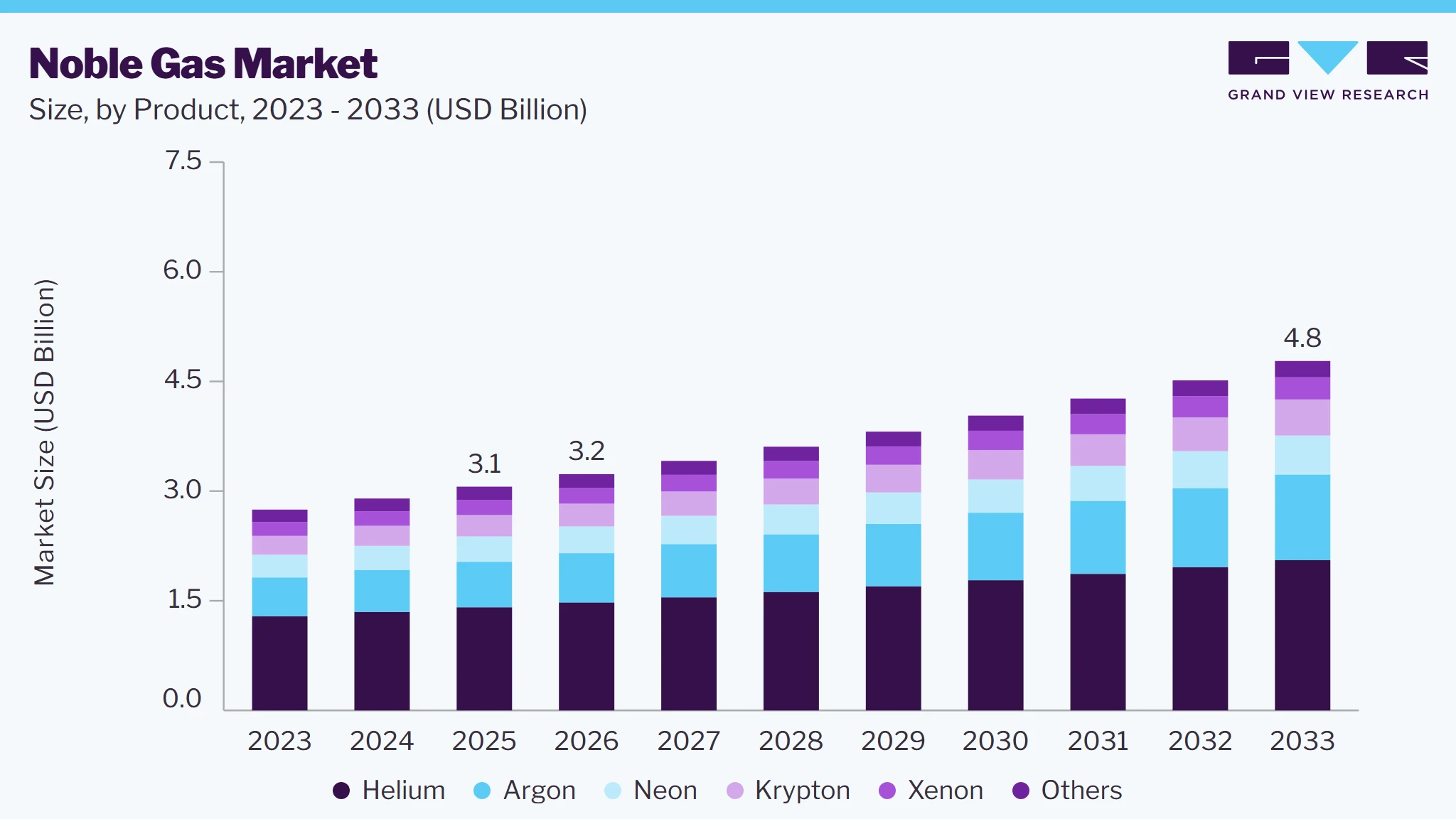
The global noble gas market size was valued at USD 3.1 billion in 2025 and is projected to grow from USD 3.2 billion in 2026 to USD 4.8 billion by 2033, at a CAGR of 5.7% from 2026 to 2033. Asia Pacific dominated the market, accounting for a revenue share of 32.5% in 2025. Increasing application areas for noble gases in the healthcare and industrial sectors and supportive government policies are expected to boost the growth.
 Source: Grand View Research, IR Documents, Primary Interviews, Paid DatabasesTo learn more about this report,
 Download Free Sample Report
Key Market Trends & Insights
- By product: Helium segment led the market with the largest revenue share of 46.1% in 2025.
- By distribution: Cylinder segment captured the highest revenue share at 36.1% in 2025.
- By application: Construction segment accounted for the largest revenue share of 21.9% in 2025.
Regional Highlights
- Largest regional market: Asia Pacific (32.5% revenue share, 2025)
- By country: China held the largest market share in 2025.
Market Size & Forecast
- Market size in 2025: USD 3.1 Billion
- Estimated market size in 2026: USD 3.2 Billion
- Projected market size by 2033: USD 4.8 Billion
- CAGR (2026-2033): 5.7%
Three ways to get this report
Buy it, customize it, or ask a question.Ask an Analyst
Analyst response in 1 business day
- AccessReport author, directly
- Reply timeWithin 1 working day
- No sales callDirect answer only
- FormatEmail reply
- CostFree, no cost
Get the Full Report
What the study covers
- FormatsPDF · Excel · Dashboard
- Timeline2026–2033 annual, 2025 base
- Coverage20+ countries, 5 regions
- Companies10+ key players profiled
Customize the Report
20% free customization
- IncludeCountries, segments, points
- TailorTo your product definition
- ExtendDeeper competitor detail
- OrA fully bespoke study
- Turnaround5–10 working days
The helium gas segment is projected to lead the market during the forecast period owing to increasing demand for it from various end-use industries such as manufacturing, aerospace, and healthcare, as well as the growing application scope of helium gas in cryogenics and analytical applications. The surging demand for noble gases from the manufacturing and electronics industries is anticipated to contribute to the growth over the forecast period.The U.S. emerged as the largest noble gas market in North America in 2022. The U.S. is the most significant market for noble gas in North America owing to the bulk production in the country. The production of high-purity noble gas is carried out on a large scale in the U.S. owing to their surged consumption in healthcare applications and the presence of large-scale manufacturers like BASF SE, Air Liquide, and MESA Specialty Gases & Equipment.
 To learn more about this report, Download Free Sample Report
Noble gases are expected to gain preference in the manufacturing industry worldwide owing to their usage in metal melting applications due to their inertness at high temperatures. These gases are used for the distillation of highly pure oxygen by carrying out the cryogenic distillation of air. The flourishing display market worldwide plays a vital role in surging the consumption of noble gases in electronic applications.
The utilization of these gases is expected to bring about significant advancements in the areas of aerospace, electrical & electronics, manufacturing, and healthcare. Helium is making significant progress both in terms of commercialization and breakthroughs in research & development.
Noble gases are used as a vector for drugs administered by inhalation. These gases are non-reactive with other elements and non-toxic to humans which makes them ideal for use in health care applications. The growth of the healthcare sector is mounting on account of increasing life expectancy, rising population, and expanding urban wealth. Based on these factors, the demand for noble gases is expected to increase over the forecasted period.
The demand for noble gas has increased in the healthcare sector due to increased hospitalizations. The COVID-19 virus damaging a patient’s lungs has led to many serious patients needing respiratory support across the globe, thereby increasing the demand for noble gases in the sector. However, the demand from industrial and commercial end-users witnessed a significant dip in 2020 owing to the lockdown imposed in the majority of countries around the globe.
Market Dynamics
The noble gas market is expanding because these gases serve critical functions across healthcare, electronics, aerospace, manufacturing, and scientific research. Semiconductor fabrication requires ultra-high purity neon, argon, and xenon to maintain production quality, while hospitals depend on helium and xenon for medical applications. Rising investments in space exploration and advanced lighting systems are creating steady consumption across multiple industries. Growth in industrial gas distribution networks and increasing demand for precision manufacturing continue to strengthen the commercial value of noble gases despite their limited natural availability.
Driver: Expanding Semiconductor Manufacturing Increases Demand For High Purity Noble Gases Worldwide
Semiconductor manufacturing depends on noble gases such as neon, argon, and xenon to achieve precise etching, lithography, and plasma processing during chip production. The continuous expansion of fabrication facilities across Asia Pacific, North America, and Europe has raised the need for consistent supplies of ultra-high purity gases that maintain product quality and manufacturing efficiency. Growing production of consumer electronics, electric vehicles, data centers, and artificial intelligence hardware continues to increase semiconductor output, creating sustained demand for noble gases throughout the supply chain.
Gas suppliers are investing in purification systems, production capacity, and long term supply agreements to meet the strict quality standards required by semiconductor manufacturers. The increasing complexity of integrated circuits requires higher purity levels and reliable gas delivery systems, making noble gases an essential component of modern electronics manufacturing and supporting long term market expansion.
Noble gases are obtained mainly as byproducts of large scale air separation processes, while helium is extracted from a limited number of natural gas fields. This dependence on restricted production sources limits the ability to increase supply quickly when demand rises. Supply interruptions caused by maintenance activities, geopolitical events, or production constraints often lead to price fluctuations and procurement difficulties for end users. Industries that require continuous access to high purity noble gases face increased operating costs and supply uncertainty, making long term planning more difficult. The limited number of commercially viable production sites also reduces supply flexibility, creating a structural restraint that influences market growth.
Expanding investments in commercial space missions, satellite deployment, and deep space exploration are opening new business opportunities for manufacturers of noble gases. Xenon is widely used as a propellant in electric ion propulsion systems because it provides efficient thrust for long duration missions, while helium supports rocket testing, pressurization, and cooling operations. Increasing government funding and private sector participation in the global space industry are expected to raise demand for reliable supplies of high purity gases. Manufacturers that expand purification capabilities, strengthen distribution networks, and establish partnerships with aerospace companies can secure long term contracts while developing specialized products tailored to the evolving requirements of advanced space technologies.
Analyst Perspective
The noble gas market is expected to maintain steady growth as demand remains closely tied to semiconductor manufacturing, healthcare services, aerospace programs, and precision industrial processes. Supply security and high purity requirements continue to influence purchasing decisions, encouraging long term agreements between producers and end users. Companies investing in gas purification, distribution infrastructure, and application specific solutions are likely to strengthen their market position. Expanding use of noble gases in advanced electronics and space technologies is expected to create sustained opportunities for industry participants over the coming years.
Product Insights
The helium segment accounted for the largest share of the noble gas market, representing 46.1% of total revenue in 2025, owing to the rising demand for use in healthcare, aerospace, automotive, deep-sea exploration, and manufacturing applications.
Unlike other noble gases, it is unfeasible to extract helium from the atmosphere owing to its low concentration in the atmosphere. It is generated as a byproduct during natural gas extraction. After the natural gas is extracted from the earth, the vent gas built up is stored in gas rejection units.
This gas is then treated to develop high-quality helium. Helium has extensive applications in the healthcare industry; for instance, liquid helium is used in MRI machines to cool superconductive magnets. It is used in helium-neon eye surgeries. Helium is also used as a breathing gas.
Application Insights
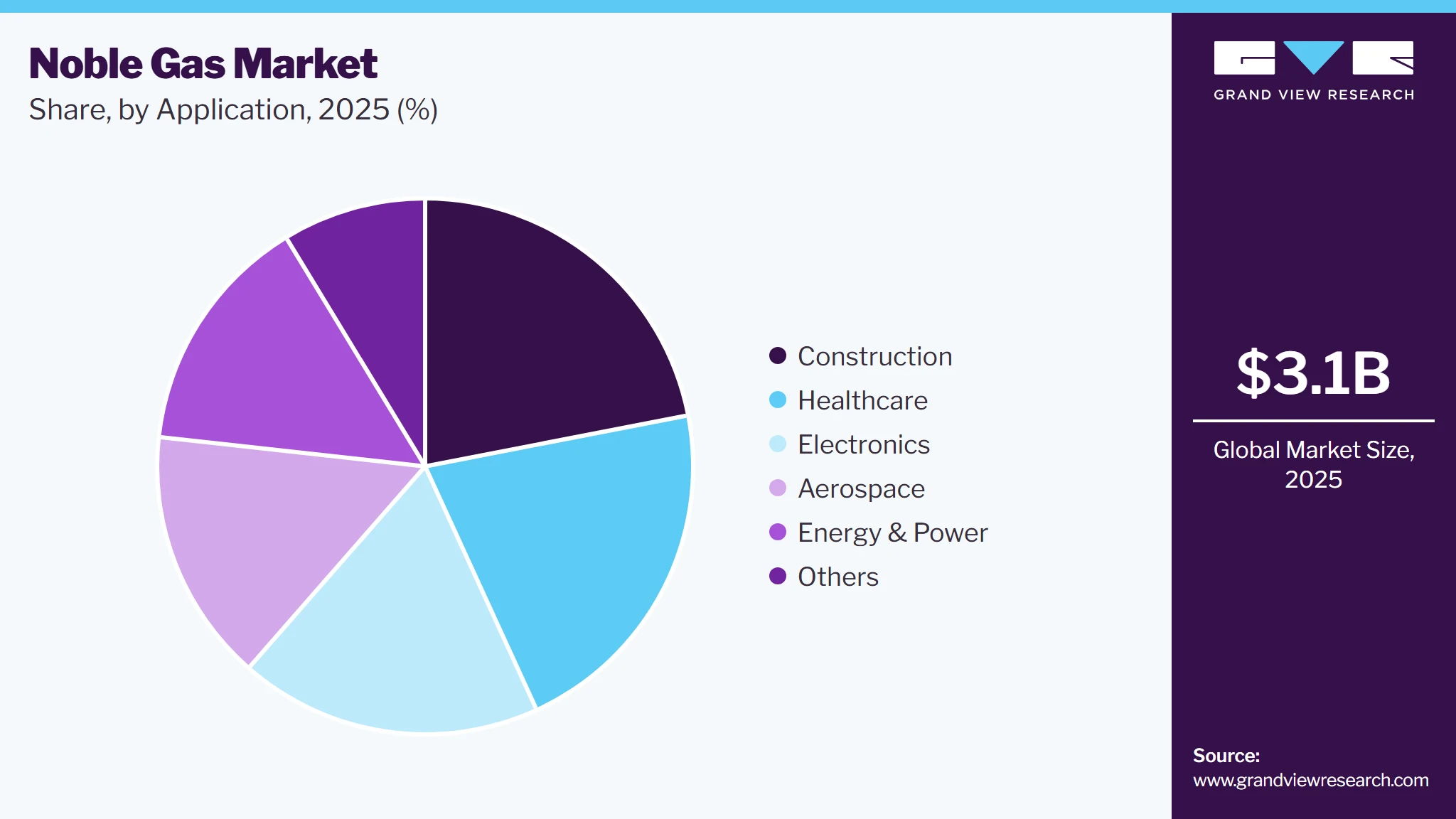
The construction segment accounted for the largest revenue share of 21.9% in 2025, on account of rising construction and infrastructure activities on a global scale and especially in the developing economies of the world such as India, Japan, Argentina, China, Brazil, Russia, Kuwait, Saudi Arabia, and many more.
 To learn more about this report, Download Free Sample Report
The growth of the healthcare segment can be attributed to versatile properties offered by noble gases in the form of low chemical reactivity, fewer impurities, inertness, etc. that reduce the potential complications and make them safe for use by patients. Noble gases are also increasingly used in analytical applications in manufacturing, energy & power, aerospace, and construction industries in the Asia Pacific and North America.
The demand for noble gas is surging owing to increasing healthcare expenditure, ongoing technological advancements, and the rising consumption of substantial volumes of specialty gas in therapies. This, in turn, drives the growth of the healthcare application segment of the market from 2023 to 2030.
Distribution Insights
The cylinder segment captured the highest revenue share at 36.1% in 2025, as it provides a safe and efficient way to store and transport these valuable and useful elements. The cylinders used to store noble gases are typically made of high-strength materials such as steel or aluminum to withstand the high pressure required to store the gases. The cylinders are designed to safely contain the gas and prevent it from leaking out.
Noble gases can also be distributed in bulk in addition to being stored in cylinders. Bulk distribution is often used when large quantities of gas are required for industrial or commercial applications. The main advantage of bulk distribution is that it allows for a continuous supply of gas without the need for frequent cylinder replacements. This can be particularly important for applications that require a constant and uninterrupted supply of noble gas.
The other alternative method is through cryogenic distribution. This involves storing the noble gas at extremely low temperatures, typically below -150°C, which allows for a high storage density. Cryogenic distribution is often used for applications that require very large quantities of gas, such as in the production of semiconductors or in medical applications.
Regional Insights
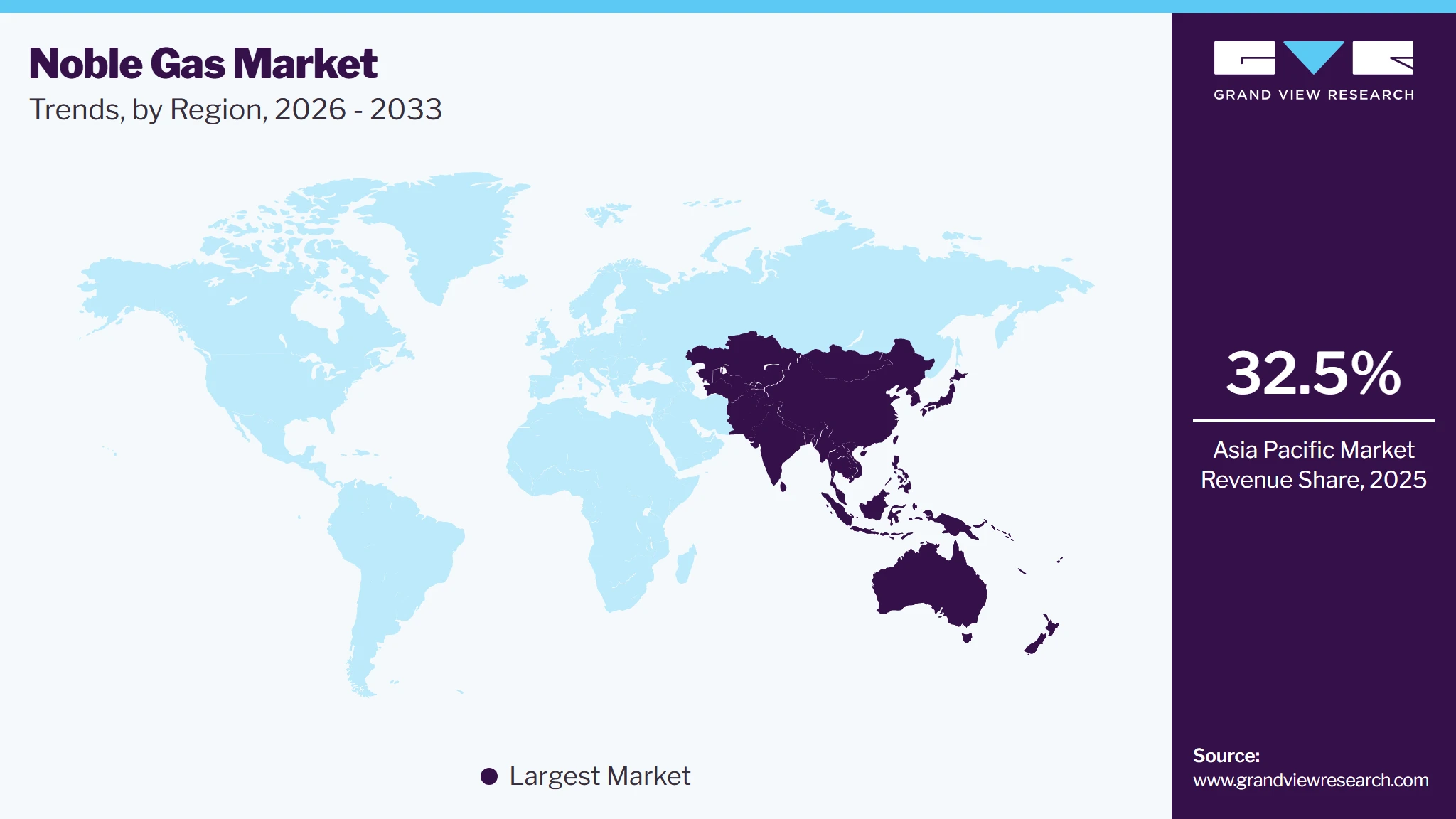
Asia Pacific accounted for 32.5% of the noble gas market revenue in 2025, making it the largest regional market, due to the initiatives are undertaken by governments of different countries of Asia Pacific to strengthen their manufacturing and electronics industries in the form of subsidies, trade promotion, and supportive policies, as well as increasing foreign investments, are expected to expand product demand over the forecast period.
 To learn more about this report, Download Free Sample Report
China Noble Gas Market Trends
China maintained a leading position in the Asia Pacific noble gas market.
North America is one of the significant markets for noble gas in the world owing to the large-scale production of these gas in the region. Massive investments for developing air separation techniques and production technologies in North America are anticipated to surge the demand for noble gas in the region in the coming years.
Increasing demand for noble gas in Europe is positively influencing the growth of the market in this region owing to the high rate of facility establishment, technological advancements, high disposable income, and improved standard of living of the masses. Supportive government investments for noble gas production in Europe are projected to fuel the growth of the market for noble gas in this region from 2023 to 2030.
Key Companies & Market Share Insights
The market is competitive in nature, with key participants involved in R&D activities and constant innovation by vendors, which has become one of the most important factors for companies to perform in this industry. Acquisitions and joint ventures are an integral part of this market as they enable companies to enhance their position in the market. For instance, in May 2022, Air Water America, Inc., a subsidiary of Air Water Inc., announced the acquisition of Noble Gas Solutions, Inc.
Prevailing trends in the market signify that companies manufacturing noble gases are acquiring companies possessing technologies and patents for producing these gases. Increasing usage of renewable sources and recycling and reusing byproducts are strategic initiatives adopted by companies in the market.
The competitive landscape among suppliers is based on offering superior service and delivery to end-users. R&D into more applications for noble gases R&D in various sectors such as healthcare aerospace and manufacturing is projected to contribute to the market growth in the coming years. Some prominent players in the global noble gas market include:
Key Noble Gas Companies
The following key companies have been profiled for this study on the noble gas market.
-
Air Liquide
-
Air Products Inc.
-
BASF SE
-
Linde plc
-
Messer
-
TAIYO NIPPON SANSO CORPORATION
-
Norco Inc.
-
Iwatani Corporation
-
SHOWA DENKO K.K.
-
MESA Specialty Gases & Equipment
-
Gulf Cryo
Competitive Benchmarking
Category
Operating Strategies
Competitive Edge
Weakness
Established Players (Air Liquide, Air Products Inc., Linde plc, Messer, Taiyo Nippon Sanso Corporation, Iwatani Corporation)
- These companies focus on long term supply agreements with semiconductor, healthcare, aerospace, and manufacturing customers while expanding high purity noble gas portfolios. They strengthen market presence through global distribution infrastructure, air separation facilities, strategic acquisitions, and investments in specialty gas purification technologies.
- Continuous investment in application development and customer specific gas solutions enables these companies to secure recurring business from industries requiring reliable and uninterrupted gas supply.
- Their extensive production networks, advanced purification capabilities, and integrated logistics systems allow consistent delivery of high purity noble gases across global markets. Strong research capabilities support product innovation for demanding industrial applications.
- Long standing customer relationships, diversified regional operations, and financial strength enable these companies to respond efficiently to changing demand while maintaining stable supply across multiple industries.
- Large operational networks require substantial capital investment and high maintenance costs, reducing flexibility during periods of lower industrial demand. Dependence on large industrial customers also exposes revenues to cyclical manufacturing activity.
- Global operations remain sensitive to energy costs, regulatory changes, and supply disruptions affecting air separation units and helium sourcing, creating pressure on operating margins.
Category
Operating Strategies
Competitive Edge
Weakness
Emerging Players (Norco Inc., Gulf Cryo, MESA Specialty Gases & Equipment, Showa Denko K.K., BASF SE
- These companies emphasize regional market expansion, specialty gas distribution, and customized customer support for laboratories, healthcare providers, and industrial users. Growth is supported through local partnerships, flexible delivery services, and niche application development.
- Many also focus on strengthening cylinder distribution networks and expanding product availability in underserved regional markets to increase customer reach and improve service responsiveness.
- Strong regional presence, faster customer response, and specialized technical support allow these companies to compete effectively in local markets. Their flexibility enables them to address customized gas requirements for small and medium sized customers.
- Close relationships with regional distributors and end users support customer retention while allowing quicker adaptation to changing application requirements and purchasing preferences.
- Limited international presence and smaller distribution networks reduce their ability to compete for large multinational supply contracts. Lower financial resources can also restrict investments in purification technologies and infrastructure expansion.
- Dependence on regional demand and third party sourcing may expose operations to supply interruptions, pricing volatility, and competitive pressure from globally integrated industrial gas manufacturers.
Noble Gas Market Report Scope
Report Attribute
Details
Market size value in 2025
USD 3.1 billion
Estimated market size in 2026
USD 3.2 billion
Projected market size by 2033
USD 4.8 billion
Growth rate
CAGR of 5.7% from 2026 to 2033
Base year for estimation
2025
Historical data
2021 - 2024
Forecast period
2026 - 2033
Quantitative units
Revenue in USD million/billion and CAGR from 2026 to 2033
Report coverage
Revenue forecast, company ranking, competitive landscape, growth factors, and trends
Segments covered
Product, distribution, application, region
Regional scope
North America; Europe; Asia Pacific; Latin America; MEA
Country scope
U.S.; Canada; Mexico; Germany; UK; France; Italy; Spain; China; Japan; India; South Korea; Australia; Brazil; Argentina; Saudi Arabia; South Africa; UAE;
Key companies profiled
Air Liquide, Air Products, BASF SE, Linde plc, Messer, Taiyo Nippon Sanso Corporation, Norco Inc., Iwatani Corporation, Showa Denko K.K., MESA Specialty Gases & Equipment, Gulf Cryo
Customization scope
Free report customization (equivalent up to 8 analysts' working days) with purchase. Addition or alteration to country, regional & segment scope.
Pricing and purchase options
Avail customized purchase options to meet your exact research needs. Explore purchase options
Global Noble Gas Market Report Segmentation
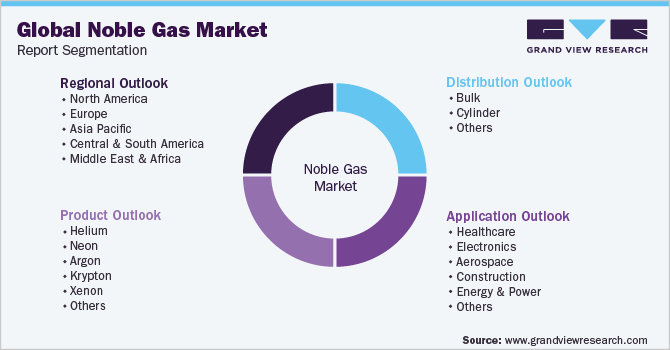
This report forecasts revenue growth at global, regional, and country levels and provides an analysis of the latest industry trends in each of the sub-segments from 2021 to 2033. For this study, Grand View Research has segmented the global noble gas market report based on product, application, distribution, and region:
 To learn more about this report, Download Free Sample Report
-
Product Outlook (Revenue, USD Million, 2021 - 2033)
-
Helium
-
Neon
-
Argon
-
Krypton
-
Xenon
-
Others
-
-
Application Outlook (Revenue, USD Million, 2021 - 2033)
-
Healthcare
-
Electronics
-
Aerospace
-
Construction
-
Energy & Power
-
Others
-
-
Distribution Outlook (Revenue, USD Million, 2021 - 2033)
-
Bulk
-
Cylinder
-
Others
-
-
Regional Outlook (Revenue, USD Million, 2021 - 2033)
-
North America
-
U.S.
-
Canada
-
Mexico
-
-
Europe
-
Germany
-
Russia
-
Italy
-
Spain
-
France
-
-
Asia Pacific
-
China
-
India
-
Japan
-
South Korea
-
Australia
-
-
Central and South America
-
Brazil
-
Colombia
-
-
Middle East and Africa
-
South Africa
-
UAE
-
Egypt
-
-
Research Methodology
The noble gas market figures in this report are based on a proven research process that combines executive interviews with secondary research from proprietary databases, company filings, and recognized regulatory and institutional sources. Market size is built through value-chain sizing - reconciling supply-side and demand-side estimates - and triangulated with bottom-up and top-down approaches. Every estimate passes multiple levels of expert validation before publication, with each noble gas segment quantified using the revenue-capture definitions in the table below.
Segment Definition
Segment
Revenue Capture Definition
Helium
Revenue is captured through the supply of helium for applications including magnetic resonance imaging, semiconductor manufacturing, leak detection, welding, and aerospace operations. Income is generated from long term supply contracts and recurring purchases by healthcare providers, research institutions, and industrial manufacturers requiring high purity gas.
Neon
Revenue is generated through the sale of high purity neon used primarily in semiconductor lithography, laser systems, and specialty lighting. Demand from chip manufacturers and electronics producers creates recurring revenue through continuous gas consumption and supply agreements.
Argon
Revenue is captured through the supply of argon for metal fabrication, welding, electronics manufacturing, and industrial processing. Gas producers generate income from bulk deliveries and cylinder sales to manufacturing facilities that require inert gas for production and quality control.
Krypton
Revenue is generated through the sale of krypton for high performance lighting, insulated glazing units, and specialized laser applications. Manufacturers capture value by supplying industries requiring premium gas properties for energy efficiency and precision technologies.
Xenon
Revenue is captured through the supply of xenon for spacecraft propulsion, medical imaging, lighting, and semiconductor applications. Income is supported by specialized contracts with aerospace, healthcare, and electronics industries requiring high purity noble gases.
Other Products
Revenue is generated through the sale of other noble gases and customized gas mixtures serving research laboratories, industrial processing, analytical equipment, and niche scientific applications. Recurring demand from specialized industries supports continued revenue generation.
Segment - Distribution
Revenue Capture Definition
Bulk
Revenue is captured through large volume deliveries of noble gases using cryogenic tankers and on site storage systems. Income is generated from long term supply agreements with industrial facilities, semiconductor plants, hospitals, and energy companies requiring continuous gas availability.
Cylinder
Revenue is generated through the sale and rental of compressed gas cylinders supplied to customers with moderate or intermittent consumption requirements. Gas suppliers earn recurring income through cylinder refilling, distribution services, and equipment leasing across healthcare, laboratories, manufacturing, and research facilities.
Other Distributions
Revenue is captured through alternative delivery methods including liquid containers, microbulk systems, packaged gas solutions, and specialty distribution formats designed to meet specific customer requirements across commercial and industrial applications.
Segment - Application
Revenue Capture Definition
Healthcare
Revenue is generated through the supply of noble gases for medical imaging, respiratory treatments, cryogenic preservation, and laboratory diagnostics. Hospitals, healthcare providers, and research institutions create recurring demand for medical grade gases and reliable distribution services.
Electronics
Revenue is captured through the sale of high purity noble gases used in semiconductor fabrication, display manufacturing, plasma processing, and electronic component production. Continuous manufacturing operations generate recurring revenue through long term supply agreements.
Aerospace
Revenue is generated through the supply of noble gases for satellite propulsion, rocket testing, leak detection, and aerospace research. Manufacturers capture value by providing gases that meet stringent purity and performance requirements for space and aviation applications.
Construction
Revenue is captured through the sale of noble gases used in insulated glass manufacturing, metal fabrication, and welding operations supporting residential, commercial, and infrastructure projects. Continuous construction activities sustain recurring product demand.
Energy & Power
Revenue is generated through the supply of noble gases for power generation equipment, gas insulated systems, nuclear research, and energy infrastructure maintenance. Industrial gas suppliers benefit from long term contracts with utilities and energy companies requiring dependable gas supplies.
Other Applications
Revenue is captured through the supply of noble gases for scientific research, automotive manufacturing, analytical instrumentation, specialty lighting, and various industrial processes. Diverse end use industries contribute recurring demand across multiple niche applications.
Estimation Model
Layer Name
Key Question
Content
Noble Gas Production Base Layer
What forms the demand base?
Identify global production volumes of helium, neon, argon, krypton, xenon, and other noble gases generated through air separation units and natural gas processing facilities across major producing regions. This layer establishes the total available supply that supports commercial consumption across industrial and specialty applications.
End Use Consumption Layer
Where are noble gases consumed?
Estimate the penetration and utilization of noble gases across healthcare, electronics, aerospace, construction, energy and power, research laboratories, manufacturing, and other industrial sectors. Demand is evaluated according to application specific purity requirements, operational usage, and purchasing patterns across each end use industry.
Consumption Intensity Layer
How much noble gas is consumed?
Analyze the average consumption of each noble gas per application by considering production capacity, operational frequency, purity specifications, equipment requirements, and replacement cycles. Consumption intensity differs across semiconductor manufacturing, medical imaging, welding, spacecraft propulsion, insulated glazing, and scientific research activities.
Revenue Layer
How is market revenue generated?
Market revenue is quantified through the sale of helium, neon, argon, krypton, xenon, and other noble gases supplied in bulk, cylinders, liquid containers, and specialty packaging formats. Revenue is generated from recurring supply agreements, gas refilling services, long term industrial contracts, and specialty gas sales across healthcare providers, semiconductor manufacturers, aerospace companies, construction firms, energy producers, research institutions, and industrial manufacturing facilities worldwide.
Delivered Customizations
This report has been delivered with the following In-depth customizations
Client Request
Customization Delivered
Value Added
Regional Segmentation
Expanded regional assessment covering additional countries such as Kazakhstan, Qatar, Colombia, etc., highlighting noble gas demand across healthcare, semiconductor manufacturing, aerospace activities, scientific research, and industrial applications. The analysis includes country level consumption trends, end use patterns, regulatory environment, and investment outlook beyond the standard market scope.
Helps clients identify untapped geographic markets, evaluate country specific demand potential, and prioritize market entry or expansion strategies based on industry development, customer concentration, and regulatory conditions.
Competitive Benchmarking
Comparative evaluation of leading noble gas suppliers based on product portfolio diversity, geographic presence, distribution network strength, purification capabilities, customer industry focus, strategic collaborations, sustainability initiatives, and recent business developments.
Supports vendor selection, competitive positioning, partnership evaluation, and strategic planning by providing a detailed understanding of supplier capabilities and market differentiation across global and regional participants.
Opportunity Assessment
Detailed assessment of growth opportunities arising from semiconductor fabrication expansion, commercial space programs, advanced medical imaging, hydrogen economy projects, and increasing demand for high purity industrial gases across emerging application areas.
Enables businesses to identify high growth investment areas, align product development with evolving industry requirements, and capture new revenue opportunities by targeting rapidly expanding end use sectors and specialty applications.
Frequently Asked Questions About This Report
Key factors driving the noble gas market growth include the increasing adoption of noble gases in the healthcare industry over the forecast period.
The global noble gas market size was valued at USD 3.1 billion in 2025 and is estimated at USD 3.2 billion in 2026.
Key players include Air Liquide, Air Products, BASF SE, Linde plc, Messer, Taiyo Nippon Sanso Corporation, Norco Inc., Iwatani Corporation, Showa Denko K.K., MESA Specialty Gases & Equipment, Gulf Cryo
The helium segment accounted for the largest share of the noble gas market, representing 46.1% of total revenue in 2025.
The cylinder segment captured the highest revenue share at 36.1% in 2025.
The construction segment accounted for the largest revenue share of 21.9% in 2025.
Asia Pacific dominated the market, accounting for a revenue share of 32.5% in 2025.
The global noble gas market is expected to grow at a CAGR of 5.7% from 2026 to 2033 to reach USD 4.8 billion by 2033.
About the Author(s)
Petrochemicals Research Team
Bulk Chemicals · PetrochemicalsThis report was authored by the petrochemicals research team at Grand View Research - comprising two research analysts, one senior research analyst, and one industry expert - with specialized expertise in the petrochemicals segment of the bulk chemicals industry. All findings are based on proprietary bulk chemicals databases, executive interviews, and regulatory analysis, subject to internal peer review prior to publication.
Last Updated:
Speak to Analyst

Customize this report to your needs - add regions, segments, or data points, with 20% free customization.
Or view our licence options:


ISO 9001:2015 & 27001:2022 Certified
We are GDPR and CCPA compliant! Your transaction & personal information is safe and secure. For more details, please read our privacy policy.


