
- Home
- »
- Consumer F&B
- »
-
Non-alcoholic Beer Market Size & Share Report, 2026-2033GVR Report cover

Non-alcoholic Beer Market (2026 - 2033)
Size, Share & Trends Analysis Report By Type (Lager, Ale), By Distribution Channel (Supermarkets & Hypermarkets, Convenience Stores, Specialty Stores), By Region, And Segment Forecasts
Market Size, 2025
$21.4BMarket Estimate, 2026
$22.6BMarket Forecast, 2033
$38.4BCAGR, 2026–2033
7.9%Non-alcoholic Beer Market Summary
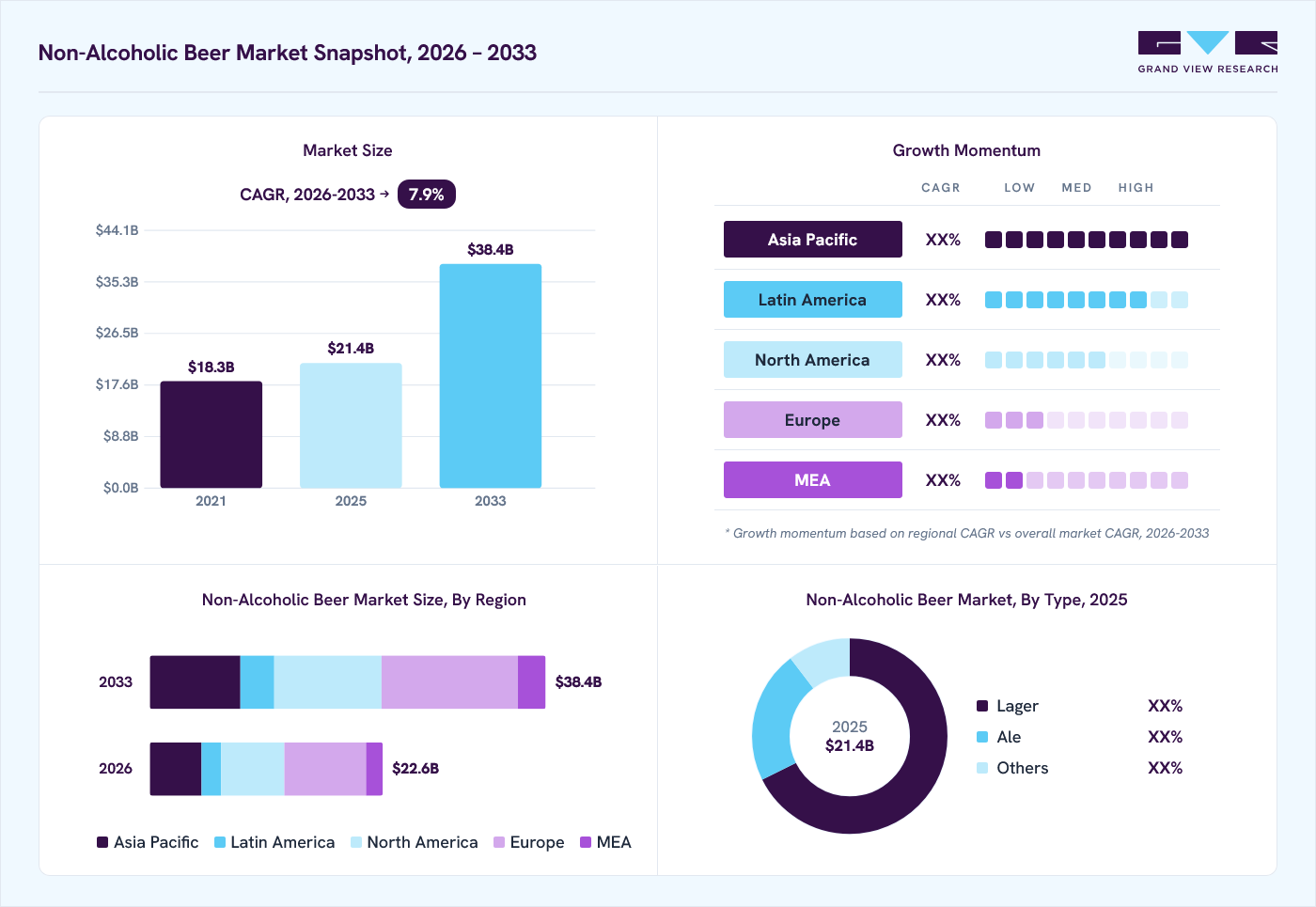
The global non-alcoholic beer market size was valued at USD 21.4 billion in 2025 and is projected to grow from USD 22.6 billion in 2026 to USD 38.4 billion by 2033, at a CAGR of 7.9% from 2026 to 2033. Europe dominated the market, accounting for a revenue share of 35.1% in 2025. The non-alcoholic beer industry is primarily driven by increasing health and wellness awareness among consumers, along with growing demand for low-calorie and alcohol-free beverages.
 Source: Grand View Research, IR Documents, Primary Interviews, Paid DatabasesTo learn more about this report,
 Download Free Sample Report
Key Market Trends & Insights
- By type: Non-alcoholic lager market held the largest share of 67.6% in 2025.
- By distribution channel: Supermarkets & hypermarkets channel held the largest share of 45.5% in 2025.
Regional Highlights
- Largest Region: Europe (35.1% revenue share, 2025)
- Fastest-growing region: Asia Pacific (highest CAGR, 2026-2033)
- By country: Germany held largest market share in 2025.
Key Market Trends & Insights
- Market size in 2025: USD 21.4 Billion
- Estimated Market Size in 2026: USD 22.6 billion
- Projected Market Size by 2033: USD 38.4 Billion
- CAGR (2026-2033): 7.9%
Prism AI by Grand View Research Free to tryAsk a question about the non-alcoholic beer marketTry asking✓Every figure cited from GVR research Prefer the report? Download free sample →
Changing lifestyles, rising social acceptance of non-alcoholic drinks, and increasing consumer preference for healthier alternatives are further supporting market growth. Additionally, product innovation, expanding distribution networks, and greater availability through retail and online channels are contributing to the rising demand for non-alcoholic beer. According to the data published in July 2024 , Corona launched Corona Cero, a zero‑alcohol beer, and backed it with an Olympic sponsorship push to accelerate global distribution and compete with rivals such as Heineken 0.0 and Athletic Brewing.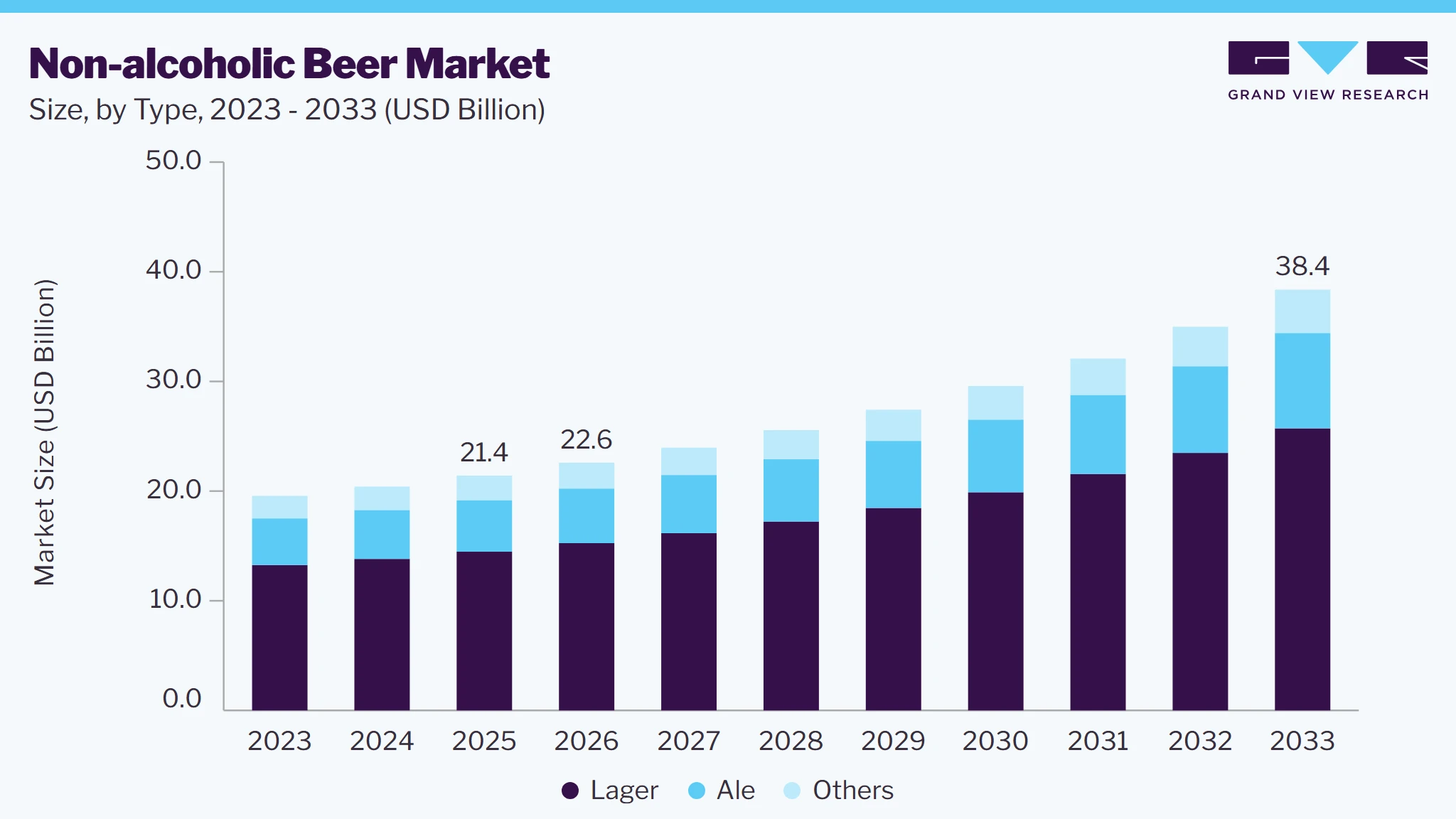 To learn more about this report, Download Free Sample Report
The market is also supported by the growing influence of younger consumers seeking beverages that fit social occasions without the effects of alcohol. Consumers are increasingly exploring diverse and higher-quality non-alcoholic beer options with distinctive flavors and premium characteristics. Increasing investments by beverage manufacturers in new flavors, brewing techniques, and attractive packaging are also creating opportunities for market expansion.
Consumer Insights
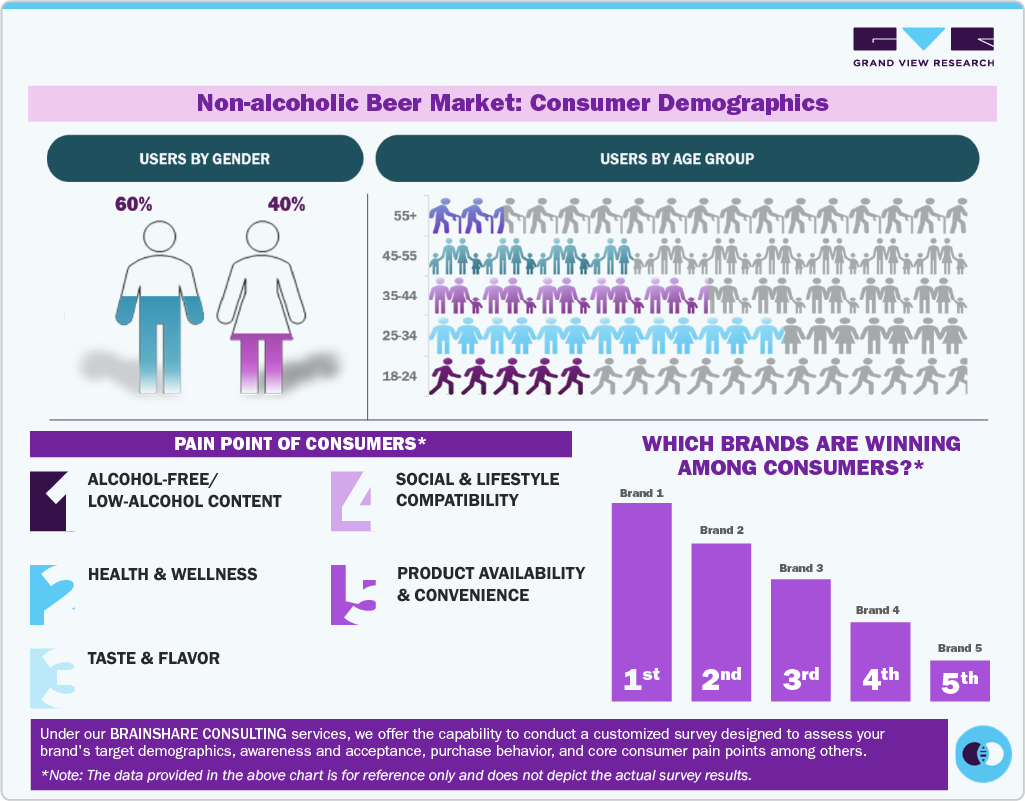
Consumer insights for the non-alcoholic beer market center on increasing interest in healthier, mindful, and socially inclusive drinking options. Consumers are drawn to products that provide the taste and experience of traditional beer without the effects of alcohol, particularly among health-conscious individuals and those practicing moderation.
 To learn more about this report, Download Free Sample Report
Flavor quality, refreshing taste, mouthfeel, brand reputation, and similarity to conventional beer strongly influence purchasing decisions. Consumers also show growing interest in premium varieties, innovative flavors, natural ingredients, and products with low sugar and calorie content.
Market Dynamics
Increasing consumer preference for alcohol-free alternatives is supporting the growth of the non-alcoholic beer market. Consumers are increasingly choosing beverages that allow them to participate in social occasions without consuming alcohol. This trend is particularly relevant among individuals who avoid alcohol for personal, lifestyle, or dietary reasons. According to a Beer Institute survey conducted in January 2025 with 2,000 respondents, approximately 60% of participants viewed low- and no-alcohol beer as a viable option for maintaining long-term moderation, representing a 2% increase from 2024. The wider availability of alcohol-free options is making such choices more convenient. As consumer preferences continue to evolve, demand for these products is expanding across different consumption occasions.
Regulatory and labeling challenges across regions can create difficulties for non-alcoholic beer manufacturers. Different countries and jurisdictions may apply varying definitions and requirements for products classified as non-alcoholic. Manufacturers may need to comply with specific rules concerning alcohol content, labeling, packaging, and product claims. In March 2026, New Zealand Food Safety recalled a batch of Steinlager Ultra Low Carb because some bottles were mistakenly marked as containing no alcohol, although the product actually contained 4.2% alcohol. These differences can increase compliance requirements and complicate product launches across multiple markets. Such regulatory variations may also affect how products are marketed and positioned.
Expansion of non-alcoholic beer into emerging markets with developing beverage industries presents an opportunity for manufacturers. Increasing urbanization and evolving beverage preferences can create new consumption occasions in these markets. Companies can introduce locally relevant products and adapt their offerings to regional consumer preferences. Establishing wider distribution networks can further improve product accessibility. Early market development can provide manufacturers with opportunities to build brand recognition in these regions. In June 2024, South African Breweries (SAB) introduced Corona Cero, a vitamin D-enriched, alcohol-free beer designed to meet the growing consumer interest in non-alcoholic drink options. The product was subsequently distributed through retail stores and beverage outlets across South Africa, broadening the range of alcohol-free beer choices available to consumers.
Analyst Perspective
The global non-alcoholic beer market is evolving as breweries increasingly focus on developing products that deliver improved taste, aroma, and drinking experiences. Technological advancements in brewing and alcohol-removal processes are enabling greater product differentiation across categories. Competition is intensifying as established beverage companies and specialized producers expand their non-alcoholic portfolios. Distribution through retail, hospitality, and digital channels is also broadening market accessibility. Overall, continued product innovation and changing beverage preferences are expected to shape the market's competitive landscape.
Type Insights
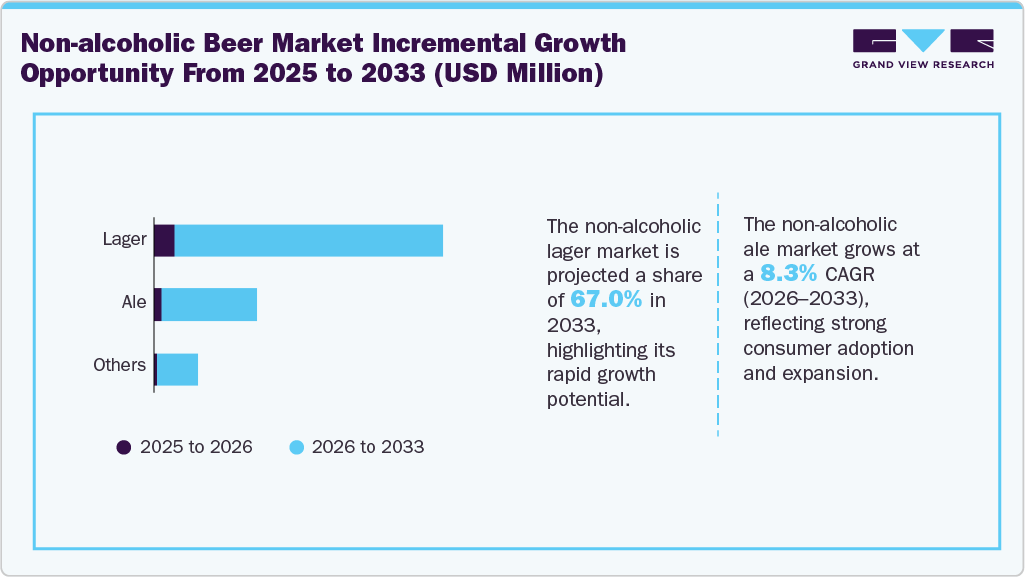
The non-alcoholic lager market accounted for the largest share of 67.6% of the revenue in 2025. Lager is a significant segment in the non-alcoholic beer market due to its clean, crisp, and refreshing taste profile. Its familiar flavor makes it accessible to consumers who are transitioning from conventional beer to alcohol-free options. The style also pairs well with a wide range of foods, supporting its consumption across casual dining occasions. Manufacturers can reproduce Lager’s characteristic taste using specialized brewing and de-alcoholization techniques. These attributes support continued demand for non-alcoholic lager products. Its broad appeal also makes it suitable for consumption at social gatherings and everyday occasions. The availability of different lager formulations provides manufacturers with additional scope to address varying consumer preferences.
 To learn more about this report, Download Free Sample Report
The non-alcoholic ale market is projected to grow significantly at a CAGR of 8.3% from 2026 to 2033. Ale-based non-alcoholic beer is gaining attention because of its broader range of flavors and distinctive aromatic profiles. Its variety allows manufacturers to offer products with fruity, malty, bitter, or complex taste characteristics. This gives consumers greater choice beyond lighter beer styles and supports experimentation with different formulations. Craft-oriented producers can also use ale varieties to differentiate their non-alcoholic offerings through specialized brewing methods. Such product diversity can contribute to the expansion of the ale segment within the market.
Distribution Channel Insights
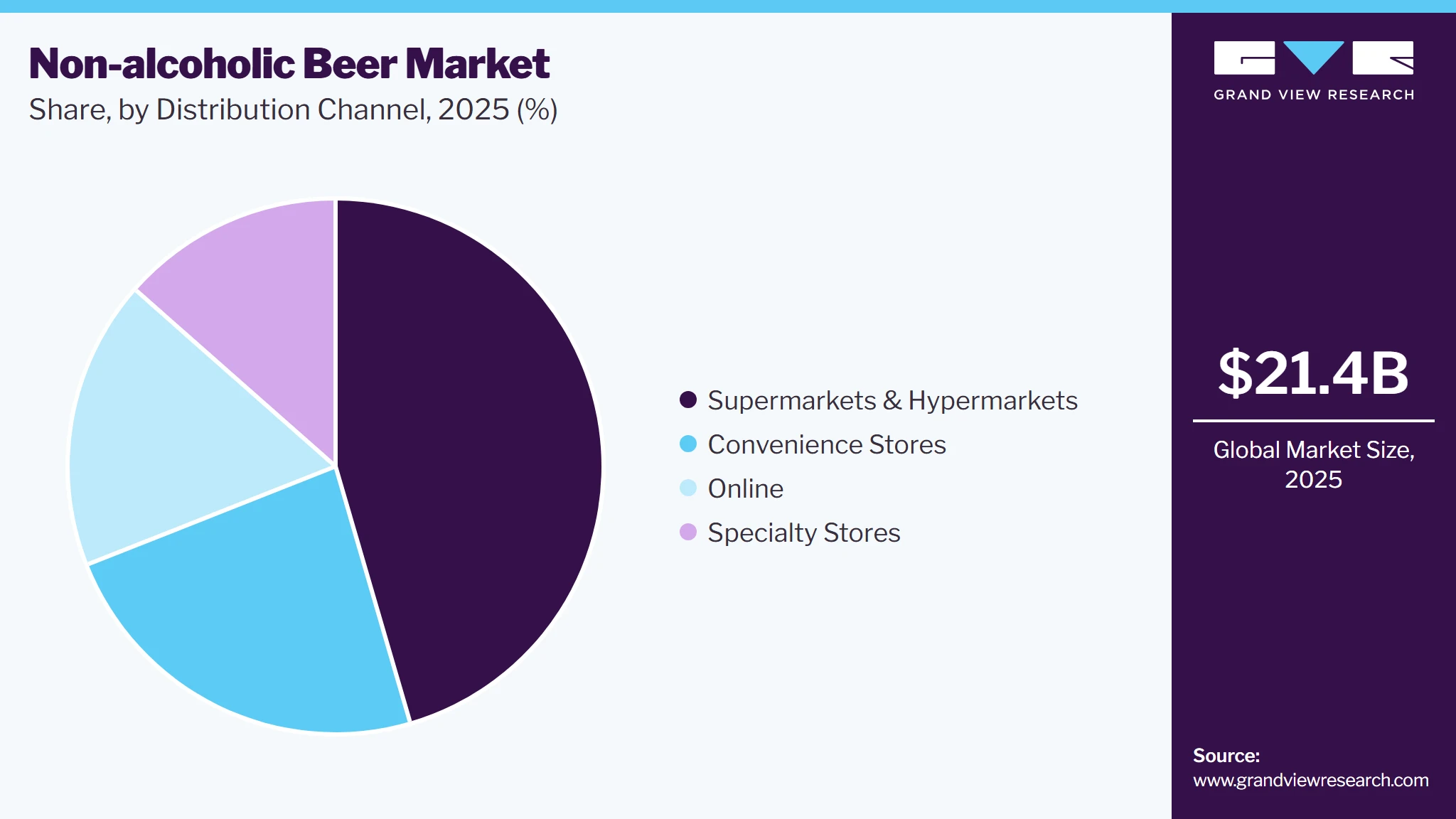
The sales of non-alcoholic beer through supermarkets & hypermarkets channel accounts for the largest share of 45.5% of the global revenue in 2025. Supermarkets and hypermarkets benefit from their ability to provide non-alcoholic beer with high product visibility and convenient in-store access. Dedicated beverage sections allow consumers to compare different brands, pack sizes, and product variants in one location. Promotional displays and in-store offers can encourage product discovery among shoppers who may be unfamiliar with the category. The presence of established retailers also supports consumer confidence when purchasing newer beverage formats. Wide physical coverage enables manufacturers to reach households through regular grocery shopping trips.
 To learn more about this report, Download Free Sample Report
The sales of non-alcoholic beer through online channels are projected to grow at the fastest CAGR of 8.4% from 2026 to 2033. Online distribution is supported by the convenience of browsing and purchasing non-alcoholic beer from home. E-commerce platforms can provide detailed product information, customer reviews, and comparisons that help consumers evaluate unfamiliar products. Digital marketplaces also allow brands to reach customers beyond the geographic limits of traditional retail stores. Subscription and repeat-order features can encourage regular purchases among existing consumers. Targeted digital promotions and personalized recommendations can further improve product visibility within online channels.
Regional Insights
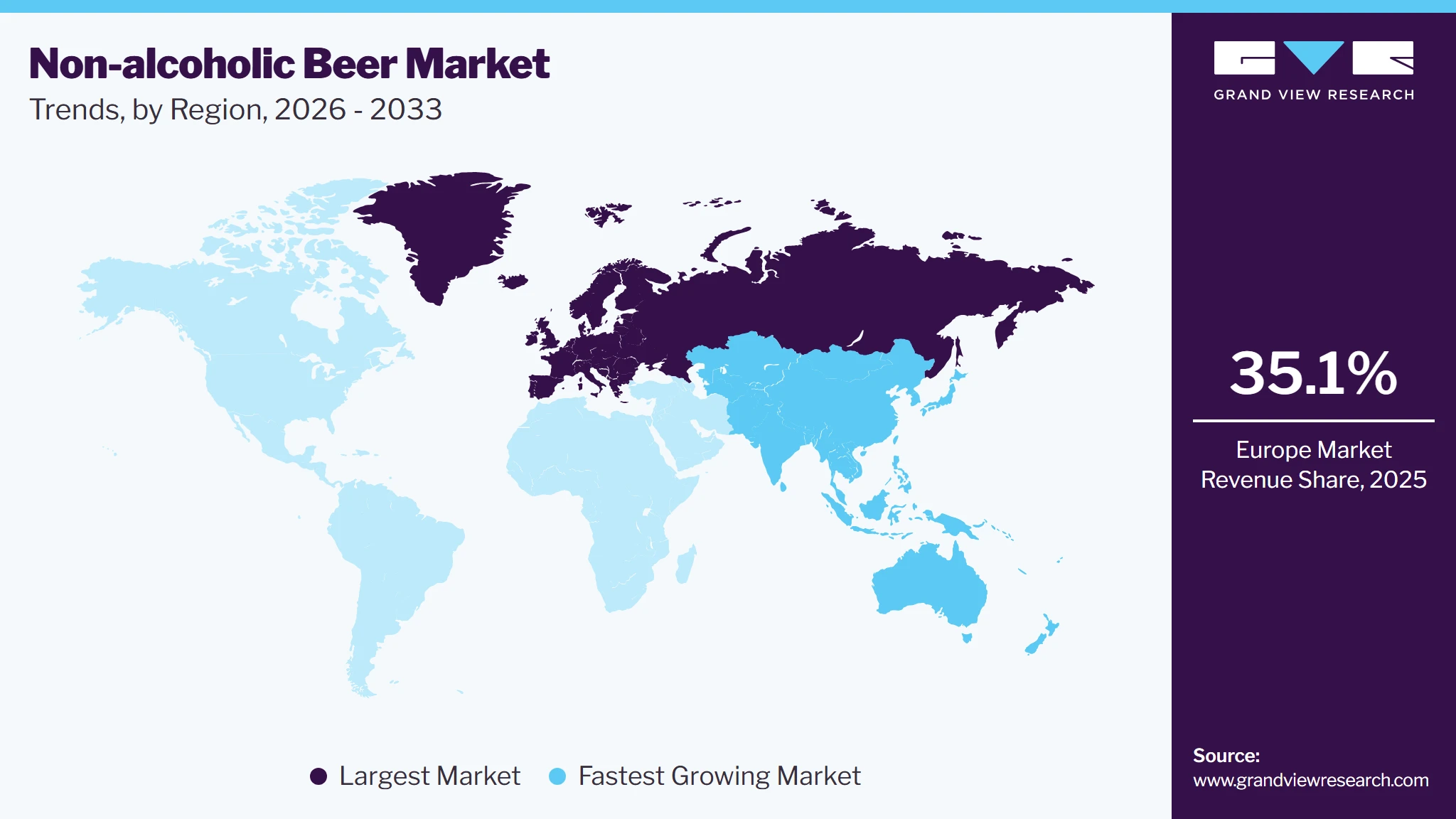
The European non-alcoholic beer industry accounted for the largest market share of 35.1% in 2025. The European non-alcoholic beer market benefits from the region's well-established beer culture and increasing preference for responsible drinking. Concerns around drinking and driving are encouraging consumers to select alcohol-free options during social and recreational activities. Established breweries are using advanced production techniques to offer products with taste profiles closer to conventional beer. Strong supermarket, hospitality, and food-service networks provide extensive distribution opportunities. Rising interest in wellness and balanced lifestyles is also creating additional demand for alcohol-free beverages.
 To learn more about this report, Download Free Sample Report
Germany Non-alcoholic Beer Market Trends
Germany led the European non-alcoholic beer market in 2025, holding the largest market share with 27.0% of the region’s total revenue. Germany's strong beer heritage provides a favorable environment for non-alcoholic beer, as consumers are already familiar with diverse beer styles and established brewing traditions. Demand is supported by consumers seeking beverages suitable for driving, workdays, sports, and other occasions where alcohol may be avoided. German breweries have also developed advanced alcohol-removal and brewing techniques that enhance product quality, while extensive distribution through supermarkets, discount retailers, beverage stores, and hospitality venues improves accessibility. This growing acceptance is also evident at major cultural events; for instance, in September 2024 , Munich’s Oktoberfest, with 16 of the festival’s 18 major tents offering non-alcoholic beer options, highlighted the increasing visibility and acceptance of alcohol-free alternatives. Growing interest in fitness and healthier lifestyles is further encouraging consumption.
North America Non-alcoholic Beer Market Trends
The North American non-alcoholic beer market accounted for a market share of 27.1% in 2025. The non-alcoholic beer market in North America is driven by growing consumer interest in healthier alternatives to alcoholic beverages and moderation-focused lifestyles. Younger consumers are increasingly adopting sober-curious habits while still seeking the social experience associated with beer. Product innovation in flavors, brewing methods, and premium formulations is improving consumer acceptance. Wider availability through supermarkets, convenience stores, restaurants, and e-commerce is supporting market penetration. Breweries are also positioning non-alcoholic beer as a lifestyle beverage rather than simply an alcohol substitute.
The U.S. led the North American non-alcoholic beer market in 2025, holding the largest market share with 81.5% of the region’s total revenue. In the U.S., increasing awareness of alcohol-related health concerns is encouraging consumers to reduce their alcohol intake. The growing sober-curious movement is expanding demand beyond consumers who completely avoid alcohol. Major breweries and craft producers are introducing new non-alcoholic varieties, providing greater product choice and visibility. Improvements in brewing technology are helping manufacturers deliver better taste, aroma, and mouthfeel. Growing availability across restaurants, bars, sporting venues, and retail outlets is further creating more consumption occasions. In January 2025, Tom Holland’s non-alcoholic beer brand Bero expanded into approximately 1,400 Target stores across the U.S., offering three varieties and a retailer-exclusive variety pack. The expansion demonstrates the growing presence of non-alcoholic beer in mainstream retail and Bero’s efforts to increase visibility through prominent in-store displays and distinctive branding.
Asia Pacific Non-alcoholic Beer Market Trends
The Asia Pacific non-alcoholic beer market is expected to grow at the fastest CAGR of 8.3% in 2025. The Asia Pacific market is being driven by urbanization, changing lifestyles, and increasing interest in healthier beverage choices. Rising disposable incomes are encouraging consumers to explore premium and innovative non-alcoholic beer products. Expansion of modern retail, convenience stores, and online shopping platforms is improving product accessibility. Younger consumers are showing greater interest in moderation, wellness, and new beverage experiences. Breweries are also developing products with localized flavors and positioning to address the diverse preferences across regional markets.
China led the Asia Pacific non-alcoholic beer industry in 2025, holding the largest market share with 32.6% of the region’s total revenue. In China, rising health consciousness is encouraging some consumers to moderate alcohol consumption while maintaining beer-related social occasions. Increasing demand for premium beverages is creating opportunities for higher-value non-alcoholic beer products. Rapid development of modern retail channels in major cities is improving consumer access to specialized beverage categories. E-commerce and digital marketing are helping brands reach younger and digitally engaged consumers more effectively. Innovation in taste, packaging, and premium branding is supporting greater awareness and acceptance of non-alcoholic beer.
Central & South America Non-Alcoholic Beer Market Trends:
The Central & South America non-alcoholic beer market is projected to grow at a CAGR of 8.1% from 2026 to 2033. The non-alcoholic beer market in Central and South America is supported by strong social drinking traditions, creating opportunities for alcohol-free products during gatherings and celebrations. Growing awareness of healthier lifestyles is encouraging consumers to moderate alcohol intake without abandoning beer-related occasions. Increasing exposure to international beverage trends is also generating interest in alcohol-free and low-alcohol alternatives. Expansion of supermarkets, convenience stores, and organized retail is improving distribution. Breweries are introducing localized products and brand extensions to attract existing beer consumers.
Middle East & Africa Non-alcoholic Beer Market Trends
The Middle East & Africa non-alcoholic beer market is expected to grow at a CAGR of 7.5% from 2026 to 2033. The Middle East & Africa market benefits from cultural and religious factors that limit alcohol consumption in several countries, creating opportunities for non-alcoholic beer alternatives. A growing young population is increasing demand for contemporary beverages suitable for social and recreational occasions. Urbanization and the expansion of organized retail are improving access to packaged non-alcoholic beverages. Growing health and wellness awareness is also encouraging consumers to consider alcohol-free options. Breweries are responding through premium packaging, varied flavors, and culturally appropriate product positioning.
Key Non-alcoholic Beer Company Insights
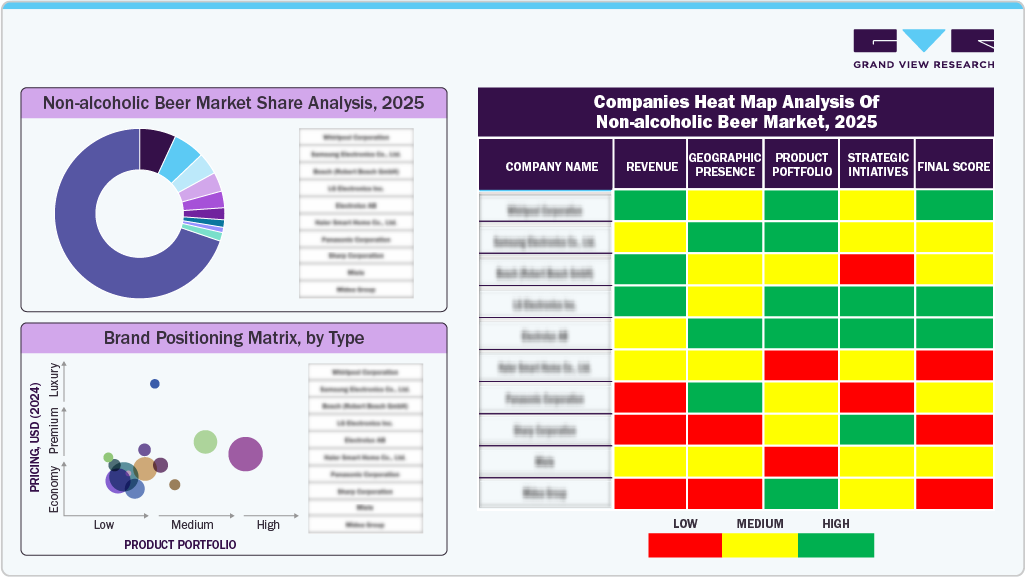
The non-alcoholic beer industry is characterized by the presence of both established global breweries and emerging specialized producers. Companies are focusing on expanding their product portfolios through new formulations, flavors, and brewing technologies to strengthen their market position. Strategic partnerships, product launches, and broader distribution networks are being used to increase brand reach across key markets.
Market share is influenced by factors such as brand recognition, product quality, pricing, innovation, and distribution capabilities. Competitive activity is expected to remain strong as manufacturers seek to capture the growing demand for non-alcoholic beer.
 To learn more about this report, Download Free Sample Report
Key Non-alcoholic Beer Companies:
Some of the key players operating in the non-alcoholic beer market include:
-
Anheuser-Busch Companies LLC
-
Heineken N.V.
-
Carlsberg Group
-
ASAHI GROUP HOLDINGS, LTD.
-
Molson Coors Beverage Company.
-
Diageo Ingredients
-
Kirin Holdings Company, Limited.
-
SUNTORY HOLDINGS LIMITED
-
ERDINGER Weißbräu
-
Radeberger Gruppe KG
Recent Developments:
-
In March 2026, Heineken introduced Heineken 0.0 Ultimate, a beer containing no alcohol, calories, or sugar, targeting health-conscious consumers interested in alcohol-free beverages. After being piloted in 2025, the product was rolled out in selected U.S. states, strengthening Heineken’s non-alcoholic beer range and providing consumers with an additional health-oriented option.
-
In January 2025, Tom Holland’s non-alcoholic beer brand Bero expanded into approximately 1,400 Target stores across the U.S., offering three varieties and a retailer-exclusive variety pack. The expansion demonstrates the growing presence of non-alcoholic beer in mainstream retail and Bero’s efforts to increase visibility through prominent in-store displays and distinctive branding.
Market Participant Categorization
Category
Operating Strategies
Competitive Edge
Weakness
Established Players (Anheuser-Busch Companies LLC, Heineken N.V.)
Scale zero/low-alcohol portfolios, expand retail presence, and use established brewing infrastructure.
Strong brands, broad distribution, and high production capabilities.
Portfolio cannibalization and higher costs to reformulate or produce alcohol-free variants.
Emerging Players (ERDINGER Weißbräu)
Focus on craft-style recipes, functional positioning, and digital-first consumer engagement.
Product innovation, niche appeal, and faster adaptation to consumer trends.
Limited scale, weaker distribution networks, and lower consumer awareness.
Non-alcoholic Beer Market Report Scope
Report Attribute
Details
Market size in 2025
USD 21.4 billion
Market value size in 2026
USD 22.6 billion
Revenue Forecast in 2033
USD 38.4 billion
Growth Rate (Revenue)
CAGR of 7.9% from 2026 to 2033
Actual data
2021 - 2025
Forecast period
2026 - 2033
Quantitative (Revenue) units
Revenue in USD million/billion and CAGR from 2026 to 2033
Report coverage
Revenue forecast, company ranking, competitive landscape, growth factors, and trends
Segments covered
Type, distribution channel, region
Regional Scope
North America; Europe; Asia-Pacific; Central & South America; Middle East & Africa
Country scope
U.S.; Canada; Mexico; U.K.; Germany; France; Italy; Spain; China; Japan; India; Australia & New Zealand; South Korea; Brazil; South Africa
Key companies profiled
Anheuser-Busch Companies LLC; Heineken N.V.; Carlsberg Group; ASAHI GROUP HOLDINGS, LTD., Molson Coors Beverage Company; Diageo; Kirin Holdings Company, Limited; SUNTORY HOLDINGS LIMITED; ERDINGER Weißbräu; Radeberger Gruppe KG
Customization scope
Free report customization (equivalent up to 8 analysts’ working days) with purchase. Addition or alteration to country, regional & segment scope.
Pricing and purchase options
Avail customized purchase options to meet your exact research needs. Explore purchase options
Global Non-alcoholic Beer Market Report Segments
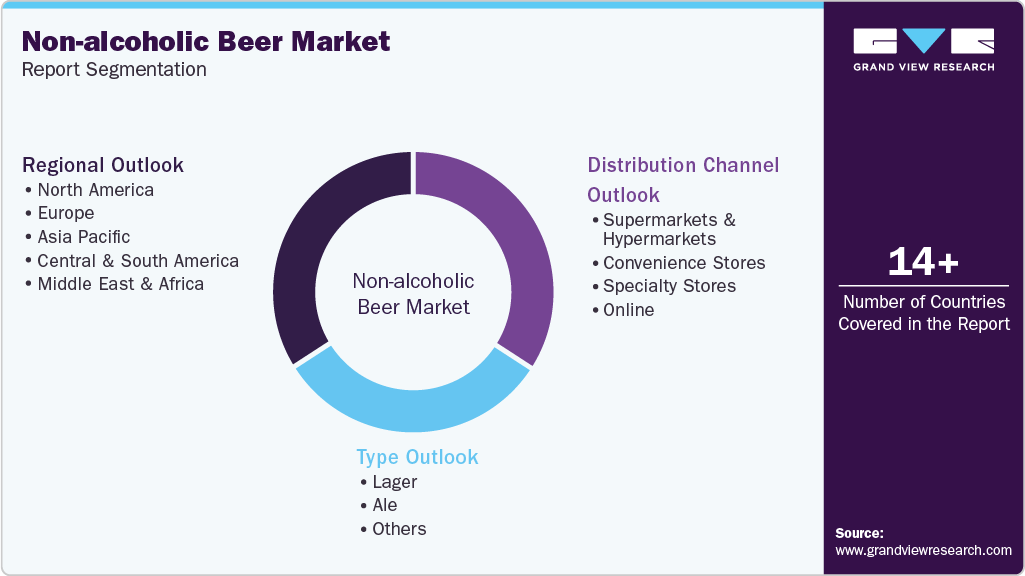
This report forecasts revenue growth at the regional and country levels and provides an analysis of the latest industry trends and opportunities in each of the sub-segments from 2021 to 2033. For the purpose of this study, Grand View Research has segmented the global non-alcoholic beer market report on the basis of type, distribution channel, and region.
 To learn more about this report, Download Free Sample Report
-
Type Outlook (Revenue, USD Million, 2021 - 2033)
-
Lager
-
Ale
-
Others
-
-
Distribution Channel Outlook (Revenue, USD Million, 2021 - 2033)
-
Supermarkets & Hypermarkets
-
Convenience Stores
-
Specialty Stores
-
Online
-
-
Regional Outlook (Revenue, USD Million, 2021 - 2033)
-
North America
-
U.S.
-
Canada
-
Mexico
-
-
Europe
-
U.K.
-
Germany
-
France
-
Italy
-
Spain
-
-
Asia Pacific
-
China
-
Japan
-
India
-
Australia & New Zealand
-
South Korea
-
-
Central & South America
-
Brazil
-
-
Middle East & Africa
-
South Africa
-
-
Research Methodology
The non-alcoholic beer market figures in this report are based on a proven research process that combines executive interviews with secondary research from proprietary databases, company filings, and recognized regulatory and institutional sources. Market size is developed through value-chain sizing, reconciling supply-side and demand-side estimates, and triangulated using bottom-up and top-down approaches. Every estimate undergoes multiple levels of expert validation before publication, with each non-alcoholic beer segment quantified according to the revenue-capture definitions presented in the table below.
Segment Definition
Segment - Type
Revenue capture definition
Lager
Non-alcoholic lager generates revenue through packaged product sales across consumer and hospitality channels. Revenue is captured through single-serve cans, bottles, multipacks, and larger-format packaging. Sales are supported by purchases for social occasions, dining, and personal consumption. Breweries can also capture value through premium lager variants featuring enhanced brewing characteristics and distinctive positioning.
Ale
Non-alcoholic ale generates revenue through the sale of products offering diverse flavor profiles and more specialized beer characteristics. Revenue is captured through retail purchases, hospitality sales, and direct-to-consumer channels where available. Craft-style formulations can command additional value through distinctive ingredients, brewing methods, and limited-edition offerings. The segment also provides opportunities for breweries to develop differentiated products aimed at consumers seeking greater variety.
Others
Other non-alcoholic beer varieties generate revenue through specialized formulations that fall outside conventional lager and ale categories. Revenue is captured through niche product sales, specialty retail, hospitality establishments, and online marketplaces. Manufacturers can create value through innovative recipes, unique flavor combinations, and alternative brewing styles. These products enable companies to address specific consumer preferences and develop differentiated positions within the market.
Estimation Model
No.
Layer
Key Question
Description
01
Consumption Profile Layer
Who consumes non-alcoholic beer?
Targets moderation-focused drinkers, wellness-conscious consumers, and those seeking beer occasions without alcohol.
02
Market Reach Layer
Where can consumers access it?
Covers supermarkets, convenience stores, bars, restaurants, e-commerce, and specialty beverage retailers.
03
Purchase & Retention Layer
What drives repeat purchases?
Driven by taste, brand trust, product variety, affordability, and availability across drinking occasions.
04
Value Generation Layer
How is revenue generated?
Generated through premium positioning, varied formats, brand differentiation, and higher-value product segments.
Customization Table
No.
CLIENT REQUEST
CUSTOMIZATION DELIVERED
VALUE ADDS
1
Global Non-Alcoholic Beer Brand & Product Landscape Assessment
Assessed brand positioning, product formats, flavor profiles, packaging approaches, and competitive differentiation across key markets.
Helps identify whitespace opportunities, positioning gaps, and potential areas for product innovation.
2
Global Non-Alcoholic Beer Channel & Pricing Assessment
Examined retail and on-premise channels, pricing structures, promotional activity, and route-to-market dynamics.
Enables channel prioritization, pricing strategy development, and identification of distribution opportunities.
3
Global Non-Alcoholic Beer Regulatory & Market Environment Assessment
Reviewed labeling requirements, alcohol-content thresholds, advertising standards, and regulatory differences across key markets.
Helps anticipate market-entry requirements, reduce compliance risks, and tailor go-to-market strategies by geography.
Frequently Asked Questions About This Report
Asia Pacific is the fastest-growing region over the forecast period.
The global non-alcoholic beer market size was valued at USD 21.4 billion in 2025 and is projected to grow from USD 22.6 billion in 2026.
The global non-alcoholic beer market is expected to grow at a CAGR of 7.9% from 2026 to 2033, reaching USD 38.4 billion by 2033
The non-alcoholic lager market accounted for the largest share of 67.6% of the revenue in 2025, while non-alcoholic ale market is the fastest-growing segment.
Europe dominated the market, accounting for a revenue share of 35.1% in 2025.
The non-alcoholic beer industry is primarily driven by increasing health and wellness awareness among consumers, along with growing demand for low-calorie and alcohol-free beverages.
Key players include Anheuser-Busch Companies LLC; Heineken N.V.; Carlsberg Group; ASAHI GROUP HOLDINGS, LTD., Molson Coors Beverage Company; Diageo; Kirin Holdings Company, Limited; SUNTORY HOLDINGS LIMITED; ERDINGER Weißbräu; Radeberger Gruppe KG
The supermarkets & hypermarkets channel held the largest share of 45.5% in 2025, while online channels segment is the fastest-growing distribution channel.
About the Author(s)
Consumer F&B Research Team
Consumer Goods · Consumer F&BThis report was authored by the consumer f&b research team at Grand View Research - comprising two research analysts, one senior research analyst, and one industry expert - with specialized expertise in the consumer f&b segment of the consumer goods industry. All findings are based on proprietary consumer goods databases, executive interviews, and regulatory analysis, subject to internal peer review prior to publication.
Last Updated:
Speak to Analyst

Customize this report to your needs - add regions, segments, or data points, with 20% free customization.
Or view our licence options:


ISO 9001:2015 & 27001:2022 Certified
We are GDPR and CCPA compliant! Your transaction & personal information is safe and secure. For more details, please read our privacy policy.


