
- Home
- »
- Plastics, Polymers & Resins
- »
-
Non-phthalate Plasticizers Market Size, Industry Report 2033GVR Report cover
![Non-phthalate Plasticizers Market Size, Share & Trends Report]()
Non-phthalate Plasticizers Market (2026 - 2033) Size, Share & Trends Analysis Report By Type (Adipates, Trimellitates, Benzoates, Epoxies), By Application (Flooring & Wall Coverings, Wires & Cables, Films & Sheets), By Region, And Segment Forecasts
Market Size, 2025
$3.4BMarket Estimate, 2026
$3.6BMarket Forecast, 2033
$4.8BCAGR, 2026–2033
4.2%Non-phthalate Plasticizers Market Summary
The global non-phthalate plasticizers market size was valued at USD 3.4 billion in 2025 and is projected to grow from USD 3.6 billion in 2026 to USD 4.8 billion by 2033, at a CAGR of 4.2% from 2026 to 2033. The Asia Pacific non-phthalate plasticizers market held the largest share of 56.8% of the global market in 2025. Health and environmental concerns associated with traditional phthalates have led industries to seek out non-phthalate options, leading to a surge in market growth. sustainability and safety.

Key Market Trends & Insights
- By type: Adipates dominated the market across all type segments in terms of revenue, accounting for a 48.7% market share in 2025
- By application: The wires and cables segment is expected to grow at a CAGR of 5.2% from 2026 to 2033 in terms of revenue.
Regional Highlights
- Largest regional market: Asia Pacific (56.8% revenue share, 2025)
- The non-phthalate plasticizers industry in India is expected to grow at a CAGR of 6.4% from 2026 to 2033.
Market Size & Forecast
- Market size in 2025: USD 3.4 Billion
- Estimated market size in 2026: USD 3.6 Billion
- Projected market size by 2033: USD 4.8 Billion
- CAGR (2026-2033): 4.2%
This trend is particularly evident in sectors such as packaging, medical devices, and automotive, where the use of non-toxic materials is becoming increasingly critical. The market is also witnessing a rise in applications across various industries, reflecting a broader shift toward

Another notable trend in the phthalate free plasticizers industry is the increasing focus on bio-based plasticizers. As sustainability becomes a paramount concern across industries, manufacturers are exploring renewable sources for plasticizer production. Bio-based plasticizers, derived from natural materials such as vegetable oils and other biomass, offer an eco-friendly alternative to conventional options. This trend is gaining momentum as companies strive to reduce their carbon footprint and meet consumer demands for greener products. The development and commercialization of bio-based non-phthalate plasticizers not only aligns with global sustainability goals but also opens new avenues for innovation and market expansion.
Drivers, Opportunities & Restraints
Stringent regulations and policies imposed by governments worldwide play a significant role, as these measures aim to reduce the use of harmful chemicals in types. Regulatory bodies such as the European Chemicals Agency (ECHA) and the U.S. Environmental Protection Agency (EPA) have been instrumental in enforcing standards that limit the use of phthalates, thereby encouraging the adoption of safer alternatives. Additionally, growing consumer awareness about the potential health risks associated with phthalates is prompting manufacturers to switch to phthalate free plasticizers.
The non-phthalate plasticizers industry presents numerous opportunities for innovation and growth. There is a growing need for cost-effective, sustainable alternatives that can match or exceed the performance of traditional phthalates. This demand is driving investments in research and development to enhance product performance and expand the application scope of phthalate free plasticizers. As industries continue to prioritize environmentally friendly solutions, companies that can develop efficient and effective non-phthalate plasticizers are well-positioned to capitalize on this trend. Additionally, increasing collaborations and partnerships among key players in the market can facilitate the development of new and improved products, further boosting market growth.
Despite the growth outlook, the market for non-phthalate plasticizers faces several challenges. One of the primary restraints is the higher production costs associated with these alternatives. Non-phthalate plasticizers often require more complex types and raw materials, which can increase overall production expenses. Moreover, there is limited awareness among end-users about the benefits of non-phthalate plasticizers, which can hinder market adoption. Educating consumers and manufacturers about the advantages of non-phthalate options is essential to overcoming these barriers.
Market Concentration & Characteristics
The market growth stage is medium, and growth is accelerating. The market exhibits fragmentation, with key players dominating the industry landscape. Major companies such as BASF, Eastman Chemical Company, ExxonMobil, Evonik Industries, DIC Corporation, Perstorp, Lanxess AG, KLJ Group, Polynt, Mitsubishi Chemical Corporation, and others play a significant role in shaping the market dynamics. These leading players often drive innovation in the market, introducing new products, technologies, and product types to meet the industry's evolving demands.
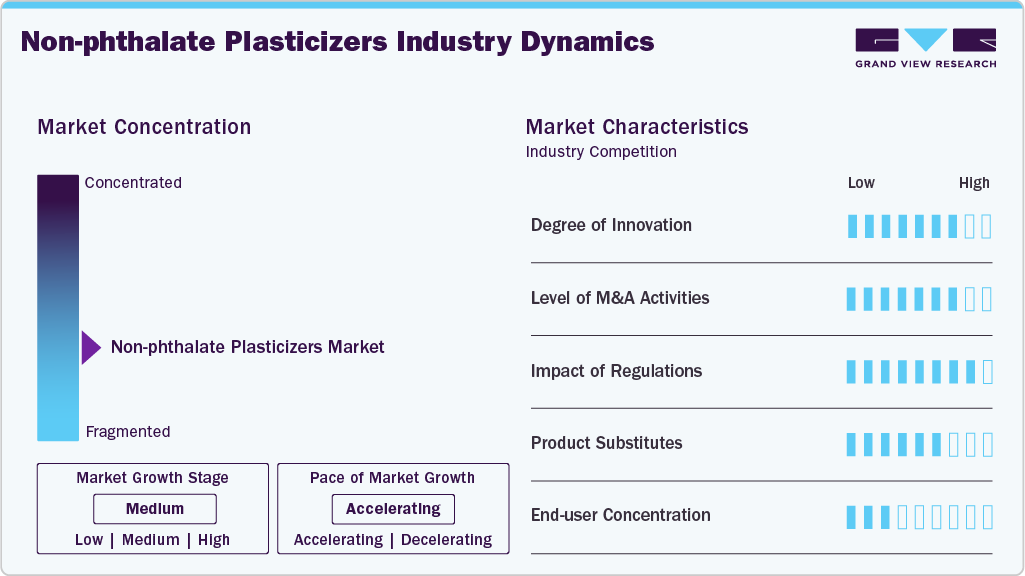
The degree of innovation in the industry is high, driven by both sustainability and performance improvements. Development of plasticizers from renewable resources, such as epoxidized soybean oil (ESBO) and citrates, helps reduce the carbon footprint and supports greener product strategies. At the same time, innovations such as DOTP and DINCH are designed to match or exceed the flexibility and durability of traditional ortho-phthalates, improving market acceptance. Products such as Perstorp’s Pevalen and BASF’s Ecoflex EL further strengthen the market by offering safer, more efficient, and environmentally responsible alternatives.
Product substitutes in the industry are shaping competition by offering safer and more sustainable options. Tributyl O-acetylcitrate (ATBC) and DEHA/DOA are widely used in flexible applications, while diethylhexyl terephthalate and diisononyl cyclohexane-1,2-dicarboxylate provide strong performance in demanding uses. Benzoate esters support cost-effective formulations with good compatibility, and bio-based plasticizers are gaining attention due to regulatory pressure and environmental concerns. Together, these substitutes are reducing reliance on traditional plasticizers, expanding application choices, and pushing manufacturers to improve product quality, compliance, and sustainability.
Type Insights
Adipates dominated the market across all type segments in terms of revenue, accounting for a 48.7% market share in 2025, and is forecasted to grow at a 3.8% CAGR from 2026 to 2033. The rising demand in the packaging industry is keeping the adipates market strong due to its food contact safe nature and flexibility to low temperatures. The automotive industry uses adipates for interior components, wiring, and seats with synthetic leather.
The epoxies segment is anticipated to grow at a CAGR of 6.0%through the forecast period. The main driver is the painting and coating industry, owing to its extreme durability, high chemical resistance, and superior adhesion due to increased demand in construction. The demand for lighter and fuel-efficient vehicles is also driving the demand for epoxies, as it is corrosion-proof, resistant to heat, and has high tolerance for chemicals. Investments toward semiconductors and processors are some driving factors in the electrical and electronics market, as epoxy provides high heat resistance and insulation.
Application Insights
Flooring & wall coverings dominated the market across the application segmentation in terms of revenue, accounting for a 36.3% market share in 2025, and are forecast to grow at a 4.2%CAGR from 2026 to 2033. Non-phthalate plasticizers provide flexibility, durability, and processing efficiency same as ortho-phthalate but without the health concerns, leading the flooring and wall covering industry to use non-phthalate for safe and healthy indoor environments.
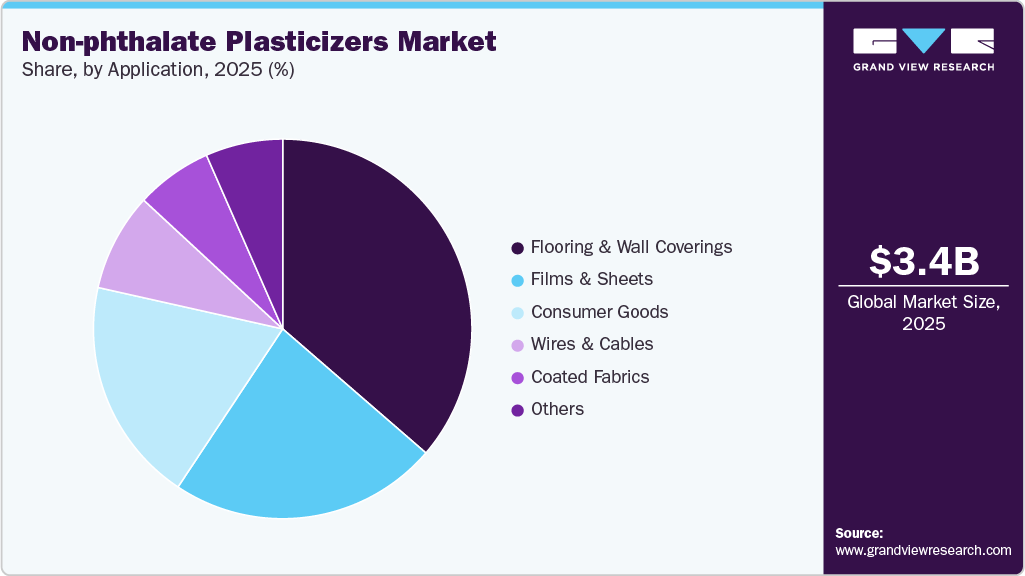
The wires and cables segment is expected to expand at a 5.2% CAGR over the forecast period. The wire and cable application segment is an important area of the non-phthalate plasticizers market, as these additives improve flexibility, durability, and performance in demanding electrical uses. Strong construction activity is supporting demand since modern buildings require safer and more reliable cabling systems. Health and safety concerns are also encouraging the use of non-phthalate alternatives, while their better insulation and heat resistance make them well-suited for wires and cables used in harsh environments.
Regional Insights
Asia Pacific dominated the global non-phthalate plasticizers market and accounted for the largest revenue share of 56.8% in 2025. The Asia-Pacific region, characterized by rapid industrialization and urbanization, is emerging as a major market for these plasticizers, driven by increasing manufacturing activities and growing environmental consciousness. Each region presents unique opportunities and challenges, shaping the global landscape of the non-phthalate plasticizers market.

China Non-phthalate Plasticizers Market Trends
The non-phthalate plasticizers market in China is experiencing steady growth, supported by strict regulatory frameworks and rising demand from key end-use industries. Government standards such as GB/T regulations and RoHS compliance requirements have encouraged manufacturers to shift away from traditional phthalate-based plasticizers toward safer, non-toxic alternatives. These regulations are particularly important in applications involving human contact, where safety and environmental impact are critical considerations. At the same time, high-growth sectors such as medical devices and food packaging are driving increased adoption of phthalate free plasticizers due to their need for materials that meet stringent hygiene and safety standards. This combination of regulatory pressure and industry demand is accelerating innovation and production within the market, positioning China as a significant contributor to the global transition toward safer plasticizer solutions.
North America Non-phthalate Plasticizers Market Trends
The non-phthalate plasticizers market in North America is driven by health, safety, and regulatory concerns as companies are transitioning from phthalates to non-phthalates due to health risks and consumer awareness. The global safety standard compliance in applications such as medical devices and food packaging requires certificates to meet sustainability goals.
The non-phthalate plasticizers market in the U.S. is characterized by high levels of innovation, with companies investing in research and development to create advanced non-phthalate plasticizers that meet stringent regulatory requirements while offering superior performance. The growing consumer awareness of the health risks associated with traditional phthalates further drives the adoption of non-phthalate plasticizers in the U.S.
Europe Non-phthalate Plasticizers Market Trends
The non-phthalate plasticizers market in Europe is driven by comprehensive regulatory frameworks such as the European Union's REACH (Registration, Evaluation, Authorization, and Restriction of Chemicals) legislation. The region's strong emphasis on sustainability and environmental protection has accelerated the adoption of non-phthalate plasticizers across various industries, including construction, automotive, and consumer goods. Countries such as Germany, France, and the United Kingdom are leading the charge, with significant investments in research and development to enhance the performance and application range of non-phthalate plasticizers.
Key Non-phthalate Plasticizers Company Insights
The non-phthalate plasticizers industry is highly competitive, with several key players dominating the landscape. Major companies include BASF, Eastman Chemical Company, ExxonMobil, Evonik Industries, DIC Corporation, Perstorp, Lanxess AG, KLJ Group, Polynt, and Mitsubishi Chemical Corporation. The non-phthalate plasticizers industry is characterized by a competitive landscape with several key players driving innovation and market growth. Major companies in this sector are investing heavily in research and development to enhance the performance, cost-effectiveness, and sustainability of their products.
Key Non-phthalate Plasticizers Companies:
The following key companies have been profiled for this study on the non-phthalate plasticizers market.
- BASF
- Eastman Chemical Company
- ExxonMobil
- Evonik Industries
- DIC Corporation
- Perstorp
- Lanxess AG
- KLJ Group
- Polynt
- Mitsubishi Chemical Corporation
Recent Developments
-
In July 2025, BASF expanded the production capacity of its non-phthalate plasticizer Hexamoll DINCH at its Ludwigshafen facility in Germany from 100,000 to 200,000 metric tons annually. The addition of a second production plant enables the company to meet increasing global demand, enhance supply reliability, and maintain high quality standards.
-
In January 2024, Pevalen Pro 100 represents a major step forward in non-phthalate plasticizers, combining strong performance with sustainable sourcing. It establishes a new standard in the flexible PVC industry by providing a solution that is fully renewable-based while maintaining high levels of performance and safety.
Non- phthalate Plasticizers Market Report Scope
Report Attribute
Details
Market size in 2025
USD 3.4 billion
Estimated market size in 2026
USD 3.6 billion
Projected market size by 2033
USD 4.8 billion
Growth rate
CAGR of 4.2% from 2026 to 2033
Historical data
2021 - 2025
Forecast period
2026 - 2033
Quantitative units
Volume in kilotons; revenue in USD million/billion, and CAGR from 2026 to 2033
Report coverage
Volume & revenue forecast, competitive landscape, growth factors, and trends
Segments covered
Type, application, region
Regional scope
North America; Europe; Asia Pacific; Central & South America; Middle East & Africa
Country scope
U.S.; Canada; Mexico; Germany; UK; France; Italy; Spain; China; India; Japan; South Korea; Australia; Brazil; Argentina; Saudi Arabia; UAE; South Africa
Key companies profiled
BASF; Eastman Chemical Company; ExxonMobil; Evonik Industries; DIC Corporation; Perstorp; Lanxess AG; KLJ Group; Polynt; Mitsubishi Chemical Corporation.
Customization scope
Free report customization (equivalent to up to 8 analyst working days) with purchase. Addition or alteration to country, regional & segment scope
Pricing and purchase options
Avail customized purchase options to meet your exact research needs. Explore purchase options
Global Non-phthalate Plasticizers Market Report Segmentation
This report forecasts volume & revenue growth at the global, regional, and country levels and provides an analysis of the latest industry trends across sub-segments from 2021 to 2033. For this study, Grand View Research has segmented the global non-phthalate plasticizers market report based on type, application, and region:

-
Type Outlook (Volume, Kilotons; Revenue, USD Million, 2021 - 2033)
-
Adipates
-
Trimellitates
-
Benzoates
-
Epoxies
-
Others
-
-
Application Outlook (Volume, Kilotons; Revenue, USD Million, 2021 - 2033)
-
Flooring & wall coverings
-
Wires & cables
-
Films & sheets
-
Coated fabrics
-
Consumer goods
-
Others
-
-
Regional Outlook (Volume, Kilotons; Revenue, USD Million, 2021 - 2033)
-
North America
-
U.S.
-
Canada
-
Mexico
-
-
Europe
-
Germany
-
UK
-
France
-
Italy
-
Spain
-
-
Asia Pacific
-
China
-
India
-
Japan
-
South Korea
-
Australia
-
-
Central & South America
-
Brazil
-
Argentina
-
-
Middle East and Africa
-
Saudi Arabia
-
UAE
-
South Africa
-
-
Frequently Asked Questions About This Report
Health and environmental concerns associated with traditional phthalates have led industries to seek out non-phthalate options. This trend is particularly evident in sectors such as packaging, medical devices, and automotive, where the use of non-toxic materials is becoming increasingly critical.
Asia Pacific dominated with a 56.8% revenue share in 2025.
Flooring & wall coverings held the largest revenue share 36.3% in 2025 and are forecast to grow at a 4.2%CAGR from 2026 to 2033.
The global non-phthalate plasticizers market size was estimated at USD 3.4 billion in 2025 and is expected to reach USD 3.6 billion in 2026.
The global non-phthalate plasticizers market is expected to grow at a compound annual growth rate of 4.2% from 2026 to 2033 to reach USD 4.8 million by 2033.
Adipates dominated the market across all type segments in terms of revenue, accounting for a 48.7% market share in 2025, and is forecasted to grow at a 3.8% CAGR from 2026 to 2033. The rising demand in the packaging industry is keeping the adipates market strong due to its food contact safe nature and flexibility to low temperatures.
Some key players operating in the non-phthalate plasticizers market include BASF, Eastman Chemical Company, ExxonMobil, Evonik Industries, DIC Corporation, Perstorp, Lanxess AG, KLJ Group, Polynt, and Mitsubishi Chemical Corporation.
About the Author(s)
Plastics, Polymers & Resins Research Team
Bulk Chemicals · Plastics, Polymers & ResinsThis report was authored by the plastics, polymers & resins research team at Grand View Research - comprising two research analysts, one senior research analyst, and one industry expert - with specialized expertise in the plastics, polymers & resins segment of the bulk chemicals industry. All findings are based on proprietary bulk chemicals databases, executive interviews, and regulatory analysis, subject to internal peer review prior to publication.
Last Updated:
Speak to Analyst


Customize this report to your needs — add regions, segments, or data points, with 20% free customization.
Or view our licence options:


ISO 9001:2015 & 27001:2022 Certified
We are GDPR and CCPA compliant! Your transaction & personal information is safe and secure. For more details, please read our privacy policy.


