
- Home
- »
- Next Generation Technologies
- »
-
Non-Volatile Memory Express Market, Industry Report, 2033GVR Report cover

Non-Volatile Memory Express Market (2025 - 2033) Size, Share & Trends Analysis Report By Communication Standard (Ethernet, Fiber Channel, InfiniBand), By Deployment (Cloud, On-Premises, Hybrid), By Application, By Region, And Segment Forecasts
Market Size, 2024
$129.0BMarket Estimate, 2026
$158.5BMarket Forecast, 2033
$876.5BCAGR, 2025–2033
23.8%Non-Volatile Memory Express Market Summary
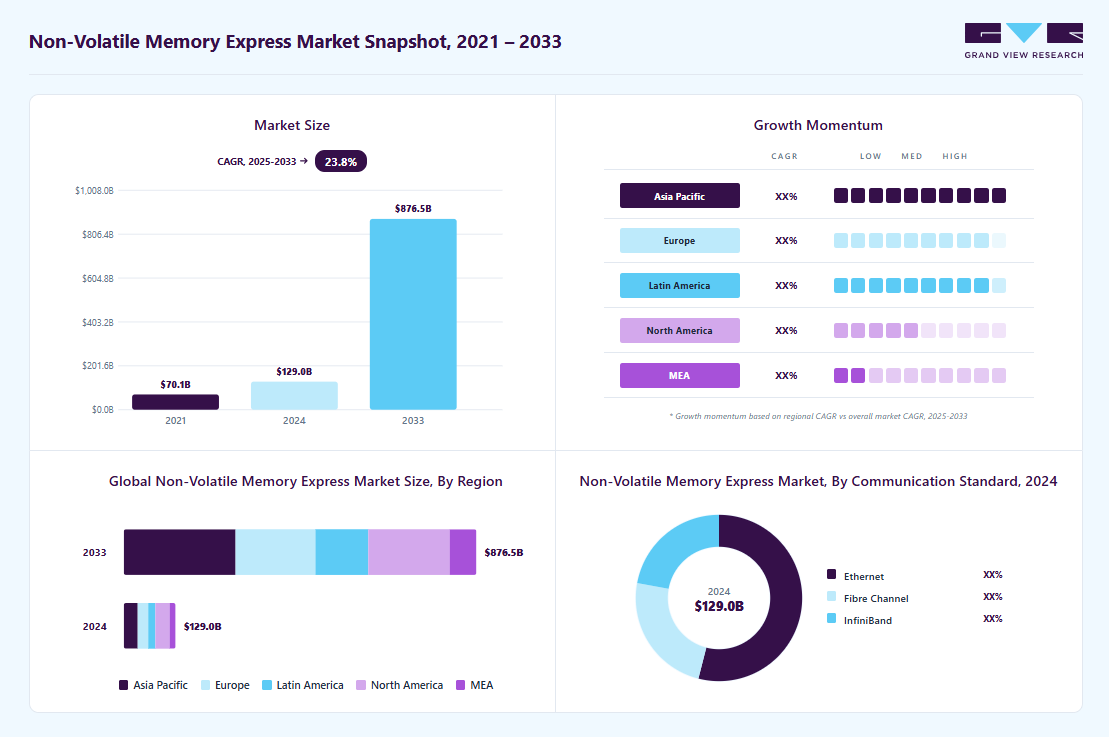
The global non-volatile memory express market size was estimated at USD 128.96 billion in 2024 and is projected to reach USD 876.53 billion by 2033, growing at a CAGR of 23.83% from 2025 to 2033. The non-volatile memory express (NVMe) market is driven by the increasing demand for high-performance storage solutions across enterprise data centers, cloud environments, and AI/ML workloads.
 Source: Grand View Research, IR Documents, Primary Interviews, Paid DatabasesTo learn more about this report,
 Download Free Sample Report
 Key Market Trends & Insights
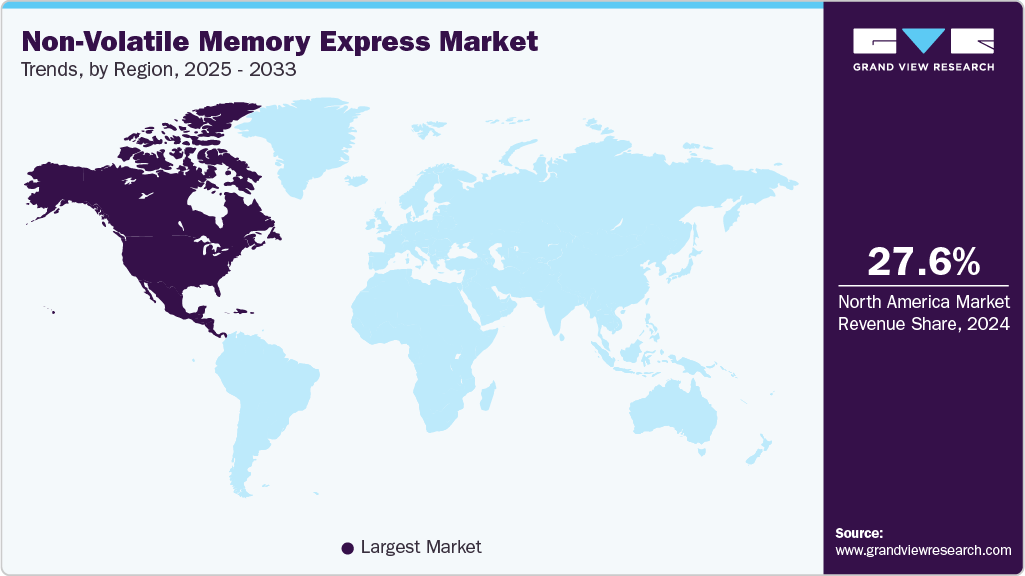
- North America dominated the global Non-Volatile memory express market with the largest revenue share of 27.58% in 2024.
- The Non-Volatile Memory express market in the U.S. led the North America market and held the largest revenue share in 2024.
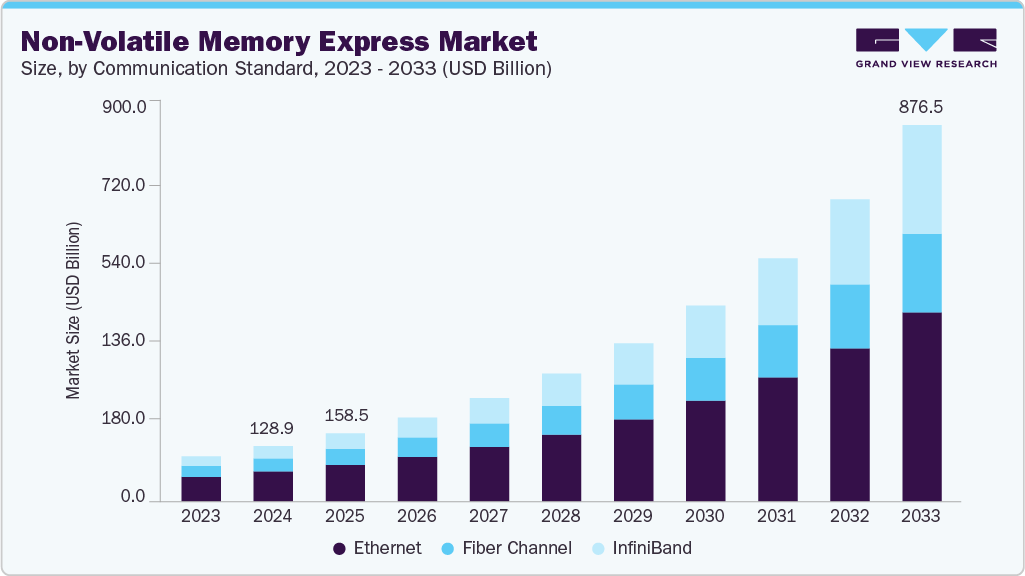
- By communication standard, the ethernet led the market, holding the largest revenue share of 53.98% in 2024.
- By deployment, on-premises segment held the dominant position in the market and accounted for the leading revenue share of 49.58% in 2024.
- By application, healthcare segment is expected to grow at the fastest CAGR of 28.22% from 2025 to 2033.
Market Size & Forecast
- 2024 Market Size: USD 128.96 Billion
- 2033 Projected Market Size: USD 876.53 Billion
- CAGR (2025-2033): 23.83%
- North America: Largest market in 2024
GVR research-powered AIAsk Prism AI about the Non-Volatile memory express marketGet cited answers from GVR research on market growth, segments, regulations and forecasts.Start with✓ Source-linked answers ✓ Market-specific context ✓ Traceable figuresExplore Prism AI ↗
The rapid growth of data traffic requires scalable and low-latency storage infrastructure, driving NVMe adoption for faster data access and processing. NVMe market expansion is driven by the escalating demand for high-speed, low-latency data storage solutions across diverse sectors. Enterprises and cloud service providers increasingly adopt NVMe SSDs to support data-intensive applications, such as artificial intelligence, machine learning, and big data analytics, which require rapid data processing and high throughput for optimized performance. This demand catalyzes the shift from traditional storage interfaces to NVMe due to its superior efficiency in handling simultaneous input/output operations.Advancements in NVMe technology, including the development of NVMe over Fabrics (NVMe-oF), extend the benefits of high-speed storage across networks, enabling scalable and efficient shared storage environments. This progression supports distributed and cloud data centers by enhancing resource utilization and lowering latency in large-scale data processing. The integration of NVMe solutions in telecommunications, particularly fueled by 5G deployment, further accelerates demand as these networks necessitate enhanced storage capabilities to manage vast data volumes generated by connected devices.
 To learn more about this report, Download Free Sample Report
 Moreover, the continuous improvement in NAND flash memory technology underpins the cost-effectiveness and performance of NVMe SSDs. Innovations in 3D NAND and controller designs increase data density while reducing production costs, making NVMe storage more accessible to enterprises and consumers. These technological upgrades contribute to lowering the total cost of ownership and foster widespread adoption of NVMe storage, including in consumer electronics, automotive infotainment, and advanced driver-assistance systems.
Communication Standard Insights
The Ethernet segment led the market in 2024, accounting for 53.98% of global revenue. This segmemt supports NVMe over Fabrics (NVMe-oF), enabling high-speed, low-latency access to disaggregated storage across data center networks. Ethernet-based NVMe solutions integrate the NVMe protocol over RDMA technologies such as RoCE and iWARP, minimizing CPU overhead while maintaining performance comparable to direct-attached storage. This approach enables efficient scale-out storage architectures by allowing NVMe SSDs to communicate natively over Ethernet, reducing bottlenecks and improving resource utilization. Ethernet NVMe also supports scalable fabric architectures, enhancing data center flexibility and enabling advanced use cases like cloud computing and big data analytics. These capabilities position Ethernet as a key enabler for next-generation storage infrastructure with reduced latency, high bandwidth, and simplified management.
The InfiniBand segment is expected to grow at the highest CAGR during the forecast period driven by its exceptional performance in high-performance computing (HPC) and data-intensive workloads. It provides extremely low latency and high throughput, supporting complex applications in scientific research, financial modeling, and artificial intelligence. InfiniBand’s direct memory access capabilities and efficient data transport enhance NVMe deployment in tightly coupled, latency-sensitive environments, making it a preferred choice where maximum performance is critical.
Deployment Insights
The on-premises segment accounted for the largest market revenue share in 2024, due to the growth of direct control over storage infrastructure, offering reduced latency and enhanced security by keeping data within internal networks. This model supports mission-critical applications requiring predictable and consistent performance, such as financial services and healthcare, where data sovereignty and compliance are paramount. Furthermore, on-premises environments enable tight integration with existing IT systems, facilitating optimized resource utilization and customized configurations tailored to specific workload demands.
The hybrid segment is expected to grow at the highest CAGR over the forecast period, as this model combines on-premises NVMe storage with cloud-based resources, balancing performance and scalability. It supports workload flexibility by allowing data and applications to move between private infrastructure and public cloud environments based on demand and cost considerations. Hybrid NVMe deployments enhance disaster recovery capabilities and facilitate phased cloud adoption without compromising enterprise control or security. This approach supports well with organizations pursuing digital transformation while managing diverse data governance requirements across distributed environments.
Application Insights
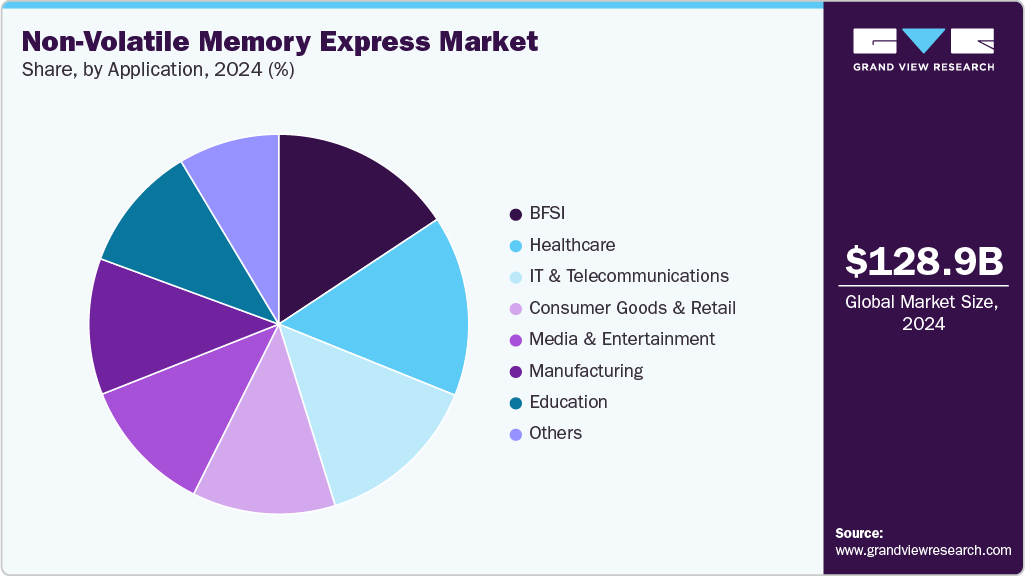
The BFSI segment accounted for the largest market revenue share in 2024 is driven by the need to handle large volumes of transaction data with minimal latency, enabling real-time analytics and faster processing. NVMe technology supports critical operations such as blockchain trading, virtual banking, and digital mobile wallets by providing rapid input/output operations per second and enhancing data access speed. These features ensure regulatory compliance and operational efficiency in high-frequency trading environments, contributing to improved customer experiences through swift service delivery.
 To learn more about this report, Download Free Sample Report
 The healthcare segment is anticipated to grow at the highest CAGR during the forecast period, in this industry the NVMe-enabled storage significantly improves access to large volumes of medical data, including electronic health records (EHR), imaging, and real-time monitoring information. The technology facilitates seamless data sharing among healthcare providers and supports advanced applications such as remote patient monitoring and real-time surgical data tracking. This capability helps reduce patient waiting times and enhances the accuracy of medical interventions by providing quick, reliable data access required for critical healthcare decision-making.
Regional Insights
North America has significant revenue share of 23.5% in 2024 in the NVMe industry which is driven by the extensive data center investments and the presence of major technology companies such as Microsoft, and SAMSUNG, which demand high-performance storage solutions to support cloud computing, AI, and big data analytics. The region’s mature technological infrastructure and early adoption of advanced memory technologies maintain its leadership in NVMe deployment, particularly across enterprise and hyperscale data centers.
 To learn more about this report, Download Free Sample Report
 U.S. Non-Volatile Memory Express Market Trends
The U.S. NVMe market is expected to grow significantly in 2024, driven by proactive implementation of next-generation storage architectures, including NVMe over fiber channel and extensive R&D activities from key hardware providers such as Intel and Cisco. The growing need for low-latency storage in sectors such as financial services and telecommunications further accelerates NVMe adoption for critical workloads and big data processing.
Europe Non-Volatile Memory Express Market Trends
The Europe NVMe market is witnessing steady growth over the forecast period. Europe’s NVMe market expansion is supported by increasing digital transformation initiatives and rising demand for efficient data management across industries such as manufacturing and automotive. Regulatory compliance requirements and government investments in smart infrastructure also stimulate the deployment of NVMe-based solutions to handle the growing volume and complexity of enterprise data.
Asia Pacific Non-Volatile Memory Express Market Trends
The NVMe market in the Asia Pacific region is anticipated to register the significant CAGR over the forecast period. The Asia Pacific region demonstrates rapid NVMe market growth driven by rapidly increasing smartphone penetration, proliferation of data-intensive applications, and massive investments in cloud infrastructure in countries such as China and India. The region’s expanding middle class and increasing adoption of 4K streaming services fuel demand for NVMe storage to support enhanced consumer experiences and business analytics.
Key Non-Volatile Memory Express Company Insights
Some key companies in the NVMe industry Corning Incorporated, Samtec, Smith’s Interconnect, Flann Microwave Ltd.
-
Intel Corporation develops and delivers advanced NVMe storage solutions incorporating its Virtual RAID on CPU (VROC) technology, which enhances storage performance by enabling direct CPU access to NVMe SSDs. The company’s NVMe SSDs support high throughput and low latency, catering to demanding enterprise and data center environments that require scalable and efficient storage architectures. Intel’s SSD products integrate optimized firmware and controllers to maximize the capabilities of emerging memory technologies, reducing overhead and improving endurance.
-
Western Digital Corporation focuses on NVMe innovations through the deployment of high-capacity and high-performance SSDs designed for diverse applications, including enterprise data centers and client computing. The company uses extensive expertise in flash memory design to optimize latency, power consumption, and reliability in its NVMe product lines. Western Digital integrates advanced data management features such as encryption, compression, and error correction, addressing critical requirements for secure and efficient data handling
Key Non-Volatile Memory Express Companies:
The following are the leading companies in the non-volatile memory express market. These companies collectively hold the largest market share and dictate industry trends.
- Broadcom
- Cisco Systems, Inc.
- Dell Inc.
- IBM
- Intel Corporation
- Marvell
- Micron Technology, Inc.
- SAMSUNG
- TOSHIBA CORPORATION
- Western Digital Corporation
Recent Developments
-
In July 2025, Amphenol RF introduced new FAKRA to SMA adapters designed to facilitate seamless integration between automotive FAKRA systems and SMA-based RF devices. These precision-engineered, durable adapters offer a high-performance solution that ensures secure and reliable signal transmission across various demanding applications, thereby enhancing connectivity within automotive and RF environments.
-
In February 2025, Samtec appointed TTI, Inc. Europe as an authorized global distributor for its full range of cables and connectors. This partnership enables TTI, Inc.'s to leverage its extensive international supply chain and inventory management expertise to deliver Samtec's high-performance connector, cable, and fiber optic products to electronic manufacturers worldwide.
-
In July 2024, Radiall, a prominent player in the design and manufacture of advanced interconnect solutions, introduced a new SP8T coaxial switch operating at 40 GHz. Available in both terminated and non-terminated configurations, these switches feature SMA 2.9 mm connectors, complementing Radiall’s existing portfolio of 40 GHz switches and addressing high-deployment switching requirements in demanding RF and microwave applications.
Non-Volatile Memory Express Market Report Scope
Report Attribute
Details
Market size value in 2025
USD 158.53 billion
Revenue forecast in 2033
USD 876.53 billion
Growth rate
CAGR of 23.83% from 2025 to 2033
Base year for estimation
2024
Actual data
2021 - 2023
Forecast period
2025 - 2033
Quantitative units
Market revenue in USD Billion & CAGR from 2021 to 2033
Report coverage
Revenue forecast, company ranking, competitive landscape, growth factors, and trends
Segments covered
Communication standard, deployment, application, and region
Regional scope
North America; Europe; Asia Pacific; Latin America; MEA
Country scope
U.S.; Canada; UK; Germany; France; China; India; Japan; South Korea; Australia; Brazil and Mexico; KSA; UAE South Africa
Key companies profiled
Broadcom; Cisco Systems, Inc.; Dell Inc.; IBM; Intel Corporation; Marvell; Micron Technology, Inc.; SAMSUNG; TOSHIBA CORPORATION; Western Digital Corporation
Customization scope
Free report customization (equivalent up to 8 analysts working days) with purchase. Addition or alteration to country, regional, and segment scope.
Pricing and purchase options
Avail customized purchase options to meet your exact research needs. Explore purchase options
Global Non-Volatile Memory Express Market Report Segmentation
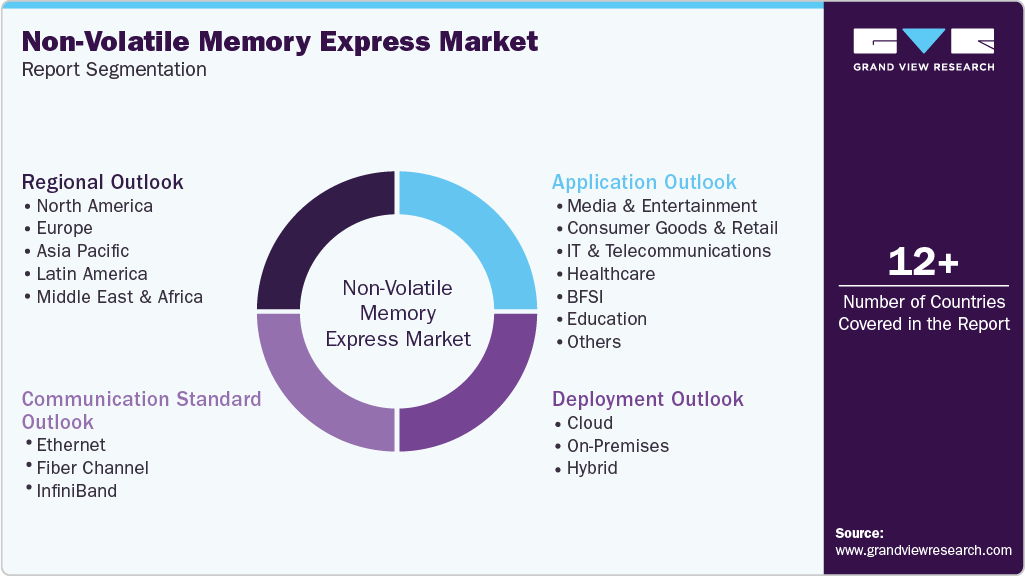
This report forecasts revenue growth on global, regional, and country levels and provides an analysis of the industry trends in each of the sub-segments from 2021 to 2033. For this study, Grand View Research has segmented the global non-volatile memory express market report based on the communication standard, deployment, application, and region.
 To learn more about this report, Download Free Sample Report
 -
Communication Standard Outlook (Revenue, USD Billion, 2021 - 2033)
-
Ethernet
-
Fiber Channel
-
InfiniBand
-
-
Deployment Outlook (Revenue, USD Billion, 2021 - 2033)
-
Cloud
-
On-Premises
-
Hybrid
-
-
Application Outlook (Revenue, USD Billion, 2021 - 2033)
-
Media & Entertainment
-
Consumer Goods & Retail
-
IT & Telecommunications
-
Healthcare
-
BFSI
-
Education
-
Manufacturing
-
Others
-
-
Regional Outlook (Revenue, USD Billion, 2021 - 2033)
-
North America
-
U.S.
-
Canada
-
Mexico
-
-
Europe
-
UK
-
Germany
-
France
-
-
Asia Pacific
-
China
-
India
-
Japan
-
South Korea
-
Australia
-
-
Latin America
-
Brazil
-
-
Middle East and Africa
-
KSA
-
UAE
-
South Africa
-
-
Frequently Asked Questions About This Report
The global non-volatile memory express market size was estimated at USD 128.96 billion in 2024 and is expected to reach USD 158.53 billion in 2025.
The global non-volatile memory express market is expected to grow at a compound annual growth rate of 23.8% from 2025 to 2033 to reach USD 876.53 billion by 2033.
North America dominated the non-volatile memory express market with a share of 27.58% in 2024. This is driven by the extensive data center investments and the presence of major technology companies such as Microsoft, and SAMSUNG, which demand high-performance storage solutions to support cloud computing, AI, and big data analytics.
Some key players operating in the non-volatile memory express market include TBroadcom; Cisco Systems, Inc.; Dell Inc.; IBM; Intel Corporation; Marvell; Micron Technology, Inc.; SAMSUNG; TOSHIBA CORPORATION; Western Digital Corporation
Key factors that are driving the market growth include NVMe market expansion is driven by the escalating demand for high-speed, low-latency data storage solutions across diverse sectors. Enterprises and cloud service providers increasingly adopt NVMe SSDs to support data-intensive applications, such as artificial intelligence, machine learning, and big data analytics, which require rapid data processing and high throughput for optimized performance
About the Author(s)
Next Generation Technologies Research Team
Technology · Next Generation TechnologiesThis report was authored by the next generation technologies research team at Grand View Research - comprising two research analysts, one senior research analyst, and one industry expert - with specialized expertise in the next generation technologies segment of the technology industry. All findings are based on proprietary technology databases, executive interviews, and regulatory analysis, subject to internal peer review prior to publication.
Last Updated:
Speak to Analyst

Customize this report to your needs - add regions, segments, or data points, with 20% free customization.
Or view our licence options:


ISO 9001:2015 & 27001:2022 Certified
We are GDPR and CCPA compliant! Your transaction & personal information is safe and secure. For more details, please read our privacy policy.


