
- Home
- »
- Power Generation & Storage
- »
-
North America Energy Storage Systems Market Report, 2033GVR Report cover
![North America Energy Storage Systems Market Size, Share & Trends Report]()
North America Energy Storage Systems Market (2026 - 2033) Size, Share & Trends Analysis Report By Technology (Electrochemical Storage, Electric Storage), By Application (Residential, Commercial, Utility), By Country, And Segment Forecasts
- Report ID: GVR-4-68040-896-0
- Number of Report Pages: 110
- Format: PDF
- Historical Range: 2021 - 2024
- Forecast Period: 2026 - 2033
- Industry: Energy & Power
- Report Summary
- Table of Contents
- Segmentation
- Methodology
- Download FREE Sample
-
 Download Sample Report
North America Energy Storage Systems Market Summary
The North America energy storage systems market recorded a cumulative installed capacity of 207.5 GW in 2025 and is projected to reach 612.6 GW by 2033, expanding at a CAGR of 14.5% from 2026 to 2033. The market is witnessing consistent expansion as governments and utility providers place growing emphasis on energy resilience, grid stability, and the transition toward cleaner and more reliable power systems to address increasing electricity demand.
Key Market Trends & Insights
- The U.S. energy storage systems industry held the largest share of 83.8% in the North American market in 2025.
- The energy storage systems industry in Mexico is expected to grow significantly over the forecast period.
- By technology, electrochemical storage held the highest market share of 59.2% in 2025.
- In 2025, the utility category within the application segment held the largest share of 54.2% in the market.
Market Size & Forecast
- 2025 Market Size: 207.5 GW
- 2033 Projected Market Size: 612.6 GW
- CAGR (2026-2033): 14.5%
Technological advancements in energy storage solutions, including lithium-ion batteries, flow batteries, and hybrid storage systems, are enhancing system performance, improving energy efficiency, reducing carbon emissions, and enabling better integration of renewable energy sources across the power network. Rising electricity demand across North America, fueled by rapid urbanization, industrial expansion, and increasing digitalization, is accelerating investments in advanced energy storage infrastructure. The region is strengthening its energy mix through the integration of renewable energy sources such as solar, wind, and hydropower, supported by large-scale battery storage and hybrid energy systems to manage intermittency and ensure grid reliability. Aging grid infrastructure in parts of the region is further driving modernization initiatives, including the deployment of smart grids, distributed energy resources, and next-generation storage technologies to enhance grid flexibility and maintain a stable and uninterrupted power supply across both urban and remote areas.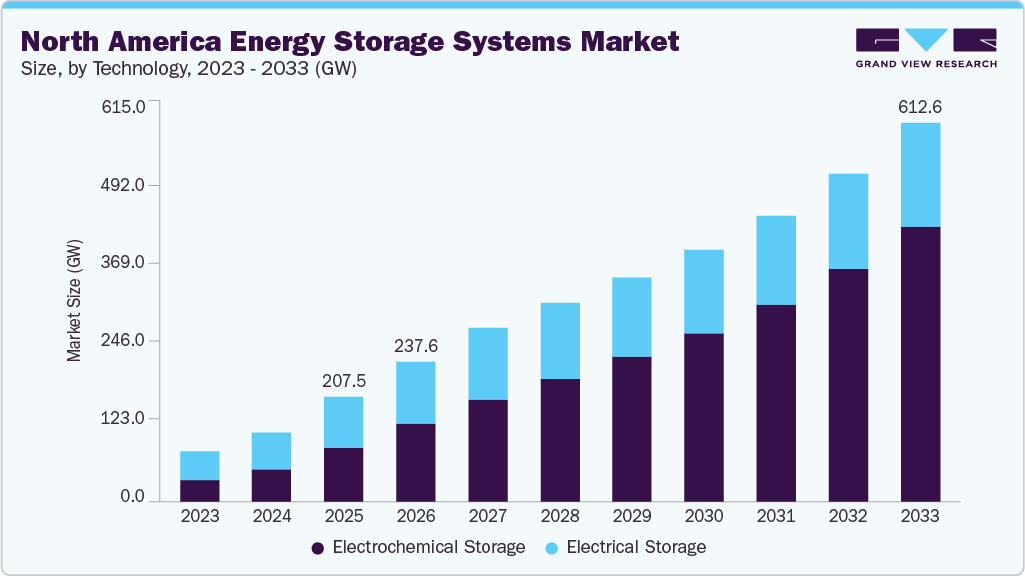
Increasing regulatory emphasis on decarbonization and clean energy transition is transforming the energy storage landscape across North America. Governments and regulatory agencies are introducing supportive policies, tax incentives, and funding programs to accelerate the adoption of energy storage systems and reduce carbon emissions. Technology providers are incorporating advanced digital solutions such as artificial intelligence, machine learning, and cloud-based energy management platforms to optimize storage performance, enable predictive maintenance, and support real-time grid balancing. As the region advances toward a low-carbon energy future and the demand for reliable, resilient, and efficient electricity systems continues to grow, energy storage technologies are becoming integral to enabling a flexible, sustainable, and future-ready power infrastructure.
Drivers, Opportunities & Restraints
The primary driver of the North America energy storage systems industry is the growing need to support renewable energy integration and ensure a reliable and uninterrupted electricity supply amid increasing power demand. The rapid expansion of solar and wind generation across the region is creating a strong requirement for advanced energy storage solutions to manage intermittency, balance supply and demand, and maintain grid stability. Governments and utilities are focusing on enhancing energy security, optimizing grid performance, and reducing reliance on fossil fuel-based peaking power plants through the deployment of large-scale and distributed storage systems. In addition, aging grid infrastructure and rising peak load pressures are accelerating investments in grid modernization initiatives, including utility-scale battery storage, smart grid technologies, and demand response systems to prevent outages and improve overall network resilience.
A significant opportunity in the North America energy storage systems industry lies in the integration of advanced digital technologies, energy storage solutions, and distributed energy resources within modern grid networks. The adoption of smart grids, artificial intelligence, predictive analytics, and cloud-based energy management platforms is enabling real-time monitoring, load forecasting, and optimized energy storage dispatch, enhancing overall grid efficiency and reliability. The United States and Canada are witnessing substantial investments in grid modernization and clean energy infrastructure to support rising electricity demand and the transition toward low-carbon energy systems. Furthermore, the increasing deployment of hybrid energy systems combining renewable generation with battery storage, along with advancements in long-duration storage technologies and hydrogen-based energy solutions, is creating new avenues for market growth and technological innovation across the North America energy landscape.
However, the North America energy storage systems industry faces restraints related to supply chain disruptions and the limited availability of critical raw materials required for battery manufacturing. Shortages of key components such as lithium, cobalt, and other essential minerals are creating procurement challenges, increasing costs, and leading to delays in project execution across utility-scale and distributed storage installations.
In addition, the market faces a critical challenge of a shortage of skilled labor required for the design, deployment, and maintenance of advanced energy storage systems, which can further slowdown project timelines and impact system performance. Variations in regulatory frameworks, permitting processes, and interconnection standards across different states may also add complexity to project development. Despite these challenges, ongoing technological advancements, increasing investments in domestic manufacturing, and supportive government initiatives aimed at strengthening supply chains and workforce development are expected to support the continued growth of the energy storage systems market in North America over the forecast period.
Technology Insights
Based on technology, the electrochemical storage segment accounted for the largest market volume share of 59.2% in 2025, driven by its widespread adoption, high energy efficiency, and scalability across utility-scale, commercial, and residential applications. Electrochemical energy storage systems, particularly lithium-ion batteries, continue to dominate the North America market due to their fast response times, high energy density, and ability to support grid stability, renewable integration, and peak load management. The increasing deployment of battery energy storage systems (BESS) across the region is supported by declining battery costs, advancements in battery chemistries, and strong policy support for clean energy transition. In addition, ongoing investments in next-generation technologies such as solid-state batteries and flow batteries are further enhancing performance, safety, and lifecycle efficiency, reinforcing the dominance of electrochemical storage in the regional energy mix.
The electrochemical storage segment is also projected to register the fastest CAGR of 17.8% during the forecast period, supported by the accelerating deployment of renewable energy projects and the growing need for flexible and reliable energy storage solutions. The rapid expansion of solar and wind capacity across North America is significantly driving demand for battery storage systems to address intermittency and ensure a continuous power supply. Furthermore, favorable regulatory frameworks, tax incentives, and increasing investments in grid modernization are encouraging the adoption of advanced electrochemical storage technologies. As utilities, businesses, and homeowners increasingly prioritize energy resilience, cost optimization, and sustainability, electrochemical storage is expected to play a central role in advancing a resilient, efficient, and low-carbon energy ecosystem across the region.
Application Insights
Based on application, the utility segment accounted for the largest market volume share of 54.2% in 2025, driven by its critical role in supporting grid-scale energy storage for enhanced grid stability, frequency regulation, and peak load management. Utility-scale energy storage systems are widely deployed across North America to facilitate large-scale renewable energy integration, particularly from solar and wind sources, while ensuring a reliable and continuous power supply. These systems enable efficient energy balancing, reduce curtailment of renewable generation, and support transmission and distribution networks. Increasing investments in grid modernization, expansion of renewable capacity, and supportive regulatory frameworks are further reinforcing the dominance of utility-scale storage in the regional market.
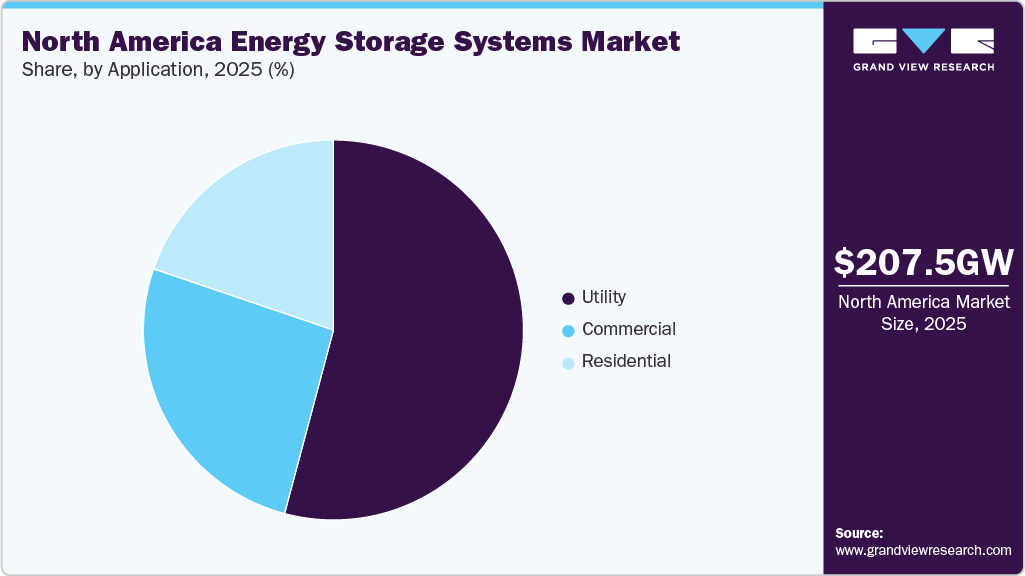
The residential segment is projected to register the fastest CAGR of 21.6% during the forecast period, supported by the growing adoption of distributed energy storage solutions among homeowners seeking energy independence and resilience. Residential energy storage systems, often integrated with rooftop solar installations, provide backup power during outages, optimize energy consumption, and reduce electricity costs. Rising concerns over grid reliability, increasing electricity prices, and favorable government incentives are accelerating the deployment of home energy storage solutions. In addition, advancements in battery technologies and declining system costs are making residential storage more accessible, positioning it as a key growth segment in the North America energy storage systems industry.
Country Insights
U.S. Energy Storage Systems Market
The U.S. dominates the North America energy storage systems market, accounting for approximately 83% of the total installed capacity. This leadership is driven by strong federal and state-level policy support, including investment tax credits and clean energy mandates, along with significant deployment of utility-scale battery energy storage systems. The country’s rapid expansion of renewable energy, particularly solar and wind, has accelerated the need for grid flexibility and reliability solutions, further boosting storage installations. Additionally, growing investments from utilities and independent power producers, coupled with advancements in lithium-ion battery technologies and increasing participation in energy arbitrage and ancillary services markets, continue to strengthen the U.S. position as the leading market in the region.
Key North America Energy Storage Systems Company Insights
Some of the key participants North America’s energy storage systems industry include ABB Ltd., BYD Co., Ltd., Cummins Inc., Eos Energy Enterprises, ESS, Inc., Fluence Energy, Hydrostor Inc., among others. These companies continue to strengthen their competitive positioning by expanding their energy storage portfolios across electrochemical, mechanical, and thermal storage technologies, while focusing on improving system efficiency, scalability, and reliability. Their operations typically include utility-scale battery energy storage systems (BESS), commercial and industrial storage solutions, residential energy storage units, and integrated energy management platforms aimed at ensuring a stable, flexible, and efficient electricity supply.
Industry leaders are increasingly prioritizing the transition toward clean and resilient energy systems through substantial investments in advanced battery technologies, grid-scale storage deployments, and digital energy solutions. The integration of artificial intelligence, predictive analytics, and cloud-based energy management systems enabling real-time monitoring, optimized energy dispatch, and enhanced operational performance across storage networks. Companies are also investing in next-generation solutions such as solid-state batteries, long-duration energy storage, and green hydrogen integration to improve flexibility and support decarbonization objectives. These advancements are helping utilities and energy providers effectively manage supply-demand dynamics, enhance grid stability, and reduce carbon emissions.
As electricity demand continues to grow and the energy transition accelerates across North America, energy storage companies are focusing on expanding manufacturing capacity, strengthening domestic supply chains, and diversifying their technology offerings. Strategic partnerships, joint ventures, and investments in large-scale storage projects remain key growth strategies for market participants. Furthermore, ongoing developments in distributed energy storage, virtual power plants, and decentralized energy systems are reshaping the competitive landscape. Continuous innovation in storage technologies, digital platforms, and grid integration solutions is expected to enhance market competitiveness and support the long-term growth of the North America energy storage systems industry.
Key North America Energy Storage Systems Companies:
- ABB Ltd.
- BYD Co., Ltd.
- Cummins Inc.
- Eos Energy Enterprises
- ESS, Inc.
- Fluence Energy
- Hydrostor Inc.
- KORE Power
- LG Energy Solution
- Powin Energy
- Samsung SDI
- Sungrow Power Supply
- Tesla, Inc.
- Wärtsilä Corporation
Recent Developments
-
In January, 2026, Hydrostor Inc. expanded its strategic partnership with Baker Hughes by making an equity investment and securing agreements to supply up to 1.4 GW of compressor and power generation technology for upcoming energy storage projects. This collaboration is aimed at advancing the deployment of long-duration energy storage solutions, enhancing project scalability, and supporting grid reliability and renewable energy integration across key markets.
-
In 2026, ABB Ltd. introduced Battery Energy Storage Systems-as-a-Service (BESS-as-a-Service) to simplify the adoption of renewable energy and energy storage solutions across North America. This offering enables customers to deploy advanced battery storage systems without significant upfront capital investment, while benefiting from flexible, service-based models for system management and maintenance. The initiative is aimed at accelerating the integration of renewable energy, enhancing grid flexibility, and improving energy resilience for utilities, commercial, and industrial users.
North America Energy Storage Systems Market Report Scope
Report Attribute
Details
Market size volume in 2026
237.6 GW
Volume forecast in 2033
612.6 GW
Growth rate
CAGR of 14.5% from 2026 to 2033
Base year for estimation
2025
Historical data
2021 - 2024
Forecast period
2026 - 2033
Quantitative Units
Volume in GW, Revenue in USD billion and CAGR from 2026 to 2033
Report coverage
Volume forecast, competitive landscape, growth factors, and trends
Segments covered
Technology, application, country
Country scope
U.S.; Canada; Mexico
Key companies profiled
ABB Ltd.; BYD Co., Ltd.; Cummins Inc.; Eos Energy Enterprises; ESS, Inc.; Fluence Energy; Hydrostor Inc.; KORE Power; LG Energy Solution; Powin Energy; Samsung SDI; Sungrow Power Supply; Tesla, Inc.; Wärtsilä Corporation
Customization scope
Free report customization (equivalent up to 8 analysts working days) with purchase. Addition or alteration to country & segment scope.
Pricing and purchase options
Avail customized purchase options to meet your exact research needs. Explore purchase options
North America Energy Storage Systems Market Report Segmentation
This report forecasts volume growth country levels and provides an analysis of the latest industry trends in each of the sub-segments from 2021 to 2033. For this study, Grand View Research has segmented the North America energy storage systems market report based on technology, application, and country.
-
Technology Outlook (Volume, GW; Revenue, USD Billion, 2021 - 2033)
-
Electrochemical Storage
-
Lithium-ion Batteries
-
Lithium cobalt oxide (LCO)
-
Lithium iron phosphate (LFP)
-
Lithium Nickel Cobalt Aluminum Oxide (NCA)
-
Lithium Manganese Oxide (LMO)
-
Lithium Titanate
-
Lithium Nickel Manganese Cobalt (LMC)
-
-
Lead Acid Batteries
-
Other Batteries
-
-
Electrical Storage
-
Supercapacitors
-
Superconducting Magnetic Energy Storage
-
-
-
Application Outlook (Volume, GW; Revenue, USD Billion, 2021 - 2033)
-
Residential
-
Commercial
-
Utility
-
-
Country Outlook (Volume, GW; Revenue, USD Billion, 2021 - 2033)
-
North America
-
U.S.
-
Canada
-
Mexico
-
-
Frequently Asked Questions About This Report
b. North America’s energy storage systems market was estimated at 207.5 GW in 2025 and is expected to reach 237.6 GW in 2026.
b. North America’s energy storage systems market is expected to grow at a compound annual growth rate of 14.5% from 2026 to 2033 to reach 612.6 GW by 2033.
b. Based on the technology, the electrochemical storage segment held the largest share of more than 59.2% in 2025.
b. Some of the key players operating in North America’s energy storage systems market include ABB Ltd., BYD Co., Ltd., Cummins Inc., Eos Energy Enterprises, ESS, Inc., Fluence Energy, Hydrostor Inc., KORE Power, LG Energy Solution, Powin Energy, Samsung SDI, Sungrow Power Supply, Tesla, Inc., Wärtsilä Corporation, among others.
b. The key factors driving North America’s energy storage systems market include the rapid expansion of renewable energy capacity, particularly solar and wind, which is increasing the need for efficient storage solutions to manage intermittency and ensure grid reliability. Growing investments in grid modernization and the replacement of aging infrastructure are further accelerating the deployment of utility-scale and distributed energy storage systems to support peak load management and prevent outages.


Share this report with your colleague or friend.
Need a Tailored Report?
Customize this report to your needs — add regions, segments, or data points, with 20% free customization.


ISO 9001:2015 & 27001:2022 Certified
We are GDPR and CCPA compliant! Your transaction & personal information is safe and secure. For more details, please read our privacy policy.
Trusted market insights - try a free sample
See how our reports are structured and why industry leaders rely on Grand View Research. Get a free sample or ask us to tailor this report to your needs.













