North America & Latin America LMW Conventional Polyisobutylene Market Summary
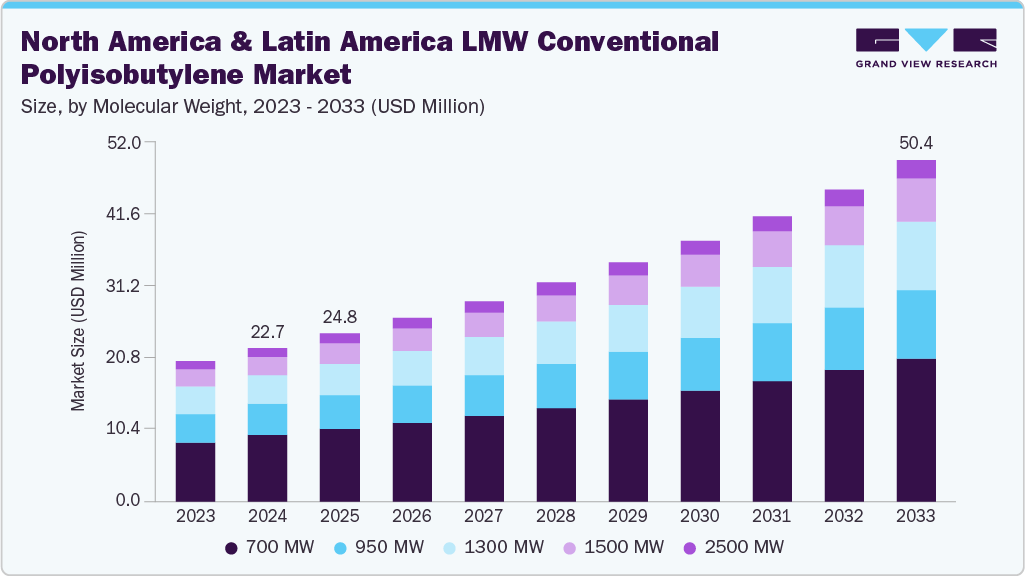
The NA & LATAM LMW conventional polyisobutylene market size was estimated at USD 22.7 million in 2024 and is projected to reach USD 50.4 million by 2033, growing at a CAGR of 9.2% from 2025 to 2033. The growing demand for automotive lubricants & fuel-additive formulations, as well as adhesives/sealants for construction and industrial maintenance, is expected to drive market growth in the coming years.
Key Market Trends & Insights
- By molecular weight, the 1300 MW segment is expected to grow at a considerable CAGR of 10.3% from 2025 to 2033 in terms of revenue.
- By application, the pressure-sensitive and hot melt adhesives (PSA) segment is expected to grow at a considerable CAGR of 10.1% from 2025 to 2033 in terms of revenue.
Market Size & Forecast
- 2024 Market Size: USD 22.7 million
- 2033 Projected Market Size: USD 50.4 million
- CAGR (2025-2033): 9.2%
The NA and LATAM LMW conventional PIB market is driven by the lubricant and fuel additives sector, where PIB is used as a thickener, viscosity modifier, and detergent additive. Conventional and HR PIBs enhance fuel efficiency, reduce engine wear, and minimize carbon deposits, supporting performance improvements in automotive and industrial engines. Rising vehicle ownership in emerging economies and the global shift toward cleaner and more efficient engine oils are key factors sustaining demand. The introduction of advanced lubricants compatible with electric and hybrid vehicles is also stimulating PIB consumption, as manufacturers focus on additives that improve thermal stability and extend equipment life.
Drivers, Opportunities & Restraints
Expansion in oilfield drilling and production across North America and Latin America is becoming a key growth driver for LMW conventional PIB. Rising global energy demand, active upstream investments, and steady petrochemical margins are pushing oil and gas producers to increase well completions and drilling intensity. As exploration and service activity expand, demand for drilling fluids, lubricants, sealants, and chemical additives that rely on PIB formulations is growing, directly linking upstream activity to polymer consumption and feedstock availability.
Nearshoring and localized manufacturing present a clear opportunity for LMW conventional PIB suppliers in North America and Latin America. Mexico’s role as a manufacturing hub, combined with continued reshoring to the United States, reduces lead times and logistics costs for converters and OEMs. Producers can capture share by establishing regional compounding or tolling centers, offering just-in-time supply, and structuring short-term offtake agreements to lower customer inventory burdens.
Raw material feedstocks for LMW conventional PIB production principally include isobutylene and isoprene, both derived from C4 streams in crackers and from refinery operations. In North America, feedstock availability benefits from the abundance of NGL and ethane-derived cracker throughput, which supports a competitive domestic supply. In Latin America, access to feedstock is more constrained, with many producers relying on imports or integrated refinery capacity in Mexico and Brazil, which increases their exposure to global petrochemical and crude price fluctuations and logistics bottlenecks.
Market Concentration & Characteristics
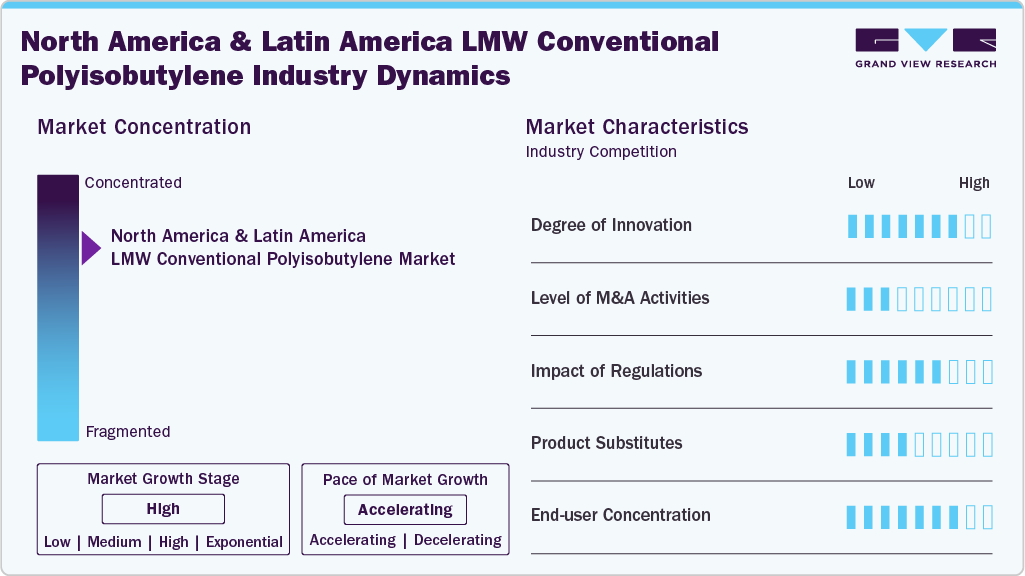
The market growth stage of the NA and LATAM LMW conventional polyisobutylene industry is high, and the pace is accelerating. The market exhibits consolidation, with key players dominating the industry landscape. Major companies like TPC Group, RB Products, Inc., Braskem, Lubrizol, Infineum International Limited, YPF QUÍMICA, ChemCeed, and others play a significant role in shaping the market dynamics. These leading players often drive innovation within the market, introducing new products, technologies, and applications to meet evolving industry demands.
Regulatory pressure and extended producer responsibility are reshaping commercial risk and cost allocation for PIB supply chains in North and Latin America. Accelerating EPR programs and state-level packaging laws in the U.S., as well as nascent regulatory moves across Latin America, are increasing collection and recycling obligations for converters and brand owners. This is forcing PIB formulators and distributors to internalise end-of-life costs, revise pricing models, and prioritise supply partners that can demonstrate take-back or circularity pathways. Companies that can document return flows and the chain of custody for PIB-containing products gain a commercial advantage when negotiating long-term contracts.
Advances in catalyst systems and reactor designs have lowered unit production costs and improved yield consistency for LMW conventional PIB producers across North and Latin America. For manufacturers, these improvements translate to tighter control over molecular weight distribution and fewer off-spec batches, reducing scrap and working capital tied to inventory. Companies that invest early in front-end process upgrades gain a durable cost advantage in commoditized LMW grades and can price more competitively into price-sensitive LATAM markets while protecting margins in North America.
Molecular Weight Insights
700 MW dominated the market across the molecular weight segmentation in terms of revenue, accounting for a market share of 43.53% in 2024, and is forecasted to grow at an 8.8% CAGR from 2025 to 2033. The 700 molecular weight segment of LMW conventional PIB is a low-viscosity, highly tacky polymer prized for pressure-sensitive adhesives, label and tape formulations, and hot-melt adhesive systems. Its low volatility and excellent compatibility with hydrocarbon resins improve initial tack, cold-temperature performance, and migration resistance. Commercially, 700 MW grades are blended as molten or solution additives, offering fast incorporation and predictable rheology. Demand is driven by adhesives growth in packaging and industrial assembly, but margins remain sensitive to C4 feedstock and formulation qualification cycles.
The 1300 MW segment is anticipated to grow at a substantial CAGR of 10.3% through the forecast period. At 1300 molecular weight, PIB delivers stronger internal strength and better shear resistance while retaining good tack. This makes it suited to higher-performance pressure-sensitive adhesives, industrial tapes, and some packaging sealants where creep resistance matters. Formulators use 1300 MW to improve peel/cohesion balance and to extend the service temperature range. Commercially, this segment commands premium pricing because it shortens field failure risk and supports longer qualification cycles with mid-to-large converters and OEM customers.
Application Insights
Lubricants & oilfield chemicals dominated the market across the application segmentation in terms of revenue, accounting for a market share of 48.22% in 2024, and are forecasted to grow at a 9.4% CAGR from 2025 to 2033. LMW PIB finds steady demand in lubricants and oilfield chemicals, where thermal stability and low volatility are critical. Mid-to-higher LMW grades such as 1500 MW and 2500 MW are used as viscosity modifiers, anti-foaming agents, and seal integrity enhancers in completion fluids and downhole lubricants, where longer service life and low migration reduce maintenance cycles.
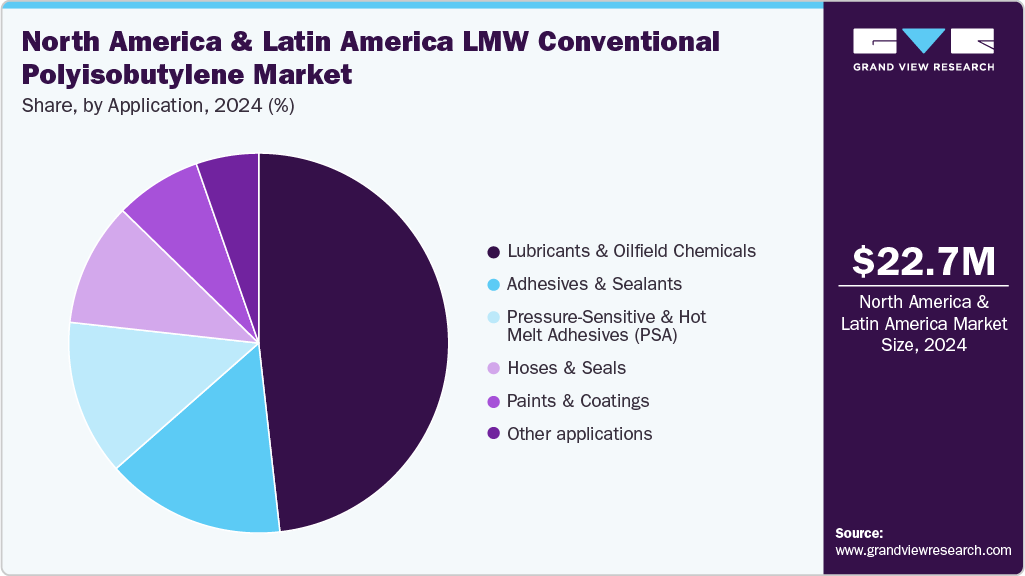
The pressure-sensitive and hot melt adhesives (PSA) segment is expected to expand at a substantial CAGR of 10.1% through the forecast period. E-commerce growth, faster packaging lines, and automated application systems further encourage formulators to use low-viscosity grades, which enable rapid coat weights and cleaner melt handling. Market momentum for linerless and recyclable labeling is supported by recent industry forecasts, which show robust linerless adoption, increasing specification calls for tailored PIB grades, and small-batch sample programs with converters. Suppliers offering application trials, adhesive rheology control data, and food-contact migration tests are winning faster adoption.
Regional Insights
North America held the largest share of 80.60% in terms of revenue in the NA and LATAM LMW conventional polyisobutylene market in 2024 and is expected to grow at the fastest CAGR of 9.2% over the forecast period. North America represents a mature, high-value market for LMW conventional PIB characterized by integrated petrochemical value chains and sophisticated end users. The U.S. benefits from abundant natural gas liquids and record ethane recovery, which keep cracker feedstock relatively advantaged and support domestic PIB production economics. Canada provides complementary demand through resilient manufacturing and specialty chemical consumption, underpinned by steady month-on-month gains in manufacturing sales that sustain converter activity for adhesives, sealants, and industrial formulations.
U.S. LMW Conventional Polyisobutylene Market Trends
The LMW conventional polyisobutylene market in the U.S. dominated North America in 2024, owing to its position as one of the world’s largest crude oil producers and refiners, providing a reliable and cost-efficient source of feedstock such as isobutylene. This upstream strength supports a competitive domestic PIB manufacturing base and ensures a stable supply for downstream applications in lubricants, sealants, and oilfield chemicals. The strong interlinkage between energy exploration and specialty chemical production sustains long-term demand across multiple industrial sectors.
Latin America LMW Conventional Polyisobutylene Market Trends
The LMW conventional polyisobutylene market in Latin America is expected to grow significantly over the forecast period. North America-adjacent manufacturing dynamics and shifting supply chains are shaping the market. Mexico’s role as a nearshoring hub is driving steady demand for adhesive, sealant, and industrial compound inputs, as regional assembly reduces lead times and increases local converter activity. Brazil supplies a large domestic chemicals market with robust downstream consumption in construction, packaging, and industrial maintenance. In contrast, Argentina’s market is more volatile and sensitive to macroeconomic shifts and policy changes.
Brazil LMW conventional polyisobutylene market, with rapid renewable energy adoption, is reshaping demand for LMW conventional PIB by creating downstream needs for specialty adhesives, sealants, and polymer-modified components used in solar and wind infrastructure. Mid-MW grades such as 950 MW are suited to encapsulant and lamination adhesives for PV modules, while 1500 MW and 2500 MW grades improve compression set and long-term sealing in wind blade joints, cable terminations, and mounting assemblies. Local content rules and project procurement favor regional compounding and shorter lead times, increasing opportunity for suppliers with in-country supply or tolling capacity.
Key North America & Latin America LMW Conventional Polyisobutylene Company Insights
The market is highly competitive, with several key players dominating the landscape. Major companies include TPC Group, RB Products, Inc., Braskem, Lubrizol, Infineum International Limited, YPF QUÍMICA, and ChemCeed. The market is characterized by a competitive landscape with several key players driving innovation and market growth. Major companies in this sector are investing heavily in research and development to enhance the performance, cost-effectiveness, and sustainability of their products.
Key North America & Latin America LMW Conventional Polyisobutylene Companies:
- TPC Group
- RB Products, Inc.
- Braskem
- Lubrizol
- Infineum International Limited
- YPF QUÍMICA
- ChemCeed
Recent Developments
-
In December 2024, TPC Group completed a capital expansion program at its Houston facility to increase its crude C4 processing capacity. The project improved infrastructure and operational reliability, resulting in a 20% increase in butadiene production capacity to 1.1 billion pounds per year. This expansion, along with increased hydrotreating capacity and a new tolling agreement, raised the overall crude C4 processing capacity by 25% above previous peak levels. Increased C4 processing directly affects the availability of C4 components such as isobutylene, the primary monomer/feedstock for polyisobutylene (PIB).
-
In October 2024, TPC Group announced that it had increased its di-isobutylene (DIB) production capacity by 27% at its Houston facility to meet rising global demand. This expansion was driven by the growing use of low-global-warming refrigerants, where DIB is a critical component of lubricants. The company emphasized its focus on safe and environmentally responsible operations, as well as enhanced global delivery capabilities. The increased DIB supply is expected to intensify competition in the conventional polyisobutylene (PIB) market by providing a more sustainable alternative to PIB-based products.
North America & Latin America LMW Conventional Polyisobutylene Market Report Scope
|
Report Attribute
|
Details
|
|
Market size value in 2025
|
USD 24.8 million
|
|
Revenue forecast in 2033
|
USD 50.4 million
|
|
Growth rate
|
CAGR of 9.2% from 2025 to 2033
|
|
Historical data
|
2021 - 2023
|
|
Forecast period
|
2025 - 2033
|
|
Quantitative units
|
Revenue in USD thousand, volume in tons, and CAGR from 2025 to 2033
|
|
Report coverage
|
Revenue forecast, competitive landscape, growth factors, and trends
|
|
Report Segmentation
|
Molecular weight, application, region
|
|
Regional scope
|
North America; Latin America
|
|
Country Scope
|
U.S.; Canada; Mexico; Brazil; Argentina
|
|
Key companies profiled
|
TPC Group; RB Products, Inc.; Braskem; Lubrizol; Infineum International Limited; YPF QUÍMICA; ChemCeed
|
|
Customization scope
|
Free report customization (equivalent up to 8 analyst’s working days) with purchase. Addition or alteration to country, regional & segment scope
|
|
Pricing and purchase options
|
Avail customized purchase options to meet your exact research needs. Explore purchase options
|
North America & Latin America LMW Conventional Polyisobutylene Market Report Segmentation
This report forecasts revenue growth at the global, regional, and country levels and provides an analysis of the latest industry trends in each of the sub-segments from 2021 to 2033. For this study, Grand View Research has segmented the North America & Latin America LMW conventional polyisobutylene market report based on molecular weight, application, and region:
-
Molecular Weight Outlook (Volume, Tons; Revenue, USD Thousand, 2021 - 2033)
-
700 MW
-
950 MW
-
1300 MW
-
1500 MW
-
2500 MW
-
Application Outlook (Volume, Tons; Revenue, USD Thousand, 2021 - 2033)
-
Regional Outlook (Volume, Tons; Revenue, USD Thousand, 2021 - 2033)
-
North America
-
Latin America

 Download Sample Report
















