
- Home
- »
- Advanced Interior Materials
- »
-
North America Mass Timber Fasteners Market Report, 2033GVR Report cover
![North America Mass Timber Fasteners Market Size, Share & Trends Report]()
North America Mass Timber Fasteners Market (2026 - 2033) Size, Share & Trends Analysis Report By Product (Structural Screws, Bolts & Threaded Rod Systems, Nails & Pins), By End Use (Residential, Commercial, Industrial, Infrastructural), By Region (U.S., Canada, Mexico), And Segment Forecasts
- Report ID: GVR-4-68040-886-5
- Number of Report Pages: 107
- Format: PDF
- Historical Range: 2021 - 2025
- Forecast Period: 2026 - 2033
- Industry: Advanced Materials
- Report Summary
- Table of Contents
- Segmentation
- Methodology
- Download FREE Sample
-
 Download Sample Report
North America Mass Timber Fasteners Market Summary
The North America mass timber fasteners market size was estimated at USD 23.0 million in 2025 and is projected to reach USD 43.0 million by 2033, growing at a CAGR of 8.2% from 2026 to 2033. The demand for mass timber fasteners in North America is rising rapidly as mass timber construction is rapidly adopted across residential and commercial sectors.
Key Market Trends & Insights
- U.S. dominated the North America mass timber fasteners industry with the largest revenue share of 81.1% in 2025.
- By product, the structural screws segment is expected to grow at a CAGR of 8.7% over the forecast period.
- The residential end use segment is expected to grow at a CAGR of 8.4% over the forecast period.
Market Size & Forecast
- 2025 Market Size: USD 23.0 Million
- 2033 Projected Market Size: USD 43.0 Million
- CAGR (2026-2033): 8.2%
- United States: Largest market in 2025
As developers shift toward low-carbon building materials, engineered wood products such as cross-laminated timber (CLT) and glulam are replacing steel and concrete in mid- and high-rise structures. This transition directly increases the need for specialized fasteners that can withstand structural loads, meet seismic performance requirements, and provide durability.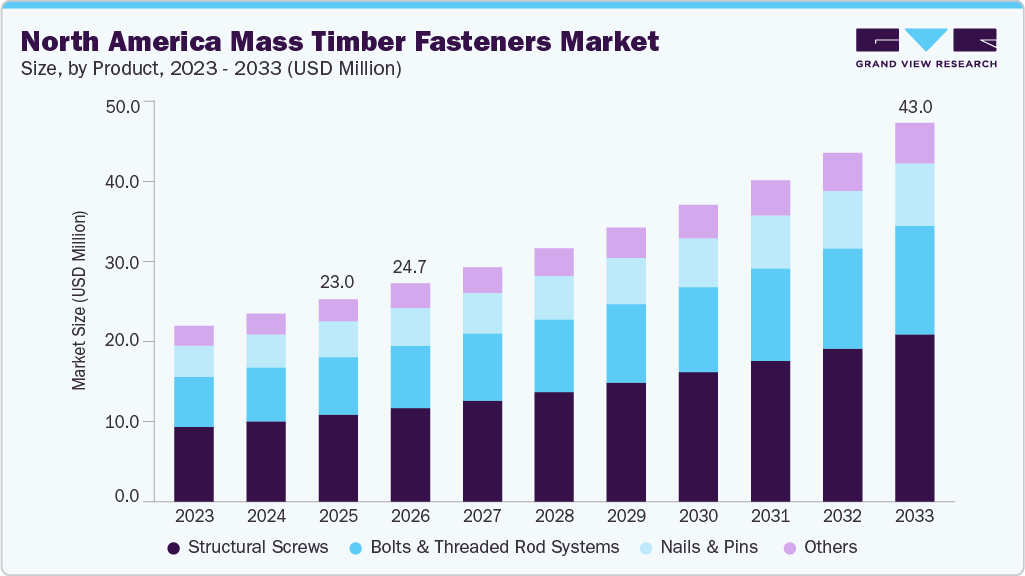
In addition, the growing emphasis on faster construction timelines is boosting the use of prefabricated timber systems, which rely heavily on high-performance fastening solutions. The expansion of urban housing and institutional infrastructure further supports this trend. Increasing awareness of sustainability and the benefits of carbon sequestration is also influencing material selection.
Key drivers include strong regulatory support and evolving building codes in the U.S. and Canada that now permit taller timber buildings, thereby increasing structural complexity and fastening requirements. Government-backed green building certifications and incentives are encouraging developers to adopt mass timber, which indirectly drives demand for advanced fastening systems. Technological advancements such as Building Information Modeling (BIM), CNC machining, and prefabrication techniques are enabling precision-based construction, increasing reliance on engineered fasteners. Rising investments in sustainable real estate and infrastructure projects are also accelerating market growth. Furthermore, the growing popularity of hybrid structures (timber-concrete or timber-steel) requires innovative fastening technologies for multi-material integration.
The market is witnessing continuous innovation in fastening technologies to meet the structural and safety requirements of mass timber buildings. Advanced self-drilling screws, concealed fastening systems, and high-strength connectors are being developed to improve load-bearing capacity and fire resistance. Automation and robotics in prefabrication processes are enabling precise placement of fasteners, reducing installation time and labor costs. There is also a growing trend toward customized fastening solutions designed for specific timber products such as CLT and glulam. In addition, digital design integration is allowing engineers to simulate fastening performance, improving efficiency and reducing material wastage. These innovations are enhancing the overall performance and scalability of mass timber construction in North America.
Market Concentration & Characteristics
The North America mass timber fasteners industry is moderately fragmented, with a mix of global and regional manufacturers competing based on product performance, innovation, and pricing. Companies are focusing on developing specialized fasteners tailored for engineered wood applications, including high-load structural screws and connectors. Strategic collaborations with construction firms and timber manufacturers are becoming common to strengthen market positioning. Increasing investments in R&D and manufacturing capabilities are enabling companies to differentiate their offerings. While a few established players hold a significant share due to strong distribution networks and technical expertise, new entrants are emerging with innovative solutions.
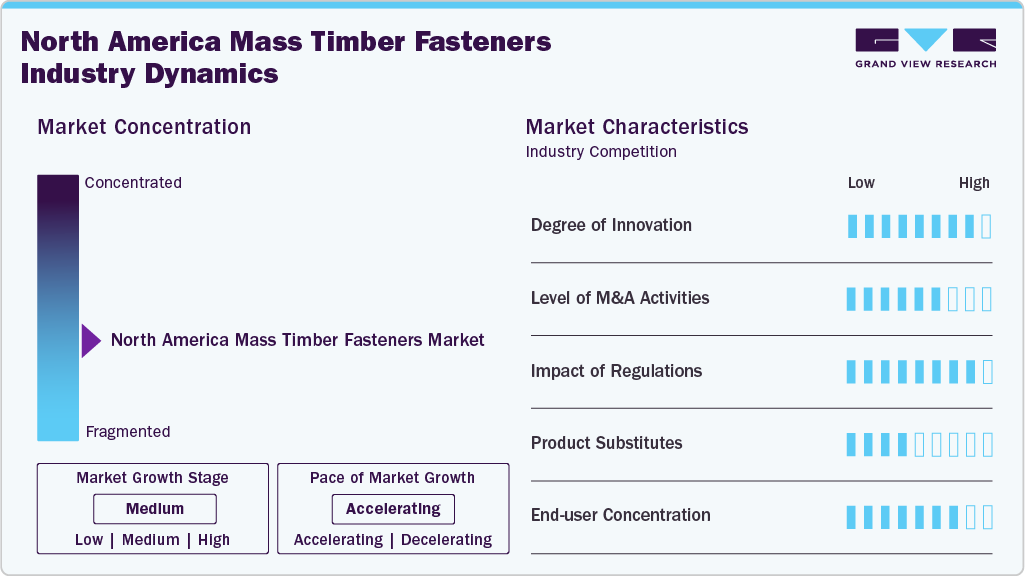
The primary substitutes for mass timber fasteners are traditional fastening systems used in steel and concrete construction, such as welding, bolting, and reinforced joints. However, these alternatives are not directly compatible with timber structures, limiting their applicability. Adhesives and bonding technologies also act as partial substitutes but lack the structural reliability required for load-bearing applications. In addition, hybrid construction techniques may reduce the total number of timber-specific fasteners used, posing a moderate substitution threat. Despite this, the growing shift toward timber construction and the need for specialized fastening solutions significantly reduce the risk of substitution. As mass timber adoption increases, the reliance on dedicated fasteners is expected to remain strong.
Product Insights
The structural screws segment accounted for the largest revenue share of 42.7% in 2025, driven by their widespread use in load-bearing timber applications, such as cross-laminated timber (CLT) and glulam structures. These screws offer high strength, ease of installation, and superior load distribution, making them ideal for modern timber construction. Their compatibility with prefabricated building systems and ability to reduce installation time further enhance their adoption. In addition, advancements in self-drilling and corrosion-resistant coatings have improved performance, driving demand across residential and commercial projects. As mass timber construction continues to expand, structural screws remain the preferred fastening solution.
The bolts & threaded rod systems segment is expected to grow at a CAGR of 8.3% over the forecast period, due to increasing demand for high-load and complex structural connections in large-scale timber buildings. These systems are essential in hybrid structures and heavy timber frameworks where enhanced tensile strength and stability are required. With the rise of mid- and high-rise timber construction, the need for robust fastening solutions capable of handling dynamic and seismic loads is increasing. In addition, their use in retrofitting and reinforcement applications further supports growth. As structural complexity in timber projects rises, this segment is anticipated to witness strong adoption.
End Use Insights
The residential segment held the largest revenue market share of 61.5% in 2025, driven by the growing adoption of mass timber in single-family and multi-family housing projects. Increasing demand for sustainable, energy-efficient homes is encouraging the use of engineered wood, which in turn drives the need for specialized fasteners. Prefabrication and modular construction techniques are widely used in residential projects, boosting demand for easy-to-install fastening systems such as structural screws. Government incentives for green housing and rising urban housing needs further contribute to segment dominance. The cost-effectiveness and faster construction timelines of timber homes also support continued growth in this segment.
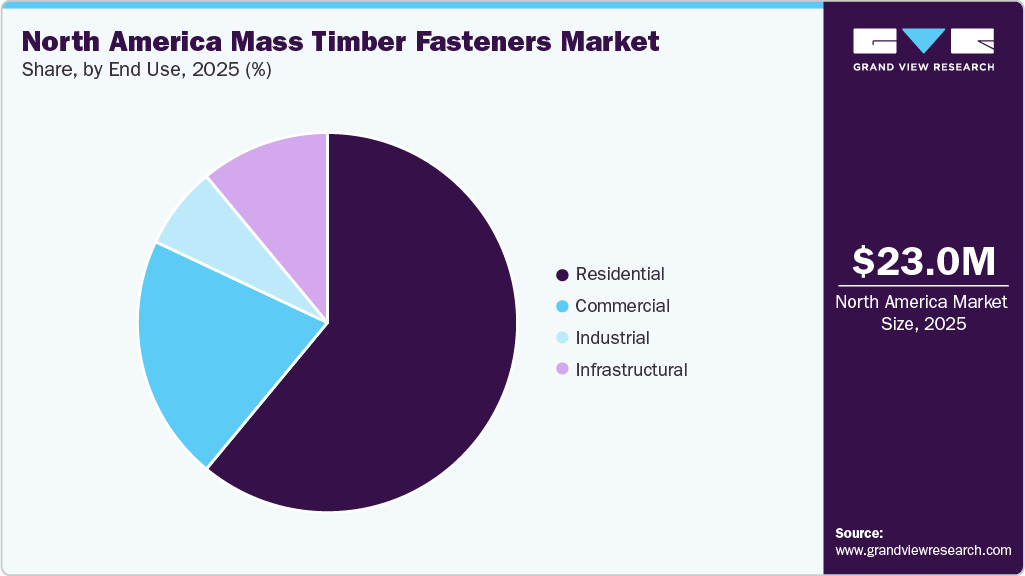
The commercial segment is expected to grow at a CAGR of 8.1% over the forecast period, due to increasing adoption of mass timber in offices, institutional buildings, and public infrastructure projects. Developers are increasingly using timber to meet sustainability targets and reduce carbon footprints, particularly in large-scale projects. The shift toward taller timber buildings is driving demand for advanced fastening systems capable of handling higher structural loads. In addition, government support for green building certifications and investments in sustainable infrastructure are accelerating adoption. As awareness and acceptance of mass timber increase in commercial construction, this segment is expected to witness robust growth over the coming years.
Regional Insights
North America mass timber fasteners industry is witnessing rapid growth in mass timber projects, particularly in mid- and high-rise buildings, which require high-performance fastening systems. Prefabrication, modular construction, and digital design tools are widely used, driving demand for precision-engineered fasteners. Government support through updated building codes and green building incentives is further accelerating market growth. In addition, the presence of established construction ecosystems and skilled labor enhances the adoption of innovative fastening technologies.
U.S. Mass Timber Fasteners Market Trends
The U.S. mass timber fasteners industry dominated the North America market, accounting for the largest revenue share of 81.1% in 2025, driven by widespread adoption of engineered wood in commercial, institutional, and residential construction. Updated building codes, including provisions for taller timber structures, have significantly expanded the scope of application for mass timber. The increasing trend of hybrid construction is further driving demand for advanced fastening solutions. Investments in sustainable infrastructure and growing awareness of carbon reduction are supporting market expansion. Technological advancements such as prefabrication and automation are improving construction efficiency and increasing reliance on specialized fasteners.
Canada Mass Timber Fasteners Market Trends
Canada mass timber fasteners industry is a key contributor to the regional market, supported by abundant timber resources and strong government initiatives promoting sustainable construction. Provinces such as British Columbia are at the forefront of mass timber adoption, with policies encouraging the use of wood in public and private infrastructure projects. The country has been an early adopter of tall wood buildings, which require advanced fastening systems for structural integrity. Increasing investments in green building and carbon-neutral construction are further boosting demand. Canada’s well-established forestry and wood processing industry also supports the supply chain for mass timber components.
Mexico Mass Timber Fasteners Market Trends
Mexico mass timber fasteners industry represents an emerging market for mass timber fasteners, with gradual adoption of engineered wood in construction. The market is primarily driven by increasing awareness of sustainable building practices and the need for cost-effective construction solutions. However, the dominance of traditional materials such as concrete and steel limits widespread adoption of mass timber. Infrastructure development and urbanization are creating opportunities for alternative construction methods, including timber-based systems. Government initiatives toward sustainability and green building are still developing but are expected to support future growth. As awareness and technical expertise improve, the demand for specialized fasteners in Mexico is anticipated to increase over time.
Key North America Mass Timber Fasteners Company Insights
Some of the key players operating in the market include Portland Bolt, GRK Fasteners (ITW)
-
Portland Bolt is a U.S.-based manufacturer specializing in custom bolts, threaded rods, and anchor fasteners used in heavy timber and mass timber construction. The company provides high-strength, made-to-order fastening solutions designed to meet structural and project-specific requirements.
-
GRK Fasteners is a North America-based manufacturer of premium structural wood screws and specialty fastening solutions, widely used in construction, remodeling, and industrial applications. Founded in 1990 and later acquired by Illinois Tool Works Inc. in 2011, the company operates as part of ITW’s Construction Products segment.
Simpson Strong-Tie Company, Inc. and F3 Timber Technologies are among the emerging market participants in the North American market.
-
Simpson Strong-Tie is a key player in the North America mass timber fasteners industry, offering a wide range of structural screws, connectors, and fastening systems used in timber construction. The company focuses on high-performance, code-compliant solutions that support structural integrity and efficient installation in mass timber projects.
-
F3 Timber Technologies is a North America-based provider of connection solutions, installation strategies, and fastening systems for mass timber construction. The company focuses on designing and supplying engineered connectors, fasteners, and bracing systems to support efficient, cost-effective, high-performance timber-building applications.
Key North America Mass Timber Fasteners Companies:
- SPAX
- GRK Fasteners (ITW)
- Portland Bolt
- Mass Timber Connections (MTC) Solutions
- SFS Group
- Big Timber Construction Fasteners
- F3 Timber Technologies
- Simpson Strong-Tie Company, Inc.
- ROTHO BLAAS SRL
- Birmingham Fastener and Supply Inc.
Recent Developments
-
In January 2026, Simpson Strong-Tie Company, Inc. opened a new 500,000 sq. ft. manufacturing facility in Tennessee, strengthening production capacity for construction fasteners and connectors.
-
In December 2025, SFS Group acquired Gödde GmbH, Oltrogge Werkzeuge GmbH, and Hch. Perschmann GmbH, expanding distribution and strengthening presence in fastening and tooling markets.
North America Mass Timber Fasteners Market Report Scope
Report Attribute
Details
Market size value in 2026
USD 24.7 million
Revenue forecast in 2033
USD 43.0 million
Growth rate
CAGR of 8.2% from 2026 to 2033
Base year for estimation
2025
Actual estimates/Historical data
2021 - 2025
Forecast period
2026 - 2033
Quantitative units
Revenue in USD million and CAGR from 2026 to 2033
Report coverage
Revenue forecast, company ranking, competitive landscape, growth factors, and trends
Segments covered
Product, end use, region
Regional scope
North America
Country scope
U.S.; Canada; Mexico
Key companies profiled
SPAX; GRK Fasteners (ITW); Portland Bolt; Mass Timber Connections (MTC) Solutions; SFS Group; Big Timber Construction Fasteners; F3 Timber Technologies; PotlatchDeltic Corporation; ROTHO BLAAS SRL; Birmingham Fastener and Supply Inc.
Customization scope
Free report customization (equivalent up to 8 analysts working days) with purchase. Addition or alteration to country, regional & segment scope.
Pricing and purchase options
Avail customized purchase options to meet your exact research needs. Explore purchase options
North America Mass Timber Fasteners Market Report Segmentation
This report forecasts revenue growth at regional & country levels and provides an analysis on the industry trends in each of the sub-segments from 2021 to 2033. For this study, Grand View Research has segmented the North America mass timber fasteners market report based on product, end use, and region:
-
Product Outlook (Revenue, USD Million, 2021 - 2033)
-
Structural Screws
-
Bolts & Threaded Rod Systems
-
Nails & Pins
-
Others
-
-
End Use Outlook (Revenue, USD Million, 2021 - 2033)
-
Residential
-
Commercial
-
Industrial
-
Infrastructural
-
-
Regional Outlook (Revenue, USD Million, 2021 - 2033)
-
North America
-
U.S.
-
Canada
-
Mexico
-
-
Frequently Asked Questions About This Report
b. The North America mass timber fasteners market size was estimated at USD 23.0 million in 2025 and is expected to reach USD 24.7 million in 2026.
b. The North America mass timber fasteners market is expected to grow at a compound annual growth rate of 8.2% from 2026 to 2033 to reach USD 43.0 million by 2033.
b. The structural screws segment accounted for the highest revenue share of 42.7% in 2025, driven by their widespread use in load-bearing timber applications, such as cross-laminated timber (CLT) and glulam structures.
b. Some of the key players operating in the North America mass timber fasteners market include SPAX, GRK Fasteners (ITW), Portland Bolt, Mass Timber Connections (MTC) Solutions, SFS Group, Big Timber Construction Fasteners, F3 Timber Technologies, PotlatchDeltic Corporation, Birmingham Fastener and Supply Inc., and ROTHO BLAAS SRL
b. Rising adoption of mass timber construction driven by sustainability goals, supportive building codes, and increased use of prefabricated and modular building techniques.


Share this report with your colleague or friend.
Need a Tailored Report?
Customize this report to your needs — add regions, segments, or data points, with 20% free customization.


ISO 9001:2015 & 27001:2022 Certified
We are GDPR and CCPA compliant! Your transaction & personal information is safe and secure. For more details, please read our privacy policy.
Trusted market insights - try a free sample
See how our reports are structured and why industry leaders rely on Grand View Research. Get a free sample or ask us to tailor this report to your needs.













