
- Home
- »
- Medical Devices
- »
-
North America Soft Contact Lenses Market Size Report, 2030GVR Report cover
![North America Soft Contact Lenses Market Size, Share & Trends Report]()
North America Soft Contact Lenses Market (2025 - 2030) Size, Share & Trends Analysis Report By Material (Hydrogel, Silicone Hydrogel), By Design (Spherical Lens, Toric Lens), By Application, By Distribution Channel, By Usage, And Segment Forecasts
- Report ID: GVR-4-68040-526-1
- Number of Report Pages: 170
- Format: PDF
- Historical Range: 2018 - 2023
- Forecast Period: 2025 - 2030
- Industry: Healthcare
- Report Summary
- Table of Contents
- Segmentation
- Methodology
- Download FREE Sample
-
 Download Sample Report
Market Size & Trends
The North America soft contact lenses market size was estimated at USD 3.6 billion in 2024 and is projected to grow at a CAGR of 8.0% from 2025 to 2030. The North America soft contact lenses industry is expanding due to rising myopia and presbyopia cases, increasing demand for daily disposables, and advancements in silicone hydrogel materials. The U.S. dominates the market, driven by high adoption rates, strong distribution networks, and growing preference for comfort-focused lenses. Technological innovations, including moisture-retaining and UV-protective lenses, further boost demand. Additionally, rising awareness of myopia control in children and the growing popularity of colored and toric lenses contribute to market growth.
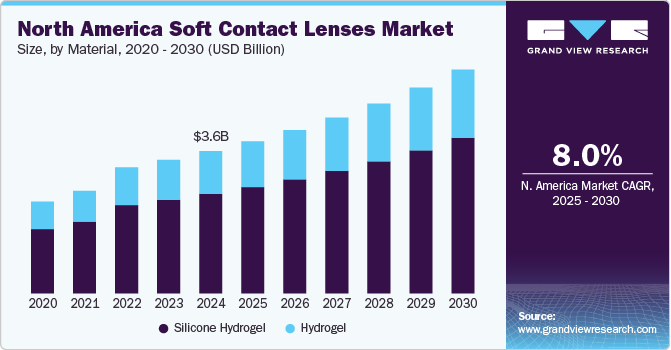
The North America soft contact lenses industry is driven by the rising prevalence of refractive errors such as myopia, hyperopia, presbyopia, and astigmatism. In the United States, myopia affects 41.6% of the population, and a 66% increase in prevalence has been recorded over the past 30 years. High myopia now impacts ~13 million Americans, highlighting the growing need for effective vision correction solutions. Similarly, hyperopia affects ~14 million people, with infants showing varying degrees of hyperopia in their first 12 months. These trends underscore the increasing demand for soft contact lenses across all age groups.
Manufacturers are continuously innovating materials and lens designs to enhance comfort, breathability, and durability. The development of silicone hydrogel lenses has improved oxygen permeability, reducing the risk of dry eyes and discomfort. Additionally, smart contact lenses capable of monitoring glucose levels for diabetics and detecting early signs of eye diseases are gaining traction. For example, Mojo Vision is developing augmented reality (AR)-enabled lenses, while companies like Alcon and Johnson & Johnson are investing in sensor-embedded lenses for real-time health monitoring. These advancements are expanding the applications of soft contact lenses beyond vision correction.
Presbyopia, which impairs near vision with age, is another significant market driver, affecting nearly 80% of individuals aged 45–55 in North America. Notably, 16% of these individuals lack adequate vision correction, creating a substantial opportunity for multifocal soft contact lenses. Despite advances in correction methods, achieving perfect vision across all distances remains challenging. In December 2023, the Centre for Ocular Research & Education (CORE) explored current and future pharmacological treatments in Issue 75 of Contact Lens Update, comparing their effectiveness to multifocal lenses. This ongoing research highlights the industry's focus on enhancing presbyopia management through innovative solutions.
Public health campaigns and increasing optometric visits have boosted awareness of vision care. According to the Centers for Disease Control and Prevention (CDC), only 50% of people with vision problems in the U.S. seek eye care due to lack of awareness. However, government and private sector initiatives promoting early diagnosis and correction of refractive errors are driving market growth. For instance, organizations like WHO’s Vision 2020 Initiative aim to eliminate avoidable blindness, which indirectly fuels demand for corrective lenses, including soft contact lenses.
With strong regulatory support and expanding e-commerce sales, soft contact lenses are becoming more accessible across North America. The combination of rising refractive error cases, technological innovations, and evolving presbyopia solutions is expected to drive continued market growth in the coming years.
Industry Concentration & Characteristics
The North America soft contact lenses industry is highly concentrated, with key players like Johnson & Johnson Vision, Alcon, Bausch + Lomb, and CooperVision dominating the industry. These companies invest heavily in R&D, advanced materials, and specialty lenses to maintain market leadership. The market is characterized by high product differentiation, with innovations in silicone hydrogel, daily disposables, and multifocal lenses. E-commerce growth, regulatory approvals, and rising consumer demand for comfortable, high-performance lenses further shape the industry.
The market is advancing rapidly with continuous innovation. In November 2024, CooperVision introduced clariti 1 day multifocal 3 Add in Canada, expanding its multifocal lens range. The lens incorporates the Binocular Progressive System, offering three Add powers to address all levels of presbyopia, ensuring clear vision at all distances. Designed for comfort and ease of fitting, it simplifies the practitioner’s fitting process, reducing chair time. By integrating multiple advanced technologies, CooperVision aims to enhance wearer experience and accessibility, reinforcing its commitment to innovation in the North America soft contact lens industry.
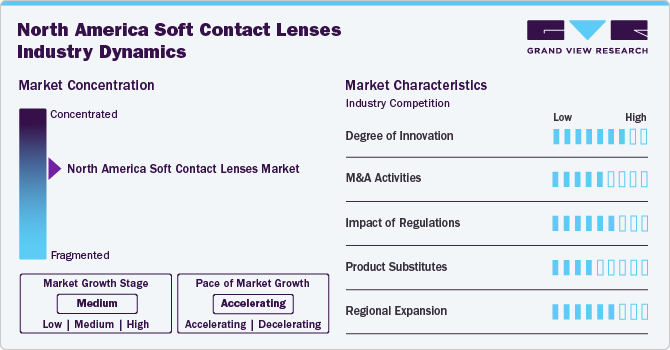
The North America soft contact lens market has seen notable M&A activity. In November 2022, CooperVision acquired SynergEyes, Inc., expanding its specialty lens portfolio. This acquisition strengthens CooperVision’s Onefit scleral lenses and enhances its offerings for keratoconus and irregular cornea treatment. CooperVision’s Specialty EyeCare division develops and supplies soft and custom rigid gas permeable lenses, including orthokeratology and scleral lenses, to address myopia, presbyopia, and corneal irregularities. The deal reflects CooperVision’s commitment to broadening its market reach and delivering innovative solutions for a wide range of vision conditions.
Regulations significantly shape the North America soft contact lens industry, ensuring safety, efficacy, and consumer protection. The FDA classifies soft contact lenses as Class II or III medical devices, requiring rigorous clinical testing and approval before market entry. In Canada, Health Canada oversees compliance with Medical Device Regulations. Recent regulatory updates emphasize stronger labeling requirements, digital device prescriptions, and stricter online sales policies to curb counterfeit products. Compliance with these evolving standards impacts manufacturers, distributors, and eye care professionals, influencing product innovation, pricing, and market accessibility, while ensuring patient safety and quality assurance across the industry.
In the North America soft contact lens industry, substitutes include eyeglasses, refractive surgeries, and orthokeratology lenses. Eyeglasses remain a cost-effective and low-maintenance alternative, appealing to consumers seeking convenience. Refractive surgeries like LASIK and PRK offer a permanent vision correction solution, reducing long-term dependency on lenses. Orthokeratology (ortho-k) lenses, worn overnight, reshape the cornea temporarily, eliminating the need for daytime lenses. Advancements in intraocular lens implants (IOLs) for presbyopia and cataracts also challenge market growth. The availability of these substitutes influences consumer choices, with preferences driven by cost, lifestyle, comfort, and long-term vision correction goals.
The North America soft contact lens industry is expanding with increasing product availability and technological advancements. Companies are enhancing their presence through new product launches and acquisitions. In April 2023, CooperVision expanded its clariti 1-day multifocal lenses into Canada, addressing the growing demand for presbyopia correction. Market players are also investing in research to improve lens materials and comfort. Additionally, regulatory approvals in Mexico are fostering market entry for global brands. The rising prevalence of myopia and presbyopia and increasing awareness of contact lens benefits are further driving regional growth, making North America a key market for innovation.
Material Insights
The silicone hydrogel segment accounted for the largest revenue share of more than 70.0% in 2024, primarily due to its breathability, comfort, and suitability for extended wear. Silicone hydrogel lenses allow more oxygen to pass through to the cornea, which improves comfort and reduces the risk of dryness and irritation. Innovations in hybrid soft lenses combining silicone hydrogel with gas-permeable materials, are also contributing to market growth. These lenses offer sharp vision, comfort, and are ideal for individuals with complex eye conditions like astigmatism and keratoconus.
The hydrogel segment is estimated to register a fastest growth rate of over 8.3% from 2025 to 2030 due to its high-water content, ensuring superior comfort and oxygen permeability, making it ideal for users with dry or sensitive eyes. The rising demand for daily disposable hydrogel lenses, particularly for their hygiene benefits, affordability, and moisture retention, is fueling growth, especially in emerging markets.
Design Insights
Spherical soft contact lenses are the most widely used, accounting for the largest share of 59.7% in 2024. These lenses are typically prescribed for myopia, hyperopia, and presbyopia. They are easy to wear and are commonly available in various prescriptions. However, the growing demand for toric lenses (for astigmatism) and multifocal lenses is driving the market forward. Innovations like moisture gradient technology and advanced materials for enhanced comfort have helped make toric lenses more popular. For instance, in 2023, Alcon launched TOTAL30 for astigmatism, which uses water gradient technology for added comfort and moisture retention throughout the day.
The toric lenses segment is estimated to observe a CAGR of over 10.7% over the forecast period. The segment is driven by the rising prevalence of astigmatism, increasing awareness and early diagnosis of refractive errors have led to a higher demand for customized toric lenses, which provide superior stability and clear vision compared to standard spherical lenses. Advancements in lens design and materials, such as silicone hydrogel toric lenses, offer better oxygen permeability and prolonged wear comfort, driving their adoption.
Application Insights
The corrective segment accounted for the largest share of 46.6% in 2024. These lenses are typically prescribed for myopia, hyperopia, and presbyopia. The rising prevalence of refractive errors such as myopia, hyperopia, astigmatism, and presbyopia is fueling demand for corrective lenses. Advancements in lens materials, oxygen permeability, and hydration technologies are enhancing comfort and wearability, further driving adoption. Additionally, increasing awareness of vision correction options and a preference for daily disposable lenses contribute to market growth.
The cosmetic segment in the North America soft contact lens market is expected to witness the fastest CAGR during the forecast period. Rising demand for colored and decorative lenses for aesthetic purposes, along with increasing social media influence, is driving growth. Consumers seek enhanced eye appearance through non-corrective and vision-correcting cosmetic lenses. Advances in lens materials and manufacturing technologies are improving comfort and safety, boosting adoption.
Distribution Channel Insights
The retail segment accounted for the largest revenue share of 51.8%, in 2024. The segment is driven by the growing preference for convenient purchasing channels, including optical stores, supermarkets, and online platforms. Brick-and-mortar optical retailers continue to dominate due to personalized fitting services, expert consultations, and immediate product availability, while e-commerce platforms are rapidly gaining traction with competitive pricing, subscription models, and home delivery options.
The E-commerce segment is estimated to record a CAGR of over 9.8% from 2025 to 2030 as they have become increasingly important in the North America soft contact lens market. With consumers seeking convenience, competitive pricing, and home delivery services, online retailers like 1-800 Contacts, Lens.com, and others are seeing substantial growth. However, brick-and-mortar optical shops and optometrist offices still hold a significant share of the market, particularly in regions with a high prevalence of eye care professionals.
Usage Insights
The daily disposable lens segment held the largest share of revenue, more than 37.1%, in 2024. This is due to the ease of use, hygiene benefits, and comfort they offer. These lenses are preferred by individuals with busy lifestyles and athletes who require flexibility and convenience. Daily disposable lenses are seen as the healthiest option, as they minimize the risk of lens buildup and bacteria accumulation. The growing preference for disposable lenses is also driven by their affordability, as they eliminate the need for cleaning solutions and storage cases.
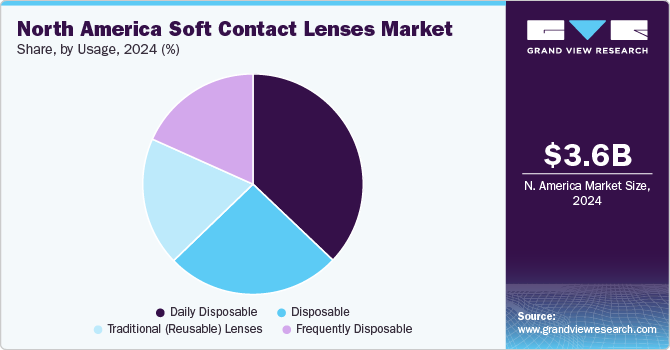
The daily disposable segment in the soft contact lens market is driven by growing consumer preference for convenience, hygiene, and eye health benefits. These lenses eliminate the need for cleaning and storage, significantly reducing the risk of bacterial infections and eye complications such as microbial keratitis and dry eye syndrome. Increased awareness of ocular health, particularly among younger demographics and first-time users, has boosted demand for single-use lenses. Additionally, the rising prevalence of myopia and astigmatism due to increased screen time and digital eye strain has accelerated the adoption of daily disposables as a hassle-free vision correction solution.
Regional Insights
North America accounted for the largest share, over 37.2%, in 2024 and is expected to grow significantly over the coming years. This region is characterized by high adoption rates of soft contact lenses and a strong focus on technological innovation. Research and development activities are highly concentrated in this region, with companies continuously launching new products, such as CooperVision’s MyDay Energys lenses designed to address digital eye strain. Moreover, the increasing awareness of ocular health and the aging population are major drivers. Advances in smart lenses and ortho-k (orthokeratology) lenses are anticipated to further fuel the market growth in the coming years.
U.S. Soft Contact Lenses Market Trends
The U.S. remains a key player in the North America soft contact lens market, driven by ongoing innovations and mergers within the sector. In particular, the adoption of smart contact lenses equipped with sensors that track glucose levels and other health metrics has gained traction. There is also a growing demand for ortho-k lenses, which reshape the cornea overnight for myopia control. Additionally, the senior population in the U.S. has heightened the demand for corrective solutions for age-related vision problems, such as macular degeneration and cataracts, propelling market growth.
The Canada soft contact lenses market is witnessing steady growth, driven by rising myopia prevalence, increasing adoption of daily disposable lenses, and technological advancements in multifocal and toric lenses. The demand for silicone hydrogel lenses is increasing due to their enhanced oxygen permeability and comfort. Additionally, e-commerce platforms and subscription-based models are making soft contact lenses more accessible. Regulatory policies from Health Canada ensure product safety and innovation, while growing awareness of eye health supports market expansion.
The Mexico soft contact lenses market is growing due to increasing myopia prevalence, greater awareness of vision correction, and expanding access to eye care services. Demand for daily disposable and silicone hydrogel lenses is rising due to their comfort and convenience. Additionally, regulatory efforts from COFEPRIS ensure product quality and safety. As urbanization and screen time increases, the need for advanced contact lens solutions is expected to drive further market expansion.
Key North America Soft Contact Lenses Company Insights
Companies operating within the industry are concentrating on mergers, partnerships, acquisitions, and introducing new products to enhance their presence in the market. For instance, in July 2024, experts said that toric soft contact lenses should be the standard correction method for individuals with low to moderate astigmatism. This recommendation is based on their effectiveness in providing stable and clear vision for astigmatic patients.
Key North America Soft Contact Lenses Companies:
- Bausch + Lomb Inc.
- Acuvue (Johnson & Johnson)
- Alcon Vision Llc
- Carl Zeiss Ag
- Cooper Vision Inc.
- Essilor International
- Hoya Corporation
- Menicon Co., Ltd.
- SEED Co., Ltd.
Recent Developments
-
In January 2023, Carter Ledyard’s client CooperVision, Inc. finalized its acquisition of SynergEyes, Inc., which offers a diverse array of specialty contact lenses, including unique hybrid lenses. These products enhance CooperVision’s portfolio, particularly its Onefit scleral lenses.
-
In February 2023, Alcon Canada introduced TOTAL30 for Astigmatism and DAILIES TOTAL1 for Astigmatism, expanding their reusable and daily disposable lens offerings for astigmatic patients. These lenses feature Alcon's proprietary Water Gradient material, ensuring a gentle cushion of moisture for enhanced comfort. The PRECISION BALANCE 8|4 design provides exceptional on-eye stability, delivering clear and stable vision.
North America Soft Contact Lenses Market Report Scope
Report Attribute
Details
Market size value in 2025
USD 3.9 billion
Revenue forecast in 2030
USD 5.7 billion
Growth Rate
CAGR of 8.0% from 2025 to 2030
Actual data
2018 - 2023
Forecast period
2025 - 2030
Quantitative units
Revenue in USD billion/million and CAGR from 2025 to 2030
Report coverage
Revenue forecast, company ranking, competitive landscape, growth factors, and trends
Segments covered
Material, Design, Application, Distribution Channel, Usage, Region
Regional scope
North America
Country scope
U.S.; Canada; Mexico
Key companies profiled
Johnson & Johnson Services, Inc. (Johnson & Johnson Vision Care, Inc.); Bausch + Lomb; ALCON INC.; CooperCompanies (CooperVision); Contamac; HOYA CORPORATION (HOYA Corporation Contact Lens Division); SEED Co., Ltd.; EssilorLuxottica; Menicon Co., Ltd.; Euclid Vision Group
Customization scope
Free report customization (equivalent to 8 analyst’s working days) with purchase. Addition or alteration to country, regional & segment scope
Pricing and purchase options
Avail customized purchase options to meet your exact research needs. Explore purchase options
North America Soft Contact Lenses Market Report Segmentation
This report forecasts revenue growth at regional and country levels and provides an analysis of the latest industry trends in each of the sub-segments from 2018 to 2030. For this study, Grand View Research has segmented the North America soft contact lenses market report based on material, design, application, distribution channel, usage and region.
-
Material Outlook (Revenue, USD Million; 2018 - 2030)
-
Silicone Hydrogel
-
Hydrogel
-
-
Design Outlook (Revenue, USD Million; 2018 - 2030)
-
Spherical Lens
-
Toric Lens
-
Multifocal Lens
-
Other Lens
-
-
Application Outlook (Revenue, USD Million; 2018 - 2030)
-
Corrective
-
Therapeutic
-
Cosmetic
-
Prosthetic
-
Lifestyle-oriented
-
-
Distribution Channel Outlook (Revenue, USD Million; 2018 - 2030)
-
E-commerce
-
Eye Care Professionals
-
Retail
-
-
Usage Outlook (Revenue, USD Million; 2018 - 2030)
-
Daily Disposable
-
Disposable
-
Frequently Disposable
-
Traditional (Reusable) lenses
-
-
Regional Outlook (Revenue, USD Million; 2018 - 2030)
-
North America
-
U.S.
-
Canada
-
Mexico
-
-
Frequently Asked Questions About This Report
b. The North American soft contact lenses market is expected to grow at a compound annual growth rate of 8.0% from 2025 to 2030, reaching USD 5.7 billion by 2030.
b. The North American soft contact lenses market size was estimated at USD 3.6 billion in 2024 and is expected to reach USD 3.9 billion in 2025.
b. The U.S. dominated the North American soft contact lenses market, with a share of 79.9% in 2024. This is attributable to the large number of market competitors in the region and the high frequency of new product releases.
b. Some key players operating in the North America soft contact lenses market include Johnson & Johnson Services, Inc. (Johnson & Johnson Vision Care, Inc.); Bausch + Lomb; ALCON INC.; CooperCompanies (CooperVision); Contamac; HOYA CORPORATION (HOYA Corporation Contact Lens Division); SEED Co., Ltd.; EssilorLuxottica; Menicon Co., Ltd.; Euclid Vision Group
b. Key factors driving the North American soft contact lens market growth include the increasing awareness of ocular health and the aging population. Advances in smart and ortho-k (orthokeratology) lenses are anticipated to fuel market growth in the coming years.

Share this report with your colleague or friend.
Need a Tailored Report?
Customize this report to your needs — add regions, segments, or data points, with 20% free customization.


ISO 9001:2015 & 27001:2022 Certified
We are GDPR and CCPA compliant! Your transaction & personal information is safe and secure. For more details, please read our privacy policy.
Trusted market insights - try a free sample
See how our reports are structured and why industry leaders rely on Grand View Research. Get a free sample or ask us to tailor this report to your needs.













