
- Home
- »
- Conventional Energy
- »
-
Oil Condition Monitoring Market Size Report, 2026-2033GVR Report cover

Oil Condition Monitoring Market (2026 - 2033)
Size, Share & Trends Analysis Report By Product (Hardware, Software, Services), By Monitoring Type (Online Monitoring, Off-line Monitoring), By End Use (Oil & Gas, Power Generation), By Region, And Segment Forecasts
Market Size, 2025
$2.3BMarket Estimate, 2026
$2.4BMarket Forecast, 2033
$3.3BCAGR, 2026–2033
4.8%Oil Condition Monitoring Market Summary
The global oil condition monitoring market size was valued at USD 2.3 billion in 2025 and is projected to grow from USD 2.4 billion in 2026 to USD 3.3 billion by 2033, at a CAGR of 4.8% from 2026 to 2033. The market in North America dominated with a revenue share of 35.4% in 2025. The market is expanding due to the growing focus on predictive maintenance and asset reliability, as industries aim to reduce equipment downtime and optimize operational efficiency.
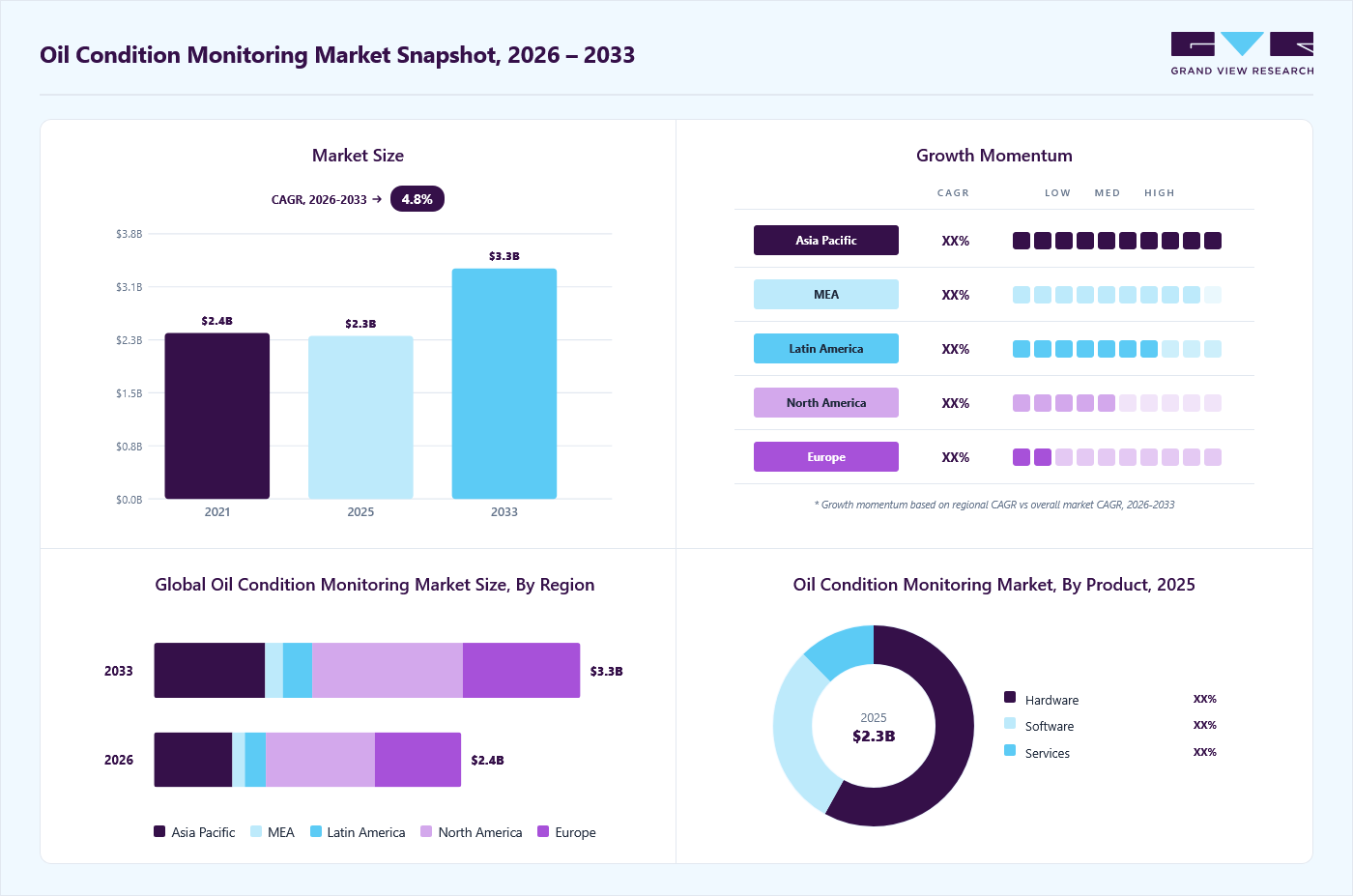 Source: Grand View Research, IR Documents, Primary Interviews, Paid DatabasesTo learn more about this report,
 Download Free Sample Report
Key Market Trends & Insights
- By monitoring type: Online monitoring segment held the largest market share of 61.8% in 2025.
- By product: Hardware segment held the largest market share of 58.0% in 2025.
- By end use: Oil & gas segment held the largest market share of 29.0% in 2025.
Regional Highlights
- Largest regional market: North America (35.4% revenue share, 2025)
- Fastest-growing regional market: Asia Pacific (highest CAGR, 2026-2033)
- By country: The U.S. held the largest market share in 2025
Market Size & Forecast
- Market size in 2025: USD 2.3 Billion
- Estimated market size in 2026: USD 2.4 Billion
- Projected market size by 2033: USD 3.3 Billion
- CAGR (2026-2033): 4.8%
Prism AI by Grand View Research Free to tryAsk a question about the oil condition monitoring marketTry asking✓Every figure cited from GVR research Prefer the report? Download free sample →
Increasing industrial automation, integration of IIoT technologies, and rising demand for real-time monitoring solutions are also accelerating the adoption of oil condition monitoring systems. The market is growing as industries shift toward data-driven maintenance strategies to enhance equipment performance and reduce unexpected failures. The adoption of inline sensors, portable analyzers, and laboratory testing services is enabling more accurate assessment of lubricant health and machinery condition. Increasing awareness of the cost implications of equipment breakdowns, along with the need to extend asset lifespan, is encouraging companies to invest in continuous monitoring solutions. Advancements in sensor precision and diagnostics are improving the reliability of condition-based maintenance practices across critical operations.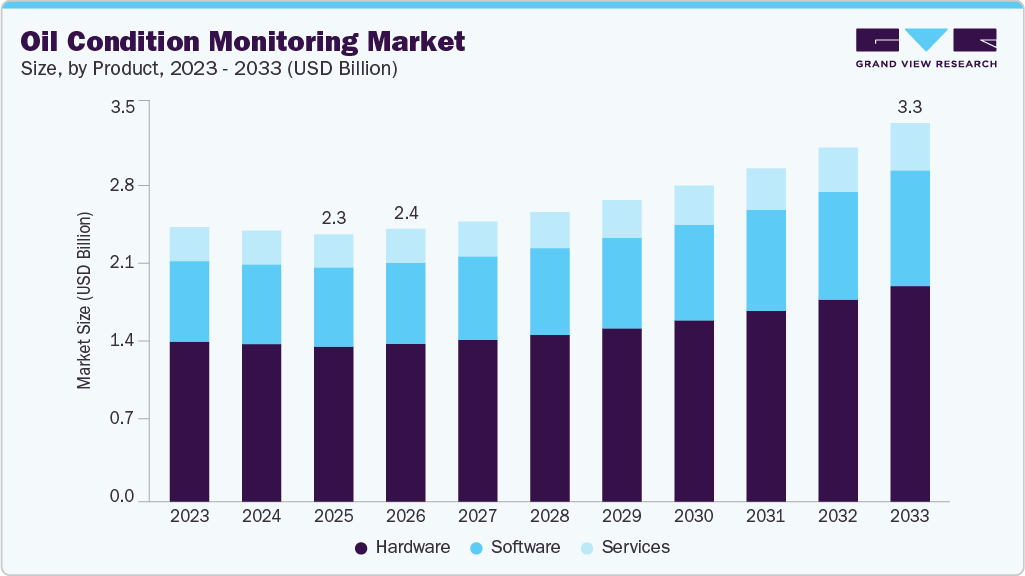 To learn more about this report, Download Free Sample Report
Growing industrialization and infrastructure development, particularly in emerging economies, are further supporting market expansion by increasing demand for efficient asset management solutions. Industries such as power generation, mining, marine, and heavy manufacturing are integrating oil monitoring systems to ensure consistent performance under demanding conditions. The evolution of cloud-based platforms and remote monitoring capabilities is enabling centralized data analysis and faster decision-making.
Drivers, Opportunities & Restraints
The oil condition monitoring market is primarily driven by the increasing need for predictive maintenance and efficient asset management across industries to minimize downtime and reduce maintenance costs. The growing adoption of advanced technologies such as IoT-enabled sensors, real-time monitoring systems, and data analytics is enhancing the accuracy and effectiveness of oil analysis. Rising industrial automation, expanding use across sectors such as oil & gas, power generation, and manufacturing, and the need to improve equipment reliability and operational safety are further supporting market growth.
The rapid expansion of wind, solar, and other renewable energy infrastructure is creating a high-growth opportunity for oil condition-monitoring solutions, particularly for critical components such as gearboxes, turbines, and hydraulic systems operating in remote, harsh environments. These assets require continuous, real-time monitoring to ensure reliability, reduce maintenance costs, and prevent unexpected failures, driving demand for advanced sensor-based and predictive maintenance technologies.
However, the oil condition monitoring market faces challenges related to the integration of modern IoT-enabled monitoring systems with legacy equipment, as older machinery often lacks compatibility with advanced digital technologies. Retrofitting these systems can be technically complex, requiring additional infrastructure, customization, and potentially causing operational downtime, thereby increasing overall implementation costs. These factors can limit adoption, particularly among industries with aging assets and constrained maintenance budgets.
A lack of trained professionals capable of managing, analyzing, and interpreting data from advanced oil condition-monitoring systems is limiting the optimal utilization of these technologies. The complexity of data analytics, sensor calibration, and predictive maintenance tools requires specialized expertise, and the shortage of skilled personnel can lead to underuse of systems, reduced diagnostic accuracy, and slower adoption across industries.
Product Insights
The hardware segment accounted for the largest revenue share of 58.0% in 2025, driven by the widespread deployment of sensors, analyzers, and on-site testing devices that form the foundation of monitoring systems. Industries rely heavily on these components for real-time data collection on oil quality, contamination, and wear, making them essential for effective condition-based maintenance. The growing adoption of inline sensors and portable diagnostic equipment, along with increasing investments in industrial automation and predictive maintenance, continues to strengthen the dominance of the hardware segment.
The software segment is the fastest-growing, with a 5.2% CAGR over the forecast period, driven by the increasing adoption of cloud-based platforms, advanced data analytics, and AI-driven predictive maintenance solutions. These tools enable real-time monitoring, remote diagnostics, and actionable insights, helping industries optimize maintenance schedules, reduce downtime, and improve overall equipment efficiency. The growing integration of software with enterprise asset management systems and IIoT platforms is further accelerating its adoption across industries.
Monitoring Type Insights
The online monitoring segment accounted for the largest market revenue share of 61.8% in 2025. This growth is supported by real-time visibility and instant intelligence, as online sensors provide continuous monitoring of oil quality, contamination, and wear particles, unlike traditional lab analysis that involves delays. The ability to enable early fault detection, reduce unplanned downtime, and support data-driven maintenance decisions is further driving the strong adoption of online monitoring solutions across industries.
The off-line monitoring segment is projected to register the second fastest CAGR of 4.5% over the forecast period, driven by its cost-effectiveness and widespread use in periodic maintenance programs. Off-line oil analysis, including laboratory testing and portable diagnostic kits, provides highly accurate and detailed insights into oil properties and wear conditions, making it a preferred choice for industries with budget constraints or less critical real-time monitoring needs. Its ease of implementation and suitability for a wide range of equipment are supporting its steady adoption.
End Use Insights
The oil & gas segment accounted for the largest revenue share of 29.0% in 2025, driven by the critical need to ensure reliability and performance of high-value, high-pressure equipment such as compressors, pumps, and engines. Failures in these operations can result in extremely high downtime costs, often running into millions per day, making continuous oil monitoring essential for early fault detection. Harsh operating environments, stringent safety standards, and the need to optimize asset life further accelerate the adoption of advanced monitoring solutions in this sector.
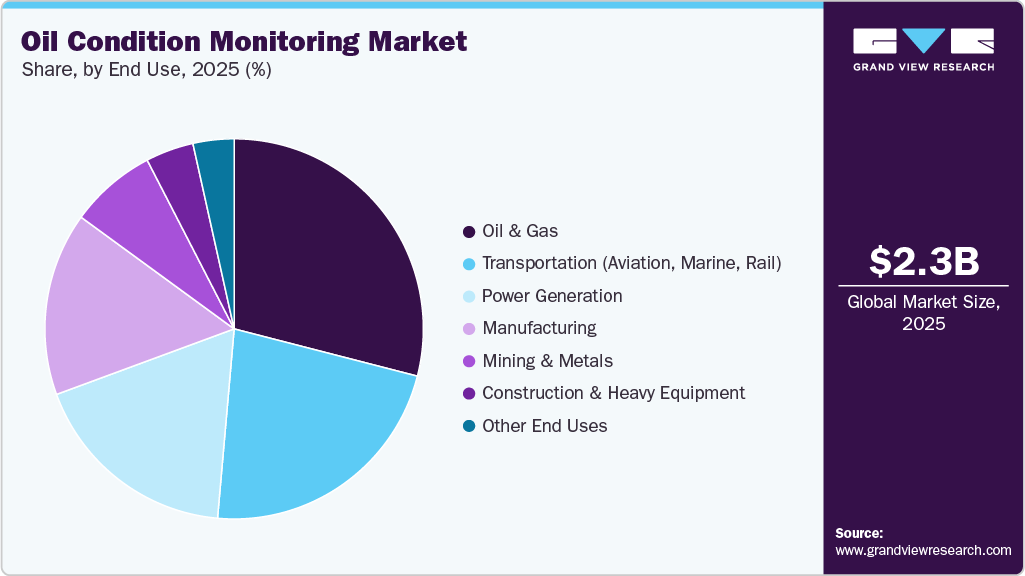 To learn more about this report, Download Free Sample Report
The transportation (aviation, marine, rail) segment is projected to register the fastest CAGR of 5.2% over the forecast period, supported by the increasing need for reliable engine performance, fuel efficiency, and reduced maintenance downtime across transportation fleets. Growing adoption of predictive maintenance practices, stringent safety regulations, and rising investments in advanced monitoring technologies for critical components such as engines, turbines, and hydraulic systems are further driving demand for oil condition monitoring solutions in this segment.
Regional Insights
North America Oil Condition Monitoring Market Trends
The North America oil condition monitoring market accounted for the largest revenue share of 35.4%, driven by the strong presence of major technology providers offering advanced sensors, AI-based diagnostics, and cloud-enabled monitoring platforms. The region also benefits from early adoption of predictive maintenance practices and high investments in industrial automation across sectors such as oil & gas, manufacturing, and power generation. The growing focus on minimizing equipment downtime and improving operational efficiency continues to support widespread deployment of advanced oil monitoring solutions.
The U.S. oil condition monitoring market is primarily driven by the increasing adoption of predictive maintenance strategies aimed at reducing maintenance costs and preventing unexpected equipment failures. Industries are shifting from traditional scheduled servicing to condition-based maintenance to improve asset reliability and operational efficiency. Strong investments in industrial automation, digital monitoring technologies, and advanced analytics across sectors such as oil & gas, manufacturing, and power generation are further accelerating market growth.
Asia Pacific Oil Condition Monitoring Market Trends
The Asia Pacific oil condition monitoring market is growing at the fastest CAGR of 5.1%, driven by rapid industrialization and the expansion of manufacturing hubs in countries such as China, India, and South Korea. The growing presence of large-scale industries and industrial machinery is increasing the demand for efficient maintenance solutions to minimize downtime and optimize operational performance. Rising investments in industrial automation, expanding power generation capacity, and increasing adoption of predictive maintenance technologies are further supporting regional market growth.
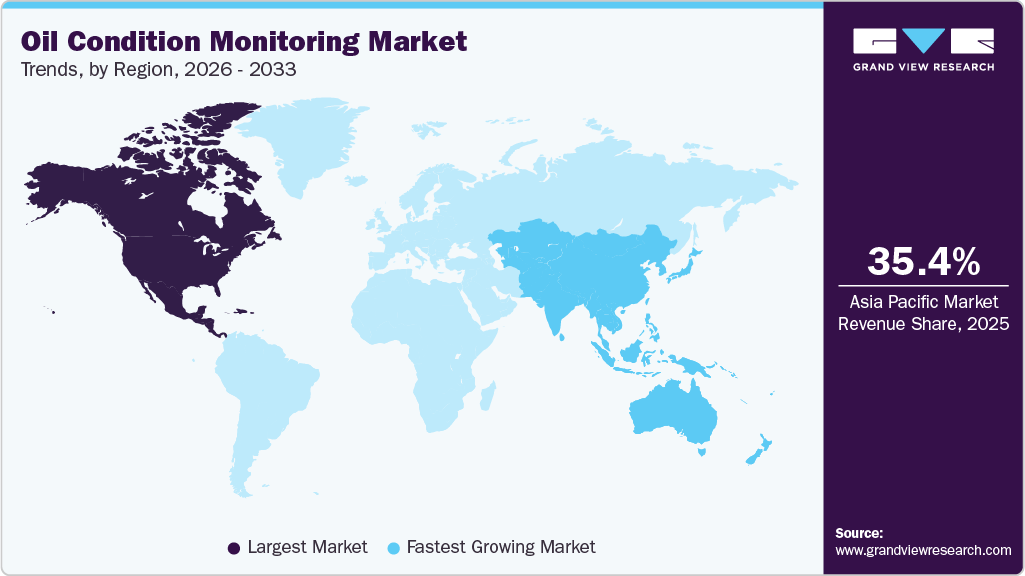 To learn more about this report, Download Free Sample Report
China Oil Condition Monitoring Market Trends
In China, the market is significantly influenced by the rising need to maintain the performance and longevity of critical industrial assets across sectors such as power generation, mining, automotive, and heavy manufacturing. Expensive machinery, including turbines, compressors, and hydraulic systems, requires continuous condition assessment to avoid unexpected breakdowns and production disruptions. The ongoing industrial modernization, increasing deployment of smart factory technologies, and stronger focus on cost-efficient maintenance practices are contributing to the growing adoption of oil condition monitoring solutions across the country.
Europe Oil Condition Monitoring Market Trends
In Europe, the market is significantly driven by the rapid adoption of advanced monitoring technologies and smart maintenance practices across industrial sectors. The increasing deployment of real-time oil quality monitoring sensors enables continuous assessment of viscosity, contamination levels, and lubricant degradation, helping industries improve equipment performance and maintenance efficiency. Strong emphasis on industrial automation, sustainability, and compliance with stringent operational standards is accelerating the implementation of oil condition monitoring solutions across the region.
Latin America Oil Condition Monitoring Market Trends
In Latin America, the oil condition monitoring market is driven by the expansion of industrial and mining activities, which is increasing the need for reliable maintenance solutions for heavy-duty machinery and equipment. Growing demand from the oil & gas and power generation sectors, particularly in countries such as Brazil, Mexico, Argentina, and Colombia, is further supporting the adoption of oil monitoring technologies. The increasing focus on improving equipment efficiency, reducing operational disruptions, and extending asset lifespans is contributing to this market’s growth.
Middle East & Africa Oil Condition Monitoring Market Trends
The oil condition monitoring market in the Middle East and Africa is driven by harsh operating environments characterized by extreme heat, dust, and demanding industrial conditions that accelerate lubricant degradation and equipment wear. Industries such as oil & gas, mining, and power generation increasingly rely on advanced monitoring solutions to prevent equipment damage, reduce unplanned downtime, and maintain operational efficiency. Growing investments in industrial infrastructure and asset reliability programs are further supporting market adoption across the region.
Key Oil Condition Monitoring Company Insights
Some of the key participants in the global oil condition monitoring market include Ametek Spectro Scientific, Bureau Veritas, Eaton, Exxon Mobil Corporation, ifm electronic gmbh, PARKER HANNIFIN CORP, Schaeffler India Limited, SGS Société Générale de Surveillance SA, Shell plc, and TE Connectivity. These companies are focused on expanding their capabilities by developing advanced sensing technologies, real-time analytics platforms, and integrated predictive maintenance solutions to support large-scale industrial adoption. These innovations enable continuous monitoring of lubricant quality and equipment health, helping industries minimize downtime and improve operational efficiency.
Their offerings span multiple monitoring approaches, including portable on-site testing kits, laboratory-based oil analysis services, inline sensors, and IIoT-enabled monitoring systems. This diversified approach enables companies operating in the oil condition monitoring services market to provide flexible solutions based on operational requirements, while ensuring accurate detection of contamination, wear, and oil degradation across critical machinery. As adoption accelerates, companies are strengthening partnerships with OEMs, industrial operators, and digital solution providers to enhance system integration and scalability.. The increasing focus on asset reliability, cost optimization, and regulatory compliance is driving continuous innovation, digital transformation, and global expansion across the oil condition-monitoring value chain.
Key Oil Condition Monitoring Companies:
The following key companies have been profiled for this study on the oil condition monitoring market.
- Ametek Spectro Scientific
- Bureau Veritas
- Eaton
- Exxon Mobil Corporation
- ifm electronic gmbh
- PARKER HANNIFIN CORP
- Schaeffler India Limited
- SGS Société Générale de Surveillance SA
- Shell plc
- TE Connectivity
Recent Developments
-
In April 2026, Gastops launched FluidSIGHT, a real-time oil condition monitoring system, designed to provide continuous insight into engine health across marine and industrial applications. This development enhances predictive maintenance capabilities by enabling early fault detection, reducing unplanned downtime, and improving operational efficiency, supporting the growing adoption of advanced, sensor-based monitoring solutions across industries.
-
In April 2026, NYK Group, through its subsidiary Nippon Yuka Kogyo Co., Ltd., launched a new lubricating oil analysis service for condition monitoring of ammonia-fueled engines. The service enables early detection of abnormalities by analyzing engine oil to assess internal engine performance, supporting improved reliability and more effective maintenance planning. This development aligns with the maritime industry’s shift toward ammonia as a low-emission fuel and strengthens efforts to ensure safe and efficient adoption of next-generation propulsion technologies.
Oil Condition Monitoring Market Report Scope
Report Attribute
Details
Market Definition
The global Oil Condition Monitoring (OCM) market refers to the revenue generated from the sales of technologies, solutions, and services designed to analyze, track, and assess the health and performance of lubricating oils and hydraulic fluids used in industrial machinery.
Market size in 2025
USD 2.3 billion
Estimated market size in 2026
USD 2.4 billion
Projected market size by 2033
USD 3.3 billion
Growth rate
CAGR of 4.8% from 2026 to 2033
Base year for estimation
2025
Historical data
2021 - 2024
Forecast period
2026 - 2033
Quantitative units
Revenue in USD Million, and CAGR from 2026 to 2033
Report coverage
Revenue forecast, competitive landscape, growth factors, and trends
Segments covered
Product, monitoring type, end use, region
Regional scope
North America; Europe; Asia Pacific; Latin America; Middle East & Africa
Country scope
U.S.; Canada; Mexico; Germany; UK; France; Italy; Spain; China; India; Australia;Japan; South Korea; Brazil; Argentina; UAE; Saudi Arabia; South Africa
Key companies profiled
Ametek Spectro Scientific; Bureau Veritas; Eaton; Exxon Mobil Corporation; ifm electronic gmbh; PARKER HANNIFIN CORP; Schaeffler India Limited; SGS Société Générale de Surveillance SA; Shell plc; TE Connectivity
Customization scope
Free report customization (equivalent up to 8 analysts working days) with purchase. Addition or alteration to country, regional & segment scope.
Pricing and purchase options
Avail customized purchase options to meet your exact research needs. Explore purchase options
Global Oil Condition Monitoring Market Report Segmentation
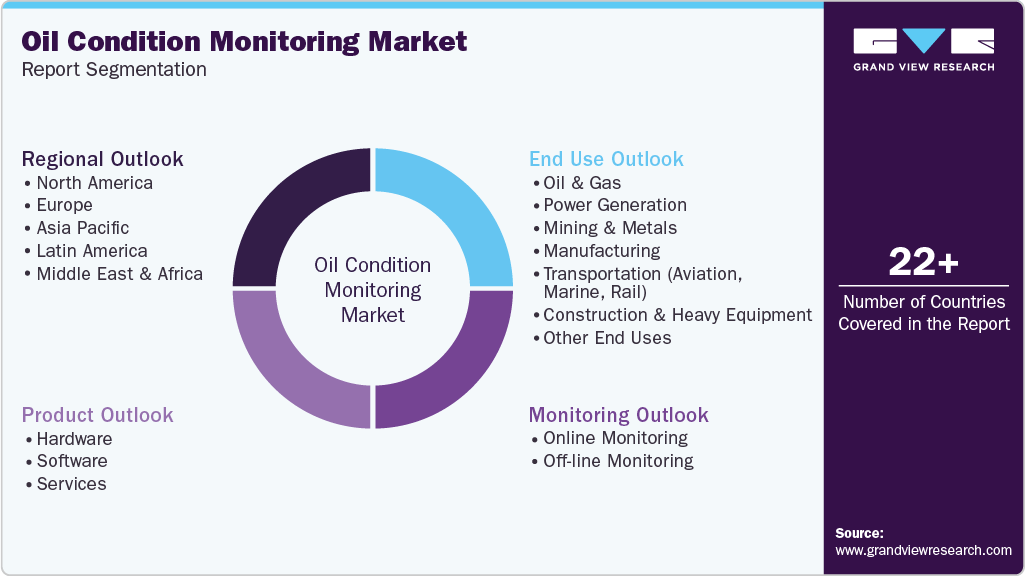
This report forecasts revenue growth at global, regional, and country levels and provides an analysis of the latest industry trends in each of the sub-segments from 2021 to 2033. For the purpose of this study, Grand View Research has segmented the global oil condition monitoring market report on the basis of product, monitoring type, end use, and region.
 To learn more about this report, Download Free Sample Report
-
Product Outlook (Revenue, USD Million, 2021 - 2033)
-
Hardware
-
Software
-
Services
-
-
Monitoring Outlook (Revenue, USD Million, 2021 - 2033)
-
Online Monitoring
-
Off-line Monitoring
-
-
End Use Outlook (Revenue, USD Million, 2021 - 2033)
-
Oil & Gas
-
Power Generation
-
Mining & Metals
-
Manufacturing
-
Transportation (Aviation, Marine, Rail)
-
Construction & Heavy Equipment
-
Other End Uses
-
-
Regional Outlook (Revenue, USD Million, 2021 - 2033)
-
North America
-
U.S.
-
Canada
-
Mexico
-
-
Europe
-
Germany
-
UK
-
France
-
Italy
-
Spain
-
-
Asia Pacific
-
China
-
India
-
Australia
-
Japan
-
South Korea
-
-
Latin America
-
Brazil
-
Argentina
-
-
Middle East & Africa
-
Saudi Arabia
-
UAE
-
South Africa
-
-
Frequently Asked Questions About This Report
North America dominated with a 35.4% revenue share in 2025.
Asia Pacific is the fastest-growing region over the forecast period.
Oil & gas segment led with a 29.0% revenue share in 2025, while transportation (aviation, marine, rail) is the fastest-growing segment.
The online monitoring segment led with a 61.8% revenue share in 2025.
Key players include Ametek Spectro Scientific; Bureau Veritas; Eaton; Exxon Mobil Corporation; ifm electronic gmbh; PARKER HANNIFIN CORP; Schaeffler India Limited; SGS Société Générale de Surveillance SA; Shell plc; TE Connectivity.
The key factors driving the growth of the global oil condition monitoring market include the increasing adoption of predictive maintenance practices to minimize downtime and optimize asset performance, along with the rapid integration of Industry 4.0 and IIoT technologies.
The global oil condition monitoring market size was valued at USD 2.3 billion in 2025 and is estimated at USD 2.4 billion for 2026.
The global oil condition monitoring market is expected to grow at a CAGR of 4.8% from 2026 to 2033, reaching USD 3.3 billion by 2033.
The hardware segment led with a 58.0% revenue share in 2025, while software is the fastest-growing product.
About the Author(s)
Conventional Energy Research Team
Energy & Power · Conventional EnergyThis report was authored by the conventional energy research team at Grand View Research - comprising two research analysts, one senior research analyst, and one industry expert - with specialized expertise in the conventional energy segment of the energy & power industry. All findings are based on proprietary energy & power databases, executive interviews, and regulatory analysis, subject to internal peer review prior to publication.
Last Updated:
Speak to Analyst

Customize this report to your needs - add regions, segments, or data points, with 20% free customization.
Or view our licence options:


ISO 9001:2015 & 27001:2022 Certified
We are GDPR and CCPA compliant! Your transaction & personal information is safe and secure. For more details, please read our privacy policy.


