
- Home
- »
- Conventional Energy
- »
-
Oil And Gas SCADA Market Size & Share Report, 2026-2033GVR Report cover

Oil And Gas SCADA Market (2026 - 2033)
Size, Share & Trends Analysis Report By Architecture (Hardware, Software, Services), By Sector (Upstream, Downstream, Midstream), By Region (North America, Europe, APAC, Latin America, MEA), And Segment Forecasts
Market Size, 2025
$4.1BMarket Estimate, 2026
$4.3BMarket Forecast, 2033
$6.7BCAGR, 2026–2033
6.3%Oil And Gas SCADA Market Summary
The global oil and gas SCADA market size was valued at USD 4.1 billion in 2025 and is projected to grow from USD 4.3 billion in 2026 to USD 6.7 billion by 2033, at a CAGR of 6.3% from 2026 to 2033. The market in North America dominated with a revenue share of 39.4% in 2025. The market is expanding due to the growing need for real-time monitoring and remote management of increasingly dispersed oil & gas assets.
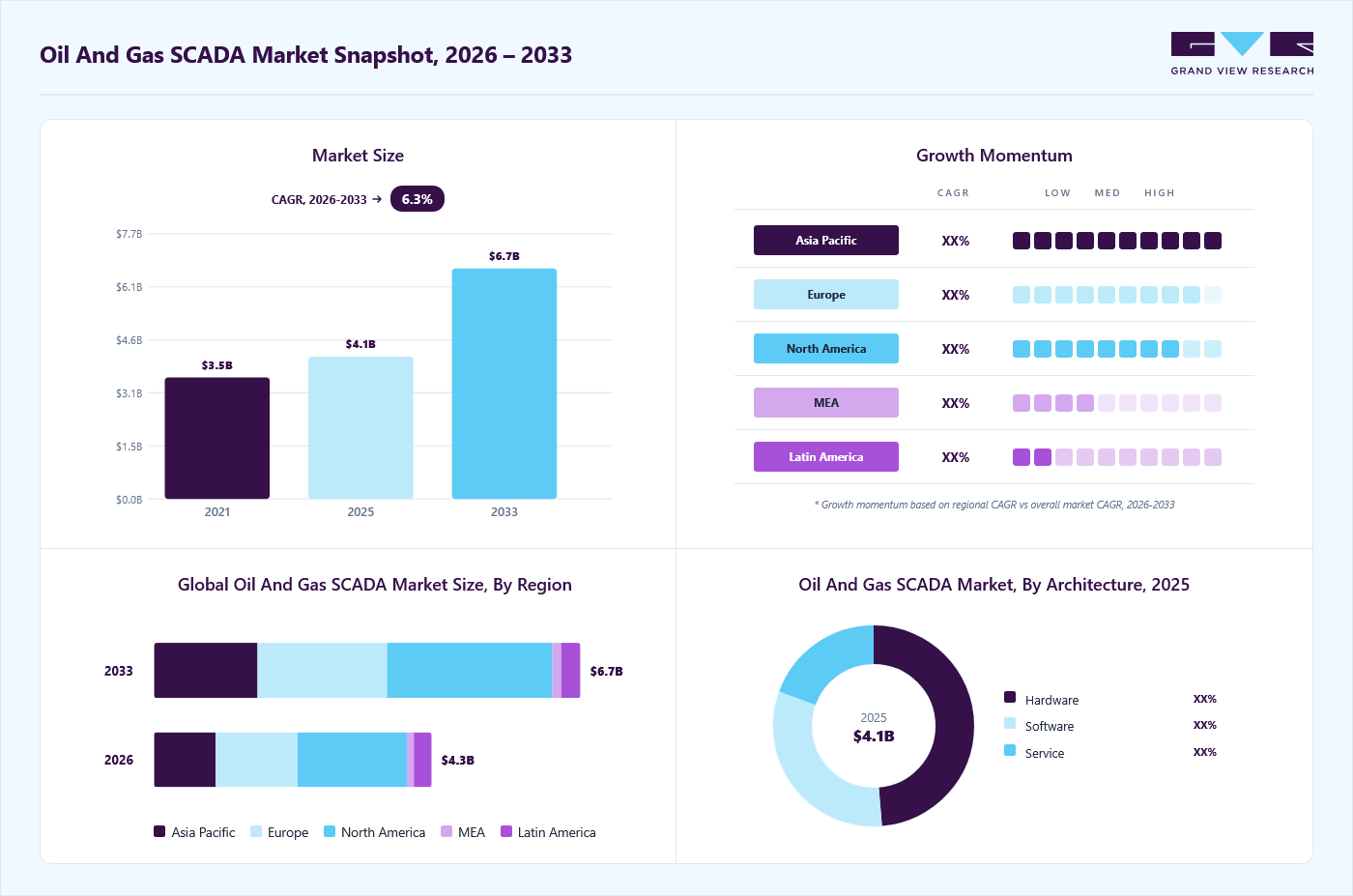 Source: Grand View Research, IR Documents, Primary Interviews, Paid DatabasesTo learn more about this report,
 Download Free Sample Report
Key Market Trends & Insights
- By architecture: Hardware segment held the largest market share of 48.6% in 2025.
- By sector: Upstream segment held the largest market share of 41.2% in 2025.
Regional Highlights
- Largest regional market: North America (39.4% revenue share, 2025)
- Fastest-growing regional market: Asia Pacific (highest CAGR, 2026-2033)
- By country: The U.S. held the largest market share in 2025
Market Size & Forecast
- Market size in 2025: USD 4.1 Billion
- Estimated market size in 2026: USD 4.3 Billion
- Projected market size by 2033: USD 6.7 Billion
- CAGR (2026-2033): 6.3%
Prism AI by Grand View Research Free to tryAsk a question about the oil and gas SCADA marketTry asking✓Every figure cited from GVR research Prefer the report? Download free sample →
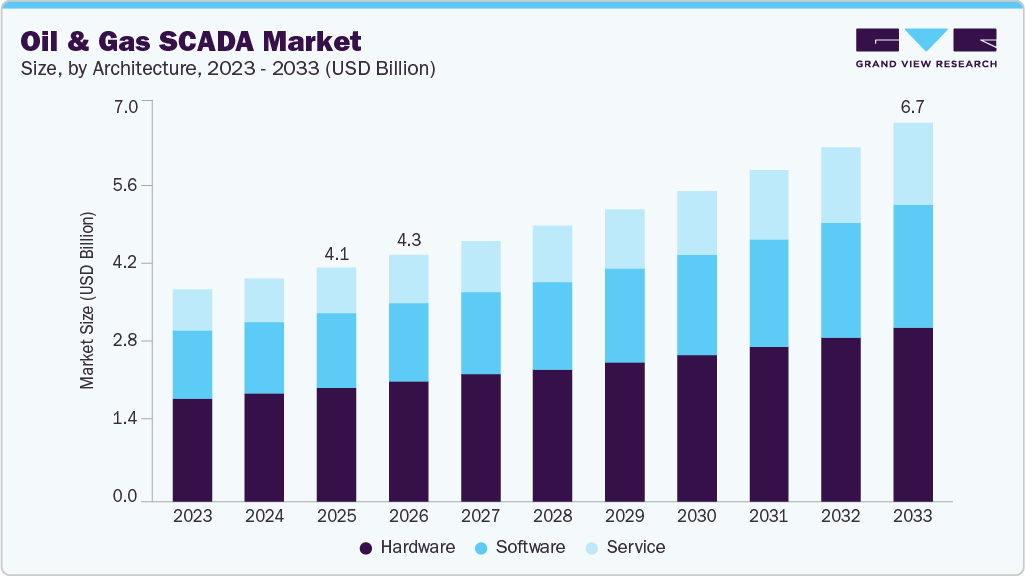
As exploration and production activities extend into remote and complex environments, SCADA systems enable operators to continuously track production levels, pipeline pressure, and equipment health, ensuring efficient operations, improved safety, and reduced downtime.The market is experiencing rapid growth, primarily driven by the increasing complexity and scale of oil & gas operations worldwide. Expansion of upstream, midstream, and downstream activities, along with the development of new pipelines and storage infrastructure, is creating a strong need for advanced monitoring and control systems. As assets become more geographically dispersed, operators are increasingly relying on SCADA systems to ensure seamless data acquisition, process automation, and operational efficiency across facilities.
 To learn more about this report, Download Free Sample Report
The rapid expansion of pipeline networks, industrialization, and global energy demand has significantly increased the need for continuous monitoring and secure management of critical infrastructure. This has led to higher adoption of SCADA systems for real-time tracking of pipeline flow, pressure, and equipment performance, particularly in remote and high-risk environments. Growing emphasis on minimizing downtime, preventing leaks, and ensuring regulatory compliance is further accelerating the deployment of SCADA solutions across the oil & gas value chain.
Drivers, Opportunities & Restraints
The oil & gas SCADA market is primarily driven by the growing need for real-time monitoring and remote management of widely dispersed assets across upstream, midstream, and downstream operations. Increasing pipeline infrastructure, exploration in remote and harsh environments, and rising global energy demand are accelerating the adoption of SCADA systems to ensure operational efficiency, safety, and reliability. The integration of digital technologies such as IoT, cloud computing, and predictive analytics is further enhancing SCADA capabilities, enabling proactive maintenance, reduced downtime, and optimized asset performance across the oil & gas value chain.
A key opportunity lies in the growing demand for cybersecurity services tailored to operational technology environments. As SCADA systems become increasingly interconnected and exposed to digital networks, the risk of cyber threats targeting critical infrastructure is intensifying. This creates strong demand for advanced security solutions, including secure communication protocols, network segmentation, and real-time threat detection. Companies that can offer robust, end-to-end cybersecurity frameworks for SCADA systems are well-positioned to capitalize on this trend, as operators prioritize safeguarding assets, ensuring operational continuity, and maintaining regulatory compliance across their digital operations.
However, maintaining secure, reliable connectivity to remote oil & gas sites remains a significant challenge for SCADA deployment. Many assets are located in geographically isolated or harsh environments where communication infrastructure is limited, leading to bandwidth constraints and intermittent network availability. These limitations can restrict real-time data transmission, delay critical decision-making, and impact system responsiveness. Ensuring consistent, high-speed, and secure data flow across such dispersed operations requires substantial investment in communication technologies, making it a key hurdle for operators adopting advanced SCADA solutions.
A key restraint in the oil & gas SCADA market is the shortage of skilled professionals with expertise in both operational technology and information technology. The limited availability of such cross-functional talent can hinder efficient system deployment, operation, and troubleshooting, ultimately impacting overall system performance and slowing the pace of digital transformation across the industry.
Architecture Insights
Based on architecture, the hardware segment accounted for the largest market share of 48.6% in 2025, primarily due to its critical role in enabling field-level data acquisition and control. Components such as Remote Terminal Units (RTUs), Programmable Logic Controllers (PLCs), sensors, and communication devices form the backbone of SCADA systems, especially in upstream and midstream operations where assets are widely dispersed and located in harsh environments. These hardware elements are essential for capturing real-time data on parameters such as pressure, temperature, and flow, enabling continuous monitoring and safe operations.
The service segment is the fastest-growing segment with a CAGR of 7.8% over the forecast period, driven by the increasing need for system integration, maintenance, and ongoing technical support. As operators deploy more complex and interconnected SCADA systems across dispersed assets, demand is rising for specialized services such as installation, consulting, cybersecurity, and remote monitoring. The growing focus on minimizing downtime, ensuring regulatory compliance, and protecting critical infrastructure is further accelerating the adoption of service-based offerings, making this segment the fastest-growing within the market.
Sector Insights
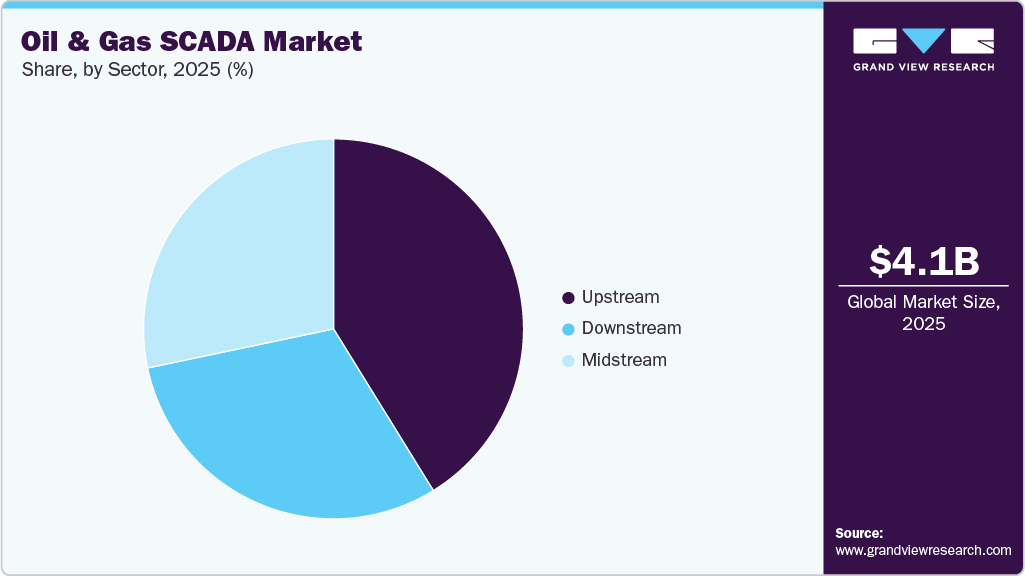
Based on sector, the upstream segment held the largest share of 41.2% in 2025, primarily due to its heavy reliance on continuous monitoring and control of drilling and production operations. Activities such as wellhead monitoring, reservoir management, and drilling automation require robust SCADA systems for real-time data visibility. The high-risk nature of upstream operations further increases the need for reliable control systems. Significant capital investments in exploration and production infrastructure support sustained SCADA adoption.
 To learn more about this report, Download Free Sample Report
The upstream segment of this market is also projected to register the fastest CAGR of 6.5% over the forecast period, driven by the rapid adoption of digital oilfield technologies and advanced automation. The integration of AI, analytics, and remote operations capabilities is enhancing efficiency and decision-making. Increasing focus on minimizing the on-site workforce and optimizing production is accelerating SCADA deployment. New exploration activities and modernization of existing oilfields are further boosting growth in this segment.
Regional Insights
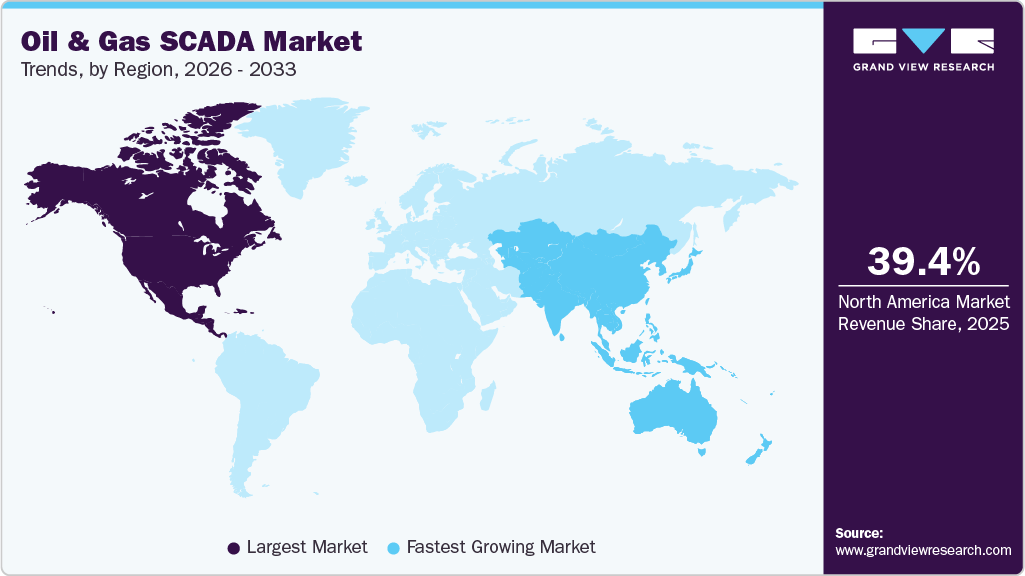
The Asia Pacific oil & gas SCADA industry is projected to witness the fastest growth of 7.7% CAGR during the forecast period, supported by rapid industrialization and rising energy demand across emerging economies. Expanding pipeline infrastructure, increasing exploration and production activities, and growing investments in refining and distribution networks are accelerating the adoption of SCADA systems. Governments and companies are focusing on modernizing legacy infrastructure and improving operational efficiency through digitalization and automation. The need for real-time monitoring, improved safety, and effective asset management across geographically dispersed operations is further fueling market growth in the region.
Europe Oil & Gas SCADA Market Trends
The oil & gas SCADA industry in Europe is driven by the region’s strong focus on operational safety, environmental compliance, and infrastructure modernization. Increasing investments in upgrading aging pipeline networks and refining facilities are supporting the adoption of advanced SCADA systems. Integration of digital technologies and automation is enhancing real-time monitoring and control across operations. The presence of stringent regulatory frameworks and a growing emphasis on energy efficiency and sustainability are further contributing to steady market growth in Europe.
North America Oil & Gas SCADA Market Trends
The oil & gas SCADA industry in North America held the largest share of 39.4% in 2025, due to its well-established oil & gas infrastructure and extensive pipeline network across the region. The presence of large-scale upstream, midstream, and downstream operations creates strong demand for advanced monitoring and control systems. The region has a high level of digitalization and early adoption of automation technologies, enabling widespread deployment of SCADA solutions. Continuous investments in upgrading aging infrastructure and enhancing operational efficiency further support market dominance.
 To learn more about this report, Download Free Sample Report
The region’s leadership is also reinforced by stringent regulatory requirements related to pipeline safety, environmental protection, and operational transparency. Oil & gas companies are increasingly adopting SCADA systems to ensure real-time monitoring, leak detection, and compliance with safety standards. The presence of major industry players and technology providers, along with growing focus on cybersecurity and system integration, continues to drive sustained demand for SCADA solutions across North America.
U.S. Oil & Gas SCADA Market Trends
The oil & gas SCADA industry in the U.S. is characterized by strong adoption of advanced control systems driven by the need to manage complex and high-volume energy operations. The presence of shale reserves and unconventional extraction activities has increased the demand for reliable monitoring solutions across drilling sites and processing facilities. Operators are increasingly focusing on integrating SCADA with advanced analytics and edge computing to enhance operational intelligence and reduce response times. The growing emphasis on infrastructure resilience, remote asset control, and protection against operational disruptions is reinforcing the expansion of SCADA deployments across the U.S. oil & gas sector.
Latin America Oil & Gas SCADA Market Trends
The oil & gas SCADA industry in Latin America is increasingly driven by the adoption of cloud-integrated and edge-enabled architectures, particularly to support operations in remote and challenging environments. As exploration and production activities expand into regions such as the offshore fields, operators are leveraging modern SCADA systems to enable real-time data access and remote decision-making. The shift toward edge-to-cloud connectivity enhances operational visibility, improves response times, and reduces reliance on on-site personnel.
Middle East & Africa Oil & Gas SCADA Market Trends
The oil & gas SCADA industry in the Middle East and Africa is driven by extensive oilfield operations and ongoing investments in expanding and modernizing energy infrastructure. The region’s vast upstream and midstream assets, often located in remote desert and offshore environments, require robust SCADA systems for real-time monitoring and control. The push toward digital transformation and smart oilfield initiatives, along with rising emphasis on pipeline security and safety, is further supporting the growth of SCADA solutions across the region.
Key Oil & Gas SCADA Company Insights
Some of the key participants in the global oil & gas SCADA market include ABB, Emerson Electric Co., General Electric, and Honeywell International Inc., among others. These companies collectively hold a significant share in the oil & gas SCADA market and play a critical role in shaping industry trends and competitive dynamics. They are heavily investing in advanced automation technologies, system integration, and cybersecurity solutions to enhance the reliability and security of SCADA networks.
Their operations typically encompass the design, deployment, and maintenance of SCADA systems across upstream, midstream, and downstream oil & gas activities. These systems are supported by robust communication networks and integrated with technologies such as IoT, cloud computing, and predictive analytics to enable efficient asset management. The adoption of data-driven solutions is helping operators improve decision-making, reduce downtime, and optimize overall operational performance.
As the oil & gas industry continues to evolve, companies in the SCADA market are prioritizing technological advancement, scalability, and enhanced system interoperability. Strategic collaborations with technology providers and infrastructure operators are becoming more common to support large-scale deployments and modernization projects. Increasing emphasis on remote operations, infrastructure security, and regulatory compliance is reshaping the competitive landscape and driving long-term market growth.
Key Oil And Gas SCADA Companies:
The following key companies have been profiled for this study on the oil & gas SCADA market.
- ABB
- Emerson Electric Co.
- General Electric
- Honeywell International Inc.
- Larsen & Toubro Limited
- Mitsubishi Electric Corporation
- Rockwell Automation, Inc.
- Schneider Electric SE
- Siemens
- Yokogawa Electric Corporation
Recent Developments
-
In April 2025, Emerson Electric Co. launched its DeltaV SaaS SCADA with Edge Connect, a cloud-enabled solution designed to enhance operational technology data mobility and enable faster integration of field devices with cloud-based SCADA systems. The launch supports improved real-time monitoring, scalability, and remote operations across oil & gas infrastructure.
-
In March 2025, Siemens completed the acquisition of Altair Engineering, strengthening its digital and automation portfolio by integrating advanced simulation and data analytics capabilities into its industrial software ecosystem. This move enhances SCADA-driven digitalization and predictive analytics in energy and industrial operations.
Oil & Gas SCADA Market Report Scope
Report Attribute
Details
Market Definition
The Global Oil & Gas SCADA market refers to the total revenue generated from the sale, deployment, and maintenance of supervisory control and data acquisition systems, including hardware, software, and services, used to monitor and control operations across upstream, midstream, and downstream oil & gas activities.
Market size in 2025
USD 4.1 billion
Estimated market size in 2026
USD 4.3 billion
Projected market size by 2033
USD 6.7 billion
Growth rate
CAGR of 6.3% from 2026 to 2033
Base year for estimation
2025
Historical data
2021 - 2024
Forecast period
2026 - 2033
Quantitative Units
Revenue in USD million/billion and CAGR from 2026 to 2033
Report coverage
Revenue forecast, competitive landscape, growth factors, and trends
Segments covered
Architecture, sector, region
Regional scope
North America; Europe; Asia Pacific; Latin America; Middle East & Africa
Country scope
U.S.; Canada; Mexico; Germany; UK; France; Italy; Spain; Russia; China; India; Australia;Japan; Brazil; Argentina; Saudi Arabia; UAE; South Africa
Key companies profiled
ABB; Emerson Electric Co.; General Electric; Honeywell International Inc.; Larsen & Toubro Limited; Mitsubishi Electric Corporation; Rockwell Automation, Inc.; Schneider Electric SE; Siemens; Yokogawa Electric Corporation
Customization scope
Free report customization (equivalent up to 8 analysts working days) with purchase. Addition or alteration to country, regional & segment scope.
Pricing and purchase options
Avail customized purchase options to meet your exact research needs. Explore purchase options
Global Oil & Gas SCADA Market Report Segmentation
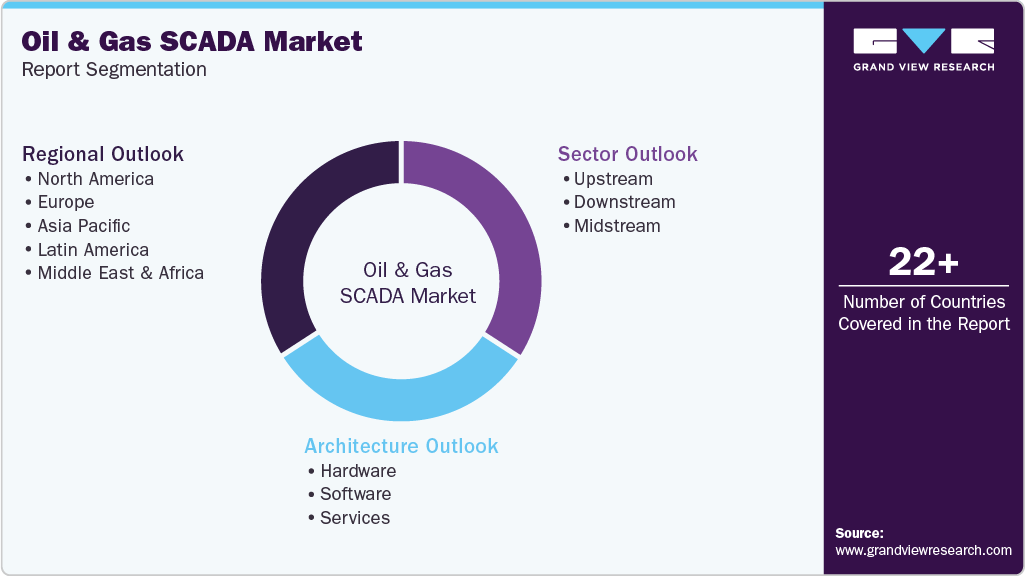
This report forecasts revenue growth at global, regional, and country levels and provides an analysis of the latest industry trends in each of the sub-segments from 2021 to 2033. For this study, Grand View Research has segmented the global oil & gas SCADA market report on the basis of architecture, sector, and region.
 To learn more about this report, Download Free Sample Report
-
Architecture Outlook (Revenue, USD Million, 2021 - 2033)
-
Hardware
-
Software
-
Services
-
-
Sector Outlook (Revenue, USD Million, 2021 - 2033)
-
Upstream
-
Downstream
-
Midstream
-
-
Regional Outlook (Revenue, USD Million, 2021 - 2033)
-
North America
-
U.S.
-
Canada
-
Mexico
-
-
Europe
-
Germany
-
UK
-
France
-
Italy
-
Spain
-
Russia
-
-
Asia Pacific
-
China
-
India
-
Australia
-
Japan
-
-
Latin America
-
Brazil
-
Argentina
-
-
Middle East & Africa
-
Saudi Arabia
-
UAE
-
South Africa
-
-
Frequently Asked Questions About This Report
The global oil & gas SCADA market size was valued at USD 4.1 billion in 2025 and is estimated at USD 4.3 billion for 2026.
North America dominated with a 39.4% revenue share in 2025.
Asia Pacific is the fastest-growing region over the forecast period.
The upstream segment led with a 41.2% revenue share in 2025, and is the fastest-growing sector.
The global oil and gas SCADA market is expected to grow at a CAGR of 6.3% from 2026 to 2033, reaching USD 6.7 billion by 2033.
Key players include ABB; Emerson Electric Co.; General Electric; Honeywell International Inc.; Larsen & Toubro Limited; Mitsubishi Electric Corporation; Rockwell Automation, Inc.; Schneider Electric SE; Siemens; Yokogawa Electric Corporation.
The hardware segment led with a 48.6% revenue share in 2025, while service is the fastest-growing architecture.
The key factors driving the growth of this market are the increasing need for operational efficiency and safety across remote and complex infrastructure like pipelines, offshore platforms, and refineries. Growing energy demand, aging pipeline infrastructure requiring modernization, and the push for real-time monitoring and automated control are key accelerators.
About the Author(s)
Conventional Energy Research Team
Energy & Power · Conventional EnergyThis report was authored by the conventional energy research team at Grand View Research - comprising two research analysts, one senior research analyst, and one industry expert - with specialized expertise in the conventional energy segment of the energy & power industry. All findings are based on proprietary energy & power databases, executive interviews, and regulatory analysis, subject to internal peer review prior to publication.
Last Updated:
Speak to Analyst

Customize this report to your needs - add regions, segments, or data points, with 20% free customization.
Or view our licence options:


ISO 9001:2015 & 27001:2022 Certified
We are GDPR and CCPA compliant! Your transaction & personal information is safe and secure. For more details, please read our privacy policy.


