
- Home
- »
- Automotive & Transportation
- »
-
Online Salvage Auctions Market Size Report, 2026-2033GVR Report cover

Online Salvage Auctions Market (2026 - 2033)
Size, Share & Trends Analysis Report By Component (Product (Used Vehicles, Salvage Vehicles, Seized Vehicle), Services), By Application (Rental Agencies, OEM, Banks & Financial Service Institutions), By Region, And Segment Forecasts
Market Size, 2025
$12.2BMarket Estimate, 2026
$14.1BMarket Forecast, 2033
$47.4BCAGR, 2026–2033
19.0%Online Salvage Auctions Market Summary
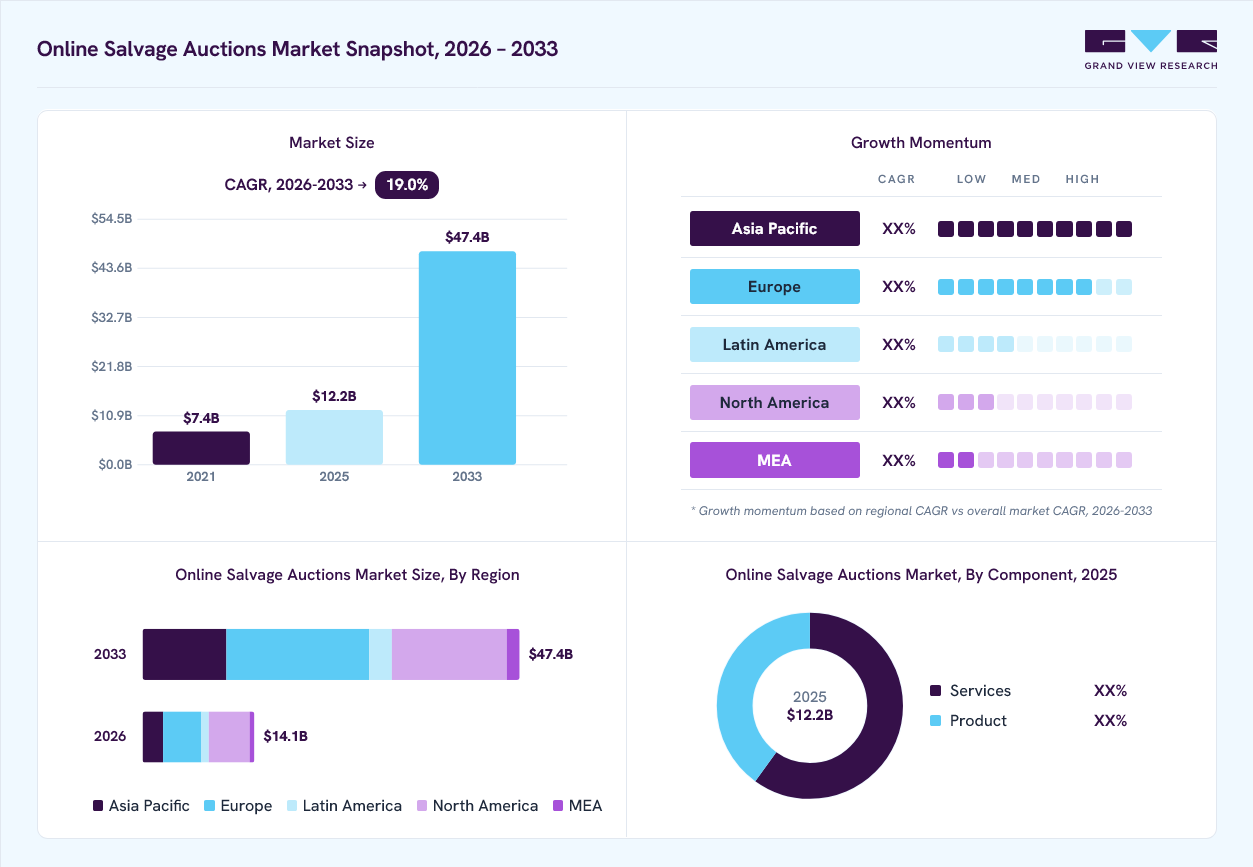
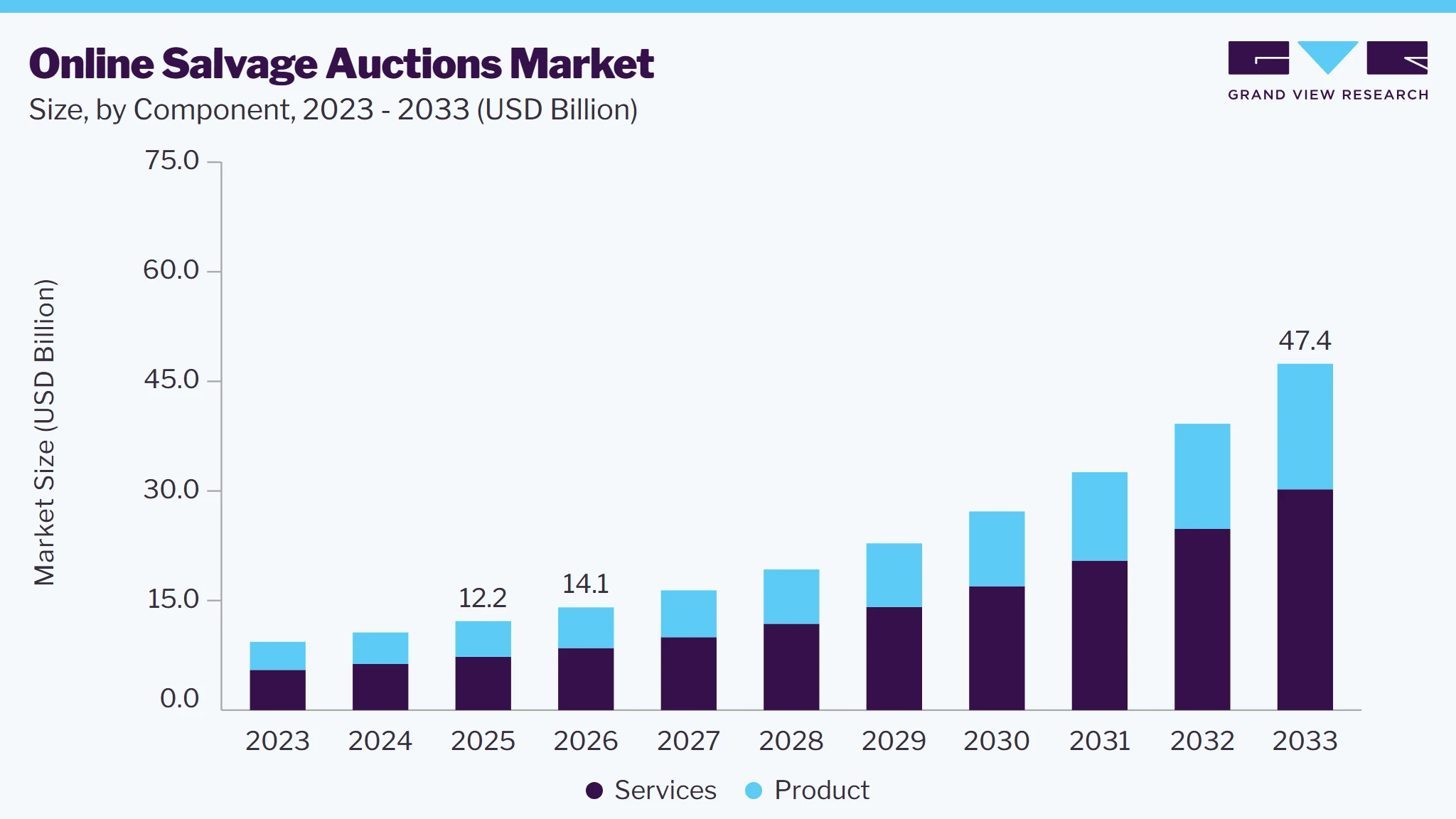
The global online salvage auctions market size was valued at USD 12.2 billion in 2025 and is projected to grow from USD 14.1 billion in 2026 to USD 47.4 billion by 2033, at a CAGR of 19.0% from 2026 to 2033. North America dominated the global market with the largest revenue share of 37.5% in 2025. The online salvage auctions industry has experienced substantial growth, emerging as a new sector within the insurance and automotive industries.
 Source: Grand View Research, IR Documents, Primary Interviews, Paid DatabasesTo learn more about this report,
 Download Free Sample Report
Key Market Trends & Insights
- By component: Services segment dominated the market, with a revenue share of 59.9% in 2025
- By application: Banks and financial service Institutions segment held the largest market share in 2025
Regional Highlights
- Largest regional market: North America (37.5% revenue share, 2025)
- Fastest-growing regional market: Asia Pacific (highest CAGR, 2026-2033)
- By country: The U.S. held the largest market share in 2025.
Market Size & Forecast
- Market size in 2025: USD 12.2 Billion
- Estimated market size in 2026: USD 14.1 Billion
- Projected market size by 2033: USD 47.4 Billion
- CAGR (2026-2033): 19.0%
Three ways to get this report
Buy it, customize it, or ask a question.Ask an Analyst
Analyst response in 1 business day
- AccessReport author, directly
- Reply timeWithin 1 working day
- No sales callDirect answer only
- FormatEmail reply
- CostFree, no cost
Get the Full Report
What the study covers
- FormatsPDF · Excel · Dashboard
- Timeline2026–2033 annual, 2025 base
- Coverage20+ countries, 5 regions
- Companies10+ key players profiled
Customize the Report
20% free customization
- IncludeCountries, segments, points
- TailorTo your product definition
- ExtendDeeper competitor detail
- OrA fully bespoke study
- Turnaround5–10 working days
These online platforms serve as marketplaces, where used, salvaged, or damaged vehicles, are listed for sale by insurance companies, auto repair shops, and private sellers. Vehicles declared a total loss or damage due to accidents, natural disasters, or other incidents can be bought and sold transparently and efficiently through these auctions. In addition, in online salvage auctions, vehicles are listed with detailed descriptions, photos, and sometimes condition reports so buyers can assess the damage and decide on their bid.
 To learn more about this report, Download Free Sample Report
The rise of digital platforms has significantly streamlined buying and selling vehicles in online salvage auctions. Platforms are becoming more intuitive and efficient with enhanced user interfaces, automated bidding systems, and AI-driven price predictions. Sellers and buyers can now access auctions from anywhere in the world, increasing competition and market liquidity. Automation has helped speed up the auction process and reduce human error, creating a more seamless experience for buyers and sellers. As technology continues to advance, digital tools such as real-time vehicle condition reports, virtual vehicle inspections, and advanced fraud detection algorithms are expected to play an important role in the growth of the online salvage auctions industry.
With the global shift toward sustainability and the increasing adoption of electric vehicles (EVs) and hybrids, the market is seeing a rising interest in these vehicles. Salvage EVs and hybrids offer a unique value proposition for repair shops and buyers who specialize in restoring or parting out vehicles. As battery technology improves and more manufacturers enter the EV space, a larger percentage of salvage vehicles is expected to be electric or hybrid models. This growing segment presents new opportunities for auction platforms to diversify their offerings and target specific buyer demographics, such as those interested in green technologies or specialized vehicle parts.
Furthermore, with new car prices rising, many consumers turn to used or salvaged vehicles as a cost-effective alternative. Online salvage auctions provide an accessible platform for purchasing vehicles that can be repaired or used for parts at significantly lower prices than new cars. This trend appeals to a diverse demographic, including budget-conscious individuals and businesses looking for value, thus driving sustained market growth. In addition, with sustainability becoming a priority for consumers and businesses alike, the market is benefiting from increased interest in recycling and repurposing vehicle parts, propelling market growth.
Despite this growth, factors such as limited inspection opportunities, risk of fraudulent listings, and shipping and transportation challenges could hamper market growth. For instance, unlike traditional vehicle auctions, where buyers can inspect vehicles in person before placing a bid, online auctions typically offer only limited information and photos of salvage cars. This lack of physical inspection makes it challenging for buyers to assess the condition of the vehicles accurately, increasing the risk of purchasing a vehicle with hidden damage or mechanical issues. In addition, online auctions often do not allow for test drives, further limiting the buyer's ability to evaluate the car's performance and functionality. As a result, buyers may end up with a vehicle that requires expensive repairs or does not match the description, potentially leading to significant financial losses.
Market Dynamics
The online salvage auctions market is evolving in response to structural shifts in vehicle ownership models, rising volumes of total-loss vehicles, and increasing digitalization across automotive remarketing value chains. Insurers, lenders, fleet operators, and OEMs are progressively replacing physical auctions with online platforms to improve asset recovery efficiency, price transparency, and buyer reach. Advancements in data analytics, remote vehicle inspection technologies, and secure digital bidding systems are reinforcing buyer confidence and supporting broader cross-border participation.
The increasing frequency of road accidents, higher repair costs due to advanced vehicle electronics, and stricter insurance loss thresholds have led to a steady rise in total-loss vehicle declarations. Insurers and financial institutions face mounting pressure to dispose of damaged, repossessed, and end-of-life vehicles quickly while maximizing recovery values. Traditional physical auctions are constrained by limited geographic reach, higher logistics costs, and slower liquidation cycles, making them less effective at scale.
Online salvage auction platforms address this challenge by enabling real-time access to a global buyer base, including dismantlers, exporters, rebuilders, and recyclers. Digital auctions accelerate turnaround times, reduce storage and transportation costs, and improve price discovery through competitive bidding. As a result, insurers and lenders increasingly rely on online channels to optimize asset recovery, directly driving transaction volumes and platform revenues.
The online salvage auctions market is subject to diverse regulatory frameworks governing vehicle titles, salvage classifications, environmental compliance, and cross-border trade. Variations in disclosure requirements, export restrictions, and dismantling regulations across jurisdictions increase operational complexity for platform operators and participants. Compliance costs and legal risks can deter smaller sellers and buyers from adopting online salvage channels.
These regulatory challenges disproportionately impact cross-border transactions and emerging markets where enforcement standards are inconsistent. Regions with stringent environmental and consumer protection laws may experience slower platform onboarding, particularly for salvage and seized vehicles. As a result, regulatory fragmentation limits market scalability and delays uniform adoption across geographies.
Rapid digital adoption, expanding vehicle parc, and improving internet infrastructure in emerging economies are creating new opportunities for online salvage auctions. Insurers, banks, and fleet operators in these markets are increasingly formalizing vehicle disposal processes, shifting away from informal resale channels. Growing acceptance of online marketplaces and digital payments is further enabling platform-based remarketing.
Online salvage auction providers that offer localized compliance support, multilingual interfaces, and flexible inspection models are well positioned to capture this opportunity. Platforms focusing on used and lightly damaged vehicles, as well as export-oriented buyers, are expected to benefit most. Strategic partnerships with insurers and financial institutions in emerging regions can unlock sustained transaction growth.
Analyst Perspective
The online salvage auctions market is transitioning from a complementary channel to a core component of automotive remarketing infrastructure. Growth is supported by rising total-loss vehicle volumes, cost pressures on insurers, and increasing acceptance of digital asset disposal models. Technology-driven transparency, data-enabled pricing, and remote inspection capabilities are reshaping buyer confidence and participation. Investment activity is expected to focus on analytics, AI-based valuation, and cross-border transaction enablement. Competitive differentiation is increasingly driven by scale, compliance expertise, and ecosystem partnerships rather than pure auction volume.
Component Insights
Based on component, the services segment led the market with the largest revenue share of 59.9% in 2025. The segment includes auction and auction-related services. This includes a wide range of services, such as vehicle inspection, transportation, and storage. As the market becomes more competitive, auction platforms increasingly focus on offering value-added services to attract buyers and sellers. The demand for vehicle inspections, particularly for salvage and used cars, is growing as buyers seek to assess the condition of cars remotely. Thus, with the maturation of the online marketplace, the services segment is expected to expand, introducing new innovations aimed at enhancing convenience, transparency, and efficiency for all participants in the auction process.
The product segment is expected to grow at a notable CAGR during the forecast period. The product segment is further bifurcated into used vehicles, salvage vehicles, and seized vehicles. The salvage vehicle is the dominant market segment, driven by the increasing number of total-loss claims from insurance companies. Salvage vehicles, which are typically damaged beyond economical repair or declared total losses, provide significant opportunities for resellers, repair shops, and individuals seeking cheaper cars for parts or restoration. The rise in car repair costs and the increasing use of insurance for total-loss vehicles have bolstered the volume of salvage cars entering online auctions, thereby driving segment growth.
Application Insights
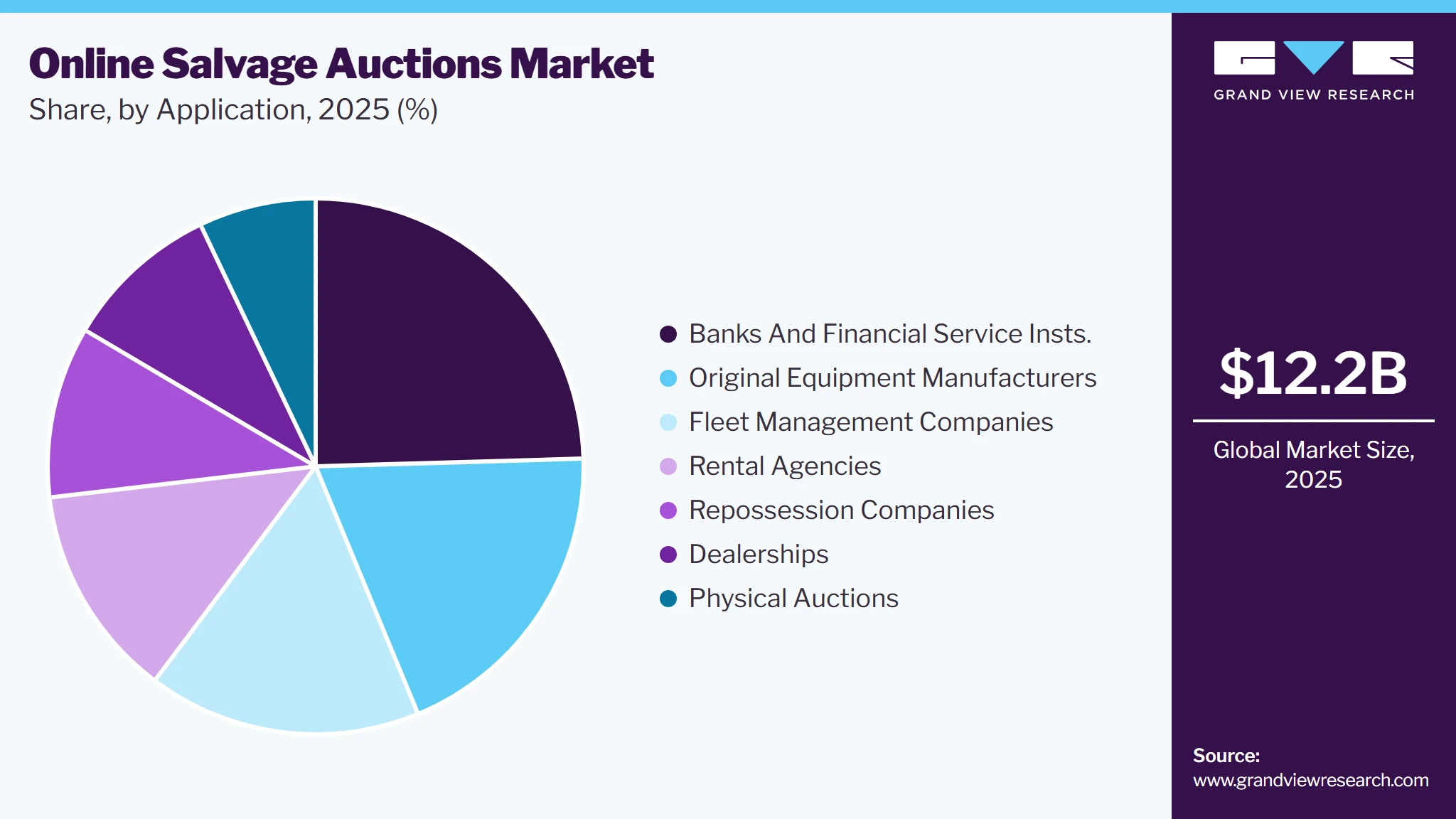
Based on application, the banks and financial service institutions segment led the market with the largest revenue share of 24.5% in 2025. The involvement of banks and financial service institutions in the market has been growing as these entities play a key role in managing repossessed or defaulted vehicles. Financial institutions, which often have large portfolios of vehicles seized due to loan defaults, increasingly turn to online salvage auctions to liquidate these assets. The growing shift toward digital platforms has made it easier for banks and financial services to reach a larger pool of potential buyers, improving the speed and efficiency of asset recovery. This segment particularly benefits from the rise in demand for affordable used vehicles, which banks can offload through online auctions at competitive prices.
 To learn more about this report, Download Free Sample Report
The repossession companies segment is anticipated to grow at a moderate CAGR during the forecast period. Repossession companies are integral to the online salvage auction landscape, bridging lenders and auction platforms. As financial institutions face higher rates of vehicle repossession, these companies facilitate the quick disposal of repossessed vehicles through online auctions. This process helps lenders recover some of their losses and ensures a steady supply of vehicles for auction platforms. The growing trend toward digital solutions has made it easier for repossession companies to list vehicles online, increasing efficiency and attracting a wider audience of potential buyers. As the market continues to expand, repossession companies are expected to become even more pivotal in connecting lenders with buyers in the online salvage auction space.
Regional Insights
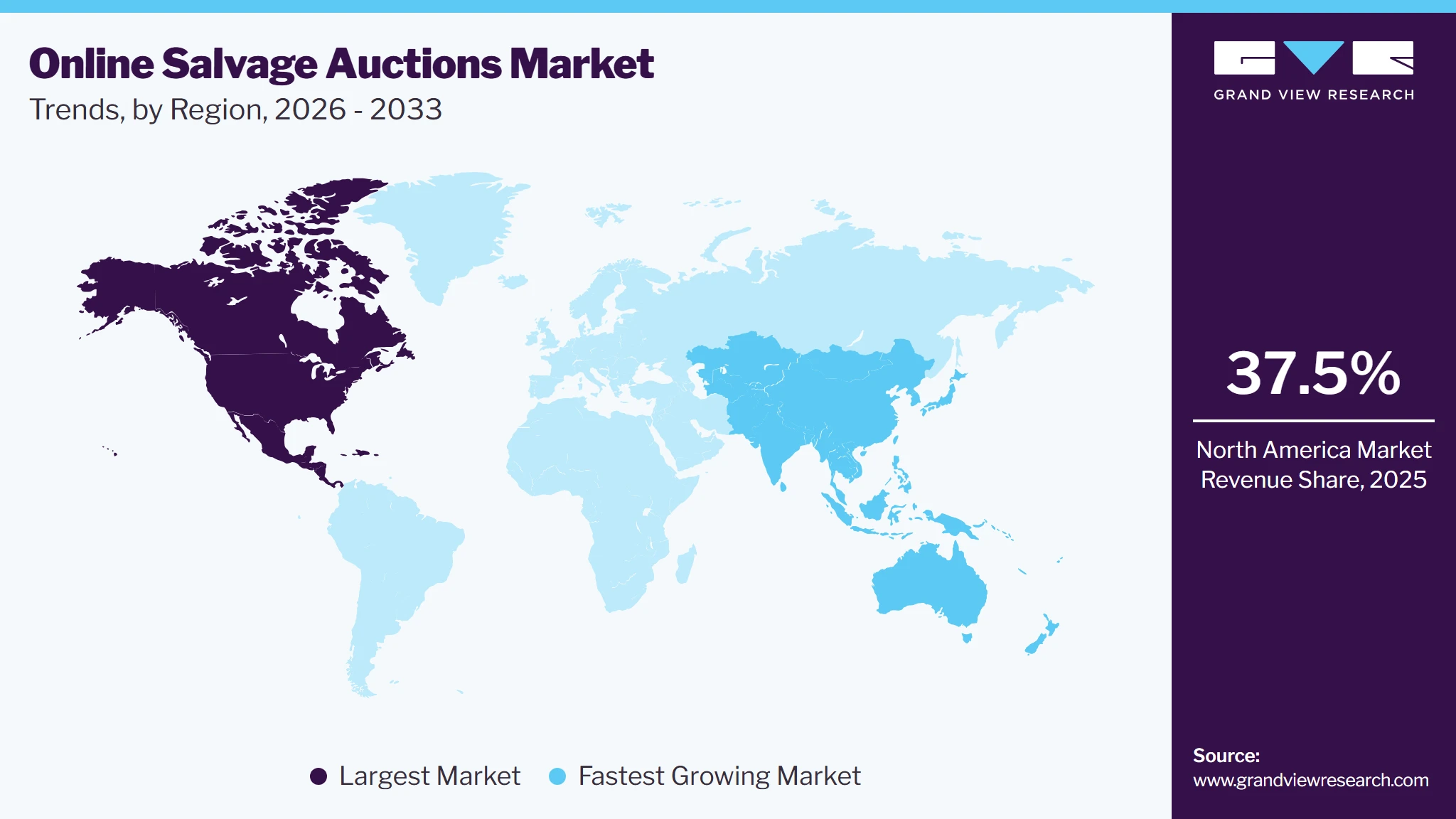
North America dominated the global online salvage auctions market with the largest revenue share of 37.5% in 2025. Market growth is driven by factors such as increasing vehicle turnover, rising demand for used and salvage vehicles, and the adoption of digital platforms. In addition, the growing emphasis on sustainability and vehicle recycling, coupled with a shift toward e-commerce, has accelerated the acceptance of online salvage auctions, thereby propelling the market’s growth.
 To learn more about this report, Download Free Sample Report
U.S. Online Salvage Auctions Market Trends
The online salvage auctions market in the U.S. held the largest share in the North America region in 2025 with its mature automotive industry and widespread use of online auction platforms. The increase in vehicle repossession, accidents, and insurance write-offs has resulted in a continual influx of salvage vehicles available for auction.
Europe Online Salvage Auctions Market Trends
The online salvage auctions market in Europe is expected to register a notable CAGR from 2025 to 2030. The market is expanding, with key players such as Copart Inc. and IAA Holdings LLC entering new markets and strengthening their presence. In the region, the UK has emerged as a significant market for online vehicle auctions, with platforms gaining popularity due to their convenience and accessibility.
The UK online salvage auctions market held a substantial market share in 2024. The UK has seen increased demand for online salvage auctions, particularly as digital platforms continue to gain traction. The market benefits from an established automotive industry and a steady supply of vehicles that are no longer fit for use, including cars written off by insurance companies or repossessed.
The online salvage auctions market in Germany is expected to grow rapidly during the forecast period. The country is home to many high-value vehicles, and the increasing number of accidents and vehicle write-offs has contributed to a growing supply of salvage vehicles, thereby driving the growth of the industry in the country.
Asia Pacific Online Salvage Auctions Market Trends
The online salvage auctions market in Asia Pacific is anticipated to grow at a CAGR of 20.7% during the forecast period. China, Japan, and India are major contributors to market growth. China, with its large vehicle fleet and rapidly growing online marketplace, is expected to see significant growth in this sector. In addition, India presents a high growth potential due to its expanding middle class, rising vehicle ownership, and increasing vehicle turnover.
Japan online salvage auctions market is expected to grow at a moderate growth rate during the forecast period. Japan has a well-established automotive industry with a strong culture of vehicle recycling, which directly supports market growth. In addition, Japan's growing focus on sustainability and the circular economy is boosting the demand for recycled parts and salvage vehicles, further supporting the expansion of online auctions in the country.
The online salvage auctions market in China held a substantial market share in 2024. The country’s rapidly growing vehicle fleet and rising vehicle ownership and accidents generate a steady supply of salvage vehicles.Moreover, China’s push toward sustainability and environmental responsibility encourages greater adoption of recycling and salvage vehicle disposal methods.
Key Online Salvage Auctions Company Insights
Some of the key companies in the online salvage auctions industry include COPART, INC., IAA Holdings, LLC., ACV Auctions, and others. Organizations are continually enhancing their platforms, expanding their global reach, and innovating to provide a better user experience. Therefore, key players are taking several strategic initiatives, such as partnerships, collaborations, and agreements.
-
COPART, INC. is a major global provider of vehicle remarketing and online auction services, with operations in the U.S., the UK, Canada, Germany, Brazil, the UAE, Spain, Finland, Oman, the Republic of Ireland, and Bahrain. The company specializes in used, wholesale, salvage, and repairable vehicles. The company provides a platform to search, bid on, and win a wide range of vehicles, including classic cars, boats, repo cars, ATVs, exotics, motorcycles, and more.
-
IAA Holdings, LLC (IAA), a subsidiary of Ritchie Bros. Auctioneers Incorporated, is a global marketplace providing services, insights, and transaction solutions for vehicles and commercial assets. By utilizing cutting-edge technology and prioritizing innovation, IAA's unique platform enables the marketing and sale of low-value, total-loss, and damaged vehicles. IAA provides sellers with a comprehensive range of services designed to maximize vehicle value, reduce administrative costs, shorten selling cycle times, and achieve the highest economic returns.
Key Online Salvage Auctions Companies:
The following key companies have been profiled for this study on the online salvage auctions market.
-
COPART, INC.
-
IAA Holdings, LLC.
-
RAW2K
-
Manheim
-
Silverlake Autoparts
-
SCA Auctions
-
RideSafely
-
ACV Auctions
-
Adesa Auctions
-
Bid N Drive Inc.
Competitive Benchmarking
Category
Operating Strategies
Competitive Edge
Weakness
Established Players (COPART, INC.; IAA Holdings, LLC.; Manheim; Adesa Auctions
- These players are focused on operating large-scale digital auction platforms with integrated logistics, inspection, and title services across multiple regions.
- These players have extensive buyer networks, strong insurer relationships, and high transaction liquidity.
- High operational complexity and exposure to regulatory changes across geographies.
Emerging Players (ACV Auctions; RideSafely; SCA Auctions)
- These players are focused on technology-led auctions, niche buyer segments, and selective geographic expansion.
- These players have agile platforms, digital-first inspection models, and competitive pricing.
- Limited global scale and lower brand recognition compared to established incumbents.
Recent Developments
-
In April 2023, IAA Holdings, LLC (IAA) announced a market alliance with Antonio, SARL in Benin, West Africa. This partnership provides Antonio, SARL-operated auction centers in Benin, the authority to assist local buyers in searching for, bidding on, paying for, transporting, shipping, and importing vehicles from IAA auctions in the U.S. Strategic alliances such as this one strengthen IAA’s global digital marketplace and ensure that its inventory reaches a broader audience of potential buyers worldwide.
Online Salvage Auctions Market Report Scope
Report Attribute
Details
Market size in 2025
USD 12.2 billion
Estimated market size in 2026
USD 14.1 billion
Projected market size by 2033
USD 47.4 billion
Growth rate
CAGR of 19.0% from 2026 to 2033
Base year for estimation
2025
Historical data
2021 - 2024
Forecast period
2026 - 2033
Quantitative units
Revenue in USD billion and CAGR from 2026 to 2033
Report coverage
Revenue forecast, company market share, competitive landscape, growth factors, and trends
Segments covered
Component, application, region
Regional scope
North America; Europe; Asia Pacific; Latin America; MEA
Country scope
U.S.; Canada; Mexico; Germany; U.K.; France; China; Japan; India; South Korea; Australia; Brazil; Saudi Arabia; UAE; and South Africa
Key companies profiled
COPART, INC.; IAA Holdings, LLC.; RAW2K; Manheim; Silverlake Autoparts; SCA Auctions; RideSafely; ACV Auctions; Adesa Auctions; Bid N Drive Inc.
Customization scope
Free report customization (equivalent up to 8 analysts' working days) with purchase. Addition or alteration to country, regional & segment scope.
Pricing and purchase options
Avail customized purchase options to meet your exact research needs. Explore purchase options
Global Online Salvage Auctions Market Report Segmentation
This report forecasts revenue growth at global, regional, and country levels and provides an analysis of the latest industry trends in each of the sub-segments from 2021 to 2033. For this study, Grand View Research has segmented the global online salvage auctions market report based on component, application, and region.
 To learn more about this report, Download Free Sample Report
-
Component Outlook (Revenue, USD Million, 2021 - 2033)
-
Product
-
Used Vehicles
-
Salvage Vehicles
-
Seized Vehicle
-
-
Services
-
-
Application Outlook (Revenue, USD Million, 2021 - 2033)
-
Banks and Financial Service Institutions
-
Original Equipment Manufacturers (OEM)
-
Fleet Management Companies
-
Rental Agencies
-
Repossession Companies
-
Dealerships
-
Physical Auctions
-
-
Regional Outlook (Revenue, USD Million, 2021 - 2033)
-
North America
-
U.S.
-
Canada
-
Mexico
-
-
Europe
-
Germany
-
UK
-
France
-
-
Asia Pacific
-
China
-
Japan
-
India
-
South Korea
-
Australia
-
-
Latin America
-
Brazil
-
-
Middle East and Africa (MEA)
-
KSA
-
UAE
-
South Africa
-
-
Research Methodology
The online salvage auctions market figures in this report are based on a proven research process that combines executive interviews with secondary research from proprietary databases, company filings, and recognized regulatory and institutional sources. Market size is built through value-chain sizing - reconciling supply-side and demand-side estimates - and triangulated with bottom-up and top-down approaches. Every estimate passes multiple levels of expert validation before publication, with each online salvage auctions segment quantified using the revenue-capture definitions in the table below.
Segment Definition
Segment - Component
Revenue capture definition
Product
Revenue generated from auction-based sales of vehicles listed on the platform, including seller listing fees, buyer premiums, transaction commissions, and resale margins earned on used, damaged, repossessed, and surplus vehicles sold through online and physical auction channels. The segment includes products such as used, salvage, and seized vehicles.
Used Vehicles: Revenue captured through auction listing fees charged to sellers, buyer premiums, transaction-based commissions, and resale margins on functional pre-owned vehicles sold via online and physical auction platforms.
Salvage Vehicles: Revenue generated from auction commissions, buyer fees, recovery handling charges, and disposal service fees on vehicles classified as total loss due to accidents, floods, fire damage, theft recovery, or natural disasters, primarily sold for parts, refurbishment, recycling, or export.
Seized Vehicles: Revenue derived from facilitation fees, buyer premiums, and recovery-related commissions earned from auctioning vehicles confiscated or repossessed by banks, financial institutions, government authorities, or enforcement agencies to recover outstanding dues or penalties.
Services
Revenue generated from inspection and condition reporting fees, documentation and title transfer services, logistics and towing charges, storage fees, platform access subscriptions, and value-added digital auction services.
Segment - Application
Revenue capture definition
Banks and Financial Service Institutions
Revenue generated from auction facilitation fees, buyer premiums, and recovery-related service charges earned through the disposal of repossessed and seized vehicles to recover outstanding loan amounts, non-performing assets, and defaulted credit exposures.
Original Equipment Manufacturers (OEM)
Revenue from auctioning surplus inventory, test vehicles, buyback units, damaged logistics vehicles, and end-of-life demonstration assets.
Fleet Management Companies
Revenue generated through auction sales of de-fleeted vehicles at lease-end or mileage thresholds, including bulk vehicle disposal programs.
Rental Agencies
Revenue captured from auction-based disposal of aging rental fleets, accident-damaged vehicles, and surplus inventory to refresh active fleets.
Repossession Companies
Revenue earned from commissions, handling fees, and auction facilitation charges linked to recovered vehicles from loan defaulters.
Dealerships
Revenue from auction-based resale of trade-in vehicles, overstock inventory, damaged units, and wholesale vehicle sourcing.
Physical Auctions
Revenue generated from on-site entry fees, bidder registration charges, live auction commissions, storage fees, and hybrid online to offline transaction services.
Estimation Model
Layer Name
Key Question
Description
Vehicle Supply Base
How many vehicles are eligible for online salvage auctions?
This layer estimates the total pool of salvage, used, and seized vehicles generated annually by insurers, lenders, fleets, and rental agencies. It accounts for accident rates, insurance write-offs, repossessions, and fleet retirement cycles. The output defines the addressable supply volume for online platforms.
Digital Auction Penetration
What share of eligible vehicles is auctioned online?
This layer measures the adoption rate of online auctions versus physical or offline channels. It considers digital readiness, regulatory acceptance, and seller preferences across regions. Penetration rates directly influence transaction volumes processed online.
Monetization Intensity
How much revenue is generated per transaction?
This layer evaluates average seller fees, buyer premiums, and service revenues per vehicle. It reflects platform pricing models, vehicle value mix, and service attachment rates. Monetization intensity varies by vehicle type and application segment.
Platform Revenue Realization
What is the total market revenue?
The final layer aggregates transaction volumes and monetization metrics to estimate total market revenues. It captures recurring auction income and ancillary service revenues. This layer reflects the realized economic value of the Online Salvage Auctions Market.
Delivered Customizations
This report has been delivered with the following In-depth customizations
Client Request
Customization Delivered
Value Adds
Regional Online Salvage Auctions Market Opportunity Assessment
Country/region-wise market sizing and forecasts
Analysis of demand, adoption trends, and regulatory landscape
Identification of high-growth regions and investment hotspots
Identified region-specific growth opportunities
Supported expansion and go-to-market strategy
Enabled informed regional investment decisions
Cross-Segmentation Analysis for the Online Salvage Auctions Market
Criss-cross market analysis by component, application
Demand and adoption assessment across key segments
Segment attractiveness and growth potential benchmarking
Identified high-potential market segments
Supported targeted Component positioning and marketing strategy
Improved customer and segment prioritization
Competitive Benchmarking and Strategic Positioning in the Online Salvage Auctions Market
Benchmarking of key competitors across Components, pricing, partnerships, and innovation
Comparative assessment of market share, capabilities, and strategies
Analysis of competitive strengths, gaps, and differentiation areas
Identified competitive white spaces and growth gaps
Supported strategic positioning and differentiation
Enabled data-driven competitive strategy development
Frequently Asked Questions About This Report
North America dominated the market with the largest revenue share of 37.5% in 2025. Market growth is driven by factors such as increasing vehicle turnover, rising demand for used and salvage vehicles, and the adoption of digital platforms.
Asia Pacific is the fastest-growing region over the forecast period.
Banks and financial service institutions segment held the largest market share of 24.5% in 2025 and is the fastest-growing segment over the forecast period.
The U.S. held the largest market share in 2025.
The global online salvage auctions market size was estimated at USD 12.2 billion in 2025 and is expected to reach USD 14.1 billion in 2026.
The global online salvage auctions market is expected to grow at a CAGR of 19.0% from 2026 to 2033, reaching USD 47.4 billion by 2033.
Services segment dominated the market, with a revenue share of 59.9% in 2025. The segment includes auction and auction-related services. This includes a wide range of services, such as vehicle inspection, transportation, and storage. As the market becomes more competitive, auction platforms increasingly focus on offering value-added services to attract buyers and sellers.
Some key players operating in the online salvage auctions market include COPART, INC., IAA Holdings, LLC., RAW2K, Manheim, Silverlake Autoparts, SCA Auctions, RideSafely, ACV Auctions, Adesa Auctions, and Bid N Drive Inc.
The online salvage auctions industry has experienced substantial growth, emerging as a new sector within the insurance and automotive industries.
About the Author(s)
Automotive & Transportation Research Team
Technology · Automotive & TransportationThis report was authored by the automotive & transportation research team at Grand View Research - comprising two research analysts, one senior research analyst, and one industry expert - with specialized expertise in the automotive & transportation segment of the technology industry. All findings are based on proprietary technology databases, executive interviews, and regulatory analysis, subject to internal peer review prior to publication.
Last Updated:
Speak to Analyst

Customize this report to your needs - add regions, segments, or data points, with 20% free customization.
Or view our licence options:


ISO 9001:2015 & 27001:2022 Certified
We are GDPR and CCPA compliant! Your transaction & personal information is safe and secure. For more details, please read our privacy policy.


