
- Home
- »
- Next Generation Technologies
- »
-
Optical Switches Market Size & Share Report, 2026-2035GVR Report cover

Optical Switches Market (2026 - 2035)
Size, Share & Trends Analysis Report By Type (MEMS Optical Switches, Electro-Optical Switches), By Technology, By Application, By Region, And Segment Forecasts
Market Size, 2025
$7.5BMarket Estimate, 2026
$8.4BMarket Forecast, 2035
$23.7BCAGR, 2026–2035
12.2%Optical Switches Market Summary
The global optical switches market size was valued at USD 7.5 billion in 2025 and is projected to grow from USD 8.4 billion in 2026 to USD 23.7 billion in 2035, at a CAGR of 12.2% from 2026 to 2035. North America dominated the market, accounting for the largest revenue share in 2025. The global market for optical switches is witnessing significant growth, driven by increasing demand for high-speed data transmission, expanding fiber optic networks, and rising investments in data centers and telecommunications infrastructure.
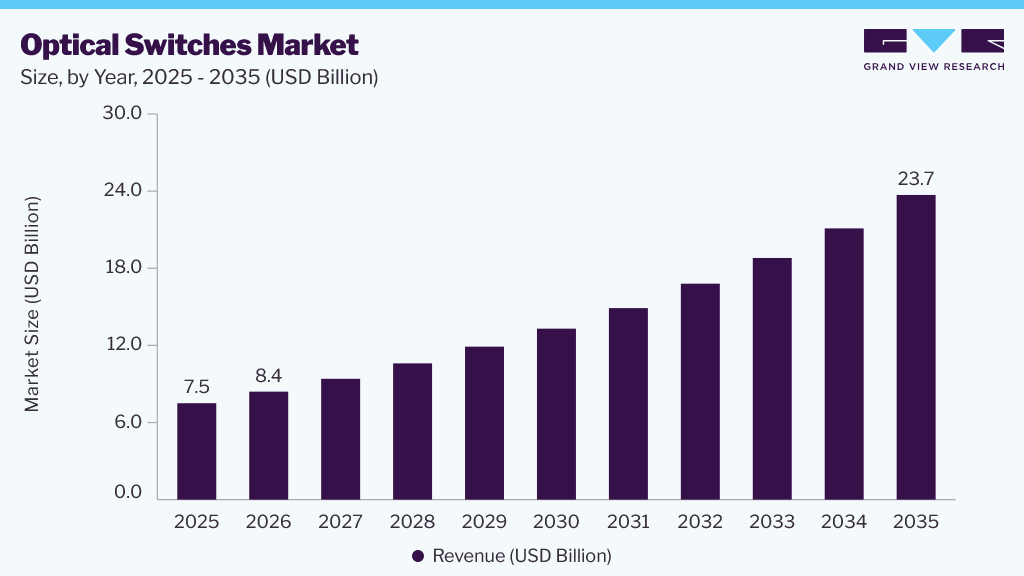 Source: Grand View Research, IR Documents, Primary Interviews, Paid DatabasesTo learn more about this report,
 Download Free Sample Report
 Key Market Trends & Insights
- By type: The MEMS optical switches segment held the largest market share in 2025.
- By technology: The MEMS technology segment accounted for the largest market share in 2025.
- By application: The telecommunications segment dominated with the largest market share in 2025.
Regional Highlights
- Largest regional market: North America (largest revenue share, 2025)
- Fastest-growing regional market: Asia Pacific (highest CAGR, 2026-2035)
Market Size & Forecast
- Market size in 2025: USD 7.5 Billion
- Estimated market size in 2026: USD 8.4 Billion
- Projected market size by 2035: USD 23.7 Billion
- CAGR (2026-2035): 12.2%
Three ways to get this report
Buy it, customize it, or ask a question.Ask an Analyst
A direct answer, usually in 1 working day
- AccessReport author, directly
- Reply timeWithin 1 working day
- No sales callDirect answer only
- FormatEmail reply
- CostFree, no cost
Get the Full Report
What the study covers
- FormatsPDF · Excel · Dashboard
- Timeline2026–2035 annual, 2025 base
- Coverage20+ countries, 5 regions
- Companies10+ key players profiled
Customize the Report
20% free customization
- IncludeCountries, segments, points
- TailorTo your product definition
- ExtendDeeper competitor detail
- OrA fully bespoke study
- Turnaround5–10 working days
The rapid expansion of artificial intelligence workloads, cloud computing, and hyperscale data centers is a primary driver of the market growth. AI clusters require extremely high bandwidth, low latency, and energy-efficient interconnect solutions, increasing the adoption of optical switching technologies for large-scale data center networks. The growing deployment of 5G infrastructure and high-performance computing systems is also accelerating investments in optical networking solutions. Furthermore, advancements in silicon photonics and optical circuit switching are enabling data center operators to improve network scalability, flexibility, and energy efficiency.Despite strong growth prospects, the market faces challenges related to high deployment costs, integration complexity, and interoperability with existing network infrastructure. Optical switching technologies require significant capital investment and specialized expertise for deployment across large-scale networks. In addition, the lack of uniform standards across optical networking ecosystems remains an ongoing challenge, particularly as AI infrastructure architectures continue to evolve rapidly.
The market presents substantial opportunities for continued innovation in AI networking and photonic switching technologies. In March 2026, Molex introduced its High-Radix Optical Circuit Switch Platform, designed to support scalable AI clusters through dynamic, low-power optical connectivity and reconfigurable network architectures. In addition, in May 2026, Corning and NVIDIA announced a long-term partnership to expand U.S. manufacturing capacity for advanced optical connectivity solutions that support AI infrastructure, highlighting growing investment across the optical networking ecosystem. These developments are expected to accelerate the adoption of optical switching technologies across next-generation cloud, AI, and high-performance computing infrastructure.
Analyst Perspective
The market is witnessing rapid growth as hyperscale data centers, cloud computing providers, and AI infrastructure operators increasingly seek high-bandwidth, low-latency networking solutions. Optical switches enable data transmission without repeated optical-to-electrical conversions, significantly improving network efficiency, reducing power consumption, and supporting the massive bandwidth requirements of AI clusters and high-performance computing environments. The growing deployment of 5G networks, edge computing, and optical transport networks is further driving demand for advanced optical switching technologies. In addition, continuous innovations in silicon photonics, MEMS, and optical circuit switching, along with increasing investments in AI networking and next-generation data center infrastructure, are expected to drive sustained market growth over the forecast period.
Type Insights
The MEMS optical switches segment accounted for the largest share of the market in 2025 and is expected to maintain its leading position throughout the forecast period. Micro-Electro-Mechanical Systems (MEMS)-based optical switches have become the preferred solution for high-capacity optical communication networks because they provide low insertion loss, excellent scalability, high switching reliability, and low power consumption. These switches are widely deployed in data centers, long-haul fiber-optic networks, telecommunications infrastructure, and cloud computing environments where rapid traffic management and efficient optical signal routing are essential.
The increasing deployment of hyperscale data centers, the expansion of 5G infrastructure, and growing demand for high-speed optical communication continue to strengthen the adoption of MEMS optical switching technologies. Network operators are investing in flexible optical transport architectures capable of supporting rapidly increasing bandwidth requirements while minimizing latency and energy consumption. MEMS switches also support software-defined networking (SDN) environments, making them well-suited for modern cloud and AI-driven networking applications.
In March 2025, Coherent Corp. introduced its next-generation wavelength-selective switching (WSS) technology designed to improve optical network scalability and support higher-capacity coherent communication systems for telecom and data center applications. The launch highlights the continued industry focus on advanced optical switching technologies capable of supporting future high-speed communication networks.
Meanwhile, the all-optical switches segment is expected to register the fastest CAGR during the forecast period. Unlike conventional optical switches that require optical-to-electrical signal conversion, all-optical switches route optical signals directly, significantly reducing latency, improving transmission efficiency, and lowering power consumption. Increasing investments in AI data centers, hyperscale cloud infrastructure, and ultra-high-speed communication networks are expected to accelerate commercial adoption of all-optical switching technologies over the coming years.
Technology Insights
The MEMS technology segment held the largest share of the market in 2025. MEMS technology has established itself as one of the most reliable optical switching platforms because it combines high port density, excellent optical performance, long operational life, and relatively low operating costs. Telecommunications operators, cloud service providers, and hyperscale data center operators increasingly deploy MEMS-based optical switches to manage growing network traffic while maintaining high reliability and operational flexibility.
The rapid expansion of fiber-optic infrastructure worldwide has strengthened demand for MEMS optical switching solutions. Continuous improvements in manufacturing precision, miniaturization, and switching speed have enabled MEMS devices to support increasingly complex optical networking architectures. As demand for high-capacity optical interconnects continues to grow, MEMS technology is expected to remain the industry's preferred switching platform.
The electro-optic technology segment is projected to witness the fastest growth during the forecast period. Electro-optic switches provide ultra-fast switching speeds and are particularly suitable for emerging applications such as artificial intelligence computing clusters, quantum communication systems, high-performance computing, and next-generation optical interconnects. Increasing investments in silicon photonics, integrated photonic circuits, and optical computing are expected to significantly accelerate the adoption of electro-optic switching technologies over the next decade. In October 2024, Nokia expanded its photonic networking portfolio with advanced coherent optical technologies designed to increase network capacity, improve energy efficiency, and support high-speed optical transport applications. These advancements highlight continued investment in next-generation photonic technologies that enable scalable optical infrastructure.
Application Insights
The telecommunications segment accounted for the largest share of the market in 2025. Optical switching technologies remain fundamental to modern telecommunications infrastructure by enabling efficient routing of high-speed optical signals across metro, long-haul, and submarine fiber-optic networks. Increasing deployment of 5G networks, fiber-to-the-home (FTTH) infrastructure, and next-generation optical transport systems continues to generate substantial demand for advanced optical switching equipment.
Telecommunication operators are modernizing legacy transport networks to accommodate exponential growth in mobile data traffic, cloud services, and video streaming. Optical switches help improve bandwidth utilization, reduce operational costs, and enable flexible network management while supporting software-defined networking and network automation initiatives.
The data centers segment is expected to register the fastest CAGR during the forecast period. The rapid expansion of hyperscale cloud infrastructure, artificial intelligence workloads, machine learning applications, and high-density server deployments has created unprecedented demand for ultra-high-speed optical interconnects. Optical switches play an essential role in reducing latency, improving bandwidth efficiency, and enabling scalable network architectures capable of supporting AI clusters and cloud computing platforms.
Reflecting this trend, Broadcom introduced its next-generation 200G/lane optical DSP PHY portfolio in March 2025, extending its leadership in high-speed optical connectivity for AI infrastructure. The new Sian3 and Sian2M digital signal processors are designed to enable 1.6T optical transceivers and support the growing bandwidth requirements of hyperscale data centers and AI clusters. By delivering higher performance, lower power consumption, and improved signal integrity, the launch strengthens next-generation AI networking and accelerates the deployment of scalable optical interconnect solutions.
Regional Insights
The optical switches industry in North America accounted for the largest share of the global market in 2025 and is expected to maintain its leadership throughout the forecast period. The region benefits from the presence of leading cloud service providers, hyperscale data center operators, advanced telecommunications infrastructure, and established optical networking technology providers. The U.S. continues to drive significant investments in artificial intelligence (AI) computing infrastructure, fiber-optic networks, and high-capacity data center interconnects, creating sustained demand for advanced optical switching technologies.
The continuous expansion of cloud computing services, AI platforms, and next-generation data center architectures is encouraging network operators and technology companies to modernize optical transport and switching infrastructure. The presence of key industry participants such as Coherent, Broadcom, Cisco, Juniper Networks, and Ciena further supports innovation in optical networking solutions, including high-capacity switching, photonic technologies, and energy-efficient network architectures.
Asia Pacific Optical Switches Market
The optical switches industry in Asia Pacific is expected to witness the fastest growth throughout the forecast period. Countries including China, Japan, South Korea, India, and Singapore are investing significantly in hyperscale data centers, 5G infrastructure, fiber-optic broadband networks, and digital infrastructure modernization. Government initiatives supporting digital transformation, increasing cloud adoption, and rising internet traffic are accelerating demand for high-capacity optical communication and switching solutions across the region. For instance, in June 2025, Huawei’s OptiXtrans DC808 Data Center Optical Switch received recognition at Interop Tokyo 2025 for its application in AI-era data center networks. The solution leverages all-optical cross-connect technology to enable flexible optical connectivity, improve network scalability, and reduce power consumption in large-scale computing environments, highlighting the increasing adoption of advanced optical switching solutions across Asia Pacific.
Key Optical Switches Company Insights
The optical switches industry is highly competitive, with leading networking, optical communications, and photonics companies focusing on high-capacity switching technologies to address the growing bandwidth requirements of hyperscale data centers, AI infrastructure, 5G networks, and cloud computing environments. Leading market participants are prioritizing research and development to deliver high-speed, low-latency optical switching solutions capable of supporting next-generation AI clusters and cloud-scale data centers. Companies are expanding their portfolios with co-packaged optics (CPO), 800G and 1.6T optical interconnects, programmable photonic switches, and energy-efficient optical networking platforms to improve network scalability and reduce power consumption.
Key Optical Switches Companies
The following key companies have been profiled for this study on the optical switches market:
-
Cisco Systems, Inc.
-
Ciena Corporation
-
Lumentum Holdings Inc.
-
Fujitsu Limited
-
Huawei Technologies Co., Ltd.
-
Nokia Corporation
-
Infinera Corporation
-
Juniper Networks, Inc.
-
Arista Networks, Inc.
-
Molex LLC
Recent Developments
-
In March 2026, Marvell Technology and Lumentum Holdings announced a live demonstration of an optical circuit switching (OCS) platform at OFC 2026. The demonstration showcased interoperability between Marvell’s optical connectivity solutions and Lumentum’s OCS platform in an integrated rack-level system designed for hyperscale AI data centers. The solution aims to enable lower-latency, more flexible, and energy-efficient network fabrics, highlighting the increasing role of optical switching architectures in scaling next-generation AI infrastructure.
-
In February 2026, Tower Semiconductor and Salience Labs announced a strategic partnership to manufacture photonic integrated circuit (PIC)-based optical circuit switches (OCS) for next-generation AI data centers. The collaboration leverages Tower’s silicon photonics platforms to enable scalable, low-power optical switching solutions for high-bandwidth, low-latency connectivity in AI clusters and hyperscale computing environments. The partnership represents a step toward commercial-scale deployment of silicon photonics-based switching architectures for AI infrastructure.
Optical Switches Market Report Scope
Report Attribute
Details
Market size in 2025
USD 7.5 billion
Estimated market size in 2026
USD 8.4 billion
Projected market size by 2035
USD 23.7 billion
Growth rate
CAGR of 12.2% from 2026 to 2035
Base year for estimation
2025
Historical data
2021 - 2025
Forecast period
2026 - 2035
Quantitative units
Revenue in USD billion and CAGR from 2026 to 2035
Report coverage
Revenue forecast, company ranking, competitive landscape, growth factors, and trends
Segments covered
Type, technology, application, region
Regional Scope
North America; Europe; Asia Pacific; Central & South America; Middle East & Africa
Country Scope
U.S.; Canada; Mexico; UK; Germany; France; Italy; Spain; China; Japan; India; Australia; South Korea; Brazil; Argentina; South Africa; Saudi Arabia; UAE
Key companies profiled
Cisco Systems, Inc.; Ciena Corporation; Lumentum Holdings Inc.; Fujitsu Limited; Huawei Technologies Co., Ltd.; Nokia Corporation; Infinera Corporation; Juniper Networks, Inc.; Arista Networks, Inc.; Molex LLC
Customization scope
Free report customization (equivalent to 8 analyst working days) with purchase. Addition or alteration to country, regional & segment scope.
Pricing and purchase options
Avail of customized purchase options to meet your exact research needs. Explore purchase options
Optical Switches Market Report Segmentation
This report forecasts revenue growth at the global, regional, and country levels and provides an analysis of the latest industry trends and opportunities across each sub-segment from 2021 to 2035. For this study, Grand View Research has segmented the global optical switches market report based on type, technology, application, and region:
-
Type Outlook (Revenue, USD Billion, 2021–2035)
-
All-Optical Switches
-
Electro-Optical Switches
-
MEMS Optical Switches
-
Liquid Crystal Optical Switches
-
Bubble Optical Switches
-
Others
-
-
Technology Outlook (Revenue, USD Billion, 2021–2035)
-
Mechanical Optical Switching
-
Waveguide Optical Switching
-
MEMS Technology
-
Electro-Optic Technology
-
Thermo-Optic Technology
-
Acousto-Optic Technology
-
Others
-
-
Application Outlook (Revenue, USD Billion, 2021–2035)
-
Data Centers
-
Telecommunications
-
High-Performance Computing (HPC)
-
Enterprise Networks
-
Military & Aerospace
-
Healthcare
-
Test & Measurement
-
Others
-
-
Regional Outlook (Revenue, USD Billion, 2021 - 2035)
-
North America
-
U.S.
-
Canada
-
Mexico
-
-
Europe
-
UK
-
Germany
-
France
-
Italy
-
Spain
-
-
Asia Pacific
-
China
-
Japan
-
India
-
Australia
-
South Korea
-
-
Central & South America
-
Brazil
-
Argentina
-
-
Middle East and Africa (MEA)
-
South Africa
-
Saudi Arabia
-
UAE
-
-
Frequently Asked Questions About This Report
The global optical switches market size was valued at USD 7.5 billion in 2025 and is estimated at USD 8.4 billion for 2026.
The global optical switches market is expected to grow at a CAGR of 12.2% from 2026 to 2035, reaching USD 23.7 billion.
The MEMS optical switches segment accounted for the largest revenue share in 2025
North America dominated with a revenue share in 2025.
Key players in the market include Cisco Systems, Inc., Ciena Corporation, Lumentum Holdings Inc., Fujitsu Limited, Huawei Technologies Co., Ltd., Nokia Corporation, Infinera Corporation, Juniper Networks, Inc., Arista Networks, Inc., Molex LLC., and others
About the Author(s)
Next Generation Technologies Research Team
Technology · Next Generation TechnologiesThis report was authored by the next generation technologies research team at Grand View Research - comprising two research analysts, one senior research analyst, and one industry expert - with specialized expertise in the next generation technologies segment of the technology industry. All findings are based on proprietary technology databases, executive interviews, and regulatory analysis, subject to internal peer review prior to publication.
Last Updated:
Speak to Analyst

Customize this report to your needs - add regions, segments, or data points, with 20% free customization.
Or view our licence options:


ISO 9001:2015 & 27001:2022 Certified
We are GDPR and CCPA compliant! Your transaction & personal information is safe and secure. For more details, please read our privacy policy.


