
- Home
- »
- Renewable Energy
- »
-
Organic Photovoltaic Market Size & Share Report 2026-2033GVR Report cover

Organic Photovoltaic Market (2026 - 2033)
Size, Share & Trends Analysis Report By Type (Small-molecule OPV Cells, Polymer-based OPV Cells), By Application (Building-Integrated Photovoltaics, Consumer Electronics, Automotive, Indoor Energy Harvesting), By Region, And Segment Forecasts
Market Size, 2025
$94.7MMarket Estimate, 2026
$119.0MMarket Forecast, 2033
$544.6MCAGR, 2026–2033
24.3%Organic Photovoltaic Market Summary
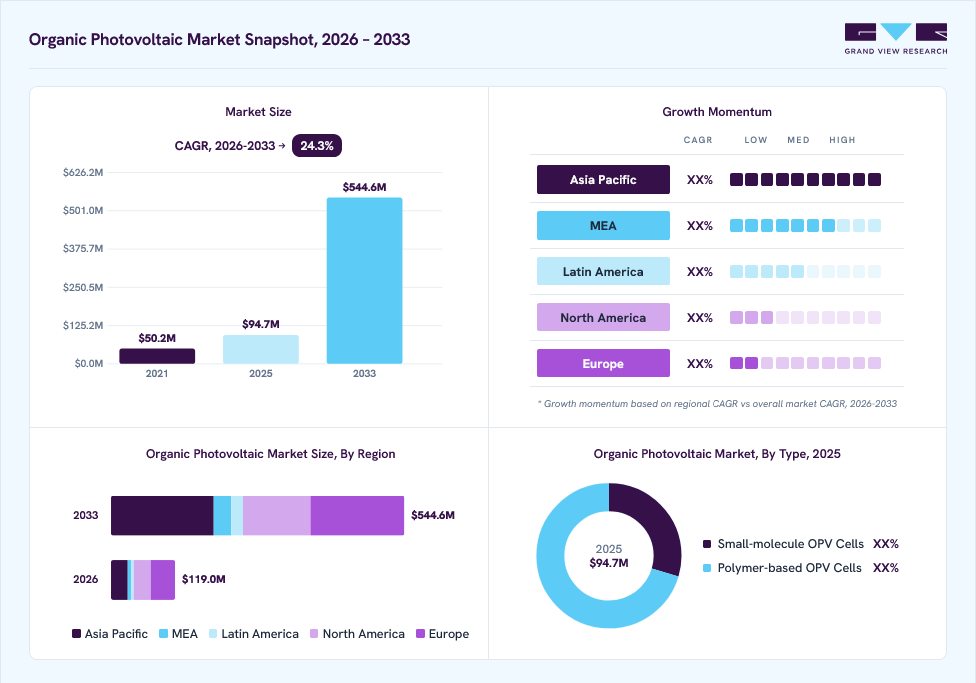
The global organic photovoltaic (OPV) market size was valued at USD 94.7 million in 2025 and is projected to grow from USD 119.0 million in 2026 to USD 544.6 million by 2033, at a CAGR of 24.3% from 2026 to 2033. Europe dominated the market, accounting for the largest revenue share of 39.0% in 2025. OPV is a type of solar technology that uses carbon-based semiconductor materials to convert sunlight into electricity.
 Source: Grand View Research, IR Documents, Primary Interviews, Paid DatabasesTo learn more about this report,
 Download Free Sample Report
Key Market Trends & Insights
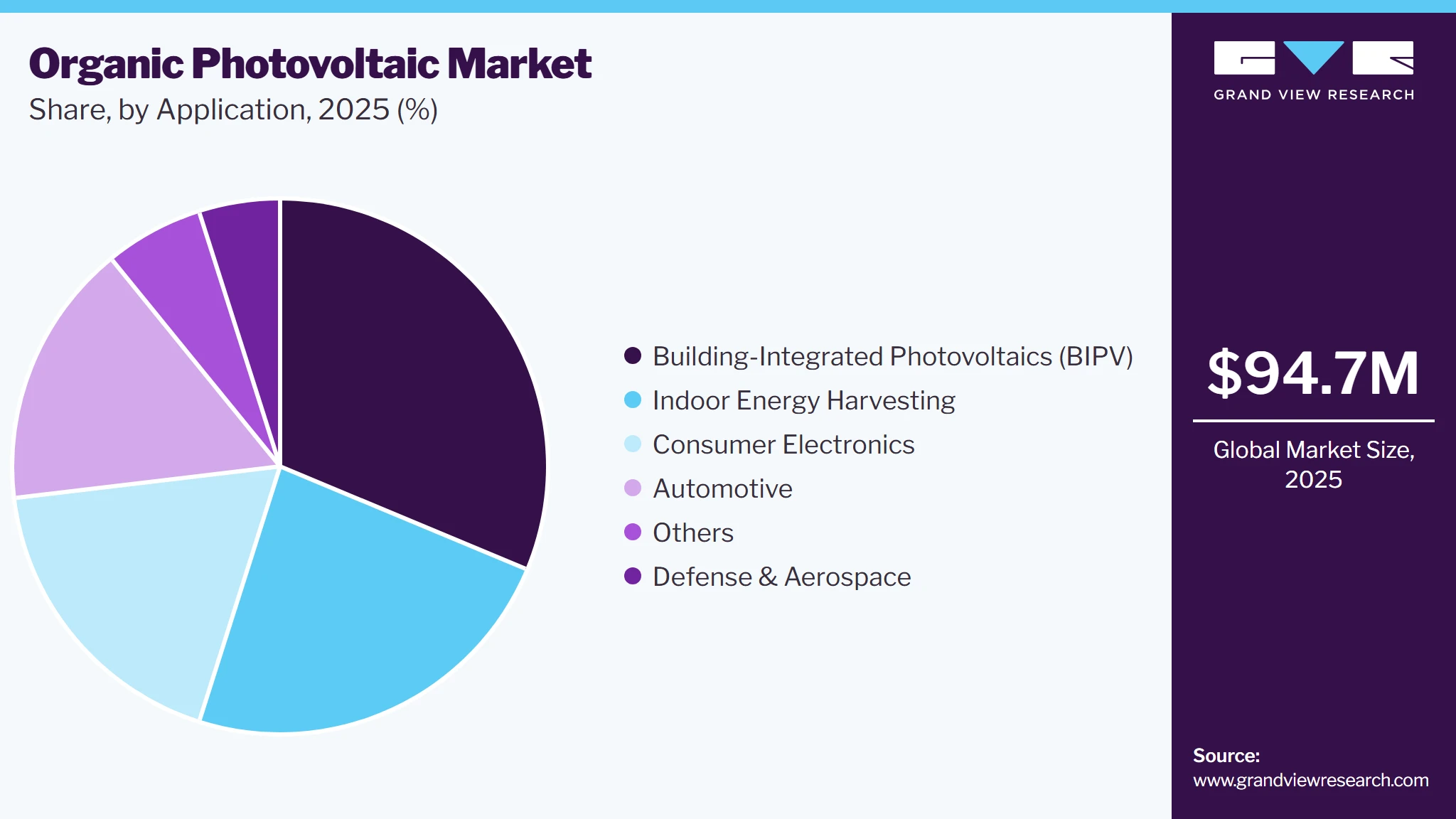
- By application: Building-Integrated Photovoltaics (BIPV) segment held the largest revenue share of 31.3% in 2025.
- By type: Polymer-based OPV cells segment held the highest revenue share of 70.4% in 2025.
Regional Highlights:
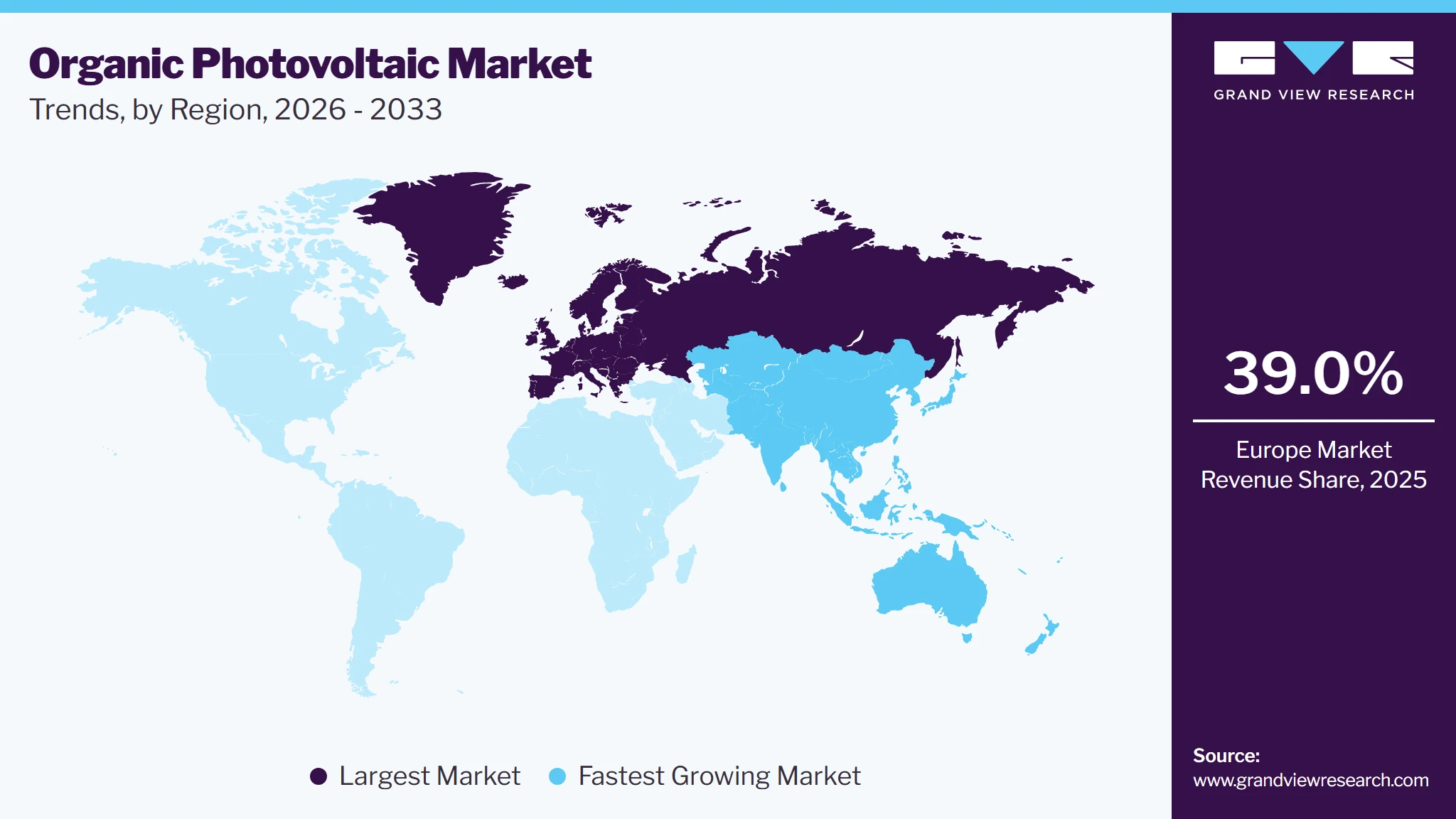
- Largest regional market: Europe (39.0% revenue share, 2025)
- Fastest-growing regional market: Asia Pacific (highest CAGR, 2026-2033)
- By country: Germany held the largest market share in 2025.
Market Size & Forecast
- Market size in 2025: USD 94.7 Million
- Estimated market size in 2026: USD 119.0 Million
- Projected market size by 2033: USD 544.6 Million
- CAGR (2026-2033): 24.3%
Prism AI by Grand View Research Free to tryAsk a question about the organic photovoltaic market✓Every figure cited from GVR research Prefer the report? Download free sample →
They are lightweight, flexible, and can be made semi-transparent, making them suitable for applications such as BIPV, wearable electronics, and indoor energy harvesting.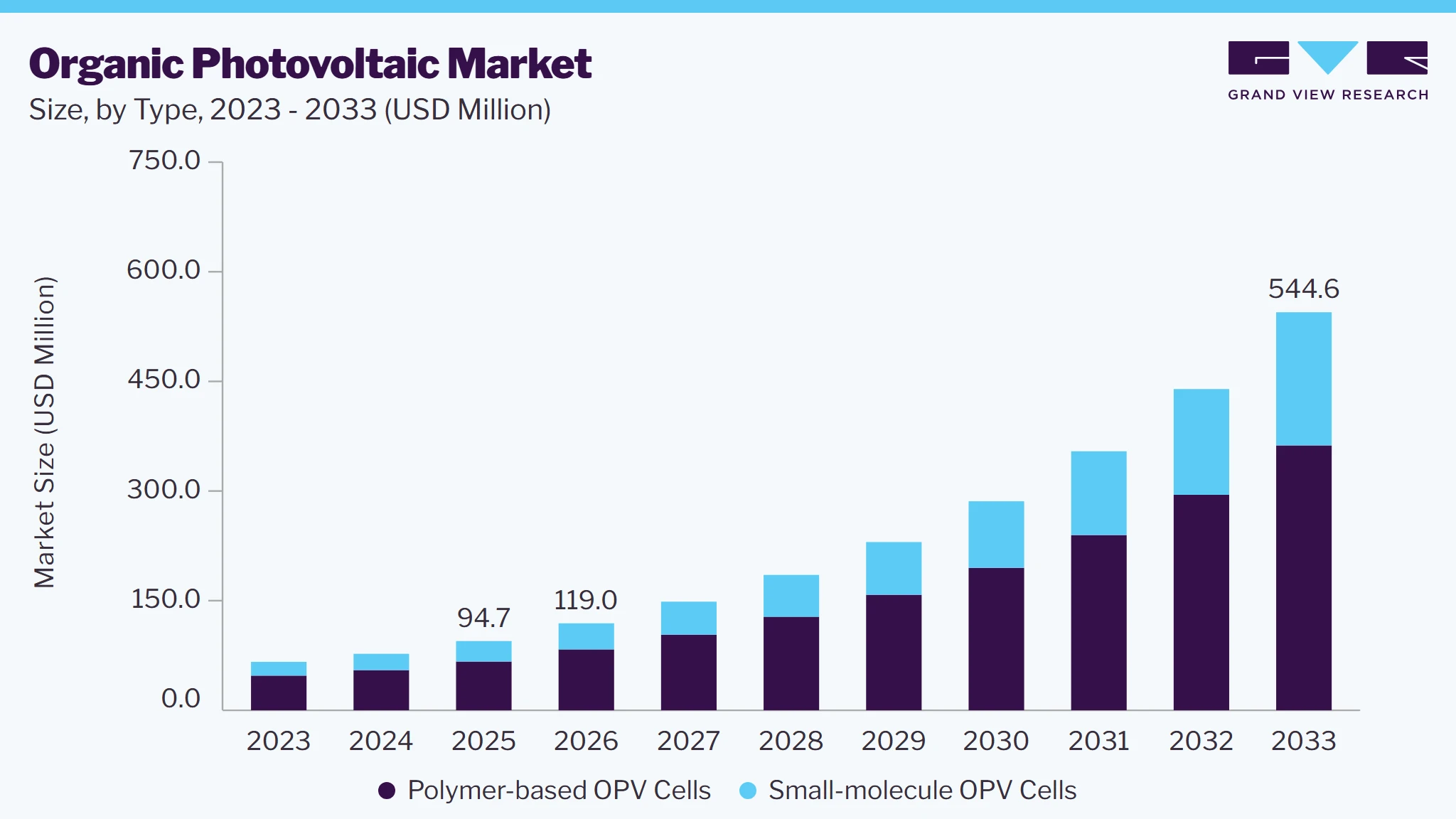 To learn more about this report, Download Free Sample Report
Market Dynamics
The OPV market is witnessing steady growth as manufacturers focus on low-cost roll-to-roll production and scalable printed electronics, making solar integration feasible for new product categories. Rising adoption of IoT devices, smart packaging, and self-powered sensors is expanding the commercial potential of OPV beyond traditional solar applications. Ongoing improvements in material stability and encapsulation technologies are addressing durability challenges that have historically constrained market adoption. Strategic collaborations among material developers, research institutes, and electronics manufacturers are further accelerating product innovation and commercialization.
The unique mechanical flexibility, ultra-lightweight structure, and semi-transparent nature of OPV modules are emerging as major growth drivers for the market. Unlike conventional silicon solar panels, OPV technology can be manufactured on flexible substrates, allowing integration into curved facades, windows, skylights, wearable textiles, and lightweight electronic devices without significantly increasing structural load. This versatility enables architects and product designers to incorporate renewable energy generation into applications where rigid solar modules are impractical. As demand for aesthetically integrated, energy-generating materials grows across the construction, consumer electronics, and mobility sectors, OPV adoption is expected to accelerate.
For instance, in March 2025, Heliatek received UL certification for its HeliaSol organic photovoltaic modules, enabling commercial deployment across the U.S., Canada, and other North American markets. The certification validates the safety and reliability of its lightweight, flexible OPV technology and supports its use in building-integrated photovoltaic (BIPV) applications. According to the company, the certification strengthens opportunities for new partnerships and pilot projects, particularly as demand grows for photovoltaic modules that can be seamlessly integrated into buildings and other weight-sensitive structures.
The limited operational lifetime of OPV modules remains a key restraint to market growth. OPV materials are highly sensitive to UV radiation, oxygen, and moisture, which accelerate degradation and reduce power conversion efficiency over time. This results in lower energy output, shorter service life, and higher replacement requirements compared to conventional silicon PV. While advancements in encapsulation and barrier films have improved stability, enhancing long-term durability for outdoor applications continues to be one of the biggest commercialization challenges for the OPV market.
The growing adoption of low-power IoT devices is creating significant opportunities for the OPV market. OPV modules perform efficiently under indoor and low-light conditions, making them ideal for powering wireless sensors, smart labels, and asset trackers without battery replacement. For instance, in June 2025, Linxens and Dracula Technologies announced a strategic partnership to develop battery-free, solar-powered smart labels for industrial IoT and traceability applications by integrating Dracula's LAYER OPV technology, demonstrating the expanding commercial potential of indoor OPV energy harvesting. Continued improvements in indoor light conversion efficiency are expected to further accelerate OPV adoption across smart buildings, logistics, and retail.
Analyst Perspective
The organic photovoltaic (OPV) market is increasingly focusing on applications where conventional silicon PV is less effective, with manufacturers prioritizing design flexibility, integration, and energy autonomy over maximum power output. OPV is also converging with printed electronics and smart materials, enabling self-powered products such as intelligent packaging, electronic shelf labels, and connected building components. As manufacturing scales and production costs decline, companies building partnerships across electronics, construction, and IoT ecosystems are expected to gain an early competitive advantage and accelerate commercial adoption.
Type Insights
Polymer-based OPV cells dominated the market with a revenue share of 70.4% in 2025. This dominance is attributed to their lightweight structure, flexibility, and compatibility with low-cost roll-to-roll manufacturing processes, enabling large-scale production. These cells are widely adopted in applications such as building integrated photovoltaics (BIPV), consumer electronics, and indoor energy harvesting due to their ease of integration onto curved and lightweight surfaces. Ongoing advancements in polymer materials have also improved power conversion efficiency, durability, and commercial viability, further strengthening their market position.
The small-molecule OPV cells segment is expected to register the fastest CAGR of 26.2% during the forecast period. This growth is driven by continuous advancements in material engineering that are improving power conversion efficiency, operational stability, and device lifespan. Small-molecule OPV cells also offer excellent purity and precise molecular design, enabling consistent performance in high-value applications. Rising investments in next-generation organic solar technologies and flexible electronic devices are expected to further accelerate the adoption of this segment.
Application Insights
The Building-Integrated Photovoltaics (BIPV) segment held the largest market share of 31.3% in 2025, driven by the increasing adoption of energy-efficient and sustainable building solutions that seamlessly integrate solar power generation into roofs, facades, and windows. OPV technology is particularly well suited for BIPV applications due to its lightweight, flexible, and semi-transparent properties, enabling greater architectural freedom. Growing green building initiatives, stricter energy-efficiency regulations, and rising investments in net-zero infrastructure continue to support the segment's market leadership.
 To learn more about this report, Download Free Sample Report
The consumer electronics segment is expected to register the fastest CAGR of 26.2% for the forecast period. The growth is supported by the rising demand for lightweight, flexible, and self-powered electronic devices, including wearables, smart sensors, e-paper displays, and IoT-enabled products. Organic photovoltaic technology enables efficient indoor energy harvesting, reducing dependence on conventional batteries and extending device operating life. Continuous innovation in flexible electronics and increasing adoption of low-power consumer devices are expected to further accelerate segment growth.
Regional Insights
Europe Organic Photovoltaic Market Trends
Organic photovoltaic market in Europe held the largest revenue share of 39.0% in 2025. The market is supported by strong renewable energy policies, increasing investments in sustainable building technologies, and continuous advancements in flexible solar materials. The region is witnessing growing adoption of OPVs in BIPV, indoor energy harvesting, and smart electronics, supported by its well-established research ecosystem. For instance, Germany-based Heliatek continues to commercialize flexible organic solar films for building facades and industrial applications. EU-funded research programs under Horizon Europe are accelerating the development of higher-efficiency OPV materials and scalable manufacturing technologies, supporting long-term market growth.
 To learn more about this report, Download Free Sample Report
The organic photovoltaic market in the UK is growing with support from the country's clean energy goals and increasing investment in solar technology. The UK government's Clean Energy Superpower Mission aims to achieve Clean Power by 2030, creating opportunities for advanced solar solutions such as OPVs. In 2025, renewable energy generated 63% of Great Britain's electricity, with solar accounting for about 6.5% of total electricity generation. The UK Engineering and Physical Sciences Research Council (EPSRC) has invested about USD 50 million in solar technology research, helping accelerate innovation in next-generation photovoltaic technologies.
North America Organic Photovoltaic Market Trends
North America OPV market is supported by strong investments in renewable energy, advanced materials research, and clean technology development. The region is seeing increasing use of OPVs in smart buildings, wearables, IoT devices, and consumer electronics due to their lightweight and flexible design. For instance, the U.S. Department of Energy continues to fund next-generation solar technologies through the Solar Energy Technologies Office, including research on emerging photovoltaic materials and manufacturing. Growing government support, along with collaborations between research institutions and industry, is expected to accelerate the commercialization of OPV technologies across the region.
U.S. Organic Photovoltaic Market Trends
The U.S. organic photovoltaic market is growing due to increasing demand for lightweight, flexible, and energy-efficient solar technologies, along with rising adoption of BIPV, consumer electronics, and indoor energy harvesting applications. Strong investments in renewable energy innovation, supportive government funding for advanced photovoltaic research, and the presence of leading technology developers are accelerating market growth. Continuous advancements in OPV materials, improved power conversion efficiency, and scalable manufacturing processes are further enhancing commercial adoption. As the demand for sustainable and aesthetically integrated solar solutions increases, the adoption of organic photovoltaic technologies is expected to accelerate across the U.S.
Asia Pacific Organic Photovoltaic Market Trends
The organic photovoltaic market in Asia Pacific is expected to register the fastest CAGR of 29.6% from 2026 to 2033. Growing investments in renewable energy, expanding electronics manufacturing, and supportive government policies are driving the Asia Pacific OPV market. Rising demand for lightweight, flexible, and low-cost solar technologies in consumer electronics, smart buildings, and wearable devices is further supporting market growth. Countries such as China, Japan, South Korea, and India are increasing investments in advanced photovoltaic research and manufacturing capabilities. Continuous technological advancements and the region's strong focus on clean energy adoption are expected to accelerate the commercialization of OPV technologies over the forecast period.
Latin America Organic Photovoltaic Market Trends
Increasing solar investments, growing demand for sustainable energy solutions, and the expansion of renewable power infrastructure are driving the Latin America OPV market. The region’s focus on clean energy transition is creating opportunities for lightweight, flexible, and adaptable photovoltaic technologies across applications such as buildings, portable devices, and off-grid systems. For instance, in April 2025, Chile’s Oasis de Atacama project commenced operations with 221 MW of solar capacity and a 1.2 GWh battery storage system, highlighting the region’s rapid growth in advanced solar deployment. Increasing investments in renewable technologies and advancements in solar materials are expected to support the adoption of OPVs across Latin America.
Middle East & Africa Organic Photovoltaic Market Trends
Rising investments in renewable energy, increasing focus on energy diversification, and growing demand for sustainable power solutions are driving the Middle East & Africa organic photovoltaic market. The region’s high solar potential and expanding clean energy initiatives are creating opportunities for lightweight and flexible photovoltaic technologies in buildings, remote power systems, and portable applications. Continued investments in solar infrastructure and research activities are expected to contribute to the development of OPV technologies across the region.
Key Organic Photovoltaic Company Insights
Some of the key players operating in the global organic photovoltaics market include Heliatek and Epishine, among others.
-
Heliatek is a major manufacturer in the OPV market, specializing in the development and production of flexible organic solar films for building-integrated and customized solar applications. The company manufactures lightweight, ultra-thin, and semi-transparent solar films based on its proprietary HeliaFilm technology, enabling solar integration into facades, roofs, and surfaces where conventional PV modules are unsuitable. Heliatek focuses on scaling OPV production through advanced manufacturing processes while improving efficiency, durability, and sustainability. Its established OPV technology, strong R&D capabilities, and focus on flexible solar solutions position it as a key participant in the global OPV market.
-
Epishine is a prominent manufacturer in the organic photovoltaic market, focusing on indoor solar cells designed for energy harvesting in low-power electronic applications. The company develops and produces flexible OPV modules that convert ambient indoor light into electricity, enabling battery-free operation of IoT devices, sensors, and smart electronics. It focuses on improving energy efficiency, product miniaturization, and sustainable power solutions for connected devices. Its specialized indoor PV technology, commercial-ready products, and focus on the growing IoT ecosystem position it as a key participant in the OPV market.
Key Organic Photovoltaic Companies
The following key companies have been profiled for this study on the organic photovoltaic market.
-
Brilliant Matters
-
Dracula Technologies
-
Epishine
-
Heliatek
-
HERING group (ASCA GmbH & Co. KG)
-
infinityPV
-
NanoFlex Power Corporation
-
NEXT Energy Technologies
-
Raynergy Tek Incorporated
-
Solivus Limited
Competitive Benchmarking
Category
Operating Strategies
Competitive Edge
Weakness
Established Players (Heliatek, HERING group, infinityPV, Raynergy Tek Incorporated)
- Develop commercial-scale OPV manufacturing capabilities to support applications across building integrated photovoltaics, electronics, and specialized solar markets.
- Invest in improving OPV efficiency, durability, and production scalability through advanced materials, manufacturing processes, and technology innovation.
- Expand collaborations with construction firms, technology providers, and renewable energy companies to accelerate OPV adoption across industries.
- Possess established OPV technologies, proprietary materials, and manufacturing expertise developed through years of research and commercialization efforts.
- Offer customized flexible and lightweight solar solutions suitable for applications where conventional photovoltaic modules face limitations.
- Benefit from strong industry partnerships, intellectual property portfolios, and technical expertise in emerging solar applications.
- Face challenges related to higher production costs and limited economies of scale compared with conventional silicon-based solar technologies.
- Experience slower market penetration due to lower efficiency levels and limited large-scale OPV deployment compared with traditional PV systems.
- Depend on continued investments in research, manufacturing optimization, and market development to achieve commercial competitiveness.
Emerging Players (Brilliant Matters, Dracula Technologies, Epishine, NanoFlex Power Corporation, NEXT Energy Technologies, Solivus Limited)
- Focus on niche OPV applications such as indoor energy harvesting, IoT devices, smart electronics, and customized solar solutions.
- Develop innovative product designs and application-specific technologies to address unmet needs in emerging renewable energy markets.
- Build strategic partnerships with technology companies, research institutions, and end users to accelerate product commercialization.
- Demonstrate high flexibility and innovation by targeting specialized applications beyond traditional solar power generation.
- Enable lightweight, customizable, and design-friendly solar solutions for new markets such as smart devices and connected systems.
- Adapt quickly to evolving market requirements through focused product development and application-driven approaches.
- Have limited manufacturing capacity and commercial scale compared with established OPV technology providers.
- Face challenges in achieving cost competitiveness due to early-stage production processes and lower market volumes.
- Depend heavily on funding, partnerships, and technological advancements to expand market presence and achieve scalability.
Recent Developments:
-
In January 2026, Dracula Technologies introduced LAYER V2.0, the next generation of its OPV technology, at CES 2026, delivering a 30% increase in overall performance compared with the previous generation. The upgraded OPV modules use advanced proprietary inks and improved printing processes to provide higher power output, better performance under low indoor lighting conditions, and greater design flexibility for battery-free IoT devices, smart sensors, and connected applications. The launch strengthens Dracula Technologies’ position in sustainable indoor energy harvesting solutions, supported by its automated Green MicroPower Factory with an annual production capacity of up to 150 million cm² of printed OPV devices.
Organic Photovoltaic Market Report Scope
Report Attribute
Details
Market Definition
The Global Organic Photovoltaic Market comprises revenue generated from the sale of organic photovoltaic (OPV) modules, cells, and films across all end-use applications.
Market size in 2025
USD 94.7 million
Estimated market size in 2026
USD 119.0 million
Projected market size by 2033
USD 544.6 million
Growth rate
CAGR of 24.3% from 2026 to 2033
Base year for estimation
2025
Historical data
2021 - 2024
Forecast period
2026 - 2033
Quantitative units
Revenue in USD Million and CAGR from 2026 to 2033
Report coverage
Revenue forecast, competitive landscape, growth factors, and trends
Segments covered
Type, application, and region
Regional scope
North America; Europe; Asia Pacific; Latin America; Middle East & Africa
Country scope
U.S.; Canada; Mexico; Germany; UK; France; Italy; Spain; China; India; Japan; South Korea; Australia; Brazil; Argentina; UAE; Saudi Arabia; South Africa
Key companies profiled
Brilliant Matters; Dracula Technologies; Epishine; Heliatek; HERING group; infinityPV; NanoFlex Power Corporation; NEXT Energy Technologies; Raynergy Tek Incorporated; Solivus Limited
Customization scope
Free report customization (equivalent up to 8 analysts working days) with purchase. Addition or alteration to country, regional & segment scope.
Pricing and purchase options
Avail customized purchase options to meet your exact research needs. Explore purchase options
Global Organic Photovoltaic Market Report Segmentation
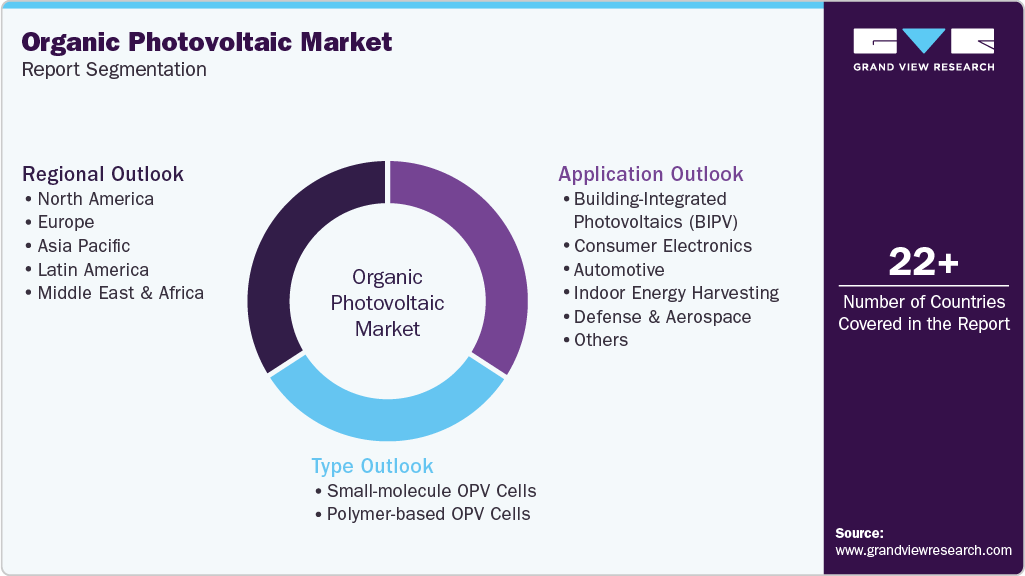
This report forecasts revenue growth at global, regional, and country levels and provides an analysis of the latest industry trends in each of the sub-segments from 2021 to 2033. For this study, Grand View Research has segmented the global organic photovoltaics market report based on type, application, and region.
 To learn more about this report, Download Free Sample Report
-
Type Outlook (Revenue, USD Million, 2021 - 2033)
-
Small-molecule OPV Cells
-
Polymer-based OPV Cells
-
-
Application Outlook (Revenue, USD Million, 2021 - 2033)
-
Building-Integrated Photovoltaics (BIPV)
-
Consumer Electronics
-
Automotive
-
Indoor Energy Harvesting
-
Defense & Aerospace
-
Others
-
-
Regional Outlook (Revenue, USD Million, 2021 - 2033)
-
North America
-
U.S.
-
Canada
-
Mexico
-
-
Europe
-
Germany
-
UK
-
France
-
Italy
-
Spain
-
-
Asia Pacific
-
China
-
India
-
Japan
-
South Korea
-
Australia
-
-
Latin America
-
Brazil
-
Argentina
-
-
Middle East & Africa
-
Saudi Arabia
-
UAE
-
South Africa
-
-
Research Methodology
The organic photovoltaic market figures in this report are based on a proven research process that combines executive interviews with secondary research from proprietary databases, company filings, and recognized regulatory and institutional sources. Market size is built through value-chain sizing—reconciling supply-side and demand-side estimates—and triangulated with bottom-up and top-down approaches. Every estimate passes multiple levels of expert validation before publication, with each organic photovoltaic segment quantified using the revenue-capture definitions in the table below.
Segment Definition
Segment – Type
Revenue capture definition
Small-molecule OPV Cells
Includes sales of OPV cells that use small organic molecules as the active photovoltaic material for converting light into electricity.
Polymer-based OPV Cells
Covers sales of OPV cells based on polymer organic materials, offering flexibility, lightweight design, and suitability for scalable solar applications.
Segment – Application
Revenue capture definition
Building-Integrated Photovoltaics (BIPV)
Includes sales of OPV modules integrated into building structures such as façades, windows, and roofs for on-site power generation.
Consumer Electronics
Captures sales of OPV solutions incorporated into portable electronics, wearables, smart devices, and connected consumer products.
Automotive
Includes sales of OPV modules designed for vehicle surfaces and components to support solar-assisted power generation.
Indoor Energy Harvesting
Covers sales of OPV cells used to convert ambient indoor light into electricity for IoT devices, sensors, and low-power electronics.
Defense & Aerospace
Includes sales of lightweight OPV solutions designed for defense equipment, aerospace systems, and remote power applications.
Others
Covers sales of OPV technologies used in emerging applications such as agriculture, portable chargers, smart packaging, marine devices, smart textiles, decorative products.
Estimation Model
Layer No.
Layer Name
Key Question
Description
01
Cell Type Layer
Which OPV cell types drive market demand?
Assess market adoption based on small-molecule and polymer-based OPV cells. Analyze material characteristics, conversion efficiency, flexibility, manufacturing scalability, production methods, and suitability for different end-use applications influencing demand.
02
Application Layer
Which applications generate demand for OPV technologies?
Evaluate OPV adoption across building integrated photovoltaics (BIPV), consumer electronics, automotive, indoor energy harvesting, defense & aerospace, and other emerging applications. Analyze integration requirements, performance expectations, design flexibility, and application-specific demand trends.
03
End-Use Integration Layer
How are OPV cells incorporated into products and systems?
Analyze deployment through flexible films, customized modules, transparent coatings, and printed solar solutions across various end uses. Assess factors such as product design requirements, lightweight characteristics, energy needs, and commercialization potential affecting adoption.
04
Revenue Layer
How is market revenue generated?
Market revenue is quantified through the sales of small-molecule and polymer-based OPV cells across applications including BIPV, consumer electronics, automotive, indoor energy harvesting, defense & aerospace, and other uses such as agriculture, portable chargers, smart packaging, marine devices, smart textiles, and decorative products. Revenue is influenced by OPV production volumes, module pricing, technology adoption, manufacturing capacity, and investments in advanced solar solutions.
Delivered Customizations
We have successfully delivered the following deep-dive customizations:
Client Request
Customization Delivered
Value Adds
Regional Opportunity Assessment
Country-level analysis was conducted to assess OPV adoption based on renewable energy policies, BIPV growth, flexible electronics demand, indoor energy harvesting applications, and investments in next-generation photovoltaic technologies across key regions.
Identified high-growth regions with strong OPV market potential, supported by clean energy initiatives, advanced electronics manufacturing, and demand for lightweight solar solutions.
Application-Level Opportunity Assessment
Market analysis was performed across BIPV, consumer electronics, automotive, indoor energy harvesting, defense & aerospace, and other emerging applications such as smart packaging, portable chargers, smart textiles, marine devices, and agriculture.
Enabled identification of attractive application areas based on product integration opportunities, end-use requirements, and adoption potential for flexible solar technologies.
Competitive Landscape Assessment
Apart from the companies covered in the standard report, additional OPV manufacturers were analyzed based on cell technology portfolio, application focus, product developments, manufacturing capabilities, partnerships, and competitive positioning.
Supported benchmarking of key market participants and evaluation of strategies related to flexible OPV modules, indoor energy harvesting, BIPV solutions, and advanced organic materials.
Frequently Asked Questions About This Report
The organic photovoltaic market size was estimated at USD 94.7 million in 2025 and is expected to reach USD 119.0 million in 2026.
The organic photovoltaic market is expected to grow at a CAGR of 24.3% from 2026 to 2033 to reach USD 544.6 million by 2033.
Growing demand for lightweight, flexible solar technologies and expanding applications in BIPV, consumer electronics, and indoor energy harvesting are driving the organic photovoltaic market.
Europe region dominated the organic photovoltaic market with a revenue share of 39.0% in 2025.
Germany dominated the Europe region market with a revenue share of 26.0% in 2025.
Asia Pacific is anticipated to register the fastest CAGR of 29.6% over the forecast period.
Based on type, the polymer-based OPV cells segment accounted for the largest revenue share of 70.4% in 2025.
Based on application, the Building-Integrated Photovoltaics (BIPV) segment accounted for largest revenue share of 31.3% in 2025.
The key players operating in the organic photovoltaic market are Brilliant Matters, Dracula Technologies, Epishine, Heliatek, HERING group, infinityPV, NanoFlex Power, Corporation, NEXT Energy Technologies, Raynergy Tek Incorporated, Solivus Limited, and others.
About the Author(s)
Renewable Energy Research Team
Energy & Power · Renewable EnergyThis report was authored by the renewable energy research team at Grand View Research - comprising two research analysts, one senior research analyst, and one industry expert - with specialized expertise in the renewable energy segment of the energy & power industry. All findings are based on proprietary energy & power databases, executive interviews, and regulatory analysis, subject to internal peer review prior to publication.
Last Updated:
Speak to Analyst

Customize this report to your needs - add regions, segments, or data points, with 20% free customization.
Or view our licence options:


ISO 9001:2015 & 27001:2022 Certified
We are GDPR and CCPA compliant! Your transaction & personal information is safe and secure. For more details, please read our privacy policy.


