
- Home
- »
- Electronic Devices
- »
-
Oscilloscope Market Size, Share And Trends Report, 2033GVR Report cover

Oscilloscope Market (2026 - 2033)
Size, Share, & Trends Analysis Report By Component (Hardware, Software), By Type (Analog, Digital, Mixed-Signal), By Bandwidth (Below 500 MHz, 500 MHz–1 GHz, 1–4 GHz), By End Use (Electronics & Semiconductor, Automotive), By Region, and Segment Forecasts
Market Size, 2025
$3.2BMarket Estimate, 2026
$3.4BMarket Forecast, 2033
$6.0BCAGR, 2026–2033
8.2%Oscilloscope Market Summary
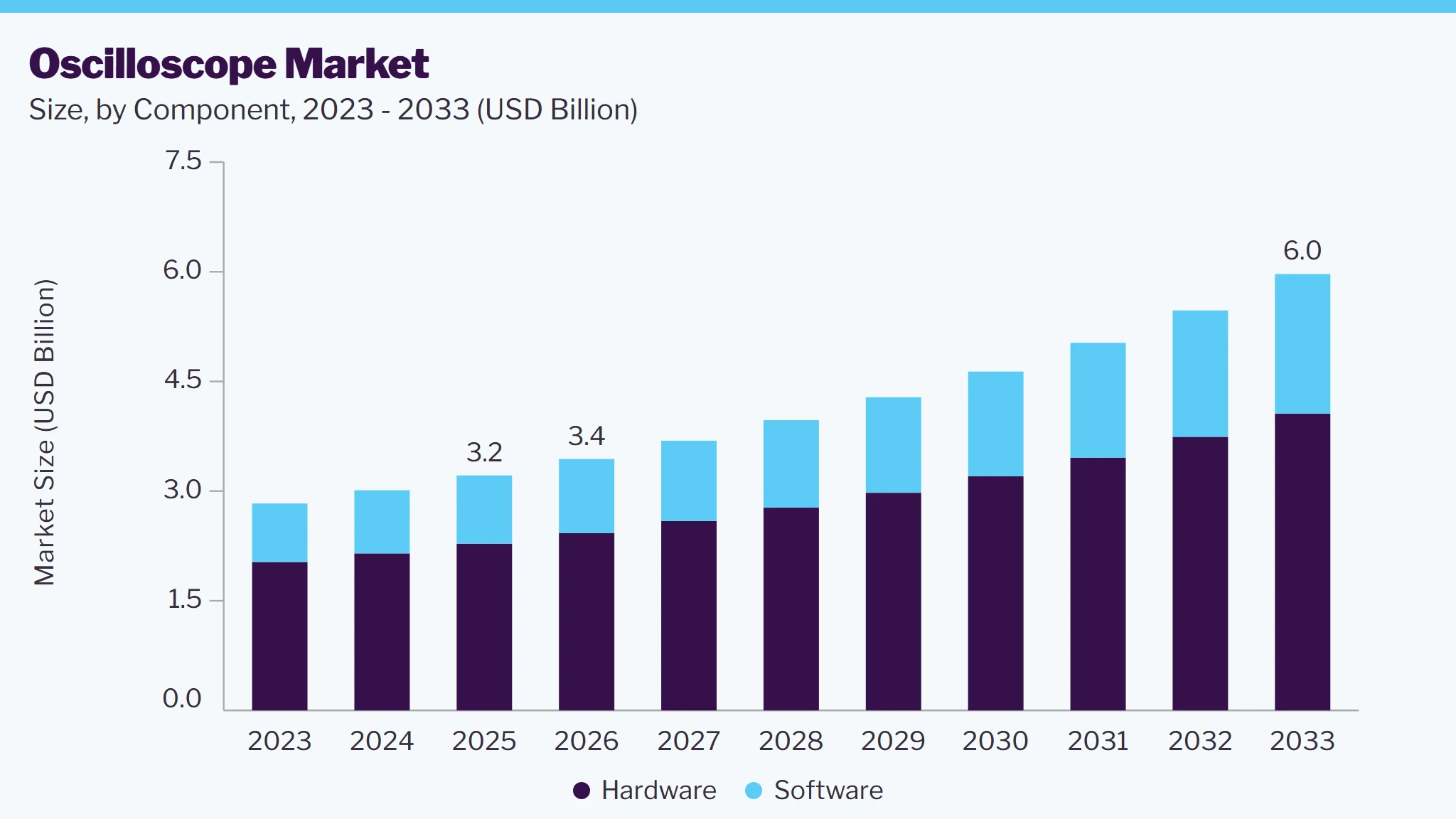
The global oscilloscope market size was valued at USD 3.2 billion in 2025 and is projected to grow from USD 3.4 billion in 2026 to USD 6.0 billion by 2033, at a CAGR of 8.2% from 2026 to 2033. Asia Pacific dominated the market, accounting for a revenue share of 42.2% in 2025. Market growth is primarily driven by the increasing demand for high-speed electronics testing, expanding semiconductor and electronic device manufacturing, rising adoption of advanced automotive electronics, and growing need for high-bandwidth oscilloscopes capable of analyzing increasingly complex and high-frequency signals.
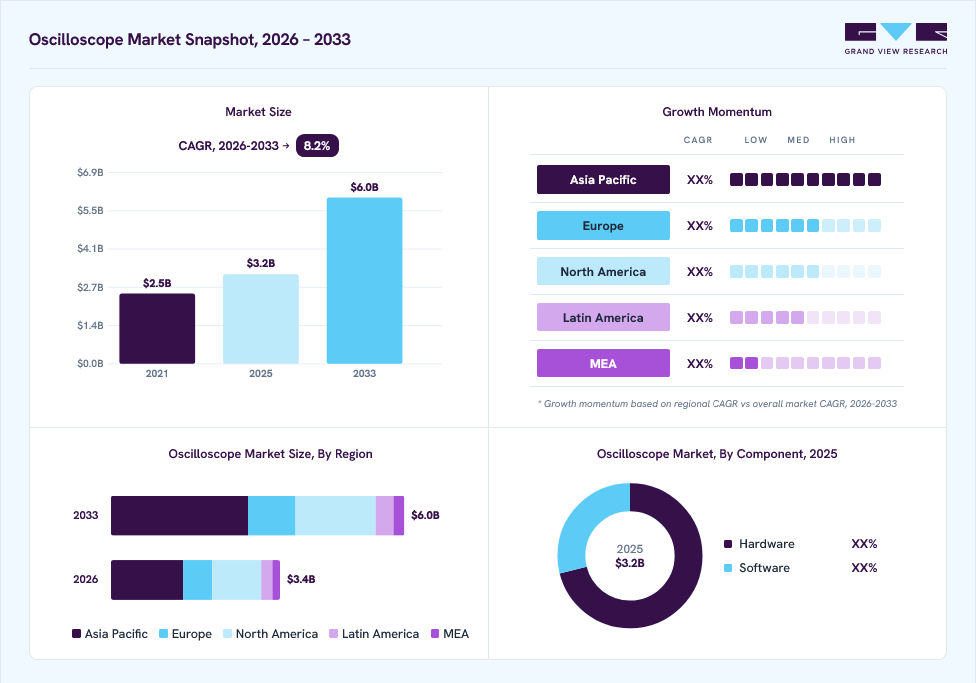 Source: Grand View Research, IR Documents, Primary Interviews, Paid DatabasesTo learn more about this report,
 Download Free Sample Report
Key Market Trends & Insights
- By Component: The hardware segment held the largest market share of 71.0% in 2025.
- By Type: The digital segment held the largest market revenue share in 2025.
- By Bandwidth: The below 500 MHz segment led the market with the largest revenue share in 2025.
- By End Use: The electronics & semiconductor segment held the largest market revenue share in 2025.
Regional Highlights
- Largest regional market: Asia Pacific (42.2% revenue share, 2025)
- Leading country: China held the largest share in 2025
Market Size & Forecasts
- Market size in 2025: USD 3.2 Billion
- Estimated market size in 2026: USD 3.4 Billion
- Projected market size by 2033: USD 6.0 Billion
- CAGR (2026-2033): 8.2%
Three ways to get this report
Buy it, customize it, or ask a question.Ask an Analyst
Analyst response in 1 business day
- AccessReport author, directly
- Reply timeWithin 1 working day
- No sales callDirect answer only
- FormatEmail reply
- CostFree, no cost
Get the Full Report
What the study covers
- FormatsPDF · Excel · Dashboard
- Timeline2026–2033 annual, 2025 base
- Coverage20+ countries, 5 regions
- Companies10+ key players profiled
Customize the Report
20% free customization
- IncludeCountries, segments, points
- TailorTo your product definition
- ExtendDeeper competitor detail
- OrA fully bespoke study
- Turnaround5–10 working days
The increasing complexity of electronic systems is driving demand for advanced oscilloscopes capable of capturing, measuring, and analyzing high-speed and increasingly complex electrical signals. Modern electronic devices incorporate faster processors, higher-speed interfaces, dense circuitry, and sophisticated power management systems, requiring precise waveform analysis during design and validation. This is encouraging manufacturers to develop oscilloscopes with higher bandwidth, faster sampling rates, deeper memory, and advanced triggering capabilities to address increasingly demanding testing requirements across electronics, semiconductor, industrial, and research applications.Additionally, the continued expansion of semiconductor manufacturing and electronic product development is creating sustained demand for test and measurement equipment throughout the product development cycle. Oscilloscopes are widely used for circuit design, debugging, signal integrity testing, validation, and quality control across semiconductor devices, printed circuit boards, embedded systems, and consumer electronics. Increasing investments in semiconductor fabrication capacity and domestic electronics manufacturing are further expanding the requirement for reliable and high-performance measurement instruments, particularly across major electronics manufacturing hubs, thereby driving the oscilloscope industry expansion.
 To learn more about this report, Download Free Sample Report
Furthermore, the growing electronic content of modern vehicles is broadening the application of oscilloscope industry across automotive development and testing. Electric vehicles, advanced driver assistance systems, battery management systems, electronic control units, vehicle communication networks, and power electronics require accurate analysis of electrical and digital signals. Automotive manufacturers and component suppliers are increasingly using oscilloscopes for design verification, troubleshooting, validation, and performance testing, supporting demand for instruments equipped with automotive-specific measurement capabilities and advanced serial-bus analysis.
Moreover, the adoption of high-speed communication technologies, advanced computing architectures, high-frequency semiconductor devices, and sophisticated electronic systems is increasing the need for oscilloscopes with higher bandwidth and faster signal acquisition. Applications in telecommunications, aerospace and defense, semiconductor development, and high-speed digital electronics require accurate characterization of rapidly changing signals and transient events. This trend is shifting demand toward high-performance oscilloscopes that combine high sampling rates, deep memory, sophisticated triggering, and advanced signal-processing capabilities. These factors collectively are expected to drive the oscilloscope industry expansion in the coming years.
Market Dynamics
The oscilloscope industry is shaped by increasing demand for advanced electronic testing and measurement, rising complexity of electronic circuits, adoption of high-speed and high-frequency technologies, and growing investments in semiconductor and electronics development. Demand is further influenced by the need to validate circuit performance, troubleshoot signal integrity issues, characterize electronic components, and ensure compliance with performance and safety requirements. Adoption is also supported by the development of electric and connected vehicles, 5G and advanced communication systems, industrial automation, aerospace and defense electronics, and consumer electronic devices.
The growing complexity of electronic systems is driving demand for oscilloscopes capable of capturing and analyzing high-speed, high-frequency, and rapidly changing electrical signals. Modern electronic devices increasingly incorporate high-speed processors, advanced semiconductor components, wireless communication technologies, power electronics, and compact circuit architectures, creating greater requirements for accurate waveform measurement and signal analysis.
The expansion of electric vehicles, advanced driver-assistance systems, 5G infrastructure, data communication equipment, semiconductor devices, and industrial automation is further increasing the need to measure voltage, current, timing, frequency, noise, and signal integrity during product development and testing. Engineers and manufacturers increasingly require instruments with higher bandwidth, faster sampling rates, deeper memory, and advanced triggering and analysis capabilities to identify transient events, signal distortions, electromagnetic interference, and other circuit-level issues. These requirements are expected to support continued adoption of advanced digital and mixed-signal oscilloscopes across research, design, production, and maintenance environments.
Advanced oscilloscopes, particularly high-bandwidth and high-sampling-rate models, require significant investment in sophisticated hardware, high-performance processors, memory, probes, and signal-analysis capabilities. The cost can be substantial for small laboratories, educational institutions, smaller electronics manufacturers, and organizations with limited testing budgets. Additional expenses associated with specialized probes, accessories, software, calibration, and maintenance can further increase the overall cost of ownership.
Additionally, the effective use of advanced oscilloscopes requires technical expertise in waveform analysis, triggering, probing techniques, signal integrity, and measurement configuration. Incorrect probe selection, grounding, bandwidth settings, or measurement techniques can affect the accuracy of results, creating a learning barrier for less experienced users. Rapid technological developments also require organizations to periodically upgrade testing equipment to support increasingly faster interfaces and more complex electronic systems, which can constrain adoption among price-sensitive users.
The rapid development of electric vehicles, power electronics, advanced semiconductor devices, and high-speed communication technologies is creating new opportunities for oscilloscope manufacturers. Electric and hybrid vehicles require extensive testing of battery management systems, inverters, motor drives, charging systems, power converters, electronic control units, and vehicle communication networks. These applications create demand for oscilloscopes capable of analyzing power signals, transient behavior, switching characteristics, and communication protocols.
Furthermore, the development of high-speed semiconductor devices, data-center hardware, 5G equipment, and next-generation electronic interfaces is increasing the need for instruments with higher bandwidth, faster sampling, advanced triggering, and sophisticated protocol-analysis capabilities. Manufacturers can further expand their addressable market through portable oscilloscopes, application-specific solutions, automated measurement functions, software-based analysis, and connected instruments that support remote monitoring and collaborative engineering workflows.
Market Concentration & Characteristics
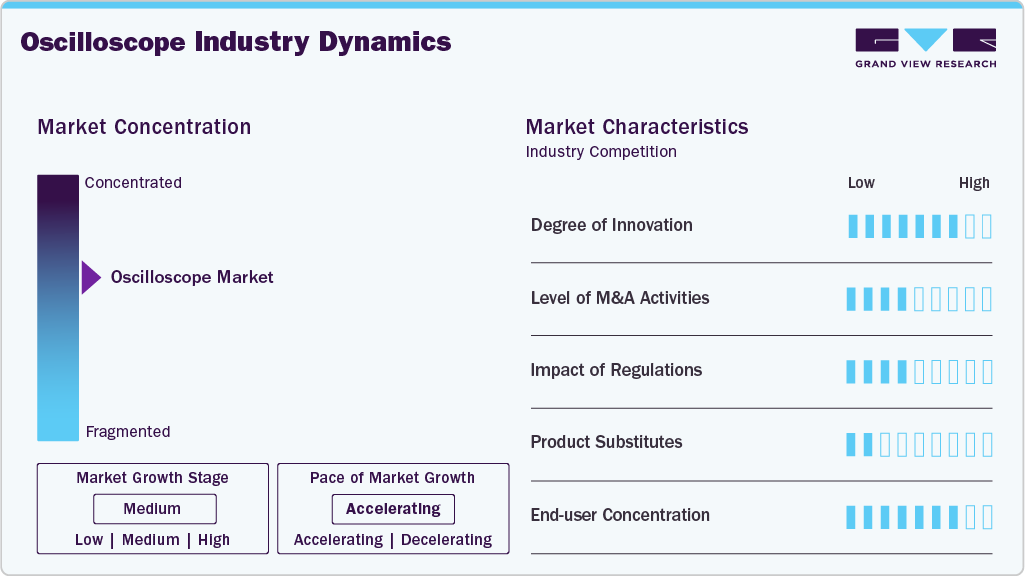
The oscilloscope industry is moderately concentrated, with competition among established test and measurement companies, specialized electronic instrumentation manufacturers, and regional suppliers offering benchtop, handheld, mixed-signal, digital storage, and high-performance oscilloscopes across research, design, manufacturing, automotive, telecommunications, aerospace and defense, and education applications. The market is characterized by strong emphasis on bandwidth, sampling rate, waveform capture, measurement accuracy, memory depth, triggering capabilities, channel configuration, software functionality, and ease of use.
 To learn more about this report, Download Free Sample Report
Technology capabilities, product performance, application-specific functionality, global distribution networks, software ecosystems, technical support, and brand reputation play important roles in competitive positioning. Increasing demand for higher-speed measurements is encouraging manufacturers to invest in advanced acquisition architectures, high-bandwidth probes, real-time analysis, automated measurements, protocol decoding, and application-specific software. Established customer relationships, extensive product portfolios, calibration capabilities, and engineering expertise create barriers for new entrants, while price competition and the availability of lower-cost instruments can exert pressure on margins, particularly in entry-level and general-purpose segments.
Analyst Perspective
The market is evolving from conventional waveform measurement toward high-speed, application-specific, software-enabled, and increasingly intelligent electronic testing solutions. The growing complexity of semiconductor devices, communication systems, automotive electronics, and power electronics is increasing requirements for higher bandwidth, faster sampling, deeper memory, and more sophisticated signal-analysis capabilities. Furthermore, the integration of protocol analysis, automated measurements, advanced triggering, remote connectivity, and software-based visualization is improving the efficiency of electronic testing and troubleshooting.
Component Insights
The hardware segment dominated the market with a share of 71.0% in 2025, driven by the widespread requirement for physical oscilloscopes, probes, input channels, signal acquisition systems, displays, and other measurement components across electronics design, semiconductor testing, automotive development, telecommunications, industrial troubleshooting, and research applications. The increasing complexity of electronic systems and growing need for accurate real-time signal measurement further support demand for advanced hardware with higher bandwidth, faster sampling rates, deeper memory, and greater channel capabilities. These requirements continue to position hardware as the core revenue-generating component of oscilloscope systems across diverse end-use industries.
The software segment is expected to grow at the highest CAGR of 9.5% from 2026 to 2033. The segmental growth is supported by increasing adoption of software-enabled waveform analysis, automated measurements, protocol decoding, advanced signal processing, data visualization, and application-specific testing functions. Software capabilities allow users to extend instrument functionality, simplify analysis of complex signals, automate repetitive testing tasks, and support more efficient design verification and troubleshooting. The growing shift toward intelligent and flexible test environments is therefore expected to strengthen demand for oscilloscope software throughout the forecast period.
Type Insights
The digital segment dominated the market with a share in 2025, fueled by the widespread adoption of digital oscilloscopes for accurate waveform capture, signal storage, automated measurements, and detailed analysis across electronics, semiconductor, automotive, telecommunications, and industrial applications. Their ability to combine high sampling rates, advanced triggering, deep memory, and software-based signal analysis makes them suitable for increasingly complex electronic testing requirements. The growing need for reliable and flexible measurement solutions further supports the continued dominance of digital oscilloscopes.
The mixed-signal segment is expected to grow at the highest CAGR from 2026 to 2033, supported by the increasing need to simultaneously analyze analog waveforms and digital logic signals in complex electronic systems. Mixed-signal oscilloscopes enable engineers to correlate analog behavior with digital events, supporting efficient debugging and validation of embedded systems, microcontrollers, power electronics, automotive electronics, and communication interfaces. The rising integration of analog and digital components within modern electronic devices is expected to further increase demand for mixed-signal testing capabilities.
Bandwidth Insights
The below 500 MHz segment dominated the market with a share in 2025, driven by the widespread use of lower-bandwidth oscilloscopes for general-purpose electronic testing, circuit debugging, education, maintenance, and laboratory applications. Their relatively accessible cost, ease of operation, and suitability for measuring low- to medium-frequency signals make them widely adopted across electronics manufacturers, educational institutions, service organizations, and industrial facilities. Continued demand for routine testing and troubleshooting of electronic circuits supports the segment’s growth.
The above 4 GHz segment is expected to grow at the highest CAGR from 2026 to 2033, fueled by the increasing adoption of high-speed electronic systems, advanced semiconductor devices, high-frequency communication technologies, and sophisticated computing architectures that require precise characterization of rapidly changing signals. High-bandwidth oscilloscopes provide the measurement accuracy, sampling performance, and signal analysis capabilities required for applications such as high-speed digital design, telecommunications, aerospace and defense, semiconductor development, and advanced automotive electronics. The continued evolution toward faster and more complex electronic systems is expected to accelerate demand for oscilloscopes exceeding 4 GHz bandwidth.
End Use Insights
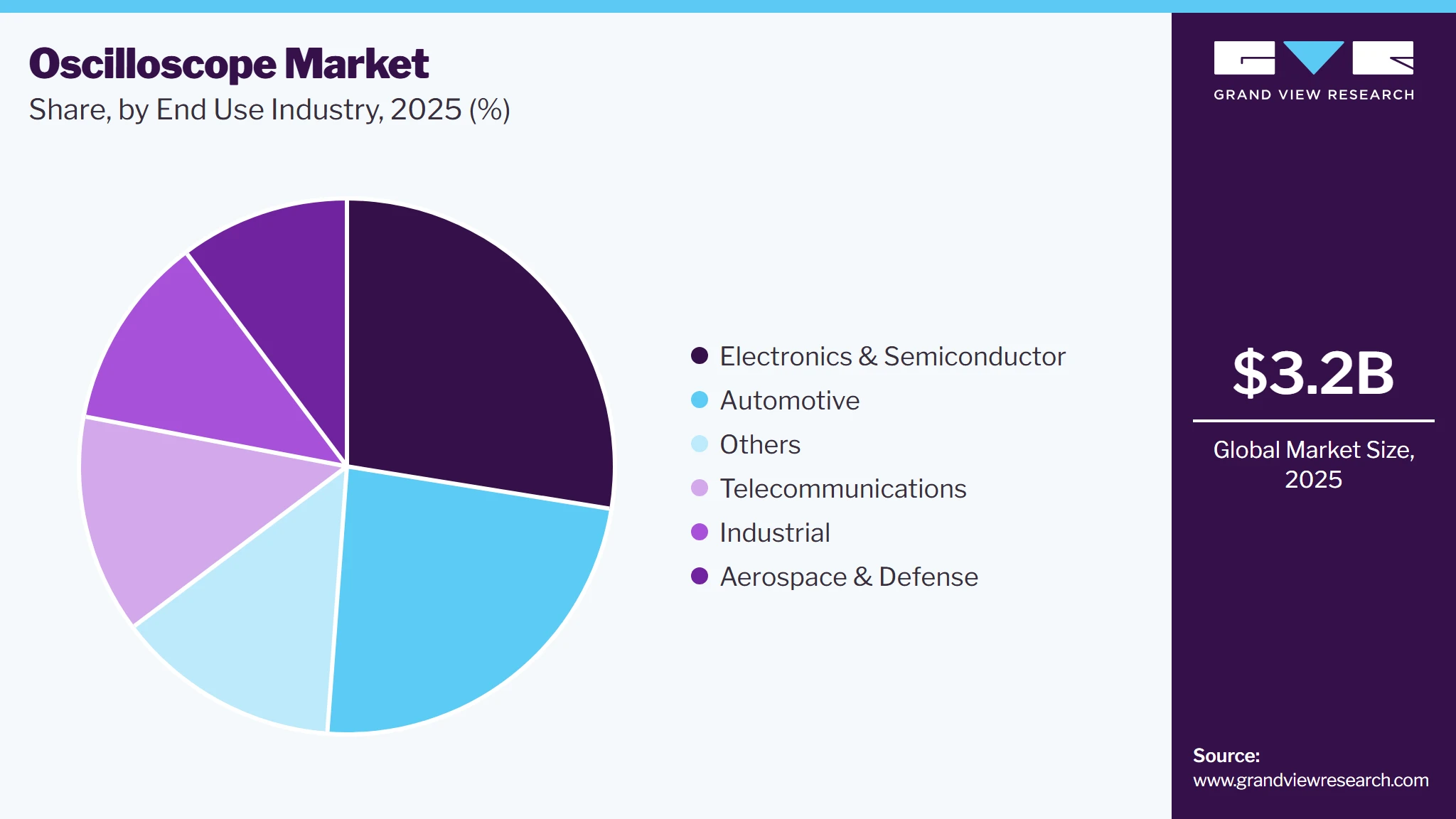
The electronics & semiconductor segment dominated the market with a share in 2025, driven by the extensive use of oscilloscopes across semiconductor design, electronic component development, circuit testing, signal integrity analysis, debugging, and product validation. The increasing complexity of integrated circuits, printed circuit boards, embedded systems, and high-speed electronic devices requires precise waveform measurement and analysis throughout the development and testing cycle. Rising investments in semiconductor manufacturing and R&D electronics are further supporting demand for advanced oscilloscopes within the segment.
 To learn more about this report, Download Free Sample Report
The telecommunications segment is expected to grow at the highest CAGR from 2026 to 2033, fueled by the increasing deployment of high-speed communication networks and growing complexity of telecommunications equipment, which require accurate measurement and analysis of high-frequency and high-speed signals. The expansion of 5G infrastructure, development of next-generation communication technologies, and increasing demand for high-speed data transmission are driving the need for high-bandwidth oscilloscopes for signal integrity testing, protocol analysis, equipment validation, and troubleshooting.
Regional Insights
North America oscilloscope industry accounted for a significant share of 29.3% in 2025, supported by strong demand for advanced test and measurement equipment across semiconductor, telecommunications, aerospace & defense, automotive, and electronics industries. The region's concentration of semiconductor design activities, advanced R&D facilities, and high-performance computing applications is supporting adoption of high-bandwidth oscilloscopes for signal integrity, high-speed interface, and complex electronic system testing. In addition, continued development of 5G infrastructure, electric vehicles, advanced driver-assistance systems, and sophisticated aerospace and defense electronics is creating demand for precision waveform analysis and multi-channel measurement capabilities.
U.S. Oscilloscope Market Trends
The U.S. market led the regional market in 2025, fueled by the extensive semiconductor R&D, advanced electronics development, aerospace and defense programs, and telecommunications infrastructure investments. Increasing complexity of high-speed electronic systems is encouraging engineers to adopt higher-bandwidth instruments for signal integrity analysis, protocol debugging, power electronics testing, and validation of next-generation communication technologies. Furthermore, growing development of electric vehicles, connected devices, 5G infrastructure, and advanced semiconductor technologies is supporting demand for sophisticated oscilloscopes across R&D laboratories, manufacturing facilities, and engineering organizations.
Europe Oscilloscope Market Trends
Europe oscilloscope industry accounted for a significant share in 2025, supported by the region's established automotive, industrial automation, telecommunications, aerospace, and electronics industries. The increasing electrification of vehicles and development of advanced automotive electronics are creating demand for oscilloscopes used in ECU, powertrain, battery, inverter, and automotive communication testing. In addition, investments in renewable energy, smart-grid infrastructure, and industrial electronics are expanding applications for waveform analysis and power-electronics testing. Germany, the UK, and France remain important demand centers, supported by established engineering capabilities and stringent quality and testing requirements.
The UK oscilloscope industry is fueled by the rising demand from aerospace and defense, automotive, telecommunications, electronics R&D, and industrial technology sectors. The country's established engineering and research ecosystem is creating applications for high-precision oscilloscopes in electronic system development, radar and communication equipment testing, and advanced vehicle electronics. Growing investments in electrification, wireless communications, and high-performance computing are also increasing the need for instruments capable of analyzing high-speed and complex electrical signals. The presence of specialized research institutions and advanced engineering companies further supports demand for sophisticated test and measurement equipment.
Germany oscilloscope market presents strong opportunities through its large automotive manufacturing base, industrial automation ecosystem, and advanced engineering capabilities. The transition toward electric and software-defined vehicles is increasing testing requirements for batteries, power electronics, inverters, ECUs, and automotive communication networks. At the same time, Germany's industrial machinery and automation sectors require precise signal measurement for equipment development, troubleshooting, and quality assurance. Growing investment in renewable energy and smart-grid technologies is also creating additional applications for oscilloscopes in power conversion and electrical-system testing.
Asia Pacific Oscilloscope Market Trends
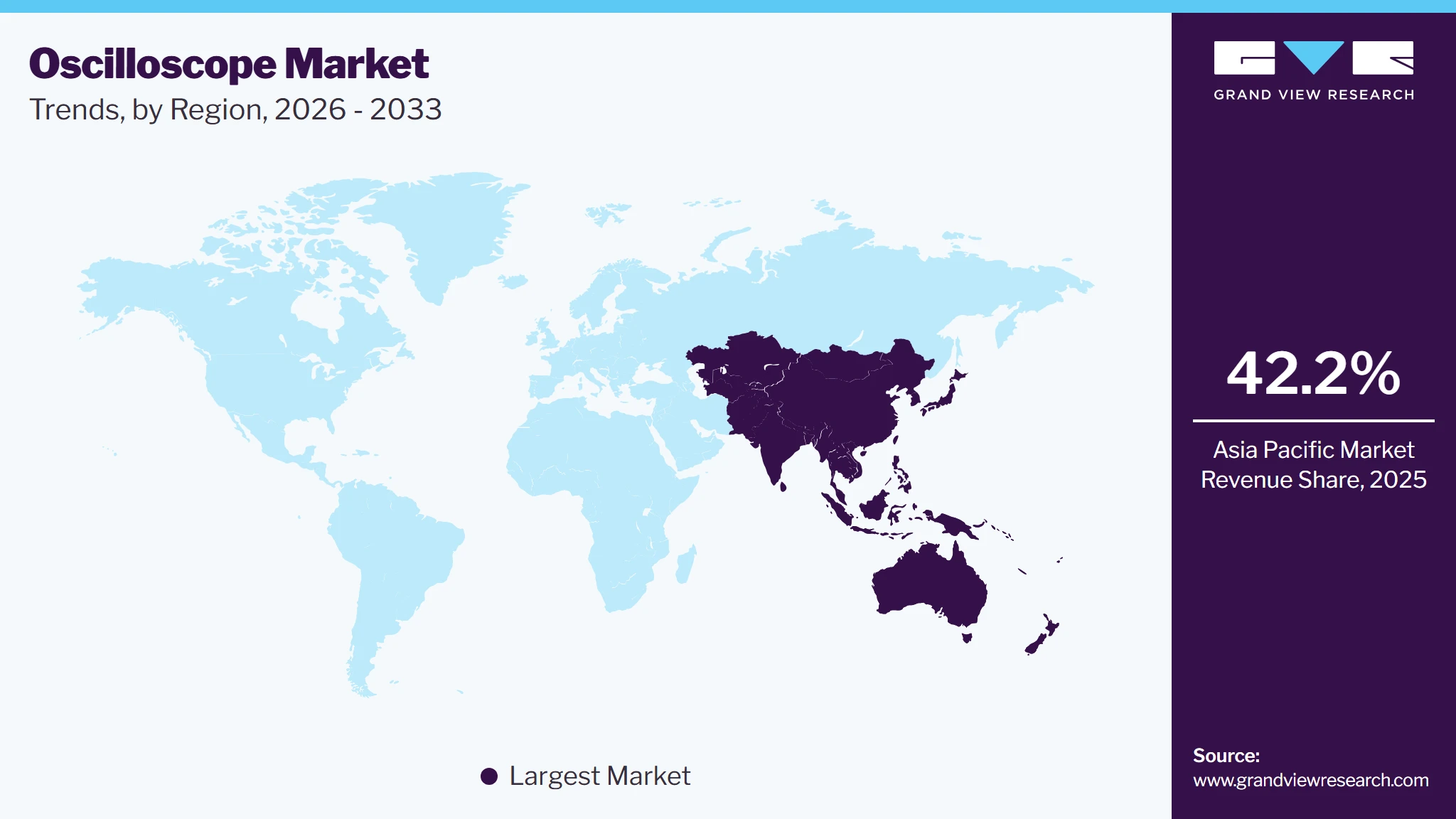
Asia Pacific oscilloscope market is expected to grow at the highest CAGR of 9.6% from 2026 to 2033, supported by the region's extensive electronics manufacturing base, semiconductor ecosystem, telecommunications infrastructure, and growing automotive electronics industry. The region accounted for approximately 41.2% of the global oscilloscope market in 2025 according to Fortune Business Insights, with China, Japan, and India identified as important contributors. Rapid expansion of semiconductor manufacturing, consumer electronics production, 5G infrastructure, electric vehicles, and advanced electronics R&D is increasing demand for oscilloscopes across design, production, quality control, and maintenance applications.
 To learn more about this report, Download Free Sample Report
China oscilloscope industry is strongly influenced by country's large electronics manufacturing and semiconductor industries, as well as continued investment in telecommunications, electric vehicles, and advanced industrial technologies. Increasing domestic development of semiconductors, consumer electronics, EV powertrains, and communication equipment is generating demand for oscilloscopes across product development and manufacturing environments. The expansion of domestic test-and-measurement capabilities is also supporting local adoption of advanced digital and mixed-signal instruments, while the development of high-speed electronics is increasing requirements for higher bandwidth and more sophisticated signal-analysis capabilities.
Japan oscilloscope industry is increasingly supported by supported by its strong presence in automotive, semiconductor, consumer electronics, industrial equipment, and precision-engineering industries. Increasing development of electric vehicles, advanced automotive electronics, semiconductor devices, and high-speed communication technologies is sustaining demand for sophisticated waveform-analysis instruments. Japanese manufacturers and research organizations also maintain extensive requirements for precision measurement across electronics R&D and production testing. Continued 5G deployment, automotive electronics development, and semiconductor investment are further expanding applications for high-bandwidth and mixed-signal oscilloscopes.
Key Oscilloscope Company Insights
Some of the key players operating in the oscilloscope market include Keysight Technologies and Tektronix., among others
-
Keysight Technologies, Inc. is a global technology company providing electronic design and test solutions across communications, networking, aerospace and defense, automotive, semiconductor, and general electronics industries. The company offers hardware, software, and services spanning simulation, design, validation, manufacturing test, and optimization. Its portfolio includes oscilloscopes, signal analyzers, network analyzers, and signal sources, with its oscilloscope business focused on high-performance measurement and analysis applications. Keysight's electronic measurement heritage dates back to 1939 and supports its established position in advanced test and measurement.
-
Tektronix, Inc. is a test and measurement company specializing in electronic measurement solutions for engineers, scientists, and technicians. The company provides a broad portfolio of oscilloscopes, probes, signal generators, analyzers, and related test solutions serving aerospace and defense, automotive, communications, semiconductor, industrial, power electronics, and research applications. Tektronix has been developing test and measurement solutions since 1946 and maintains a broad oscilloscope portfolio spanning basic, mixed-signal, and advanced signal-analysis instruments.
Some of the emerging players operating in the oscilloscope market include RIGOL Technologies and SIGLENT Technologies, among others
-
RIGOL Technologies Co., Ltd. is an electronic test and measurement company offering oscilloscopes, waveform generators, spectrum analyzers, vector network analyzers, RF signal generators, power supplies, multimeters, and other measurement instruments. The company serves customers across more than 90 countries and regions and focuses on providing high-performance and cost-effective testing solutions. RIGOL's solutions address applications across automotive electronics, semiconductors, new energy, communications, education, scientific research, and general electronics.
-
SIGLENT Technologies Co., Ltd. is an R&D-driven electronic test and measurement company offering digital oscilloscopes, vector network analyzers, spectrum analyzers, RF and arbitrary waveform generators, power supplies, electronic loads, and digital multimeters. The company has developed capabilities across R&D, manufacturing, sales, and service and serves customers in more than 80 countries and regions. Its products are used across automotive electronics, communications, power supplies, consumer electronics, research, and education, with oscilloscopes forming a key part of its general-purpose electronic test and measurement portfolio.
Key Oscilloscope Companies
The following key companies have been profiled for this study on the oscilloscope market.
-
Keysight Technologies, Inc.
-
Tektronix, Inc.
-
Rohde & Schwarz GmbH & Co. KG
-
Teledyne LeCroy, Inc.
-
Yokogawa Test & Measurement Corporation
-
RIGOL Technologies Co., Ltd.
-
SIGLENT Technologies Co., Ltd.
-
Pico Technology Ltd.
-
Good Will Instrument Co., Ltd. (GW Instek)
-
B&K Precision Corporation
Competitive Benchmarking
Operating Strategies
Competitive Edge
Weaknesses
Mature Players: Keysight Technologies, Inc.; Tektronix, Inc.; Rohde & Schwarz GmbH & Co. KG
- Invest heavily in high-bandwidth oscilloscopes, advanced signal analysis, and application-specific measurement solutions.
- Expand product portfolios through continuous R&D, software development, and integrated test workflows.
- Strong global brand recognition and established customer relationships.
- Extensive high-performance product portfolios covering general-purpose to advanced oscilloscopes.
- Premium product pricing can limit adoption among price-sensitive customers.
- Complex high-end instruments require specialized technical expertise and training.
Emerging Players: Pico Technology Ltd., Good Will Instrument Co., Ltd.
- Focus on cost-effective oscilloscopes offering competitive bandwidth, sampling rates, and functionality.
- Expand into higher-performance instruments to address semiconductor, automotive, communications, and research applications.
- Strong price-to-performance positioning.
- Increasing product capabilities across digital, mixed-signal, and high-bandwidth oscilloscopes.
- Comparatively lower brand recognition in some premium markets.
- Smaller global service and support infrastructure than established players.
Recent Developments
-
In September 2026, Tektronix introduced the DPO718AX, an 8-channel oscilloscope with up to 25 GHz bandwidth across eight synchronized channels. The instrument is designed for high-speed digital validation, RF, sensing, spectroscopy, electronic warfare, and advanced research applications.
-
In February 2026, Keysight Technologies, Inc. launched the Infiniium XR8 real-time oscilloscope series to accelerate high-speed digital validation and compliance testing, addressing increasingly complex USB, DisplayPort, DDR, and other high-speed interfaces.
-
In May 2025, Yokogawa Test & Measurement released the SL2000 High-Speed Data Acquisition Unit, a modular ScopeCorder platform combining mixed-signal oscilloscope and data-acquisition capabilities.
Oscilloscope Market Report Scope
Report Attribute
Details
Market size in 2025
USD 3.2 billion
Estimated market size in 2026
USD 3.4 billion
Projected market size by 2033
USD 6.0 billion
Growth rate
CAGR of 8.2% from 2026 to 2033
Actual data
2021 - 2025
Forecast period
2026 - 2033
Quantitative units
Revenue in USD million/billion and CAGR from 2026 to 2033
Report coverage
Revenue forecast, company share, competitive landscape, growth factors, and trends
Segments covered
Component, type, bandwidth, end use, region
Regional scope
North America; Europe; Asia Pacific; Latin America; Middle East and Africa
Country scope
U.S.; Canada; Mexico; UK; Germany; France; China; Japan; India; South Korea; Australia; Brazil; UAE; KSA; South Africa
Key companies profiled
Keysight Technologies, Inc.; Tektronix, Inc.; Rohde & Schwarz GmbH & Co. KG; Teledyne LeCroy, Inc.; Yokogawa Test & Measurement Corporation; RIGOL Technologies Co., Ltd.; SIGLENT Technologies Co., Ltd.; Pico Technology Ltd.; Good Will Instrument Co., Ltd. (GW Instek); B&K Precision Corporation
Customization scope
Free report customization (equivalent to up to 8 analyst working days) with purchase. Addition or alteration to country, regional & segment scope.
Pricing and purchase options
Avail customized purchase options to meet your exact research needs. Explore purchase options
Global Oscilloscope Market Report Segmentation
This report forecasts revenue growth at global, regional, and country levels and provides an analysis of the latest industry trends in each of the sub-segments from 2021 to 2033. For this study, Grand View Research has segmented the global oscilloscope market report based on component, type, bandwidth, end use, and region.
-
Component Outlook (Revenue, USD Million, 2021 - 2033)
-
Hardware
-
Software
-
-
Type Outlook (Revenue, USD Million, 2021 - 2033)
-
Analog
-
Digital
-
Mixed-Signal
-
Others
-
-
Bandwidth Outlook (Revenue, USD Million, 2021 - 2033)
-
Below 500 MHz
-
500 MHz–1 GHz
-
1–4 GHz
-
Above 4 GHz
-
-
End Use Outlook (Revenue, USD Million, 2021 - 2033)
-
Electronics & Semiconductor
-
Automotive
-
Aerospace & Defense
-
Telecommunications
-
Industrial
-
Others
-
-
Regional Outlook (Revenue, USD Million, 2021 - 2033)
-
North America
-
U.S.
-
Canada
-
Mexico
-
-
Europe
-
UK
-
Germany
-
France
-
-
Asia Pacific
-
China
-
Japan
-
India
-
South Korea
-
Australia
-
-
Latin America
-
Brazil
-
-
Middle East and Africa
-
UAE
-
KSA
-
South Africa
-
-
Research Methodology
The oscilloscope market figures in this report are based on a proven research process that combines executive interviews with secondary research from proprietary databases, company filings, and recognized regulatory and institutional sources. Market size is built through value-chain sizing-reconciling supply-side and demand-side estimates-and triangulated with bottom-up and top-down approaches. Every estimate passes multiple levels of expert validation before publication, with each oscilloscope segment quantified using the revenue-capture definitions in the table below.
Segment Definition
Component
Revenue Capture Definition
Hardware
Revenue is generated through the sale of oscilloscopes, probes, measurement accessories, input modules, acquisition hardware, and other physical components used for signal measurement and analysis.
Software
Revenue is generated through the sale of oscilloscope software, software licenses, application-specific analysis packages, firmware upgrades, and subscription-based testing and measurement applications.
Type
Revenue Capture Definition
Analog
Revenue is generated through the sale of analog oscilloscopes and associated probes, accessories, and replacement components.
Digital
Revenue is generated through the sale of digital oscilloscopes, probes, accessories, software packages, and application-specific measurement options.
Mixed-Signal
Revenue is generated through the sale of mixed-signal oscilloscopes, logic-analysis options, probes, software, and application-specific measurement packages.
Others
Revenue is generated through the sale of specialized oscilloscopes, application-specific configurations, probes, accessories, and related software.
Bandwidth
Revenue Capture Definition
Below 500 MHz
Revenue is generated through the sale of low-bandwidth oscilloscopes, probes, accessories, and related software and service packages.
500 MHz–1 GHz
Revenue is generated through the sale of 500 MHz–1 GHz oscilloscopes, specialized probes, software options, accessories, and calibration services.
1–4 GHz
Revenue is generated through the sale of high-bandwidth oscilloscopes, high-frequency probes, advanced analysis software, application modules, and related services.
Above 4 GHz
Revenue is generated through the sale of ultra-high-bandwidth oscilloscopes, high-frequency probes, advanced software, specialized measurement options, and associated services.
End Use
Revenue Capture Definition
Electronics & Semiconductor
Revenue is generated through the sale of oscilloscopes, probes, software, and testing accessories to electronics and semiconductor manufacturers, laboratories, and R&D facilities.
Automotive
Revenue is generated through the sale of oscilloscopes, automotive testing solutions, probes, software, and application-specific measurement packages to automotive manufacturers and suppliers.
Aerospace & Defense
Revenue is generated through the sale of high-performance oscilloscopes, specialized probes, software, measurement systems, and testing solutions for aerospace and defense applications.
Telecommunications
Revenue is generated through the sale of high-bandwidth oscilloscopes, specialized probes, software, and communication-focused measurement solutions.
Industrial
Revenue is generated through the sale of oscilloscopes, probes, software, accessories, and industrial testing and measurement solutions.
Others
Revenue is generated through the sale of oscilloscopes, accessories, software, and specialized measurement solutions to organizations outside the major end-use industries.
Estimation Model
Layer
Key Questions
Description
End-User Adoption Layer
Who are the potential adopters?
Identifies electronics and semiconductor manufacturers, automotive companies, aerospace and defense organizations, telecommunications companies, industrial equipment manufacturers, research institutions, educational organizations, and other users that adopt oscilloscopes for electrical signal measurement, circuit testing, product development, troubleshooting, quality control, and validation of electronic systems.
Oscilloscope Manufacturer & Solution Provider Layer
Who supplies oscilloscopes and related solutions?
Evaluates test and measurement companies, electronic instrumentation manufacturers, and specialized oscilloscope providers offering analog, digital, and mixed-signal oscilloscopes, along with probes, accessories, software, application-specific measurement solutions, and related technical support.
Distribution & Sales Layer
How are oscilloscopes delivered to end users?
Maps direct sales, authorized distributors, specialized test and measurement equipment suppliers, online channels, and system integrators through which oscilloscopes and related accessories reach end users. This layer also covers product configuration, application consultation, installation, calibration, and after-sales support.
Measurement & Application Layer
Where and how are oscilloscopes used?
Maps oscilloscope deployment across electronics design laboratories, semiconductor testing facilities, automotive development centers, telecommunications laboratories, aerospace and defense testing environments, industrial facilities, educational institutions, and research centers for waveform analysis, signal integrity testing, debugging, validation, and performance verification.
End-User Adoption Layer
Who are the potential adopters?
Identifies electronics and semiconductor manufacturers, automotive companies, aerospace and defense organizations, telecommunications companies, industrial equipment manufacturers, research institutions, educational organizations, and other users that adopt oscilloscopes for electrical signal measurement, circuit testing, product development, troubleshooting, quality control, and validation of electronic systems.
Delivered Customizations
This report has been delivered with the following In-depth customizations
Client Request
Customization Delivered
Value Adds
Market Sizing, Segmentation & Growth Opportunity Assessment
Assessed the global oscilloscope market size, historical trends, forecast growth outlook, and detailed segmentation by component, type, bandwidth, and end-use industry.
Enables oscilloscope manufacturers, test and measurement companies, electronics and semiconductor companies, automotive manufacturers, and other industry stakeholders to identify high-growth segments, prioritize product development, optimize resource allocation, expand product portfolios, and capture emerging opportunities in electronic testing and measurement.
Regional Market Demand & Growth Opportunity Assessment
Assessed oscilloscope market demand across North America, Europe, Asia Pacific, Latin America, and Middle East & Africa, considering electronics and semiconductor manufacturing, automotive electronics development, telecommunications infrastructure, aerospace and defense activities, industrial automation, R&D investments, and demand for advanced electronic testing equipment across key countries.
Provides insights into regional growth opportunities, market-entry priorities, investment hotspots, and competitive positioning, enabling oscilloscope manufacturers and stakeholders to prioritize high-potential geographies, strengthen distribution networks, target electronics and industrial testing applications, and align product portfolios with regional demand patterns.
Competitive Landscape & Strategic Positioning Analysis
Evaluated the competitive environment across test and measurement companies, electronic instrumentation manufacturers, and specialized oscilloscope providers, comparing product portfolios, oscilloscope types, bandwidth capabilities, channel configurations, signal acquisition technologies, software and analysis capabilities, application coverage, distribution networks, geographic presence, partnerships, and recent product developments.
Enables companies to benchmark their market position, identify product and technology gaps, assess differentiation opportunities, evaluate capabilities across hardware, software, and supporting solutions, prioritize R&D investments, strengthen distribution and technology partnerships, and enhance competitive positioning across electronics & semiconductor, automotive, aerospace & defense, telecommunications, industrial, and research applications.
Frequently Asked Questions About This Report
Key factors that are driving the oscilloscope market growth include the increasing demand for high-speed electronics testing, expanding semiconductor and electronic device manufacturing, rising adoption of advanced automotive electronics, and growing need for high-bandwidth oscilloscopes capable of analyzing increasingly complex and high-frequency signals.
The digital segment held the largest market revenue share in 2025.
The electronics & semiconductor segment held the largest market revenue share in 2025.
Asia Pacific dominated with a 42.2% revenue share in 2025.
The global oscilloscope market size was valued at USD 3.2 billion in 2025 and is estimated at USD 3.4 billion for 2026.
The global oscilloscope market is expected to grow at a CAGR of 8.2% from 2026 to 2033, reaching USD 6.0 billion by 2033.
The hardware segment accounted for the largest share, with 71.0% of revenue in 2025.
Some key players operating in the oscilloscope market include Keysight Technologies, Inc.; Tektronix, Inc.; Rohde & Schwarz GmbH & Co. KG; Teledyne LeCroy, Inc.; Yokogawa Test & Measurement Corporation; RIGOL Technologies Co., Ltd.; SIGLENT Technologies Co., Ltd.; Pico Technology Ltd.; Good Will Instrument Co., Ltd. (GW Instek); and B&K Precision Corporation.
The below 500 MHz segment led the market with the largest revenue share in 2025.
About the Author(s)
Electronic Devices Research Team
Semiconductors & Electronics · Electronic DevicesThis report was authored by the electronic devices research team at Grand View Research - comprising two research analysts, one senior research analyst, and one industry expert - with specialized expertise in the electronic devices segment of the semiconductors & electronics industry. All findings are based on proprietary semiconductors & electronics databases, executive interviews, and regulatory analysis, subject to internal peer review prior to publication.
Last Updated:
Speak to Analyst

Customize this report to your needs - add regions, segments, or data points, with 20% free customization.
Or view our licence options:


ISO 9001:2015 & 27001:2022 Certified
We are GDPR and CCPA compliant! Your transaction & personal information is safe and secure. For more details, please read our privacy policy.


