
- Home
- »
- Organic Chemicals
- »
-
Oxalic Acid Market Size, Share & Growth Report, 2026-2033GVR Report cover

Oxalic Acid Market (2026 - 2033)
Size, Share & Trend Analysis Report, By Application (Bleaching/Cleaning, Pharmaceuticals, Water Treatment, Textile Dyeing, Metal Leaching), By Region, And Segment Forecasts
Market Size, 2025
$665.2MMarket Estimate, 2026
$696.6MMarket Forecast, 2033
$979.6MCAGR, 2026–2033
5.0%Oxalic Acid Market Size & Trends
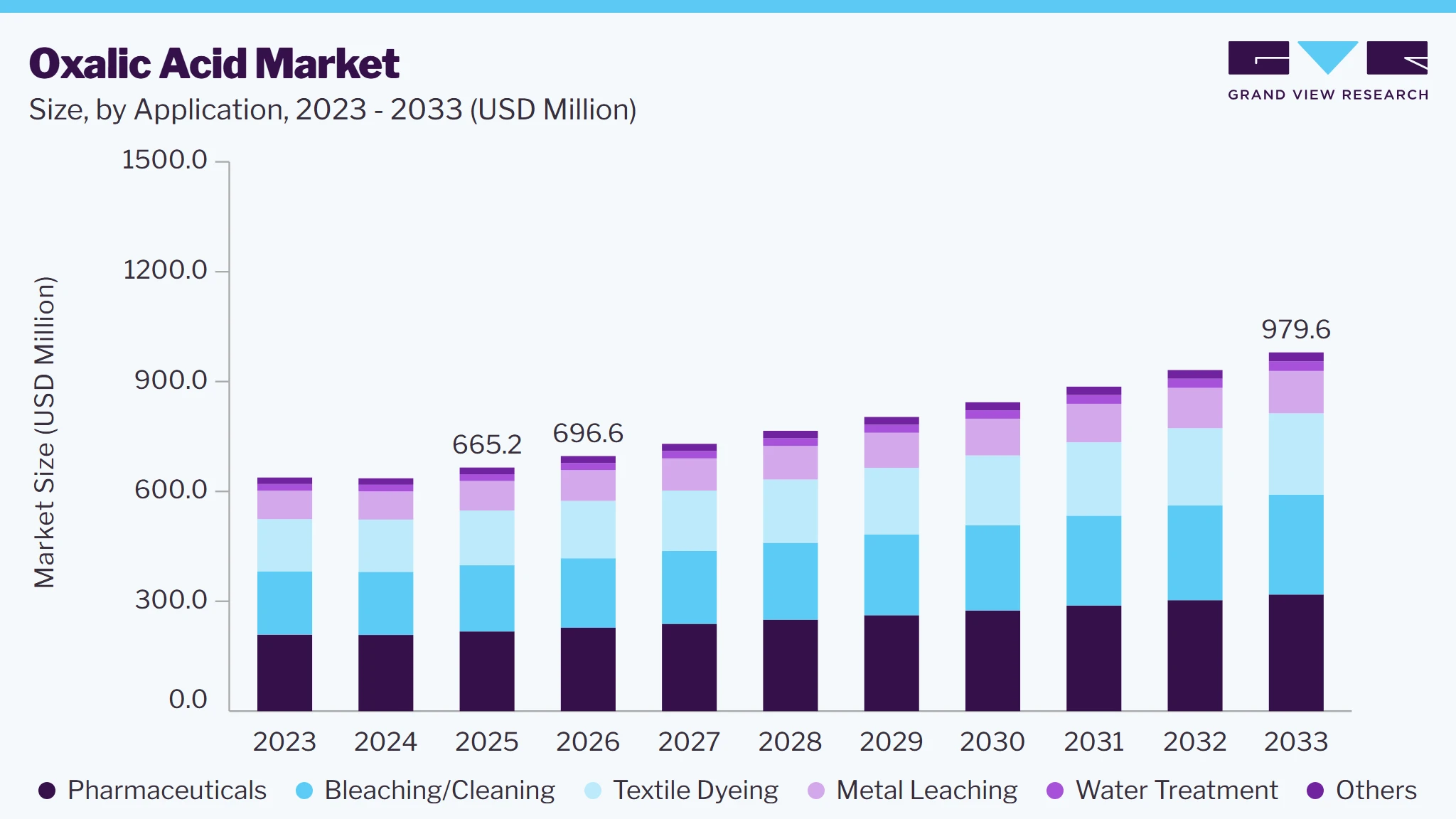
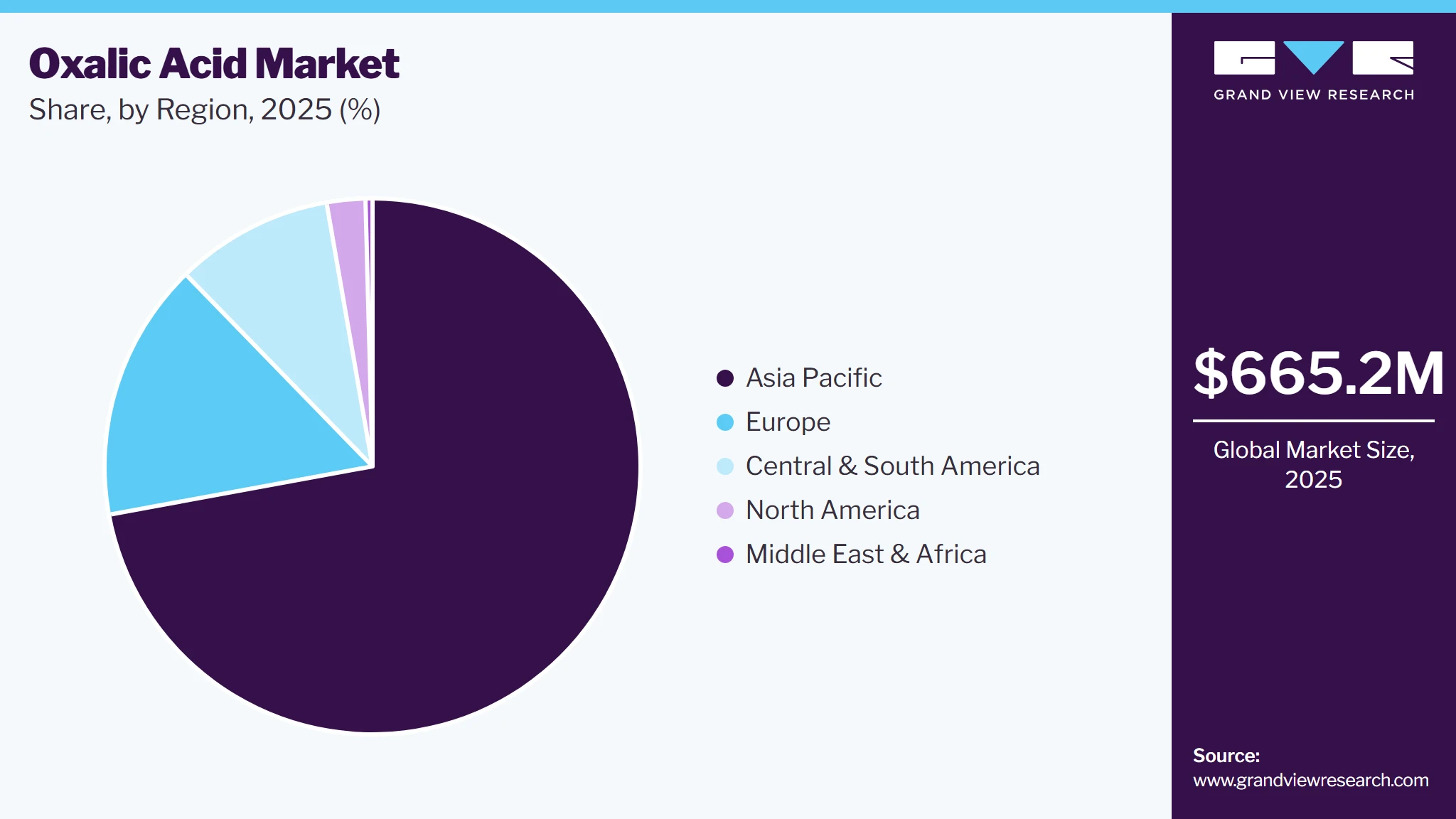
The global oxalic acid market size was valued at USD 665.2 million in 2025 and is projected to grow from USD 696.6 million in 2026 to USD 979.6 million by 2033, at a CAGR of 5.0% from 2026 to 2033. The market in Asia Pacific dominated with a revenue share of 72.1% in 2025. Oxalic acid is used in the textile sector for bleaching, dyeing, and finishing. With the expansion of the global textile industry, especially in emerging economies such as China, India, and Southeast Asia, the demand for oxalic acid has surged. The growing population and increasing disposable income in these regions have led to greater consumption of clothing and textiles, directly boosting the need for chemicals such as oxalic acid in production processes.
 Source: Grand View Research, IR Documents, Primary Interviews, Paid DatabasesTo learn more about this report,
 Download Free Sample Report
 Key Market Trends & Insights
- By application: Pharmaceuticals segment held the largest market share of 32.7% in 2025.
Regional Highlights
- Largest regional market: Asia Pacific (72.1% revenue share, 2025)
- By country: China held the largest market share in 2025
Market Size & Forecast
- Market size in 2025: USD 665.2 Million
- Estimated market size in 2026: USD 696.6 Million
- Projected market size by 2033: USD 979.6 Million
- CAGR (2026-2033): 5.0%
Three ways to get this report
Buy it, customize it, or ask a question.Ask an Analyst
A direct answer, usually in 1 working day
- AccessReport author, directly
- Reply timeWithin 1 working day
- No sales callDirect answer only
- FormatEmail reply
- CostFree, no cost
Get the Full Report
What the study covers
- FormatsPDF · Excel · Dashboard
- Timeline2026–2033 annual, 2025 base
- Coverage20+ countries, 5 regions
- Companies10+ key players profiled
Customize the Report
20% free customization
- IncludeCountries, segments, points
- TailorTo your product definition
- ExtendDeeper competitor detail
- OrA fully bespoke study
- Turnaround5–10 working days
Oxalic acid is a valuable component in synthesizing various drugs, such as analgesics and antipyretics, and is also used for purifying active pharmaceutical ingredients. The demand for pharmaceutical-grade oxalic acid has increased with the growing emphasis on healthcare and wellness globally, especially in developed markets. The aging population in many countries also drives the demand for healthcare products and treatments, further accelerating the pharmaceutical industry's need for this chemical compound.In addition to textiles and pharmaceuticals, the oxalic acid market also benefits from its widespread application in the metal and mining industries. Oxalic acid is an essential component in metal cleaning and polishing, as well as in extracting certain minerals like uranium and rare earth elements. The rapid industrialization and expansion of the mining sector in countries such as China, Australia, and South Africa have created a growing need for oxalic acid in mining operations. Moreover, its use as a rust remover and cleaning agent in maintaining machinery and metal products contributes to its increasing demand in this sector.
 To learn more about this report, Download Free Sample Report
 The agricultural sector is another important driver of the oxalic acid market. Oxalic acid is used in agriculture for various purposes, such as in controlling certain pests and as a cleaning agent for equipment. It is also applied in beekeeping to control varroa mites, a significant threat to honeybee populations. With the growing focus on sustainable farming practices and the increasing adoption of organic farming methods, the demand for oxalic acid in agriculture has risen. In addition, the need to protect crops and maintain healthy ecosystems prompts farmers and beekeepers to utilize oxalic acid for pest control, further boosting the market.
Market Dynamics
The oxalic acid market is experiencing steady growth driven by increasing demand from pharmaceutical, chemical, textile, metal processing, and rare earth element industries. Oxalic acid is widely utilized as a reducing agent, bleaching agent, cleaning chemical, and intermediate in various industrial applications, making it an essential raw material across multiple sectors. Rising industrialization, expanding manufacturing activities, and growing investments in specialty chemicals are supporting market expansion globally. Advancements in production technologies, growing demand for high-purity grades, and expanding applications in clean energy and advanced manufacturing industries are expected to create favorable opportunities for the oxalic acid market during the forecast period.
The oxalic acid market is witnessing steady growth due to its extensive use across pharmaceutical, chemical, textile, and metal treatment applications. Oxalic acid serves as an important reducing agent, bleaching agent, and cleaning chemical in various industrial processes. The increasing demand for pharmaceutical intermediates, specialty chemicals, and high-purity cleaning solutions is supporting market expansion.
In metal processing industries, oxalic acid is widely used for rust removal, metal cleaning, and surface treatment applications. The growing industrialization in emerging economies, coupled with expanding manufacturing activities, is further driving consumption. Increasing use of oxalic acid in rare earth element processing and electronics manufacturing is creating new growth opportunities for market participants.
The toxic and corrosive nature of oxalic acid remains a key challenge for market growth. Exposure to oxalic acid can pose health risks, including skin irritation, respiratory issues, and other safety concerns if not handled properly. As a result, manufacturers and end users must comply with stringent occupational safety and environmental regulations.
Regulations governing storage, transportation, and disposal of hazardous chemicals can increase operational costs for producers. The availability of alternative cleaning and bleaching agents in certain applications may also limit market penetration, particularly in industries seeking safer and more environmentally friendly chemical solutions.
The increasing demand for rare earth elements used in electric vehicles, renewable energy technologies, and advanced electronics is creating significant opportunities for the oxalic acid market. Oxalic acid plays a critical role in the precipitation and purification of rare earth metals, making it an essential chemical in the growing clean energy supply chain.
Rising demand for efficient industrial cleaning and metal treatment solutions is encouraging the development of high-purity and specialty-grade oxalic acid products. Growing investments in sustainable manufacturing processes and advanced chemical applications are expected to create new avenues for market growth. Companies focusing on product quality, process efficiency, and environmentally responsible production methods are likely to strengthen their competitive position in the evolving oxalic acid market.
Analyst Perspective
The oxalic acid market is positioned for steady growth, supported by its diverse applications across pharmaceuticals, metal treatment, rare earth processing, textiles, and specialty chemicals. Increasing industrialization, expanding chemical manufacturing activities, and rising demand for high-performance cleaning and reducing agents continue to drive market consumption. The growing importance of rare earth elements in electric vehicles, renewable energy systems, and advanced electronics is expected to create additional demand for oxalic acid, given its critical role in metal purification and precipitation processes. From an industry perspective, manufacturers are increasingly focusing on production efficiency and product.
Drivers, Opportunities & Restraints
The oxalic acid market is primarily driven by its diverse applications across various industries, including textiles, chemicals, pharmaceuticals, and agriculture. Its increasing use as a bleaching agent and rust remover, in producing various chemicals such as oxalates, and as a precursor for synthetic compounds is driving growth. The rising demand for oxalic acid in cleaning products and its role as a reducing agent in the metal and mining industries also contribute to market expansion. In addition, the growing use of oxalic acid in agriculture to remove pests and clean plant surfaces further fuels demand.
The oxalic acid market presents several growth opportunities due to the advancements in the pharmaceutical and biotechnological sectors, where oxalic acid is utilized to synthesize active pharmaceutical ingredients (APIs). Emerging economies, particularly in Asia Pacific, are seeing an increased demand for oxalic acid as urbanization and industrialization progress, leading to new applications. In addition, with the rising trend of sustainable and eco-friendly products, oxalic acid’s biodegradable nature positions it as a promising solution in green chemistry initiatives, thus opening up new opportunities in various industrial sectors.
Oxalic acid is toxic and can cause severe irritation or poisoning if handled improperly, causing environmental and health concerns. These hazards can lead to stringent regulations and safety protocols, increasing operational costs. In addition, the volatility in raw material prices and the potential for supply chain disruptions may hinder market stability. The limited availability of natural sources of oxalic acid and reliance on synthetic production processes may also affect its overall cost-effectiveness and market growth.
Application Insights
Pharmaceuticals dominated the raw material segment at a revenue share of 32.7% in 2025. Oxalic acid manufactures certain analgesics, antibiotics, and other therapeutic compounds. With the increasing demand for better medical treatments and the expansion of the global healthcare sector, the pharmaceutical industry's need for high-quality raw materials, including oxalic acid, has risen. The growing population further bolsters this demand, as the increasing prevalence of chronic diseases and the expanding focus on developing new medicines continue to drive the pharmaceutical segment within the oxalic acid market.
Bleaching/Cleaning is anticipated to register the fastest CAGR of 5.3% over the forecast period. Oxalic acid, known for breaking down organic stains and removing rust and mineral deposits, is widely used in household and industrial cleaning applications. The rise in consumer awareness about the benefits of using safer, less toxic chemicals for cleaning has accelerated the demand for oxalic acid-based products. In addition, its widespread application in the textile industry for fabric bleaching and in wood and metal cleaning processes has significantly bolstered its market growth. As consumers seek more sustainable and efficient cleaning solutions, oxalic acid is an ideal alternative to harsher, traditional chemicals.
Regional Insights
Asia Pacific accounted for 72.1% of the oxalic acid market revenue in 2025, making it the largest regional market due to its extensive use in textile, leather, and chemical industries including bleaching, dyeing, and as a reducing agent. Oxalic acid is widely used in the textile, chemical, and pharmaceutical industries, where it serves as a key component in processes such as bleaching, dyeing, and cleaning. The demand for oxalic acid in the textile industry is bolstered by the growing trend of high-quality fabric production, particularly in countries such as the U.S. and Canada.
 To learn more about this report, Download Free Sample Report
 Asia Pacific Oxalic Acid Market Trends
The Asia Pacific oxalic acid market accounted for the largest market revenue share of 72.2% in 2024 due to its extensive use in textile, leather, and chemical industries including bleaching, dyeing, and as a reducing agent. The rapid industrialization in countries such as China, India, and Southeast Asia has resulted in higher consumption of chemicals, including oxalic acid, for these sectors. Furthermore, the automotive industry’s growth, especially in China, has contributed to the rise in demand for oxalic acid as a cleaning agent and in manufacturing batteries and other electronic components. This surge in industrial activity is fueling the demand for oxalic acid across various manufacturing processes.
Europe Oxalic Acid Market Trends
Europe is expected to experience rapid growth. With its advanced manufacturing capabilities, the chemical industry in Europe is a key driver of demand for oxalic acid, particularly for its use in metal cleaning, rust removal, and textile bleaching. As European manufacturers continue to focus on high-quality production and environmental standards, oxalic acid is increasingly utilized for its effectiveness and relatively low environmental impact compared to other chemicals.
Latin America Oxalic Acid Market Trends
In Latin America, the growth of the oxalic acid market is largely driven by its increasing application in agriculture, particularly in the treatment of pests and crop diseases. Countries such as Brazil and Argentina, major players in global agriculture, are witnessing a rising demand for oxalic acid as a safer, more sustainable alternative to traditional chemical pesticides. The growing trend towards organic farming and adopting integrated pest management (IPM) practices across the region has fueled the need for biocontrol agents and non-toxic solutions such as oxalic acid.
Middle East & Africa Oxalic Acid Market Trends
The Middle East and African agrochemicals market is expected to grow significantly over the forecast period. In countries such as South Africa, where agriculture plays a significant role in the economy, oxalic acid controls pests such as varroa mites in beekeeping, which is essential for maintaining healthy bee populations for pollination. In addition, the growing interest in organic farming practices in Morocco and Egypt is driving the demand for environmentally friendly agricultural chemicals, with oxalic acid being a popular choice due to its biodegradability and non-toxic properties.
Key Oxalic Acid Company Insights
Some of the key players operating in the market include Mudanjiang Fengda Chemical Co., Ltd., Oxaquim, Merck KGaA, and others.
-
Mudanjiang Fengda Chemical Co., Ltd. specializes in the production and supply of oxalic acid, which is a versatile chemical used across various industries. In metallurgy, it serves as a precipitating agent for rare-earth metals, while in the pharmaceutical sector, it is utilized in the formulation of drugs such as Tetracycline and Phenobarbital.
-
Merck KGaA offers oxalic acid, an important organic compound used in various industrial applications, including chemical synthesis and as a cleaning agent. The company provides oxalic acid in its anhydrous form, characterized by its chemical formula HOOCCOOH, which is utilized in diverse sectors such as pharmaceuticals, agriculture, and materials science.
Key Oxalic Acid Companies
The following key companies have been profiled for this study on the oxalic acid market.
-
Mudanjiang Fengda Chemical Co., Ltd.
-
Oxaquim
-
Merck KGaA
-
UBE Industries Ltd.
-
Clariant International Limited
-
Indian Oxalate Limited
-
Shijiazhuang Taihe Chemical Co., Ltd.
-
Spectrum Chemical Manufacturing Corp.
-
Shandong Fengyuan Chemical Co., Ltd.
-
Penta s.r.o
Competitive Benchmarking
Operating Strategies
Competitive Edge
Weaknesses
Established Players (Merck KGaA, Clariant International Limited, UBE Industries Ltd., Indian Oxalate Limited, Oxaquim)
- Focus on expanding production capacity and improving product purity to serve pharmaceutical, chemical, and industrial applications.
- Invest in process optimization, sustainable manufacturing technologies, and cost-efficient production methods.
- Strengthening market position through long-term supply agreements with pharmaceutical, chemical, metal processing, and rare earth manufacturers.
- Expand geographic presence through distribution partnerships, exports, and strategic investments in high-growth regions.
- Strong manufacturing capabilities and established global distribution networks.
- Broad product portfolios including technical-grade, industrial-grade, and high-purity oxalic acid.
- Extensive regulatory compliance expertise and quality certifications.
- Strong customer relationships across multiple end-use industries and regions.
- Exposure to fluctuations in raw material and energy costs.
- High compliance and environmental management costs associated with chemical manufacturing.
- Dependence on industrial production cycles and downstream demand trends.
- Capital-intensive operations may limit flexibility in rapidly changing market conditions.
Emerging & Specialized Players (Mudanjiang Fengda Chemical Co., Ltd., Shijiazhuang Taihe Chemical Co., Ltd., Shandong Fengyuan Chemical Co., Ltd., Spectrum Chemical Manufacturing Corp., Penta s.r.o)
- Focus on niche applications such as specialty chemicals, laboratory reagents, metal treatment, and customized purity grades.
- Compete through cost-efficient manufacturing, regional distribution strength, and application-specific solutions.
- Expand through local partnerships and targeted customer engagement programs.
- Develop specialized products for pharmaceutical, electronics, and rare earth processing applications.
- Greater operational flexibility and faster response to customer-specific requirements.
- Strong focus on niche industrial applications and customized product offerings.
- Ability to compete effectively in regional markets through localized supply chains.
- Faster adaptation to emerging application opportunities and market trends.
- Limited production scale and international market presence compared to global leaders.
- Lower financial resources for large-scale expansion and advanced R&D initiatives.
- Greater dependence on regional demand and customer concentration.
- Increased vulnerability to pricing pressure from large integrated chemical manufacturers.
Oxalic Acid Market Report Scope
Report Attribute
Details
Market size in 2025
USD 665.2 million
Estimated market size in 2026
USD 696.6 million
Projected market size by 2033
USD 979.6 million
Growth rate
CAGR of 5.0% from 2026 to 2033
Base year for estimation
2025
Historical data
2021 - 2024
Forecast period
2026 - 2033
Quantitative units
Revenue in USD million/billion, volume in kilotons and CAGR from 2026 to 2033
Report coverage
Revenue forecast, company ranking, competitive landscape, growth factors, and trends
Segments covered
Application, region
Regional scope
North America; Europe; Asia Pacific; Latin America; MEA
Country scope
U.S.; Canada; Mexico; Germany; UK; France; Italy; Spain; China; India; Japan; South Korea; Brazil; Argentina; Saudi Arabia; South Africa
Key companies profiled
Mudanjiang Fengda Chemical Co., Ltd.; Oxaquim; Merck KGaA; UBE Industries Ltd.; Clariant International Limited; Indian Oxalate Limited; Shijiazhuang Taihe Chemical Co., Ltd.; Spectrum Chemical Manufacturing Corp.; Shandong Fengyuan Chemical Co., Ltd.; Penta s.r.o
Customization scope
Free report customization (equivalent up to 8 analysts' working days) with purchase. Addition or alteration to country, regional & segment scope.
Pricing and purchase options
Avail customized purchase options to meet your exact research needs. Explore purchase options
Global Oxalic Acid Market Segmentation
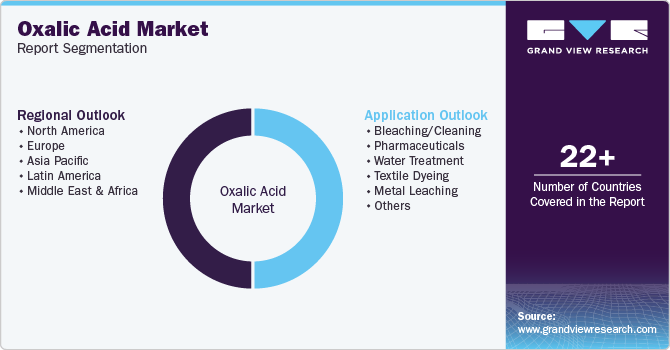
This report forecasts revenue and volume growth at global, regional, and country levels and provides an analysis of the latest industry trends in each of the sub-segments from 2021 to 2033. For the purpose of this study, Grand View Research has segmented the global oxalic acid market report on the basis of application and region.
 To learn more about this report, Download Free Sample Report
 -
Application Outlook (Volume, Kilotons; Revenue, USD Million, 2021 - 2033)
-
Bleaching/Cleaning
-
Pharmaceuticals
-
Water Treatment
-
Textile Dyeing
-
Metal Leaching
-
Others
-
-
Regional Outlook (Volume, Kilotons; Revenue, USD Million, 2021 - 2033)
-
North America
-
U.S.
-
Canada
-
Mexico
-
-
Europe
-
Germany
-
UK
-
France
-
Italy
-
Spain
-
-
Asia Pacific
-
China
-
India
-
Japan
-
South Korea
-
-
Latin America
-
Brazil
-
Argentina
-
-
Middle East & Africa
-
Saudi Arabia
-
South Africa
-
-
Research Methodology
The oxalic acid market figures in this report are based on a proven research process that combines executive interviews with secondary research from proprietary databases, company filings, and recognized regulatory and institutional sources. Market size is built through value-chain sizing-reconciling supply-side and demand-side estimates-and triangulated with bottom-up and top-down approaches. Every estimate passes multiple levels of expert validation before publication, with each oxalic acid segment quantified using the revenue-capture definitions in the table below.
Segment Definition
Segment – Raw Material
Revenue capture definition
Bleaching/Cleaning
Revenue generated from the sale of oxalic acid used as a bleaching, stain-removal, descaling, and cleaning agent in industrial, commercial, and household cleaning applications, including rust removal, surface preparation, and equipment maintenance.
Pharmaceuticals
Revenue generated from oxalic acid utilized as a chemical intermediate and reagent in pharmaceutical manufacturing processes, active pharmaceutical ingredient (API) synthesis, laboratory applications, and specialty healthcare formulations.
Water Treatment
Revenue generated from the use of oxalic acid in water treatment processes for metal ion removal, equipment cleaning, scale control, and maintenance of water treatment systems across industrial and municipal facilities.
Textile Dyeing
Revenue generated from oxalic acid consumption in textile processing, including bleaching, dyeing, color fixation, stain removal, and fabric finishing operations to improve product quality and process efficiency.
Metal Leaching
Revenue generated from oxalic acid used in metal extraction, metal surface treatment, rare earth element processing, rust removal, metal cleaning, and hydrometallurgical applications across mining and industrial sectors.
Other Applications
Revenue generated from oxalic acid utilized in chemical intermediates, leather processing, electronics manufacturing, laboratory reagents, wood treatment, specialty chemicals, and various industrial applications not covered under the primary segments.
Estimation Model
Layer Name
Key Question
Description
Oxalic Acid Production Layer
What forms is the supply base?
Identify global oxalic acid production capacity supported by the availability of raw materials such as carbohydrates, ethylene glycol, propylene, and other feedstocks, along with manufacturing technologies, production processes, plant capacities, quality standards, and regional production facilities. This establishes the foundational supply base available for pharmaceutical, chemical, metal treatment, textile, rare earth processing, and other industrial applications worldwide.
Application Adoption Layer
Where is oxalic acid utilized?
Estimate the proportion of oxalic acid consumed across pharmaceuticals, metal cleaning and surface treatment, rare earth element processing, textile dyeing and bleaching, chemical intermediates, leather processing, and other industrial applications based on functional requirements, production volumes, process efficiencies, and regional demand patterns.
Consumption Intensity Layer
How much oxalic acid is used?
Analyze application-specific consumption rates, industrial production volumes, processing requirements, operating capacities, purity specifications, manufacturing cycles, and regional industrial activity to determine annual oxalic acid consumption across major end-use sectors.
Revenue Layer
How is market revenue generated?
Market revenue is quantified through the sale of technical-grade, industrial-grade, and high-purity oxalic acid products supplied to pharmaceutical manufacturers, chemical producers, metal processing facilities, textile manufacturers, rare earth processing companies, and other industrial end users worldwide.
Delivered Customizations
This report has been delivered with the following In-depth customizations
Client Request
Customization Delivered
Value Adds
Cross-Segmentation Analysis
Detailed cross-segmentation assessment evaluating the relationship between application areas, end-use industries, and oxalic acid consumption patterns. Analysis identifies usage intensity, purity requirements, processing functions, performance characteristics, and revenue contribution across intersecting segments such as pharmaceutical intermediates in healthcare applications, metal cleaning and surface treatment in industrial processing, rare earth element purification in advanced materials production, and textile bleaching and dyeing operations.
Supports product portfolio optimization and market prioritization by identifying the most attractive application–end-use combinations, enabling improved resource allocation, sales targeting, product development strategies, and long-term growth planning across the oxalic acid value chain.
Competitive Benchmarking
Comparative evaluation of leading oxalic acid manufacturers based on production capacity, product portfolio breadth, purity grades, manufacturing technologies, raw material sourcing strategies, geographic presence, sustainability initiatives, distribution networks, customer relationships, and strategic developments across key regional markets.
Assists competitive intelligence, partnership evaluation, and supplier assessment by providing deeper visibility into market positioning, operational capabilities, differentiation strategies, innovation potential, supply chain strength, and areas of competitive advantage.
Opportunity Assessment
Comprehensive assessment of emerging opportunities associated with rare earth element processing, pharmaceutical manufacturing expansion, high-purity chemical applications, advanced metal treatment solutions, specialty chemical production, electronics manufacturing growth, and sustainable industrial processing technologies across global markets.
Helps identify high-growth investment areas, emerging application opportunities, technology development priorities, and market expansion strategies, supporting long-term revenue growth and competitive positioning across the oxalic acid value chain.
Frequently Asked Questions About This Report
Asia Pacific dominated the oxalic acid market in 2025, accounting for 72.1% of the global revenue share, driven by strong demand from chemical manufacturing, pharmaceuticals, textiles, and rare earth processing industries across major economies such as China and India.
The bleaching/cleaning segment is projected to register the fastest growth during the forecast period, with a CAGR of 5.3%.
Europe is anticipated to be the fastest-growing regional market, expanding at a CAGR of 5.7% during the forecast period.
Sustainability initiatives are encouraging manufacturers to adopt cleaner production technologies, improve process efficiency, reduce emissions, and develop environmentally responsible manufacturing practices, supporting long-term growth and regulatory compliance in the oxalic acid market.
The global oxalic acid market size was valued at USD 665.2 million in 2025 and is estimated at USD 696.6 million for 2026.
Pharmaceuticals accounted for the largest revenue share of 32.7% in 2025 of oxalic acid market owing to its use as a reagent in drug synthesis and as a key component in the production of certain medications.
The global oxalic acid market is expected to grow at a CAGR of 5.0% from 2026 to 2033, reaching USD 979.6 million by 2033.
Some of the key players operating in the oxalic acid market include Mudanjiang Fengda Chemical Co., Ltd.; Oxaquim; Merck KGaA; UBE Industries Ltd.; Clariant International Limited; Indian Oxalate Limited; Shijiazhuang Taihe Chemical Co., Ltd.; Spectrum Chemical Manufacturing Corp.; Shandong Fengyuan Chemical Co., Ltd.; Penta s.r.o.
The key factors that are driving the oxalic acid market include the increasing demand in industries such textiles, chemicals, and pharmaceuticals and the rising use of oxalic acid in metal cleaning and water treatment applications.
About the Author(s)
Organic Chemicals Research Team
Bulk Chemicals · Organic ChemicalsThis report was authored by the organic chemicals research team at Grand View Research - comprising two research analysts, one senior research analyst, and one industry expert - with specialized expertise in the organic chemicals segment of the bulk chemicals industry. All findings are based on proprietary bulk chemicals databases, executive interviews, and regulatory analysis, subject to internal peer review prior to publication.
Last Updated:
Speak to Analyst

Customize this report to your needs - add regions, segments, or data points, with 20% free customization.
Or view our licence options:


ISO 9001:2015 & 27001:2022 Certified
We are GDPR and CCPA compliant! Your transaction & personal information is safe and secure. For more details, please read our privacy policy.


