
- Home
- »
- Plastics, Polymers & Resins
- »
-
Packaging As A Service Market Size & Share Report, 2033GVR Report cover
![Packaging As A Service Market (2026 - 2033)Report]()
Packaging As A Service Market (2026 - 2033)
Size, Share & Trends Analysis Report By Service (Packaging Design & Engineering, Packaging Manufacturing & Procurement, Packaging Management), By Business Model, By Packaging Format, By End-use, By Region, And Segment Forecasts
Market Size, 2025
$11.9BMarket Estimate, 2026
$12.9BMarket Forecast, 2033
$24.4BCAGR, 2026–2033
9.5%Packaging As A Service Market Summary
The global packaging as a service market size was valued at USD 11.9 billion in 2025 and is projected to grow from USD 12.9 billion in 2026 to USD 24.4 billion by 2033, at a CAGR of 9.5% from 2026 t o 2033. North America dominated the market, accounting for the largest revenue share of 33.4% in 2025. The industry is driven by increasing packaging outsourcing, e-commerce expansion, demand for cost-effective and scalable packaging solutions, rising focus on supply chain efficiency, and growing adoption of sustainable packaging practices.

Key Market Trends & Insights
- By packaging format: The rigid packaging segment accounted for the largest revenue share of 37.1% in 2025.
- By service: The packaging manufacturing & procurement segment dominated with the largest revenue share of 29.1% in 2025.
- By end use: The food & beverage segment led the market with the largest revenue share of 26.9% in 2025.
- By business model: The subscription / contract-based segment accounted for the largest revenue share of 31.4% in 2025.
Regional Highlights
- Largest regional market: North America (33.4% revenue share, 2025)
- Fastest-growing regional market: Asia Pacific (highest CAGR, 2026-2033)
- By country: The U.S. held the largest share of North America in 2025.
Market Size & Forecast
- Market Size in 2025: USD 11.9 Billion
- Estimated Market Size in 2026: USD 12.9 Billion
- Projected Market Size by 2033: USD 24.4 Billion
- CAGR (2026-2033): 9.5%
The packaging-as-a-service market is driven by the increasing outsourcing of packaging activities across manufacturing, retail, e-commerce, food & beverage, healthcare, and industrial sectors. As companies seek to reduce capital expenditure and improve operational flexibility, demand is rising for integrated services covering packaging manufacturing and procurement, fulfillment and logistics, and packaging management. Packaging-as-a-Service providers enable businesses to access scalable packaging capacity, specialized expertise, inventory management, and logistics support without maintaining extensive in-house packaging infrastructure. The growing complexity of omnichannel distribution and the need for faster order fulfillment are further accelerating the adoption of outsourced packaging solutions. Packaging Manufacturing & Procurement remained the largest service, reaching USD 3.5 billion in 2025 and projected to reach USD 6.9 billion by 2033.

An increasing focus on supply chain optimization, cost efficiency, and circular packaging management is expected to support market growth in the coming years. Businesses are increasingly adopting third-party packaging fulfillment and logistics services to improve inventory utilization, shorten fulfillment cycles, and manage fluctuating packaging requirements across multiple distribution channels. At the same time, reverse logistics and reuse are gaining importance as companies seek to recover, refurbish, and redeploy packaging assets, reducing material consumption and packaging waste. The reverse logistics & reuse segment is projected to register the fastest CAGR of 10.3% from 2026 to 2033, reflecting the growing emphasis on reusable packaging systems and closed-loop supply chains.
Sustainability initiatives and the transition toward circular and service-based packaging models are also contributing significantly to market growth. Packaging-as-a-Service providers are increasingly integrating reusable packaging, asset pooling, return management, and lifecycle tracking into their service offerings, enabling customers to shift from one-time packaging purchases toward more resource-efficient models. The growing adoption of pooling/shared-asset and pay-per-use models further supports this transition by enabling businesses to share packaging assets and pay based on utilization rather than maintaining large packaging inventories. These developments are expected to strengthen demand for integrated Packaging-as-a-Service solutions while improving packaging utilization, reducing waste, and enhancing supply chain efficiency.
Market Dynamics
The packaging-as-a-service market is witnessing strong growth, driven by increasing outsourcing of packaging operations, rising demand for flexible and scalable packaging solutions, and the growing complexity of global supply chains. Businesses across food & beverage, retail & e-commerce, healthcare, pharmaceuticals, and industrial sectors are increasingly adopting integrated packaging services to reduce capital expenditure, optimize packaging procurement, and improve fulfillment efficiency. Additionally, the expansion of reusable packaging systems, reverse logistics, and shared-asset models is supporting market growth, while implementation costs and dependence on third-party service providers may constrain adoption.
The increasing outsourcing of packaging activities is a key driver of the Packaging-as-a-Service market. Companies are increasingly seeking external providers for packaging manufacturing and procurement, packaging management, fulfillment and logistics, and reverse logistics to reduce in-house infrastructure requirements and improve operational flexibility. The growing complexity of omnichannel distribution, fluctuating packaging demand, and the need for faster fulfillment are encouraging businesses to adopt service-based packaging models.
As companies focus on improving supply chain efficiency and controlling operating costs, Packaging-as-a-Service providers are offering scalable solutions that combine packaging production, inventory management, logistics, and asset recovery. The Packaging Manufacturing & Procurement segment accounted for the largest service-type revenue in 2025 at USD 3.46 billion, highlighting the strong demand for outsourced packaging procurement and production capabilities.
A significant restraint for the Packaging-as-a-Service market is the initial investment and operational complexity associated with integrating third-party packaging services into existing supply chains. Businesses may face costs related to system integration, packaging standardization, technology adoption, asset tracking, and logistics coordination. In addition, dependence on external service providers can create concerns related to service reliability, quality control, delivery timelines, and data integration, particularly for companies requiring highly customized packaging solutions.
A major opportunity for the Packaging-as-a-Service market lies in the growing shift toward circular packaging models, reusable assets, reverse logistics, and shared packaging systems. Businesses are increasingly looking for alternatives to conventional packaging ownership that can reduce waste, improve asset utilization, and support sustainability objectives. Packaging-as-a-Service providers can capitalize on this trend by offering integrated solutions covering packaging supply, collection, cleaning, refurbishment, tracking, and redistribution, allowing customers to access packaging functionality without managing the entire asset lifecycle. The increasing use of digital tracking and data platforms can further improve visibility of packaging assets, optimize return cycles, and support efficient resource utilization.
Market Concentration & Characteristics
The packaging-as-a-service market is characterized by its service-oriented and integrated operating model, where businesses outsource packaging activities to specialized providers rather than managing the entire packaging lifecycle internally. The industry focuses on packaging manufacturing and procurement, packaging management, fulfillment and logistics, and reverse logistics and reuse, enabling customers to improve operational flexibility, reduce infrastructure requirements, and optimize packaging-related costs. As e-commerce, retail, food & beverage, healthcare, and industrial supply chains become more complex, providers are increasingly offering scalable packaging solutions, inventory management, fulfillment support, and asset recovery services. Leading players compete through service integration, supply chain capabilities, technology adoption, and the ability to provide customized packaging solutions across multiple end use industries.
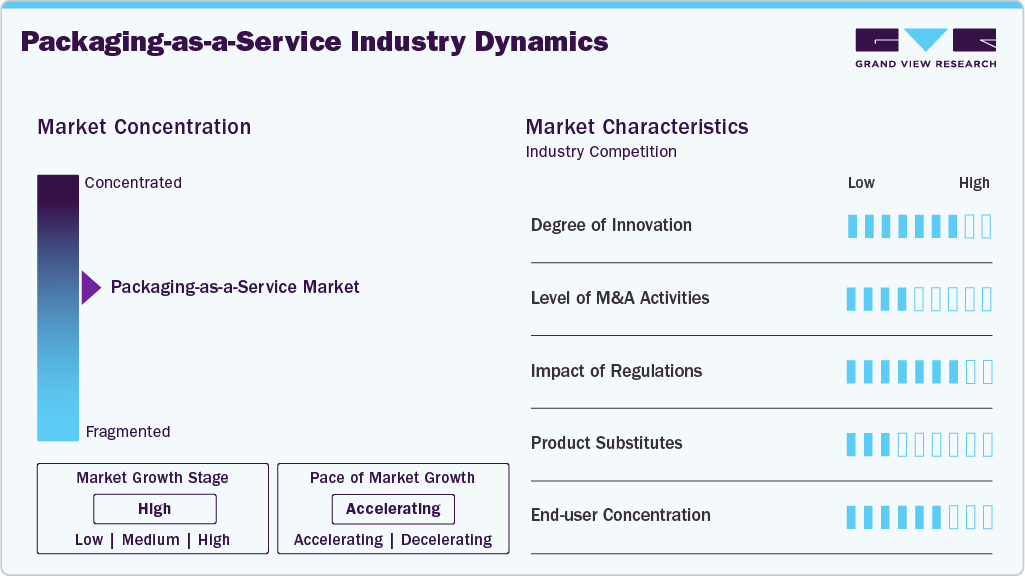
A defining feature of the industry is its increasing shift toward flexible, reusable, and circular packaging service models. Instead of relying solely on conventional packaging procurement, businesses are adopting subscription-based, rental, pay-per-use, and pooling models that allow packaging assets to be accessed according to operational requirements. The growing emphasis on sustainability is further encouraging providers to integrate reverse logistics, packaging reuse, asset tracking, refurbishment, and lifecycle management into their offerings. Digital technologies such as IoT-enabled tracking, data analytics, and automated inventory management are also becoming important for improving packaging visibility and utilization, while the expansion of e-commerce and omnichannel distribution continues to increase demand for efficient and scalable Packaging-as-a-Service solutions.
Analyst Perspective
The global packaging-as-a-service market has evolved from conventional packaging procurement to integrated service models that cover packaging design, manufacturing, management, fulfillment, logistics, and reuse. Historically, companies handled packaging activities internally or through fragmented suppliers, while the growth of e-commerce, supply chain complexity, outsourcing, and sustainability requirements has accelerated the shift toward flexible, service-based solutions. The market is driven by increasing adoption of subscription-based, pay-per-use, rental, and shared-asset models. Going forward, digital packaging management, automation, reusable packaging, and reverse logistics are expected to further support market growth.
Service Insights
The packaging manufacturing & procurement segment led the packaging-as-a-service market with the largest revenue share of 29.1% in 2025. This segment is a major component of the market, as businesses increasingly outsource packaging production and sourcing to specialized service providers. Packaging Manufacturing & Procurement services help companies reduce in-house infrastructure requirements, optimize procurement costs, and access scalable production capacity. The segment has gained traction due to the growing demand for flexible packaging supply, standardized production, and integrated procurement solutions across multiple end use industries.
The reverse logistics & reuse segment is expected to grow at the fastest CAGR of 10.3% during the forecast period. Increasing emphasis on circular economy practices, packaging reuse, asset recovery, and waste reduction is encouraging businesses to adopt reverse logistics services. Packaging-as-a-Service providers are increasingly integrating collection, refurbishment, redistribution, and lifecycle management into their offerings, enabling customers to improve packaging utilization, reduce material consumption, and support sustainability objectives.
Business Model Insights
The subscription / contract-based segment accounted for the largest revenue share of 31.4% in 2025. Subscription and contract-based models provide businesses with predictable packaging costs, continuous access to packaging services, and greater flexibility in managing recurring packaging requirements. Their adoption is supported by increasing outsourcing of packaging activities and the need for long-term partnerships with specialized packaging service providers.
The pooling / shared-asset segment is expected to grow at the fastest CAGR of 10.3% during the forecast period. The segment is gaining traction as businesses increasingly seek to share packaging assets, improve asset utilization, reduce ownership costs, and support reusable packaging systems. Pooling models also enable more efficient asset circulation across supply chains, supporting the transition toward flexible and sustainable Packaging-as-a-Service solutions.
Packaging Format Insights
The rigid packaging segment dominated the packaging-as-a-service market with the largest revenue share of 37.1% in 2025. Rigid packaging remains widely adopted for its durability, structural strength, and suitability for diverse product-handling and distribution requirements. Demand is supported by its extensive use across food & beverage, healthcare, consumer goods, and industrial supply chains, where businesses increasingly outsource packaging production, procurement, and management to specialized service providers.
The transport packaging segment is expected to grow at the fastest CAGR of 10.1% during the forecast period. Growth is supported by the expansion of e-commerce, logistics, warehousing, and omnichannel distribution, which is increasing demand for efficient packaging solutions that facilitate safe product movement and handling. The growing adoption of reusable transport packaging and outsourced logistics services is further supporting the segment's expansion.
End-use Insights
The food & beverage segment accounted for the largest revenue share of 26.9% in 2025. The segment is supported by high-volume packaging requirements, stringent product safety standards, and the need for efficient packaging procurement, fulfillment, and logistics. Food & beverage companies are increasingly outsourcing packaging activities to improve operational efficiency, manage fluctuating demand, and optimize supply chain costs.

The retail & e-commerce segment is expected to grow at the fastest CAGR of 10.4% during the forecast period. Rapid e-commerce expansion, increasing order volumes, omnichannel fulfillment, and the need for efficient last-mile packaging solutions are driving the adoption of Packaging-as-a-Service. Service providers offer scalable packaging procurement, fulfillment, logistics, and management solutions that help retailers and e-commerce companies respond efficiently to changing packaging requirements.
Regional Insights
North America held the largest share of the global packaging-as-a-service market, accounting for 33.4% of revenue in 2025. The region benefits from well-developed logistics infrastructure, high e-commerce penetration, and widespread adoption of outsourced supply chain services. Demand for integrated packaging procurement, fulfillment, inventory management, and logistics solutions is increasing as businesses seek to improve operational efficiency and manage packaging requirements more flexibly. The North America market is projected to reach USD 7.7 billion by 2033, reflecting continued adoption across major end use industries.

U.S. Packaging As A Service Market Trends
The U.S. is a major contributor to the North American packaging-as-a-service market, supported by its mature retail and e-commerce ecosystem and extensive third-party logistics network. Companies are increasingly engaging specialized providers for packaging manufacturing, procurement, fulfillment, and reverse logistics to reduce operational complexity and improve scalability. Growing interest in reusable packaging systems and technology-enabled asset management is also creating opportunities for service providers.
Asia Pacific Packaging As A Service Market Trends
The packaging-as-a-service market in the Asia Pacific is expected to depict the fastest growth, registering a CAGR of 10.4% from 2026 to 2033. Growth is driven by rapid e-commerce expansion, manufacturing development, urbanization, and increasing investment in logistics and warehousing infrastructure. The region's expanding consumer goods, food & beverage, healthcare, and electronics industries are generating demand for scalable packaging procurement, fulfillment, and management services.
The China packaging-as-a-service market is a significant contributor to the Asia Pacific industry growth, supported by its extensive manufacturing ecosystem, large consumer market, and highly developed e-commerce sector. The country's expanding logistics and fulfillment networks are encouraging businesses to outsource packaging operations to improve speed and flexibility. Increasing adoption of reusable packaging and automated supply chain solutions is expected to further support demand.
The packaging-as-a-service market in India is expected to witness strong growth, supported by rapid e-commerce penetration, expanding organized retail, and ongoing development of logistics infrastructure. Increasing manufacturing activity across food & beverage, pharmaceuticals, consumer goods, and industrial sectors is creating demand for outsourced packaging and fulfillment capabilities. Growing adoption of digital supply chain technologies and reusable packaging models is expected to further accelerate market development.
Europe Packaging As A Service Market Trends
The packaging-as-a-service market in Europe is expected to experience strong growth during the forecast period, reaching USD 6.7 billion by 2033 at a CAGR of 9.6%. The region's established manufacturing base, sophisticated logistics networks, and increasing focus on resource efficiency are supporting demand for outsourced packaging services. Businesses are increasingly adopting integrated packaging management and reuse solutions to improve supply chain efficiency while supporting sustainability objectives.
The Germany packaging-as-a-service market shows robust growth due to its strong manufacturing and industrial base, advanced logistics infrastructure, and emphasis on supply chain optimization. Demand for Packaging-as-a-Service is supported by the country's large automotive, industrial, food & beverage, and consumer goods sectors. Increasing adoption of reusable packaging, pooling systems, and outsourced logistics services is expected to support market development.
The UK packaging-as-a-service market is supported by the rapid development of e-commerce, established retail networks, and increasing demand for flexible fulfillment solutions. Businesses are increasingly turning to external packaging providers to manage variable order volumes and streamline packaging procurement and logistics. The growing emphasis on packaging waste reduction and reusable systems is also encouraging the adoption of service-based packaging models.
Latin America Packaging As A Service Market Trends
The packaging-as-a-service market in Latin America is projected to grow steadily at a CAGR of 9.4% from 2026 to 2033. Market expansion is supported by growing retail and e-commerce activity, improving logistics infrastructure, and increasing demand for outsourced packaging solutions. Food & beverage, consumer goods, and industrial companies are increasingly adopting external packaging services to improve procurement and distribution efficiency.
The Brazil packaging-as-a-service market accounts for a significant portion of the Latin American industry due to its large consumer base, expanding retail sector, and developing logistics ecosystem. Increasing e-commerce activity and demand for efficient distribution are encouraging companies to outsource packaging fulfillment and management. Growth in food & beverage and consumer goods manufacturing is also supporting demand for integrated packaging services.
The packaging-as-a-service market in Argentina is expected to develop steadily as businesses seek greater cost efficiency and operational flexibility in packaging procurement and distribution. Growth in food & beverage, retail, and consumer goods applications is supporting demand for outsourced packaging services. Increasing interest in reusable packaging and efficient asset management is expected to create additional opportunities.
Middle East & Africa Packaging As A Service Market Trends
The packaging-as-a-service market in the Middle East & Africa is projected to grow at a CAGR of 9.3% from 2026 to 2033, supported by expanding retail and e-commerce activities, infrastructure development, and modernization of logistics networks. Increasing investments in warehousing, distribution, and industrial operations are encouraging businesses to adopt outsourced packaging and fulfillment solutions. The growing need for efficient packaging management across diverse supply chains is expected to support regional growth.
Key Packaging As A Service Company Insights
Some key companies in the Packaging-as-a-Service market include Amcor Plc, DS Smith, Smurfit Westrock, Sealed Air, Mondi, International Paper, Sonoco, Ranpak, Packsize International, LLC., ProAmpac, Stora Enso, Orora Packaging Australia, and CHEP. The market is characterized by integrated packaging solutions, outsourced packaging operations, supply-chain optimization, reusable packaging systems, and technology-enabled packaging management. Leading participants are increasingly offering end-to-end services covering packaging design, manufacturing, procurement, fulfillment, logistics, reuse, and inventory management to help customers reduce operational complexity and improve packaging efficiency.
-
Amcor Plc provides integrated packaging solutions across flexible and rigid formats, supported by packaging design, material development, manufacturing, and supply-chain capabilities. Its broad production footprint enables customers to outsource packaging requirements while benefiting from standardized production, lightweighting initiatives, and customized packaging solutions across food, beverage, healthcare, and consumer goods applications.
-
DS Smith focuses on integrated packaging solutions that combine packaging design, manufacturing, supply-chain services, and recycling capabilities. The company supports customers through optimized packaging systems and circular solutions, helping businesses improve material utilization, streamline packaging operations, and manage packaging requirements across distribution networks.
Key Packaging As A Service Companies
The following key companies have been profiled for this study on the Packaging-as-a-Service market
-
Amcor Plc
-
DS Smith
-
Smurfit Westrock
-
Sealed Air
-
Mondi
-
International Paper
-
Sonoco
-
Ranpak
-
Packsize International, LLC.
-
ProAmpac
-
Stora Enso
-
Orora Packaging Australia
-
CHEP
Competitive Benchmarking
Category
Operating Strategies
Competitive Edge
Weakness
Established Players (Amcor Plc; DS Smith; Smurfit Westrock; Sealed Air; Mondi; International Paper; Sonoco; Stora Enso; CHEP)
Focus on end-to-end Packaging-as-a-Service, covering packaging design, manufacturing, procurement, fulfillment, logistics, reuse, and optimization. Companies leverage global production networks, automation, digital solutions, and sustainability initiatives to serve diverse end use industries.
Strong global presence, broad packaging portfolios, technical expertise, customer relationships, and integrated supply-chain capabilities enable comprehensive service offerings.
High capital and operating costs, complex supply chains, and significant investment requirements for automation, digitalization, and circular packaging infrastructure can limit flexibility.
Emerging Players (Ranpak; Packsize International, LLC.; ProAmpac; Orora Packaging Australia)
Emphasize specialized and technology-enabled packaging services, including on-demand packaging, automation, protective packaging, customization, and packaging optimization.
Strong expertise in packaging automation, right-sized packaging, customization, and resource efficiency supports differentiation and rapid response to customer requirements.
Relatively smaller production scale, geographic reach, and logistics infrastructure can limit expansion. Dependence on technology adoption and customer investment in automated packaging can also create challenges.
Recent Development
-
In June 2026, Amcor expanded its healthcare packaging production capability in India by inaugurating a new manufacturing line at its Sira facility. The expansion is intended to meet growing healthcare packaging demand and strengthen Amcor’s local manufacturing and supply capabilities, supporting its integrated packaging solutions model.
-
In July 2026, Smurfit Westrock partnered with Coca-Cola China to develop paper-based packaging solutions for Coca-Cola’s 2026 World Cup campaign. The solutions are designed for retail and e-commerce channels, highlighting the company’s focus on customized packaging development and scalable packaging solutions for major brands.
-
In August 2026, Packsize was recognized as a Great Supply Chain Partner for its connected packaging approach combining intelligent software, right-sized packaging automation, corrugated supply, and technical support. The development highlights the growing integration of automation and digital technologies within Packaging-as-a-Service models.
-
In July 2026, CHEP highlighted its share-and-reuse model as a supply-chain strategy for improving cost efficiency, resilience, and sustainability. The company emphasized reusable packaging and pooled assets as mechanisms to reduce waste and improve overall supply chain performance.
Packaging as a Service Market Report Scope
Report Attribute
Details
Market size in 2025
USD 11.9 billion
Estimated Market size in 2026
USD 12.9 billion
Projected market size by 2033
USD 24.4 billion
Growth rate
CAGR of 9.5%from 2026 to 2033
Base year for estimation
2025
Historical data
2021 - 2024
Forecast period
2026 - 2033
Quantitative units
Revenue in USD billion, and CAGR from 2026 to 2033
Report coverage
Revenue forecast, company ranking, competitive landscape, growth factors, and trends
Segments covered
Service, business model, packaging format, end-use, region
Regional scope
North America; Europe; Asia Pacific; Latin America; Middle East & Africa
Country scope
U.S.; Canada; Mexico; Germany; France; UK; Italy; Spain; China; India; Japan; South Korea; Australia; Brazil; Argentina; Saudi Arabia; UAE; South Africa
Key companies profiled
Amcor Plc; DS Smith; Smurfit Westrock; Sealed Air; Mondi; International Paper; Sonoco; Ranpak; Packsize International, LLC.; ProAmpac; Stora Enso; Orora Packaging Australia; CHEP
Customization scope
Free report customization (equivalent up to 8 analysts working days) with purchase. Addition or alteration to country, regional & segment scope.
Pricing and purchase options
Avail of customized purchase options to meet your exact research needs. Explore purchase options
Global Packaging As A Service Market Report Segmentation
This report forecasts revenue growth at the global, regional, and country levels and provides an analysis on the latest industry trends and opportunities in each of the sub-segments from 2021 to 2033. For this study, Grand View Research has segmented the global packaging-as-a-service market report on the basis of service, business model, packaging format, end-use, and region:
-
Service Outlook (Revenue, USD Billion, 2021 - 2033)
-
Packaging Design & Engineering
-
Packaging Manufacturing & Procurement
-
Packaging Management
-
Packaging Fulfillment & Logistics
-
Reverse Logistics & Reuse
-
-
Business Model Outlook (Revenue, USD Billion, 2021 - 2033)
-
Subscription / Contract-Based
-
Rental / Leasing
-
Pay-per-Use
-
Pooling / Shared-Asset
-
-
Packaging Format Outlook (Revenue, USD Billion, 2021 - 2033)
-
Flexible Packaging
-
Rigid Packaging
-
Transport Packaging
-
Protective Packaging
-
-
End-use Outlook (Revenue, USD Billion, 2021 - 2033)
-
Food & Beverage
-
Retail & E-commerce
-
Healthcare & Pharmaceuticals
-
Automotive & Industrial
-
Consumer Goods & Electronics
-
Other End Uses
-
-
Regional Outlook (Revenue, USD Billion, 2021 - 2033)
-
North America
-
U.S.
-
Canada
-
Mexico
-
-
Europe
-
Germany
-
France
-
UK
-
Italy
-
Spain
-
-
Asia Pacific
-
China
-
India
-
Japan
-
South Korea
-
Australia
-
-
Latin America
-
Brazil
-
Argentina
-
-
Middle East & Africa
-
Saudi Arabia
-
UAE
-
South Africa
-
-
Research Methodology
The packaging as a service marketfigures in this report are based on a proven research process that combines executive interviews with secondary research from proprietary databases, company filings, and recognized regulatory and institutional sources. Market size is built through value-chain sizing-reconciling supply-side and demand-side estimates-and triangulated with bottom-up and top-down approaches. Every estimate passes multiple levels of expert validation before publication, with eachpackaging as a service segment quantified using the revenue-capture definitions in the table below.
Segment Definition
Segment - Service
Revenue capture definition
Packaging Design & Engineering
Revenue generated from packaging design, engineering, prototyping, testing, optimization, and customization services provided to customers. Includes structural design, material selection, packaging performance testing, artwork support, and development of application-specific packaging solutions.
Packaging Manufacturing & Procurement
Revenue generated from the outsourced manufacturing and procurement of packaging materials and finished packaging products. Includes sourcing of raw materials, packaging production, supplier management, quality control, and customized packaging manufacturing across flexible, rigid, transport, and protective formats.
Packaging Management
Revenue generated from services that manage customers’ packaging operations, inventory, sourcing, specifications, and overall packaging programs. Includes packaging inventory management, supplier coordination, cost optimization, quality management, and performance monitoring.
Packaging Fulfillment & Logistics
Revenue generated from packaging fulfillment, warehousing, distribution, transportation, and related supply-chain services. Includes packaging storage, order fulfillment, kitting, delivery coordination, and integration of packaging supply with customer logistics and distribution operations.
Reverse Logistics & Reuse
Revenue generated from reusable packaging management, collection, return transportation, cleaning, refurbishment, redistribution, and pooling services. Includes reverse logistics programs and shared-asset models for reusable pallets, crates, containers, and other transport packaging.
Segment - Business Model
Revenue capture definition
Subscription / Contract-Based
Revenue generated through recurring packaging-as-a-service contracts that provide customers with ongoing access to packaging design, manufacturing, management, fulfillment, logistics, or reuse services for a defined period.
Rental / Leasing
Revenue generated from renting or leasing packaging assets, equipment, or reusable packaging systems to customers for a specified duration. Includes pallets, crates, containers, protective packaging systems, and related packaging equipment.
Pay-per-Use
Revenue generated based on the actual usage of packaging products or services, such as packaging units supplied, fulfillment orders processed, logistics activities completed, or reusable packaging cycles utilized.
Pooling / Shared-Asset
Revenue generated through shared-use packaging systems where reusable assets such as pallets, crates, containers, and transport packaging are pooled among multiple customers. Includes asset access, circulation, collection, maintenance, and redistribution services.
Segment - Packaging Format
Revenue capture definition
Flexible Packaging
Revenue generated from Packaging-as-a-Service solutions involving flexible packaging formats such as pouches, films, bags, wraps, sachets, and flexible laminates. Includes design, manufacturing, procurement, fulfillment, and packaging management services.
Rigid Packaging
Revenue generated from services involving rigid packaging formats such as bottles, containers, jars, tubs, trays, cans, and rigid boxes. Includes packaging design, manufacturing, procurement, inventory management, and related service solutions.
Transport Packaging
Revenue generated from services involving packaging used for storage, handling, and transportation, including pallets, crates, totes, bulk containers, drums, and reusable transport units. Includes rental, pooling, logistics, asset management, and reverse logistics services.
Protective Packaging
Revenue generated from services involving packaging designed to protect products during handling, storage, and transportation, including cushioning, void fill, protective wraps, inserts, and protective systems. Includes customized design, manufacturing, fulfillment, and packaging optimization services.
Segment - End Use
Revenue capture definition
Food & Beverage
Revenue generated from Packaging-as-a-Service solutions provided to food and beverage manufacturers, processors, distributors, and retailers. Includes packaging design, manufacturing, procurement, fulfillment, logistics, and reusable packaging services.
Retail & E-commerce
Revenue generated from packaging services supporting retail and e-commerce operations, including packaging design, on-demand packaging, order fulfillment, distribution, protective packaging, and reverse logistics.
Healthcare & Pharmaceuticals
Revenue generated from packaging-as-a-service solutions for pharmaceutical, medical device, and healthcare companies. Includes customized packaging design, compliant packaging manufacturing, inventory management, fulfillment, and specialized logistics services.
Automotive & Industrial
Revenue generated from packaging services supporting automotive manufacturers, component suppliers, and industrial companies. Includes transport packaging, protective packaging, reusable containers, pooling, logistics, and packaging optimization services.
Consumer Goods & Electronics
Revenue generated from packaging services for consumer products and electronics, including packaging design, manufacturing, protective solutions, fulfillment, inventory management, and reusable packaging programs.
Other End Uses
Revenue generated from Packaging-as-a-Service solutions serving other industries, including agriculture, chemicals, construction, personal care, and general manufacturing, covering packaging design, supply, logistics, management, and reuse services.
Estimation Model
Layer Name
Key Question
Description
End use Industry Layer
What drives Packaging-as-a-Service demand?
Estimate demand from key industries including food & beverage, retail & e-commerce, healthcare & pharmaceuticals, automotive & industrial, consumer goods, and electronics that increasingly outsource packaging activities.
Packaging Service Adoption Layer
Which packaging services are being outsourced?
Assess adoption of Packaging-as-a-Service across design & engineering, manufacturing & procurement, packaging management, fulfillment & logistics, and reverse logistics & reuse based on customer requirements for cost efficiency, flexibility, scalability, and supply-chain optimization.
Business Model & Format Layer
How are Packaging-as-a-Service solutions delivered?
Evaluate service delivery through subscription/contract-based, rental/leasing, pay-per-use, and pooling/shared-asset models across flexible, rigid, transport, and protective packaging formats.
Revenue Layer
How is revenue generated?
Revenue is generated through recurring contracts, packaging production and procurement, management fees, fulfillment and logistics services, rental and usage charges, and reusable packaging pooling and reverse logistics services.
Delivered Customizations
This report has been delivered with the following In-depth customizations
Client Request
Customization Delivered
Value Adds
Competitive Benchmarking
Comparative benchmarking of leading Packaging-as-a-Service companies based on service portfolio, packaging formats, business models, digital capabilities, sustainability initiatives, geographic presence, logistics infrastructure, and strategic developments.
Helps clients assess competitor positioning, identify service gaps, benchmark capabilities, and develop effective market entry, differentiation, and expansion strategies.
Pricing Analysis
Detailed assessment of pricing structures across subscription/contract-based, rental/leasing, pay-per-use, and pooling/shared-asset models, considering service scope, packaging format, utilization, logistics costs, and regional variations.
Supports pricing strategy, cost optimization, margin management, procurement planning, and contract negotiations with packaging service providers.
Trade Assessment
Evaluation of cross-border movement and trade dynamics for key packaging formats and reusable assets, including flexible, rigid, transport, and protective packaging, with analysis of import-export trends, logistics costs, regional supply networks, and trade regulations.
Helps identify regional supply opportunities, sourcing markets, logistics efficiencies, trade risks, and expansion opportunities across international packaging value chains.
Frequently Asked Questions About This Report
Reverse logistics & reuse segment is the fastest-growing service type segment, with a CAGR of 10.3% over the forecast period, supported by increasing adoption of reusable packaging and circular supply-chain models.
Packaging manufacturing & procurement segment led the packaging as a service market with a 29.1% revenue share in 2025.
Subscription / Contract-based services led the packaging as a service market with a 31.4% revenue share in 2025, supported by demand for predictable costs and long-term integrated packaging services.
Key players in the packaging as a service market include Amcor Plc, DS Smith, Smurfit Westrock, Sealed Air, Mondi, International Paper, Sonoco, Ranpak, Packsize International, LLC., ProAmpac, Stora Enso, Orora Packaging Australia, and CHEP.
The global packaging as a service market size was valued at USD 11.9 billion in 2025 and is estimated to reach USD 12.9 billion in 2026.
The global packaging as a service market is expected to grow at a CAGR of 9.5% from 2026 to 2033, reaching USD 24.4 billion by 2033.
The packaging as a service market is primarily driven by increasing outsourcing of packaging operations, rapid e-commerce growth, demand for scalable packaging solutions, supply-chain optimization, adoption of reusable packaging, and increasing focus on packaging cost efficiency and sustainability.
North America dominated the packaging as a service market with a 33.4% revenue share in 2025, supported by advanced logistics infrastructure, strong e-commerce activity, and widespread adoption of outsourced packaging and fulfillment services.
Asia Pacific is the fastest-growing region in the packaging as a service market, with a CAGR of 10.4% over the forecast period, driven by expanding manufacturing, e-commerce, organized retail, and logistics networks.
About the Author(s)
Plastics, Polymers & Resins Research Team
Bulk Chemicals · Plastics, Polymers & ResinsThis report was authored by the plastics, polymers & resins research team at Grand View Research - comprising two research analysts, one senior research analyst, and one industry expert - with specialized expertise in the plastics, polymers & resins segment of the bulk chemicals industry. All findings are based on proprietary bulk chemicals databases, executive interviews, and regulatory analysis, subject to internal peer review prior to publication.
Last Updated:
Speak to Analyst


Customize this report to your needs — add regions, segments, or data points, with 20% free customization.
Or view our licence options:


ISO 9001:2015 & 27001:2022 Certified
We are GDPR and CCPA compliant! Your transaction & personal information is safe and secure. For more details, please read our privacy policy.


