
- Home
- »
- Plastics, Polymers & Resins
- »
-
Reusable Packaging Market Size & Share Report, 2026-2033GVR Report cover

Reusable Packaging Market (2026 - 2033)
Size, Share & Trends Analysis Report By Material (Plastic, Wood, Metal, Glass), By Product Type (Container, Crates, Bottles, Pellets), By End-use (Food & Beverage, Automotive, Healthcare), By Region, And Segment Forecasts
Market Size, 2025
$142.7BMarket Estimate, 2026
$150.5BMarket Forecast, 2033
$232.3BCAGR, 2026–2033
6.4%Reusable Packaging Market Summary
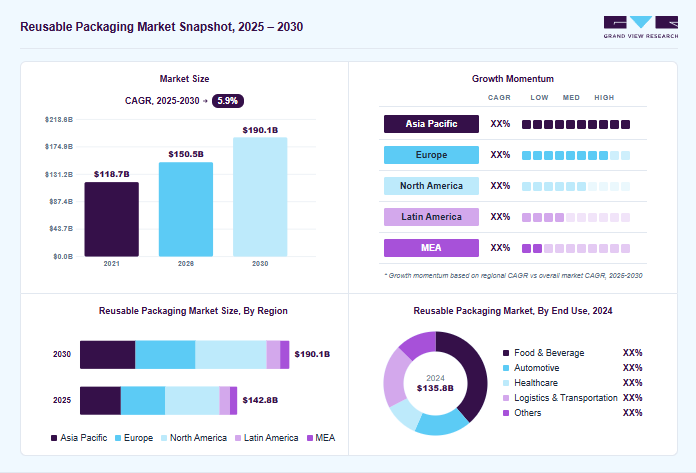
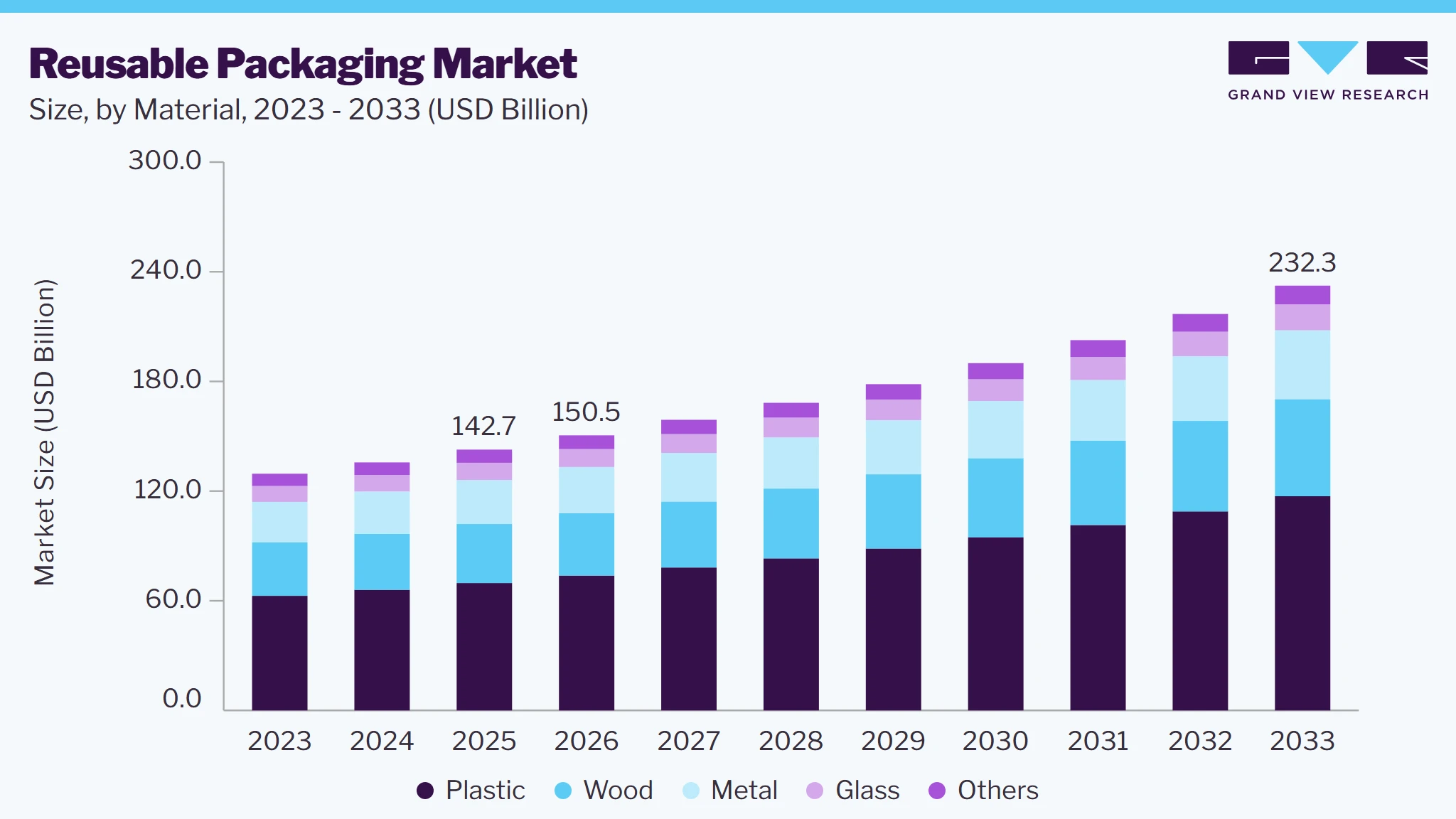
The global reusable packaging market size was valued at USD 142.7 billion in 2025 and is projected to grow from USD 150.5 billion in 2026 to USD 232.3 billion by 2033, at a CAGR of 6.4% from 2026 to 2033. North America dominated the reusable packaging market with the largest revenue share of 34.3% in 2025. One of the primary growth drivers of the reusable packaging industry is the increasing global awareness of sustainability and environmental conservation.
 Source: Grand View Research, IR Documents, Primary Interviews, Paid DatabasesTo learn more about this report,
 Download Free Sample Report
 Key Market Trends & Insights
- By material: Plastic segment held the largest market share of 48.8% in 2025.
- By product: Container segment held the largest market share of 37.3% in 2025.
- By end use: Food & beverage segment held the largest market share of 39.0% in 2025.
Regional Highlights
- Largest regional market: North America (34.3% revenue share, 2025)
- By country: The U.S. held the largest market share in 2025.
Market Size & Forecast
- Market size in 2025: USD 142.7 Billion
- Estimated market size in 2026: USD 150.5 Billion
- Projected market size by 2033: USD 232.3 Billion
- CAGR (2026-2033): 6.4%
Three ways to get this report
Buy it, customize it, or ask a question.Ask an Analyst
Analyst response in 1 business day
- AccessReport author, directly
- Reply timeWithin 1 working day
- No sales callDirect answer only
- FormatEmail reply
- CostFree, no cost
Get the Full Report
What the study covers
- FormatsPDF · Excel · Dashboard
- Timeline2026–2033 annual, 2025 base
- Coverage20+ countries, 5 regions
- Companies10+ key players profiled
Customize the Report
20% free customization
- IncludeCountries, segments, points
- TailorTo your product definition
- ExtendDeeper competitor detail
- OrA fully bespoke study
- Turnaround5–10 working days
Governments and regulatory bodies worldwide are imposing stringent regulations on single-use plastics, leading industries to shift towards eco-friendly alternatives. Reusable packaging significantly reduces waste generation, carbon footprint, and resource depletion, making it a preferred choice for businesses looking to align with sustainability goals. Consumers are also becoming more conscious of environmentally friendly products, driving demand for packaging solutions that promote circular economies.
 To learn more about this report, Download Free Sample Report
 Reusable packaging offers significant cost advantages over single-use packaging in the long run. Although the initial investment in durable packaging materials such as plastic, wood, metal, and glass is higher, businesses benefit from reduced repurchasing costs, waste management expenses, and lower dependency on raw materials. Industries such as food & beverage, automotive, and logistics experience increased profitability as reusable packaging enhances efficiency in supply chain management, reducing overall operational costs.
The development of high-quality and durable materials such as reinforced plastics, advanced composites, and sustainable metals has significantly improved the lifespan and usability of reusable packaging solutions. Innovations in smart packaging, including RFID tracking, IoT-enabled containers, and tamper-proof features, enhance supply chain visibility and security. These technological advancements make reusable packaging more attractive to industries requiring efficient storage, handling, and distribution.
Governments across various regions are promoting circular economy models, where products and materials are continuously reused and recycled to minimize waste. Policies and incentives encouraging businesses to adopt sustainable practices, such as extended producer responsibility (EPR) programs and bans on single-use packaging, are driving the market for reusable packaging. Companies are increasingly focusing on closed-loop supply chains, where packaging materials are collected, cleaned, and reused multiple times, reducing their environmental footprint.
Furthermore, with rapid urbanization and infrastructural development worldwide, industries require robust and sustainable packaging solutions for large-scale transportation of goods. The demand for reusable drums, barrels, and pallets is increasing in construction, chemical, and industrial applications. As economies invest in better logistics and supply chain infrastructure, the adoption of reusable packaging solutions is expected to witness substantial growth.
Additionally, businesses are increasingly adopting sustainable practices as part of their corporate social responsibility (CSR) initiatives. Companies that implement reusable packaging solutions enhance their brand image and appeal to environmentally conscious consumers and investors. Many global corporations are setting ambitious sustainability goals, including reducing packaging waste, adopting circular economy models, and minimizing environmental impact, which further drives the demand for reusable packaging solutions.
Market Dynamics
The reusable packaging market is witnessing strong growth, driven by the increasing emphasis on sustainable supply chains, circular economy initiatives, and the rising need for cost-effective packaging solutions across industries. Unlike single-use packaging, reusable packaging systems are designed for multiple usage cycles, helping businesses reduce packaging waste, lower long-term operational costs, and comply with evolving environmental regulations. Industries such as automotive, food & beverage, retail, healthcare, logistics, and e-commerce are increasingly adopting reusable containers, pallets, crates, totes, drums, and intermediate bulk containers (IBCs) to improve supply chain efficiency and minimize environmental impact. In addition, technological advancements such as RFID tracking, IoT-enabled asset monitoring, and durable lightweight materials are further enhancing the adoption of reusable packaging by improving asset visibility, reducing losses, and extending product lifespan.
The growing emphasis on sustainability and circular economy practices is one of the primary factors driving the reusable packaging market. Governments across the globe are introducing stringent regulations aimed at reducing packaging waste, limiting single-use plastics, and promoting resource-efficient packaging systems. At the same time, companies across industries are strengthening their environmental, social, and governance (ESG) commitments by adopting packaging solutions that minimize waste generation and reduce carbon emissions. Reusable packaging, which can be used repeatedly over multiple distribution cycles, significantly lowers the consumption of raw materials and decreases the environmental impact associated with disposable packaging, making it an attractive option for manufacturers and logistics providers In addition to regulatory support, businesses are increasingly recognizing the long-term economic and operational advantages of reusable packaging. Industries such as automotive, food & beverage, retail, healthcare, and logistics are implementing returnable pallets, crates, containers, totes, and intermediate bulk containers (IBCs) to improve supply chain efficiency while reducing packaging procurement and disposal costs. Advances in durable materials and digital tracking technologies such as RFID and IoT are further enhancing the performance and management of reusable packaging assets, encouraging broader adoption. As organizations continue to prioritize sustainable operations alongside cost optimization, the demand for reusable packaging solutions is expected to grow steadily across global supply chains.
One of the key restraints affecting the reusable packaging market is the high initial investment required to establish reusable packaging systems. Compared to disposable packaging, reusable solutions involve higher upfront costs for durable packaging materials, tracking technologies, cleaning infrastructure, and return logistics networks. Efficient collection, inspection, sanitization, and redistribution of packaging assets require well-developed reverse logistics systems, which can be complex and costly to implement, particularly across geographically dispersed supply chains. Additionally, packaging loss, theft, and damage during return cycles can increase operational expenses and reduce overall return on investment, limiting adoption among small and medium-sized enterprises.
The increasing adoption of digital technologies presents a significant opportunity for the reusable packaging market. Companies are increasingly integrating RFID tags, QR codes, GPS, and IoT-enabled sensors into reusable packaging systems to improve asset tracking, inventory management, and supply chain visibility. Smart reusable packaging enables real-time monitoring of packaging location, usage cycles, condition, and return status, reducing losses and improving operational efficiency. These technologies also provide valuable data analytics that help businesses optimize packaging utilization, reduce downtime, and lower logistics costs. As digital transformation accelerates across manufacturing, logistics, and retail industries, demand for intelligent reusable packaging solutions is expected to create substantial growth opportunities for market participants.
Analyst Perspective
The reusable packaging market has evolved significantly over the past decade, transitioning from a niche solution primarily used in automotive and beverage industries to a strategic packaging approach adopted across food & beverage, healthcare, logistics, retail, and industrial sectors. Growing environmental regulations, corporate sustainability initiatives, and the need for cost-efficient supply chain operations have accelerated the adoption of reusable packaging systems. Looking ahead, the market is expected to witness steady growth, supported by increasing circular economy initiatives, advancements in smart packaging technologies such as RFID and IoT, and expanding investments in reverse logistics and packaging pooling services. Rising industrialization and sustainability commitments in emerging economies are further expected to create new growth opportunities, positioning reusable packaging as a key component of future global supply chains.
Material Insights
Based on material, the plastic segment led the market with the largest revenue share of 48.8%in 2025. One of the key factors making plastic dominate the reusable packaging industry is its durability. Unlike glass or metal, which can be prone to breakage, plastic offers a lightweight yet robust structure that can withstand repeated use in various industries. High-density polyethylene (HDPE), polypropylene (PP), and polyethylene terephthalate (PET) are commonly used plastics that provide excellent resistance to impact, moisture, and harsh environmental conditions. This makes plastic ideal for industries such as food & beverage, logistics, and healthcare, where packaging needs to endure long transportation cycles and frequent handling.
Plastic is significantly more cost-effective compared to other materials like metal, wood, or glass. The lower production cost, coupled with its long lifespan in reusable applications, makes plastic a financially viable choice for businesses. The initial investment in plastic-based reusable packaging is relatively lower than in metal or glass, and its lightweight nature reduces shipping and logistics costs.
Furthermore, Plastic outperforms materials like wood and metal in terms of resistance to moisture, chemicals, and corrosion. Wood-based packaging can absorb moisture, leading to microbial growth and deterioration, while metal is prone to rust and oxidation. Plastic, on the other hand, is non-porous and does not degrade easily in humid or chemical-exposed environments. This makes it particularly suitable for industries like healthcare, food & beverage, and chemical manufacturing, where hygiene and contamination resistance are crucial.
Product Type Insights
Based on product, the container segment led the market with the largest revenue share of 37.3% in 2025 and is forecasted to grow rapidly in the coming years. Containers are the most widely used product type in reusable packaging because they serve diverse functions across various industries. Whether in food & beverage, automotive, healthcare, or logistics, containers provide a flexible solution for transporting and storing different types of goods. Unlike other packaging products such as crates or pallets, which are often specific to certain applications, containers can be designed to hold both solid and liquid products, making them the most adaptable reusable packaging option.
One of the major advantages of containers is their ability to provide superior protection for goods. Containers are designed to be rigid, impact-resistant, and durable, ensuring that products remain intact during transportation and storage. This is especially critical in industries like food & beverage and healthcare, where maintaining hygiene and product integrity is essential. In contrast to crates or pallets, which primarily support stacking and transport, containers fully enclose the products, preventing contamination, spills, and exposure to external elements.
Additionally, the rise in circular economy practices has further fueled the demand for reusable containers. Many companies are shifting to closed-loop supply chains, where packaging is collected, sanitized, and reused multiple times. Governments and businesses are encouraging the adoption of recyclable and reusable packaging to reduce waste and carbon footprints. Containers, being highly durable and recyclable, align perfectly with these sustainability goals.
End-use Insights
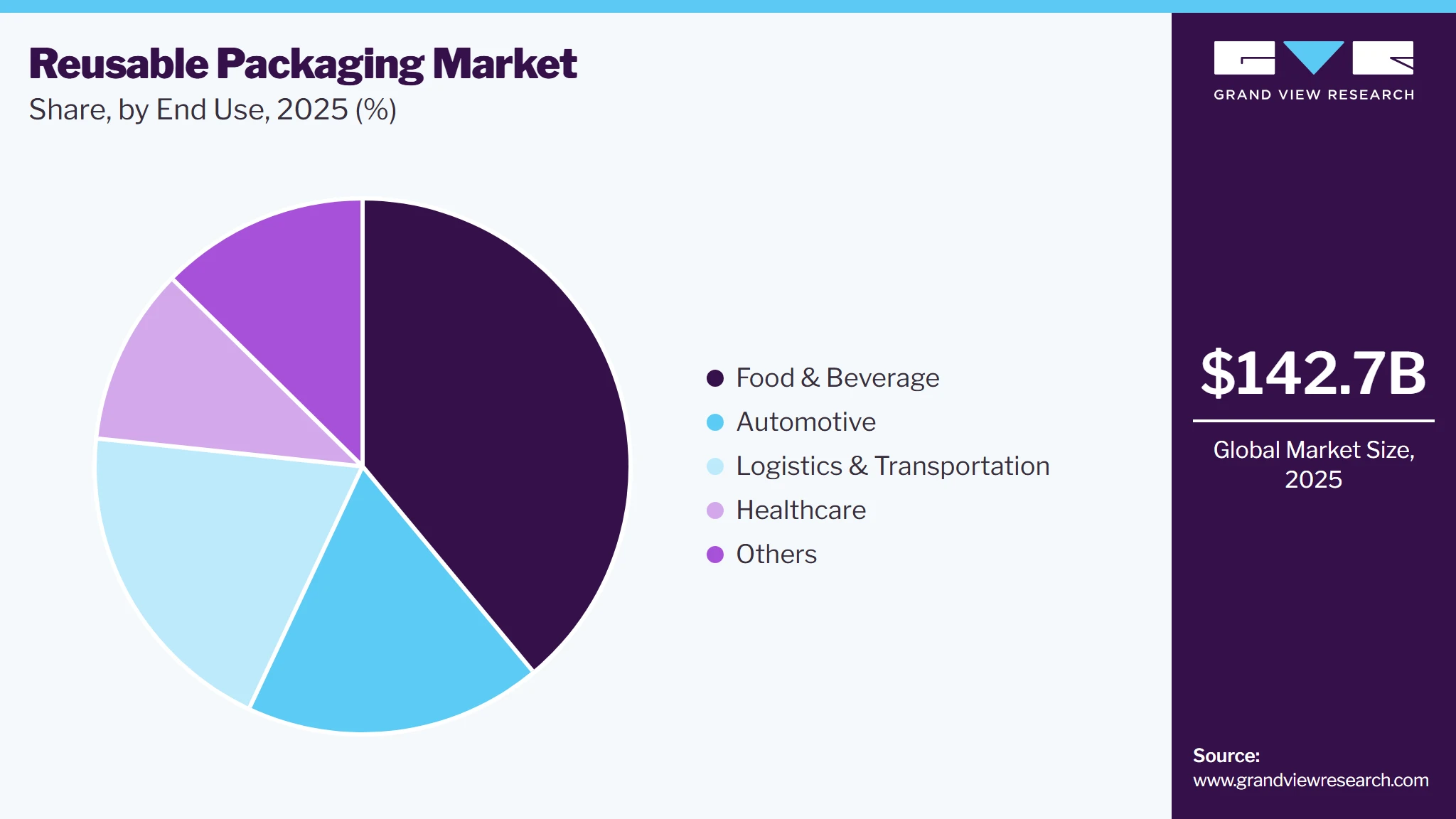
Based on end use, food & beverage segment led the market with the largest revenue share of 39.0% in 2025 and is projected to grow at the fastest CAGR during the forecast period. The food & beverage industry is under immense pressure to reduce its environmental footprint, leading to a strong shift toward reusable packaging. Governments and regulatory bodies worldwide are enforcing restrictions on single-use plastics, pushing food and beverage companies to adopt sustainable alternatives. Reusable packaging solutions, such as plastic crates, glass bottles, and durable food containers, help companies reduce packaging waste, lower carbon emissions, and comply with environmental regulations.
Food and beverage products require high standards of hygiene and safety to prevent contamination and ensure product integrity. Reusable packaging solutions, especially those made of plastic, glass, and metal, provide airtight, moisture-resistant, and contamination-proof storage, preserving food freshness and quality. Compared to disposable packaging, which can be easily damaged or compromised, reusable packaging offers better protection against bacteria, moisture, and external contaminants, making it the preferred choice in the industry.
 To learn more about this report, Download Free Sample Report
 The rapid growth of online grocery shopping, food delivery services, and cloud kitchens has increased the demand for secure, reusable packaging solutions. Companies in the food & beverage sector are moving towards durable plastic and insulated containers to transport food safely while reducing packaging waste. Many meal delivery companies are adopting returnable containers to minimize environmental impact, reinforcing the dominance of reusable packaging in this sector.
The beverage industry is a major driver of reusable packaging, with many companies using glass bottles, plastic crates, and kegs for transportation and distribution. Large beverage manufacturers, including soft drink, beer, and dairy companies, have well-established bottle return systems that allow for the collection, cleaning, and reuse of packaging materials. This circular economy model helps reduce packaging waste, conserve raw materials, and lower production costs, further solidifying the dominance of the food & beverage sector in the reusable packaging market.
Region Insights
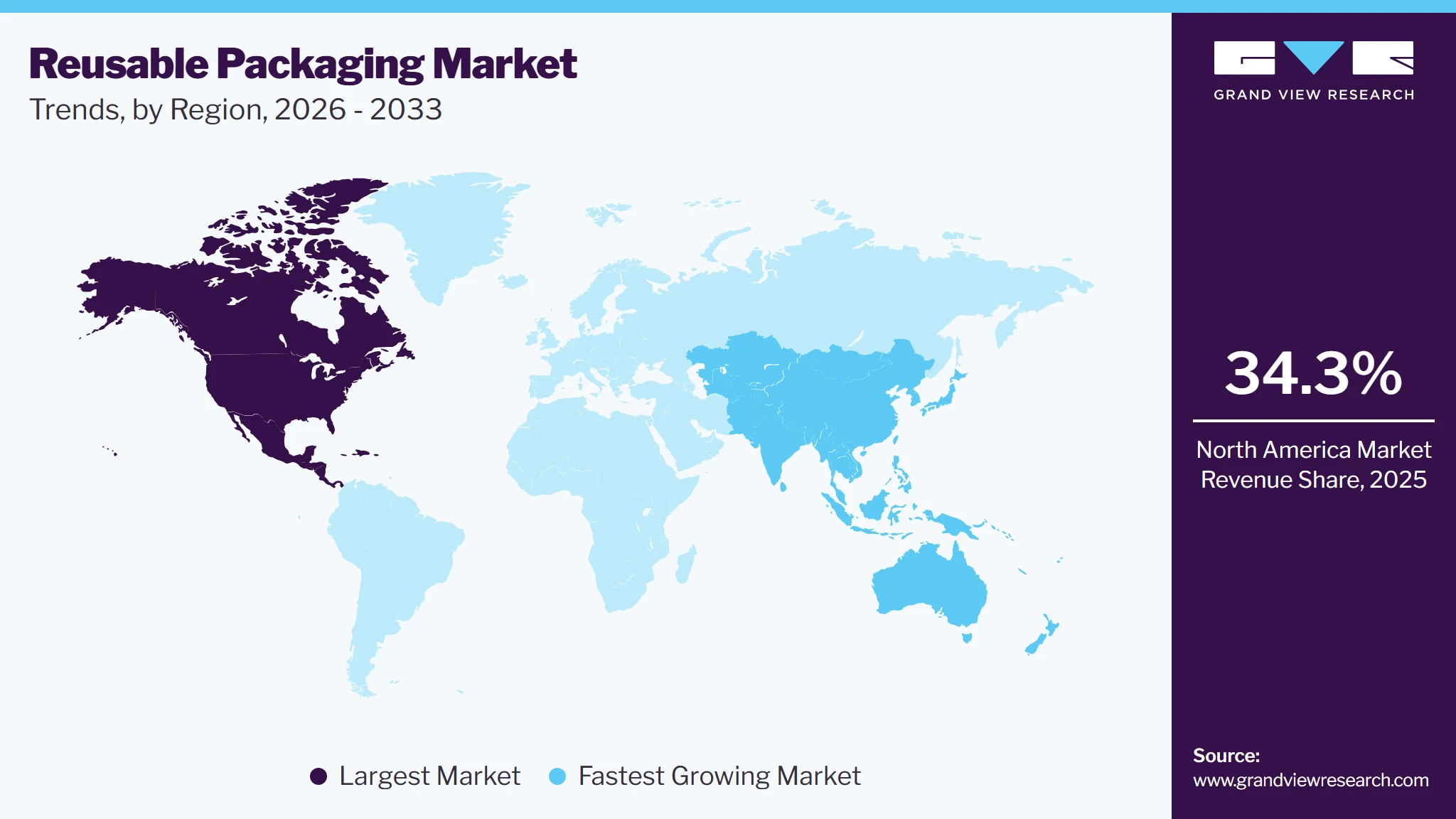
North America dominated the reusable packaging market with the largest revenue share of 34.3%in 2025. It is anticipated to grow at a CAGR of 5.6% over the forecast period. North America, particularly the United States and Canada, has seen a significant push toward sustainable and reusable packaging solutions due to increasing environmental concerns and stringent government regulations. Both federal and state governments are implementing policies to reduce single-use plastics, encourage recycling programs, and promote circular economy initiatives. Programs such as Extended Producer Responsibility (EPR) laws in Canada and various U.S. states are compelling businesses to adopt reusable packaging as part of their sustainability strategies. These regulatory efforts have accelerated the adoption of reusable containers, pallets, and crates across industries.
 To learn more about this report, Download Free Sample Report
 U.S. Reusable Packaging Market Trends
The reusable packaging market in U.S. held the largest share in the North America region in 2025. Growth of the U.S. reusable packaging industry can be attributed to several interconnected factors. The country's massive population of 1.4 billion people, combined with rapid urbanization and a growing middle class, has created significant demand for single-serve and on-the-go products. This trend is particularly evident in personal care items, food condiments, and household products. Additionally, the country’s robust manufacturing infrastructure and advanced packaging technology capabilities have contributed to its market growth. The country has invested heavily in flexible packaging production facilities, particularly in regions such as Guangdong and Zhejiang provinces.
Europe Reusable Packaging Market Trends
Europe reusable packaging industry is expanding rapidly due to stringent EU environmental policies, a strong focus on circular economy practices, and growing consumer preference for eco-friendly packaging. Many European brands are shifting to deposit-return systems, reusable glass bottles, and collapsible transport containers to comply with sustainability targets. Additionally, the rise of zero-waste retail stores, refillable packaging programs, and corporate-led green initiatives is reinforcing the region’s leadership in reusable packaging adoption.
The reusable packaging market in Germany is fueled by its strong circular economy policies, high recycling rates, and advanced packaging innovations. With stringent EU regulations and Germany’s Packaging Act (VerpackG), companies are shifting to returnable crates, pallets, and glass containers to comply with sustainability mandates. Furthermore, Germany's automotive and food & beverage industries are embracing reusable packaging solutions to enhance efficiency and meet carbon neutrality targets, positioning the country as a leader in sustainable packaging practices.
Asia Pacific Reusable Packaging Market Trends
The Asia Pacific reusable packaging industry is experiencing significant growth, due to booming urbanization, increasing middle-class consumption, and aggressive government policies against plastic waste. Countries like India, Japan, and South Korea are investing in sustainable packaging solutions as part of their environmental commitments. The region’s dominance in manufacturing, food exports, and cross-border trade is also driving demand for durable, cost-efficient, and stackable reusable packaging in logistics and warehousing.
The China reusable packaging market growth is driven by the country’s rapid industrialization, expanding e-commerce sector, and government-led sustainability initiatives. The country’s "Zero-Waste Cities" initiative and strict regulations on single-use plastics are compelling businesses to adopt returnable transport packaging (RTP) solutions. Additionally, China's dominance in global manufacturing and logistics requires durable, cost-effective, and reusable packaging materials to optimize supply chain efficiency while reducing environmental impact.
Key Reusable Packaging Company Insights
The global reusable packaging market is highly competitive, with key players focusing on innovation, material advancements, and sustainability-driven solutions to gain a competitive edge. Key players such as Smart Crates, Schoeller Arca Systems, Reusable Packaging Group, Polymer Logistics, Reusable Transit Packaging, Mauser Packaging Solutions, ORBIS Corp, Smurfit Kappa, RPP Containers, Schoeller Allibert, Schutz, SSI Schaefer, Tri-pack Packaging Systems, and Tri-Wall.
Many of these companies are expanding their product portfolios with RFID-enabled, IoT-integrated, and AI-powered tracking solutions, allowing for real-time monitoring of reusable packaging assets in supply chains. Additionally, mergers, acquisitions, and strategic partnerships are common, with players collaborating with logistics providers, sustainability organizations, and tech firms to enhance the efficiency and reach of reusable packaging solutions globally.
-
In August 2024, ALPLA and zerooo unveiled a standardized solution for cosmetics, launching reusable PET bottles designed for shampoo, shower gel, and other personal care products. This initiative promotes sustainability through a circular economy model, featuring digital labeling for transparency and an efficient return system for consumers in Germany and Austria.
-
In August 2024, Berry Global partnered with Aquafigure to launch a new line of reusable 330ml water bottles made from BPA-free Tritan. Designed with interchangeable bottle cards for personalization, the initiative targets young consumers and promotes sustainable water consumption. The bottles feature a design for interchangeable, 3D bottle cards, to promote water consumption among young people. The 330ml bottles are made from bisphenol A (BPA)-free Tritan, a recyclable, food-approved copolyester capable of withstanding hundreds of dishwasher cycles. This collaboration reinforces Berry’s commitment to advancing the circular economy.
Key Reusable Packaging Companies
The following key companies have been profiled for this study on the reusable packaging market.
-
Smart Crates
-
Schoeller Arca Systems
-
Reusable Packaging Group
-
Polymer Logistics
-
Reusable Transit Packaging
-
Mauser Packaging Solutions
-
ORBIS Corp
-
Smurfit Kappa
-
RPP Containers
-
Schoeller Allibert
-
Schutz
-
SSI Schaefer
-
Tri-pack Packaging Systems
-
Tri-Wall
Competitive Benchmarking
Category
Operating Strategies
Competitive Edge
Weakness
Established Players (ORBIS Corp; Schoeller Allibert; Schoeller Arca Systems; Mauser Packaging Solutions; SCHÜTZ; SSI Schaefer; Smurfit Kappa)
Focus on expanding reusable packaging portfolios through durable containers, pallets, crates, drums, intermediate bulk containers (IBCs), and integrated returnable packaging systems for automotive, food & beverage, healthcare, chemicals, and logistics industries. Invest in advanced manufacturing technologies, RFID-enabled packaging, digital asset tracking, sustainable materials, and global pooling and reverse logistics capabilities while strengthening partnerships with multinational manufacturers and supply chain operators.
Strong global manufacturing footprint, extensive product portfolios, well-established distribution and service networks, and long-term relationships with leading industrial and logistics companies support recurring revenue and high-volume contracts. Continuous investments in automation, product innovation, circular economy solutions, and sustainable packaging technologies strengthen their competitive position across international markets.
High capital expenditure requirements for manufacturing facilities, reverse logistics infrastructure, digital tracking technologies, and sustainability initiatives increase operating costs. Dependence on industrial production cycles, fluctuating raw material prices, and the complexity of managing global returnable packaging networks can impact profitability and operational efficiency.
Emerging Players (Smart Crates; Reusable Packaging Group; Polymer Logistics; Reusable Transit Packaging; RPP Containers; Tri-Pack Packaging Systems; Tri-Wall)
Focus on customized reusable packaging solutions tailored to regional manufacturing, retail, agriculture, and logistics customers. Expand market presence through flexible production capabilities, niche returnable packaging products, cost-effective solutions, and customer-specific designs while gradually adopting recyclable materials, lightweight packaging, and smart tracking technologies to address growing sustainability and supply chain requirements.
Greater operational flexibility enables rapid product customization, shorter lead times, and responsive customer service for regional clients and specialized industries. Competitive pricing, strong local market expertise, and the ability to develop application-specific reusable packaging solutions help these companies build long-term relationships with distributors and industrial customers.
Limited manufacturing capacity, smaller international footprint, and lower financial resources restrict participation in large-scale global supply contracts. Lower brand recognition, fewer investments in advanced automation, digital tracking technologies, and R&D may reduce their competitiveness against established multinational reusable packaging manufacturers.
Reusable Packaging Market Report Scope
Report Attribute
Details
Market size in 2025
USD 142.7 billion
Estimated market size in 2026
USD 150.5 billion
Projected market size by 2033
USD 232.3 billion
Growth rate
CAGR of 6.4% from 2026 to 2033
Base year for estimation
2025
Historical data
2021 - 2024
Forecast period
2026 - 2033
Quantitative units
Revenue in USD million/billion, and CAGR from 2026 to 2033
Report coverage
Revenue forecast, company ranking, competitive landscape, growth factors, and trends
Segments covered
Material, product, end-use, region
Regional scope
North America; Europe; Asia Pacific; Latin America; MEA
Country scope
U.S.; Canada; Mexico; Germany; France; UK; Italy; Spain; China; India; Japan; South Korea; Australia; Brazil; Argentina; South Africa; Saudi Arabia; UAE
Key companies profiled
Smart Crates; Schoeller Arca Systems; Reusable Packaging Group; Polymer Logistics; Reusable Transit Packaging; Mauser Packaging Solutions; ORBIS Corp; Smurfit Kappa; RPP Containers; Schoeller Allibert; Schutz; SSI Schaefer; Tri-pack Packaging Systems; Tri-Wall
Customization scope
Free report customization (equivalent up to 8 analysts' working days) with purchase. Addition or alteration to country, regional & segment scope.
Pricing and purchase options
Avail customized purchase options to meet your exact research needs. Explore purchase options
Global Reusable Packaging Market Report Segmentation
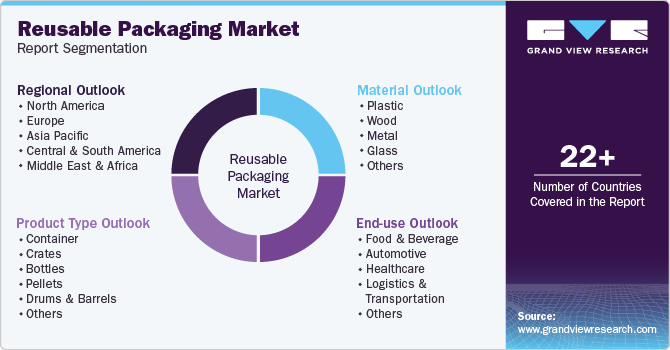
This report forecasts revenue growth at the global, regional, and country levels and provides an analysis of the latest industry trends in each of the sub-segments from 2021 to 2033. For this study, Grand View Research has segmented the global reusable packaging market report based on material, product type, end-use, and region:
 To learn more about this report, Download Free Sample Report
 -
Material Outlook (Revenue, USD Million, 2021 - 2033)
-
Plastic
-
Wood
-
Metal
-
Glass
-
Others
-
-
Product Type Outlook (Revenue, USD Million, 2021 - 2033)
-
Container
-
Crates
-
Bottles
-
Pellets
-
Drums & Barrels
-
Others
-
-
End-use Outlook (Revenue, USD Million, 2021 - 2033)
-
Food & Beverage
-
Automotive
-
Healthcare
-
Logistics & Transportation
-
Others
-
-
Regional Outlook (Revenue, USD Million, 2021 - 2033)
-
North America
-
U.S.
-
Canada
-
Mexico
-
-
Europe
-
Germany
-
France
-
UK
-
Italy
-
Spain
-
-
Asia Pacific
-
China
-
India
-
Japan
-
South Korea
-
Australia
-
-
Central & South America
-
Brazil
-
Argentina
-
-
Middle East & Africa
-
South Africa
-
Saudi Arabia
-
UAE
-
-
Research Methodology
The reusable packaging market figures in this report are based on a proven research process that combines executive interviews with secondary research from proprietary databases, company filings, and recognized regulatory and institutional sources. Market size is built through value-chain sizing - reconciling supply-side and demand-side estimates - and triangulated with bottom-up and top-down approaches. Every estimate passes multiple levels of expert validation before publication, with each reusable packaging segment quantified using the revenue-capture definitions in the table below.
Segment Definition
Segment - Material
Revenue capture definition
Plastic
Revenue generated from reusable packaging products manufactured using plastic materials such as high-density polyethylene (HDPE), polypropylene (PP), polyethylene terephthalate (PET), and other durable polymers. Includes reusable crates, pallets, containers, totes, drums, bottles, and bins designed for multiple usage cycles.
Wood
Revenue generated from reusable packaging products made from wood, including wooden pallets, crates, boxes, and bulk bins used repeatedly in industrial, agricultural, logistics, and export applications.
Metal
Revenue generated from reusable packaging manufactured using metals such as steel and aluminum. Includes metal pallets, roll cages, drums, intermediate bulk containers (IBCs), racks, and industrial storage containers designed for long-term reuse.
Glass
Revenue generated from reusable glass packaging solutions, including refillable bottles, jars, and containers primarily used in food & beverage, pharmaceutical, and chemical industries.
Others
Revenue generated from reusable packaging produced using alternative materials such as paperboard composites, textile-based packaging, bamboo, rubber, composite materials, and other specialty materials not classified under plastic, wood, metal, or glass.
Segment - Product
Revenue capture definition
Container
Revenue generated from reusable storage and transport containers, including bulk containers, intermediate bulk containers (IBCs), totes, bins, and insulated containers used across manufacturing, retail, healthcare, agriculture, and logistics.
Crates
Revenue generated from reusable plastic, metal, or wooden crates used for handling, storing, and transporting food products, beverages, agricultural produce, industrial goods, and retail merchandise.
Bottles
Revenue generated from refillable and reusable bottles manufactured from glass or durable plastics for beverages, dairy products, pharmaceuticals, personal care products, and household chemicals.
Pallets
Revenue generated from reusable pallets made from plastic, wood, metal, or composite materials used for material handling, warehousing, transportation, and supply chain operations.
Drums & Barrels
Revenue generated from reusable industrial drums and barrels used for storing and transporting chemicals, oils, lubricants, food ingredients, pharmaceuticals, and hazardous or non-hazardous liquids.
Others
Revenue generated from other reusable packaging products such as dunnage trays, reusable boxes, foldable bins, roll cages, racks, reusable bags, pails, and specialty returnable packaging solutions.
Segment - End-Use
Revenue capture definition
Food & Beverage
Revenue generated from reusable packaging supplied to food processing, beverage manufacturing, dairy, fresh produce, meat, seafood, bakery, and grocery supply chains for storage, transportation, and distribution.
Automotive
Revenue generated from reusable packaging used for transporting automotive components, spare parts, engines, electronics, and assemblies between suppliers, manufacturers, and distributors.
Healthcare
Revenue generated from reusable packaging solutions used in pharmaceutical manufacturing, medical device transportation, hospital logistics, laboratory sample handling, and healthcare supply chains requiring durable and hygienic packaging.
Logistics & Transportation
Revenue generated from reusable packaging utilized by logistics providers, warehousing companies, courier services, third-party logistics (3PL) operators, and e-commerce fulfillment centers for efficient handling and repeated transportation of goods.
Others
Revenue generated from reusable packaging used across additional industries, including chemicals, agriculture, retail, electronics, textiles, aerospace, industrial manufacturing, and consumer goods not covered under the above categories.
Estimation Model
Layer Name
Key Question
Description
Industrial & Logistics Demand Base Layer
What forms the demand base?
Identify the global demand generated by industries including food & beverage, automotive, healthcare, chemicals, retail, e-commerce, and logistics that require durable packaging for repeated transportation and storage. This layer establishes the total addressable market based on manufacturing output, warehouse activity, trade volumes, palletized shipments, and increasing adoption of circular supply chain practices across developed and emerging economies.
Reusable Packaging Adoption Layer
Where is reusable packaging utilized?
Estimate the adoption of reusable packaging solutions across major end-use industries, including food & beverage, automotive, healthcare, logistics & transportation, and industrial manufacturing. Assess the penetration of reusable containers, pallets, crates, bottles, drums & barrels, and other returnable packaging formats based on product handling requirements, transportation frequency, reverse logistics infrastructure, hygiene standards, and sustainability initiatives.
Packaging Utilization Intensity Layer
How much reusable packaging is utilized?
Analyze the volume of reusable packaging required based on shipment frequency, asset rotation cycles, packaging lifespan, return rates, inventory requirements, and supply chain complexity. Packaging utilization is influenced by transportation distances, warehouse automation, export activities, durability requirements, product protection needs, and the increasing integration of RFID, IoT, and asset tracking technologies that improve packaging utilization efficiency.
Revenue Layer
How is market revenue generated?
Market revenue is quantified through the sale, leasing, pooling, and lifecycle management of reusable packaging products, including containers, crates, pallets, bottles, drums & barrels, and other returnable packaging solutions manufactured from plastic, wood, metal, glass, and other materials. Revenue is generated from recurring purchases, rental and pooling services, maintenance, repair, cleaning, refurbishment, and replacement demand from manufacturers, distributors, logistics providers, retailers, and industrial end users seeking cost-effective and sustainable packaging solutions.
Delivered Customizations
This report has been delivered with the following In-depth customizations
Client Request
Customization Delivered
Value Adds
Cross-Segmentation Analysis
Detailed cross-segmentation analysis of the reusable packaging market by material, product type, end-use industry, and region. Includes revenue estimation, adoption trends, demand patterns, and growth opportunities across combinations such as plastic containers for food & beverage, metal drums for chemicals, wooden pallets for logistics, and glass bottles for beverages.
Enables identification of high-growth segment combinations, supports targeted product development and market entry strategies, and assists in prioritizing investments across the most attractive customer segments.
Competitive Benchmarking
Comprehensive benchmarking of leading reusable packaging companies based on product portfolio, material expertise, manufacturing capacity, geographic presence, sustainability initiatives, technological capabilities (RFID, IoT, smart packaging), strategic partnerships, mergers & acquisitions, and innovation pipeline.
Helps evaluate competitive positioning, identify market gaps and best practices, support strategic planning, and benchmark organizational capabilities against key industry participants.
Pricing Analysis
In-depth pricing analysis of reusable packaging products across materials (plastic, wood, metal, glass), product types (containers, crates, pallets, bottles, drums & barrels), and key regional markets. Includes pricing trends, raw material cost impact, rental/pooling pricing models, and competitive price comparisons.
Supports pricing optimization, procurement planning, supplier evaluation, cost competitiveness analysis, and informed decision-making for procurement, product positioning, and contract negotiations.
Frequently Asked Questions About This Report
The plastic segment is expected to be the fastest-growing material segment in the reusable packaging market, owing to its durability, lightweight properties, recyclability, and widespread use across logistics, automotive, and food & beverage industries.
The plastic segment led the reusable packaging market with a revenue share of 48.8%in 2025.
The containers segment led the reusable packaging market with a revenue share of 37.3%in 2025, driven by its extensive use in industrial storage, transportation, food distribution, and retail supply chains.
Key players in the reusable packaging market include ORBIS Corp, Schoeller Allibert, Schoeller Arca Systems, Mauser Packaging Solutions, SCHÜTZ, SSI Schaefer, Smurfit Kappa, Polymer Logistics, Reusable Packaging Group, Smart Crates, Reusable Transit Packaging, RPP Containers, Tri-Pack Packaging Systems, and Tri-Wall.
Asia Pacific is the fastest-growing region in the reusable packaging market, registering a CAGR of 6.9% over the forecast period.
The reusable packaging market is primarily driven by increasing adoption of sustainable and circular packaging solutions, stringent regulations on single-use plastics, growing demand for cost-efficient supply chain operations, expansion of logistics and e-commerce activities, and advancements in durable materials and smart tracking technologies such as RFID and IoT.
The global reusable packaging market was valued at USD 142.7 billion in 2025 and is estimated to reach USD 150.5 billion in 2026.
The global reusable packaging market is expected to grow at a CAGR of 6.4% from 2026 to 2033, reaching USD 232.3 billion by 2033.
North America dominated the reusable packaging market with a revenue share of 34.3% in 2025.
About the Author(s)
Plastics, Polymers & Resins Research Team
Bulk Chemicals · Plastics, Polymers & ResinsThis report was authored by the plastics, polymers & resins research team at Grand View Research - comprising two research analysts, one senior research analyst, and one industry expert - with specialized expertise in the plastics, polymers & resins segment of the bulk chemicals industry. All findings are based on proprietary bulk chemicals databases, executive interviews, and regulatory analysis, subject to internal peer review prior to publication.
Last Updated:
Speak to Analyst

Customize this report to your needs - add regions, segments, or data points, with 20% free customization.
Or view our licence options:


ISO 9001:2015 & 27001:2022 Certified
We are GDPR and CCPA compliant! Your transaction & personal information is safe and secure. For more details, please read our privacy policy.


