
- Home
- »
- Plastics, Polymers & Resins
- »
-
Packaging Testing Services Market Size Report, 2026-2033GVR Report cover

Packaging Testing Services Market (2026 - 2033)
Size, Share & Trends Analysis Report By Material (Plastic, Paper & Paperboard, Glass, Metal, Composite & Multilayer Materials), By Testing Service, By Packaging, By End Use, By Region, And Segment Forecasts
Market Size, 2025
$14.7BMarket Estimate, 2026
$15.4BMarket Forecast, 2023
$23.2BCAGR, 2026–2023
6.0%Packaging Testing Services Market Summary
The global packaging testing services market size was valued at USD 14.7 billion in 2025 and is projected to grow from USD 15.4 billion in 2026 to USD 23.2 billion by 2033, at a CAGR of 6.0% from 2026 to 2033. North America dominated the market, accounting for a revenue share of 29.8% in 2025, driven by increasing demand for packaging quality, safety, durability, and regulatory compliance across food & beverage, pharmaceuticals, consumer goods, and e-commerce applications.
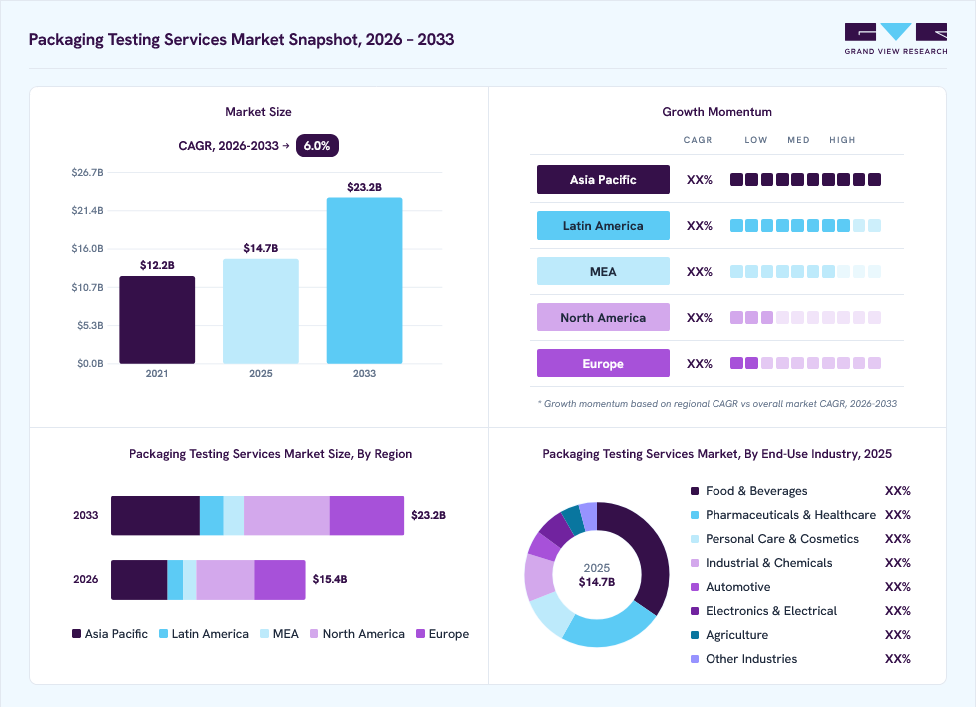 Source: Grand View Research, IR Documents, Primary Interviews, Paid DatabasesTo learn more about this report,
 Download Free Sample Report
 Key Market Trends & Insights
- By packaging: The rigid packaging segment held the largest revenue share of 42.1% in 2025.
- By testing service: The physical & mechanical testing dominated the market with the largest revenue share of 24.6% in 2025.
- By material: The plastic segment led the market with the largest revenue share of 40.2% in 2025.
- By end use: The food & beverages segment held the largest revenue share of 31.9% in 2025.
Regional Highlights
- Largest regional market: North America (29.8% revenue share, 2025)
- Fastest-growing regional market: Asia Pacific (highest CAGR, 2026-2033)
- By country: The U.S. dominated North America with the largest revenue share in 2025
Market Size & Forecast
- Market size in 2025: USD 14.7 billion
- Estimated market size in 2026: USD 15.4 billion
- Projected market size by 2033: USD 23.2 billion
- CAGR (2026-2033): 6.0%
Three ways to get this report
Buy it, customize it, or ask a question.Ask an Analyst
Analyst response in 1 business day
- AccessReport author, directly
- Reply timeWithin 1 working day
- No sales callDirect answer only
- FormatEmail reply
- CostFree, no cost
Get the Full Report
What the study covers
- FormatsPDF · Excel · Dashboard
- Timeline2026–2023 annual, 2025 base
- Coverage20+ countries, 5 regions
- Companies10+ key players profiled
Customize the Report
20% free customization
- IncludeCountries, segments, points
- TailorTo your product definition
- ExtendDeeper competitor detail
- OrA fully bespoke study
- Turnaround5–10 working days
The market is further supported by the expansion of packaged products and stringent packaging standards, which are increasing the adoption of specialized testing services for material performance, package integrity, shelf life, and transportation durability. The packaging testing services industry is driven by the increasing complexity of packaging materials and the need to ensure consistent performance, product protection, and compatibility across diverse applications. The growing use of plastics, paper and paperboard, glass, metal, and multilayer structures is expanding the need for specialized testing throughout the packaging development cycle. Manufacturers increasingly rely on physical, mechanical, barrier, integrity, and compatibility testing to identify material weaknesses, improve package durability, and reduce the risk of leakage, contamination, product damage, and packaging failure during storage and transportation. This is particularly important as packaging formats become lighter and more performance-oriented, requiring manufacturers to maintain functional strength and protection while optimizing material consumption.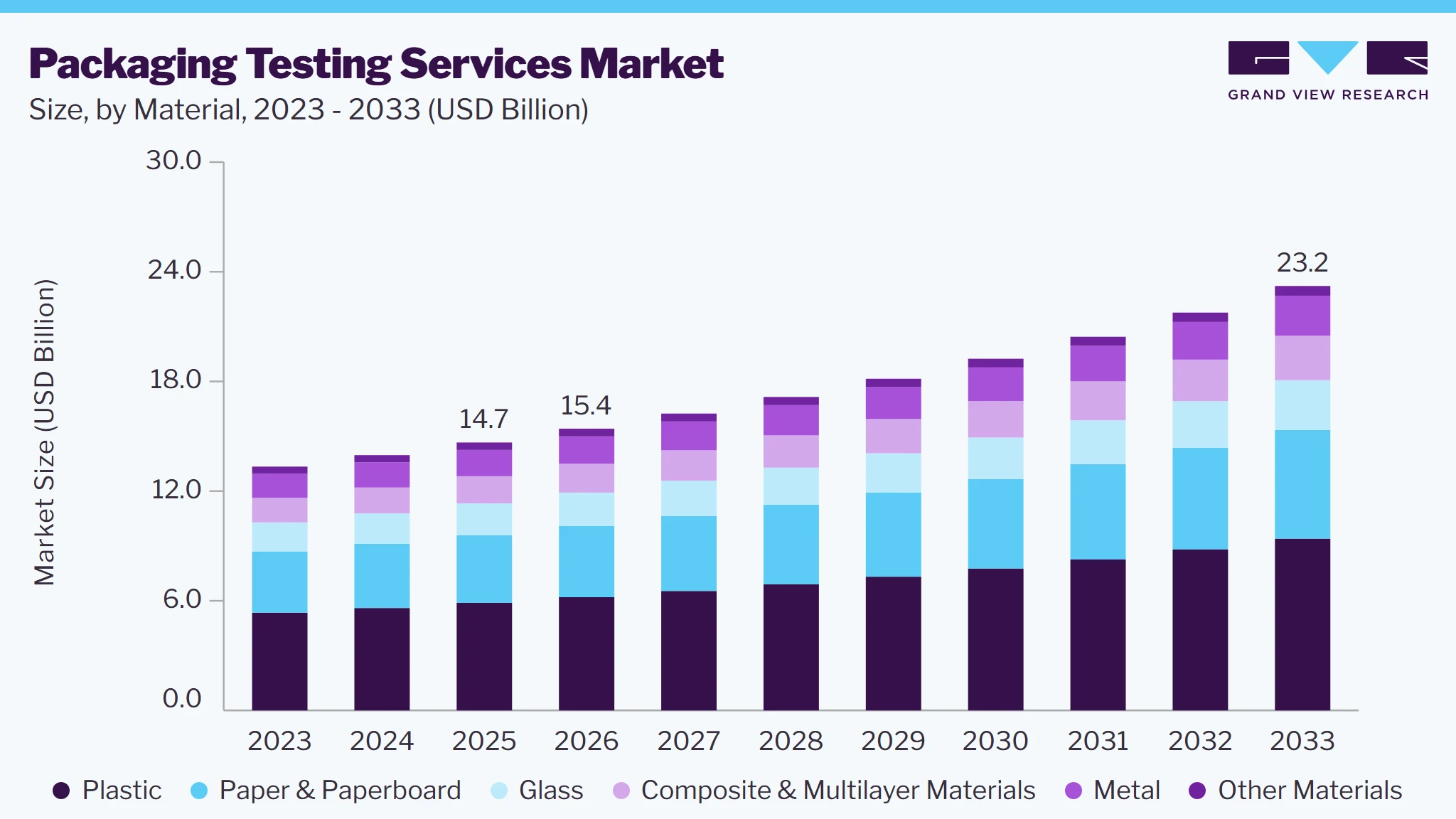 To learn more about this report, Download Free Sample Report
 An increasing focus on product safety, regulatory compliance, and quality assurance is expected to support market growth in the coming years. Food, pharmaceutical, healthcare, cosmetics, and consumer product manufacturers require packaging to meet increasingly stringent requirements related to migration, extractables and leachables, barrier performance, sterility, and container integrity. Testing is therefore becoming an integral part of packaging development rather than a final-stage quality check, enabling companies to validate packaging suitability across its intended shelf life and distribution environment. The expansion of international supply chains is further increasing demand for standardized transportation, climatic, and environmental testing to ensure packages can withstand real-world handling and storage conditions.
Sustainability initiatives and the transition toward circular packaging systems are also reshaping the packaging testing services industry. The increasing adoption of recycled plastics, fiber-based materials, lightweight packaging, and multilayer structures is creating a need to verify that changes in material composition do not compromise strength, barrier performance, safety, or recyclability. Testing providers are consequently expanding capabilities beyond conventional performance assessment to include recycled-content verification, recyclability, compostability, food-contact suitability, and other sustainability-related evaluations. The growing use of advanced, multilayer materials is driving more sophisticated characterization and failure analysis, allowing packaging manufacturers to balance environmental objectives with the functional requirements of modern packaging systems.
Market Dynamics
The market is expanding as packaging manufacturers and end-use industries place greater emphasis on package performance, product safety, regulatory compliance, and supply-chain reliability. The increasing use of diverse packaging materials, including plastics, paper and paperboard, glass, metal, and composite structures, is creating demand for specialized testing across mechanical, barrier, integrity, migration, environmental, and stability parameters. At the same time, the development of lightweight and sustainable packaging formats is increasing the need to validate whether new materials and designs can maintain required levels of protection and durability. Growing international trade, complex distribution networks, and stricter quality requirements are further encouraging companies to incorporate testing into packaging development and quality-assurance programs.
The growing emphasis on packaging safety and performance is a major driver of the packaging testing services industry. Food & beverages, pharmaceuticals, healthcare, personal care, and other packaged-product industries increasingly require packaging to protect products from contamination, moisture, oxygen, physical damage, and environmental exposure throughout storage and distribution. Manufacturers and brand owners are therefore conducting more comprehensive testing to assess package integrity, material strength, barrier properties, chemical compatibility, and shelf-life performance before products reach the market.
The expansion of global supply chains is further increasing the importance of packaging validation. Products frequently pass through multiple handling, transportation, storage, and climatic conditions, creating potential risks of seal failure, deformation, leakage, and material degradation. Testing services help manufacturers identify these vulnerabilities during packaging development and optimize package designs for real-world distribution conditions. As companies seek to reduce product losses, recalls, and packaging-related quality issues, the integration of testing into quality-control and product-development processes is expected to support continued market growth.
The high cost and technical complexity of specialized packaging testing can restrain market growth, particularly for small and mid-sized manufacturers. Advanced testing often requires sophisticated analytical equipment, controlled laboratory environments, skilled personnel, and adherence to multiple testing protocols. The increasing complexity of multilayer structures, recycled materials, and application-specific packaging may require multiple assessments of mechanical strength, barrier performance, migration, integrity, and compatibility. These requirements can increase validation costs and development timelines, leading some manufacturers to prioritize mandatory tests over comprehensive performance evaluations.
The transition toward sustainable and advanced packaging materials is creating significant opportunities for testing service providers. The growing adoption of recycled plastics, paper-based alternatives, lightweight formats, and composite or multilayer structures requires manufacturers to verify that changes in material composition do not compromise strength, barrier protection, sealing performance, product safety, or shelf life. This is increasing demand for specialized assessments covering recycled-material performance, migration, food-contact suitability, recyclability, barrier properties, and package integrity. As brands introduce sustainable packaging while meeting regulatory and functional requirements, testing providers with specialized capabilities are well positioned to capture the expanding demand across the packaging value chain.
Market Concentration & Characteristics
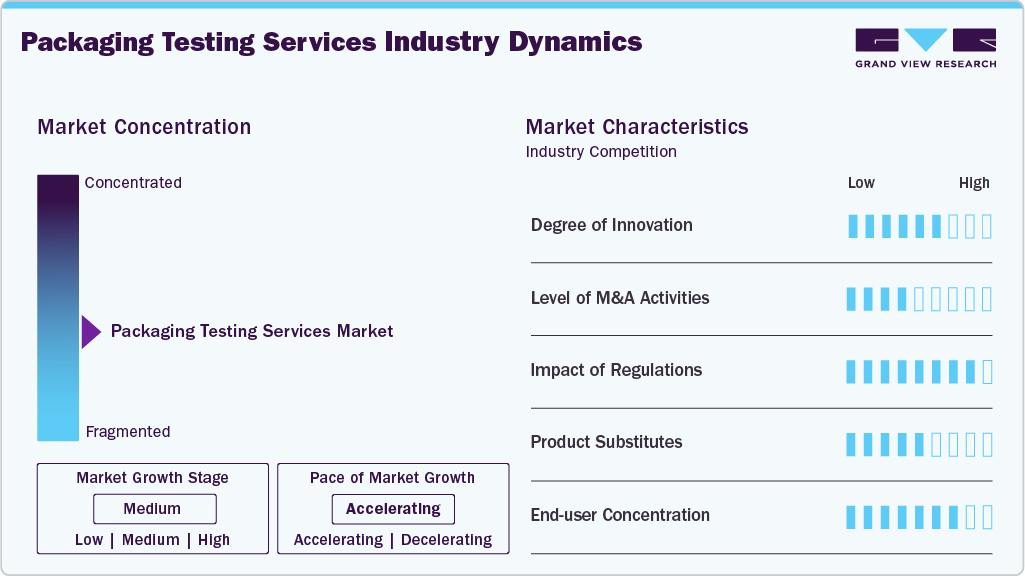
The market is characterized by its technical, compliance-driven, and quality-intensive nature, with testing integrated across packaging development, validation, and quality assurance. Service providers offer specialized physical and mechanical testing, barrier and permeability testing, package integrity testing, chemical and migration analysis, environmental testing, and shelf-life evaluation to verify packaging performance. Demand varies by material and application, requiring testing laboratories to maintain advanced analytical equipment, controlled testing environments, accredited methodologies, and technical expertise.
 To learn more about this report, Download Free Sample Report
 A defining feature of the industry is the increasing complexity of sustainable, lightweight, recycled-content, and multilayer packaging formats, which requires more specialized performance validation. Food & beverage and pharmaceutical packaging particularly require stringent evaluation of material compatibility, migration, seal integrity, sterility, barrier properties, and product protection. As manufacturers adopt new materials while maintaining regulatory compliance and packaging functionality, testing providers are expanding their capabilities in material characterization, sustainability testing, regulatory testing, and package-performance validation.
Analyst Perspective
The global market has evolved from basic quality and mechanical checks toward comprehensive performance, safety, compliance, and material validation across the packaging lifecycle. In the past, testing primarily focused on structural strength and basic durability, while current demand increasingly covers package integrity, barrier properties, chemical migration, shelf life, sterility, and transportation performance. The shift toward lightweight, recycled, multilayer, and sustainable packaging is further expanding testing requirements, as manufacturers must verify that new materials maintain product protection and regulatory compliance. Going forward, the market is expected to sustain steady growth, supported by stricter packaging standards, expanding applications in pharmaceuticals and food, more complex packaging designs, and greater emphasis on sustainable material performance.
Material Insights
The plastic segment led the market with the largest revenue share of 40.2% in 2025. The extensive use of plastic packaging across food & beverages, pharmaceuticals, personal care, and consumer products creates sustained demand for testing of mechanical strength, package integrity, barrier performance, chemical compatibility, migration, and shelf life. The widespread adoption of lightweight and recycled-content plastics is further increasing the need to validate material consistency and packaging performance, particularly as manufacturers optimize designs for durability, product protection, and regulatory compliance.
The composite & multilayer materials segment is expected to grow at the fastest CAGR of 6.5% during the forecast period. The increasing use of multilayer structures to enhance barrier protection, lightweighting, seal performance, and material efficiency is driving demand for more specialized testing capabilities. These structures often combine different materials to meet specific functional requirements, increasing the need for testing of interlayer adhesion, permeability, seal integrity, migration, compatibility, and mechanical performance. As packaging manufacturers adopt advanced structures to improve product protection and support sustainability objectives, demand for comprehensive testing and material characterization is expected to increase.
Testing Service Insights
The physical & mechanical testing segment dominated the market with the largest revenue share of 24.6% in 2025. The segment is supported by the fundamental need to assess packaging strength, durability, compression resistance, puncture resistance, tensile properties, and structural performance before products enter distribution channels. These evaluations are particularly important for packaging exposed to stacking, handling, filling, and transportation stresses, enabling manufacturers to identify structural weaknesses and optimize packaging designs without compromising product protection. The widespread use of physical and mechanical validation across plastic, paperboard, glass, metal, and other packaging formats continues to sustain its leading position.
The microbiological & sterility testing segment is expected to grow at the fastest CAGR of 7.0% during the forecast period. Increasing requirements for hygienic, contamination-controlled packaging, particularly in pharmaceuticals, healthcare, medical products, and sensitive food applications, are driving demand for microbiological evaluation and sterility assurance. Testing helps assess microbial contamination risks and supports validation of packaging systems intended to maintain product integrity under controlled conditions. Growing emphasis on patient safety, product quality, aseptic packaging, and stringent quality-control procedures is expected to further increase the adoption of microbiological and sterility testing services.
Packaging Insights
The rigid packaging segment accounted for the largest revenue share of 42.1% in 2025. Its leading position is supported by the widespread use of bottles, containers, jars, trays, and other structurally stable formats across food & beverages, pharmaceuticals, personal care, and consumer products. Testing requirements for these formats commonly center on compression strength, drop resistance, dimensional stability, closure performance, leakage, and resistance to handling and distribution stresses. As rigid packs are increasingly optimized for lightweighting and material efficiency, testing services play an important role in confirming that reduced material usage does not weaken structural performance or product protection.
The flexible packaging segment is projected to grow at the fastest CAGR of 6.6% from 2026 to 2033. The expanding use of films, pouches, sachets, and other flexible formats is generating more demand for evaluations of seal strength, puncture and tear resistance, leakage, barrier performance, and package integrity. Unlike structurally rigid formats, flexible packs can be more sensitive to sealing conditions, flexing, and mechanical stresses during filling and transportation. The shift toward lightweight, high-barrier, and material-efficient packaging is therefore increasing the need for specialized validation to ensure that thinner structures continue to provide adequate protection, shelf-life performance, and functional reliability.
End Use Insights
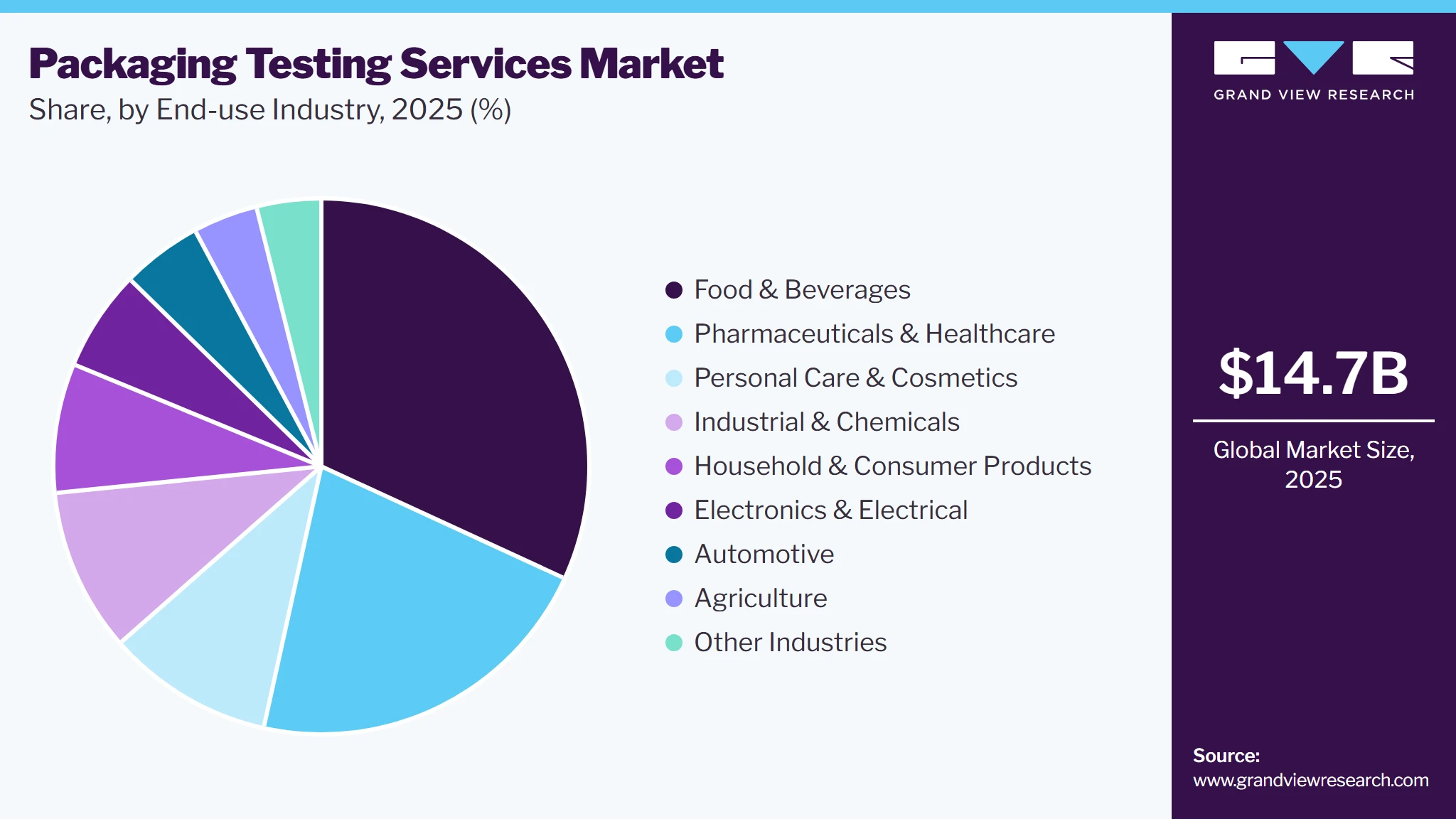
The food & beverages segment led the market with the largest revenue share of 31.9% in 2025. The segment’s dominance reflects the extensive use of packaging across processed foods, beverages, dairy, bakery products, and other packaged consumables, where packaging performance directly influences product protection and shelf life. Testing requirements span food-contact compliance, migration, seal integrity, barrier properties, leakage, and resistance to handling and distribution conditions. The increasing variety of packaging formats used for food and beverages is also broadening the range of validation requirements, particularly for materials and structures designed to preserve freshness, prevent contamination, and maintain package integrity throughout the product lifecycle.
 To learn more about this report, Download Free Sample Report
 The pharmaceuticals & healthcare segment is projected to grow at the fastest CAGR of 6.8% from 2026 to 2033. The segment requires highly controlled packaging validation because packaging failures can affect product stability, sterility, and patient safety. Testing services increasingly encompass container-closure integrity, extractables and leachables, material compatibility, sterility, barrier performance, and stability assessment for pharmaceutical and healthcare packaging. The adoption of sophisticated drug-delivery formats and stricter quality requirements is further raising the need for specialized analytical capabilities. As pharmaceutical manufacturers place greater emphasis on maintaining product quality from filling through storage and distribution, demand for comprehensive packaging testing is expected to expand steadily.
Regional Insights
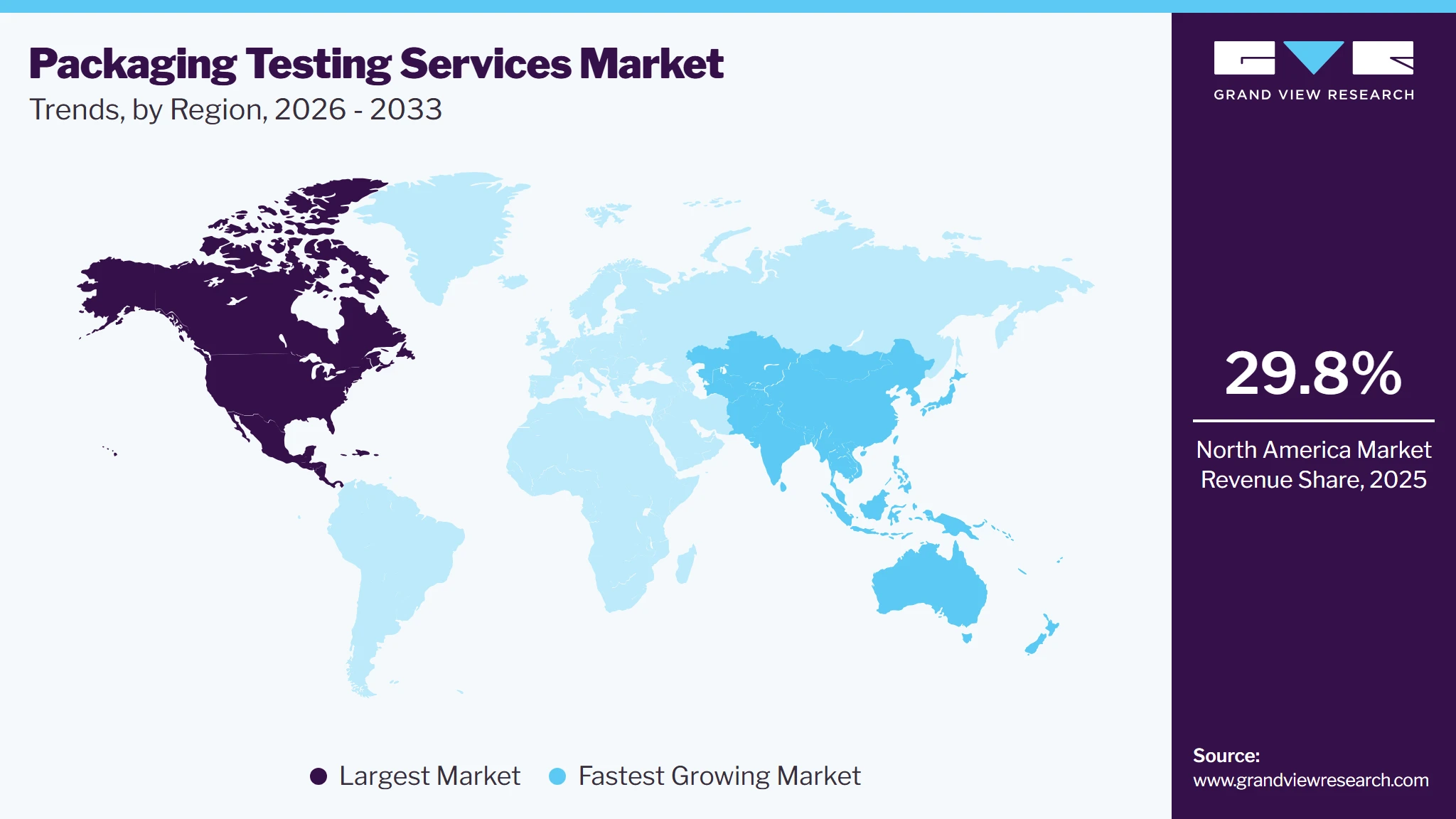
The North America packaging testing services market held the largest revenue share of 29.8% in 2025, supported by a mature packaging industry and widespread adoption of structured quality-control programs. The region has strong demand for physical and mechanical evaluation, package integrity, barrier assessment, migration analysis, and transportation testing across food, healthcare, consumer, and industrial packaging. Established laboratory infrastructure and the presence of sophisticated packaging supply chains further support service adoption.
 To learn more about this report, Download Free Sample Report
 U.S. Packaging Testing Services Market Trends
The packaging testing services market in the U.S. accounted for the largest market revenue share in North America in 2025, supported by extensive packaged food production, pharmaceutical manufacturing, consumer goods activity, and highly developed logistics networks. Demand for testing is driven by the need to validate packaging safety, material performance, package integrity, shelf life, and resistance to transportation. Pharmaceutical and healthcare applications are particularly relevant for specialized evaluations such as container-closure integrity, sterility, and material compatibility. Continued development of lightweight, recycled-content, and advanced packaging formats is also creating additional requirements for performance and compliance testing.
Europe Packaging Testing Services Market Trends
The packaging testing services market in Europe is projected to advance at a measured pace, supported by its established packaging manufacturing base and strong emphasis on product safety, sustainability, and quality assurance. Demand spans mechanical, chemical, migration, barrier, environmental, and shelf-life testing across food, pharmaceutical, cosmetics, and industrial applications. The region's transition toward recyclable, recycled-content, lightweight, and fiber-based packaging is creating new validation requirements, particularly where material changes can affect strength, barrier characteristics, or food-contact suitability.
The Germanypackaging testing services market accounts for a significant portion of the European region in 2025, supported by its advanced manufacturing ecosystem and strong presence across automotive, pharmaceuticals, food processing, chemicals, and industrial packaging. The country's focus on engineering quality and manufacturing precision sustains demand for detailed mechanical, dimensional, integrity, and material-performance assessments. The increasing use of recyclable, lightweight packaging structures is also encouraging manufacturers to validate new material combinations and to maintain functional performance throughout distribution and storage.
The packaging testing services market in the UKis expected to grow steadily, supported by demand from food and beverage producers, pharmaceutical companies, cosmetics manufacturers, and consumer product suppliers. Testing requirements are increasingly shaped by packaging safety, material suitability, sustainability objectives, and product shelf-life considerations. The adoption of recyclable, fiber-based formats is creating additional requirements for barrier, migration, strength, and package performance evaluations. Service providers with capabilities spanning regulatory testing and packaging validation are well positioned to support manufacturers adapting to changing packaging specifications.
Asia Pacific Packaging Testing Services Market Trends
The packaging testing services market in the Asia Pacific is projected to grow at the fastest CAGR of 6.7% from 2026 to 2033. The region's expansion is underpinned by rapid growth in packaged food and beverages, pharmaceutical production, consumer goods, electronics, and e-commerce distribution. Rising packaging output across China, India, Japan, South Korea, and Southeast Asia is widening the need for quality verification across materials and formats. The region is also gaining share as manufacturers increasingly adopt flexible, multilayer, lightweight, and sustainable packaging, requiring more sophisticated assessments of integrity, barrier performance, durability, and material compatibility.
The China packaging testing services market represents a major contributor to the Asia Pacific market, reflecting its extensive packaging manufacturing capacity and large consumer-product, food, pharmaceutical, electronics, and industrial sectors. The country's high-volume production environment creates substantial requirements for standardized quality assessment, package durability, material characterization, and transportation simulation. Expansion of premium packaged products and greater attention to packaging safety are broadening testing requirements beyond basic physical evaluations. The increasing adoption of flexible and multilayer structures is also driving demand for specialized barrier, sealing, and integrity assessments.
Thepackaging testing services market in Indiais expected to be one of the key growth markets in Asia Pacific, supported by the expansion of food processing, pharmaceutical manufacturing, organized retail, e-commerce, and consumer product industries. The increasing formalization of packaging quality practices is encouraging manufacturers to incorporate testing into product development and validation processes. Demand is also emerging around flexible packaging, paper-based formats, recycled materials, and packaging designed for longer distribution networks. As domestic manufacturers expand production and strengthen quality systems, opportunities are increasing for laboratories providing material, migration, integrity, shelf-life, and transportation-related testing.
Latin America Packaging Testing Services Market Trends
The packaging testing services market in Latin America is projected to grow steadily. Market development is linked to the expansion of packaged food and beverage production, pharmaceutical distribution, personal care manufacturing, and modern retail channels. Greater use of flexible and rigid packaging is driving the need for structural, leakage, barrier, and material suitability evaluations. Manufacturers are also placing greater emphasis on packaging consistency and product protection as supply chains across the region become more sophisticated.
The Brazilpackaging testing services market accounts for a substantial portion of the Latin American market, supported by its large food and beverage industry, pharmaceutical sector, consumer goods manufacturing base, and broad domestic distribution network. The diversity of packaging applications creates demand for evaluations covering mechanical performance, package integrity, migration, shelf life, and transportation resistance. Growth in processed foods, personal care products, and modern retail packaging is further increasing the importance of standardized testing during packaging development and quality assurance.
The packaging testing services market in Argentina is expected to grow gradually, supported by the food processing, beverage production, pharmaceuticals, agricultural products, and consumer goods sectors. Packaging suppliers and manufacturers require testing to verify structural performance, material suitability, sealing, and product protection, particularly for products distributed through extended domestic and regional supply chains. Increasing attention to packaging efficiency and material optimization is expected to create additional opportunities for testing providers capable of evaluating both conventional and newer packaging formats.
Middle East & Africa Packaging Testing Services Market Trends
The packaging testing services market in the Middle East & Africa is expected to grow at a significant CAGR of 6.2% from 2026 to 2033, supported by industrial diversification, food and beverage production, pharmaceutical development, and expanding consumer markets. Packaging demand is increasing alongside investments in manufacturing, logistics, and modern retail infrastructure. The region's climatic conditions also make environmental, shelf-life, durability, and transportation-related assessments particularly relevant for products exposed to heat, humidity, and long distribution routes. Growing adoption of higher-quality packaging formats is expected to broaden the need for specialized testing services across food, healthcare, and industrial applications.
Key Packaging Testing Services Company Insights
Some key companies in the global market include SGS Société Générale de Surveillance, Intertek Group plc, TÜV SÜD, Smithers, Bureau Veritas, Eurofins, UL LLC, TÜV Rheinland, Element Materials Technology, Nelson Laboratories, LLC, ISTA Packaging Testing Services, Applus+ Keystone, Ten-E Packaging Services, and ITC Labs. The market is characterized by specialized laboratory testing, packaging performance validation, regulatory compliance, material characterization, and application-specific testing capabilities. Key participants are focusing on expanding analytical capabilities, accredited testing infrastructure, digital testing solutions, and specialized services for sustainable, flexible, pharmaceutical, food-contact, and advanced packaging formats. Providers are also strengthening their service portfolios to address increasingly complex requirements related to package integrity, migration, barrier performance, transportation durability, shelf life, and sustainability.
-
SGS Société Générale de Surveillance provides comprehensive packaging testing and inspection services covering packaging materials, performance, safety, and regulatory requirements. Its testing capabilities enable manufacturers to evaluate package integrity, mechanical properties, chemical characteristics, and suitability for different applications, helping companies validate packaging quality before commercialization.
-
Intertek Group plc offers packaging testing services focused on package performance, material assessment, safety, and regulatory compliance. Its capabilities include physical testing, barrier evaluation, migration, package integrity, and transportation-related assessments, helping manufacturers improve packaging reliability and meet market-specific requirements.
Key Packaging Testing Services Companies
The following key companies have been profiled for this study on the global packaging testing services market:
-
SGS Société Générale de Surveillance
-
Intertek Group plc
-
TÜV SÜD
-
Smithers
-
Bureau Veritas
-
Eurofins
-
UL LLC
-
TÜV Rheinland
-
Element Materials Technology
-
Nelson Laboratories, LLC
-
ISTA Packaging Testing Services.
-
Applus+ Keystone
-
Ten-E Packaging Services
-
ITC Labs
Company Categorization
Category
Operating Strategies
Competitive Edge
Weakness
Established Players (SGS Société Générale de Surveillance; Intertek Group plc; TÜV SÜD; Bureau Veritas; Eurofins; UL LLC; TÜV Rheinland; Element Materials Technology)
Focus on expanding global packaging testing portfolios through accredited laboratories, advanced analytical capabilities, regulatory testing, and specialized services covering package integrity, mechanical performance, migration, barrier properties, shelf life, and transportation testing.
Extensive global laboratory networks, broad accreditation coverage, technical expertise, diversified testing portfolios, established customer relationships, and strong regulatory-compliance capabilities provide significant competitive advantages.
Higher operating and laboratory infrastructure costs, complex accreditation requirements, and large organizational structures can reduce flexibility. Continuous investment in advanced analytical equipment and evolving testing standards also increases operating expenditure.
Emerging & Specialized Players (Smithers; Nelson Laboratories, LLC; ISTA Packaging Testing Services; Applus+ Keystone; Ten-E Packaging Services; ITC Labs)
Concentrate on specialized packaging performance, materials testing, pharmaceutical and healthcare packaging validation, distribution testing, and application-specific laboratory services. Strengthen market position through technical specialization, customized testing protocols, and focused customer support.
Strong expertise in niche testing applications, flexible service models, specialized laboratory capabilities, and faster response to customer-specific packaging validation requirements support competitiveness in targeted segments.
Smaller geographic coverage, narrower service portfolios, and comparatively limited laboratory infrastructure can restrict scalability. Dependence on specialized applications and regional customer bases may also limit penetration into large multinational accounts.
Recent Development:
-
In May 2026, SGS Société Générale de Surveillance opened a new bicycle, e-mobility, and transit packaging testing laboratory in Bentonville, Arkansas. The facility expands SGS’s North American testing network and serves as its central transit packaging testing facility in the region, with capabilities including compression, drop, vibration, environmental, and mechanical durability testing. The expansion strengthens SGS’s ability to support packaging performance and regulatory validation for products moving through complex distribution networks.
-
In June 2026, Smithers announced the expansion of its UK Distribution Testing Laboratory in Leatherhead. The project will increase the facility’s footprint by 55%, adding 3,800 sq. ft. of conditioned laboratory space. The expansion is intended to address rising demand from e-commerce, consumer goods, pharmaceuticals, and medical devices and will enhance capabilities for distribution simulation, including combined-hazard testing involving temperature variation, vibration, and handling stresses.
Packaging Testing Services Market Report Scope
Report Attribute
Details
Market size in 2025
USD 14.7 billion
Estimated market size in 2026
USD 15.4 billion
Projected market size by 2033
USD 23.2 billion
Growth rate
CAGR of 6.0% from 2026 to 2033
Base year for estimation
2025
Historical data
2021 – 2024
Forecast period
2026 – 2033
Quantitative units
Revenue in USD billion and CAGR from 2026 to 2033
Report coverage
Revenue forecast, company ranking, competitive landscape, growth factors, and trends
Segments covered
Material, testing service, packaging, end use, region
Regional scope
North America; Europe; Asia Pacific; Latin America; Middle East & Africa
Country scope
U.S.; Canada; Mexico; Germany; France; UK; Italy; Spain; China; India; Japan; South Korea; Australia; Brazil; Argentina; Saudi Arabia; UAE; South Africa
Key companies profiled
SGS Société Générale de Surveillance; Intertek Group plc; TÜV SÜD; Smithers; Bureau Veritas; Eurofins; UL LLC; TÜV Rheinland; Element Materials Technology; Nelson Laboratories, LLC; ISTA Packaging Testing Services; Applus+ Keystone; Ten-E Packaging Services; ITC Labs
Customization scope
Free report customization (equivalent up to 8 analysts working days) with purchase. Addition or alteration to country, regional & segment scope.
Pricing and purchase options
Avail of customized purchase options to meet your exact research needs. Explore purchase options
Global Packaging Testing Services Market Report Segmentation
This report forecasts revenue growth at the regional and country levels and provides an analysis of the latest industry trends and opportunities in each of the sub-segments from 2021 to 2033. For this study, Grand View Research has segmented the global packaging testing services market report based on the material, testing service, packaging, end use, region :
-
Material Outlook (Revenue, USD Million, 2021 – 2033)
-
Plastic
-
Paper & Paperboard
-
Glass
-
Metal
-
Composite & Multilayer Materials
-
Other Materials
-
-
Testing Service Outlook (Revenue, USD Million, 2021 – 2033)
-
Physical & Mechanical Testing
-
Barrier & Permeability Testing
-
Package Integrity Testing
-
Environmental & Climatic Testing
-
Chemical & Migration Testing
-
Microbiological & Sterility Testing
-
Transportation Simulation Testing
-
Shelf-life & Stability Testing
-
Other Specialized Testing
-
-
Packaging Outlook (Revenue, USD Million, 2021 – 2033)
-
Rigid Packaging
-
Flexible Packaging
-
Semi-Rigid Packaging
-
Transport & Industrial Packaging
-
-
End Use Outlook (Revenue, USD Million, 2021 - 2033)
-
Food & Beverages
-
Pharmaceuticals & Healthcare
-
Personal Care & Cosmetics
-
Household & Consumer Products
-
Industrial & Chemicals
-
Automotive
-
Electronics & Electrical
-
Agriculture
-
Other Industries
-
-
Regional Outlook (Revenue, USD Million, 2021 - 2033)
-
North America
-
U.S.
-
Canada
-
Mexico
-
-
Europe
-
Germany
-
France
-
UK
-
Italy
-
Spain
-
-
Asia Pacific
-
China
-
India
-
Japan
-
South Korea
-
Australia
-
-
Latin America
-
Brazil
-
Argentina
-
-
Middle East & Africa
-
Saudi Arabia
-
UAE
-
South Africa
-
-
Research Methodology
The packaging testing services marketfigures in this report are based on a proven research process that combines executive interviews with secondary research from proprietary databases, company filings, and recognized regulatory and institutional sources. Market size is built through value-chain sizing—reconciling supply-side and demand-side estimates—and triangulated with bottom-up and top-down approaches. Every estimate passes multiple levels of expert validation before publication, with eachpackaging testing services segment quantified using the revenue-capture definitions in the table below.
Segment Definition
Material Type
Revenue capture definition
Plastic
Revenue from testing services for plastic packaging, including bottles, containers, films, pouches, and trays. Covers mechanical strength, package integrity, barrier performance, migration, seal strength, and material compatibility.
Paper & Paperboard
Revenue from testing services for paper and paperboard packaging, including cartons, corrugated boxes, bags, and food-service packs. Covers strength, moisture resistance, barrier properties, migration, and durability.
Glass
Revenue from testing services for glass packaging such as bottles, jars, vials, and ampoules. Covers mechanical strength, impact resistance, thermal resistance, leakage, container integrity, and chemical compatibility.
Metal
Revenue from testing services for metal packaging, including cans, drums, containers, and closures. Covers strength, corrosion resistance, coating integrity, leakage, sealing, and chemical compatibility.
Composite & Multilayer Materials
Revenue from testing services for multilayer and composite packaging combining materials such as plastics, paper, foil, and coatings. Covers adhesion, barrier performance, seal strength, migration, permeability, and package integrity.
Other Materials
Revenue from testing services for specialty packaging materials such as wood, textiles, molded fiber, biodegradable, and bio-based materials. Covers relevant mechanical, environmental, chemical, barrier, and performance testing.
Testing Service
Revenue capture definition
Physical & Mechanical Testing
Revenue from testing packaging strength, compression, tensile, puncture, impact, and durability to assess structural performance.
Barrier & Permeability Testing
Revenue from testing packaging resistance to oxygen, moisture, water vapor, gases, and other permeants to evaluate product protection and shelf life.
Package Integrity Testing
Revenue from testing leaks, seals, closures, joints, and container integrity to identify defects and ensure packaging remains properly sealed.
Environmental & Climatic Testing
Revenue from testing packaging performance under temperature, humidity, thermal cycling, and other environmental conditions.
Chemical & Migration Testing
Revenue from testing chemical compatibility, extractables, leachables, and material migration to assess packaging safety and regulatory compliance.
Microbiological & Sterility Testing
Revenue from testing packaging for microbial contamination, sterility, microbial barrier performance, and hygienic protection, particularly for pharmaceutical and healthcare applications.
Transportation Simulation Testing
Revenue from testing packaging against vibration, shock, compression, drop, handling, and distribution stresses encountered during transportation.
Shelf-life & Stability Testing
Revenue from testing packaging performance over time under defined storage, temperature, humidity, and aging conditions to support shelf-life validation.
Other Specialized Testing
Revenue from specialized packaging tests not covered above, including dimensional, print, coating, recyclability, sustainability, and application-specific performance testing.
Packaging
Revenue capture definition
Rigid Packaging
Revenue from testing services for bottles, jars, containers, cans, trays, and rigid packs, covering strength, compression, impact, leakage, closure, and structural integrity.
Flexible Packaging
Revenue from testing services for films, pouches, sachets, bags, and wraps, covering seal strength, puncture, tear resistance, barrier performance, leakage, and package integrity.
Semi-Rigid Packaging
Revenue from testing services for cups, tubs, clamshells, trays, and semi-rigid containers, covering dimensional stability, strength, sealing, impact resistance, and product protection.
Transport & Industrial Packaging
Revenue from testing services for pallets, crates, drums, bulk containers, and protective transport packaging, covering compression, vibration, shock, drop, load-bearing, and distribution durability.
End Use
Revenue capture definition
Food & Beverages
Revenue from packaging testing services for food, beverages, dairy, bakery, processed foods, and packaged consumables, covering migration, barrier, seal integrity, leakage, mechanical strength, and shelf-life performance.
Pharmaceuticals & Healthcare
Revenue from testing services for pharmaceutical, medical, diagnostic, and healthcare packaging, covering container-closure integrity, sterility, microbial barrier, migration, compatibility, stability, and package integrity.
Personal Care & Cosmetics
Revenue from testing services for cosmetic, skincare, haircare, fragrance, and personal care packaging, covering leakage, compatibility, chemical resistance, seal performance, durability, and material safety.
Household & Consumer Products
Revenue from testing services for packaging used in household goods, cleaning products, personal-use items, and general consumer products, covering strength, leakage, durability, chemical compatibility, and package integrity.
Industrial & Chemicals
Revenue from testing services for packaging of chemicals, industrial materials, lubricants, coatings, and hazardous substances, covering chemical compatibility, leakage, corrosion resistance, structural strength, and containment performance.
Automotive
Revenue from testing services for packaging used for automotive components, spare parts, fluids, and related products, covering impact resistance, vibration, compression, durability, and transportation protection.
Electronics & Electrical
Revenue from testing services for packaging of electronic devices, electrical components, appliances, and sensitive equipment, covering shock, vibration, cushioning, moisture protection, ESD-related performance, and transportation durability.
Agriculture
Revenue from testing services for packaging of seeds, fertilizers, pesticides, crop-protection products, and agricultural inputs, covering strength, moisture resistance, chemical compatibility, leakage, and storage durability.
Other Industries
Revenue from packaging testing services for textiles, construction materials, specialty products, and other applications, covering application-specific mechanical, environmental, integrity, and material-performance parameters.
Estimation Model
Layer No.
Layer Name
Key Question
Description
01
End Use Layer
What drives testing demand?
Estimate testing-service demand generated by key industries including food & beverages, pharmaceuticals & healthcare, personal care & cosmetics, household products, industrial & chemicals, automotive, electronics, and agriculture, based on packaging safety, performance, shelf-life, and regulatory requirements.
02
Packaging Adoption Layer
Where is testing required?
Assess testing requirements across rigid, flexible, semi-rigid, and transport & industrial packaging, considering factors such as material strength, barrier performance, sealing, leakage prevention, durability, and transportation protection.
03
Testing Service Consumption Layer
Which services generate demand?
Evaluate utilization of physical & mechanical, barrier & permeability, package integrity, environmental & climatic, chemical & migration, microbiological & sterility, transportation simulation, and shelf-life & stability testing across packaging formats and end-use applications.
04
Revenue Layer
How is revenue generated?
Revenue is generated through laboratory testing, analytical evaluation, performance validation, regulatory compliance testing, and specialized packaging assessments conducted for manufacturers, brand owners, pharmaceutical companies, food producers, and other packaging stakeholders.
Delivered Customizations
We have successfully delivered the following deep-dive customizations:
Client Request
Customization Delivered
Value Adds
Competitive Benchmarking
Comparative assessment of key Packaging Testing Services providers based on testing-service portfolio, laboratory capabilities, accreditation, material and packaging expertise, end-use coverage, geographic presence, regulatory capabilities, technology adoption, and strategic developments.
Enables evaluation of competitive positioning, service differentiation, specialized testing capabilities, and expansion strategies across major market participants.
Cross-Segmentation Analysis
Detailed assessment of market opportunities across combinations of Packaging (Rigid, Flexible, Semi-Rigid, Transport & Industrial), Testing Service (Physical & Mechanical, Barrier & Permeability, Package Integrity, Chemical & Migration, Microbiological & Sterility, and others), Material (Plastic, Paper & Paperboard, Glass, Metal, Composite & Multilayer), End Use, and regional markets.
Helps identify high-value segment combinations, application-specific testing demand, and emerging pockets of service adoption for targeted market strategies.
Opportunity Assessment
Evaluation of emerging opportunities arising from sustainable and recycled packaging, multilayer structures, pharmaceutical and healthcare packaging, food-contact compliance, e-commerce distribution, advanced barrier materials, and increasingly stringent packaging regulations.
Supports identification of high-growth service areas, underserved applications, regional expansion opportunities, and specialized testing capabilities with potential for future revenue growth.
About the Author(s)
Plastics, Polymers & Resins Research Team
Bulk Chemicals · Plastics, Polymers & ResinsThis report was authored by the plastics, polymers & resins research team at Grand View Research - comprising two research analysts, one senior research analyst, and one industry expert - with specialized expertise in the plastics, polymers & resins segment of the bulk chemicals industry. All findings are based on proprietary bulk chemicals databases, executive interviews, and regulatory analysis, subject to internal peer review prior to publication.
Last Updated:
Speak to Analyst

Customize this report to your needs - add regions, segments, or data points, with 20% free customization.
Or view our licence options:


ISO 9001:2015 & 27001:2022 Certified
We are GDPR and CCPA compliant! Your transaction & personal information is safe and secure. For more details, please read our privacy policy.


