
- Home
- »
- Paints, Coatings & Printing Inks
- »
-
Paint Additives Market Size, Share And Trends Report, 2033GVR Report cover

Paint Additives Market (2026 - 2033)
Size, Share & Trends Analysis Report By Product (Rheology Modifiers, Biocides), By Application (Architectural, Automotive, Industrial, Wood & Furniture), By Region, And Segment Forecasts
Market Size, 2025
$10.1BMarket Estimate, 2026
$10.4BMarket Forecast, 2033
$13.8BCAGR, 2026–2033
4.1%Paint Additives Market Summary
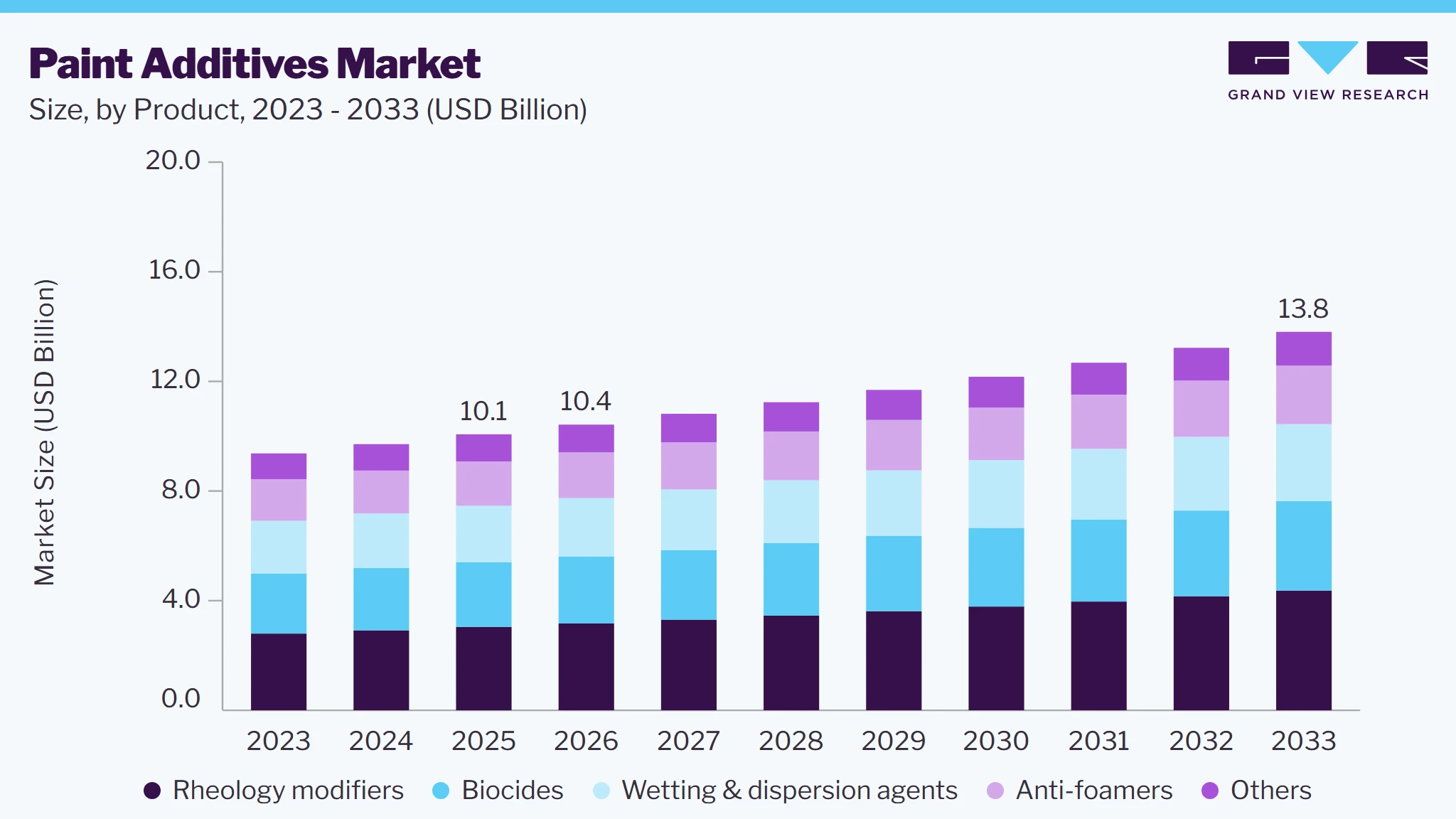
The global paint additives market size was valued at USD 10.1 billion in 2025 and is projected to grow from USD 10.4 billion in 2026 to USD 13.8 billion by 2033, at a CAGR of 4.1% from 2026 to 2033. Asia Pacific dominated the market, accounting for a revenue share of 40.7% in 2025. The demand for paint additives is attributed to their beneficial properties, such as wetting, foam control, and dispersion, which enhance surface performance and regulate the viscosity of coatings used in buildings, automobiles, and other applications.
 Source: Grand View Research, IR Documents, Primary Interviews, Paid DatabasesTo learn more about this report,
 Download Free Sample Report
Key Market Trends & Insights
- By product: Rheology modifiers held a dominant position, contributing 30.2% of total revenue in 2025.
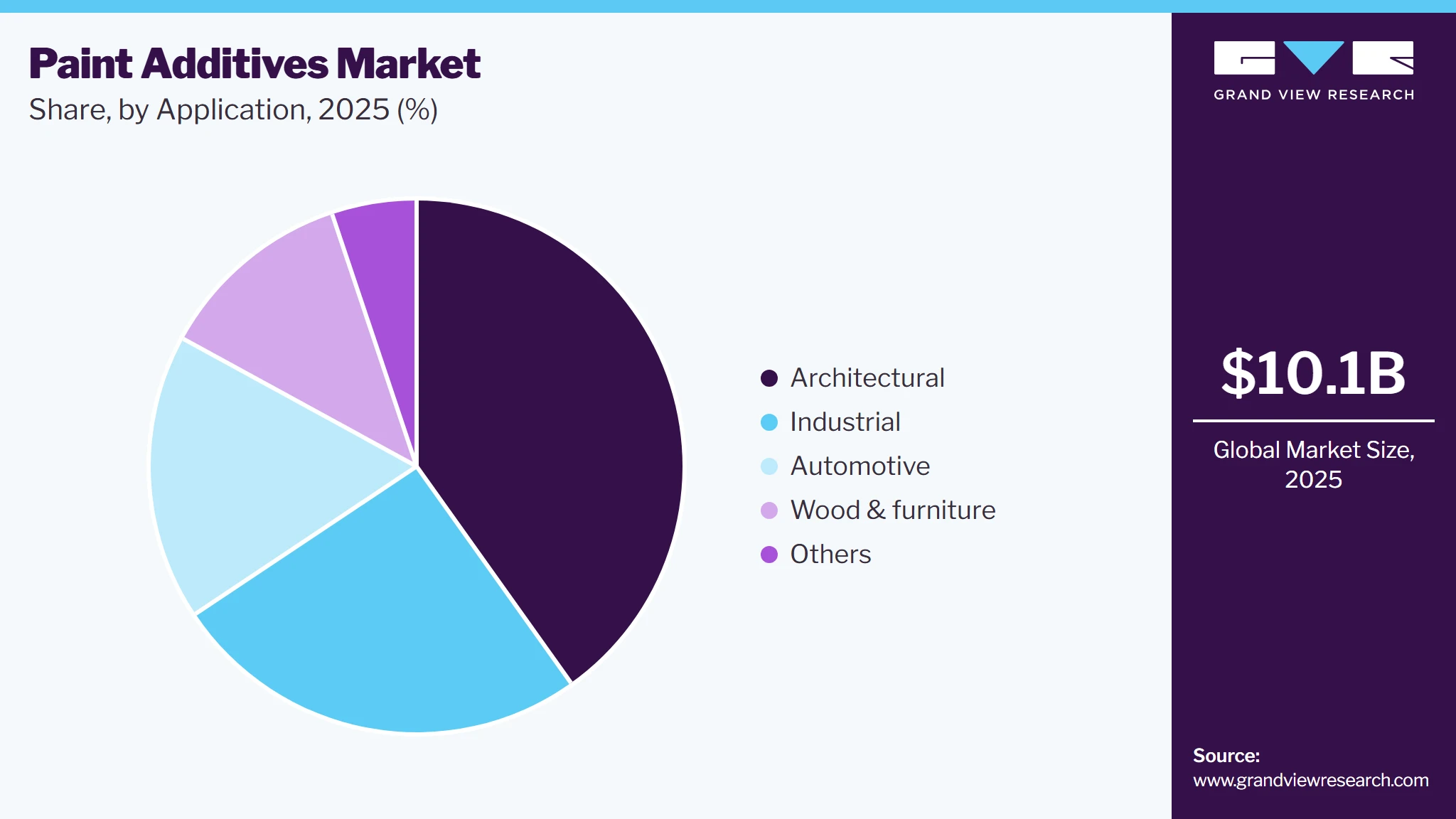
- By application: The architectural segment accounted for the largest revenue share of 40.1% in 2025.
Regional Highlights
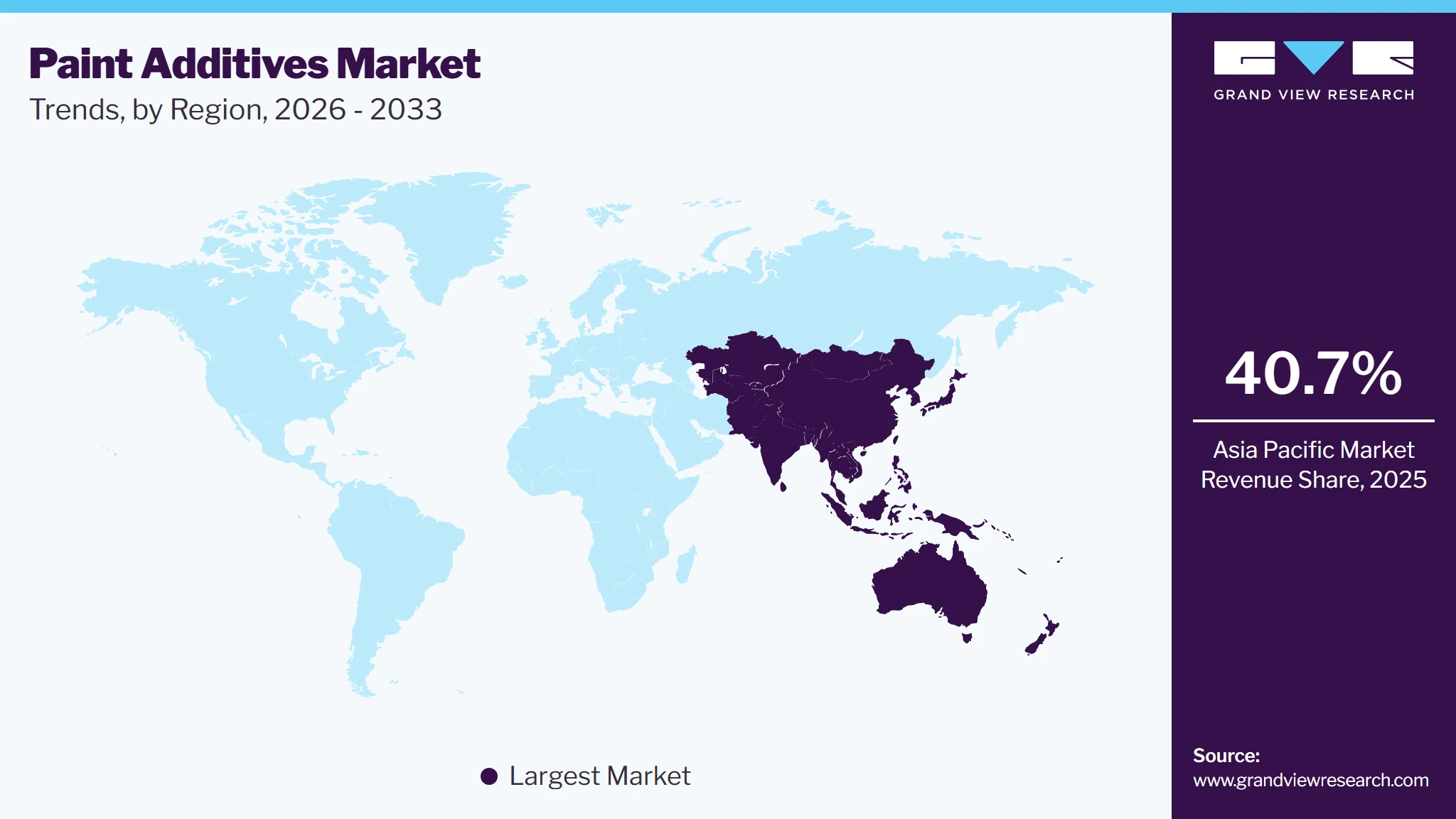
- Largest regional market: Asia Pacific (40.7% revenue share, 2025)
- By country: China held the largest market share in 2025.
Market Size & Forecast
- Market size in 2025: USD 10.1 Billion
- Estimated market size in 2026: USD 10.4 Billion
- Projected market size by 2033: USD 13.8 Billion
- CAGR (2026-2033): 4.1%
GVR research-powered AIAsk Prism AI about the paint additives marketGet cited answers from GVR research on market growth, segments, regulations and forecasts.Start with✓ Source-linked answers ✓ Market-specific context ✓ Traceable figuresExplore Prism AI ↗
Paint additives are essential element to increase the consistency and long lasting effects of the paints. The demand for paint and coating is growing at a steady rate owing to increase in consumption from architectural applications and end-use industries such as oil & gas, aerospace, marine, steel industry etc. This in turn is expected to have a positive impact on the market over the forecast period.The quantity of paints and coatings manufactured worldwide is large, however most of these are produced by regional manufacturers with approximately ten or so dominant global players. These key multinational companies have expanded to other regions or are planning for expansion in any region that has a potential for paint & coating market. Rising demand for paint is expected to boost need for paint additives need over the forecast period.
 To learn more about this report, Download Free Sample Report
Increased use of paints and coatings in the construction as well as the automotive sector, to elevate the aesthetical appearance and provide protection from external effects such as water, dust, and others is expected to fuel product growth over the next few years. Increased construction spending and growing automotive sector in emerging countries of Asia Pacific has made it largest region for paint & coating market, which in turn will have a positive impact on the additives demand over the forecast period.
Aerospace sector is a big market for paint and coatings. The four major worldwide commercials for Original Equipment Market (OEM) are: Bombardier, Embraer, Boeing, and Airbus. The aerospace coatings sector is huge sector for meeting consumer demand where companies like AkzoNobel N.V. have split the market into further sub-sectors. This is expected to fuel paint additive demand in this sector over the next few years.
The paint and coating industry faces stringent regulations from EPA, OSHA, EU and other regional agencies worldwide for manufacturing wet paints and coatings. This in turn will have a negative impact on the overall paint additives market over the forecast period. Volatile Organic Compounds (VOC) are required to conform to various statutory regulations and legislations. These organic compounds, which are widely utilized in paints, coatings, and technical applications, are subject to several governmental and federal regulations for controlling VOC emissions and limit human exposure to toxic substances.
Market Dynamics
The paint additives market is witnessing steady growth, supported by rising demand for high-performance and environmentally compliant coatings across architectural, industrial, automotive, and protective applications. Increasing emphasis on improving coating properties such as durability, dispersion, rheology control, anti-foaming, and surface finish is driving the adoption of advanced additive formulations. Regulatory pressure to reduce VOC emissions, coupled with the growing shift toward waterborne and sustainable coating technologies, is accelerating product innovation.
The increasing demand for high-performance coatings across the construction, automotive, industrial, and wood finishing sectors is a key factor driving the paint additives market. Paint additives play a critical role in enhancing coating performance by improving properties such as flow and leveling, dispersion, foam control, scratch resistance, UV stability, corrosion protection, and overall durability. As end users seek coatings with longer service life and superior finish quality, manufacturers are increasingly incorporating specialized additives into their formulations to meet evolving performance expectations.
The industry's transition toward environmentally sustainable coating systems is accelerating the adoption of advanced paint additives. Stringent regulations on volatile organic compound (VOC) emissions and growing customer preference for waterborne, low-VOC, and bio-based coatings are encouraging the development of innovative additive technologies that deliver performance while supporting regulatory compliance. Continuous investments in formulation innovation and sustainable product development are expected to further strengthen demand for paint additives across both mature and emerging markets.
Fluctuations in the prices of key raw materials used in paint additives, including specialty chemicals, petrochemical derivatives, silicones, acrylics, and surfactants, present a significant challenge for market participants. Changes in crude oil prices, geopolitical uncertainties, transportation costs, and demand imbalances often result in higher production costs and reduced profit margins for manufacturers. These pricing pressures can also limit the ability of companies to offer competitive pricing, particularly in cost-sensitive markets.
Global supply chain disruptions and inconsistent availability of critical raw materials can affect production schedules and lead times, impacting the timely delivery of paint additives to coating manufacturers. Smaller manufacturers are especially vulnerable due to their limited procurement capabilities and lower bargaining power with suppliers. As a result, raw material volatility and supply chain uncertainties continue to restrain the growth potential of the paint additives market.
The increasing focus on sustainable coatings presents a significant growth opportunity for the paint additives market. Rising environmental awareness, coupled with stringent regulations governing volatile organic compound (VOC) emissions, is encouraging coating manufacturers to adopt bio-based, low-VOC, and environmentally friendly additive solutions. This transition is creating demand for innovative additives that enhance coating performance while meeting evolving sustainability standards across architectural, industrial, automotive, and wood coating applications.
Advancements in green chemistry and renewable raw materials are enabling manufacturers to develop next-generation paint additives with improved functionality and reduced environmental impact. Increasing investments in research and development, along with the growing adoption of waterborne and high-solid coating technologies, are expected to expand the commercial potential of sustainable paint additives. Companies that strengthen their portfolios with eco-friendly and high-performance formulations are likely to gain a competitive advantage as sustainability becomes a key purchasing criterion across global coating industries.
Analyst Perspective
The paint additives market is expected to witness steady growth, supported by increasing demand for high-performance and sustainable coating solutions across architectural, industrial, automotive, and wood applications. Ongoing innovation in rheology control, dispersion, defoaming, and surface modification technologies, coupled with the industry's transition toward low-VOC and waterborne coatings, is reshaping product development strategies. Manufacturers that invest in advanced formulations, strengthen regional supply chains, and expand their sustainable additive portfolios are expected to enhance their competitive positioning and capitalize on evolving customer and regulatory requirements.
Product Insights
By product, rheology modifiers held a dominant position, contributing 30.2% of total revenue in 2025. Its high share is driven by its growing usage as a key ingredient in inks, coatings, and paints. They are used to control the properties and characteristics of fluid products. During application, paints tend to spatter in all directions, have little hiding power and exhibit a much shorter shelf life. By using rheology modifiers, the flow behavior of paints and coatings can be adjusted. Rheology additives can be both organic and inorganic in nature.
Wetting and dispersing agents are used in paints and coatings for preventing the formation of agglomerates. These agents get adsorbed on the surface of the pigments as a spacer. The dispersing and wetting agents, allow the formed agglomerates to separate easily into single particles and then permanently stabilize in a uniform distribution. Paint additives are used in all types of paints and coatings that are further used in industrial, architectural, wood and furniture and automotive applications. For uniform distribution of the paint of on a surface, wetting and dispersion additives are required.
Application Insights
Architectural segment accounted for the largest revenue of 40.1% in 2025. Its high share is driven by excessive rise in consumption of paint additives to coat buildings and homes. The growth of the building & construction sector across the globe is expected to propel the demand for architectural coating which in turn is expected to boost the demand for paint additives. The paints and coatings are used as deck finishers, roof coatings, and wall paints. In addition, the rising need for green coatings that can be used in interiors is expected to positively impact the market over the forecast period.
 To learn more about this report, Download Free Sample Report
Paints are used on automotive surfaces for both protection as well as for decoration purpose. The growth of the automotive sector, especially in the countries of Asia Pacific is expected to impact the market for paint additives. The key factors driving the automotive coatings market are population growth, need for weather protection and improved standards of living. The increased trend of refurbishing, repair and maintenance, of older vehicles is expected to stimulate growth. In addition, the growing number of road accidents in countries with adverse road conditions in mountainous areas are anticipated to fuel the demand for these products over the upcoming years, particularly in Brazil and India. These trends are expected to propel the demand for automotive coatings which in turn is expected to boost the demand for paint additives over the forecast period
Regional Insights
Asia Pacific dominated the paint additives market with the highest revenue share of 40.7% in 2025. China dominated the Asia Pacific paint additives market in 2025. The growing population in Asia Pacific has been the key reason for rising architectural activities and increasing usage of automobiles in the region. The continuous increase in the population in Asia Pacific is driving infrastructure development activities across the region. As China and India are the two most populous countries in the world, they drive the growth of the construction industry in Asia Pacific. Ongoing urbanization and increasing individual disposable income owing to a surge in the number of private sector jobs in China, India, Japan, and South Korea have been driving citizens to construct their own houses for residential and investment purposes in these countries. This is anticipated to fuel the usage of paints, thereby augmenting the demand for paint additives in the region.
 To learn more about this report, Download Free Sample Report
Europe is a global manufacturing hub for automobiles owing to the presence of leading automotive companies such as Volkswagen AG, Daimer-Chrysler, and Mercedes-Benz in countries such as Germany, Hungary, Austria, and Romania of the region. The automotive industry extensively utilizes paints and coatings in various applications. The flourishing automotive industry in Europe is anticipated to fuel the demand for paint additives in the region in the coming years. Moreover, rising architectural activities in countries such as Germany, the U.K., France, and Italy in Europe have been fueling the demand for paint additives in the region. The growth of the construction industry in Europe is propelled by supportive government policies and tax relaxations. The flourishing construction industry is expected to propel the consumption of paints in Europe, thereby surging the demand for paint additives in the region in the coming years.
Key Companies & Market Share Insights
The players in the market use the cost advantage approach for their products. The presence of major players such as AkzoNobel N.V, Arkema S.A, BASF SE, Evonik Industries and Ashland Global Holdings Inc. and a few others has intensified the competition in the market. These companies have enough capital to invest into research and development, thus giving them an opportunity to improve upon the quality of their products.
Key Paint Additives Companies
The following key companies have been profiled for this study on the paint additives market:
-
AkzoNobel N.V.
-
Arkema
-
BASF SE
-
The Dow Chemical Company
-
Evonik Industries
-
Ashland Global Holdings Inc.
-
ANGUS Chemical Company
-
Buckman Laboratories International, Inc.
-
Cabot Corporation
-
DAIKIN INDUSTRIES, Ltd.,
-
Eastman Chemical Company
-
Elementis Specialties, Inc.
-
Dynea Oy
-
The Lubrizol Corporation
Competitive Benchmarking
Category
Operating Strategies
Competitive Edge
Weakness
Established Players (AkzoNobel N.V., Arkema, BASF SE, The Dow Chemical Company, Evonik Industries, Ashland Global Holdings Inc., Cabot Corporation, DAIKIN INDUSTRIES, Ltd., Eastman Chemical Company, Elementis Specialties, Inc., The Lubrizol Corporation.)
- Focus on continuous R&D investment, global manufacturing expansion, sustainable product development, strategic acquisitions, and long-term partnerships with major coating manufacturers.
- Broad product portfolios, strong global distribution networks, advanced formulation expertise, established customer relationships, high production capacity, and robust financial resources.
- Higher operating costs, complex global supply chains, slower commercialization due to organizational scale, and greater exposure to raw material price volatility and regulatory compliance costs.
Emerging Players (ANGUS Chemical Company, Buckman Laboratories International, Inc., Dynea Oy)
- Emphasize niche product innovation, customized additive solutions, regional market expansion, flexible manufacturing, and competitive pricing strategies to strengthen market presence.
- Faster product customization, greater operational flexibility, strong regional customer engagement, and the ability to address specialized application requirements.
- Limited global presence, smaller R&D budgets, lower production capacities, weaker brand recognition, and dependence on third-party distributors and raw material suppliers.
Paint Additives Market Report Scope
Report Attribute
Details
Market size in 2025
USD 10.1 billion
Estimated market size in 2026
USD 10.4 billion
Projected market size by 2033
USD 13.8 billion
Growth rate
CAGR of 4.1% from 2026 to 2033
Base year for estimation
2025
Historical data
2021 - 2024
Forecast period
2026 - 2033
Quantitative units
Revenue in USD billion, Volume in kilotons and CAGR from 2026 to 2033
Report coverage
Revenue forecast, company ranking, competitive landscape, growth factors, and trends
Segments covered
Product, application, region
Regional scope
North America; Europe; Asia Pacific; Latin America; MEA
Country scope
U.S., Canada, Mexico, Germany, UK, France, Italy, China, Japan, India, Brazil, Argentina, Saudi Arabia, South Africa; South Korea
Key companies profiled
AkzoNobel N.V.; Arkema; BASF SE; The Dow Chemical Company; Evonik Industries; Ashland Global Holdings Inc.; ANGUS Chemical Company; Buckman Laboratories International, Inc.; Cabot Corporation; DAIKIN INDUSTRIES, Ltd.; Eastman Chemical Company; Elementis Specialties, Inc.; Dynea Oy; The Lubrizol Corporation
Customization scope
Free report customization (equivalent up to 8 analysts' working days) with purchase. Addition or alteration to country, regional & segment scope.
Pricing and purchase options
Avail customized purchase options to meet your exact research needs. Explore purchase options
Global Paint Additives Market Report Segmentation
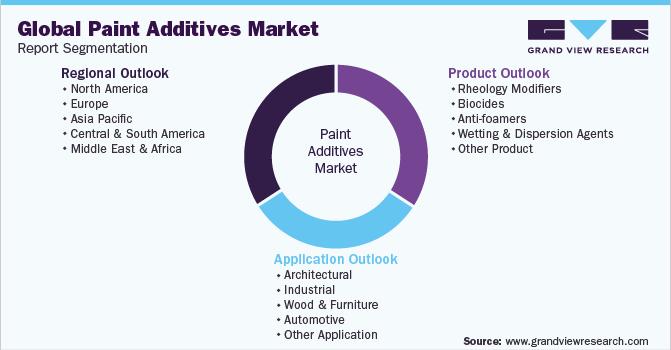
This report forecasts revenue growth at global, regional, and country levels and provides an analysis of the latest industry trends in each of the sub-segments from 2021 to 2033. For the purpose of this study, Grand View Research has segmented the global paint additives market report on the basis of product, application, and region:
 To learn more about this report, Download Free Sample Report
-
Product Outlook (Volume, Kilotons; Revenue, USD Million, 2021 - 2033)
-
Rheology Modifiers
-
Biocides
-
Anti-foamers
-
Wetting & Dispersion Agents
-
Other Product
-
-
Application Outlook (Volume, Kilotons; Revenue, USD Million, 2021 - 2033)
-
Architectural
-
Industrial
-
Wood & Furniture
-
Automotive
-
Other Application
-
-
Regional Outlook (Volume, Kilotons; Revenue, USD Million, 2021 - 2033)
-
North America
-
U.S.
-
Canada
-
Mexico
-
-
Europe
-
Germany
-
France
-
U.K.
-
Italy
-
-
Asia Pacific
-
China
-
Japan
-
India
-
South Korea
-
-
Latin America
-
Brazil
-
Argentina
-
-
Middle East & Africa
-
Saudi Arabia
-
South Africa
-
-
Research Methodology
The paint additives market figures in this report are based on a proven research process that combines executive interviews with secondary research from proprietary databases, company filings, and recognized regulatory and institutional sources. Market size is built through value-chain sizing - reconciling supply-side and demand-side estimates - and triangulated with bottom-up and top-down approaches. Every estimate passes multiple levels of expert validation before publication, with each paint additives segment quantified using the revenue-capture definitions in the table below.
Segment Definition
Segment - Product
Revenue capture definition
Rheology Modifiers
Revenue is generated from additives that control the viscosity, flow, leveling, and sag resistance of paints and coatings, ensuring consistent application and film formation. These products are widely used in waterborne, solvent-borne, and high-solid coating formulations.
Biocides
Revenue includes additives designed to prevent the growth of bacteria, fungi, algae, and other microorganisms in wet paints and dried coatings. Demand is driven by the need to extend product shelf life and improve coating durability.
Anti-Foamers
Revenue is derived from additives that suppress foam generation during paint manufacturing, mixing, and application processes. These additives enhance coating appearance, processing efficiency, and surface quality across multiple coating systems.
Wetting & Dispersion Agents
Revenue covers additives that improve pigment wetting, dispersion stability, and color development while preventing pigment agglomeration. They are essential for achieving uniform color, gloss, and long-term coating stability.
Other Products
Revenue includes specialty paint additives such as leveling agents, adhesion promoters, UV stabilizers, slip additives, wax additives, corrosion inhibitors, and surface modifiers that enhance specific coating performance characteristics.
Segment - Application
Revenue capture definition
Architectural
Revenue is generated from paint additives used in residential, commercial, and institutional building coatings to improve application properties, durability, weather resistance, and aesthetic performance for interior and exterior surfaces.
Industrial
Revenue includes additives used in industrial coatings for machinery, equipment, infrastructure, marine, and protective applications where enhanced corrosion resistance, chemical resistance, and mechanical performance are required.
Wood & Furniture
Revenue is derived from additives incorporated into wood coatings and furniture finishes to improve surface smoothness, scratch resistance, gloss retention, stain resistance, and overall finish durability.
Automotive
Revenue covers paint additives used in automotive OEM and refinish coatings to enhance color consistency, flow, appearance, UV resistance, chemical resistance, and long-term exterior protection.
Other Application
Revenue includes paint additives used in specialty coating applications such as packaging, coil coatings, aerospace, electronics, marine, and other niche industries requiring customized coating performance.
Estimation Model
Layer Name
Key Question
Description
End-use Industry Demand Analysis
Which end-use industries generate demand for paint additives?
Evaluates paint and coating consumption across architectural, industrial, automotive, wood & furniture, and other applications to estimate additive demand by coating type and end-use sector.
Product Penetration Analysis
What is the adoption level of different paint additive products?
Estimates the penetration and consumption of rheology modifiers, biocides, anti-foamers, wetting & dispersion agents, and other specialty additives based on formulation requirements and performance characteristics.
Company Revenue Mapping
How much revenue do leading manufacturers generate from paint additives?
Maps product portfolios, regional sales, manufacturing capacity, pricing strategies, and financial performance of key market participants to estimate company-level market contribution.
Market Size Estimation & Forecast Validation
What is the current and future size of the paint additives market?
Integrates demand-side analysis, supply-side assessment, pricing trends, production volumes, trade analysis, and expert validation to generate reliable market size estimates and long-term forecasts.
Delivered Customizations
This report has been delivered with the following In-depth customizations
Client Request
Customization Delivered
Value Adds
Regional Segmentation
A comprehensive regional assessment of the paint additives market was conducted across North America, Europe, Asia Pacific, Latin America, and Middle East & Africa. The study evaluated country-level demand for rheology modifiers, biocides, anti-foamers, wetting & dispersion agents, and other additives while assessing consumption across architectural, industrial, wood & furniture, automotive, and other coating applications. Manufacturing activity, coating production trends, and regional regulatory developments were also examined.
Provides deeper visibility into regional demand patterns and country-specific growth opportunities. Supports expansion planning, production allocation, and identification of high-potential markets across the coatings value chain.
Cross-Segmentation Analysis
The relationship between paint additive types and coating applications was assessed to evaluate product adoption across architectural, industrial, automotive, and wood & furniture coatings. The analysis examined the performance requirements of each application and identified demand trends for specific additive chemistries across different coating formulations.
Enables identification of high-value product-application combinations. Supports portfolio optimization, product positioning, and development of application-specific commercialization strategies.
Competitive Benchmarking
Leading paint additive manufacturers were benchmarked based on product portfolio, formulation capabilities, innovation pipeline, manufacturing footprint, sustainability initiatives, distribution network, and penetration across decorative and industrial coatings. The assessment also evaluated strategic developments and technological differentiation within the market.
Helps identify competitive strengths, innovation leadership, and market positioning gaps. Facilitates strategic differentiation, partnership evaluation, and long-term competitive planning.
Frequently Asked Questions About This Report
The global paint additives market size was valued at USD 10.1 billion in 2025 and is projected to grow from USD 10.4 billion in 2026.
The global paint additives market is expected to grow at a compound annual growth rate of 4.1% from 2026 to 2033 forecast period to reach USD 13.8 billion by 2033.
Architectural segment dominated the paint additives market with a share of 40.1% in 2025. This is attributable to the rising demand in application such as deck finishers, roof coatings, and wall paints.
Some key players operating in the paint additives market include AkzoNobel N.V.; Arkema S.A.; BASF SE; Evonik Industries; Ashland Global Holdings Inc.; ANGUS Chemical Company; and Buckman Laboratories International, Inc.
Key factors that are driving the market growth include increasing demand of paints and coatings in construction and automotive industry and rising demand of environment-friendly paints with zero volatile organic compound.
By product, rheology modifiers held a dominant position, contributing 30.2% of total revenue in 2025, driven by their critical role in controlling viscosity, improving sag resistance, enhancing application properties, and ensuring uniform pigment distribution across architectural and industrial coatings
Asia Pacific dominated the paint additives market with the highest revenue share of 40.7% in 2025, supported by rapid urbanization, expanding construction activities, and strong manufacturing output across major economies such as China and India.
About the Author(s)
Paints, Coatings & Printing Inks Research Team
Bulk Chemicals · Paints, Coatings & Printing InksThis report was authored by the paints, coatings & printing inks research team at Grand View Research - comprising two research analysts, one senior research analyst, and one industry expert - with specialized expertise in the paints, coatings & printing inks segment of the bulk chemicals industry. All findings are based on proprietary bulk chemicals databases, executive interviews, and regulatory analysis, subject to internal peer review prior to publication.
Last Updated:
Speak to Analyst

Customize this report to your needs - add regions, segments, or data points, with 20% free customization.
Or view our licence options:


ISO 9001:2015 & 27001:2022 Certified
We are GDPR and CCPA compliant! Your transaction & personal information is safe and secure. For more details, please read our privacy policy.


