
- Home
- »
- Paints, Coatings & Printing Inks
- »
-
Paint Protection Film Market Size & Share Report, 2026-2033GVR Report cover

Paint Protection Film Market (2026 - 2033)
Size, Share & Trends Analysis By Material (Thermoplastic Polyurethane (TPU), Polyvinyl Chloride (PVC)), By Application (Automotive & Transportation, Electrical & Electronics, Aerospace & Defense), By Region (North America), And Segment Forecasts
Market Size, 2025
$527.5MMarket Estimate, 2026
$556.7MMarket Forecast, 2033
$744.8MCAGR, 2026–2033
4.3%Paint Protection Film Market Summary
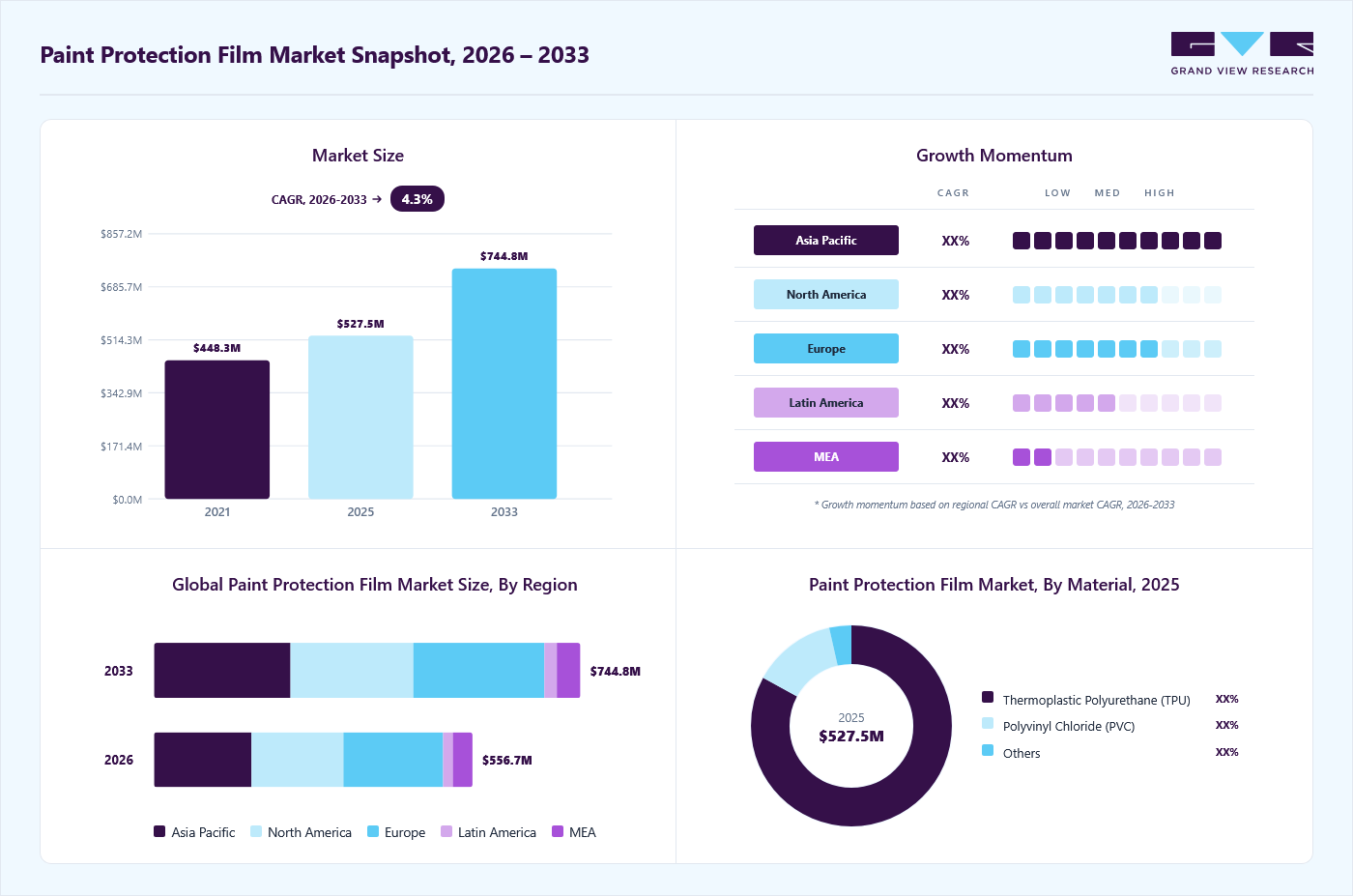
The global paint protection film market size was valued at USD 527.5 million in 2025 and is projected to grow from USD 556.7 million in 2026 to USD 744.8 million by 2033, growing at a CAGR of 4.3% from 2026 to 2033. Europe dominated the market with the largest revenue share of 31.4% in 2025. The shift in consumer preference toward keeping the finish of their vehicles intact, coupled with the rising awareness among them for ensuring proper maintenance of their automobiles, is expected to fuel the demand for paint protection films worldwide.
 Source: Grand View Research, IR Documents, Primary Interviews, Paid DatabasesTo learn more about this report,
 Download Free Sample Report
Key Market Trends & Insights
- By material: Thermoplastic polyurethane (TPU) segment led the market with the largest revenue share of 82.9% in 2025.
- By application: Automotive & transportation dominated the market, with a revenue share of 74.2% in 2025.
Regional Highlights
- Largest regional market: Europe (31.4% revenue share, 2025)
- By country: The U.S. held the largest market share in 2025.
Market Size & Forecast
- Market size in 2025: USD 527.5 Million
- Estimated market size in 2026: USD 556.7 Million
- Projected market size by 2033: USD 744.8 Million
- CAGR (2026-2033): 4.3%
Three ways to get this report
Buy it, customize it, or ask a question.Ask an Analyst
Analyst response in 1 business day
- AccessReport author, directly
- Reply timeWithin 1 working day
- No sales callDirect answer only
- FormatEmail reply
- CostFree, no cost
Get the Full Report
What the study covers
- FormatsPDF · Excel · Dashboard
- Timeline2026–2033 annual, 2025 base
- Coverage20+ countries, 5 regions
- Companies10+ key players profiled
Customize the Report
20% free customization
- IncludeCountries, segments, points
- TailorTo your product definition
- ExtendDeeper competitor detail
- OrA fully bespoke study
- Turnaround5–10 working days
The U.S. is one of the leading automotive markets in the world. As such, the country is expected to witness significant demand for paint protection films throughout the forecast period. The presence of major paint protection film (PPF) manufacturers and many of their installers in the U.S. is anticipated to further boost the market growth for these films in the country from 2024 to 2030. Increasing awareness among consumers regarding the benefits of paint protection films is expected to surge the consumption of these films in the U.S. during the next few years.Asia Pacific was the fastest-growing market for PPF in 2023, as the establishment of automobile manufacturing facilities in India, Thailand, and Indonesia by leading automotive manufacturers, coupled with rising automotive sales in Asia Pacific, is anticipated to drive the demand for PPFs in the region. This, in turn, leads to market growth for these films in the Asia Pacific during the forecast period.
 To learn more about this report, Download Free Sample Report
The market for second-hand or used cars has witnessed considerable growth in Asia Pacific owing to the increasing preference of consumers for mobility. Moreover, the emergence of online portals to promote the selling of used cars and conduct condition checks to estimate the proper value of used cars has enhanced the confidence of consumers to procure them.
For novice drivers, investing in new vehicles will not be economical. As such, they prefer used vehicles over new vehicles, thereby leading to the growth of the used vehicles market in the Asia Pacific. Thus, the flourishing used vehicles market in the region is expected to drive the demand for paint protection films that protect the exterior paint of these cars and reduce their repainting costs.
Market Dynamics
The paint protection film market is shaped by premium vehicle ownership, aftermarket customization, and the need to preserve resale value through reversible surface protection. Demand is concentrated in North America and Europe, where detailing studios, installer networks, and stronger consumer spending support premium film adoption, while Asia Pacific is gaining share on the back of rapid vehicle parc expansion and modification culture. Commercial demand is also rising from fleet branding and service vehicles, which broadens end-use intensity beyond passenger cars. The market remains commercially fragmented, with value captured through branded films, installation services, and distributor-led channel control.
Consumer willingness to spend on exterior protection is increasing as buyers look to maintain factory finish quality, reduce minor damage exposure, and protect resale value. This is especially visible in premium and enthusiast vehicle segments, where film adoption is no longer limited to appearance enhancement but is tied to asset preservation and long-term ownership economics. The market benefits from the same behavior that supports vinyl wrap demand, but with stronger emphasis on functional protection and durability.
The channel structure reinforces this driver. Installers, detailing studios, and aftermarket specialists convert product demand into service-led revenue, which raises average transaction value and improves customer stickiness. Product innovation is also expanding the addressable base, particularly through self-healing, easy-apply, UV-stable, and eco-friendlier film lines that improve installation quality and user confidence. As a result, the market is moving from a pure aesthetic purchase toward a performance-led protective solution.
The market remains constrained by its dependence on skilled installers and disciplined material handling. Wrap performance is highly sensitive to surface preparation, application quality, and adhesive consistency, which raises labor costs and limits scalability for smaller regional players. At the same time, manufacturers face compliance pressure from VOC rules, environmental requirements, and the shift away from PVC in some premium segments. These factors increase formulation cost, testing burden, and product development time. Price competition is also intense because low-cost alternatives and local service providers can compress margins, especially in commoditized color-change applications.
The strongest opportunity lies in premium, environmentally improved film platforms. PVC-free, low-VOC, recyclable, and self-healing products are gaining relevance as buyers and installers seek higher durability and stronger sustainability positioning. This creates room for price premium capture in North America and Europe, while Asia Pacific offers scale potential as vehicle personalization expands. Suppliers that combine product performance with installer-friendly adhesive systems and strong channel partnerships are likely to gain share.
Market Concentration & Characteristics
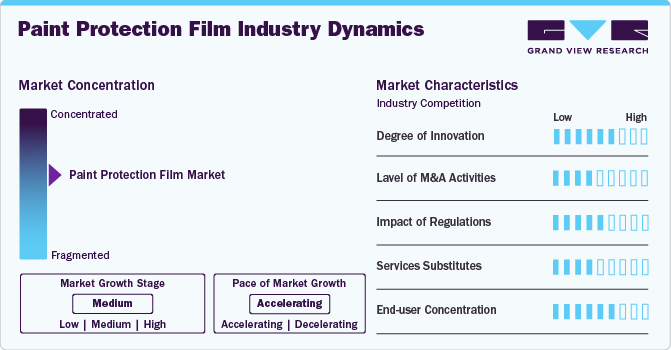
Market growth stage is medium and pace of the market growth is accelerating. The paint protection film industry is characterized by a high degree of innovation owing to the rapid technological advancements.
The market is also characterized by a high level of merger and acquisition (M&A) activity by the leading players. This is due to several factors, including the desire to gain access to new production technologies and talent, need to consolidate in a rapidly growing market.
 To learn more about this report, Download Free Sample Report
The market is also subject to increasing regulatory scrutiny. The global paint protection film industry is subject to numerous regulations, guidelines, and restrictions suchas Regulation (EC) No 1935/2004,Regulation (EU) No 10/2011, Commission Regulation (EU) 2016/1416,US FDA Regulations, ASTM D882, U.S. EPA, and EU DIRECTIVE 2000/53/EC, among others.
There is a limited number of direct product substitutes for paint protection films. However, products such as ceramic coatings, car waxes and sealants, vinyl wraps, nanotechnology coatings, self-healing films, custom clear bras, among others, can serve as substitutes.
End-user concentration is a significant factor in the market growth. There are a large number of end-users which drive the demand for paint protection films. Increasing sales of passenger cars and EVs are expected to propel product demand.
Analyst Perspective
The market is moving from a volume-led customization category toward a value-led protective solutions market. Over the next 5 to 10 years, demand should remain anchored in premium passenger vehicles, dealer-installed programs, and fleet branding, while growth in Asia Pacific will widen participation beyond mature North American and European aftermarket structures. Product differentiation will increasingly depend on self-healing performance, PVC-free construction, low-VOC formulations, installer-friendly adhesives, and stronger warranty credibility. The strongest players will be those that combine film chemistry, distribution depth, and installer training with regional manufacturing or supply flexibility. Sustainability pressure, raw material volatility, and quality inconsistency will continue to compress margins, while substitution from ceramic coatings and low-cost imports may restrain pricing power. The market’s long-term winners are likely to be companies that treat protection, aesthetics, and compliance as one integrated value proposition.
Material Insights
Based on material, the thermoplastic polyurethane (TPU) segment led the market with the largest revenue share of 82.9% in 2025, polyvinyl chloride (PVC), and others. PPFs are high-grade thermoplastic polyurethane films that are either colored or translucent and are professionally applied to the uppermost layer of the vehicle's paint.
The thermoplastic polyurethane (TPU) film segment accounted for a market share of 82.76% in 2024 and is anticipated to maintain its dominance throughout the forecast period. TPU films are produced from TPU pellets manufactured using polyether polyurethanes or polyester polyurethanes. Methylene diphenyl diisocyanate (MDI) is a raw material for manufacturing polyurethane.
These films require low-temperature flexibility, hydraulic stability, and fungal resistance. Various additives are also added to thermoplastic polyurethanes during the process to enhance their properties. Various methods are used to produce TPU films from pellets. These processes include cast films and sheet extrusion, extrusion coating, blown film, wire & cable coating, hose jacketing, and tubing & profile extrusion.
The first and most popular type of paint protection film was polyvinyl chloride (PVC) film. These films are frequently referred to as first-generation paint protection films. PVC films provide some paint protection for automobiles, but because of their rigid construction, the installation might be difficult. In addition, PVC ages in 1 to 3 years before hardening and gradually loses color and elasticity. Another disadvantage is that the vehicle’s paint may flake when PVC sheets are removed.
Application Insights
Based on application, the automotive & transportation segment led the market with the largest revenue share of 74.2% in 2025. Increasing sales in countries such as India, China, and the U.S., are expected to augment the product demand during the next seven years. For instance, according to the Society of Indian Automobile Manufacturers (SIAM), sales of passenger cars increased from 1.46 million units to 1.75 million units in 2022 compared to the previous year.
 To learn more about this report, Download Free Sample Report
The aerospace and defense industry is expected to grow at a CAGR of 5.6% during the forecast period owing to the increasing number of air passengers yearly. Strong growth in the aerospace and defense sector in India, the U.S., and the U.K. is another critical factor driving this segment. Paint protection films have been widely used in numerous end-use industries since their invention, and their demand is expected to grow strongly.
Regional Insights
Europe dominated the paint protection film market with the largest revenue share of 31.4% in 2025. Europe has a robust automotive sector. According to the European Commission, the automotive sector in Europe represents more than 7% share of the European Union GDP and is linked with upstream and downstream industries such as textiles, chemicals, steel & mobility, repair, and ICT.
 To learn more about this report, Download Free Sample Report
Europe Paint Protection Film Market Trends
The automotive sector in Europe consists of leading manufacturers such as Volkswagen AG, Stellantis NV, Renault Group, and Mercedes-Benz Group AG. The region also has assembly lines set up by foreign automobile manufacturers such as Hyundai Motor Company, TOYOTA MOTOR CORPORATION, and Kia. Furthermore, the region has a significant presence of many SMEs specialized in manufacturing automobile components in the EU member countries such as Italy, Spain, France, the Czech Republic, and Hungary, which is expected to play a pivotal role in driving the automotive industry in Europe.
North America Paint Protection Film Market Trends
North America is expected to grow at a CAGR of 4.2% over the forecast period.. Several states in the U.S., including California, New Jersey, Washington, and Louisiana, offer tax credits, exemptions, and rebates for promoting the procurement of electric vehicles (EVs). New Jersey and Washington exempt the sales and use taxes on electric vehicles (EVs), while California offers rebates on the purchase and usage of plug-in hybrid electric vehicles (PHEVs) and other light-duty zero-emission vehicles.
The paint protection film market in the U.S. held the largest share in the North America region in 2025. This, in turn, is anticipated to fuel the consumption of paint protection films applied to exterior parts of vehicles in the U.S. during the coming years.
The growing aerospace & defense industry in North America is further anticipated to fuel the demand for paint protection films in the region. Countries such as the U.S. and Canada are mature automotive markets and are expected to account for significant shares of the demand for pre-owned vehicles in terms of revenue in the coming years. In addition, surging concerns regarding vehicle protection in North America and increasing penetration of paint protection films in various applications are expected to drive the demand for them in the region. The demand for TPU-based paint protection films in North America is expected to be driven by the superior scratch resistance and aesthetic appeal offered by them.
The region is expected to witness increasing demand for fuel-efficient aircraft in the coming years owing to the rising fuel prices. The plans of airlines in the region to modify/replace their existing inefficient aircraft with fuel-efficient airplanes are expected to augment the market growth in the region from 2024 to 2030.
Key Companies & Market Share Insights
Some of the key players operating in the market include 3M and XPEL, Inc.
-
3M is engaged in providing adhesives, sealants, consumer goods, tapes, films, and other allied products. The key business divisions of the company include safety & industrial, healthcare, transportation & electronics, and consumer. Paint protection films are manufactured by the company through its films segment under the safety & industrial business division. 3M produces automotive films, electronics films, paint protection films, window films, and architectural finishes under the brand name Scotchgard. The Scotchgard Paint Protection Film Pro Series offers superior protection to automotive surfaces against weathering, chips, and scratches. Internationally, 3M operates 89 manufacturing facilities in 30 countries.
-
XPEL, Inc. manufactures, distributes, and installs aftermarket automotive products in the U.S., Canada, and the UK. In the U.S., Canada, and parts of Europe, the company operates primarily by selling complete paint protection film solutions directly to independent installers and car dealerships with the products including XPEL protection films, installation training, and access to the company’s proprietary design software, marketing support, and lead generation. The company operates six company-owned installation centers in the U.S. and one installation center each in the UK, and the Netherlands, which serve the wholesale and retail customers. It operates through third-party distributors in the rest of the world, who operate under contracts with the company to distribute and install the company’s products. The product portfolio of XPEL Technologies Corp. includes paint protection films, automotive window films, flat glass window films, and plotters.
Beijing Kangde Xin Composite Material Co., Ltd. and Premier Protective Films International are some of the emerging market participants in the market.
-
Beijing Kangde Xin Composite Material Co., Ltd. has three major business segments including new materials, intelligent display, and carbon fiber. The six core markets for the company include healthcare, transportation, consumer products, industrial, energy, and smart cities. KDX Group operates through KDX America LLC, KDX Europe BV, and K3DX display. Kangde Xin Optical Film Materials (Shanghai) Co., Ltd. or KDX Window Films registered in 2014 in Shanghai Pilot Free Trade Zone operates as a subsidiary of KDX Composite Material Co., Ltd. It handles the paint protection and window film business of the KDX Composite Material Co., Ltd.
-
Premier Protective Films International specializes in advanced paint protection films, window tint installations, and radar detector/laser jamming systems. The company is involved in the installation of paint protection films for the automotive industry. For installation purposes, the company uses products manufactured by different companies including Bekaert, Avery, Venture, Llumar, 3M, and Madico. Primarily, Premier Protective Films International uses products from Prestige Film Technologies, which manufactures paint protection films, window films, and screen protection for the automotive industry.
Key Paint Protection Film Companies
The following key companies have been profiled for this study on the paint protection film market.
-
Kangde Xin Optical Film Materials (Shanghai) Co., Ltd
-
3M
-
XPEL
-
SWM
-
Novacel
-
Eastman Chemical Company
-
Avery Dennison Corporation
-
Saint-Gobain S.A.
-
RENOLIT SE
-
Ziebart International Corporation
-
Hexis S.A.S
-
Orafol Europe GmbH
-
Sharpline Converting Inc.
-
Madico Inc.
-
Garware Hi-Tech Films Ltd
Competitive Benchmarking
Category
Operating Strategies
Competitive Edge
Weakness
Established Players (3M, Avery Dennison Corporation, ORAFOL Europe GmbH, LLumar (Eastman Performance Films, LLC), Fedrigoni S.P.A, Hexis S.A.S, KPMF)
- Expand premium product lines through installer-ready films, easy-apply adhesives, and higher-durability surface solutions.
- Use wide distributor coverage and professional installer networks to secure repeat demand.
- Strengthen regional presence through partnerships, localized color portfolios, and channel education.
- Strong brand recognition across premium protection and customization segments.
- Better R&D depth for self-healing, UV-stable, and PVC-free products.
- Broader commercial reach across retail, installer, and fleet channels.
- Higher operating cost structure than smaller regional competitors.
- Slower product and pricing agility in niche subsegments.
- Greater exposure to compliance, warranty, and quality-control expectations.
Emerging Players (Arlon Graphics LLC, Vvivid Vinyl, CARBINS Film)
- Focus on niche colorways, specialty finishes, and fast product refresh cycles.
- Use digital marketing, community-led promotion, and installer partnerships.
- Compete through targeted pricing and product-line differentiation.
- Faster launch cycles and stronger responsiveness to design trends.
- Better ability to address underserved buyer preferences.
- More agile positioning in online and independent installer channels.
- Lower brand trust relative to established leaders.
- Limited distribution depth and smaller global footprint.
- More vulnerable to price pressure and channel concentration risk.
Recent Developments
-
In February 2025, The Lubrizol Corporation, a global company in specialty chemicals, launched a new ESTANE TPU production line at its Shanghai manufacturing facility. This strategic move aims to enhance local production capabilities, improve supply chain efficiency, and accelerate market responsiveness in the Asia-Pacific region, particularly in the paint protection film (PPF) industry.
-
In January 2025, ALP Group launched its innovative Paint Protection Film (PPF) line at the Bharat Mobility Global Expo 2025, held in New Delhi, India. The new product range-Defender, Armor, and Ranger-has been designed to provide superior vehicle protection against environmental damage, wear and tear, and UV rays. These films feature advanced technologies such as self-healing properties, UV resistance, and long-lasting durability, ensuring enhanced aesthetics and protection for vehicles.
Paint Protection Film Market Report Scope
Report Attribute
Details
Market size in 2025
USD 527.5 million
Estimated market size in 2026
USD 556.7 million
Projected market size by 2033
USD 744.8 million
Growth rate
CAGR of 4.3% from 2026 to 2033
Base year for estimation
2025
Historical data
2021 - 2024
Forecast period
2026 - 2033
Quantitative units
Revenue in USD million/billion, volume in thousand sq. meters, and CAGR from 2026 to 2033
Report coverage
Revenue forecast, company ranking, competitive landscape, growth factors, and trends
Segments covered
Material, application, region
Regional scope
North America; Europe; Asia Pacific; Central & South America; Middle East & Africa
Country scope
U.S.; Canada; Mexico; Germany; France; UK; Italy; Spain; Netherlands; Norway; China; Japan; India; South Korea; Australia; Malaysia; Indonesia; Thailand; Brazil; Argentina; Saudi Arabia; UAE; South Africa
Key companies profiled
3M; XPEL Inc.; Schweitzer-Mauduit International, Inc.; Eastman Chemical Company; Avery Dennison Corporation; Saint-Gobain S.A.; RENOLIT SE; Ziebart International Corporation; Hexis S.A.S; Garware Hi-Tech Films Ltd
Customization scope
Free report customization (equivalent up to 8 analysts' working days) with purchase. Addition or alteration to country, regional & segment scope.
Pricing and purchase options
Avail customized purchase options to meet your exact research needs. Explore purchase options
Global Paint Protection Film Market Report Segmentation
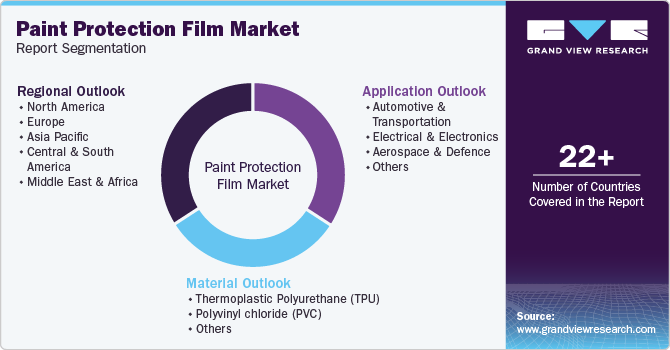
This report forecasts revenue growth at global, regional, and country levels and provides an analysis of the latest industry trends in each of the sub-segments from 2021 to 2033. For this study, Grand View Research has segmented the global paint protection film market report based on material, application, and region:
 To learn more about this report, Download Free Sample Report
-
Material Outlook (Volume, Thousand Sq. Meters; Revenue, USD Million, 2021 - 2033)
-
Thermoplastic Polyurethane (TPU)
-
Polyvinyl chloride (PVC)
-
Others
-
-
Application Outlook (Volume, Thousand Sq. Meters; Revenue, USD Million, 2021 - 2033)
-
Automotive & Transportation
-
Electrical & Electronics
-
Aerospace & Defense
-
Others
-
-
Regional Outlook (Volume, Thousand Sq. Meters; Revenue, USD Million, 2021 - 2033)
-
North America
-
U.S.
-
Canada
-
Mexico
-
-
Europe
-
UK
-
Germany
-
France
-
Italy
-
Spain
-
Norway
-
Netherlands
-
-
Asia Pacific
-
China
-
Japan
-
India
-
Australia
-
Thailand
-
South Korea
-
Indonesia
-
Malaysia
-
-
Central & South America (MEA)
-
Brazil
-
Argentina
-
-
Middle East and Africa (MEA)
-
Saudi Arabia
-
South Africa
-
UAE
-
-
Research Methodology
Segment Definition
Segment - Material
Revenue capture definition
Thermoplastic Polyurethane (TPU)
Revenue is captured through premium protective films with higher durability, self-healing performance, and stronger clarity. Sales are concentrated in high-ASP paint protection and premium customization applications.
Polyvinyl chloride (PVC)
Revenue is generated through mainstream color-change and graphics films where cost competitiveness, broad availability, and high installation volume support faster channel turnover.
Others
Revenue covers hybrid polymers, specialty laminates, and niche formulations sold for customized projects, low-volume performance needs, or differentiated surface finishes.
Segment - Application
Revenue capture definition
Automotive & Transportation
Revenue is earned through passenger vehicles, commercial fleets, buses, trucks, dealership programs, and detailing channels that purchase films for protection, branding, and restyling.
Electrical & Electronics
Revenue is captured through protective and decorative films used on device housings, appliance surfaces, accessories, and enclosure branding where surface finish and abrasion resistance matter.
Aerospace & Defense
Revenue is generated from specialty protective and identification films used on aircraft surfaces, mission equipment, and defense assets where specification control and compliance drive pricing.
Others
Revenue includes architectural, marine, signage, and industrial uses where films are purchased for protection, visual enhancement, or surface finishing outside core transport applications.
Estimation Model
Demand Screen
Application Allocation
Channel Realization
Regional Weighting
Where demand originates?
Which vehicles consume films?
How is revenue captured?
Where is demand concentrated?
The model starts with vehicle appearance and protection demand, because purchase intent is created at the end-user level.
Revenue is then allocated across trucks, buses, and passenger cars, reflecting distinct buying behavior and order sizes.
The split is checked against installer, distributor, and direct fleet channels, which determine realized monetization.
Final values are adjusted for North America, Europe, Asia Pacific, Latin America, and MEA demand concentration.
Delivered Customizations
This report has been delivered with the following In-depth customizations
Client Request
Customization Delivered
Value Adds
Add country-level market view
Added country-level commentary for the U.S., Germany, China, and India to reflect regional demand concentration, aftermarket maturity, and growth imbalance.
Improves geographic usefulness for commercial planning and regional sales targeting.
Include material-level split
Added a material split across TPU, PVC, and others with revenue capture logic tied to performance grade, pricing, and application depth.
Clarifies product positioning and supports portfolio prioritization.
Expand competitive benchmarking
Added a company classification framework separating mature and emerging players with operating strategy, edge, and weakness analysis.
Strengthens competitive screening and investor-style assessment.
Frequently Asked Questions About This Report
The global paint protection film market size was estimated at USD 527.5 million in 2025 and is expected to reach USD 556.7 million in 2026.
Some of the key players operating in the paint protection film market include KDX Composite Material, 3M Company, Eastman Chemical Company, Premier Protective Films International, Renolit, SWM, Inc., XPEL, Inc., and Avery Dennison Corp.
The key factors that are driving the paint protection film market include the growing application scope of the product and the development of high-performance films and innovations in technology to offer sustainable products with minimal environmental impact.
The paint protection film market is expected to grow at a compound annual growth rate of 4.3% from 2026 to 2033 to reach USD 744.8 million by 2033.
Europe dominated the paint protection film market with a revenue share of 31.4% in 2025, on account of several factors including the presence of high automotive production and consumption in the region.
Based on material, the thermoplastic polyurethane (TPU) segment led the market with the largest revenue share of 82.9% in 2025.
Based on application, the passenger cars segment led the market with the largest revenue share of 74.2% in 2025.
The Asia Pacific paint protection film market is expected to grow at the fastest CAGR of 4.9% over the forecast period.
The paint protection film market is shaped by premium vehicle ownership, aftermarket customization, and the need to preserve resale value through reversible surface protection. Demand is concentrated in North America and Europe, where detailing studios, installer networks, and stronger consumer spending support premium film adoption, while Asia Pacific is gaining share on the back of rapid vehicle parc expansion and modification culture.
About the Author(s)
Paints, Coatings & Printing Inks Research Team
Bulk Chemicals · Paints, Coatings & Printing InksThis report was authored by the paints, coatings & printing inks research team at Grand View Research - comprising two research analysts, one senior research analyst, and one industry expert - with specialized expertise in the paints, coatings & printing inks segment of the bulk chemicals industry. All findings are based on proprietary bulk chemicals databases, executive interviews, and regulatory analysis, subject to internal peer review prior to publication.
Last Updated:
Speak to Analyst

Customize this report to your needs - add regions, segments, or data points, with 20% free customization.
Or view our licence options:


ISO 9001:2015 & 27001:2022 Certified
We are GDPR and CCPA compliant! Your transaction & personal information is safe and secure. For more details, please read our privacy policy.


