
- Home
- »
- Next Generation Technologies
- »
-
Parcel Locker Market Size, Share, Growth Report, 2026-2033GVR Report cover

Parcel Locker Market (2026 - 2033)
Size, Share & Trends Analysis Report By Component (Hardware, Software), By Deployment Type (Indoor, Outdoor), By Type (Modular Parcel Lockers, Postal Lockers), By Application, By Region, And Segment Forecasts
Market Size, 2025
$1.2BMarket Estimate, 2026
$1.3BMarket Forecast, 2033
$2.9BCAGR, 2026–2033
12.2%Parcel Locker Market Summary
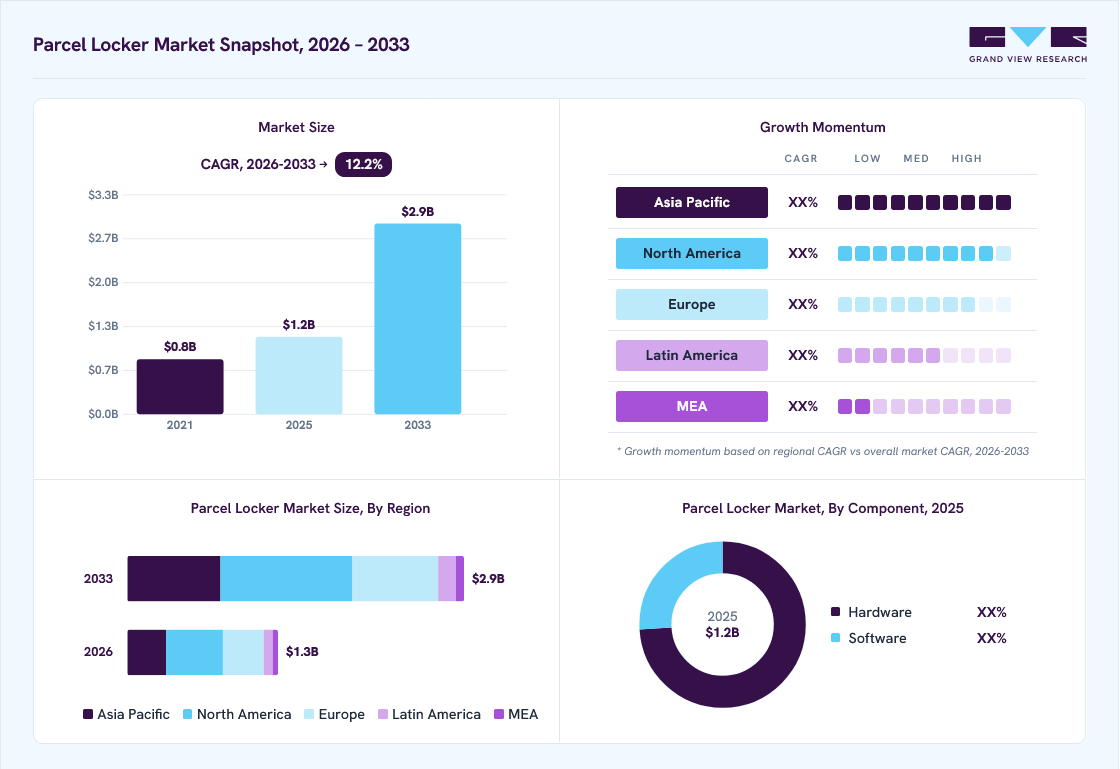
The global parcel locker market size was valued at USD 1.2 billion in 2025 and is projected to grow from USD 1.3 billion in 2026 to USD 2.9 billion by 2033, at a CAGR of 12.2% from 2026 to 2033. North America led the global market, accounting for 37.5% of global revenue in 2025. The growing demand for e-commerce and last-mile delivery is fueling the market.
 Source: Grand View Research, IR Documents, Primary Interviews, Paid DatabasesTo learn more about this report,
 Download Free Sample Report
 Key Market Trends & Insights
- By component: Hardware components segment led the market and accounted for 74.0% of the global revenue in 2025
- By deployment type: Indoor segment led the market, accounting for 55.2% of global revenue in 2025.
- By type: Modular parcel locker segment accounted for the largest share of global revenue in 2025.
- By application: Commercial/corporate offices segment accounted for the largest market revenue share in 2025.
Regional Highlights
- Largest regional market: North America (37.5% revenue share, 2025)
- Fastest-growing regional market: Asia Pacific (highest CAGR, 2026-2033)
- By country: The U.S. held the largest market share in 2025
Market Size & Forecast
- Market Size in 2025: USD 1.2 Billion
- Estimated Market Size in 2026: USD 1.3 Billion
- Projected Market Size by 2033: USD 2.9 Billion
- CAGR (2026-2033): 12.2%
Three ways to get this report
Buy it, customize it, or ask a question.Ask an Analyst
A direct answer, usually in 1 working day
- AccessReport author, directly
- Reply timeWithin 1 working day
- No sales callDirect answer only
- FormatEmail reply
- CostFree, no cost
Get the Full Report
What the study covers
- FormatsPDF · Excel · Dashboard
- Timeline2026–2033 annual, 2025 base
- Coverage20+ countries, 5 regions
- Companies10+ key players profiled
Customize the Report
20% free customization
- IncludeCountries, segments, points
- TailorTo your product definition
- ExtendDeeper competitor detail
- OrA fully bespoke study
- Turnaround5–10 working days
The rapid growth of e-commerce is increasing parcel volumes and driving demand for efficient last-mile delivery solutions. Parcel lockers provide secure, self-service pickup and return options that reduce failed deliveries and improve operational efficiency for logistics providers. Retailers and delivery service providers are expanding parcel locker networks to offer customers greater delivery flexibility and convenience. Recent industry trends indicate a growing consumer preference for out-of-home delivery options, including parcel lockers and pickup points, as they improve delivery success rates and enhance customer convenience. This increasing shift toward flexible last-mile delivery solutions is expected to drive continued adoption of parcel lockers.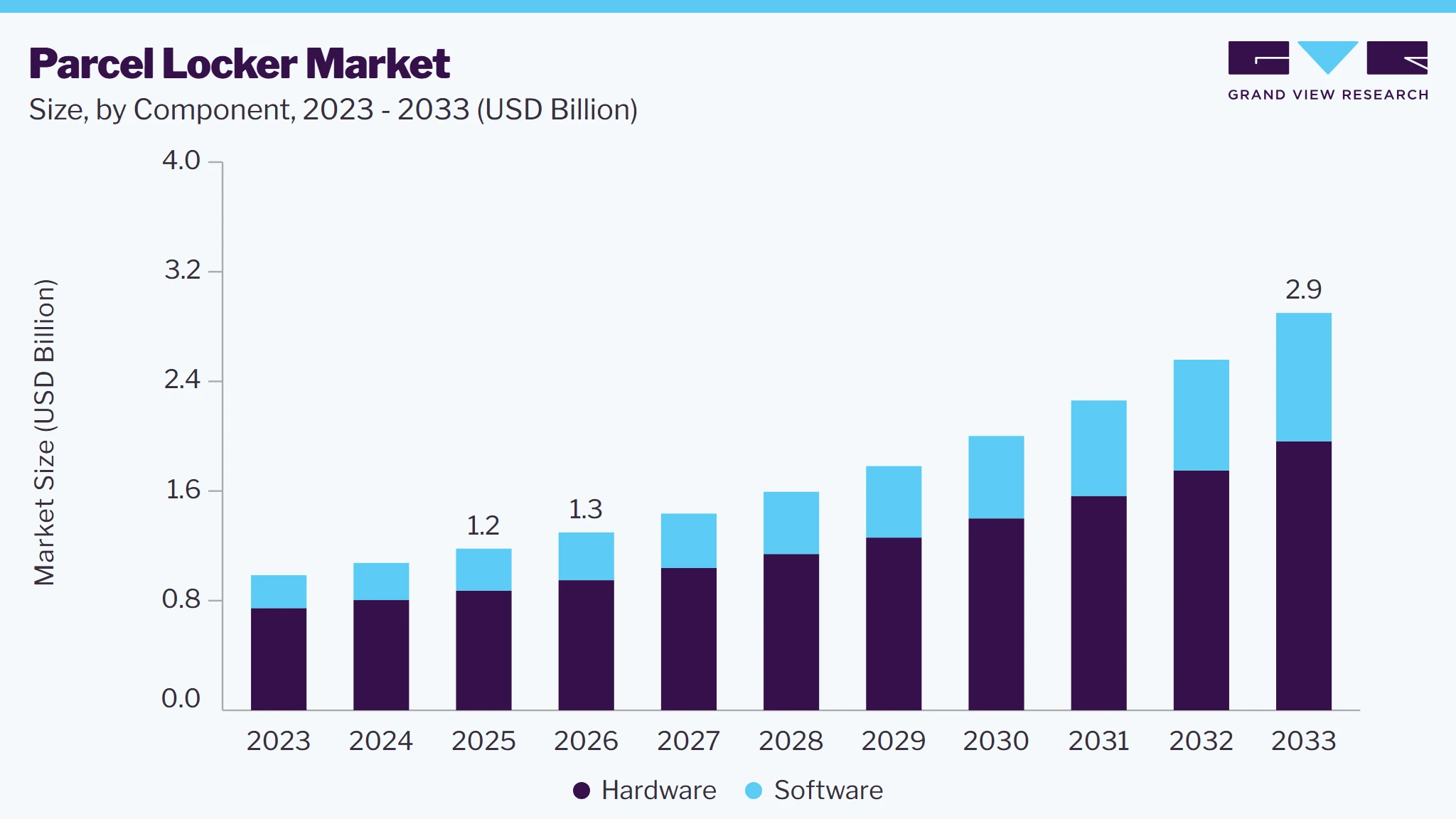 To learn more about this report, Download Free Sample Report
 The market is seeing a growing trend toward adopting AI-based forecasting to enhance operational efficiency. AI models are being deployed to predict parcel arrivals, sorting center allocation, shelving time, and customer pickup patterns, enabling more accurate logistics planning. These AI-based forecasts enable more efficient locker capacity management by accounting for daily, hourly, and regional demand fluctuations. As a result, logistics providers can optimize locker utilization while minimizing unnecessary parcel redirection. This trend is improving delivery efficiency and supporting more effective parcel locker operations.
The installation of parcel lockers must comply with applicable building and infrastructure regulations when integrated into existing structures or connected to public utilities. Although parcel lockers are generally not classified as buildings, their installation may require compliance with zoning, permitting, and planning requirements. In addition, supporting logistics infrastructure must adhere to applicable building and environmental regulations. These requirements ensure regulatory compliance while supporting the efficient installation of parcel lockers.
The market faces challenges in planning efficient locker networks across different locations. Operators must optimize locker placement, configuration, and capacity while aligning with customer demand and budget constraints. These planning complexities can reduce locker utilization, increase operational costs, and affect overall network efficiency.
Market Dynamics
The growing preference for contactless delivery and self-service parcel collection has become a major market driver. Consumers increasingly expect flexible pickup options that allow them to collect or return parcels at their convenience without depending on home delivery schedules. Businesses and logistics providers are also prioritizing delivery methods that improve customer convenience while reducing operational complexity.
Parcel locker solutions address this demand by providing secure, automated, and 24/7 self-service access to packages. Integrated with mobile applications, QR code authentication, and real-time notifications, these systems enhance customer experience while reducing failed deliveries and labor requirements. As retailers, courier companies, and residential property operators continue investing in customer-centric delivery infrastructure, demand for parcel locker deployments is expected to grow steadily.
The deployment of parcel locker networks requires considerable upfront investment in hardware, secure enclosure systems, software platforms, installation services, electrical infrastructure, networking equipment, and ongoing maintenance. Outdoor installations further increase costs because of weather-resistant construction, surveillance systems, connectivity requirements, and municipal permitting. For smaller logistics companies, residential developers, and regional retailers, these capital requirements can create significant financial barriers, particularly when deployment volumes are limited.
The high capital intensity slows adoption across cost-sensitive markets where delivery volumes may not immediately justify infrastructure investments. Emerging economies, rural areas, and smaller residential communities are particularly affected by lower parcel density and longer return-on-investment periods. Smaller locker operators also face challenges in expanding nationwide networks compared with larger logistics providers that possess stronger financial resources. Consequently, deployment remains concentrated in high-density urban locations, slowing broader market penetration.
Retailers worldwide are increasingly investing in omnichannel fulfillment strategies that integrate physical stores with digital commerce. Buy Online, Pick Up in Store (BOPIS), click-and-collect, and contactless pickup services have become important customer engagement channels as retailers seek to improve convenience while reducing shipping expenses. Simultaneously, advancements in cloud platforms, mobile commerce, digital payments, and inventory synchronization enable retailers to integrate parcel lockers directly into store operations and fulfillment systems.
This evolution creates significant opportunities for parcel locker vendors offering flexible, software-integrated locker solutions tailored to retail environments. Modular lockers capable of supporting pickups, returns, exchanges, and customer service operations are expected to experience strong demand. Vendors providing cloud management platforms, API integration capabilities, and omnichannel fulfillment software are well-positioned to benefit as retailers expand their automated pickup infrastructure across supermarkets, shopping centers, pharmacies, and convenience stores. Growing investments in retail digitalization will continue creating long-term opportunities for intelligent locker ecosystems.
Market Concentration & Characteristics
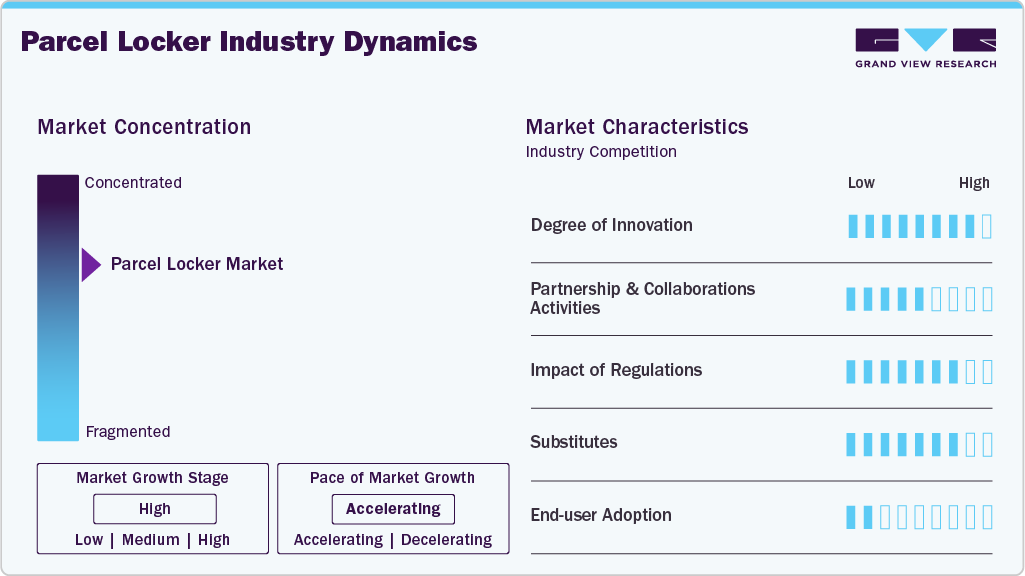
The parcel locker industry is moderately concentrated due to the presence of a limited number of global providers, as well as several regional manufacturers and specialized smart locker solution companies that offer hardware, software, cloud-based locker management platforms, and installation and maintenance services. Companies are focusing on expanding parcel locker networks, enhancing software capabilities, integrating IoT-enabled monitoring and mobile applications, and strengthening partnerships with e-commerce retailers, logistics providers, postal operators, and residential developers. As automated last-mile delivery continues to gain adoption across retail, residential, and public infrastructure, vendors compete through technological innovation, deployment scalability, service quality, and integrated digital ecosystems rather than price alone.
 To learn more about this report, Download Free Sample Report
 Moderate market concentration is further supported by the strong presence of established companies such as InPost, Quadient, KEBA, Pitney Bowes Inc., and Cleveron, which continue to expand through product innovation, strategic collaborations, and international deployment networks. At the same time, companies including LUXER ONE, SMIOTA, SHENZHEN ZHILAI SCI AND TECH CO., LTD., Hangzhou Dongcheng Electronic Co., Ltd., and TZ Limited are strengthening their market positions by offering customized solutions for residential, retail, commercial, and institutional applications. Market participants primarily compete on product reliability, software integration, security features, user experience, scalability, after-sales support, and the ability to integrate seamlessly with courier, postal, and e-commerce platforms, thereby maintaining the market's moderate concentration.
Analyst Perspective
The market is transitioning from a niche delivery solution to an essential component of modern last-mile logistics and omnichannel retail ecosystems. Continued growth in e-commerce, increasing consumer preference for flexible delivery options, and rising investments in logistics automation are expected to sustain market expansion. Artificial intelligence, IoT-enabled monitoring, cloud-based management platforms, predictive maintenance, and mobile-first user experiences are reshaping product innovation across the industry. Market participants are increasingly pursuing strategic partnerships with retailers, logistics providers, residential developers, and smart city projects to strengthen their deployment networks. As digital commerce continues to evolve, investment is expected to shift toward intelligent, interoperable, and highly scalable parcel locker platforms that deliver operational efficiency and enhanced customer convenience.
Component Insights
The hardware components segment accounted for the largest share of 74.0% in 2025. The segment's dominance reflects the core market infrastructure, including locker cabinets, electronic locks, access control systems, sensors, cameras, touchscreens, and connectivity components. The segment is growing due to rising parcel volumes, increasing e-commerce deliveries, and demand for secure and durable locker systems. Adoption of modular and temperature-controlled lockers across residential, retail, and commercial locations is further supporting segment growth.
The software component segment is projected to grow at the fastest CAGR over the forecast period. The increasing adoption of smart parcel locker networks and the growing complexity of last-mile delivery operations are generating higher demand for advanced locker management software. Since parcel lockers require real-time monitoring, secure user authentication, remote access control, and seamless integration with logistics platforms, operators are expanding their digital capabilities to improve operational efficiency. The growing need for automated parcel tracking, data-driven management, and enhanced customer experience is further strengthening demand for software components in smart delivery infrastructure.
Deployment Type Insights
The indoor segment led the market and accounted for the global revenue in 2025. The indoor segment growth can be attributed to increasing deployment of parcel lockers in residential buildings, offices, retail stores, and educational institutions for secure package management. Indoor installations provide better protection, easy integration with existing infrastructure, and convenient access for users. The growing adoption of smart lockers in commercial and residential facilities is driving demand for indoor parcel locker solutions.
The outdoor deployment types segment is projected to grow at the fastest CAGR over the forecast period. The increasing demand for accessible 24/7 parcel collection points in public spaces, transit stations, and retail locations is driving growth in the outdoor parcel locker segment. Outdoor parcel lockers enable logistics providers to expand their delivery networks with weather-resistant systems featuring secure access and remote monitoring. The expansion of out-of-home delivery networks and last-mile automation initiatives is accelerating the adoption of outdoor parcel locker installations.
Type Insights
The modular parcel lockers segment accounted for the largest share of global revenue in 2025. The increasing demand for flexible and scalable locker systems across residential, retail, and commercial settings is driving growth in the modular parcel lockers segment. Modular designs allow operators to expand locker capacity, customize configurations, and integrate additional features as parcel volumes change. The growing need for adaptable last-mile delivery infrastructure is strengthening the adoption of modular parcel locker solutions.
The cooling locker segment is projected to grow at the fastest CAGR over the forecast period, driven by increasing adoption of online grocery delivery and meal kits, as well as the distribution of temperature-sensitive products. Temperature-controlled lockers help maintain product quality by providing refrigerated storage with digital monitoring and secure access features. The expansion of fresh-food e-commerce and the demand for convenient pickup solutions are accelerating the deployment of cooling parcel lockers.
Application Insights
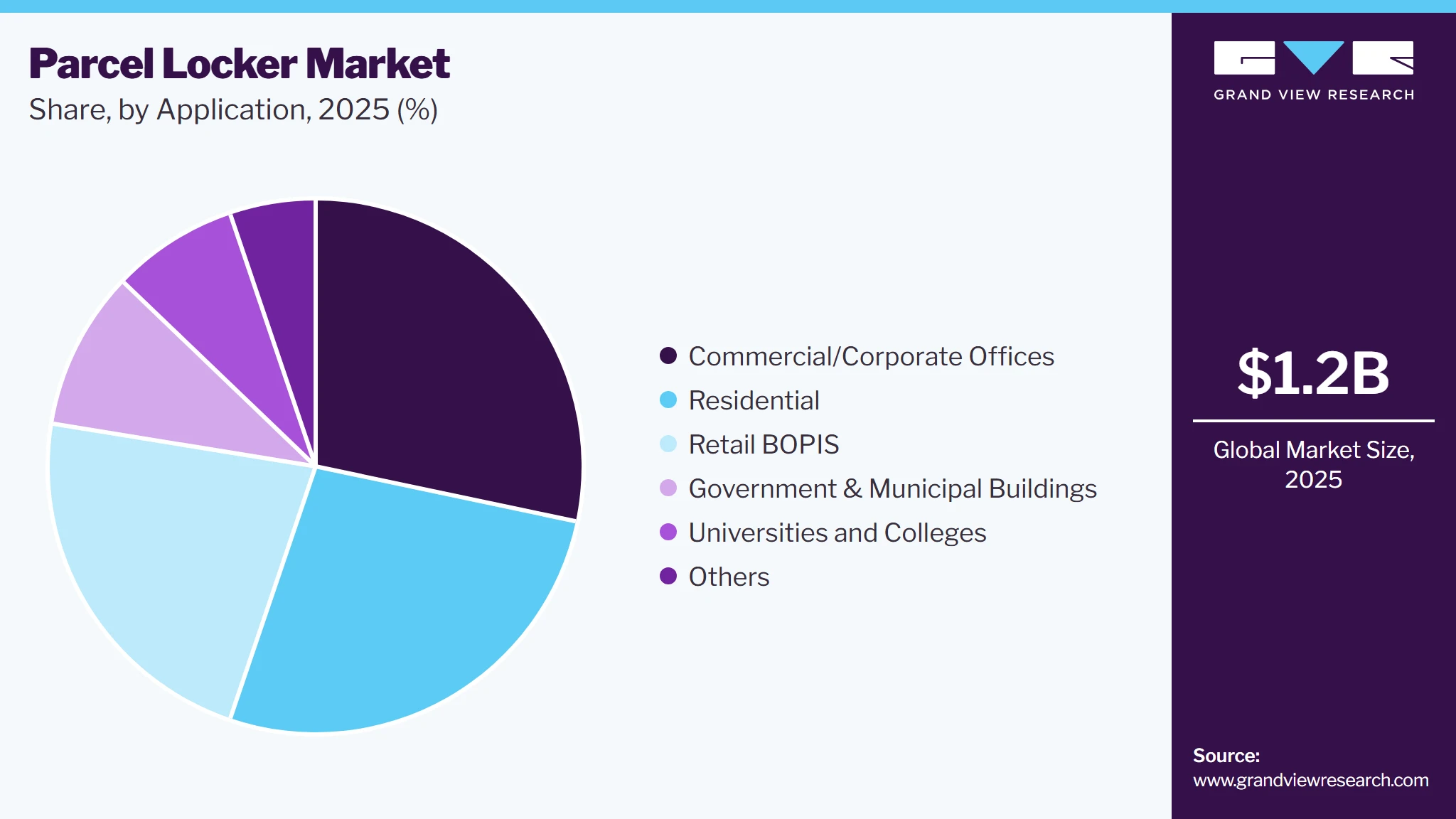
The commercial/corporate offices segment accounted for the largest share of revenue in 2025. Rising workplace parcel volumes and the need for efficient package management solutions are driving the growth of the segment. Smart lockers enable secure employee deliveries, reduce dependence on reception areas, and improve internal mail-handling processes. The growing adoption of automated workplace services is supporting demand for parcel lockers in corporate environments.
 To learn more about this report, Download Free Sample Report
 The government & municipal buildings segment is projected to grow at the fastest CAGR over the forecast period, driven by the increasing adoption of automated self-service infrastructure for secure parcel and document distribution. Smart lockers support digital public services by enabling convenient collection, improving operational efficiency, and reducing manual handling requirements. The expansion of smart city initiatives and the modernization of public facilities is driving the adoption of parcel lockers in government locations.
Regional Insights
The North America parcel locker market led the global market, accounting for 37.5% of global revenue in 2025. The market is growing due to the expansion of shared locker networks that improve last-mile delivery efficiency. Logistics providers, retailers, and technology companies are investing in open-access locker infrastructure to enable secure parcel pickup, returns, and deliveries through a unified network. For instance, in April 2025, Koloni, a smart locker software platform, partnered with Virtual.com, a premier transportation technology and pickup-and-drop-off network, to deploy over 5,000 parcel locker locations across the U.S. and Canada, expanding shared infrastructure for parcel delivery, pickup, and returns. Such initiatives are accelerating the adoption of parcel lockers by improving last-mile delivery efficiency and accessibility.
 To learn more about this report, Download Free Sample Report
 U.S. Parcel Locker Market Trends
The U.S. parcel locker market holds the largest market share. The U.S. market’s growth is driven by increasing investments in automated parcel pickup infrastructure to improve last-mile delivery efficiency. The expansion of 24/7 self-service locker facilities and rising parcel volumes are accelerating the adoption of parcel lockers by enhancing delivery convenience, reducing wait times, and minimizing failed deliveries.
Asia Pacific Parcel Locker Market Trends
The parcel locker market in the Asia Pacific is projected to grow at the fastest CAGR over the forecast period. The market is driven by rapid e-commerce growth, rising online shoppers, and smart city development initiatives. Increasing investments in digital delivery infrastructure and automated last-mile solutions across countries such as India, China, and Vietnam are accelerating the adoption of parcel lockers.
China parcel locker marketheld a dominant share in the Asia Pacific. China continues to expand the deployment of parcel lockers as e-commerce platforms and logistics providers increase their investments in automated delivery infrastructure. Smart parcel lockers are being installed across residential communities, office buildings, universities, and retail locations to support parcel pickup, delivery, and return services. The adoption of intelligent lockers with digital access systems and cloud-based management platforms is increasing to handle growing parcel volumes and improve last-mile delivery efficiency.
The parcel locker market in Japan is expected to grow at a significant CAGR over the forecast period. Japan is witnessing increased adoption of parcel lockers as demand for convenient, contactless parcel collection solutions grows. Parcel lockers are being deployed in residential buildings, railway stations, commercial facilities, and public spaces to support flexible delivery options. The use of automated lockers is expanding to address delivery labor shortages and improve parcel management, with applications including e-commerce deliveries, returns, and temperature-controlled storage for fresh products.
Europe Parcel Locker Market Trends
The parcel locker market in Europe is poised for significant growth from 2026 to 2033, driven by the rapid expansion of out-of-home delivery networks, with parcel locker and pickup locations increasing significantly across the region. Rising consumer preference for flexible delivery options and investments in automated pickup infrastructure are improving last-mile efficiency and accelerating the adoption of parcel lockers.
The UK parcel locker market is driven by the expansion of open-access locker networks that provide flexible parcel collection and return services. The growing availability of multi-carrier locker infrastructure is improving last-mile efficiency, reducing delivery challenges, and enhancing convenience for consumers and logistics providers.
The parcel locker market in Germanyheld a substantial share in Europe, driven by the expansion of open and carrier-neutral locker networks that support convenient 24/7 parcel pickup, returns, and shipping services. The growing deployment of shared locker infrastructure is improving last-mile efficiency, reducing delivery traffic, and supporting sustainable urban logistics.
Key Parcel Locker Company Insights
Key players operating in the market include InPost, Cleveron, Quadient, KEBA AG, TZ Limited, Pitney Bowes Inc., Luxer One, Smiota, Shenzhen Zhilai Science and Technology Co., Ltd., and Hangzhou Dongcheng Electronic Co., Ltd. Key players in the market are expanding smart locker networks, cloud-based locker management platforms, digital tracking solutions, and secure contactless parcel handling capabilities. Companies are focusing on improving last-mile delivery efficiency, reducing failed delivery attempts, and supporting the growing demand for e-commerce, retail, residential, and logistics applications.
-
Cleveron is a technology company that develops and manufactures automated parcel delivery solutions and robotic parcel lockers. The company specializes in smart locker systems designed to support the retail sector by improving the efficiency of click-and-collect services for online purchases. Cleveron offers software platforms, maintenance services, and comprehensive after-sales support to ensure reliable and seamless parcel management.
-
InPost is a logistics company specializing in out-of-home parcel delivery and automated parcel locker solutions. The company offers a network of 24/7 self-service parcel lockers, InPost Shops, and home delivery services, enabling customers to send, collect, and return parcels conveniently. InPost focuses on improving last-mile delivery efficiency by providing secure, flexible, and convenient delivery solutions for e-commerce retailers and consumers.
Key Parcel Locker Companies
The following key companies have been profiled for this study on the parcel locker market.
-
InPost
-
Cleveron
-
Quadient
-
KEBA
-
TZ Limited
-
Pitney Bowes Inc.
-
LUXER ONE
-
SMIOTA
-
SHENZHEN ZHILAI SCI AND TECH CO., LTD.
-
Hangzhou Dongcheng Electronic Co., Ltd.
Competitive Benchmarking
Operating Strategies
Competitive Edge
Weaknesses
Mature Players: InPost, Quadient, KEBA, Pitney Bowes Inc.
Mature players in the market are focusing on expanding global parcel locker networks, investing in smart locker software platforms, forming partnerships with logistics providers and retailers, and enhancing cloud-based locker management capabilities.
Mature players gain a competitive advantage through a strong global presence, an extensive installed base, a broad product portfolio, advanced software integration, established customer relationships, and comprehensive after-sales support.
These companies often face higher operational costs due to ongoing investments in global locker networks, software platforms, and customer support. These players face intense competition in requiring ongoing innovation and expansion to maintain market share. Additionally, standardized product portfolios can make customization for niche customer requirements slower than smaller competitors.
Emerging Players: LUXER ONE, Cleveron, SHENZHEN ZHILAI SCI AND TECH CO., LTD.
Emerging players in the market are focusing on customized locker solutions, regional expansion, technology innovation, and partnerships targeting residential, retail, and commercial applications.
Emerging players gain market traction through flexible product offerings, faster innovation cycles, strong customization capabilities, competitive pricing, and growing presence in high-growth regional markets.
Emerging players face limitations due to a smaller customer base and limited global presence compared to established companies. Lower brand recognition makes it more difficult to win large contracts with major retailers and logistics providers.
Recent Developments
-
In March 2026, InPost partnered with The Football Association (The FA), which is the governing body of football in England, to expand its UK parcel locker network by deploying automated lockers at grassroots football clubs. The initiative strengthens the company's out-of-home delivery infrastructure while improving access to convenient 24/7 parcel services.
-
In September 2025, Cleveron partnered with Ingrid, a delivery experience platform, to expand the Retail-Driven Open Network (RDON) across Europe by integrating parcel lockers, robotics, and software with Ingrid's delivery platform. The partnership supports the expansion of automated locker infrastructure and enhances out-of-home delivery services across European markets.
Parcel Locker Market Report Scope
Report Attribute
Details
Market size in 2025
USD 1.2 billion
Estimated market size in 2026
USD 1.3 billion
Projected market size by 2033
USD 2.9 billion
Growth rate
CAGR of 12.2% from 2026 to 2033
Historical data
2021 - 2025
Forecast period
2026 - 2033
Quantitative units
Revenue in USD billion and CAGR from 2026 to 2033
Report coverage
Revenue forecast, company ranking, competitive landscape, growth factors, and trends
Segments covered
Component, deployment type, type, application, region
Regional scope
North America; Europe; Asia Pacific; Latin America; MEA
Country scope
U.S.; Canada; Mexico; Germany; UK; France; China; Japan; India; South Korea; Australia; Brazil; KSA; UAE; South Africa
Key companies profiled
InPost; Cleveron; Quadient; KEBA; TZ Limited; Pitney Bowes Inc.; LUXER ONE; SMIOTA; SHENZHEN ZHILAI SCI AND TECH CO., LTD.; Hangzhou Dongcheng Electronic Co., Ltd.
Customization scope
Free report customization (equivalent up to 8 analysts working days) with purchase. Addition or alteration to country, regional & segment scope.
Pricing and purchase options
Avail customized purchase options to meet your exact research needs. Explore purchase options
Global Parcel Locker Market Report Segmentation
The report forecasts revenue growth at global, regional, and country levels and provides an analysis of the latest industry trends in each of the sub-segments from 2021 to 2033. For this study, Grand View Research has segmented the global parcel locker market report based on component, deployment type, type, application, and region:
-
Component Outlook (Revenue, USD Billion, 2021 - 2033)
-
Hardware
-
Software
-
-
Deployment Type Outlook (Revenue, USD Billion, 2021 - 2033)
-
Indoor
-
Outdoor
-
-
Type Outlook (Revenue, USD Billion, 2021 - 2033)
-
Modular Parcel Lockers
-
Postal Lockers
-
Cooling Lockers for Fresh Food
-
Laundry Lockers
-
-
Application Outlook (Revenue, USD Billion, 2021 - 2033)
-
Commercial/Corporate Offices
-
Residential
-
Retail BOPIS
-
Government & Municipal Buildings
-
Universities & Colleges
-
Others
-
-
Regional Outlook (Revenue, USD Billion, 2021 - 2033)
-
North America
-
U.S.
-
Canada
-
Mexico
-
-
Europe
-
Germany
-
UK
-
France
-
-
Asia Pacific
-
China
-
India
-
Japan
-
South Korea
-
Australia
-
-
Latin America
-
Brazil
-
-
Middle East & Africa (MEA)
-
UAE
-
Saudi Arabia
-
South Africa
-
-
Research Methodology
The parcel locker market figures in this report are based on a proven research process that combines executive interviews with secondary research from proprietary databases, company filings, and recognized regulatory and institutional sources. Market size is built through value-chain sizing—reconciling supply-side and demand-side estimates—and triangulated with bottom-up and top-down approaches. Every estimate passes multiple levels of expert validation before publication, with each parcel locker segment quantified using the revenue-capture definitions in the table below.
Segment Definition
Segment - Component
Revenue capture definition
Hardware
The segment revenue is generated from the sale of parcel locker cabinets, locker compartments, electronic locks, touchscreen interfaces, barcode/QR scanners, controllers, communication modules, sensors, cameras, cooling units, power systems, installation hardware, and associated physical infrastructure.
Software
The segment revenue is generated from locker management platforms, cloud subscriptions, mobile applications, user authentication software, courier management systems, API integration services, analytics platforms, maintenance software, cybersecurity solutions, software licensing, and recurring SaaS subscriptions.
Segment - Deployment Type
Revenue capture definition
Indoor
Segment revenue is generated from parcel locker installations in residential buildings, offices, retail stores, shopping malls, universities, hospitals, transportation hubs, and other enclosed facilities, including installation, software, and maintenance services.
Outdoor
The segment revenue is generated from weatherproof parcel locker systems installed in public spaces, parking areas, transit stations, mixed-use developments, and standalone collection points, including ruggedized hardware, outdoor installation, networking, and service contracts.
Segment - Type
Revenue capture definition
Modular Parcel Lockers
The segment revenue is generated from configurable locker systems that can be expanded or customized with additional compartments, software modules, installation services, and lifecycle upgrades.
Postal Lockers
The segment revenue is generated from locker systems deployed by postal operators and courier organizations for parcel collection, delivery, and returns, including hardware, software, maintenance, and operational support.
Cooling Lockers for Fresh Food
Segment revenue is generated from temperature-controlled locker systems designed for grocery, meal kit, pharmaceutical, and fresh-food deliveries, including refrigeration equipment, monitoring software, and maintenance services.
Laundry Lockers
The segment revenue is generated from automated lockers used for laundry collection and delivery services, including locker hardware, cloud management software, customer applications, and service integrations.
Segment - Application
Revenue capture definition
Commercial/Corporate Offices
The segment revenue is generated from locker deployments in office buildings for employee parcel management, internal mail distribution, visitor deliveries, software licensing, and maintenance services.
Residential
The segment revenue is generated from parcel lockers installed in apartment complexes, gated communities, condominiums, and residential developments, including hardware, software subscriptions, installation, and maintenance.
Retail BOPIS
Segment revenue is generated from parcel lockers that support buy-online-pick-up-in-store, click-and-collect, returns processing, customer notifications, and retailer software integrations.
Government & Municipal Buildings
The segment revenue is generated from locker systems deployed in public offices, municipal facilities, government buildings, and public service centers for secure parcel and document distribution.
Universities and Colleges
Segment revenue is generated from campus locker installations that support student parcel delivery, mailroom automation, software management platforms, and ongoing maintenance services.
Others
Segment revenue is generated from other sectors, including hospitals, transportation hubs, hotels, industrial facilities, logistics centers, and other specialized applications requiring automated parcel management solutions.
Estimation Model
Layer Name
Key Question
Description
Addressable Infrastructure
Where are parcel lockers being deployed?
This layer estimates the total addressable installation base across residential buildings, retail stores, corporate offices, universities, public infrastructure, logistics hubs, and transportation facilities. It evaluates the number of potential deployment locations by geography and application. Urbanization, e-commerce penetration, and delivery density are incorporated to estimate deployment potential.
Deployment & Adoption Analysis
How many locker systems are installed annually?
This layer measures annual parcel locker installations by deployment type, application, and locker category. Adoption rates are estimated using logistics investments, retailer expansion strategies, residential construction activity, and government digital infrastructure initiatives. Replacement demand and expansion projects are also considered.
Revenue Modeling
What revenue is generated from each deployment?
Revenue estimation combines hardware sales, software subscriptions, installation services, maintenance contracts, cloud platform licensing, and aftermarket upgrades. Average selling prices are calculated for different locker configurations and applications. Recurring software and maintenance revenues are incorporated into the estimate of total market value.
Market Validation & Forecast
How will the market evolve?
This layer validates estimates using company revenues, shipment trends, deployment announcements, regional investment activity, and end-user demand indicators. Forecast assumptions incorporate technology adoption, omnichannel retail expansion, smart city initiatives, logistics automation, and competitive developments. Sensitivity analysis is performed to evaluate different market growth scenarios.
Delivered Customization
This report has been delivered with the following In-depth customizations
Client Request
Customization Delivered
Value Adds
Regional Parcel Locker Industry Opportunity Assessment
- Country/region-wise market sizing and forecasts
- Analysis of demand, adoption trends, and regulatory landscape
- Identification of high-growth regions and investment hotspots
- Identified region-specific growth opportunities
- Supported expansion and go-to-market strategy
- Enabled informed regional investment decisions
Cross-Segmentation Analysis for the Parcel Locker Industry
- Criss-cross market analysis by component, deployment type, type, and application
- Demand and adoption assessment across key segments
- Segment attractiveness and growth potential benchmarking
- Identified high-potential market segments
- Supported targeted component positioning and marketing strategy
- Improved customer and segment prioritization
Competitive Benchmarking and Strategic Positioning in the Parcel Locker Industry
- Benchmarking of key competitors across components, pricing, partnerships, and innovation
- Comparative assessment of market share, capabilities, and strategies
- Analysis of competitive strengths, gaps, and differentiation areas
- Identified competitive white spaces and growth gaps
- Supported strategic positioning and differentiation
- Enabled data-driven competitive strategy development
Frequently Asked Questions About This Report
The global parcel locker market size was estimated at USD 1.2 billion in 2025 and is expected to reach USD 1.3 billion in 2026.
The global parcel locker market is expected to grow at a compound annual growth rate of 12.2% from 2026 to 2033, reaching USD 2.9 billion by 2033.
Hardware components segment led the market and accounted for 74.0% of the global revenue in 2025. The increasing adoption of lightweight bus structures is driving the growth of the segment. The segment is growing due to rising parcel volumes, increasing e-commerce deliveries, and demand for secure and durable locker systems
North America parcel locker market led the global market and accounted for 37.5% of the global revenue in 2025, The North American parcel locker market is growing due to the expansion of shared locker networks that improve last-mile delivery efficiency
The growing demand for e-commerce and last-mile delivery is fueling the parcel locker market.
Some key players operating in the parcel locker market include InPost, Cleveron, Quadient, KEBA AG, TZ Limited, Pitney Bowes Inc., Luxer One, Smiota, Shenzhen Zhilai Science and Technology Co., Ltd., and Hangzhou Dongcheng Electronic Co., Ltd
Indoor segment led the market and accounted for the global revenue in 2025, while outdoor is projected to grow at the fastest CAGR over the forecast period.
Modular parcel locker segment accounted for the largest share of global revenue in 2025, while cooling locker is projected to grow at the fastest CAGR over the forecast period.
Commercial/corporate offices segment accounted for the largest market revenue share in 2025, while the government & municipal buildings segment is projected to grow at the fastest CAGR over the forecast period.
About the Author(s)
Next Generation Technologies Research Team
Technology · Next Generation TechnologiesThis report was authored by the next generation technologies research team at Grand View Research - comprising two research analysts, one senior research analyst, and one industry expert - with specialized expertise in the next generation technologies segment of the technology industry. All findings are based on proprietary technology databases, executive interviews, and regulatory analysis, subject to internal peer review prior to publication.
Last Updated:
Speak to Analyst

Customize this report to your needs - add regions, segments, or data points, with 20% free customization.
Or view our licence options:


ISO 9001:2015 & 27001:2022 Certified
We are GDPR and CCPA compliant! Your transaction & personal information is safe and secure. For more details, please read our privacy policy.


