
- Home
- »
- Advanced Interior Materials
- »
-
Particle Size Analysis Market Size & Share Report 2026-2033GVR Report cover

Particle Size Analysis Market (2026 - 2033)
Size, Share & Trends Analysis Report By Technology (Imaging, NTA, Laser Diffraction, Dynamic Light Scattering), By End User (Healthcare, Pharmaceuticals, Chemicals), By Dispersion Type, By Region, And Segment Forecasts
Market Size, 2025
$700.0MMarket Estimate, 2026
$800.0MMarket Forecast, 2033
$1,400.0MCAGR, 2026–2033
8.4%Particle Size Analysis Market Summary
The global particle size Analysis market size was valued at USD 700 million in 2025 and is projected to grow from USD 800 million in 2026 to USD 1400 million by 2033, at a CAGR of 8.4% from 2026 to 2033. Asia Pacific dominated the market, accounting for a revenue share of 47.0% in 2025. The widespread research in nanotechnology and the surging demand in industries such as automotive, aerospace, semiconductors, and pharmaceuticals have led to market growth.
Key Market Trends & Insights
- By dispersion type: The wet particle dispersion segment dominated the market, with a revenue share of around 34.0% in 2025.
- By end user: The healthcare end-use segment dominated the market, with a revenue share of about 23.0% in 2025.
- By technology: The laser diffraction technology clinical diagnostics segment dominated the market, with a revenue share of 32.0% in 2025.
Regional Highlights
- Largest regional market: Asia Pacific (47.0% revenue share, 2025)
Market Size & Forecast
- Market size in 2025: USD 700 Million
- Estimated market size in 2026: USD 800 Million
- Projected market size by 2033: USD 1400 Million
- CAGR (2026-2033): 8.4%
Three ways to get this report
Buy it, customize it, or ask a question.Ask an Analyst
Analyst response in 1 business day
- AccessReport author, directly
- Reply timeWithin 1 working day
- No sales callDirect answer only
- FormatEmail reply
- CostFree, no cost
Get the Full Report
What the study covers
- FormatsPDF · Excel · Dashboard
- Timeline2026–2033 annual, 2025 base
- Coverage20+ countries, 5 regions
- Companies10+ key players profiled
Customize the Report
20% free customization
- IncludeCountries, segments, points
- TailorTo your product definition
- ExtendDeeper competitor detail
- OrA fully bespoke study
- Turnaround5–10 working days
The integration of advanced particle-size analysis methods offering enhanced precision and flexibility into systems is anticipated to further stimulate market growth. Particle size analysis supports innovation in numerous industries by aiding in the development of improved products with optimized properties and performance. In addition, advancements in particle-size analysis instruments and software have improved their accuracy, speed, and ease of use, making them more accessible and valuable to a broader range of industries. The rising demand for pharmaceutical products is also propelling the market growth. Factors such as improvements in healthcare infrastructure, rising consumer purchasing power, advances in diagnostics, and the easy availability of pharmaceuticals play pivotal roles in driving this growth.The pharmaceutical sector operates within strict regulatory frameworks, and compliance with these standards is of utmost importance. Particle size analysis plays a crucial role in ensuring that pharmaceutical products adhere to size specifications and meet regulatory requirements. For instance, in 2025, Anton Paar GmbH expanded its particle characterization portfolio for pharmaceutical and biotechnology applications, allowing researchers to enhance formulation development and quality control. Developments such as these reflect growing demand for precision particle analysis instruments in the pharmaceutical industry.
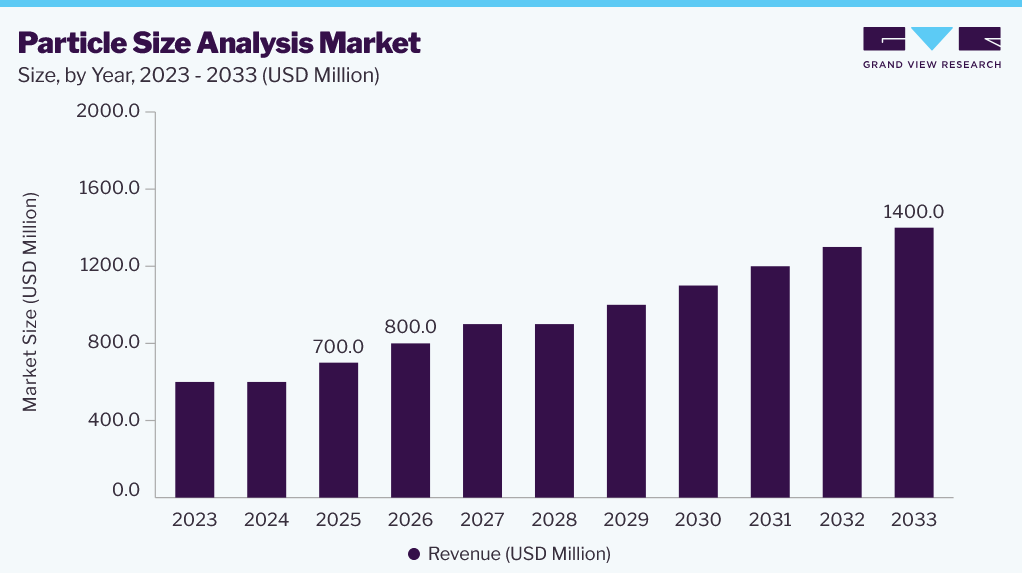 Source: Grand View Research, IR Documents, Primary Interviews, Paid DatabasesTo learn more about this report,
 Download Free Sample Report
 In addition, the availability of accurate particle-size analysis methods encourages the development and introduction of new products and technologies, thereby expanding market opportunities. Particle size analysis instruments are widely adopted as they provide insights into particle characteristics. Particle size analysis enables process optimization, leading to increased productivity in manufacturing and research activities. In addition, it is vital for the development and testing of advanced materials used in automotive and aerospace applications, where high performance and safety standards are critical. As international trade continues to grow, adherence to quality standards, including particle size specifications, is essential for products crossing borders.
Global market growth is primarily driven by increased emphasis on research and development initiatives focused on environmentally friendly, bio-based analytical methods. This also aligns with stringent regulatory frameworks across multiple countries, which are pushing industries to maintain high levels of quality control and necessitate precise particle-size analysis. Furthermore, as businesses recognize the importance of more precise, meticulous measurements, demand for advanced particle-size analysis techniques is expected to grow.
Analyst Perspective
The market is expected to grow steadily over the coming years, driven by the increasing need for precise particle characterization across the pharmaceutical, chemical, food, and advanced materials industries. The need for precise particle measurement techniques is set to grow as manufacturers continue to focus on product quality, process efficiency, and regulatory compliance. Particle size analysis has now established itself as a critical technique in achieving product consistency, increased manufacturing efficiency, and improved end-product quality. The pharmaceutical sector is expected to be a major contributor to market growth, driven by the ongoing development of complex formulations, inhalation treatments, and nanoparticle delivery systems. As quality standards become increasingly stringent across industries, the adoption of particle size analysis technologies is likely to grow steadily in the coming years.
Dispersion Type Insights
The wet particle dispersion type segment is expected to register a lucrative growth rate of around 34.0% from 2026 to 2033. Particle size analysis by wet particle dispersion type is a valuable technique used in various industries to measure and analyze particle sizes in liquid suspensions. As wet dispersion methods offer high accuracy and precision in measuring particle sizes, they are suitable for applications where precise size information is critical. This, in turn, helps boost the adoption of the wet particle dispersion type.
The dry particle dispersion-type segment accounted for a significant share of revenue in 2025. Dry dispersion methods do not alter the sample's properties, preserving its integrity for further analysis or testing. This is crucial for maintaining sample characteristics. In addition, dry dispersion techniques are ideal for analyzing powder and solid materials, including pharmaceutical powders, minerals, pigments, and polymers.
End User Insights
The healthcare end user segment is expected to register a lucrative growth rate of about 23.0% from 2026 to 2033. In the development of medical devices, such as drug-eluting stents and implants, particle size analysis is used to characterize coatings, drug carriers, and materials to ensure their safety and performance. Moreover, it is used in the development of diagnostic assays and tests, including immunoassays, lateral flow tests, and point-of-care (PoC) diagnostics, in which particle size can affect assay performance. Thus, the increasing application of particle size analysis instruments in the healthcare sector is anticipated to fuel the segment growth over the forecast period. Researchers in the chemicals industry use particle-size analysis to develop advanced materials with specific particle-size distributions tailored to various applications.
The academic & research institutes segment accounted for a significant share of the market in 2025, owing to the increasing focus on nanotechnology, materials science, biotechnology, and pharmaceutical research. Particle size analysis is widely used in research laboratories to understand behavior, optimize formulations, and assess the physical properties of materials across several applications. An increase in government-funded research programs, along with partnerships between academic and industrial members, is expected to support growth in this segment.
Technology Insights
The laser diffraction technology segment accounted for a market share of 32.0% in 2025. Laser diffraction technology is known for its high accuracy and precision in measuring particle size distributions. It provides detailed, reliable information on particle sizes, making it essential for industries that require precise measurements. In addition, compliance with stringent regulatory requirements across various industries necessitates precise particle-size analysis, making laser diffraction a valuable tool.
The dynamic light scattering (DLS) segment is anticipated to record lucrative growth over the forecast period. Particle size analysis by DLS technology is driven by several key factors that contribute to its growth and adoption in various industries. DLS is a versatile and widely used technique for measuring particle size and size distribution in both nanometer and micrometer ranges. DLS is known for its high sensitivity to small particles and aggregates, making it well-suited for analyzing nanoparticles and macromolecules, thereby fueling growth in this segment.
Regional Insights
Asia Pacific accounted for the largest share of approximately 47.0% in 2025 and is expected to grow at the fastest CAGR over the forecast period. The Asia Pacific regional market serves a wide range of industries, including pharmaceuticals, chemicals, materials science, food & beverages, environmental monitoring, and electronics. The rapid economic growth & industrialization in countries like China and India are driving demand for particle-size analysis equipment across multiple industries. In addition, the pharmaceutical industry in the Asia Pacific region is expanding, with a focus on drug development, which is driving increased demand for particle size analysis in formulation and quality control.
 To learn more about this report, Download Free Sample Report
 North America Particle Size Analysis Market Trends
The particle size analysis market in North America is another well-established regional market and is expected to continue to grow steadily. It is characterized by a mature industrial base and a strong focus on R&D. North America accounted for a significant share of the market in 2025. The region is home to a robust pharmaceutical industry, with a significant emphasis on research, drug development, and quality control, which drives demand for particle-size analysis solutions. Particle size analysis is crucial in materials science R&D, contributing to innovations in advanced materials and nanotechnology. Ongoing advancements in particle size analysis technology, including improvements in instruments and software, enhance the capabilities and precision of particle size analysis. Europe places significant importance on environmental protection and monitoring, leading to the adoption of particle size analysis instruments and services for environmental assessments. In addition, European research institutions and academia heavily utilize particle size analysis for scientific research and experimentation.
Key Particle Size Analysis Company Insights
The market is highly fragmented, with numerous manufacturers and suppliers, ranging from small to large, competing for market share. This fragmentation offers buyers a wide selection of equipment and customization options while catering to specific industry needs. To meet the rising demand across a diverse range of industries, market players are pursuing growth through strategies such as mergers & acquisitions, the establishment of new manufacturing facilities, and geographic expansion.
Key Particle Size Analysis Companies
The following key companies have been profiled for this study on the particle size analysis market:
-
Malvern Panalytical Ltd.
-
Horiba Ltd.
-
Agilent Technologies Inc.
-
Microtrac Inc. (Verder Scientific GmbH & Co. KG)
-
Beckman Colter Inc.
-
Anton Paar GmbH
-
Brookhaven Instruments
-
Fritsch GmbH
-
Mettler Toledo
-
Micromeritics Instrument Corporation
Recent Developments
-
In March 2026, HORIBA launched Partica, a laser diffraction and dynamic imaging particle size and shape analyzer. The system delivers particle size distribution and particle shape analysis measurements in about one minute and can reduce measurement time by up to 50% compared to the previous system.
-
In July 2025, Malvern Panalytical became a member of the International Pharmaceutical Aerosol Consortium on Regulation & Science (IPAC-RS). The company also mentioned using its Spraytec, Morphologi MDRS, Mastersizer, and Zetasizer platforms to analyze aerosol particles and characterize their properties in pharmaceutics.
-
In July 2024, Micromeritics announced an agreement to be acquired by Malvern Panalytical, combining to create a world leader in particle characterization technology. The combined entity provides solutions across powder size, surface area, and porosity; powder rheology; and material characterization for pharmaceutical, energy, and advanced materials applications.
Particle Size Analysis Market Report Scope
Report Attribute
Details
Market size in 2025
USD 700 million
Estimated market size in 2026
USD 800 million
Projected market size by 2033
USD 1400 million
Growth rate
CAGR of 8.4% from 2026 to 2033
Actual data
2021 - 2025
Forecast period
2026 - 2033
Quantitative units
Revenue in USD million, and CAGR from 2026 to 2033
Report coverage
Revenue forecast, company ranking, competitive landscape, growth factors, and trends
Segments covered
Technology, dispersion type, end user, region
Regional Scope
North America; Europe; Asia Pacific; CSA; MEA
Country Scope
U.S.; Canada; Mexico; Germany; UK; France; Spain; The Netherlands; Italy; China; India; Japan; South Korea; Australia; Brazil; Argentina; UAE; South Africa
Key companies profiled
Malvern Panalytical Ltd.; Horiba Ltd.; Agilent Technologies Inc.; Microtrac Inc. (Verder Scientific GmbH & Co. KG); Beckman Colter Inc.; Anton Paar GmbH; Brookhaven Instruments; Fritsch GmbH; Mettler Toledo; Micromeritics Instrument Corp
Customization scope
Free report customization (equivalent to up to 8 analysts working days) with purchase. Addition or alteration to country, regional & segment scope.
Pricing and purchase options
Avail of customized purchase options to meet your exact research needs. Explore purchase options
Global Particle Size Analysis Market Report Segmentation
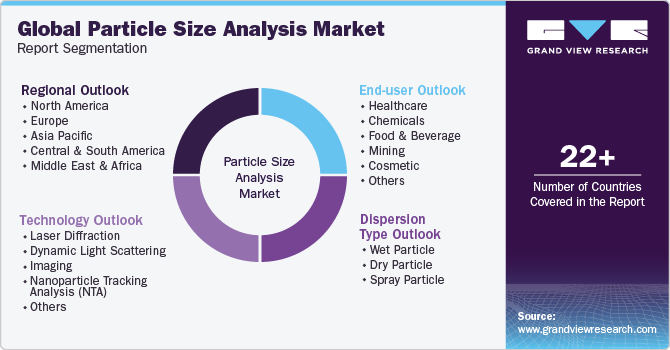
This report forecasts revenue growth at global, regional, and country levels and provides an analysis of the latest industry trends and opportunities in each of the sub-segments from 2021 to 2033. For this study, Grand View Research has segmented the global particle size analysis market report based on technology, dispersion type, end user, and region:
 To learn more about this report, Download Free Sample Report
 -
Technology Outlook (Revenue, USD Million, 2021 - 2033)
-
Laser Diffraction
-
Dynamic Light Scattering
-
Imaging
-
Nanoparticle Tracking Analysis (NTA)
-
Others
-
-
Dispersion Type Outlook (Revenue, USD Million, 2021 - 2033)
-
Wet Particle
-
Dry Particle
-
Spray Particle
-
-
End User Outlook (Revenue, USD Million, 2021 - 2033)
-
Healthcare
-
Chemicals
-
Food & Beverage
-
Mining
-
Cosmetic
-
Pharmaceuticals
-
Energy
-
Others
-
-
Regional Outlook (Revenue, USD Million, 2021 - 2033)
-
North America
-
U.S.
-
Canada
-
Mexico
-
-
Europe
-
Germany
-
UK
-
France
-
Spain
-
The Netherlands
-
Italy
-
-
Asia Pacific
-
China
-
India
-
Japan
-
South Korea
-
Australia
-
-
Central & South America
-
Brazil
-
Argentina
-
-
Middle East & Africa
-
UAE
-
South Africa
-
-
Frequently Asked Questions About This Report
The global particle size analysis market size was valued at USD 700 million in 2025 and is estimated at USD 800 million for 2026.
The global particle size analysis market is expected to grow at a CAGR of 5.4% from 2026 to 2033, reaching USD 1400 million by 2033.
Asia Pacific dominated with a revenue share of 47.0% in 2025.
Some of the key players operating in the particle size analysis market include Malvern Panalytical Ltd, Horiba Ltd, Agilent Technologies Inc., Microtrac Inc. (Verder Scientific GmbH & Co. KG), Beckman Coulter Inc., among others.
Wet particle dispersion type dominated the particle size analysis market with a share of 34.0% in 2025.
About the Author(s)
Advanced Interior Materials Research Team
Advanced Materials · Advanced Interior MaterialsThis report was authored by the advanced interior materials research team at Grand View Research - comprising two research analysts, one senior research analyst, and one industry expert - with specialized expertise in the advanced interior materials segment of the advanced materials industry. All findings are based on proprietary advanced materials databases, executive interviews, and regulatory analysis, subject to internal peer review prior to publication.
Last Updated:
Speak to Analyst

Customize this report to your needs - add regions, segments, or data points, with 20% free customization.
Or view our licence options:


ISO 9001:2015 & 27001:2022 Certified
We are GDPR and CCPA compliant! Your transaction & personal information is safe and secure. For more details, please read our privacy policy.


