
- Home
- »
- Clothing, Footwear & Accessories
- »
-
Percussion Instruments Market Size & Share Report, 2033GVR Report cover

Percussion Instruments Market (2026 - 2033)
Size, Share & Trends Analysis Report By Type (Drum Set, Tabla, Cajon), By Region (North America, Asia Pacific, Europe, Central & South America, Middle East & Africa), And Segment Forecasts
Market Size, 2025
$1.0BMarket Estimate, 2026
$1.1BMarket Forecast, 2033
$1.4BCAGR, 2026–2033
4.2%Percussion Instruments Market Summary
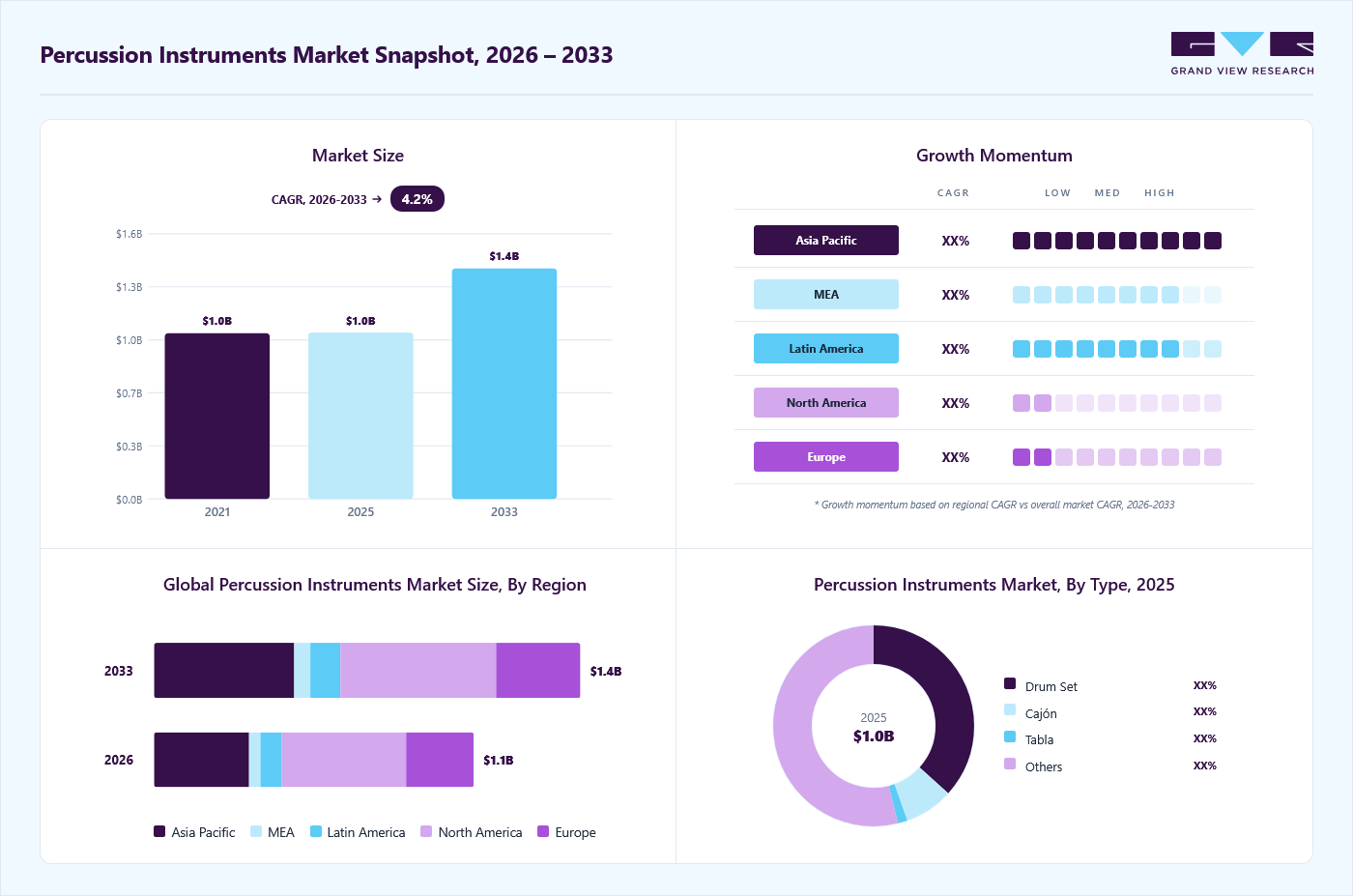
The global percussion instruments market size was valued at USD 1.0 billion in 2025 and is projected to grow from USD 1.1 billion in 2026 to USD 1.4 billion by 2033, at a CAGR of 4.2% from 2026 to 2033. North America dominated the market, accounting for the largest share of 39.3% in 2025. The global industry has evolved from a niche segment focused primarily on orchestral and traditional musical applications into a diversified one serving professional musicians, educational institutions, marching bands, religious organizations, live entertainment, recording studios, and recreational consumers.
 Source: Grand View Research, IR Documents, Primary Interviews, Paid DatabasesTo learn more about this report,
 Download Free Sample Report
 Key Market Trends & Insights
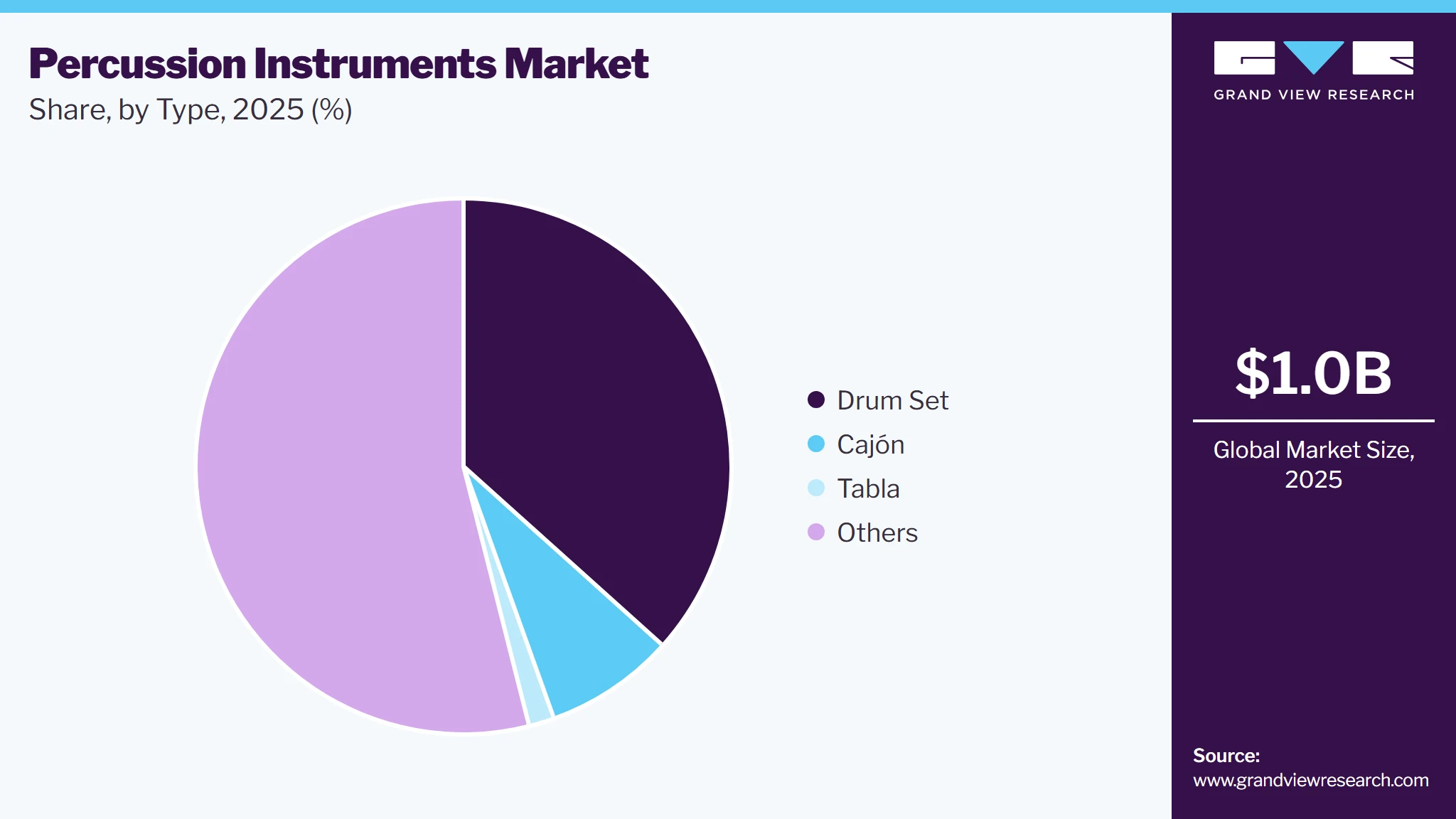
- By type: Drum set percussion instruments held a market share of 36.6% in 2025.
Regional Highlights
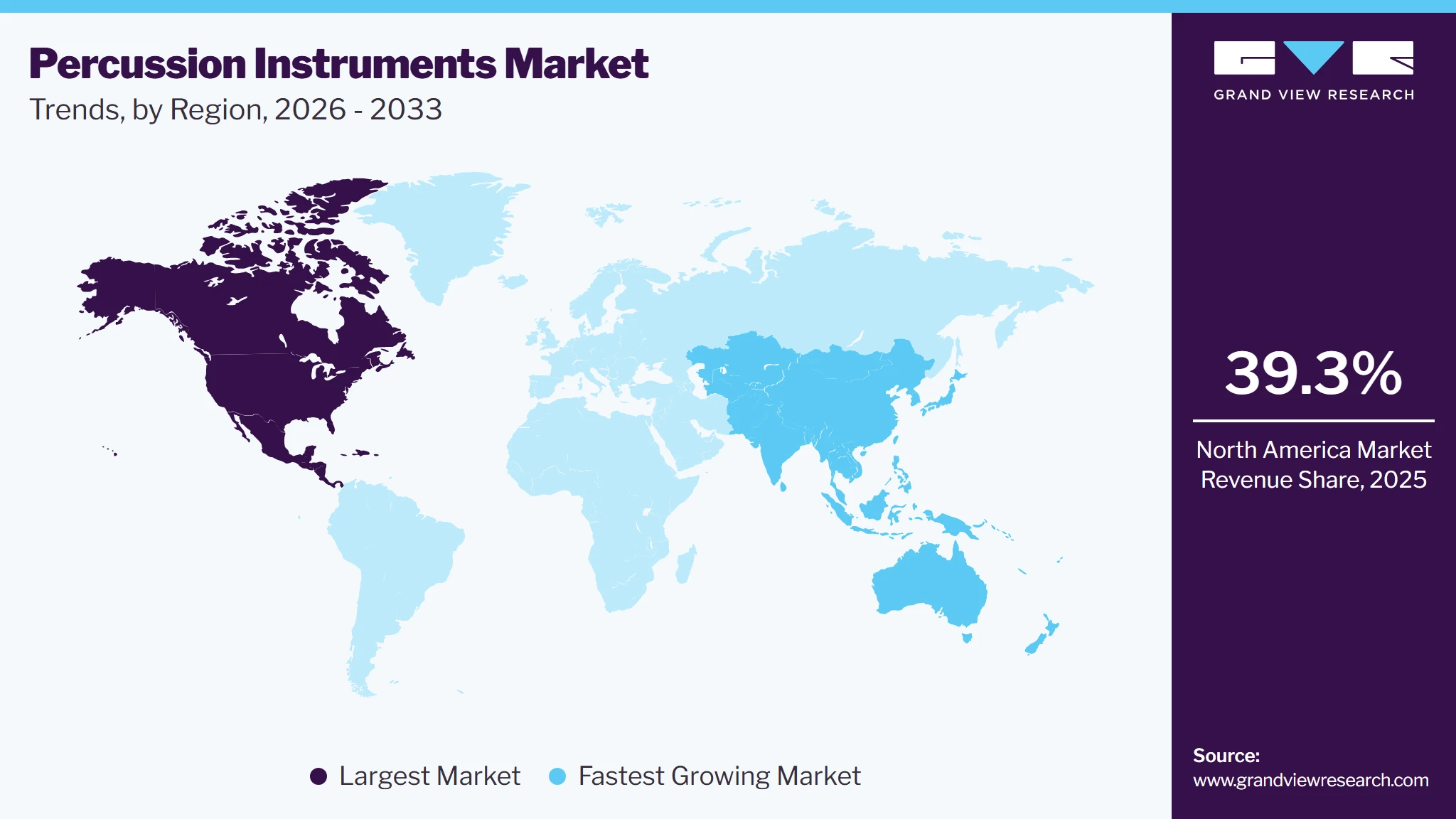
- Largest market: North America (39.3% revenue share in 2025)
- Fastest growing market: Asia Pacific (highest CAGR from 2026-2033)
- By country: The U.S. held the largest market share in 2025.
Market Size & Forecast
- Market Size in 2025: USD 1.0 Billion
- Estimated Market Size in 2026: USD 1.1 Billion
- Projected Market Size by 2033: USD 1.4 Billion
- CAGR (2026-2033): 4.2%
Three ways to get this report
Buy it, customize it, or ask a question.Ask an Analyst
A direct answer, usually in 1 working day
- AccessReport author, directly
- Reply timeWithin 1 working day
- No sales callDirect answer only
- FormatEmail reply
- CostFree, no cost
Get the Full Report
What the study covers
- FormatsPDF · Excel · Dashboard
- Timeline2026–2033 annual, 2025 base
- Coverage20+ countries, 5 regions
- Companies10+ key players profiled
Customize the Report
20% free customization
- IncludeCountries, segments, points
- TailorTo your product definition
- ExtendDeeper competitor detail
- OrA fully bespoke study
- Turnaround5–10 working days
Growth is no longer driven solely by rising musical instrument sales but increasingly by expanding music education programs, growing participation in live performances, digital content creation, and increasing consumer interest in recreational music-making. At the same time, growing investment in performing arts education, the expansion of independent musicians through digital streaming platforms, and increasing cultural appreciation for world music and percussion traditions are reshaping market demand and encouraging manufacturers to develop innovative, durable, and versatile percussion instruments tailored to diverse user segments.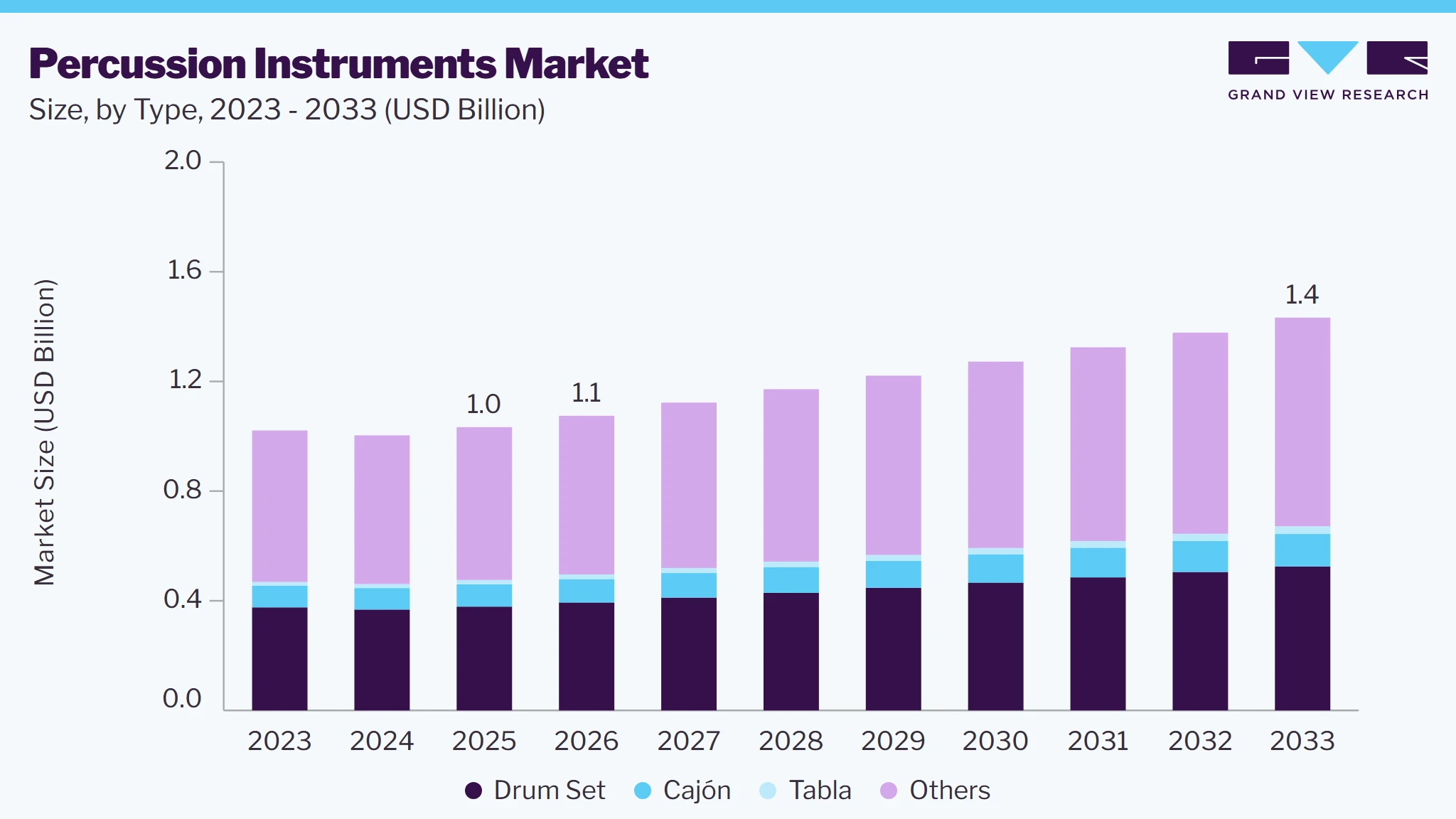 To learn more about this report, Download Free Sample Report
 Competition across the percussion instruments industry has intensified as leading manufacturers expand beyond traditional acoustic product portfolios into comprehensive ecosystems that include electronic percussion, hybrid drum kits, digital learning solutions, accessories, and artist collaborations. Major companies are strengthening their global distribution networks while investing in product innovation, sustainable manufacturing practices, and premium craftsmanship to appeal to both professional performers and beginner musicians. Yamaha Corporation continues to strengthen its position through a broad portfolio of acoustic and electronic percussion instruments while expanding educational initiatives and digital music solutions.
In January 2026, Yamaha Corporation showcased the EAD50 Electronic Acoustic Drum Module at The NAMM Show 2026, highlighting its capabilities as an all-in-one solution for modern drummers. The EAD50 combines a stereo microphone, drum trigger sensor, effects processor, recorder, and USB audio interface into a single system that can be attached to an acoustic drum kit with minimal setup. The device enables users to enhance their drum sound with built-in effects, record performances directly to external devices, connect with music production software, and share content through digital platforms. Designed for practice, live performances, studio recording, online lessons, and social media content creation, the EAD50 offers greater flexibility for drummers operating across multiple performance environments.
Growing participation in music education, live performances, cultural events, and recreational music activities is significantly driving the industry. Consumers view percussion instruments as a means of creative expression, rhythm development, and musical collaboration, leading to higher adoption among beginners, students, hobbyists, and professional musicians. This trend is supporting demand across product categories such as drum sets, tablas, cajóns, congas, bongos, djembes, timpani, xylophones, and other percussion instruments. Buyers are also prioritizing instruments that offer superior sound quality, durability, ergonomic construction, and ease of play. Additionally, the growing popularity of home recording, independent music creation, and online music tutorials is encouraging first-time musicians to invest in percussion instruments and related accessories.
The industry is also witnessing increasing demand for technologically advanced and premium percussion instruments as musicians seek enhanced performance and versatility. Consumers are adopting electronic drum kits, hybrid percussion systems, digital percussion pads, trigger modules, and lightweight hardware that provide improved connectivity, sound customization, and recording capabilities. Manufacturers are responding through innovations in shell materials, premium drumheads, ergonomic hardware, sustainable wood sourcing, and advanced sound engineering to enhance playing experience and product longevity.
In October 2025, Roland Corporation expanded its electronic percussion portfolio with the introduction of the V-Drums 3 Series and V-Drums 5 Series, designed to deliver professional-level drumming performance across entry-level and intermediate market segments. The new lineup features the V31 and V51 sound modules, which utilize the same advanced sound engine as Roland's flagship V71 module from the V-Drums 7 Series, providing realistic drum sounds and highly responsive performance. The kits incorporate newly developed mesh drum pads, upgraded hardware components, digital pad compatibility, wireless app integration, and access to Roland Cloud sound expansions, enabling users to customize kits and expand their sound libraries. Designed for home practice, music education, studio recording, and live performances, the launch reflects Roland's continued investment in digital percussion innovation while addressing the growing demand for connected, customizable, and high-performance electronic drum solutions.
Market Dynamics
The growth of the industry is being driven by increasing participation in music education, rising interest in recreational music, and the expanding popularity of rhythm-based performances. Schools, universities, music academies, and private training centers are increasingly incorporating percussion instruments such as drum sets, tablas, cajóns, congas, bongos, djembes, and xylophones into their music programs, encouraging greater adoption among students and beginners. Simultaneously, the growth of live concerts, marching bands, orchestras, worship music, and independent music creation is motivating consumers to learn percussion instruments for both personal enjoyment and professional development. The rapid expansion of online music education platforms, virtual drum lessons, and social media tutorials has made percussion learning more accessible, attracting a broader audience. In response, manufacturers are introducing electronic drum kits, digital percussion pads, practice pads, and beginner-friendly starter kits that enhance learning and convenience. These trends, combined with growing participation in community music groups and percussion ensembles, continue to drive demand and support sustained growth of the industry.
The high cost associated with premium percussion instruments and their ongoing maintenance remains a major restraint. Professional-grade products such as drum sets, electronic drum kits, tablas are manufactured using premium materials and advanced components, resulting in higher purchase prices. In addition to the initial investment, consumers must also purchase accessories such as cymbals, drumsticks, pedals, stands, protective cases, and electronic modules, increasing the overall cost of ownership. Regular maintenance, including drumhead replacement, tuning, hardware servicing, cymbal care, and repairs, further adds to long-term expenses. Electronic percussion instruments also require softwareupdates and replacement of trigger pads or sensors over time. These costs discourage adoption among students, beginners, and price-sensitive consumers, particularly in emerging markets. As a result, high acquisition costs, recurring maintenance expenses, and affordability challenges continue to limit wider consumer adoption and restrain the overall growth of the industry
Percussion Instruments Market Share Insights
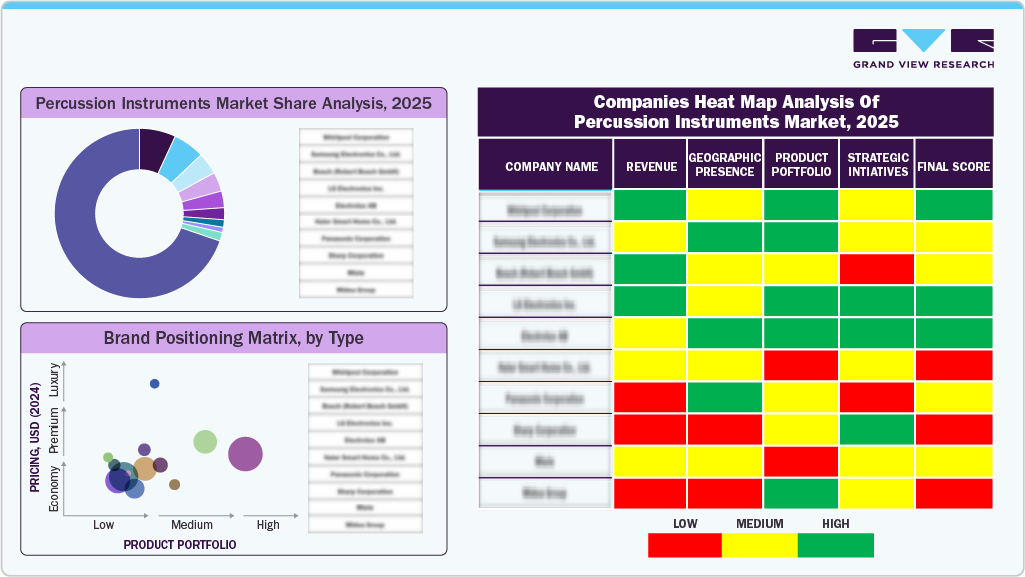
The market is highly competitive, driven by continuous product innovation, expanding electronic percussion portfolios, and increasing investments in music education and digital music technologies. Leading companies such as Yamaha Group, Roland Corporation, Pearl Musical Instrument Co., Ltd., Gretsch Drums, Ludwig Drums, and Conn-Selmer, Inc. compete by introducing advanced acoustic and electronic percussion instruments, enhancing product performance, expanding artist endorsement programs, and strengthening global dealer and e-commerce networks. Competition is increasingly centered on developing electronic drum kits, hybrid percussion systems, premium handcrafted instruments, and beginner-friendly product lines while integrating Bluetooth connectivity, app-based sound customization, and recording capabilities to improve user experience and strengthen customer loyalty.
 To learn more about this report, Download Free Sample Report
 The market is also witnessing growing investments in premium percussion instruments, sustainable manufacturing practices, and digitally connected percussion solutions that cater to professional musicians, educational institutions, and recreational players. Companies including Remo Inc., Meinl Percussion, InMusic Brands, Inc. (Alesis), D'Addario, Majestic Holland BV, Ashton Music, and Walberg & Auge are focusing on expanding percussion accessories, electronic percussion technologies, educational product portfolios, and direct-to-consumer sales channels to strengthen their competitive positioning. In addition, strategic partnerships with artists, expansion of online retail platforms, development of lightweight and ergonomic percussion instruments, and increasing adoption of smart percussion technologies are enabling manufacturers to differentiate their offerings and support long-term growth.
Consumer Insights
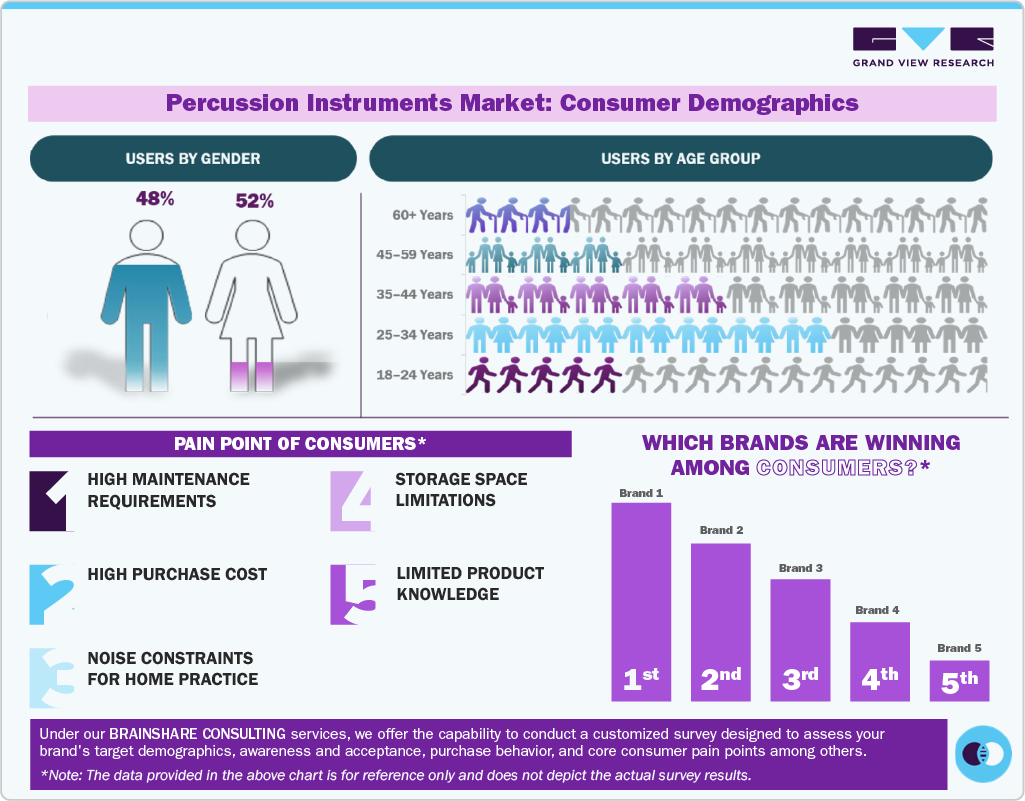
Consumer behavior in the industry is centered on performance, versatility, and accessibility, with buyers seeking instruments that combine superior sound quality, durability, and ease of use. Professional musicians prioritize premium acoustic drums, handcrafted traditional percussion instruments, and advanced electronic drum kits that deliver authentic sound, customization, and reliable performance for live concerts and studio recording. Meanwhile, students, hobbyists, and first-time learners are increasingly choosing beginner-friendly drum kits, practice pads, cajóns, tablas, and compact percussion instruments that offer affordability, portability, and simplified learning experiences. Growing participation in music education, recreational music, and independent content creation is further encouraging consumers to invest in percussion instruments that support long-term skill development and creative expression.
 To learn more about this report, Download Free Sample Report
 At the same time, purchasing behavior is increasingly influenced by digital engagement, product innovation, and online accessibility. Consumers actively compare percussion instruments through e-commerce platforms, online reviews, virtual demonstrations, and social media content before making purchasing decisions. Demand for electronic drum kits, hybrid percussion systems, Bluetooth-enabled practice solutions, and app-connected sound modules continues to rise as musicians seek greater flexibility for home practice, recording, and live performances. Artist endorsements, online music tutorials, influencer content, and percussion communities are also shaping buying preferences, while manufacturers are strengthening direct-to-consumer channels, personalized product offerings, and digital customer engagement strategies.
Analyst Perspective
The market is driven by increasing participation in music education, live performances, and digital music creation. Rising demand for electronic drum kits, hybrid percussion systems, and smart practice solutions is transforming the market, while continued interest in traditional instruments supports broader consumer adoption. Manufacturers are focusing on product innovation, ergonomic designs, premium materials, and sustainable manufacturing to enhance performance and user experience. The expansion of e-commerce platforms, online music learning, and artist collaborations is improving product accessibility and customer engagement. Overall, technological advancements and growing global interest in rhythm-based music are expected to support long-term market growth.
Type Insights
The drum set segment accounted for a market share of 36.6% in 2025, supported by the growing popularity of live music performances, independent music production, and digital content creation. Drummers are increasingly adopting hybrid setups that combine acoustic drums with electronic triggers, sound modules, and recording technologies to enhance versatility and performance capabilities. The expansion of home studios, online music education, and social media platforms has also encouraged demand for drum kits that offer recording, connectivity, and sound customization features. Manufacturers are focusing on innovation in electronic drum technology, sound modeling, and integrated recording solutions to cater to both professional and recreational musicians.
 To learn more about this report, Download Free Sample Report
 The Cajón segment is anticipated to grow at a CAGR of 4.8% from 2026 to 2033, due to its versatility, portability, and ability to complement a wide range of musical styles, including acoustic, flamenco, folk, worship, and contemporary music. Unlike traditional drum kits, cajóns offer a compact percussion solution that is easy to transport and suitable for small venues, unplugged performances, and home practice. Growing interest in acoustic music sessions, live café performances, and singer-songwriter formats continues to support demand for cajóns among both professional musicians and hobbyists. For example, in 2025, Meinl Percussion expanded its Snarecraft Cajón portfolio by introducing additional models and finishes within its professional cajón range. The updated lineup includes models such as the SC100, SC80, and professional Snarecraft Cajons, featuring Baltic birch construction, internal snare wire systems, rounded corners for improved playing comfort, and multiple wood finishes. The series is designed to provide enhanced bass response, snare articulation, and tonal versatility for professional performers, educators, and recreational musicians.
Regional Insights
The North America percussion instruments market accounted for the largest share of 39.3% in 2025, driven by a well-established music culture, high household spending on recreational activities, and strong participation in music education across schools, universities, and community programs. The region benefits from the presence of leading manufacturers such as Yamaha Corporation of America, alongside one of the world's largest retail and distribution networks for musical instruments. Consumer demand is increasingly shifting toward electronic percussion, reflecting the growing popularity of home recording, music production, content creation, and live performances. In addition, omnichannel retailing, direct-to-consumer sales, and subscription-based music learning platforms are reshaping purchasing behavior across the region.
 To learn more about this report, Download Free Sample Report
 U.S. Percussion Instruments Market Trends
The percussion instruments market in the U.S. accounted for a revenue share of around 86.5% of the North America market in 2025, supported by a well-established music industry, widespread participation in school band and orchestra programs, and a strong culture of live entertainment and independent music creation. Demand is driven by increasing adoption of drum sets, electronic drum kits, marching percussion, orchestral percussion, and hand percussion instruments across educational institutions, professional musicians, churches, and recreational users. The country also benefits from the presence of leading percussion manufacturers and brands such as Ludwig Drums, Gretsch Drums, DW Drums, Remo, Zildjian, and Roland, which continuously introduce innovative products and strengthen artist collaborations. The growing popularity of home recording studios, online music education, and digital content creation is further accelerating demand for electronic percussion systems and hybrid drum technologies. In addition, expanding e-commerce platforms, specialty music retailers, and direct-to-consumer sales channels have improved product accessibility, while increasing investments in music education, touring events, and professional performances continue to support long-term market growth across the U.S.
The Mexico percussion instruments market is expected to grow at a CAGR of 4.7% from 2026 to 2033, supported by the country's rich musical heritage, strong demand for regional music, and the growing presence of cultural festivals and community performances. Traditional percussion instruments such as congas, bongos, timbales, maracas, güiros, and hand percussion remain widely used alongside modern drum kits and electronic percussion systems in live entertainment, music education, and religious events. Increasing investments in music education programs, expanding participation in local bands and performance groups, and the growing popularity of contemporary genres such as Latin pop, rock, and jazz are driving demand for percussion instruments across both professional and amateur musicians. Additionally, the expansion of specialty music retailers, online marketplaces, and regional distributors has improved product availability, while rising tourism and cultural events continue to encourage purchases of both traditional handcrafted percussion instruments and modern electronic percussion products, supporting steady market growth in Mexico.
Europe Percussion Instruments Market Trends
The percussion instruments market in Europe accounted for a revenue share of 21.2% of the global market in 2025,supported by the region's strong classical music tradition, well-established orchestras, expanding live entertainment industry, and widespread participation in music education. Demand for drum sets, orchestral percussion, marching percussion, timpani, marimbas, vibraphones, cajóns, and electronic percussion instruments continues to grow across professional musicians, conservatories, schools, and community music groups. The region is also witnessing increasing adoption of electronic drum kits and hybrid percussion systems as musicians seek advanced sound customization, compact designs, and seamless integration with digital recording and live performance environments. Furthermore, Europe's strong network of music festivals, concert venues, and cultural events continues to stimulate demand for high-quality percussion instruments and accessories. Manufacturers are strengthening their presence through product innovation, sustainable manufacturing practices, artist collaborations, and expanded distribution across specialty music retailers and online sales channels. Rising consumer interest in premium handcrafted percussion instruments, together with increasing investments in music education and professional performance infrastructure, continues to support the long-term growth of the market across Europe.
Germany percussion instruments market accounted for a revenue share of around 24.1% of the European market in 2025, supported by its strong manufacturing capabilities, vibrant performing arts sector, and high consumer spending on premium musical equipment. The country has a well-established network of conservatories, music academies, and professional training institutions that create consistent demand for orchestral, marching, and contemporary percussion instruments. Germany also serves as an important hub for music trade and innovation, with international exhibitions and industry events providing manufacturers with opportunities to showcase new percussion technologies and strengthen business partnerships. Rising adoption of electronic percussion systems among recording studios, touring artists, and contemporary performers is further supporting market expansion. Additionally, consumers are increasingly investing in high-quality percussion accessories, replacement components, and customized equipment to enhance performance and durability. The combination of strong domestic demand, advanced retail infrastructure, and continuous product innovation positions Germany as one of the most influential markets in Europe.
The percussion instruments market in Spain is expected to grow at a CAGR of 3.5% from 2026 to 2033, driven by the country's rich flamenco heritage and strong influence of Latin and Mediterranean music traditions. Demand remains particularly strong for cajóns, castanets, hand percussion, frame drums, and modern drum kits, reflecting their widespread use in professional performances, music academies, cultural festivals, and tourism-related entertainment. The country's vibrant performing arts scene and growing independent music community continue to encourage purchases of both traditional and contemporary percussion instruments. In addition, increasing participation in community music programs, private music education, and studio recording is supporting demand among students and emerging musicians. Manufacturers and distributors are expanding their presence through specialty music stores, online retail platforms, and collaborations with professional percussion artists. Growing consumer interest in handcrafted percussion instruments, premium accessories, and compact performance solutions continues to strengthen Spain's role as a significant market in Southern Europe.
Asia Pacific Percussion Instruments Market Trends
The percussion instruments industry in Asia Pacific is expected to grow at a CAGR of 5.7% from 2026 to 2033, supported by its large consumer base, strong manufacturing presence, and expanding music education ecosystem. The region benefits from a strong manufacturing base, expanding music education programs, and increasing participation in live performances and digital content creation. Countries such as Japan, China, India, and South Korea are driving demand for both traditional and electronic musical instruments. Consumers are increasingly adopting electronic percussion instruments, supported by the rapid growth of online music learning platforms and home music production. In addition, the presence of leading manufacturers such as Yamaha, Roland, Casio, Kawai, and Pearl strengthens the region's position as both a major production hub and consumer market.
Japan percussion instruments market accounted for a revenue share of around 23.0% of the Asia Pacific market in 2025, supported by its advanced musical instrument industry, strong consumer preference for high-quality craftsmanship, and continuous innovation in electronic music technology. Demand is driven by professional performers, recording studios, educational institutions, and hobby musicians seeking precision, durability, and advanced functionality. The country has witnessed increasing adoption of electronic drum kits, hybrid percussion systems, compact practice instruments, and digital percussion accessories, reflecting the growing popularity of home music production and space-efficient practice solutions. Japan's vibrant concert culture, anime and gaming music industry, and active amateur band community further contribute to the steady demand for percussion equipment. In addition, domestic manufacturers continue to invest in product innovation, lightweight materials, enhanced sound technology, and environmentally responsible manufacturing, while strong retail networks and online sales platforms ensure broad product accessibility, reinforcing Japan's position as one of Asia-Pacific's leading markets.
The percussion instruments market in India is expected to grow at a CAGR of 8.5% from 2026 to 2033, supported by its deep-rooted musical traditions, diverse regional music styles, and growing participation in contemporary music. The country is a major producer and consumer of traditional percussion instruments such as tabla, dhol, mridangam, pakhawaj, ghatam, and khanjira, while demand for modern drum kits and electronic percussion continues to rise among youth musicians and bands. Increasing enrollment in music academies, cultural institutions, and performing arts programs is encouraging the adoption of percussion instruments across all age groups. The expanding film, devotional, and independent music industries are also creating consistent demand for both traditional and contemporary percussion products. Additionally, the presence of skilled artisan communities, growing exports of handcrafted percussion instruments, and the rapid expansion of online musical instrument retailers are improving market reach and strengthening India's position as both a leading manufacturing hub and a fast-growing consumer market for percussion instruments.
Central & South America Percussion Instruments Market Trends
The percussion instruments market in Central & South America is expected to grow at a CAGR of 5.0% from 2026 to 2033,driven by the region's vibrant musical traditions, strong influence of Latin rhythms, and widespread participation in cultural celebrations and community performances. Countries across the region have a long-standing demand for percussion instruments used in samba, salsa, cumbia, tango, Afro-Latin, and folkloric music, supporting sales of both traditional and modern percussion products. The growing popularity of local music festivals, dance performances, and independent artists is encouraging greater investment in professional-grade percussion equipment and accessories. Rising disposable incomes and expanding access to international musical instrument brands through specialty retailers and e-commerce platforms are further broadening consumer choice. Additionally, increasing collaborations between regional musicians and global music producers, along with the continued preservation of indigenous percussion traditions, are supporting steady demand for handcrafted as well as technologically advanced percussion instruments across the CSA market.
Middle East & Africa Percussion Instruments Market Trends
The percussion instruments market in the Middle East & Africa is expected to grow at a CAGR of 5.0% from 2026 to 2033, supported by the region's rich cultural heritage, expanding entertainment industry, and growing investments in music and performing arts. Traditional percussion instruments such as darbuka, doumbek, riq, frame drums, djembes, and talking drums remain integral to religious ceremonies, cultural festivals, and folk performances, while demand for modern drum kits and electronic percussion is increasing among contemporary musicians and recording studios. The expansion of music festivals, tourism-driven entertainment, and government initiatives promoting cultural preservation are creating new opportunities for percussion instrument manufacturers and distributors. In addition, the growing presence of music academies, worship bands, and independent artists is encouraging demand for both entry-level and professional percussion instruments. Rising availability of international brands through specialty retailers and online sales platforms, coupled with increasing consumer interest in premium and technologically advanced percussion products, is supporting the long-term growth of the market across the MEA region.
Key Percussion Instruments Companies:
The following key companies have been profiled for this study on the percussion instruments market.
-
Conn-Selmer, Inc.
-
Yamaha Group
-
K.H.S. Musical Instrument Co., Ltd.
-
Gretsch Drums
-
Ludwig Drums
-
InMusic Brands, Inc. (Alesis)
-
Remo Inc.
-
Roland Corporation
-
Ashton Music
-
Pearl Musical Instrument Co.
Competitive Benchmarking
Category
Operating Strategies
Competitive Edge
Weakness
Established Players (Yamaha Group, Roland Corporation, Pearl Musical Instrument Co., Conn-Selmer, Gretsch Drums, Ludwig Drums, Remo Inc.)
Expand global percussion portfolios through continuous product innovation, launch advanced electronic and hybrid percussion instruments, strengthen artist endorsement programs, invest in R&D and digital technologies, expand dealer and e-commerce networks, and collaborate with music schools, orchestras, and professional musicians.
Globally recognized brands, comprehensive acoustic and electronic percussion product portfolios, strong R&D capabilities, advanced manufacturing expertise, extensive global distribution networks, strong customer loyalty, and robust financial resources supporting continuous innovation and market expansion.
High manufacturing and R&D costs, premium pricing limits affordability in emerging markets, dependence on mature North American and European markets, complex supply chains, and continuous investment required to keep pace with evolving digital technologies.
Emerging & Specialized Players (K.H.S. Musical Instrument Co., Ltd., InMusic Brands (Alesis), Ashton Music, Majestic Holland BV, Meinl Percussion, D'Addario, Walberg & Auge)
Focus on affordable percussion instruments, specialized accessories, electronic percussion solutions, educational product lines, regional expansion, direct-to-consumer sales, OEM partnerships, and digital retail channels while strengthening presence in developing markets.
Strong specialization in niche percussion categories, competitive pricing, flexibility in product development, growing regional distribution networks, recurring revenue from accessories and replacement components, and increasing adoption among students, hobbyists, and semi-professional musicians.
Lower global brand recognition than established players, limited financial and R&D resources, narrower product portfolios, dependence on regional demand, fewer artist endorsements, and comparatively weaker presence in the premium professional percussion segment.
Recent Developments:
-
In January 2026, Drum Workshop (DW) expanded its DWe electronic-acoustic drum kit lineup by introducing new four-piece and five-piece bundle configurations compatible with Roland's V71, V51, and V31 drum sound modules. The updated kits combine DW's premium acoustic drum shells with built-in wireless triggering technology, allowing drummers to switch seamlessly between acoustic and electronic performance. The new bundles also include Roland electronic cymbals, DrumLink wireless connectivity, and DW's Soundworks software, providing greater flexibility for live performances, studio recording, and hybrid drumming applications. The launch reflects increasing demand for drum kits that integrate traditional acoustic performance with advanced digital technologies.
-
In June 2025, Roland Corporation introduced the Mood Pan, an electronic hand percussion instrument inspired by the soothing sound of traditional handpans. Designed for musicians, beginners, and wellness enthusiasts, the instrument combines expressive hand-play performance with modern digital features, including Bluetooth audio streaming, a built-in 2.1 speaker system, rechargeable battery operation, USB-C connectivity, and multiple onboard sound variations. Its intuitive playing experience requires no prior musical training, making it suitable for music creation, relaxation, meditation, and live performances. The launch highlights Roland's continued focus on digital percussion innovation and expanding accessible, portable, and technology-enabled percussion solutions for a broad range of users.
Percussion Instruments Market Report Scope
Report Attribute
Details
Market size value in 2025
USD 1.0 billion
Market size value in 2026
USD 1.1 billion
Revenue forecast in 2033
USD 1.4 billion
Growth rate
CAGR of 4.2% from 2026 to 2033
Base year for estimation
2025
Historical data
2021 - 2025
Forecast period
2026 - 2033
Quantitative units
Volume in thousand units, revenue in USD billion and CAGR from 2026 to 2033
Report coverage
Volume & revenue forecast, company ranking, competitive landscape, growth factors, and trends
Segments covered
Type, region
Regional scope
North America; Europe; Asia Pacific; Central & South America; Middle East & Africa
Country scope
U.S.; Canada; Mexico; UK; Germany; France; Italy; Spain; China; India; Japan; South Korea; Australia & New Zealand; Malaysia; Indonesia; Vietnam; Philippines; Singapore; Thailand; Brazil; South Africa
Key companies profiled
Conn-Selmer, Inc.; Yamaha Group; K.H.S. Musical Instrument Co., Ltd.; Gretsch Drums; Ludwig Drums; InMusic Brands, Inc. (Alesis); Remo Inc.; Roland Corporation; Ashton Music; Pearl Musical Instrument Co.; D'Addario; Majestic Holland BV; Meinl Percussion; Walberg; Auge
Customization scope
Free report customization (equivalent up to 8 analysts working days) with purchase. Addition or alteration to country, regional & segment scope.
Pricing and purchase options
Avail customized purchase options to meet your exact research needs. Explore purchase options
Percussion Instruments Market Report Segmentation
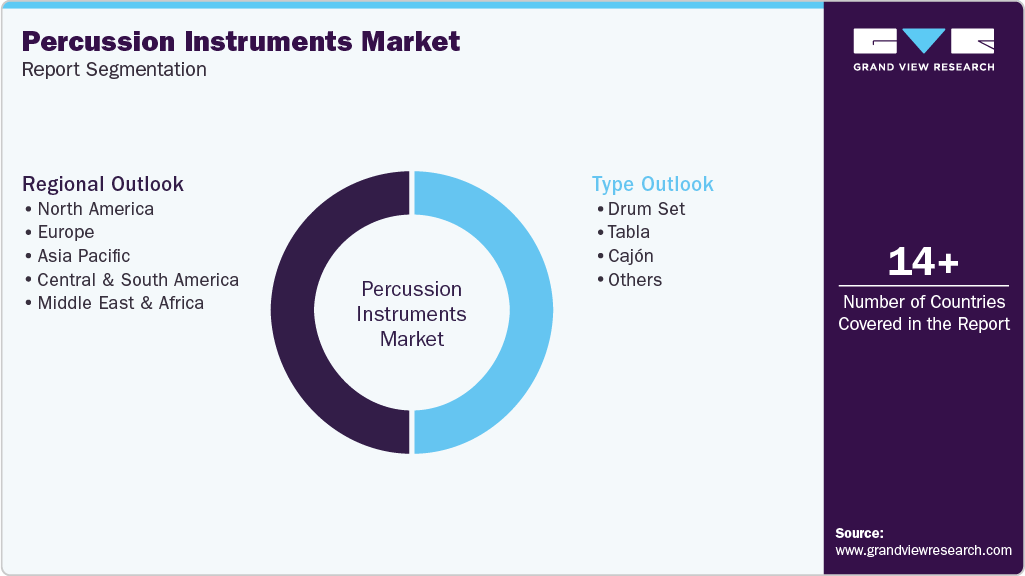
This report forecasts volume & revenue growth at global, regional & country levels and provides an analysis of the latest trends and opportunities in each of the sub-segments from 2021 to 2033. For this study, Grand View Research has segmented the global percussion instruments market report based on type and region:
 To learn more about this report, Download Free Sample Report
 -
Type Outlook (Volume, Thousand Units, Revenue, USD Million, 2021 - 2033)
-
Drum Set
-
Tabla
-
Cajón
-
Others
-
-
Regional Outlook (Volume, Thousand Units, Revenue, USD Million, 2021 - 2033)
-
North America
-
U.S.
-
Canada
-
Mexico
-
-
Europe
-
UK
-
Germany
-
France
-
Italy
-
Spain
-
-
Asia Pacific
-
China
-
India
-
Japan
-
South Korea
-
Australia & New Zealand
-
Malaysia
-
Singapore
-
Thailand
-
Vietnam
-
Indonesia
-
Philippines
-
-
Central & South America
-
Brazil
-
-
Middle East & Africa
-
South Africa
-
-
Research Methodology
The percussion instruments market figures in this report are based on a proven research process that combines executive interviews with secondary research from proprietary databases, company filings, and recognized regulatory and institutional sources. Market size is built through value-chain sizing—reconciling supply-side and demand-side estimates—and triangulated with bottom-up and top-down approaches. Every estimate passes multiple levels of expert validation before publication, with each percussion instrument segment quantified using the revenue-capture definitions in the table below.
Segment Definition
Segment - Type
Revenue capture definition
Drum Set
A percussion instrument consisting of multiple drums and cymbals mounted on a single stand or rack system and played by one musician using drumsticks and foot pedals. Drum sets are widely used in rock, pop, jazz, metal, blues, and contemporary music performances.
Tabla
A traditional Indian percussion instrument comprising two hand-played drums the smaller dayan and the larger bayan used primarily in Hindustani classical, devotional, folk, and fusion music, producing a wide range of tonal variations through finger and palm techniques.
Cajón
A box-shaped percussion instrument typically made of wood and played by striking the front playing surface with the hands, fingers, or brushes. Originally from Peru, it is widely used in acoustic, flamenco, Latin, folk, and contemporary music due to its portability and versatile rhythmic capabilities.
Others
Includes percussion instruments such as congas, bongos, djembes, timpani, tambourines, marimbas, vibraphones, xylophones, cowbells, shakers, triangles, castanets, gongs, chimes, and other hand and orchestral percussion instruments used across classical, folk, marching band, world music, religious, educational, and contemporary performance applications.
Estimation Model
Layer
Key Question
Description
Potential Consumer Base Layer
Who has the potential to purchase percussion instruments?
Begin with the global population interested in music, including students, professional musicians, hobbyists, music educators, religious institutions, and recreational learners. Apply factors such as music education enrollment, participation in live performances, cultural music traditions, and recreational music engagement to estimate the total addressable consumer base for percussion instruments.
Product Accessibility & Distribution Layer
Who has access to percussion instruments?
Filter the addressable consumer base using the availability of percussion instruments through specialty music retailers, e-commerce platforms, distributors, educational institutions, rental programs, and regional manufacturers. Account for product affordability, retail penetration, import availability, music infrastructure, and online accessibility to estimate the serviceable percussion instrument market.
Active Purchase & Usage Layer
Who actively purchases and uses percussion instruments?
Apply purchase conversion rates based on consumer spending, replacement cycles, participation in music education, live performances, studio recording, religious and cultural events, and recreational music activities. Consider purchases by individuals, educational institutions, orchestras, bands, and commercial music organizations to estimate active percussion instrument buyers.
Revenue Generation Layer
How much revenue is generated?
Multiply annual unit sales by the Average Selling Price (ASP) across product categories including drum sets, tablas, cajóns, and other percussion instruments. Include recurring revenue from percussion accessories such as drumheads, pedals, stands, cases, maintenance products, replacement parts, and electronic sound modules to estimate the total percussion instruments market revenue.
Delivered Customizations
This report has been delivered with the following In-depth customizations
Client Request
Customization Delivered
Value Adds
Drum Set Market & Electronic Percussion Trends
Conducted a detailed assessment of acoustic drum sets, electronic drum kits, and hybrid percussion systems by evaluating product innovation, consumer adoption, pricing trends, performance applications, music education demand, and technological advancements including Bluetooth connectivity, app integration, and digital sound modules.
Helps stakeholders identify high-growth product categories, evaluate technology adoption, optimize product development strategies, and capitalize on expanding demand for electronic and hybrid percussion instruments.
Traditional & Hand Percussion Demand Analysis
Evaluated demand across tabla, cajón, congas, bongos, djembes, and other hand percussion instruments by assessing cultural adoption, educational usage, artisan manufacturing, export opportunities, regional demand patterns, and consumer purchasing preferences across professional and recreational musicians.
Provides insights into regional growth opportunities, supports portfolio diversification, identifies export potential, and enables manufacturers to strengthen traditional percussion product offerings and cultural market expansion.
Percussion Industry Innovation & Distribution Assessment
Assessed emerging trends in percussion technologies, online retail expansion, artist collaborations, music education initiatives, replacement demand, accessories market, and global distribution networks. The analysis also evaluated aftermarket opportunities including drumheads, cymbals, sticks, pedals, stands, and maintenance products.
Supports long-term investment strategies by identifying emerging market opportunities, improving distribution efficiency, optimizing accessory sales, strengthening digital commerce initiatives, and enhancing competitive positioning within the global percussion instruments market.
Frequently Asked Questions About This Report
The global percussion instruments market size was estimated at USD 1.0 billion in 2025 and is expected to reach USD 1.1 billion in 2026.
The global percussion instruments market is expected to grow at a compound annual growth rate of 4.2% from 2026 to 2033 to reach USD 1.4 billion by 2033.
North America dominated the market, accounting for the largest share of 39.3% in 2025.
Some key players operating in the percussion instruments market include Conn-Selmer, Inc., Yamaha Group, K.H.S. Musical Instrument Co., Ltd., Gretsch Drums, Ludwig Drums, InMusic Brands, Inc. (Alesis), Remo Inc., Roland Corporation, Ashton Music, Pearl Musical Instrument Co., D'Addario, Majestic Holland BV, Meinl Percussion, and Walberg and Auge.
Key factors that are driving the percussion instruments market growth include rising inclination among music hobbyists of adopting percussion instruments and the rising demand from professionals owing to the rise in the number of musical events.
Asia Pacific is the fastest-growing region over the forecast period.
The drum set segment accounted for a market share of 36.6% in 2025, while cajón segment is fastest growing type.
About the Author(s)
Clothing, Footwear & Accessories Research Team
Consumer Goods · Clothing, Footwear & AccessoriesThis report was authored by the clothing, footwear & accessories research team at Grand View Research - comprising two research analysts, one senior research analyst, and one industry expert - with specialized expertise in the clothing, footwear & accessories segment of the consumer goods industry. All findings are based on proprietary consumer goods databases, executive interviews, and regulatory analysis, subject to internal peer review prior to publication.
Last Updated:
Speak to Analyst

Customize this report to your needs - add regions, segments, or data points, with 20% free customization.
Or view our licence options:


ISO 9001:2015 & 27001:2022 Certified
We are GDPR and CCPA compliant! Your transaction & personal information is safe and secure. For more details, please read our privacy policy.


