
- Home
- »
- Pharmaceuticals
- »
-
Pharmaceutical Cartridges Market Size, Share Report, 2033GVR Report cover

Pharmaceutical Cartridges Market (2026 - 2033)
Size, Share & Trends Analysis Report By Material (Glass Cartridges, Plastic Cartridges, Rubber), By Application, By Chamber Type (Dual Chamber, Large Volume), By Size, By Therapeutic Area, By End-use, By Region, And Segment Forecasts
Market Size, 2025
$1.6BMarket Estimate, 2026
$1.8BMarket Forecast, 2033
$3.2BCAGR, 2026–2033
8.4%Pharmaceutical Cartridges Market Summary
The global pharmaceutical cartridges market size was valued at USD 1.6 billion in 2025 and is projected to grow from USD 1.8 billion in 2026 to USD 3.2 billion by 2033, at a CAGR of 8.4% from 2026 to 2033. North America dominated the market, accounting for a revenue share of 30.0% in 2025. Growing demand for drug delivery devices and the rising prevalence of chronic conditions such as diabetes & arthritis drive the market.
Key Market Trends & Insights
- By material: Glass pharmaceutical cartridges segment captured the largest revenue share in 2025.
- By application: Pen injectors segment captured the largest revenue share in 2025.
- By chamber: Dual chamber pharmaceutical cartridges segment held a significant market share in 2025.
- By size: 3ml pharmaceutical cartridges segment held the largest market share in 2025.
- By therapeutic area: Diabetes pharmaceutical cartridges segment held a notable market share in 2025.
Regional Highlights
- Largest regional market: North America (30.0% revenue share, 2025)
- Fastest-growing regional market: Asia Pacific (highest CAGR, 2026-2033)
Market Size & Forecast
- Market size in 2025: USD 1.6 Billion
- Estimated market size in 2026: USD 1.8 Billion
- Projected market size by 2033: USD 3.2 Billion
- CAGR (2026-2033): 8.4%
Prism AI by Grand View Research Free to tryAsk a question about the pharmaceutical cartridges marketTry asking✓Every figure cited from GVR research Prefer the report? Download free sample →
According to the World Health Organization (WHO) diabetes fact sheet for 2025, approximately 830 million people worldwide are living with diabetes, with a significant number residing in low- and middle-income countries. More than half of the adults with diabetes are not receiving treatment, highlighting the urgent need for advanced injectable drug delivery systems, including pharmaceutical cartridges used for insulin therapies. As the global incidence of diabetes continues to rise, there is an increasing demand for pharmaceutical products, particularly insulin and other medications for diabetes management. The critical role of pharmaceutical cartridges in packaging and dispensing these medications underscores their importance. The market dynamics of these cartridges are closely linked to the growing population of diabetics, creating a favorable environment for their use.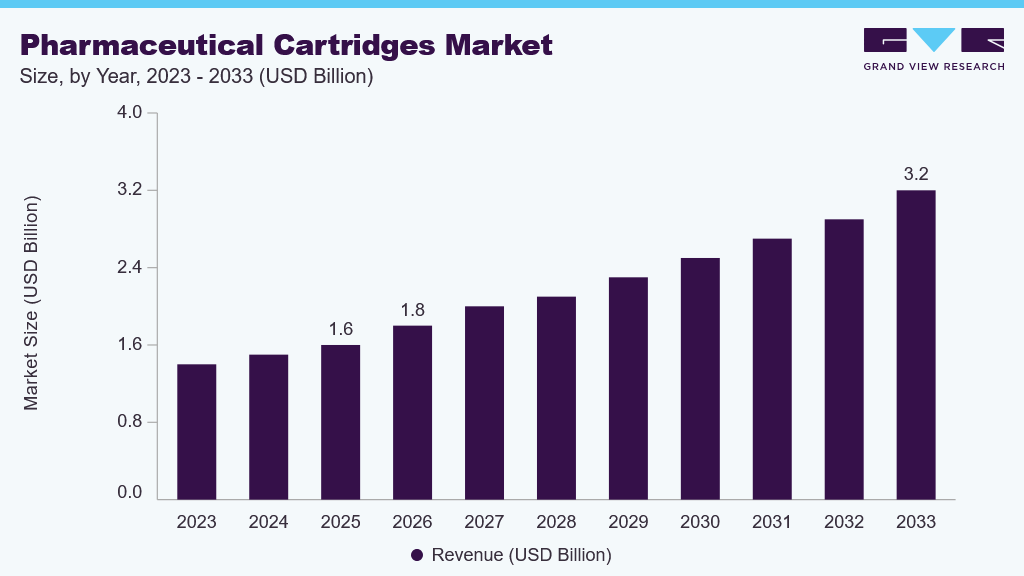 Source: Grand View Research, IR Documents, Primary Interviews, Paid DatabasesTo learn more about this report,
 Download Free Sample Report
The industry is expected to experience significant growth, driven by rising demand for advanced drug-delivery devices. Devices such as injectors, pens, and inhalers are becoming more popular among patients and healthcare providers due to their user-friendly design and effectiveness in improving medication adherence. A considerable portion of these drug delivery devices relies on prefilled cartridges to ensure the safe and accurate administration of medications. For example, when a patient uses an autoinjector to deliver critical medications such as epinephrine, a prefilled cartridge containing the required drug is typically used. As the demand for these drug delivery devices increases, so too will the demand for compatible pharmaceutical cartridges. Pharmaceutical companies must design and manufacture cartridges compatible with various drug-delivery devices to ensure safe and effective medication delivery.
Furthermore, Indian pharmaceutical companies focused on research are continually investing in the development and dissemination of new medication delivery technologies. This has led to frequent mergers and successful collaborations among major drug companies. Needle-free devices and other transdermal technologies have created new opportunities for pharmaceutical partners looking to develop delivery methods for existing compounds that lack effective routes of administration. Over the forecast period, these factors are expected to drive growth in the medication delivery systems market, benefiting both the insulin and dental cartridge industries in India.
The introduction of new products often brings innovation and advanced technology to the industry, including improvements in drug delivery systems, materials, or design. In the pharmaceutical cartridge sector, innovations such as enhanced drug stability, improved safety features, and more precise dosing mechanisms can attract attention and stimulate market growth. For instance, in January 2025, West Pharmaceutical Services, Inc. showcased its latest containment innovations at Pharmapack Europe 2025 by introducing Daikyo PLASCAP Ready-to-Use Validated (RUV) closures in a new nested format. This solution is compatible with advanced injectable drug packaging systems, including pharmaceutical cartridge and vial filling applications, thereby improving manufacturing efficiency while meeting the growing demand for biologics and advanced therapies.
Analyst Perspective
The industry is becoming important as drug delivery shifts toward self-administration, biologics, and high-value injectable therapies. Pharmaceutical companies are looking for reliable containment solutions that ensure drug stability, accurate dosing, and compatibility with advanced injection devices. This is creating opportunities for manufacturers that can deliver high-quality cartridges while meeting strict regulatory and quality standards. As the pipeline of injectable drugs continues to expand, demand is expected to favor suppliers with strong manufacturing capabilities, material expertise, and long-term partnerships with pharmaceutical companies. In the coming years, competitive advantage will depend on product quality, production scalability, and the ability to support evolving drug delivery technologies without compromising safety or performance.
Material Insights
The glass cartridges segment dominated the market in 2025. The use of glass in pharmaceutical packaging, such as cartridges, is common, and its production is steadily increasing. Companies are undertaking strategic initiatives to expand their share in pharmaceutical glass cartridges. For instance, in March 2026, Stevanato Group introduced additional EZ-fill pre-sterilized containment solutions, including glass cartridges, designed to improve manufacturing efficiency and support high-value biologic and injectable therapies. This can enable pharmaceutical companies to take advantage of a cartridge-based on-body delivery system that includes a preloaded and prefilled drug container compatible with standard fill-finish techniques. This platform technology can significantly reduce time-to-market and optimize the supply chain.
The plastic cartridges segment is expected to register the fastest CAGR during the forecast period. Plastic has favorable characteristics such as low weight, malleability, and cost-effectiveness compared with metal and glass. Consequently, end-use enterprises prefer packaging solutions based on plastic. The escalating need for pharmaceutical products packaged for convenience, reduced weight, and portability in the pharmaceutical industry is expected to significantly drive growth in the plastic materials segment in the foreseeable future.
Application Insights
The pen injectors segment dominated the market in 2025. A pen injector cartridge is a medical device designed to deliver medication using a pen-like mechanism. It includes a cartridge that contains the medication and a delivery system for injecting it into the body. Companies are focused on developing and manufacturing pen injector cartridges that are safe, effective, and easy to use, catering to the needs of patients and healthcare providers. They collaborate closely with pharmaceutical companies to create customized solutions for specific medications, ensuring that the cartridges are compatible with the drugs and easy to administer.
In March 2025, Phillips-Medisize expanded its Envoi Pen Injector platform by adding compatibility with customizable 1.5 mL and 3 mL pharmaceutical cartridges. This enhancement supports the high-volume delivery of biologics and injectable therapies. The upgraded platform is designed to accelerate drug development and improve manufacturing efficiency for cartridge-based drug delivery devices. According to the company, these pen injectors are specifically engineered for high-volume manufacturing, making them an appealing option for pharmaceutical companies aiming to enter the market quickly, efficiently, and cost-effectively. Furthermore, the company believes that the pen injector will help expand its platform and product portfolio, enabling biopharmaceutical companies to speed up the rollout of both novel and generic drug treatments at significant economies of scale.
The wearable injectors segment is expected to register the fastest CAGR during the forecast period. This is attributed to the increasing prevalence of homecare settings and advancements in drug delivery technologies. Industry stakeholders are implementing a range of competitive measures to strengthen their presence in this segment. For instance, in December 2025, SCHOTT Pharma announced its strategy to expand production capacity in the U.S. and Asia, particularly China and India, while continuing investments at its manufacturing facilities in Hungary and Serbia to meet the growing global demand for injectable drug containment solutions, including pharmaceutical cartridges. As a major provider of injection devices, with a focus on wearable injectors, SCHOTT Pharma aimed to enhance its cartridge production capabilities to bolster its industry position. Such initiatives propel industry growth.
Chamber Type Insights
The dual chamber segment dominated the market in 2025. Dual-chamber cartridges are frequently used to reconstitute pharmaceuticals, particularly for substances such as vaccines, biologics, and hormone therapies. The prevalence of delicate drug formulations has witnessed a steady increase in recent years and is anticipated to continue expanding, presenting noteworthy hurdles in terms of shelf-life stability. The individual reconstitution of lyophilized compounds may compromise both dosage precision and operational efficiency. Nevertheless, the use of dual-chamber cartridges emerges as an effective solution to address these challenges. By separating the two substances with a plunger, these cartridges enable immediate reconstitution of the components before administration, thereby enhancing both accuracy and handling efficiency.
The large-volume segment is expected to grow significantly during the forecast period, driven by increasing demand for high-volume injectable biologics, biosimilars, and specialty pharmaceuticals. Large-volume cartridges enable efficient drug delivery for therapies requiring higher doses while improving patient convenience and reducing dosing frequency. In addition, the growing adoption of self-injection devices and the expansion of biologics production are supporting segment growth. Furthermore, continuous advancements in cartridge manufacturing and the rising prevalence of chronic diseases are expected to drive sustained demand for large-volume pharmaceutical cartridges.
Size Insights
The 3ml segment dominated the market in 2025. 3 mL cartridges are commonly used for drugs that require a larger volume of medication to be delivered to the patient, such as certain hormone therapies, anticoagulants, and other biologics. One of the primary advantages of 3 mL cartridges is that they can reduce the number of injections required to administer a given dose of medication, which can be particularly beneficial for patients who require frequent injections. The 3 mL cartridge kit from Pii supports a variety of therapies that require frequent injections and variable doses, thereby increasing patient compliance. A 3 mL size might be preferred for certain drug delivery applications due to factors such as dosage requirements, patient convenience, or specific therapeutic needs. Additionally, pharmaceutical formulations often require flexibility in dosing, and a 3ml cartridge provides a good balance by accommodating a range of dosages while remaining manageable for ease of use.
The 5 mL segment is expected to see significant growth during the forecast period, driven by increasing demand for injectable biologics, specialty drugs, and high-volume therapies. In addition, the growing adoption of reusable injection devices and self-administration systems is supporting segment growth. Furthermore, the expansion of biologics manufacturing and the rising prevalence of chronic diseases are expected to drive sustained demand for 5 mL pharmaceutical cartridges.
Therapeutic Area Insights
The diabetes segment dominated the market in 2025. In diabetes management, pharmaceutical cartridges play a crucial role in insulin delivery via specialized devices such as insulin pens and pumps. As a result, the evolution of these delivery devices is expected to impact the pharmaceutical cartridges market significantly. This holds particular significance because both insulin pens and pumps rely on prefilled cartridges for the controlled delivery of insulin to individuals with diabetes. For instance, in January 2025, Tandem Diabetes Care revised its acquisition agreement with AMF Medical SA, simplifying the terms of the transaction to accelerate development of the Sigi Patch Pump, which uses pre-filled insulin cartridges for advanced diabetes management. The updated agreement reinforces Tandem's commitment to expanding innovative cartridge-based drug delivery solutions.
The oncology segment is expected to see significant growth during the forecast period, driven by the increasing use of injectable biologics, targeted therapies, and immunotherapies for cancer treatment. Pharmaceutical cartridges offer accurate dosing, reduced drug wastage, and compatibility with advanced drug delivery devices, making them well suited for oncology applications. For instance, in March 2025, SCHOTT Pharma announced the expansion of its sterile ready-to-use (RTU) cartridge portfolio to support advanced injectable biologics and specialty therapies, including oncology drugs.
End-use Insights
The pharmaceuticals segment led the market in 2025. Pharmaceutical enterprises can strategically employ cartridges to enhance their manufacturing and packaging processes, as illustrated by the utilization of prefilled cartridges engineered to accommodate precise drug volumes. This methodology reduces the need for manual filling, thereby lowering the risk of errors. Furthermore, integrating cartridges into automated filling and packaging systems enhances operational efficiency and cost-effectiveness. Pharmaceutical cartridges offer a reliable, streamlined approach to storing and delivering drugs while adhering to stringent standards for patient safety and product quality. With the increasing demand for injectable drugs, continued adoption of pharmaceutical cartridges is anticipated in the pharmaceutical sector.
The others segment is expected to register the fastest CAGR during the forecast period. The other end-user segment includes life sciences companies, academic institutions, and drug product/fill-and-finish contract manufacturers. Academic institutes, such as universities, use cartridges to store and deliver various types of drugs, including experimental formulations & clinical trial samples. Academic institutes may use cartridges made of glass or plastic, depending on the specific needs of their research. Overall, while the pharmaceutical industry's needs primarily drive the market for pharmaceutical cartridges, academic institutions may be an important customer segment for manufacturers. As R&D efforts in the pharmaceutical and biotech industries continue to expand, the demand for cartridges by academic institutions is likely to continue growing, driving growth in the near future.
Regional Insights
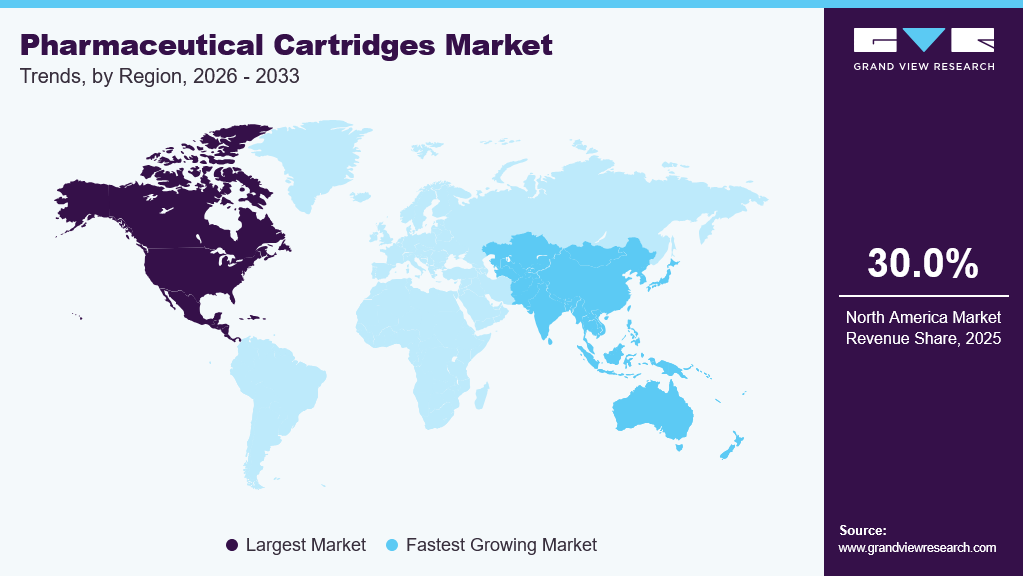
The North America pharmaceutical cartridges market accounted for around 30.0% of the global market in 2025 and is expected to continue its dominance over the forecast period. Several factors contribute to this growth, including increasing demand for advanced drug delivery systems, a growing focus on patient safety and convenience, and a rising number of chronic diseases. A surge in demand for self-administered injectable medications and the development of new biologic drugs with complex formulation requirements are also fueling the expansion of the market in North America.
 To learn more about this report, Download Free Sample Report
U.S. Pharmaceutical Cartridges Market Trends
The pharmaceutical cartridges market in the U.S. is expected to grow over the forecast period due to rising demand, driven by the rising prevalence of chronic diseases such as diabetes, cancer, and autoimmune disorders, as well as an aging population.
Asia Pacific Pharmaceutical Cartridges Market Trends
The pharmaceutical cartridges market in Asia Pacific is anticipated to grow at the fastest CAGR over the forecast period. The robust growth observed in the market can be attributed to the significant presence of key companies and the rising incidence of chronic diseases. The proliferation of numerous small and medium-sized production units in the region substantiates this accelerated growth. Additionally, the presence of lenient regulatory regimes in the region facilitates manufacturers and fosters an environment that attracts foreign investment.
The China pharmaceutical cartridges industry is expected to grow over the forecast period owing to increasing government initiatives, expanding contract manufacturing activities, and an aging population. The substantial population growth, coupled with sustained economic advancement, is fueling the growth of the market. The rising disposable income among the middle class and the robust expansion of credit facilities stand out as key factors driving the industry.
Key Pharmaceutical Cartridges Company Insights
The pharmaceutical cartridges market has seen significant trends recently, particularly the growing demand for pre-filled syringes and cartridges, driven by the preference for self-administration and the rise of biologics. Advanced materials and manufacturing technologies, such as high-quality polymers and improved barrier properties, are enhancing cartridge systems’ safety and efficacy. Additionally, the increasing focus on personalized medicine and the biopharmaceutical sector’s growth emphasize the need for precise drug delivery, creating opportunities for collaboration between established and emerging players to develop customized solutions.
Key Pharmaceutical Cartridges Companies
The following key companies have been profiled for this study on the pharmaceutical cartridges market:
-
Stevanato Group S.p.A.
-
NIPRO Corporation
-
Gerresheimer AG
-
West Pharmaceutical Services, Inc.
-
SCHOTT AG
-
Transcoject GmbH
-
Shandong Medicinal Glass Co., Ltd.
-
Dätwyler Holding Inc.
-
AptarGroup, Inc.
-
Sonata Rubber Pvt. Ltd.
Recent Developments
-
In January 2026, SCHOTT Pharma announced the commercial expansion of its prefillable glass containment portfolio, including pharmaceutical cartridges, to support the growing demand for GLP-1 therapies, biologics, and advanced injectable drug delivery systems.
-
In October 2024, Dätwyler expanded its NeoFlex ready-to-use closure portfolio for pharmaceutical cartridges and injectable containment systems. The expanded portfolio enhances compatibility with biologics and other high-value injectable medicines while supporting the increasing demand for ready-to-use primary packaging solutions.
Pharmaceutical Cartridges Market Report Scope
Report Attribute
Details
Market size in 2025
USD 1.6 billion
Estimated market size in 2026
USD 1.8 billion
Projected market size by 2033
USD 3.2 billion
Growth rate
CAGR of 8.4% from 2026 to 2033
Base year for estimation
2025
Actual data
2021 - 2024
Forecast period
2026 - 2033
Quantitative units
Revenue in USD billion, and CAGR from 2026 to 2033
Report coverage
Revenue forecast, company ranking, competitive landscape, growth factors, and trends
Segments covered
Material, application, chamber type, size, therapeutic area, end-use, region
Regional scope
North America; Europe; Asia Pacific; Latin America; MEA
Country scope
U.S.; Canada; UK; Germany; Italy; France; Spain; Denmark; Sweden; Norway; Japan; China; India; South Korea; Australia; Thailand; Brazil; Mexico; Argentina; South Africa; Saudi Arabia; UAE; Kuwait
Key companies profiled
Stevanato Group S.p.A.; NIPRO Corporation; Gerresheimer AG; West Pharmaceutical Services, Inc.; SCHOTT AG; Transcoject GmbH; Shandong Medicinal Glass Co., Ltd.; Dätwyler Holding Inc.; AptarGroup, Inc.; Sonata Rubber Pvt. Ltd.
Customization scope
Free report customization (equivalent up to 8 analysts working days) with purchase. Addition or alteration to country, regional & segment scope.
Pricing and purchase options
Avail of customized purchase options to meet your exact research needs. Explore purchase options
Global Pharmaceutical Cartridges Market Report Segmentation
This report forecasts revenue growth at global, regional, and country levels and provides an analysis of the latest industry trends and opportunities in each of the sub-segments from 2021 to 2033. For this study, Grand View Research has segmented the global pharmaceutical cartridges market report based on material, application, chamber type, size, therapeutic area, end-use, and region:
- Material Outlook (Revenue, USD Billion, 2021 - 2033)
- Glass Cartridges
- Type 1
- Type 2
- Type 3
- Plastic Cartridges
- Polypropylene (PP)
- Cyclic Olefin Copolymer (COC)
- Cyclic Olefin Polymer (COP)
- Polyethylene
- Rubber
- Glass Cartridges
- Application Outlook (Revenue, USD Billion, 2021 - 2033)
- Dental Anesthesia
- Pen Injectors
- Autoinjectors
- Wearable Injectors
- Chamber Type Outlook (Revenue, USD Billion, 2021 - 2033)
- Dual Chamber
- Large Volume
- Size Outlook (Revenue, USD Billion, 2021 - 2033)
- 0.5 ml
- 1.8 ml
- 2ml to 2.5 ml
- 3 ml
- 5 ml
- More than 10 ml
- Therapeutic Area Outlook (Revenue, USD Billion, 2021 - 2033)
- Ophthalmology
- Respiratory
- Neurology
- Oncology
- Immunology
- Cardiology
- Diabetes
- Dental
- Others
- End-use Outlook (Revenue, USD Billion, 2021 - 2033)
- Pharmaceuticals
- Biotechnology
- Research Organizations
- Others
- Regional Outlook (Revenue, USD Billion, 2021 - 2033)
- North America
- U.S.
- Canada
- Europe
- UK
- Germany
- France
- Italy
- Spain
- Denmark
- Sweden
- Norway
- Asia Pacific
- Japan
- China
- India
- Thailand
- South Korea
- Australia
- Latin America
- Brazil
- Mexico
- Argentina
- Middle East & Africa
- South Africa
- Saudi Arabia
- UAE
- Kuwait
- North America
Frequently Asked Questions About This Report
The global pharmaceutical cartridges market size was valued at USD 1.6 billion in 2025 and is estimated at USD 1.8 billion for 2026.
The global pharmaceutical cartridges market is expected to grow at a CAGR of 8.4% from 2026 to 2033, reaching USD 3.2 billion.
North America dominated with an approximately 30.0% revenue share in 2025. This is attributable to rising healthcare awareness coupled with the rising prevalence of chronic conditions.
Key players in the market include Stevanato Group S.p.A.; NIPRO Corporation; Gerresheimer AG; West Pharmaceutical Services, Inc.; SCHOTT AG; Transcoject GmbH; Shandong Medicinal Glass Co., Ltd.; Dätwyler Holding Inc.; AptarGroup, Inc.; Sonata Rubber Pvt. Ltd., and others.
Asia Pacific is the fastest-growing region over the forecast period.
The glass pharmaceutical cartridges segment captured the largest revenue share in 2025, while the plastic cartridges segment is the fastest-growing.
The pen injectors segment captured the largest revenue share in 2025, while the wearable injectors segment is the fastest-growing.
The dual chamber pharmaceutical cartridges segment held a significant market share in 2025.
Key factors that are growing demand for drug delivery devices and the rising prevalence of chronic conditions such as diabetes & arthritis drive the market.
About the Author(s)
Pharmaceuticals Research Team
Healthcare · PharmaceuticalsThis report was authored by the pharmaceuticals research team at Grand View Research - comprising two research analysts, one senior research analyst, and one industry expert - with specialized expertise in the pharmaceuticals segment of the healthcare industry. All findings are based on proprietary healthcare databases, executive interviews, and regulatory analysis, subject to internal peer review prior to publication.
Last Updated:
Speak to Analyst

Customize this report to your needs - add regions, segments, or data points, with 20% free customization.
Or view our licence options:


ISO 9001:2015 & 27001:2022 Certified
We are GDPR and CCPA compliant! Your transaction & personal information is safe and secure. For more details, please read our privacy policy.


