
- Home
- »
- Advanced Interior Materials
- »
-
Photolithography Equipment Market, Industry Report, 2033GVR Report cover

Photolithography Equipment Market (2026 - 2033) Size, Share & Trends Analysis Report By Process (Ultraviolet UV, Deep Ultraviolet, Extreme Ultraviolet), By Light Source (Mercury Lamp, Fluorine Laser, Excimer Laser), By Wave Length, By End Use, By Region, And Segment Forecasts
Market Size, 2025
$13.3BMarket Estimate, 2026
$14.1BMarket Forecast, 2033
$20.3BCAGR, 2026–2033
5.3%Photolithography Equipment Market Summary
The global photolithography equipment market size was valued at USD 13.3 billion in 2025 and is projected to grow from USD 14.1 billion in 2026 to USD 20.3 billion by 2033, at a CAGR of 5.3% from 2026 to 2033. Asia Pacific held the largest share of 68.0% of the global market in 2025. The ongoing expansion and modernization of semiconductor fabrication facilities by integrated device manufacturers (IDMs) and foundries is fostering the demand for photolithography equipment.
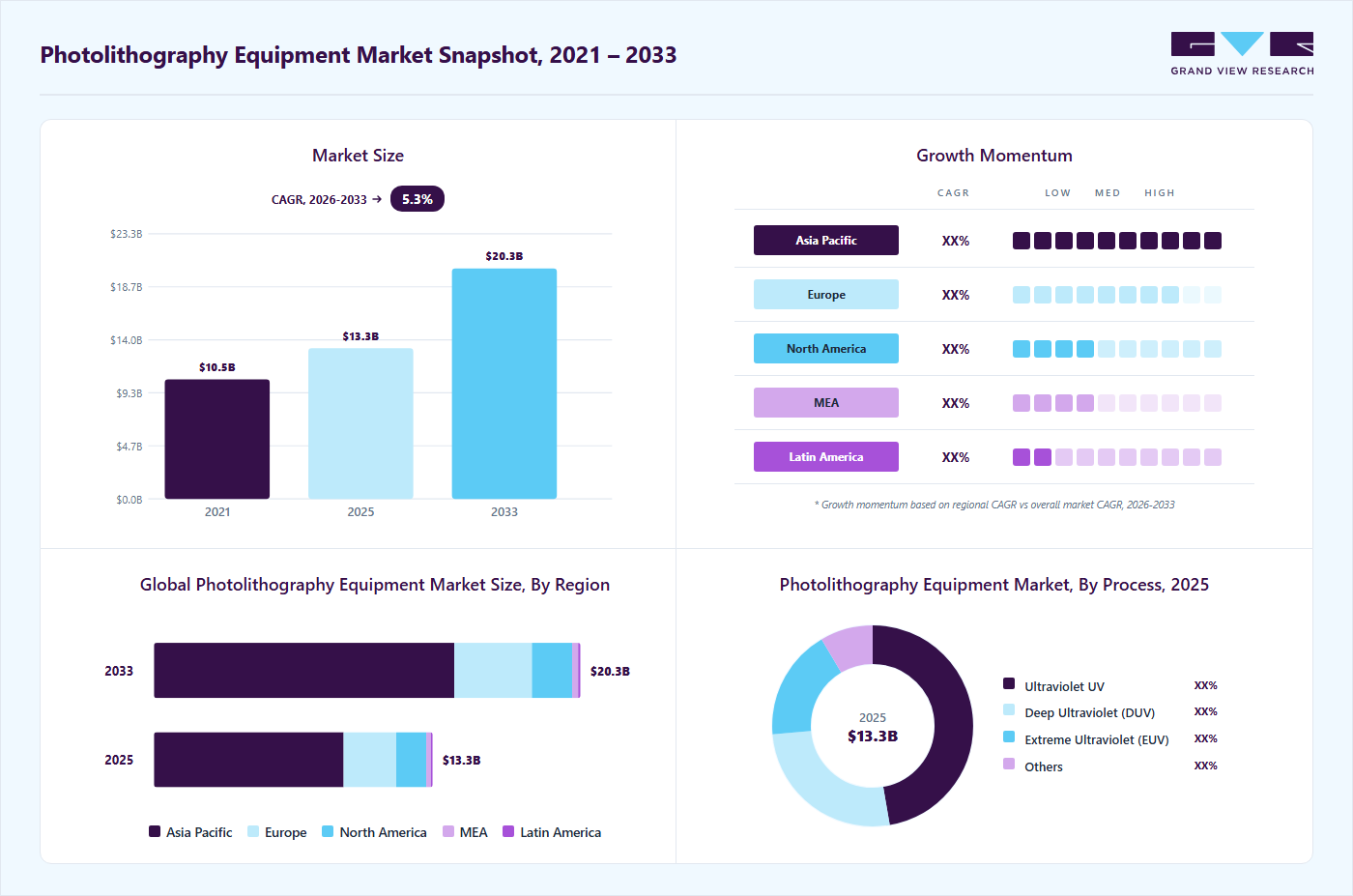 Source: Grand View Research, IR Documents, Primary Interviews, Paid DatabasesTo learn more about this report,
 Download Free Sample Report
 Key Market Trends & Insights
- By process: Ultraviolet (UV) segment dominated the market, with the largest market revenue share in 2025.
- By light source: Excimer laser segment held the largest revenue share in 2025.
- By wave length: 270nm - 170nm segment led the market, with a revenue share of 55.9% in 2025.
- By end use: Integrated device manufacturers segment led the market, with a revenue share of 58.0% in 2025.
Regional Highlights
- Largest regional market: Asia Pacific (68.0% revenue share, 2025)
- Fastest-growing regional market: Asia Pacific (highest CAGR, 2026-2033)
- By country: The China held the largest revenue share in 2025.
Market Size & Forecast
- Market size in 2025: USD 13.3 Billion
- Estimated market size in 2026: USD 14.1 Billion
- Projected market size by 2033: USD 20.3 Billion
- CAGR (2026-2033): 5.3%
Three ways to get this report
Buy it, customize it, or ask a question.Ask an Analyst
Analyst response in 1 business day
- AccessReport author, directly
- Reply timeWithin 1 working day
- No sales callDirect answer only
- FormatEmail reply
- CostFree, no cost
Get the Full Report
What the study covers
- FormatsPDF · Excel · Dashboard
- Timeline2026–2033 annual, 2025 base
- Coverage20+ countries, 5 regions
- Companies10+ key players profiled
Customize the Report
20% free customization
- IncludeCountries, segments, points
- TailorTo your product definition
- ExtendDeeper competitor detail
- OrA fully bespoke study
- Turnaround5–10 working days
Increasing investments in new fabrication plants and the upgrading of existing facilities are encouraging the adoption of advanced lithography equipment. As semiconductor devices continue to scale and integrate more components within smaller chip areas, manufacturers require highly precise lithography systems capable of producing extremely fine circuit patterns. This rising need for high-resolution patterning is encouraging semiconductor manufacturers to invest in advanced photolithography equipment to maintain production efficiency and device performance.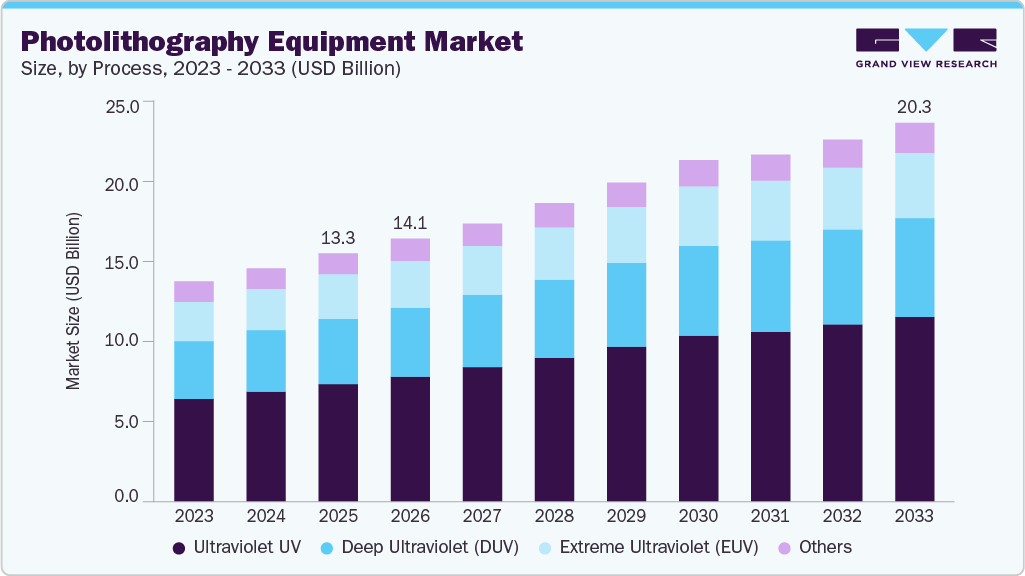 To learn more about this report, Download Free Sample Report
 Market Dynamics
The increasing global demand for semiconductors across applications such as consumer electronics, artificial intelligence (AI), automotive electronics, 5G infrastructure, data centers, and industrial automation is a major factor driving the photolithography equipment market. Photolithography equipment plays a critical role in semiconductor manufacturing by enabling the precise transfer of circuit patterns onto silicon wafers during chip fabrication processes. As semiconductor manufacturers continue to develop smaller, faster, and more energy-efficient chips, demand for advanced lithography technologies that support high-resolution patterning and nanoscale manufacturing is rising significantly.
The rapid adoption of advanced technologies such as AI processors, electric vehicles (EVs), high-performance computing, and IoT devices is further accelerating investments in semiconductor fabrication facilities worldwide. In addition, the transition toward advanced process nodes, including 7nm, 5nm, and below, is driving demand for cutting-edge photolithography systems, such as extreme ultraviolet (EUV) and deep ultraviolet (DUV) lithography equipment.
Despite strong semiconductor demand, the photolithography equipment market faces significant challenges, including extremely high capital investment and technological complexity. Advanced photolithography systems, particularly EUV lithography equipment, require highly sophisticated optics, light sources, precision engineering, and contamination control systems, resulting in exceptionally high manufacturing and procurement costs. Semiconductor fabrication facilities must invest billions of dollars in cleanroom infrastructure, wafer processing equipment, and advanced lithography systems, creating substantial financial barriers for new entrants and smaller semiconductor manufacturers.
Market Concentration & Characteristics
The photolithography equipment industry is concentrated, with a limited number of global suppliers dominating the industry due to the high technological barriers and capital requirements involved in developing advanced lithography systems. The market is characterized by strong dependence on a few leading manufacturers that possess specialized expertise in precision optics, light source technologies, and semiconductor process integration. This concentration limits new entrant participation and strengthens the competitive position of established players, particularly in advanced lithography segments such as extreme ultraviolet (EUV).
The threat of alternatives in the photolithography equipment industry remains relatively limited, as photolithography continues to be the primary method used for semiconductor patterning in large-scale manufacturing. However, emerging technologies such as nanoimprint lithography and other advanced patterning techniques are being explored for specific semiconductor applications. While these alternatives are still in early stages of adoption and face scalability challenges, continued research and development in next-generation lithography technologies may gradually influence future market dynamics.
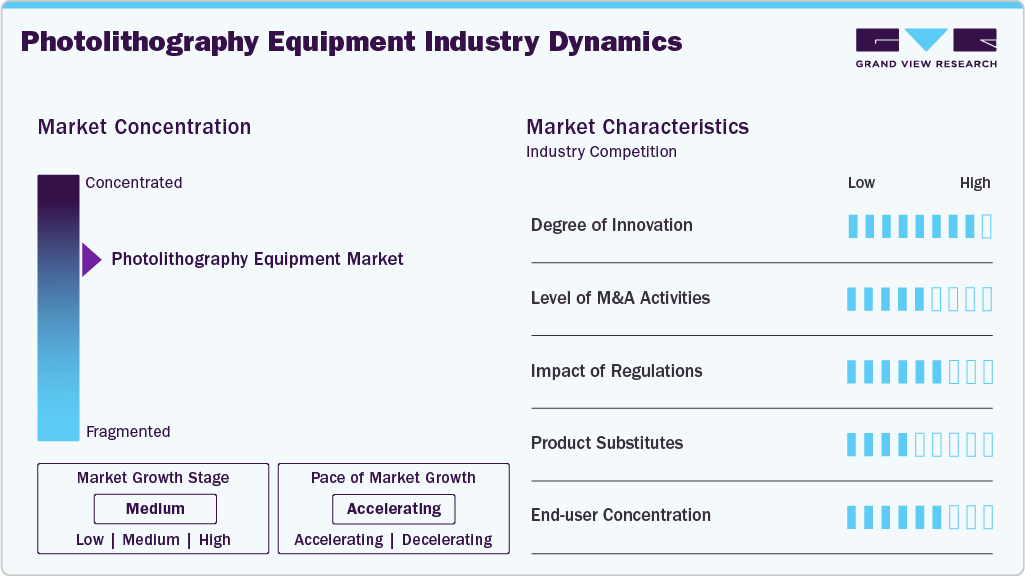 To learn more about this report, Download Free Sample Report
 Regulatory frameworks and technological advancements also play an important role in shaping the photolithography equipment industry. Semiconductor manufacturing is subject to export control regulations, environmental standards, and technology transfer restrictions in several regions, which can affect equipment supply chains and international trade. At the same time, leading companies are focusing on strategies such as increased research and development investment, strategic collaborations with semiconductor manufacturers, and continuous innovation in light source technologies and lithography processes to strengthen their market position and address evolving industry requirements.
Process Insights
The ultraviolet (UV) segment accounted for the largest market revenue share in 2025 and is projected to grow at the fastest CAGR during the forecast period. UV segment is a foundational technology in the photolithography equipment industry, widely used in semiconductor manufacturing for pattern transfer processes. UV lithography systems utilize ultraviolet light to transfer circuit patterns onto wafers and are applied across various semiconductor fabrication stages. Their continued use in mature and legacy semiconductor nodes supports steady demand, particularly for applications where extremely small feature sizes are not required.
The deep ultraviolet (DUV) segment is expected to grow at a significant CAGR during the forecast period. Operating at shorter wavelengths than conventional ultraviolet systems, DUV lithography enables finer patterning and improved resolution, making it suitable for many high-volume semiconductor manufacturing applications. Its established infrastructure and compatibility with existing fabrication processes continue to support strong adoption among semiconductor manufacturers.
End Use Insights
The integrated device manufacturers (IDMs) segment led the market with the largest revenue share of 58.0% in 2025. IDMs design, manufacture, and package semiconductor devices within their own facilities and invest significantly in advanced fabrication technologies to improve production efficiency and maintain technological competitiveness. Their ongoing investments in semiconductor manufacturing infrastructure contribute to steady demand for photolithography equipment.
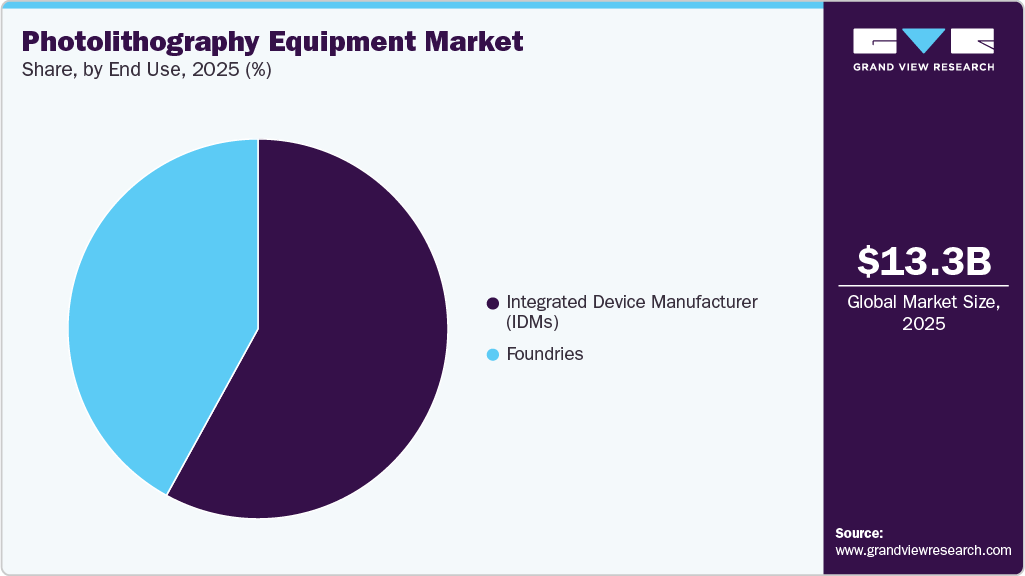 To learn more about this report, Download Free Sample Report
 The foundry segment is anticipated to grow at the fastest CAGR during the forecast period. This segment plays a critical role in the photolithography equipment industry by providing contract semiconductor manufacturing services for fabless chip companies. Foundries typically operate large-scale fabrication facilities and adopt advanced lithography technologies to support diverse semiconductor production requirements. The increasing demand for outsourced semiconductor manufacturing and ongoing investments in advanced fabrication processes are driving the adoption of photolithography equipment in foundry operations.
Light Source Insights
The excimer laser segment accounted for the largest market revenue share in 2025 and is projected to grow at the fastest CAGR during the forecast period, as a key light source for deep ultraviolet lithography systems. Excimer lasers generate short-wavelength ultraviolet light, enabling high-resolution patterning required in semiconductor manufacturing. Their ability to deliver stable and high-intensity light output supports precise wafer processing and high-throughput fabrication, contributing to their widespread use in advanced semiconductor lithography equipment.
The mercury lamp segment is expected to grow at a significant CAGR during the forecast period. Mercury lamps are among the traditional light sources used in photolithography systems, particularly in applications involving mature semiconductor technologies and lower-resolution patterning requirements. These lamps generate ultraviolet light suitable for basic lithographic processes and are often used in legacy semiconductor manufacturing environments. Although newer light-source technologies have gained prominence, mercury lamps remain relevant in certain fabrication processes due to their cost-effectiveness and established operational reliability.
Wave Length Insights
The 270nm - 170nm segment led the market with the largest revenue share of 55.9% in 2025 and is projected to grow at the fastest CAGR during the forecast period. The 270 nm-170 nm wavelength range corresponds primarily to deep-ultraviolet lithography technologies used in advanced semiconductor manufacturing. These wavelengths enable improved resolution and pattern accuracy compared with longer ultraviolet wavelengths, supporting the production of smaller semiconductor features. As semiconductor devices continue to scale down in size, the demand for photolithography equipment operating at these wavelengths remains strong in high-volume fabrication facilities.
The 370 nm - 270 nm segment is projected to grow at a significant CAGR of 5.2% from 2026 to 2033. The 370 nm-270 nm wavelength range is associated with conventional ultraviolet lithography processes commonly used in mature semiconductor manufacturing technologies. Equipment operating within this wavelength range is suitable for patterning applications that require moderate resolution and stable process performance. This segment continues to serve semiconductor fabrication processes focused on legacy nodes and cost-efficient production.
Regional Insights
The photolithography equipment market in North America is experiencing steady growth, due to strong semiconductor manufacturing infrastructure, the presence of major chipmakers and equipment suppliers, and increasing investments in advanced technologies such as artificial intelligence, 5G, and automotive electronics. In addition, government initiatives to strengthen domestic semiconductor production and expand fabrication capacity are supporting demand for advanced lithography systems used in integrated circuit manufacturing.
U.S. Photolithography Equipment Market Trends
The photolithography equipment market in the U.S. is driven by strong investments in domestic semiconductor manufacturing and technological innovation in advanced chip production. Government initiatives aimed at strengthening semiconductor supply chains and expanding fabrication capacity are encouraging the establishment of new fabrication facilities and the modernization of existing plants. In addition, the presence of leading semiconductor companies and continuous research and development activities in advanced semiconductor manufacturing technologies support steady demand for photolithography equipment.
Asia Pacific Photolithography Equipment Market Trends
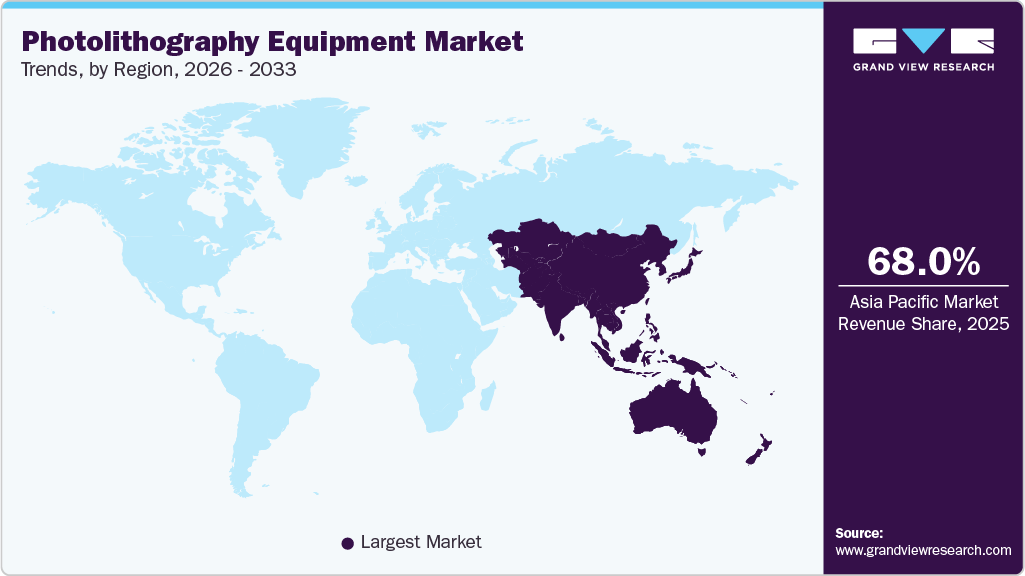
Asia Pacific dominated the global photolithography equipment market with the largest revenue share of 68% in 2025 and is projected to grow at the fastest CAGR during the forecast period, due to its strong semiconductor manufacturing base and extensive fabrication capacity. Countries such as Taiwan, South Korea, China, and Japan host a large number of semiconductor foundries and integrated device manufacturers that continuously invest in advanced lithography technologies to support high-volume chip production. The region’s well-established semiconductor supply chain, increasing investments in new fabrication plants, and strong demand for advanced semiconductor manufacturing technologies continue to drive market growth.
 To learn more about this report, Download Free Sample Report
 The photolithography equipment market in China accounted for the largest market revenue share in the Asia Pacific in 2025, due to its large semiconductor manufacturing base and ongoing efforts to strengthen domestic chip production capabilities. The country continues to invest heavily in semiconductor fabrication facilities and technology development to reduce dependence on imported semiconductor components. These investments, along with increasing government support for the semiconductor industry, are driving demand for photolithography equipment, although export controls and technology restrictions may influence equipment availability.
The Taiwan photolithography equipment market plays a critical role in the Asia Pacific region, as it hosts some of the world’s largest semiconductor foundries and advanced chip manufacturing facilities. Continuous investments in advanced semiconductor fabrication processes and capacity expansion by major foundries are supporting strong demand for advanced lithography equipment. While geopolitical tensions between Taiwan and China present potential risks to semiconductor supply chains, Taiwan continues to maintain its position as a leading hub for advanced semiconductor manufacturing.
Europe Photolithography Equipment Market Trends
The photolithography equipment market in Europe is supported by the region strong semiconductor equipment manufacturing ecosystem and increasing efforts to enhance semiconductor production capacity. Government policies and funding programs aimed at improving technological sovereignty in semiconductor manufacturing are encouraging investments in new fabrication facilities and technology development.
The Germany photolithography equipment market is supported by its strong semiconductor and advanced manufacturing ecosystem. The country is focusing on expanding semiconductor production capacity and strengthening its role in Europe semiconductor value chain through investments in new fabrication facilities and research initiatives. Demand for advanced semiconductor devices used in automotive electronics and industrial applications is also encouraging semiconductor manufacturers to adopt advanced lithography technologies.
The photolithography equipment market in the UK is primarily supported by semiconductor research, design activities, and investments in emerging semiconductor technologies. The country has a strong presence in semiconductor innovation, particularly through research institutions and technology companies focusing on advanced materials and chip design. Although large-scale semiconductor fabrication capacity remains limited, ongoing efforts to strengthen domestic semiconductor capabilities and research infrastructure are contributing to market development.
Latin America Photolithography Equipment Market Trends
The photolithography equipment market in Latin America remains relatively limited but is gradually developing due to increasing interest in semiconductor manufacturing and electronics production. Some countries in the region are focusing on strengthening their electronics manufacturing capabilities and supporting semiconductor-related research initiatives. However, limited semiconductor fabrication infrastructure and lower levels of investment compared with major semiconductor manufacturing regions may restrict rapid market expansion.
The Brazil photolithography equipment market is relatively small and mainly supported by semiconductor research activities and limited domestic semiconductor manufacturing capabilities. The country is gradually focusing on strengthening its electronics manufacturing and semiconductor research infrastructure to support technological development. However, limited large-scale fabrication facilities and lower investment levels compared with major semiconductor-producing countries may restrain significant market growth.
Middle East & Africa Photolithography Equipment Market Trends
The photolithography equipment market in the Middle East and Africa is still in the early stages of development, with growth mainly supported by emerging investments in technology infrastructure and manufacturing initiatives. Several countries in the region are exploring opportunities to develop semiconductor-related capabilities as part of broader economic diversification strategies. Nevertheless, the limited presence of large-scale semiconductor fabrication facilities and technical infrastructure in the region remains a key challenge affecting the region’s position in the global market.
The Israel photolithography equipment market is influenced by the country strong semiconductor research and chip design ecosystem, supported by the presence of major technology companies and innovation centers. Investments in semiconductor research, advanced technology development, and specialized chip design continue to support the adoption of semiconductor manufacturing technologies. Although ongoing regional geopolitical tensions present certain economic uncertainties, Israel’s well-established technology sector continues to support semiconductor-related development and investment.
Key Photolithography Equipment Company Insights
Some of the key players operating in the market include AMSL and Nikon Corporation.
-
ASML is a Netherlands-based semiconductor equipment manufacturer and one of the key suppliers of photolithography systems used in semiconductor fabrication. The company specializes in advanced lithography technologies, including deep ultraviolet (DUV) and extreme ultraviolet (EUV) systems, which are critical for producing high-performance semiconductor chips with extremely small circuit features. ASML’s equipment is widely used by integrated device manufacturers (IDMs) and semiconductor foundries for wafer patterning processes in advanced semiconductor manufacturing.
-
Nikon Corporation is a Japan-based technology company founded in 1917 that specializes in optics, imaging, and precision equipment solutions. The company develops and manufactures a wide range of products including digital cameras and interchangeable lenses, semiconductor and flat-panel display lithography systems, microscopes, and industrial measurement instruments. Nikon operates globally across regions such as Japan, North America, Europe, and Asia, serving industries ranging from consumer imaging to semiconductor manufacturing and advanced industrial inspection.
Key Photolithography Equipment Companies:
The following key companies have been profiled for this study on the photolithography equipment market.
- ASML
- Nikon Corporation
- Canon U.S.A., Inc
- EV Group (EVG)
- Veeco Instruments Inc
- Neutronix Quintel
- SUSS MicroTec SE
- Comp8
Competitive Benchmarking
Operating Strategies
Competitive Edge
Weaknesses
Mature Players: ASML; Nikon Corporation; Canon U.S.A., Inc.; EV Group (EVG); Veeco Instruments Inc.; SUSS MicroTec SE
- Strong investments in advanced semiconductor lithography technologies, including EUV and DUV systems
- Expansion of wafer processing, advanced packaging, MEMS, and nanofabrication solutions
- Focus on high-precision optics, automation integration, and next-generation semiconductor manufacturing capabilities
- Strong global brand recognition and advanced technological expertise in semiconductor lithography systems
- High precision, process reliability, and nanoscale patterning capabilities
- Established customer base across semiconductor fabrication, advanced packaging, and microelectronics industries
- Extremely high R&D and manufacturing costs
- Dependence on semiconductor capital expenditure cycles and foundry investments
- Complex supply chain dependencies for optics, lasers, and semiconductor-grade components
Emerging Players: Neutronix Quintel, Comp8
- Increasing emphasis on customized lithography systems and cost-effective wafer processing technologies
- Expansion into MEMS, microelectronics, and research laboratory applications
- Strengthening partnerships with regional semiconductor and R&D organizations
- Competitive flexibility and responsiveness to specialized semiconductor manufacturing requirements
- Strong focus on niche and application-specific lithography solutions
- Growing adoption in research institutes and small-scale semiconductor fabrication environments
- Comparatively lower global market penetration and brand visibility
- Limited financial scale for large R&D and international expansion investments
- Lower technological diversification compared to multinational semiconductor equipment providers
Recent Developments
-
In March 2025, ASML and imec signed a strategic partnership agreement to advance next-generation semiconductor manufacturing technologies. Under the collaboration, ASML will provide advanced lithography systems, including high numerical aperture (High-NA) extreme ultraviolet (EUV) and deep ultraviolet (DUV) equipment, for imec’s semiconductor research pilot line. The partnership aims to support the development of future semiconductor nodes and improve innovation in advanced chip manufacturing processes.
-
In February 2026, ASML announced plans to introduce a next-generation extreme ultraviolet (EUV) lithography machine with a 1,000-watt light source by 2030, significantly increasing chip manufacturing productivity. The higher light power would allow semiconductor manufacturers to process around 330 wafers per hour compared with about 220 currently, enabling up to 50% more chips to be produced per machine. The upgrade is expected to improve wafer throughput and reduce manufacturing costs, supporting growing demand for advanced semiconductors.
Photolithography Equipment Market Report Scope
Report Attribute
Details
Market size in 2025
USD 13.3 billion
Estimated Market size in 2026
USD 14.1 billion
Projected Market size by 2033
USD 20.3 billion
Growth rate
CAGR of 5.3% from 2026 to 2033
Base year for estimation
2025
Historical data
2021 - 2024
Forecast period
2026 - 2033
Quantitative units
Revenue in USD million/billion, and CAGR from 2026 to 2033
Report coverage
Revenue forecast, company market position analysis, competitive landscape, growth factors, and trends
Segments covered
Process, light source, wave length, end use, region
Regional scope
North America; Europe; Asia Pacific; Latin America; Middle East & Africa
Country Scope
U.S.; Canada; Mexico; UK; Germany; France; Italy; Spain; Netherlands; China; India; Japan; South Korea; Malaysia; Taiwan; Brazil; South Africa; Israel
Key companies profiled
ASML; Nikon Corporation; Canon U.S.A., Inc.; EV Group (EVG); Veeco Instruments Inc.; Neutronix Quintel; SUSS MicroTec SE.
Customization scope
Free report customization (equivalent up to 8 analysts working days) with purchase. Addition or alteration to country, regional & segment scope.
Pricing and purchase options
Avail customized purchase options to meet your exact research needs. Explore purchase options
Global Photolithography Equipment Market Report Segmentation
This report forecasts revenue growth at global, regional, and country levels and provides an analysis of the latest industry trends in each of the sub-segments from 2021 to 2033. For this study, Grand View Research has segmented the global photolithography equipment market report based on type,light source, wavelength, end use, and region.
-
Process Outlook (Revenue, USD Billion, 2021 - 2033)
-
Ultraviolet UV
-
Deep Ultraviolet (DUV)
-
Extreme Ultraviolet (EUV)
-
Others
-
-
Light Source Outlook (Revenue, USD Billion, 2021 - 2033)
-
Mercury Lamp
-
Fluorine Laser
-
Excimer Laser
-
Others
-
-
Wave Length Outlook (Revenue, USD Billion, 2021 - 2033)
-
370nm -270nm
-
270nm - 170nm
-
70nm - 1nm
-
-
End Use Outlook (Revenue, USD Billion, 2021 - 2033)
-
Integrated Device Manufacturer (IDMs)
-
Foundries
-
-
Regional Outlook (Revenue, USD Billion; 2021 - 2033)
-
North America
-
U.S.
-
Canada
-
Mexico
-
-
Europe
-
UK
-
Germany
-
France
-
Italy
-
Spain
-
Netherlands
-
-
Asia Pacific
-
China
-
India
-
Japan
-
South Korea
-
Malaysia
-
Taiwan
-
-
Latin America
-
Brazil
-
-
Middle East & Africa
-
South Africa
-
Israel
-
-
Delivered Customizations
This report has been delivered with the following In-depth customizations
Client Request
Customization Delivered
Value Adds
Regional Segmentation
Detailed market estimates and forecasts for the Photolithography Equipment Market across North America, Europe, Asia Pacific, Latin America, and the Middle East & Africa. Country-level demand analysis covering semiconductor foundries, integrated device manufacturers (IDMs), MEMS fabrication, and advanced packaging facilities.
Identify high-growth semiconductor manufacturing hubs and fabrication investment hotspots. Support regional expansion planning, supply chain localization strategies, and demand forecasting.
Competitive Benchmarking
Detailed benchmarking of leading photolithography equipment manufacturers based on product offerings, optics technology, automation integration, regional presence, and strategic partnerships with semiconductor foundries.
Enable competitive intelligence and technology benchmarking. Support partnership evaluation, product positioning, and innovation strategy development.
Opportunity Assessment
Identification of emerging growth opportunities driven by AI chip demand, 5G infrastructure expansion, electric vehicle semiconductor requirements, advanced packaging technologies, and increasing investments in domestic semiconductor fabrication facilities.
Prioritize high-growth applications and investment opportunities. Support innovation roadmap development and long-term strategic planning.
Frequently Asked Questions About This Report
Key factors that are driving the photolithography equipment market include the ongoing demand for smaller, more powerful, and energy-efficient semiconductor devices drives the need for advanced photolithography equipment. As semiconductor technology evolves, manufacturers require equipment capable of producing smaller feature sizes and higher resolution.
Asia Pacific dominated with a 68.0% revenue share in 2025.
Asia Pacific is the fastest-growing region over the forecast period.
The excimer laser segment held the largest revenue share in 2025.
Integrated Device Manufacturers (IDMs) held the largest revenue share of 58.0% in 2025.
The 270nm - 170nm segment held the largest share of 55.9% in 2025 and is projected to grow at the fastest CAGR during the forecast period.
The global photolithography equipment market size was valued at USD 13.3 billion in 2025 and is estimated at USD 14.1 billion for 2026.
The global photolithography equipment market is expected to grow at a CAGR of 5.3% from 2026 to 2033, reaching USD 20.3 billion.
Key players include ASML, Nikon Corporation, Canon U.S.A., Inc., EV Group (EVG), Veeco Instruments Inc., Neutronix Quintel, and SUSS MicroTec SE.
About the Author(s)
Advanced Interior Materials Research Team
Advanced Materials · Advanced Interior MaterialsThis report was authored by the advanced interior materials research team at Grand View Research - comprising two research analysts, one senior research analyst, and one industry expert - with specialized expertise in the advanced interior materials segment of the advanced materials industry. All findings are based on proprietary advanced materials databases, executive interviews, and regulatory analysis, subject to internal peer review prior to publication.
Last Updated:
Speak to Analyst

Customize this report to your needs - add regions, segments, or data points, with 20% free customization.
Or view our licence options:


ISO 9001:2015 & 27001:2022 Certified
We are GDPR and CCPA compliant! Your transaction & personal information is safe and secure. For more details, please read our privacy policy.


