
- Home
- »
- Next Generation Technologies
- »
-
PLC Market Size, Growth Report, 2026-2035GVR Report cover
![PLC Market (2026 - 2035)Report]()
PLC Market (2026 - 2035)
Size, Share & Trends Analysis Report By Product Type (Modular PLC, Compact PLC, Rack-mounted PLC, Safety PLC), By Component (Hardware, Software), By End Use, By Region, And Segment Forecasts
Market Size, 2025
$13.9BMarket Estimate, 2026
$14.7BMarket Forecast, 2035
$23.7BCAGR, 2026–2035
5.5%PLC Market Summary
The global PLC market size was valued at USD 13.9 billion in 2025 and is projected to grow from USD 14.7 billion in 2026 to USD 23.7 billion in 2035, at a CAGR of 5.5% from 2026 to 2035. Asia Pacific dominated the market, accounting for the largest revenue share in 2025. The PLC market is witnessing steady growth, driven by increasing adoption of industrial automation, smart manufacturing, and Industry 4.0 initiatives. Rising demand for efficient process control, real-time monitoring, and enhanced operational productivity across manufacturing, automotive, energy, food & beverage, and pharmaceutical industries is further supporting market expansion.
Key Market Trends & Insights
- By product type: The modular PLC segment held the largest market share in 2025.
- By component: The hardware segment held the largest market share in 2025.
- By end use: The manufacturing segment accounted for the largest market share in 2025.
Regional Highlights
- Largest regional market: Asia Pacific (2025)
- Fastest-growing regional market: Asia Pacific (highest CAGR, 2026-2035)
Market Size & Forecast
- Market size in 2025: USD 13.9 Billion
- Estimated market size in 2026: USD 14.7 Billion
- Projected market size by 2035: USD 23.7 Billion
- CAGR (2026-2035): 5.5%
The PLC (Programmable Logic Controller) market is experiencing strong growth as industries continue to automate production processes and modernize manufacturing facilities. Companies are increasingly investing in PLCs to improve operational efficiency, reduce downtime, and achieve greater accuracy in production. The rapid adoption of Industry 4.0, smart factories, robotics, and Industrial Internet of Things (IIoT) technologies has significantly increased the demand for advanced PLC systems capable of real-time monitoring, data processing, and seamless machine-to-machine communication. Growing investments in sectors such as automotive, food & beverage, pharmaceuticals, energy, and water treatment are further contributing to market expansion.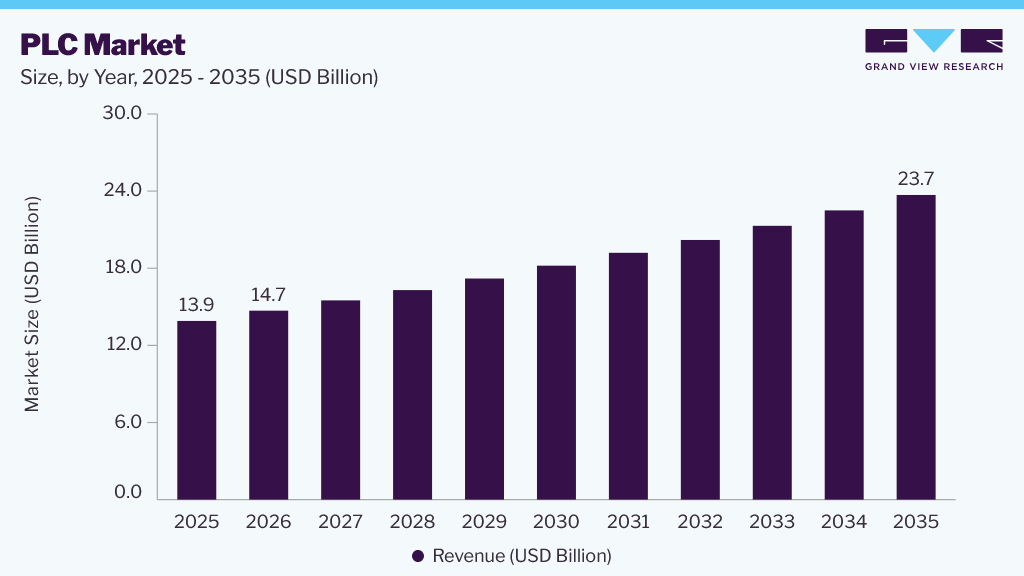
Despite favorable growth trends, the market faces challenges related to the high initial cost of advanced PLC systems and the complexity of integrating them with legacy industrial infrastructure. Small and medium-sized enterprises often face budget constraints when upgrading existing automation systems. Increasing cybersecurity concerns associated with connected industrial control systems and the shortage of skilled automation professionals can slow the adoption of advanced PLC technologies in certain regions. The growing demand for smart manufacturing, connected factories, and real-time process control across industries such as manufacturing, automotive, energy, food & beverage, and pharmaceuticals continues to drive innovation and market growth.
The market presents significant opportunities as manufacturers accelerate digital transformation and expand investments in intelligent automation. The growing deployment of edge computing, AI-enabled process optimization, cloud-based industrial platforms, and predictive maintenance solutions is creating new demand for next-generation PLCs. Emerging economies are also investing heavily in manufacturing modernization, renewable energy projects, and smart infrastructure, opening new avenues for PLC vendors. As industrial operations become increasingly connected and data-driven, the demand for flexible, scalable, and high-performance PLC solutions is expected to continue to rise over the forecast period.
Analyst Perspective
The PLC (Programmable Logic Controller) market is expected to witness sustained growth as industrial automation becomes a strategic priority across manufacturing and process industries. The shift toward smart factories, connected production environments, and data-driven operations is increasing the demand for advanced PLC systems that offer greater flexibility, faster processing, and seamless integration with IIoT and cloud platforms. Manufacturers are focusing on developing compact, high-performance controllers with enhanced cybersecurity, remote connectivity, and AI-enabled capabilities to meet evolving industrial requirements. As industries continue to invest in digital transformation, predictive maintenance, and energy-efficient operations, the PLC market is well positioned for long-term growth and technological innovation.
Product Type Insights
The modular PLC segment held the largest market share in 2025. Modular PLCs are widely adopted across large-scale manufacturing facilities and complex industrial processes due to their flexibility, scalability, and ability to support multiple input/output (I/O) modules. These systems enable users to expand functionality as operational requirements evolve, making them well suited for industries such as automotive, oil & gas, energy, pharmaceuticals, and food & beverage. Their high processing capability, ease of customization, and reliable performance in demanding industrial environments continue to drive widespread adoption, helping the segment maintain its leading market position.
The safety PLC segment is expected to register the fastest growth over the forecast period. Increasing emphasis on workplace safety, stringent industrial safety regulations, and the growing use of automated machinery are driving demand for safety PLCs across manufacturing, chemical processing, mining, and energy industries. These controllers are designed to monitor critical safety functions, minimize operational risks, and ensure compliance with international safety standards. Rising investments in smart factories, collaborative robotics, and advanced industrial automation are expected to further accelerate the adoption of safety PLCs as companies prioritize both productivity and worker safety. For instance, in April 2024, Siemens introduced the SIMATIC S7-1200 G2, the next-generation PLC designed to meet the growing demands of modern machine automation. As part of the Siemens Xcelerator portfolio, the new controller combines higher processing performance, integrated motion control, flexible machine safety, enhanced communication, and seamless scalability.
Component Insights
The hardware segment held the largest market share in 2025. Hardware forms the core of every programmable logic controller (PLC) system, comprising CPUs, input/output (I/O) modules, power supplies, communication modules, and processors that enable reliable industrial automation. The widespread deployment of PLC hardware across manufacturing, automotive, energy, oil & gas, food & beverage, and pharmaceutical industries continues to drive segment growth. Increasing investments in factory automation, production line modernization, and industrial control systems have further strengthened demand for high-performance PLC hardware. Its durability, reliability, and ability to operate in harsh industrial environments continue to support its dominant market position.
The software segment is expected to register the fastest growth over the forecast period. The growing adoption of Industry 4.0, Industrial Internet of Things (IIoT), cloud-based automation, and digital twin technologies is driving demand for advanced PLC programming, visualization, diagnostics, and monitoring software. Modern PLC software enables real-time process control, predictive maintenance, remote access, and seamless integration with SCADA, MES, and enterprise management systems. As manufacturers increasingly focus on operational efficiency, data-driven decision-making, and flexible production environments, investments in intelligent PLC software solutions are expected to accelerate throughout the forecast period. For instance, in October 2024, Rockwell Automation enhanced its FactoryTalk Optix platform with new cloud-enabled visualization and remote monitoring capabilities, enabling seamless integration with PLC systems for real-time industrial automation and operational analytics. The update reflects the growing importance of software-driven automation in modern manufacturing environments.
End Use Insights
The manufacturing segment held the largest market share in 2025. The dominance of this segment is driven by the widespread adoption of PLCs for automating production lines, assembly operations, packaging, material handling, and quality control processes. PLCs enable manufacturers to improve operational efficiency, minimize downtime, enhance production accuracy, and reduce labor costs through reliable real-time process control. The growing implementation of smart factories, robotics, and Industry 4.0 technologies has further increased demand for PLCs across discrete and process manufacturing industries. Continuous investments in factory modernization and digital transformation continue to support the segment's leading position.
The energy & utilities segment is expected to register the fastest growth over the forecast period. Increasing investments in renewable energy projects, smart grids, power generation, and water and wastewater treatment facilities are driving the adoption of advanced PLC systems. These controllers enable efficient monitoring, process automation, remote operation, and predictive maintenance of critical infrastructure, improving system reliability and operational efficiency. The growing focus on energy efficiency, grid modernization, and industrial sustainability is expected to further accelerate the deployment of PLCs across the energy and utilities sector.
Regional Insights
The Asia Pacific region held the largest market share in 2025. The region's leadership is driven by rapid industrialization, strong manufacturing output, and increasing investments in factory automation across countries such as China, Japan, South Korea, and India. The presence of major automotive, electronics, semiconductor, and industrial manufacturing hubs has significantly boosted the adoption of programmable logic controllers (PLCs). In addition, government initiatives supporting smart manufacturing, digital transformation, and Industry 4.0 are encouraging manufacturers to modernize production facilities with advanced automation technologies. Ongoing investments in industrial infrastructure and automation solutions continue to strengthen the region's market position.
The Asia Pacific region is also expected to register the fastest growth over the forecast period. Rising investments in smart factories, renewable energy, industrial robotics, electric vehicle manufacturing, and process automation are creating strong demand for PLC systems across the region. Emerging economies are increasingly adopting intelligent automation to improve production efficiency, product quality, and operational safety. Furthermore, supportive government policies promoting advanced manufacturing and expanding industrial sectors are expected to accelerate PLC deployment across diverse end-use industries, making Asia Pacific the fastest-growing regional market.
In March 2025, Mitsubishi Electric Corporation announced the establishment of the Mitsubishi Electric Intelligent Manufacturing Technology (China) Group Co., Ltd. in Suzhou, China, to strengthen its Factory Automation (FA) systems business. The new headquarters will oversee product planning, development, manufacturing, and sales, reinforcing the company's commitment to expanding industrial automation solutions across the Asia Pacific region.
Key PLC Company Insights
The PLC (Programmable Logic Controller) market is characterized by the presence of global, regional, and specialized automation companies competing through continuous product innovation, strategic partnerships, acquisitions, and expansion of their industrial automation portfolios. Leading manufacturers are increasingly investing in Industry 4.0 technologies, Industrial Internet of Things (IIoT), artificial intelligence (AI), edge computing, cloud-enabled automation, and cybersecurity-enhanced PLC solutions to strengthen their competitive positions.
Key PLC Companies
The following key companies have been profiled for this study on the PLC market:
-
Siemens AG
-
Schneider Electric SE
-
Rockwell Automation.
-
Mitsubishi Electric Corporation
-
Omron Corporation
-
ABB
-
Bosch Rexroth AG
-
Delta Electronics, Inc.
-
Emerson Electric Co.
-
KEYENCE CORPORATION
Recent Developments
- In June 2026, Schneider Electric SE launched Industrial Automation Modernization as a Service, built on HPE infrastructure, to help industrial organizations modernize their automation environments using EcoStruxure Automation Expert. The solution enables customers to incrementally modernize existing PLC and DCS systems while improving operational flexibility, cybersecurity, and cloud-enabled automation capabilities.
- In October 2025, Rockwell Automation, Inc. launched the ControlLogix 5590 Controller, a next-generation PLC offering higher processing performance, integrated safety, robust cybersecurity, and multidiscipline control to support modern smart manufacturing environments.
PLC Market Report Scope
Report Attribute
Details
Market size in 2025
USD 13.9 billion
Estimated market size in 2026
USD 14.7 billion
Projected market size by 2035
USD 23.7 billion
Growth rate
CAGR of 5.5% from 2026 to 2035
Base year for estimation
2025
Actual data
2021 – 2024
Forecast period
2026 – 2035
Quantitative units
Revenue in USD billion, and CAGR from 2026 to 2035
Report coverage
Revenue forecast, company ranking, competitive landscape, growth factors, and trends
Segments covered
Product type, end use, component, and region
Regional scope
North America; Europe; Asia Pacific; Latin America; Middle East & Africa
Country scope
U.S.; Canada; Mexico; UK; Germany; France Italy; Spain; China; Japan; India; Australia; South Korea; Brazil; Argentina; South Africa; Saudi Arabia; UAE
Key companies profiled
ABB; Yokogawa Electric Corporation; Weatherford; Baker Hughes Company; Siemens AG; Emerson Electric Co.; Honeywell International Inc.; Schneider Electric; Rockwell Automation; Endress+Hauser
Customization scope
Free report customization (equivalent to 8 analyst working days) with purchase. Addition or alteration to country, regional & segment scope.
Pricing and purchase options
Avail of customized purchase options to meet your exact research needs. Explore purchase options
Global PLC Market Report Segmentation
This report forecasts revenue growth at the global, regional, and country levels and provides an analysis of the latest industry trends and opportunities across each sub-segment from 2021 to 2035. For this study, Grand View Research has segmented the global PLC market report based on product type, end use, component, and region:
-
Product Type Outlook (Revenue, USD Billion, 2021 - 2035)
-
Modular PLC
-
Compact PLC
-
Rack-mounted PLC
-
Safety PLC
-
-
End Use Outlook (Revenue, USD Billion, 2021 - 2035)
-
Manufacturing
-
Oil & Gas
-
Energy & Utilities
-
Automotive
-
Food & Beverage
-
Pharmaceuticals
-
Others
-
-
Component Outlook (Revenue, USD Billion, 2021 - 2035)
-
Hardware
-
Software
-
-
Regional Outlook (Revenue, USD Billion, 2021 - 2035)
-
North America
-
U.S.
-
Canada
-
Mexico
-
-
Europe
-
UK
-
Germany
-
France
-
Italy
-
Spain
-
-
Asia Pacific
-
China
-
Japan
-
India
-
Australia
-
South Korea
-
-
Latin America
-
Brazil
-
Argentina
-
-
Middle East and Africa (MEA)
-
South Africa
-
Saudi Arabia
-
UAE
-
-
Frequently Asked Questions About This Report
The global PLC market size was valued at USD 13.9 billion in 2025 and is estimated at USD 14.7 billion for 2026.
The global PLC market is expected to grow at a CAGR of 5.5% from 2026 to 2035, reaching USD 23.7 billion in 2035.
The modular PLC segment accounted for the largest revenue share in 2025.
Asia Pacific dominated with the largest revenue share in 2025.
Key players in the market include Siemens AG, Schneider Electric SE, Rockwell Automation, Mitsubishi Electric Corporation, Omron Corporation, ABB, Bosch Rexroth AG, Delta Electronics, Inc., Emerson Electric Co., and KEYENCE CORPORATION.
About the Author(s)
Next Generation Technologies Research Team
Technology · Next Generation TechnologiesThis report was authored by the next generation technologies research team at Grand View Research - comprising two research analysts, one senior research analyst, and one industry expert - with specialized expertise in the next generation technologies segment of the technology industry. All findings are based on proprietary technology databases, executive interviews, and regulatory analysis, subject to internal peer review prior to publication.
Last Updated:
Speak to Analyst


Customize this report to your needs — add regions, segments, or data points, with 20% free customization.
Or view our licence options:


ISO 9001:2015 & 27001:2022 Certified
We are GDPR and CCPA compliant! Your transaction & personal information is safe and secure. For more details, please read our privacy policy.


