
- Home
- »
- Advanced Interior Materials
- »
-
Plywood Market Size, Share, Growth, Industry Report, 2033GVR Report cover

Plywood Market (2026 - 2033) Size, Share & Trends Analysis Report By End-use (Residential, Commercial), By Application (Structural, Non-structural), By Region (North America, Europe, Asia Pacific, Latin America, MEA), And Segment Forecasts
Market Size, 2025
$80.5BMarket Estimate, 2026
$84.1BMarket Forecast, 2033
$113.7BCAGR, 2026–2033
4.4%Plywood Market Summary
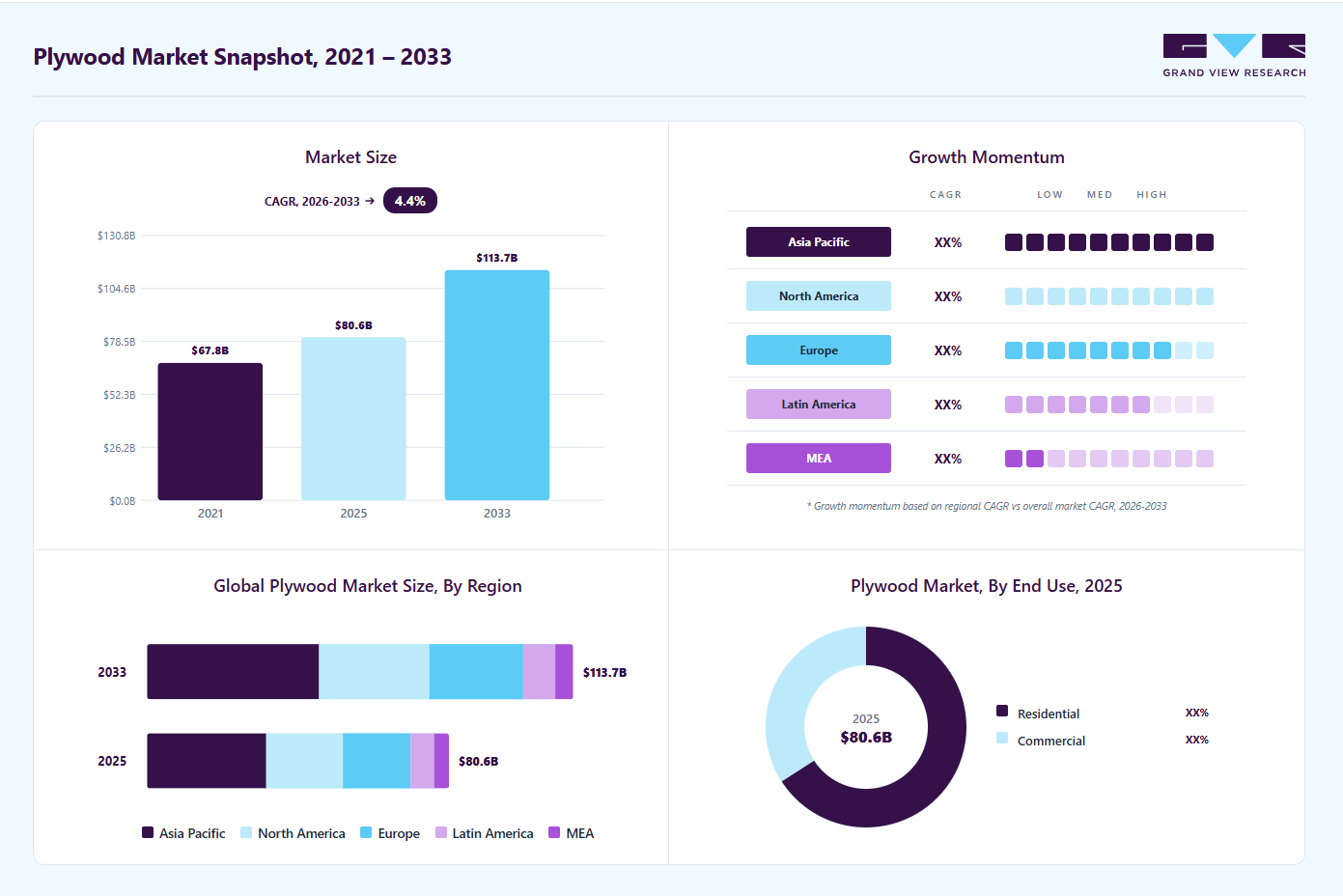
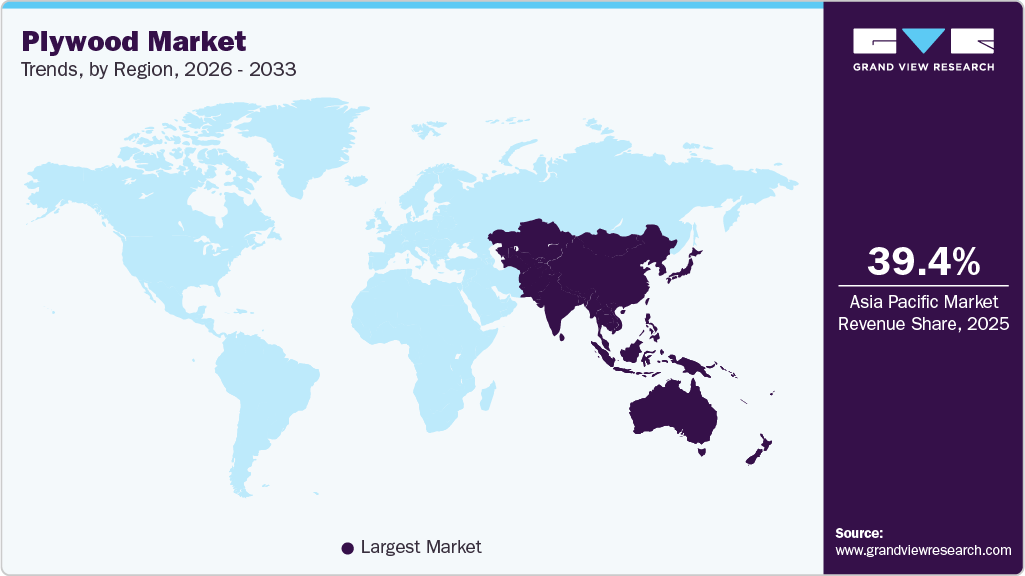
The global plywood market size was valued at USD 80.5 billion in 2025 and is projected to grow from USD 84.1 billion in 2026 to USD 113.7 billion by 2033, at a CAGR of 4.4% from 2026 to 2033. The Asia Pacific plywood market held the largest share of 39.4% of the global market in 2025. The demand for plywood is increasing steadily due to rapid growth in residential and commercial construction activities across both developed and emerging economies.
 Source: Grand View Research, IR Documents, Primary Interviews, Paid DatabasesTo learn more about this report,
 Download Free Sample Report
Key Market Trends & Insights
- By end use: Commercial segment is expected to grow at the fastest CAGR of 4.8% over the forecast period.
- By application: Non-structural segment is expected to grow at the fastest CAGR of 5.4% over the forecast period.
Regional Highlights
- Largest regional market: Asia Pacific (39.4% revenue share, 2025)
- China market is anticipated to register the fastest growth rate during the forecast period
Market Size & Forecast
- 2025 Market Size: USD 80.5 Billion
- 2026 Market Size: USD 84.1 Billion
- 2033 Projected Market Size: USD 113.7 Billion
- CAGR (2026-2033): 4.4%
Three ways to get this report
Buy it, customize it, or ask a question.Ask an Analyst
Analyst response in 1 business day
- AccessReport author, directly
- Reply timeWithin 1 working day
- No sales callDirect answer only
- FormatEmail reply
- CostFree, no cost
Get the Full Report
What the study covers
- FormatsPDF · Excel · Dashboard
- Timeline2026–2033 annual, 2025 base
- Coverage20+ countries, 5 regions
- Companies10+ key players profiled
Customize the Report
20% free customization
- IncludeCountries, segments, points
- TailorTo your product definition
- ExtendDeeper competitor detail
- OrA fully bespoke study
- Turnaround5–10 working days
Rising urbanization and population growth are driving the need for affordable housing, boosting plywood consumption in flooring, roofing, wall panels, and furniture applications. Plywood’s strength, durability, and dimensional stability make it a preferred material over solid wood. The growing trend of modular construction and prefabricated buildings is further supporting plywood usage. Increasing disposable incomes have led to higher spending on home renovation and interior furnishings. In addition, the shift toward engineered wood products for cost efficiency is accelerating plywood demand. The expansion of infrastructure projects globally continues to drive sustained market growth.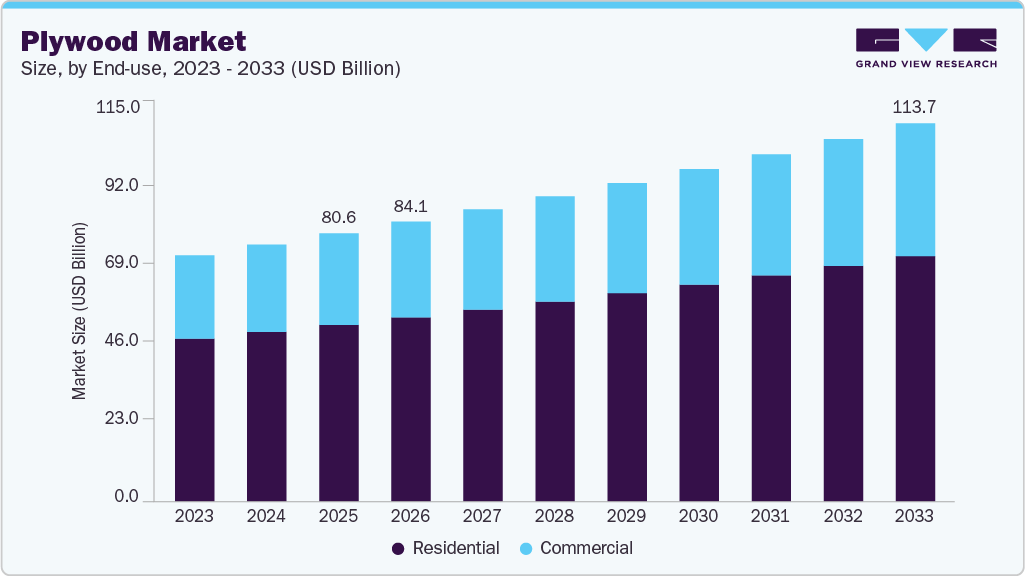 To learn more about this report, Download Free Sample Report
Key market drivers include cost-effectiveness, ease of installation, and wide application across multiple end-use industries. The booming furniture industry, particularly ready-to-assemble and modular furniture, is a major contributor to plywood demand. Growth in real estate development, including commercial offices, retail spaces, and hospitality projects, is significantly driving consumption. Rising demand for durable and moisture-resistant materials in construction applications supports market expansion. Increased use of plywood in packaging and transportation further enhances demand. Technological advancements in adhesive bonding and veneer treatment improve product performance. Availability of plywood in multiple grades and finishes also drives broader adoption.
Innovations in plywood manufacturing focus on enhanced durability, water resistance, and fire-retardant properties. Manufacturers are developing low-emission and formaldehyde-free plywood to meet environmental and indoor air quality standards. Digital printing and decorative surface finishes are gaining popularity in interior design applications. Lightweight and high-strength plywood products are emerging for modular furniture and prefabricated construction. Automation in veneer processing and pressing technology improves efficiency and product consistency. Increasing use of eco-friendly adhesives and recycled wood veneers is a key trend. Demand for customized plywood solutions tailored to specific applications continues to grow.
Market Dynamics
The rapid growth of residential and commercial construction across emerging and developed economies is a major driver of demand for plywood. Rapid urbanization, population growth, and rising investments in infrastructure development have significantly increased the consumption of plywood in flooring, roofing, wall sheathing, partitions, and furniture applications. In addition, the expansion of the real estate sector and the growing demand for affordable housing are further supporting global market growth.
Growing consumer preference for aesthetically appealing, durable interior products is also driving higher adoption of plywood in furniture and interior decoration applications. The material offers advantages over solid wood, including high strength, dimensional stability, a lightweight structure, and cost-effectiveness, making it widely preferred by manufacturers and end users. Furthermore, increasing renovation and remodeling activities, particularly in residential spaces, along with rising demand for modular furniture and customized interiors, are expected to continue driving growth in the plywood market over the forecast period.
The plywood market faces significant challenges due to fluctuations in timber and veneer prices, which directly affect producers' manufacturing costs and profit margins. In addition, stringent environmental regulations related to deforestation, illegal logging, and sustainable forest management have increased compliance requirements for manufacturers. Limited availability of high-quality timber resources and growing concerns regarding formaldehyde emissions from certain plywood adhesives further affect market growth, particularly in environmentally regulated regions.
Market Concentration & Characteristics
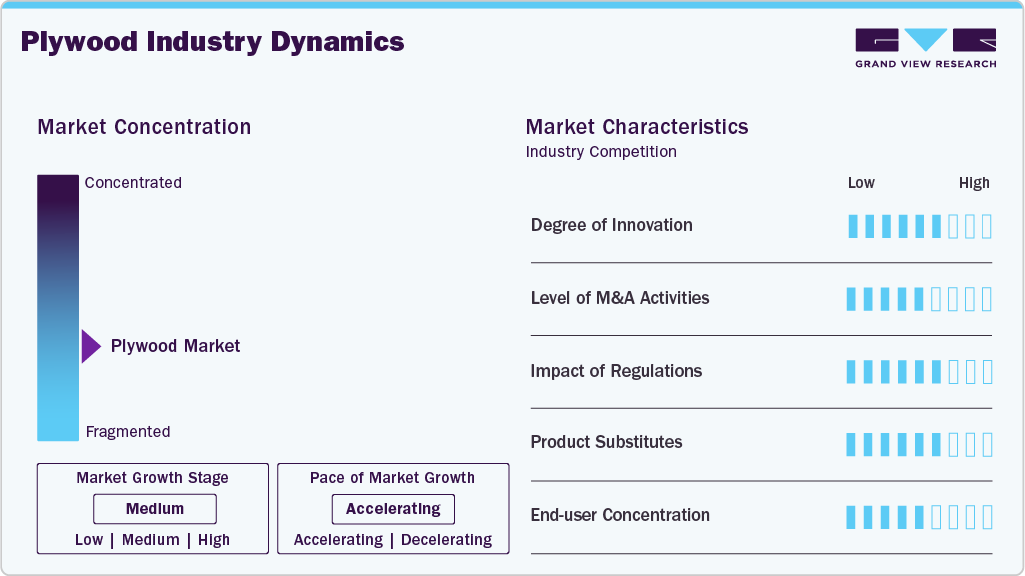
The plywood industry is moderately fragmented, with the presence of numerous regional and domestic manufacturers alongside a few large international players. Large companies benefit from integrated supply chains, established distribution networks, and strong brand recognition. However, small and mid-sized manufacturers remain competitive due to lower production costs and regional raw material access. Price sensitivity in emerging markets allows local players to maintain a significant market share. Limited product differentiation intensifies competition among manufacturers. Capacity expansion and geographic penetration are key competitive strategies. Overall, the market exhibits moderate consolidation in developed regions and fragmentation in emerging economies.
 To learn more about this report, Download Free Sample Report
Plywood faces competition from substitutes such as medium-density fiberboard (MDF), particleboard, oriented strand board (OSB), and solid wood. MDF and particleboard are often preferred in low-cost furniture applications due to their smooth finish and lower prices. OSB competes directly with plywood in structural construction applications in some regions. However, plywood offers superior strength, moisture resistance, and durability compared to many substitutes. Solid wood remains expensive and less dimensionally stable, limiting its substitution threat. Continuous product innovation helps plywood maintain competitiveness. Overall, the threat of substitutes is moderate.
End-use Insights
The residential segment held the highest revenue market share of 65.9% in 2025, due to widespread use in housing construction, interior applications, and furniture manufacturing. Plywood is widely used in flooring, roofing, wall panels, cabinets, and doors due to its strength, durability, and cost efficiency. Rapid urbanization and rising demand for affordable housing have significantly boosted residential plywood consumption. Home renovation and remodeling activities further support demand, especially in developed economies. Growing preference for modular kitchens and ready-to-assemble furniture continues to drive plywood usage. Increasing disposable income and improved living standards reinforce segment dominance.
The commercial segment is expected to grow at a significant CAGR of 4.8% over the forecast period, due to increasing construction of offices, retail spaces, hospitality projects, and institutional buildings. Rising investments in commercial real estate and urban infrastructure are driving demand for plywood in interior and structural applications. Plywood is widely used in partitions, ceilings, furniture, and decorative interiors in commercial spaces. Growth in the hospitality and healthcare sectors further supports market expansion. Demand for durable, fire-resistant, and aesthetically appealing plywood products is increasing.
Application Insights
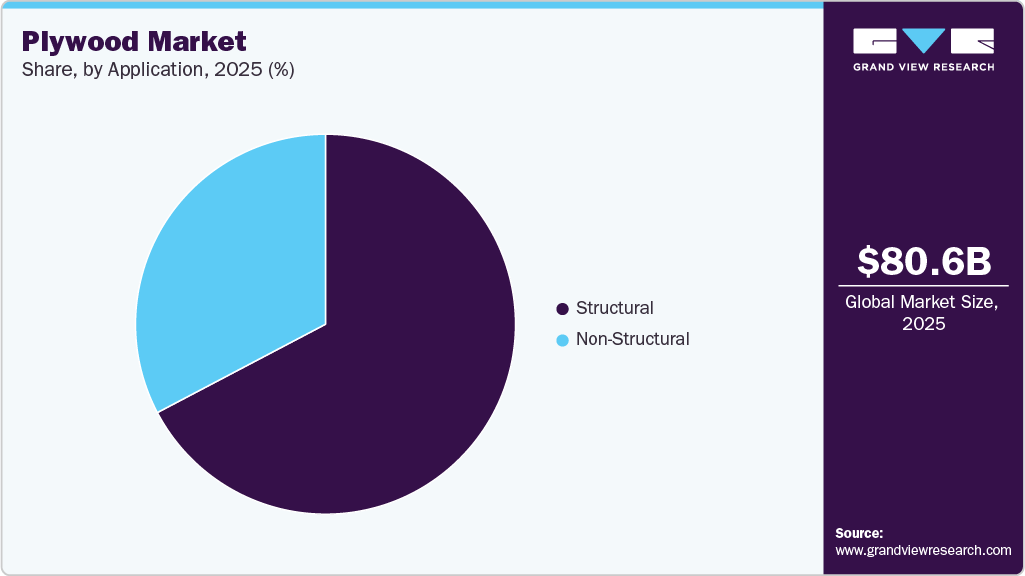
The structural segment held the highest revenue market share of 67.3% in 2025, owing to the extensive use of plywood in load-bearing construction applications. Structural plywood is commonly used in flooring, wall sheathing, roofing, and formwork due to its high strength and dimensional stability. Rapid growth in residential and infrastructure construction supports strong demand for structural plywood. Its ability to withstand heavy loads and varying environmental conditions makes it suitable for long-term use. Adoption of engineered wood products in modern construction further strengthens this segment. Building codes in many regions favor certified structural plywood.
 To learn more about this report, Download Free Sample Report
The non-structural segment is expected to grow at a significant CAGR of 5.4% over the forecast period, due to rising demand for interior and decorative applications. Non-structural plywood is widely used in furniture, cabinetry, paneling, partitions, and decorative finishes. Growth in interior design, home décor, and renovation activities supports segment expansion. Increasing demand for lightweight, flexible, and aesthetically appealing materials drives adoption. Technological advancements enable improved surface finishes and customization options. Expansion of commercial interiors also boosts non-structural plywood usage.
Regional Insights
Asia Pacific dominated the global plywood market and accounted for the largest revenue share of 39.4% in 2025, due to rapid urbanization, strong construction activity, and large-scale furniture manufacturing. Countries in the region benefit from abundant raw materials and low labor costs. Growing residential housing demand drives plywood consumption across multiple applications. Infrastructure development projects further strengthen market growth. Incre
 To learn more about this report, Download Free Sample Report
China Plywood Market Trends
asing exports from the Asia Pacific support regional dominance. Rising disposable incomes boost demand for interior and decorative plywood. Strong domestic consumption ensures sustained regional leadership.
The plywood market in China remains the largest producer and consumer of plywood globally. The country benefits from extensive manufacturing capacity and advanced production technologies. Growing construction and furniture manufacturing sectors reflect strong domestic demand. Export-oriented plywood production continues to support market expansion. Environmental regulations are pushing manufacturers toward low-emission products. Demand for decorative and value-added plywood is increasing. China remains a critical supply hub for global markets.
Europe Plywood Market Trends
The plywood market in Europe is driven by sustainable construction practices and green building initiatives. Demand for eco-certified plywood products is increasing. Renovation and refurbishment activities contribute significantly to consumption. Growth in furniture manufacturing supports market expansion. Strict quality standards ensure high product consistency. Technological innovation remains strong across the region. Europe represents a stable and quality-driven market.
Germany plywood marketbenefits from advanced construction technologies and strong furniture manufacturing. Sustainable and energy-efficient building practices drive demand. High-quality plywood products are preferred in interior and structural applications. Regulations favor low-emission and certified wood products. Innovation in engineered wood drives market growth. Domestic consumption remains strong. Germany serves as a key hub in the European market.
North America Plywood Market Trends
The plywood market in North America is driven by residential construction and home renovation activities. Strong demand for plywood in structural and sheathing applications supports growth. Adoption of engineered wood products aligns with sustainability initiatives. Technological advancements improve product quality and performance. Remodeling trends boost interior plywood usage. Stable housing demand ensures consistent consumption. North America remains a mature but steady-growth market.
The U.S. plywood market is primarily driven by demand for housing construction and remodeling. Plywood is widely used in flooring, roofing, and wall sheathing applications. Preference for durable and structural-grade plywood drives consumption. Growth in prefabricated housing supports the adoption of these products. Environmental regulations encourage the use of certified wood products. Investment in infrastructure projects boosts demand. The market shows stable long-term growth.
Latin America Plywood Market Trends
The plywood market in Latin America is supported by growing construction and infrastructure development. Availability of forest resources enables steady production. Rising residential housing projects drive demand. Exports contribute to regional market growth. Price competitiveness supports plywood adoption. Urbanization trends continue to increase consumption. The region shows moderate growth potential.
Middle East & Africa Plywood Market Trends
The plywood market in the MEA is driven by infrastructure development and commercial construction projects. Demand is strong in the hospitality and real estate sectors. Imports play a significant role due to limited local production. Urban expansion supports plywood consumption. Growth in interior design and renovation boosts demand. Government investments drive construction activity. The region presents emerging growth opportunities.
Key Plywood Company Insights
Some of the key players operating in the market include SVEZA Forest Ltd. and CenturyPly.
-
SVEZA Forest Ltd. is a leading global manufacturer of birch plywood, known for its high strength, durability, and consistent quality. The company serves construction, industrial, transportation, and interior applications, with a strong export presence across Europe, North America, and Asia.
-
CenturyPly is one of India’s largest plywood and decorative solutions manufacturers, offering a wide range of plywood, laminates, veneers, and MDF products. The company is recognized for its focus on quality, innovation, and compliance with emission and durability standards in residential and commercial applications.
Greenply Industries and Boise Cascade Company are some of the emerging market participants.
-
Greenply Industries is a prominent Indian plywood and wood products manufacturer with a strong domestic and international footprint. The company offers plywood, blockboard, decorative veneers, and medium-density fiberboard, catering mainly to furniture, interior, and construction end-use segments.
-
Boise Cascade Company is a leading U.S.-based manufacturer and distributor of engineered wood products, including plywood and veneer-based solutions. The company primarily serves the residential construction market through its integrated manufacturing and nationwide distribution network.
Key Plywood Companies:
The following are the leading companies in the plywood market. These companies collectively hold the largest market share and dictate industry trends.
- Georgia Pacific
- Weyerhaeuser Company
- Greenply Industries
- CenturyPly
- UPM
- Eksons Corporation
- Boise Cascade Company
- PotlatchDeltic Corporation.
- SVEZA Forest Ltd.
- Duroply
Competitive Benchmarking
Operating Strategies
Competitive Edge
Weaknesses
Mature Players: SVEZA Forest Ltd.; CenturyPly; Georgia-Pacific; Weyerhaeuser Company
- Investments in automation, advanced veneer processing, and manufacturing efficiency.
- Strengthening distribution networks and dealer partnerships across key regions
- Strategic acquisitions and backward integration for stable timber sourcing
- Strong brand recognition and established customer relationships.
- Large-scale manufacturing capacities with integrated supply chains.
- Broad geographic presence and extensive distribution reach.
- Sustainable forestry practices and certified wood sourcing capabilities.
- High dependence on timber availability and raw material price fluctuations.
- Exposure to environmental regulations and sustainability compliance pressures.
Emerging Players: Greenply Industries; Boise Cascade Company
- Focus on niche and innovative plywood solutions targeting high-growth applications
- Expansion through regional partnerships and dealer network development
- Emphasis on customer-centric offerings and customized product solutions
- Greater flexibility in responding to changing customer preferences.
- Ability to target regional markets with tailored product offerings.
- Limited global presence compared to established market leaders.
- Lower production capacities and comparatively weaker economies of scale.
Recent Developments
-
In October 2023, Greenply and SAMET launched a joint venture “Greenply-Samet”, commencing furniture hardware production synergistic with plywood and interior infrastructure business.
-
In November 2025, Greenply announced a mega ₹800 crore capex plan, including a new plywood greenfield plant in Odisha, targeting ~25 % capacity growth and enhanced market supply.
Plywood Market Report Scope
Report Attribute
Details
Market size in 2025
USD 80.5 Billion
Estimated Market size in 2026
USD 84.1 billion
Projected Market size by 2033
USD 113.7 billion
Growth rate
CAGR of 4.4% from 2026 to 2033
Actual data
2021 - 2025
Forecast period
2026 - 2033
Quantitative units
Revenue in USD million/billion, and CAGR from 2026 to 2033
Report coverage
Revenue forecast, company ranking, competitive landscape, growth factors, and trends
Segments covered
End-use, application, region
Regional scope
North America; Europe; Asia Pacific; Latin America; MEA
Country scope
U.S.; Canada; Mexico; Germany; UK; Italy; France; China; Japan; India
Key companies profiled
Georgia Pacific; Weyerhaeuser Company; Greenply Industries; CenturyPly; UPM; Eksons Corporation; Boise Cascade Company; PotlatchDeltic Corporation; SVEZA Forest Ltd.; Duroply
Customization scope
Free report customization (equivalent up to 8 analysts working days) with purchase. Addition or alteration to country, regional & segment scope.
Pricing and purchase options
Avail customized purchase options to meet your exact research needs. Explore purchase options
Global Plywood Market Report Segmentation
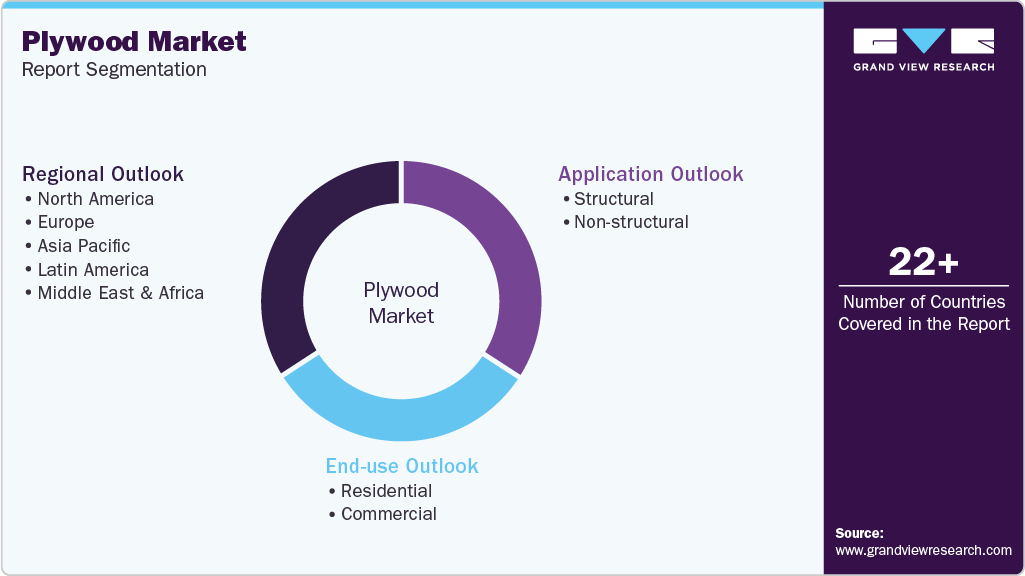
This report forecasts revenue growth at the regional & country levels and provides an analysis of the industry trends in each of the sub-segments from 2021 to 2033. For this study, Grand View Research has segmented the global plywood market report based on end-use, application, and region:
 To learn more about this report, Download Free Sample Report
-
End-use Outlook (Revenue, USD Million, 2021 - 2033)
-
Residential
-
Commercial
-
-
Application Outlook (Revenue, USD Million, 2021 - 2033)
-
Structural
-
Non-structural
-
Furniture
-
Kitchen Cabinet
-
Flooring
-
Container Floor
-
Others
-
-
-
Regional Outlook (Revenue, USD Million, 2021 - 2033)
-
North America
-
U.S.
-
Canada
-
Mexico
-
-
Europe
-
UK
-
Germany
-
France
-
Italy
-
-
Asia Pacific
-
China
-
Japan
-
India
-
-
Latin America
-
Middle East and Africa
-
Delivered Customizations
This report has been delivered with the following In-depth customizations
Client Request
Customization Delivered
Value Adds
Pricing Analysis
Analysis of plywood pricing trends across key regions, including fluctuations in timber and veneer costs, adhesive pricing, manufacturing expenses, transportation costs, and price variations across plywood grades and applications. The assessment also includes historical pricing trends and an analysis of supply and demand.
Enable understanding of pricing movements and cost fluctuations across the plywood value chain. Support procurement planning, pricing strategy development, and margin optimization initiatives.
Sustainability Trends
Assessment of sustainability trends in the plywood market, including certified wood sourcing, low-emission adhesives, recycled and engineered wood utilization, sustainable forestry practices, environmental regulations, and increasing adoption of eco-friendly plywood products in construction and furniture applications.
Enable understanding of evolving sustainability requirements and green building trends. Support ESG strategy development, regulatory compliance planning, and identification of sustainable product opportunities.
Opportunity Assessment
Evaluation of growth opportunities across residential and commercial construction, furniture manufacturing, modular housing, interior applications, and infrastructure projects, along with analysis of urbanization trends, renovation activities, and rising demand for lightweight and cost-effective wood panel products.
Identify high-growth applications and emerging demand areas. Support product development, market expansion, and strategic investment decisions across the plywood industry.
Frequently Asked Questions About This Report
The global plywood market size was estimated at USD 80.5 billion in 2025 and is expected to reach USD 84.1 billion in 2026.
The structural segment held the highest revenue market share of 67.3% in 2025, primarily due to the extensive use of plywood in load-bearing construction applications.
Some of the key players operating in the plywood market include Georgia Pacific, Weyerhaeuser Company, Greenply Industries, CenturyPly, UPM, Eksons Corporation, Boise Cascade Company, PotlatchDeltic Corporation, Duroply, and SVEZA Forest Ltd.
Rapid growth in construction and furniture manufacturing, increasing urbanization, rising demand for cost-effective engineered wood products, and expanding residential renovation activities are the key factors driving the plywood market.
The global plywood market is expected to grow at a compound annual growth rate of 4.4% from 2026 to 2033 to reach USD 113.7 billion by 2033.
The residential segment held the highest revenue market share of 65.9% in 2025, due to widespread use in housing construction, interior applications, and furniture manufacturing.
About the Author(s)
Advanced Interior Materials Research Team
Advanced Materials · Advanced Interior MaterialsThis report was authored by the advanced interior materials research team at Grand View Research - comprising two research analysts, one senior research analyst, and one industry expert - with specialized expertise in the advanced interior materials segment of the advanced materials industry. All findings are based on proprietary advanced materials databases, executive interviews, and regulatory analysis, subject to internal peer review prior to publication.
Last Updated:
Speak to Analyst

Customize this report to your needs - add regions, segments, or data points, with 20% free customization.
Or view our licence options:


ISO 9001:2015 & 27001:2022 Certified
We are GDPR and CCPA compliant! Your transaction & personal information is safe and secure. For more details, please read our privacy policy.


