
- Home
- »
- Plastics, Polymers & Resins
- »
-
Polyvinyl Butyral Market Size And Share Report, 2026-2033GVR Report cover

Polyvinyl Butyral Market (2026 - 2033)
Size, Share & Trends Analysis Report By Type (Films & Sheets, Resins, Solutions), By Application (Laminated Safety Glass, Paints & Coatings), By End-use (Automotive, Photovoltaics), By Region, And Segment Forecasts
Market Size, 2025
$3.6BMarket Estimate, 2026
$3.8BMarket Forecast, 2033
$5.9BCAGR, 2026–2033
6.7%Polyvinyl Butyral Market Summary
The global polyvinyl butyral market size was valued at USD 3.6 billion in 2025 and is projected to grow from USD 3.8 billion in 2026 to USD 5.9 billion by 2033, growing at a CAGR of 6.7% from 2026 to 2033. The market in Asia Pacific dominated with a revenue share of 39.5% in 2025. The increasing need for lighter vehicle designs is boosting the use of PVB in automotive glazing applications.
 Source: Grand View Research, IR Documents, Primary Interviews, Paid DatabasesTo learn more about this report,
 Download Free Sample Report
 Key Market Trends & Insights
- By type: Films & sheet segment led the market with the largest revenue share of 73.6% in 2025.
- By application: Laminated safety glass segment led the market with the largest revenue share of 71.4% in 2025.
- By end use: Automotive segment led the market with the largest revenue share of 59.4% in 2025.
Regional Highlights
- Largest regional market: Asia Pacific (39.5% revenue share, 2025)
- By country: The China held the largest market share in 2025.
Market Size & Forecast
- Market size in 2025: USD 3.6 Billion
- Estimated market size in 2026: USD 3.8 Billion
- Projected market size by 2033: USD 5.9 Billion
- CAGR (2026-2033): 6.7%
Three ways to get this report
Buy it, customize it, or ask a question.Ask an Analyst
Analyst response in 1 business day
- AccessReport author, directly
- Reply timeWithin 1 working day
- No sales callDirect answer only
- FormatEmail reply
- CostFree, no cost
Get the Full Report
What the study covers
- FormatsPDF · Excel · Dashboard
- Timeline2026–2033 annual, 2025 base
- Coverage20+ countries, 5 regions
- Companies10+ key players profiled
Customize the Report
20% free customization
- IncludeCountries, segments, points
- TailorTo your product definition
- ExtendDeeper competitor detail
- OrA fully bespoke study
- Turnaround5–10 working days
PVB allows for the creation of thinner laminated glass structures without compromising safety, durability, or sound performance, which aids in reducing vehicle weight and enhancing energy efficiency. Enhanced demand for lightweight vehicle designs is driving polyvinyl butyral (PVB) adoption as automakers seek thinner glazing solutions without compromising safety. Expansion of high‑end architectural projects in urban centers is boosting requirements for noise‑reducing laminated glass, further fueling PVB consumption. The polyvinyl butyral market is experiencing steady expansion driven by its pivotal role in laminated safety glass for automotive and architectural applications. Manufacturers are increasingly investing in advanced PVB formulations that offer enhanced clarity and acoustic insulation. This evolution reflects a shift toward premium vehicle cabins and modern building designs that prioritize both aesthetic appeal and occupant well‑being. As sustainability considerations gain prominence, recycled glass content blended with PVB is also emerging as a significant theme. To learn more about this report, Download Free Sample Report
 Market Dynamics
Expansion of high-end architectural projects in urban centers is increasing demand for noise-reducing laminated glass, further fueling PVB consumption. The polyvinyl butyral market is steadily expanding, driven by its pivotal role in laminated safety glass for automotive and architectural applications. Manufacturers are increasingly investing in advanced PVB formulations that deliver enhanced clarity and acoustic insulation. This evolution reflects a shift toward premium vehicle cabins and modern building designs that prioritize both aesthetic appeal and occupant well-being. As sustainability considerations gain prominence, recycled glass content blended with PVB is also emerging as a significant radical.
The increasing focus on the safety of occupants and the stability of structures in both automotive and construction sectors is greatly elevating the need for laminated safety glass. Regulatory requirements and changing safety regulations are driving manufacturers to implement enhanced glazing solutions that reduce the risk of injury upon impact and enhance overall resilience.
Polyvinyl butyral (PVB) is essential in this shift, acting as the main interlayer in laminated glass because of its superior adhesion, optical transparency, and energy absorption characteristics. Its capacity to keep glass shards intact in the event of breakage improves safety, solidifying its status as a favored material for windshields, skylights, facades, and other advanced glazing uses.
Fluctuations in the availability and pricing of key raw materials remain a major challenge for the polyvinyl butyral industry. Essential feedstocks such as polyvinyl alcohol (PVA) and butyraldehyde are closely tied to petrochemical supply chains, leaving them vulnerable to changes in crude oil prices, production outages, transportation disruptions, and geopolitical events. When raw material costs rise unexpectedly or supplies tighten, PVB manufacturers face higher production costs and procurement challenges. These pressures can erode profit margins, create pricing uncertainty, and force producers to raise prices, potentially affecting customer demand and overall market competitiveness.
The rapid expansion of the solar energy industry is creating new growth opportunities for PVB films beyond their traditional use in laminated safety glass. Increasing investments in utility-scale solar farms and residential rooftop installations are driving the need for reliable encapsulation materials that can protect solar cells from moisture, temperature fluctuations, UV exposure, and mechanical damage. PVB films offer strong adhesion, high transparency, and long-term durability, making them well-suited for photovoltaic applications. As solar module manufacturers focus on improving efficiency and lifespan, collaboration between glass producers, PVB suppliers, and renewable energy companies is expected to support the development of innovative PVB-based solutions for next-generation solar panels.
Market Concentration & Characteristics
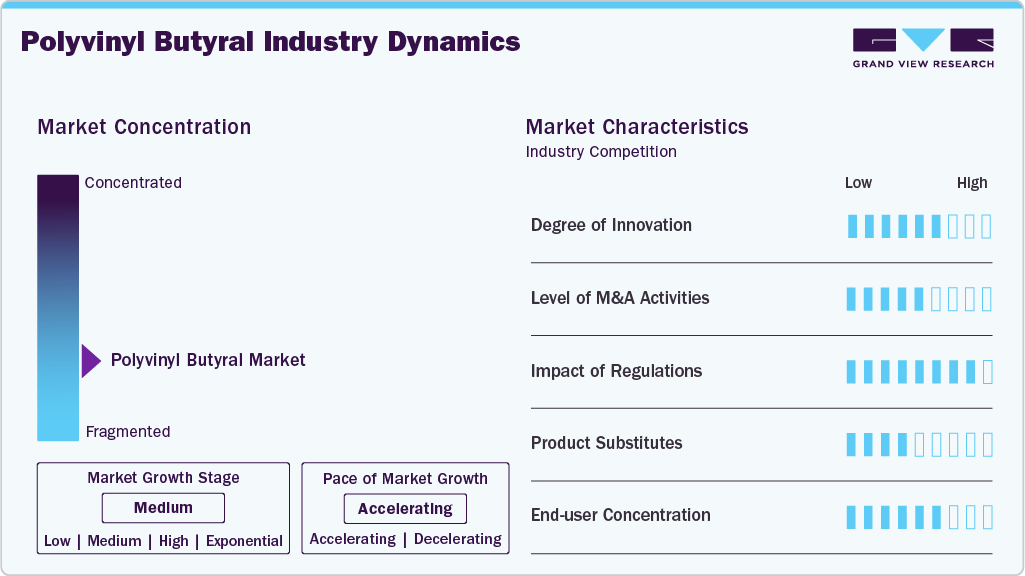
The market growth stage of the polyvinyl butyral market is medium, and the pace is accelerating. The market exhibits slight concentration, with key players dominating the industry landscape. Major companies like Sekisui Chemical Co. Ltd., Kuraray Co. Ltd., Eastman Chemical Company, Hubergroup, Chang Chun Group, Anhui WanWei Bisheng New Material Co., Ltd., Everlam, and others play a significant role in shaping the market dynamics. These leading players often drive innovation within the market, introducing new products, technologies, and applications to meet evolving industry demands.
The polyvinyl butyral market is witnessing a wave of material breakthroughs that extend beyond traditional safety interlayers. Manufacturers are formulating next‑generation PVB grades with built‑in UV filtering and noise‑dampening additives to meet evolving consumer demands. Research partnerships between resin producers and glass fabricators are yielding low‑temperature lamination processes that cut energy consumption on the production floor. Concurrent advances in bio‑based feedstocks are also positioning PVB as a more sustainable choice without sacrificing performance. These innovations are reshaping how laminated glass products are designed and manufactured.
 To learn more about this report, Download Free Sample Report
 Global safety and environmental mandates continue to shape PVB market dynamics by setting stringent performance and processing benchmarks. In the automotive sector, compliance with windshield impact resistance standards and pedestrian safety regulations has driven universal adoption of laminated glazing. Meanwhile, building codes across major markets now require laminated glass in high‑occupancy structures to meet blast‑resistance and fire‑safety criteria. On the environmental front, solvent emission limits under regional air quality directives are compelling PVB producers to retrofit plants with advanced recovery and abatement systems. These regulatory pressures are reinforcing the strategic importance of PVB in both compliance‑driven and value‑added applications.
Analyst Perspective
The polyvinyl butyral market is likely to move from a primarily volume-led interlayer business toward a more value-led, application-specific segment, with demand still anchored in automotive windshields and architectural laminated glass but increasingly pulled by acoustic, solar-control, security, storm-resistant, UV-blocking, and decorative glazing requirements. Market leaders should be those that combine broad product portfolios, strong technical support tools, global regional presence, and documented sustainability performance, including product-level EPDs and lower-carbon offerings. Competitive advantage will increasingly depend on formulation know-how, application engineering, and partnerships with glass processors and OEMs, while profitability will be shaped by raw-material cost swings, pricing discipline, regional capacity imbalances, and substitution pressure from alternative interlayers in selected high-performance uses.
Type Insights
Based on the type, the films & sheet segment led the market with the largest revenue share of 73.6% in 2025. Rising investments in modern commercial and residential glazing projects are fueling demand for PVB films and sheets. Property developers value these interlayers for their ability to combine structural integrity with enhanced acoustic insulation. As urban centers prioritize energy efficiency, architects specify PVB films that support low‑emissivity glass assemblies. This sustained demand cements films and sheets as the cornerstone of the PVB industry.
The solutionssegment is anticipated to grow at the fastest CAGR of 7.8% through the forecast period. Custom PVB solution blends are gaining traction as manufacturers seek formulations tailored to specialized lamination processes. These liquid dispersions simplify application in complex production lines and reduce cycle times. Growing interest in seamless integration of PVB into automated lamination cells is accelerating the uptake of solution forms. As converters adopt Industry 4.0 practices, PVB solutions offer the flexibility required for next‑generation glass fabrication.
Application Insights
Based on the application, the laminated safety glass segment led the market with the largest revenue share of 71.4% in 2025. Mandates for occupant protection in both automotive windshields and architectural barriers continue to elevate laminated safety glass usage. Glass fabricators increasingly rely on PVB interlayers to meet stringent impact and blast‑resistance standards. With heightened awareness of liability and insurance costs, clients are specifying laminated assemblies by default. This entrenched regulatory landscape ensures laminated safety glass remains the leading application driver.
The paints & coatings segment is anticipated to grow at the fastest CAGR of 7.0% through the forecast period. Demand for advanced protective coatings that adhere to complex substrates is opening new avenues for PVB resins. Coating formulators are leveraging PVB’s film‑forming capabilities to improve scratch and chemical resistance on metal and glass surfaces. Rapid expansion in industrial maintenance and marine coatings is pushing suppliers to incorporate PVB into their product portfolios. As end‑users seek longer‑lasting finishes, PVB‑enhanced coatings are becoming indispensable.
End-use Insights
Based on end use, the automotive segment led the market with the largest revenue share of 59.4% in 2025. Continued rollout of autonomous‑ready and premium vehicle models is intensifying the need for sophisticated glazing solutions. Automakers specify PVB interlayers to achieve laminated panoramic roofs and side windows that offer both safety and noise dampening. With consumer expectations shifting toward ultra‑quiet cabins, PVB adoption in automotive glazing is on a firm growth trajectory. Regulatory frameworks further reinforce its position as the dominant end‑use segment.
 To learn more about this report, Download Free Sample Report
 The photovoltaics segment is expected to grow at a substantial CAGR of 7.4% through the forecast period. The rapid scaling of utility-scale solar farms and distributed rooftop projects is sparking higher demand for PVB as a reliable encapsulant in photovoltaic modules. Advances in perovskite tandem solar cells require interlayers that offer exceptional moisture resistance and adhesion to sustain long-term energy output.
Policy support through renewable energy auctions and incentive schemes across Europe and Asia is driving panel manufacturers to optimize their supply chains with PVB films. Collaborative development efforts between glass producers and resin formulators have yielded low-temperature lamination techniques that accommodate emerging thin film substrates. Together, these factors position PVB as a vital material to ensure durability and efficiency in the fastest-growing photovoltaic segment.
Regional Insights
The North American polyvinyl butyral market is driven by robust investments in chemical recycling infrastructure and stringent corporate sustainability targets. Leading converters are adopting next‑generation depolymerization techniques to meet regional circular economy goals while satisfying growing demand from the medical device and pharmaceutical packaging sectors. The recent rebound in U.S. residential construction is also fueling the use of polycarbonate and acrylic glazing for energy‑efficient windows, and Canada’s cold‑weather automotive components increasingly rely on impact‑resistant clear polymers.
U.S. Polyvinyl Butyral Market Trends
The U.S. polyvinyl butyral market is driven by the expansion of healthcare facilities and outpatient clinics, which is creating a surge in demand for high‑clarity, biocompatible plastics in diagnostic kits and surgical trays. Meanwhile, accelerated residential and commercial building activity is driving transparent polymer use in lightweight window systems and interior partitions. As of 2025, the American Hospital Association reports over 6,100 hospitals and 919,000 active construction sites, underscoring the sector’s role as a key growth engine for polyvinyl butyral.
Asia Pacific Polyvinyl Butyral Market Trends
Asia Pacific dominated the polyvinyl butyral market with the largest revenue share of 39.5% in 2025. Environmental regulations and financial incentives across China, Japan, South Korea, and India are accelerating the uptake of CO₂‑based and bio‑sourced transparent polymers. Public‑private partnerships and R&D consortia are scaling up carbon capture utilization (CCU) technologies to produce low‑carbon resins, while booming consumer electronics and packaging sectors drive volume growth. The region’s holistic policy frameworks and investment in sustainable feedstocks position it as the fastest‑growing polyvinyl butyral market.
 To learn more about this report, Download Free Sample Report
 The polyvinyl butyral market in China held the largest share in the Asia Pacific region in 2025. China polyvinyl butyral market is underpinned by its vast electronics and electric vehicle industries. OEMs specify clear polycarbonate and PMMA for lightweight display covers, headlamps, and interior trim to improve energy efficiency and design flexibility. Concurrent infrastructure expansion, ranging from smart glazing in high‑rise buildings to clear plastic barriers in public transit,further cements domestic demand for advanced transparent resin grades.
Europe Polyvinyl Butyral Market Trends
Europe’s polyvinyl butyral landscape is shaped by aggressive circularity mandates, including the EU’s requirement for 25% recycled content in PET bottles by 2025. Governments are subsidizing AI‑driven sorting and advanced recycling facilities, enabling converters to supply certified recycled‑content grades for automotive headlamps and architectural façade systems. This policy‑backed momentum is complemented by rising demand for sustainable materials in high‑end packaging and electronics applications.
Key Polyvinyl Butyral Market Company Insights
The polyvinyl butyral market is highly competitive, with several key players dominating the landscape. Major companies include Sekisui Chemical Co. Ltd., Kuraray Co. Ltd., Eastman Chemical Company, Hubergroup, Chang Chun Group, Anhui WanWei Bisheng New Material Co., Ltd., and Everlam. The polyvinyl butyral market is characterized by a competitive landscape with several key players driving innovation and market growth. Major companies in this sector are investing heavily in research and development to enhance the performance, cost-effectiveness, and sustainability of their types.
Key Polyvinyl Butyral Companies:
The following key companies have been profiled for this study on the polyvinyl butyral market.
-
Sekisui Chemical Co. Ltd.
-
Kuraray Co. Ltd.
-
Eastman Chemical Company
-
Hubergroup
-
Chang Chun Group
-
Anhui WanWei Bisheng New Material Co., Ltd.
-
Everlam
Competitive Benchmarking
Category
Operating Strategies
Competitive Edge
Weakness
Established Players (Sekisui Chemical Co., Ltd., Kuraray Co., Ltd., Eastman Chemical Company, Chang Chun Group)
- Expand specialized PVB interlayer offerings for automotive, construction, and solar glass applications, focusing on products that enhance safety, durability, energy efficiency, and overall glazing performance.
- Develop advanced interlayer solutions, including acoustic, structural, decorative, and display-compatible grades, to meet evolving customer requirements and industry standards.
- Strengthen global production capabilities, technical support services, and partnerships across the value chain while advancing sustainable manufacturing practices and next-generation PVB technologies.
- Strong manufacturing capabilities and integrated supply networks help ensure consistent product availability, operational efficiency, and competitive pricing across global markets.
- Extensive experience in laminated glass applications, regulatory compliance, and long-term partnerships with automotive OEMs and architectural glass producers supports a strong market position.
- Diverse portfolios of standard and specialty PVB interlayers, combined with robust R&D resources and proven product qualifications, enable the company to address evolving customer and performance requirements.
- Significant investment is required to maintain and upgrade PVB manufacturing facilities, creating high operational and capital expenditure commitments for market participants.
- Demand is closely linked to trends in the automotive, construction, and glazing industries, making revenues vulnerable to fluctuations in these end-use sectors.
- Competition from regional suppliers in standard-grade products can affect pricing, while rigorous customer approval processes and performance testing often extend the time required to launch new products.
Emerging Players (Hubergroup, Anhui WanWei Bisheng New Material Co., Ltd., Everlam)
- Focuses on providing specialized PVB solutions for laminated glass applications, supported by technical collaboration, customized product development, and value-added offerings tailored to customer requirements.
- Strengthens its market position through cost-effective production, strong domestic presence, and localized support for automotive, construction, and industrial glass manufacturers.
- Offers high-performance PVB interlayers for architectural and automotive glazing, with an emphasis on product quality, application-specific solutions, and customer-driven innovation.
- Possesses strong technical expertise in specialty chemical formulations, supported by responsive customer service and continuous product development capabilities to address specific market requirements.
- Benefits from a strong position in the Chinese laminated glass market, supported by cost-efficient manufacturing operations and close relationships with regional customers.
- Maintains a focused presence in laminated glass interlayers, with expertise in architectural and specialty glazing applications, backed by customer-oriented product development and technical support.
- Limited presence in the global PVB industry, with lower production capacity and a more limited customer base across key automotive and construction applications.
- Primarily focused on regional markets, with a developing international distribution network and lower brand visibility compared to major global competitors.
- Operates with a smaller manufacturing footprint, resulting in fewer scale advantages and greater exposure to fluctuations in demand within its core markets.
Recent Developments
-
In January 2025, Maltha Glass Recycling, a European leader and subsidiary of Renewi, invested USD 3.14 million in polyvinyl butyral (PVB) recycling at its Lommel, Belgium site. This investment introduced new technology to recycle PVB resin from laminated glass used in automobile windshields, allowing extraction of more glass and reducing landfill waste.
-
In November 2024, Eastman Chemical Company announced that it invested to upgrade and expand its extrusion capabilities for Interlayers product lines at its manufacturing facility in Ghent, Belgium. The investment aimed to strengthen Eastman’s ability to meet growing regional and global demand for Saflex polyvinyl butyral (PVB) products in the automotive premium market and to position the site for future growth in automotive and architecture sectors.
Polyvinyl Butyral Market Report Scope
Report Attribute
Details
Market size in 2025
USD 3.6 billion
Estimated market size in 2026
USD 3.8 billion
Projected market size by 2033
USD 5.9 billion
Growth rate
CAGR of 6.7% from 2026 to 2033
Base year for estimation
2025
Historical data
2021 - 2024
Forecast period
2026 - 2033
Quantitative units
Revenue in USD million/billion, volume in kilotons, and CAGR from 2026 to 2033
Report coverage
Revenue forecast, company ranking, competitive landscape, growth factors, and trends
Segments covered
Type, applications, end-use, region
Regional scope
North America; Europe; Asia Pacific; Latin America; Middle East & Africa
Country scope
U.S.; Canada; Mexico; Germany; UK; France; Italy; Spain, China; India; Japan; South Korea, Australia Brazil; Argentina, Saudi Arabia, South Africa, UAE
Key companies profiled
Sekisui Chemical Co. Ltd.; Kuraray Co. Ltd.; Eastman Chemical Company; Hubergroup; Chang Chun Group, Anhui WanWei Bisheng New Material Co., Ltd.; Everlam
Customization scope
Free report customization (equivalent up to 8 analysts' working days) with purchase. Addition or alteration to country, regional & segment scope.
Pricing and purchase options
Avail customized purchase options to meet your exact research needs. Explore purchase options
Global Polyvinyl Butyral Market Report Segmentation
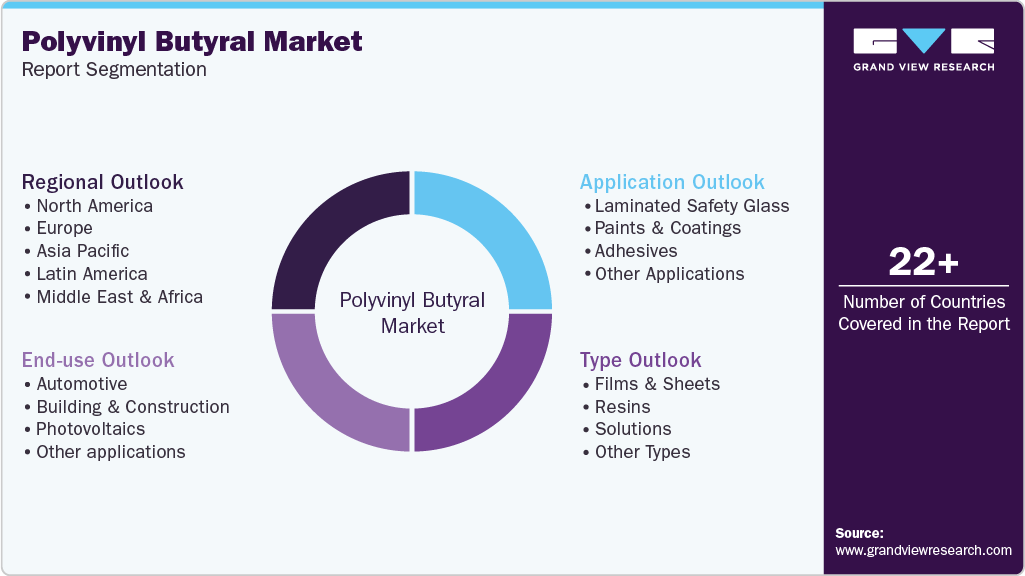
This report forecasts revenue growth at the global, regional, and country levels and provides an analysis of the latest industry trends in each of the sub-segments from 2021 to 2033. For this study, Grand View Research has segmented the global polyvinyl butyral market report based on type, applications, end-use, and region:
 To learn more about this report, Download Free Sample Report
 -
Type Outlook (Volume, Kilotons; Revenue, USD Million, 2021 - 2033)
-
Films & Sheets
-
Resins
-
Solutions
-
Other types
-
-
Application Outlook (Volume, Kilotons; Revenue, USD Million, 2021 - 2033)
-
Laminated Safety Glass
-
Paints & Coatings
-
Adhesives
-
Other applications
-
-
End-use Outlook (Volume, Kilotons; Revenue, USD Million, 2021 - 2033)
-
Automotive
-
Building & Construction
-
Photovoltaics
-
Other applications
-
-
Regional Outlook (Volume, Kilotons; Revenue, USD Million, 2021 - 2033)
-
North America
-
U.S.
-
Canada
-
Mexico
-
-
Europe
-
Germany
-
UK
-
France
-
Italy
-
Spain
-
-
Asia Pacific
-
China
-
India
-
Japan
-
South Korea
-
Australia
-
-
Latin America
-
Brazil
-
Argentina
-
-
Middle East & Africa
-
Saudi Arabia
-
South Africa
-
UAE
-
-
Research Methodology
The polyvinyl butyral market figures in this report are based on a proven research process that combines executive interviews with secondary research from proprietary databases, company filings, and recognized regulatory and institutional sources. Market size is built through value-chain sizing - reconciling supply-side and demand-side estimates - and triangulated with bottom-up and top-down approaches. Every estimate passes multiple levels of expert validation before publication, with each polyvinyl butyral segment quantified using the revenue-capture definitions in the table below.
Segment Definition
Segment - Type
Revenue capture definition
Films & Sheets
Revenue is captured through the sale of PVB films and sheets used as interlayers in laminated safety glass for automotive windshields, architectural glazing, photovoltaic modules, and specialty security applications. Demand is driven by optical clarity, impact resistance, UV protection, acoustic insulation, and compliance with safety regulations across transportation and construction sectors.
Resins
Revenue is captured through the supply of PVB resins to manufacturers producing coatings, inks, adhesives, binders, ceramic green tapes, battery components, and specialty composites. Sales are supported by the resin’s strong adhesion, flexibility, film-forming capability, and compatibility with various solvents and substrates in industrial and electronics applications.
Solutions
Revenue is captured through customized PVB-based formulations and technical solutions developed for specific end-use requirements, including specialty coatings, adhesive systems, encapsulation materials, and advanced glass-lamination technologies. Value realization is driven by performance optimization, application-specific engineering, and long-term customer partnerships.
Other Types
Revenue is captured through niche and emerging PVB product formats, including powders, recycled PVB materials, specialty compounds, and customized derivatives serving industrial, electronics, renewable energy, and research applications. These sales are typically driven by sustainability initiatives, material innovation, and specialized performance requirements that do not fit the core product families.
Segment - Application
Revenue Capture Definition
Laminated Safety Glass
Revenue is captured through sales of PVB interlayers used in laminated automotive windshields, architectural glazing, and safety/security glass applications. Demand is driven by stringent safety regulations, impact resistance requirements, acoustic insulation needs, and the growing adoption of energy-efficient and UV-protective glazing solutions in transportation and construction sectors.
Paints & Coatings
Revenue is captured through the use of PVB resins as binders and film-forming agents in protective coatings, metal primers, wash primers, and specialty industrial coatings. Growth is supported by demand for strong adhesion, corrosion resistance, chemical durability, and compatibility with metal substrates across automotive, infrastructure, marine, and industrial applications.
Adhesives
Revenue is captured through sales of PVB-based formulations used in specialty adhesives for metal bonding, flexible packaging, electronics, and construction applications. Customers value PVB for its excellent adhesion properties, flexibility, toughness, and compatibility with diverse substrates, enabling high-performance bonding solutions in demanding environments.
Other Applications
Revenue is captured through niche and emerging uses of PVB in printing inks, battery separators, photovoltaic encapsulation systems, ceramic binders, optical films, and specialty composites. Growth in this segment is supported by technological innovation, sustainability initiatives, and application-specific performance requirements that extend beyond traditional laminated glass markets.
Segment - End Use
Revenue capture definition
Automotive
Revenue is captured through PVB interlayers supplied to automotive laminated glass manufacturers for windshields, sidelights, and advanced glazing systems, where value is driven by safety compliance, acoustic insulation, UV protection, head-up display compatibility, and lightweight vehicle design requirements.
Building & Construction
Revenue is generated through PVB films used in architectural laminated glass applications, including facades, skylights, balustrades, and security glazing, with pricing influenced by impact resistance, sound attenuation, aesthetic customization, energy efficiency, and adherence to building safety standards.
Photovoltaics
Revenue is captured through PVB encapsulant films supplied to solar module manufacturers, where demand is linked to module durability, optical transparency, moisture resistance, adhesion performance, and the growing deployment of building-integrated and utility-scale photovoltaic systems.
Other End-Uses
Revenue comes from specialized applications such as aerospace glazing, bullet-resistant glass, decorative laminated glass, marine glazing, electronics, and industrial safety panels, where tailored product specifications, technical support, and performance-critical requirements support premium pricing and higher-margin contracts.
Estimation Model
Layer Name
Key Question
Description
Top-Down Glass Demand Scan Layer
What defines market boundaries?
This layer starts with global laminated glass demand across automotive, architectural, and photovoltaic applications, then filters PVB consumption intensity based on regional glass production capacity, vehicle manufacturing output, construction activity, and solar installation trends.
Application Mix Validation Layer
Where is demand generated?
This layer evaluates the split between automotive glazing, building & construction glazing, photovoltaic encapsulation, and other specialty applications to align market revenue with performance requirements, regulatory standards, and value-added PVB grades.
Interlayer Consumption Conversion Layer
Who captures market revenue?
This layer converts laminated glass production into PVB film revenue by applying interlayer loading rates, penetration of laminated versus monolithic glass, multilayer configurations, and customer qualification requirements across end-use sectors.
Regional Commercial Cross-Check Layer
How are assumptions validated?
This layer validates demand concentration by comparing the Asia Pacific scale, North American compliance intensity, and European low-migration adoption patterns.
Delivered Customizations
This report has been delivered with the following In-depth customizations
Client Request
Customization Delivered
Value Adds
Regional Segmentation
Detailed market sizing and forecasts for North America, Europe, Asia Pacific, Latin America, and Middle East & Africa, with country-level analysis for key PVB-consuming markets.
Identifies high-growth regions, demand concentration areas, investment hotspots, and region-specific regulatory drivers influencing PVB consumption.
Cross-Segmentation
Comprehensive analysis by application (automotive, building & construction, photovoltaics, others), end-use industry, and geography to identify demand patterns and revenue pockets.
Enables targeted market entry, optimized resource allocation, and identification of the most attractive customer and application segments.
Opportunity Assessment
Evaluation of emerging growth opportunities across advanced automotive glazing, energy-efficient architectural glass, photovoltaic encapsulation, security glazing, and developing regional markets.
Assists stakeholders in prioritizing investments, identifying untapped revenue streams, and developing long-term growth strategies.
Frequently Asked Questions About This Report
The films & sheets led the polyvinyl butyral market in 2025 with a 73.6% share. Rising investments in modern commercial and residential glazing projects are fueling demand for PVB films and sheets.
Some key players operating in the polyvinyl butyral market include Sekisui Chemical Co. Ltd., Kuraray Co. Ltd., Eastman Chemical Company, Hubergroup, Chang Chun Group, Anhui WanWei Bisheng New Material Co., Ltd., and Everlam.
Enhanced demand for lightweight vehicle designs is driving polyvinyl butyral (PVB) adoption as automakers seek thinner glazing solutions without compromising safety. Expansion of high‑end architectural projects in urban centers is boosting requirements for noise‑reducing laminated glass, further fueling PVB consumption.
The polyvinyl butyral market was valued at around USD 3.6 billion in the year 2025 and is expected to reach around USD 3.8 billion in 2026.
The polyvinyl butyral market is expected to grow at a compound annual growth rate of 6.7% from 2026 to 2033 to reach around USD 5.9 billion by 2033.
The Asia Pacific Polyvinyl Butyral market accounted for the largest share of 39.5% market size in 2025.
India is the leading Polyvinyl Butyral market and is expected to grow at a compound annual growth rate of 7.5% over the forecast period.
Based on application, the laminated safety glass segment accounted for the largest share of 71.4% market size in 2025. Growth is supported by glass fabricators, who increasingly rely on PVB interlayers to meet stringent impact and blast‑resistance standards.
The solutions segment based on type is expected to grow at a CAGR of 7.9% for the forecast period of 2026 to 2033.
About the Author(s)
Plastics, Polymers & Resins Research Team
Bulk Chemicals · Plastics, Polymers & ResinsThis report was authored by the plastics, polymers & resins research team at Grand View Research - comprising two research analysts, one senior research analyst, and one industry expert - with specialized expertise in the plastics, polymers & resins segment of the bulk chemicals industry. All findings are based on proprietary bulk chemicals databases, executive interviews, and regulatory analysis, subject to internal peer review prior to publication.
Last Updated:
Speak to Analyst

Customize this report to your needs - add regions, segments, or data points, with 20% free customization.
Or view our licence options:


ISO 9001:2015 & 27001:2022 Certified
We are GDPR and CCPA compliant! Your transaction & personal information is safe and secure. For more details, please read our privacy policy.


