
- Home
- »
- Food & Beverages
- »
-
Potato Starch Market Size, Share & Growth Report, 2033GVR Report cover

Potato Starch Market (2026 - 2033)
Size, Share & Trends Analysis Report By Type (Modified, Native), By Nature (Conventional, Organic), By End-use Industry (Food & Beverage, Paper), By Region, And Segment Forecasts
Market Size, 2025
$5.0BMarket Estimate, 2026
$5.2BMarket Forecast, 2033
$7.6BCAGR, 2026–2033
5.4%Potato Starch Market Summary
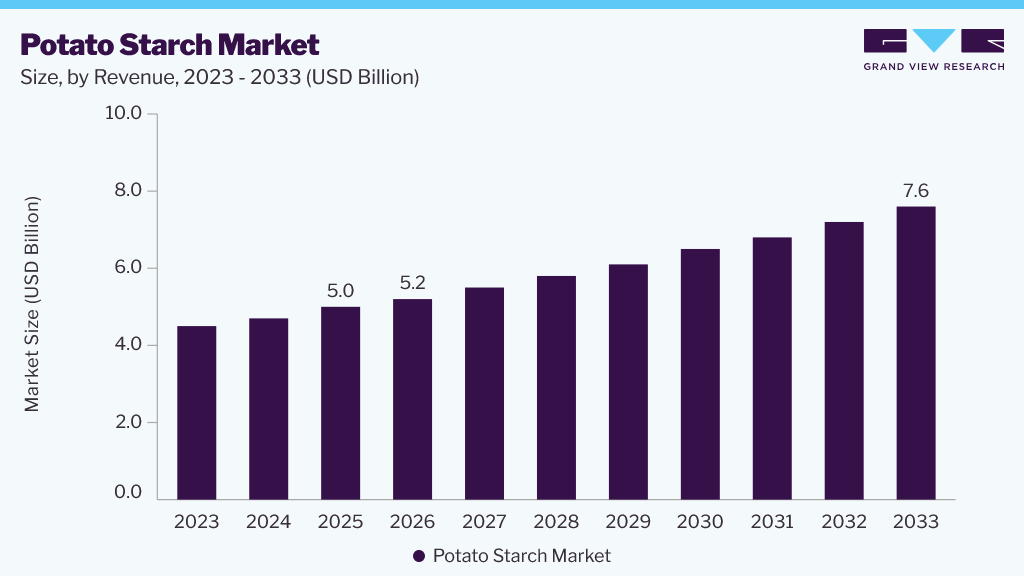
The global potato starch market size was valued at USD 5.0 billion in 2025 and is projected to grow from USD 5.2 billion in 2026 to USD 7.6 billion in 2033, at a CAGR of 5.4% from 2026 to 2033. North America dominated the market, accounting for a revenue share of 37.0% in 2025. Market growth is primarily driven by the increasing demand for potato starch across the food & beverage, paper, pharmaceutical, and industrial sectors. Its excellent thickening, binding, stabilizing, and texturizing properties, along with the growing preference for clean-label and plant-based ingredients, continue to support widespread adoption across a diverse range of applications.
 Source: Grand View Research, IR Documents, Primary Interviews, Paid DatabasesTo learn more about this report,
 Download Free Sample Report
Key Market Trends & Insights
- By type: The modified potato starch segment accounted for a share of around 72.0% in 2025
- By nature: The conventional potato starch segment held a market share of around 88.0% in 2025.
- By end use: The food and beverage end-use industry segment accounted for the largest revenue share of approximately 60.0% in 2025.
Regional Highlights
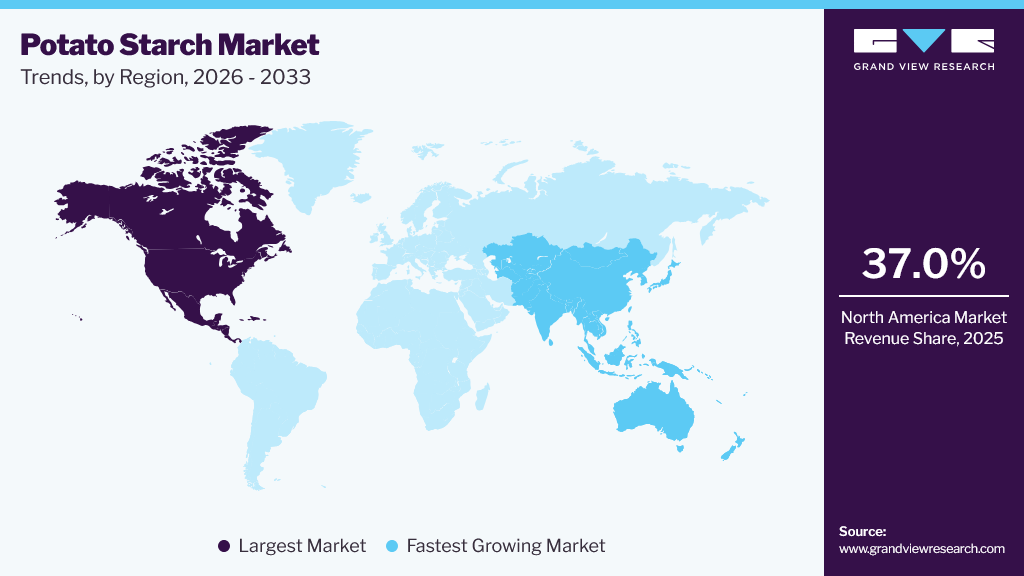
- Largest regional market: North America (37.0% revenue share, 2025)
- Fastest-growing regional market: Asia Pacific (highest CAGR, 2026-2033)
Market Size & Forecast
- Market size in 2025: USD 5.0 Billion
- Estimated market size in 2026: USD 5.2 Billion
- Projected market size by 2033: USD 7.6 Billion
- CAGR (2026-2033): 5.4%
Prism AI by Grand View Research Free to tryAsk a question about the potato starch marketTry asking✓Every figure cited from GVR research Prefer the report? Download free sample →A key market driver includes increasing consumer awareness and preference for clean-label and natural products. Potato starch, derived from potatoes through a natural extraction process, aligns with this trend as a minimally processed ingredient, appealing to those seeking healthier and more transparent food options. Moreover, a rise in gluten-free dietary preferences has significantly boosted demand for products. As consumers increasingly opt for gluten-free alternatives for health reasons or dietary restrictions, potato starch emerges as a versatile and effective substitute in a wide range of gluten-free products, including baked goods, snacks, and processed foods.
The product's functional properties also contribute to its growth. With excellent thickening, binding, and stabilizing qualities, potato starch enhances the texture and quality of various food products, making it a popular choice among food manufacturers. Its ability to enhance viscosity and moisture retention makes it a valuable ingredient in the formulation of sauces, soups, and other processed foods. Furthermore, diversifying potato starch applications beyond the food industry is pivotal to market expansion. The product is used in non-food sectors, such as textiles, pharmaceuticals, and paper manufacturing, contributing to its versatility and broadening its market scope.
Analyst Perspective
The market is experiencing steady growth due to increasing demand for clean-label and plant-based ingredients, rising consumption of processed and convenience foods, and expanding applications across the food, pharmaceutical, paper, and textile industries. The market is experiencing growing adoption of native and modified potato starch as manufacturers focus on improving product texture, stability, moisture retention, and gluten-free formulations while meeting evolving consumer preferences for natural ingredients. Although challenges such as fluctuations in potato crop yields, raw material price volatility, and competition from alternative starch sources remain, continuous advancements in starch modification technologies, sustainable production processes, and the development of bio-based industrial applications are creating new growth opportunities. Companies that focus on developing high-quality, functional, and sustainable potato starch solutions are expected to benefit from the market's long-term growth.
Type Insights
The modified potato starch segment accounted for around 72.0% in 2025 and is projected to maintain its dominance during the forecast period. The inherent characteristics of modified potato starch, such as improved stability, enhanced texture, and improved thickening properties, have fueled its widespread adoption across diverse manufacturing processes. Furthermore, increasing demand for clean-label and natural ingredients has propelled the popularity of modified potato starch, as it is derived from a widely accepted and recognizable source.
The native potato starch segment is expected to witness the fastest growth during the forecast period, driven by increasing demand for clean-label, minimally processed, and naturally sourced ingredients across the food, pharmaceutical, and nutraceutical industries. Growing consumer preference for products free from chemical modifications, coupled with the expanding availability of potatoes in major producing regions, is supporting the adoption of native potato starch. In addition, its cost-effectiveness and broad functionality as a thickener, binder, and stabilizer continue to drive demand across a wide range of industrial applications. For instance, Stagot, India's first dedicated manufacturer of native potato starch, supplies international-grade starches to the pharmaceutical, nutraceutical, and food industries, reflecting the rising global demand for high-quality native potato starch solutions.
Nature Insights
The conventional potato starch segment accounted for around 88.0% of the market in 2025. The geographical distribution of potato cultivation and processing facilities, particularly in regions with well-established potato industries, is expected to contribute significantly to the market's growth during the forecast period. In addition, the relatively lower production costs of conventional farming practices may sustain demand for conventional potato starch, especially in markets where cost-effectiveness is a critical factor.
The organic potato starch segment is expected to witness the fastest growth from 2026 to 2033. The agriculture industry's emphasis on sustainable and eco-friendly practices has further propelled the adoption of organic potato starch. Farmers adopting organic farming methods produce potatoes without synthetic chemicals, enhancing the appeal of the starch derived from these crops. As a result, organic potato starch has gained credibility not only for its health benefits but also for its positive environmental impact.
End Use Insights
In 2025, the food & beverage end-use industry segment accounted for the largest revenue share of approximately 60.0%, driven by the widespread use of potato starch as a functional ingredient in processed foods. It is extensively utilized in bakery products, soups, sauces, snacks, dairy products, and convenience foods to enhance texture, viscosity, stability, and moisture retention. Its neutral flavor, excellent thickening properties, and ability to improve mouthfeel have made potato starch a preferred ingredient among food manufacturers developing high-quality and clean-label products. For instance, Cargill offers native potato starch solutions under its SimPure brand for applications such as meat alternatives and culinary dry mixes, providing firm textures, improved emulsion stability, and clean-label functionality without chemical modification.
The pharmaceutical & chemical end-use industry segment is expected to register strong growth from 2026 to 2033, supported by the growing use of potato starch as a versatile, biodegradable, and biocompatible ingredient. In the pharmaceutical industry, potato starch is widely used as a binder, disintegrant, and excipient in tablet formulations and in ointments, creams, and suspensions. Its renewable origin and biodegradability are further driving its adoption in sustainable chemical applications, including biodegradable films, packaging materials, and bio-based products.
Regional Insights
North America dominated the market, accounting for a revenue share of 37.0% in 2025, driven by the region's well-established potato processing industry and strong demand from the food & beverage, paper, pharmaceutical, and industrial sectors. The U.S. and Canada benefit from abundant potato production, advanced processing infrastructure, and leading starch manufacturers, ensuring a reliable supply of high-quality potato starch. In addition, the growing consumer preference for clean-label, plant-based, and naturally derived ingredients has accelerated the adoption of potato starch among food manufacturers seeking functional and minimally processed ingredients.
 To learn more about this report, Download Free Sample Report
U.S. Potato Starch Market Trends
The potato starch market in the U.S. is driven by rising demand for clean-label food formulations and naturally sourced functional ingredients. Increasing consumption of processed and convenience foods, coupled with the expanding use of potato starch as a thickener, stabilizer, binder, and texturizer across food, pharmaceutical, and industrial applications, is expected to drive market growth. Furthermore, ongoing product innovation and the growing preference for sustainable, plant-based ingredients are anticipated to create additional opportunities for market expansion over the forecast period.
Asia Pacific Potato Starch Market Trends
The potato starch market in the Asia Pacific is expected to grow significantly over the forecast period. Market growth is expected to be driven by evolving dietary preferences and a growing population in the region. As consumer lifestyles change and become more Westernized, demand for processed and convenience foods, in which potato starch is widely used, is on the rise. In addition, the growing middle-class population with increased disposable income further fuels demand for food products, supporting demand for potato starch across various culinary applications.
Key Potato Starch Company Insights
The market is characterized by competitive dynamics shaped by product innovation, regional production capabilities, and evolving consumer preferences. Key players continuously engage in research and development activities to enhance the functional properties of potato starch, catering to the diverse needs of industries, such as food & beverages, pharmaceuticals, and chemicals. This focus on innovation allows market leaders to differentiate their products, gain a competitive edge, and respond effectively to changing demands.
Key Potato Starch Companies
The following key companies have been profiled for this study on the potato starch market:
-
Emsland Group
-
Cargill Inc.
-
Ingredion Incorporated
-
Novidon B.V.
-
Ettlinger Corporation
-
ADM
-
Royal Ingredients Group B.V.
-
PEPEES Group
-
KMC
-
Roquette Frères
Recent Developments
-
In April 2026, Royal Avebe announced the successful completion of its 2025 potato campaign, with its potato starch factories in the Netherlands and Germany operating efficiently throughout the season. The company reported high starch quality and stable processing performance while preparing its facilities for the next production cycle, reinforcing operational efficiency and the reliable supply of potato starch for food, industrial, and specialty applications.
-
In January 2026, Eurosilo announced the completion of a new potato starch storage installation for one of Poland's largest potato starch producers. The facility incorporates advanced bulk storage and handling technologies to enhance storage efficiency, preserve product quality, and improve operational reliability, supporting the growing demand for potato starch across food and industrial applications.
-
In October 2025, the Global Trade Research Initiative (GTRI) reported strong growth in India's processed potato exports, driven by increasing demand for snacks and convenience foods across Asia. The expansion of potato processing capacity is expected to support demand for potato-derived ingredients, including potato starch, which is widely used as a functional ingredient in processed food formulations.
Potato Starch Market Report Scope
Report Attribute
Details
Market size in 2025
USD 5.0 billion
Estimated market size in 2026
USD 5.2 billion
Projected market size by 2033
USD 7.6 billion
Growth rate
CAGR of 5.4% from 2026 to 2033
Base year for estimation
2025
Historical data
2021 – 2024
Forecast period
2026 – 2033
Quantitative units
Revenue in USD billion, and CAGR from 2026 to 2033
Report coverage
Revenue forecast, company ranking, competitive landscape, growth factors, and trends
Segments covered
Type, nature, end use, region
Regional scope
North America; Europe; Asia Pacific; CSA; MEA
Country scope
U.S.; Canada; Mexico; UK; Germany; France; Spain; Italy; China; Japan; South Korea; Australia & New Zealand; India; Brazil; South Africa
Key companies profiled
Emsland Group; Cargill Inc.; Ingredion Inc.; Novidon B.V.; Ettlinger Corp.; ADM; Royal Ingredients Group B.V.; PEPEES Group; KMC; Roquette Frères
Customization scope
Free report customization (equivalent to 8 analyst working days) with purchase. Addition or alteration to country, regional & segment scope.
Pricing and purchase options
Avail of customized purchase options to meet your exact research needs. Explore purchase options
Global Potato Starch Market Report Segmentation
This report forecasts revenue growth at global, regional, and country levels and provides an analysis of the latest industry trends in each of the sub-segments from 2021 to 2033. For this study, Grand View Research has segmented the global potato starch market report based on type, nature, end-use industry, and region:
-
Type Outlook (Revenue, USD Billion, 2021 - 2033)
-
Modified
-
Native
-
-
Nature Outlook (Revenue, USD Billion, 2021 - 2033)
-
Conventional
-
Organic
-
-
End Use Outlook (Revenue, USD Billion, 2021 - 2033)
-
Food & Beverage
-
Paper
-
Pharmaceutical & Chemical
-
Others
-
-
Regional Outlook (Revenue, USD Billion, 2021 - 2033)
-
North America
-
U.S.
-
Canada
-
Mexico
-
-
Europe
-
UK
-
France
-
Germany
-
Spain
-
Italy
-
-
Asia Pacific
-
China
-
Japan
-
Australia & New Zealand
-
South Korea
-
India
-
-
Central & South America
-
Brazil
-
-
Middle East & Africa
-
South Africa
-
-
Frequently Asked Questions About This Report
The global potato starch market size was valued at USD 5.0 billion in 2025 and is estimated at USD 5.2 billion in 2026
The global potato starch market is expected to grow at a CAGR of 5.4% from 2026 to 2033, reaching USD 7.6 billion in 2033.
In 2025, North America captured a revenue share of over 37.0% in the potato starch market. This strong market presence underscores the region's robust demand for potato starch and its widespread application across various industries.
Key players in the market include Emsland Group, Cargill Inc., Ingredion Inc., Novidon B.V., Ettlinger Corp., ADM, Royal Ingredients Group B.V., PEPEES Group, KMC, Roquette Frères, and others.
The modified potato starch segment dominated with approximately 72.0% revenue share in 2025.
About the Author(s)
Food & Beverages Research Team
Research · Food & BeveragesThis report was authored by the food & beverages research team at Grand View Research - comprising two research analysts, one senior research analyst, and one industry expert - with specialized expertise in the food & beverages segment of the research industry. All findings are based on proprietary research databases, executive interviews, and regulatory analysis, subject to internal peer review prior to publication.
Last Updated:
Speak to Analyst

Customize this report to your needs - add regions, segments, or data points, with 20% free customization.
Or view our licence options:


ISO 9001:2015 & 27001:2022 Certified
We are GDPR and CCPA compliant! Your transaction & personal information is safe and secure. For more details, please read our privacy policy.


