
- Home
- »
- Advanced Interior Materials
- »
-
Power Cutter Market Share Analysis, Industry Report, 2026 - 2033GVR Report cover

Power Cutter Market (2026 - 2033)
Size, Share & Trends Analysis Report By Product Type (Handheld Power Cutters, Walk-Behind Cutters), By Power Source (Electric-Corded, Battery-Powered/Cordless), By End-use (Construction & Demolition), By Region, And Segment Forecasts
Market Size, 2025
$20.1BMarket Estimate, 2026
$21.3BMarket Forecast, 2033
$32.5BCAGR, 2026–2033
6.2%Power Cutter Market Summary
The global power cutter market size was valued at USD 20.1 billion in 2025 and is projected to grow from USD 21.3 billion in 2026 to USD 32.5 billion by 2033, at a CAGR of 6.2% from 2026 to 2033. Asia Pacific dominated the market, accounting for a revenue share of 37.5% in 2025. The power cutter market is driven by sustained infrastructure development and refurbishment activities requiring efficient cutting of concrete, asphalt, masonry, and other high-density materials.
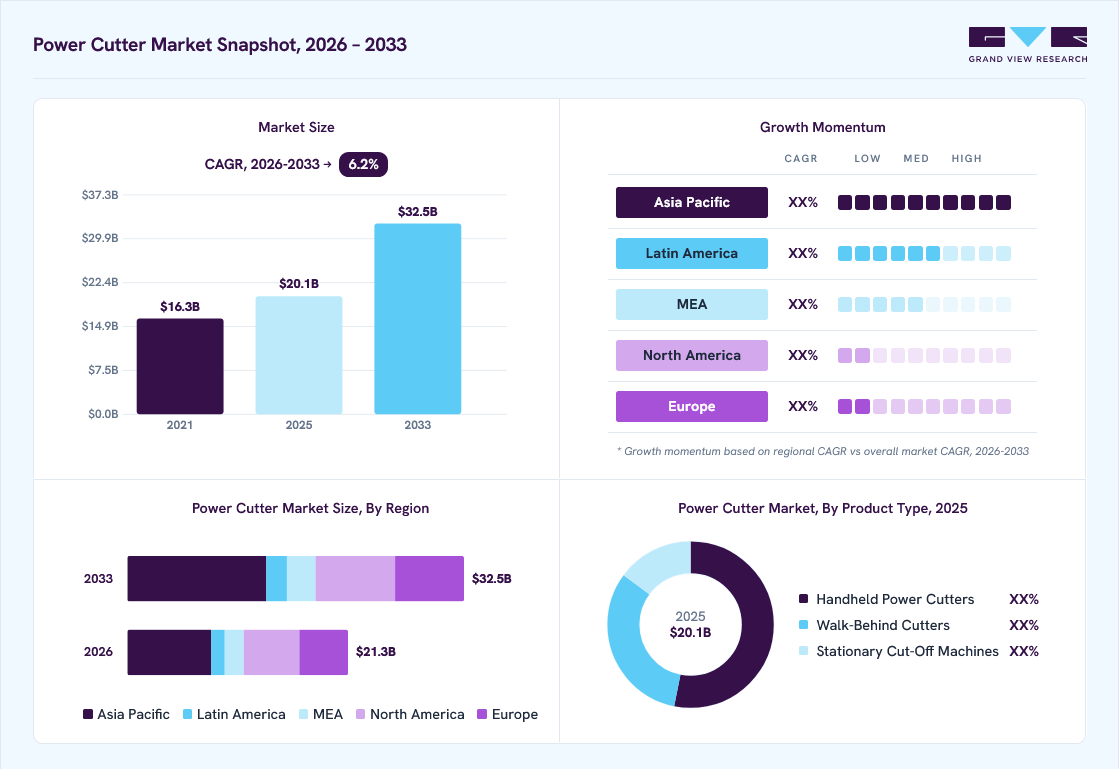 Source: Grand View Research, IR Documents, Primary Interviews, Paid DatabasesTo learn more about this report,
 Download Free Sample Report
 Key Market Trends & Insights
- By product type: Handheld power cutters accounted for the largest revenue share of 53.1% in 2025.
- By power source: Electric-corded segment dominated the market in 2025, accounting for 46.8% market share.
- By end use: Aerospace & defense is anticipated to record the fastest growth, with a CAGR of 7.7% during the forecast period.
Regional Highlights
- Largest regional market: Asia Pacific (37.5% revenue share, 2025)
- By country: China held the largest market share in 2025.
Market Size & Forecast
- Market size in 2025: USD 20.1 Billion
- Estimated market size in 2026: USD 21.3 Billion
- Projected market size by 2033: USD 32.5 Billion
- CAGR (2026-2033): 6.2%
Three ways to get this report
Buy it, customize it, or ask a question.Ask an Analyst
A direct answer, usually in 1 working day
- AccessReport author, directly
- Reply timeWithin 1 working day
- No sales callDirect answer only
- FormatEmail reply
- CostFree, no cost
Get the Full Report
What the study covers
- FormatsPDF · Excel · Dashboard
- Timeline2026–2033 annual, 2025 base
- Coverage20+ countries, 5 regions
- Companies10+ key players profiled
Customize the Report
20% free customization
- IncludeCountries, segments, points
- TailorTo your product definition
- ExtendDeeper competitor detail
- OrA fully bespoke study
- Turnaround5–10 working days
Investments in road construction, commercial and residential structures, utility infrastructure, and renovation projects are expanding the application base for power cutters across contractors and specialized construction service providers. Increasing requirements for controlled material cutting during demolition, structural modification, and installation activities are further supporting equipment demand.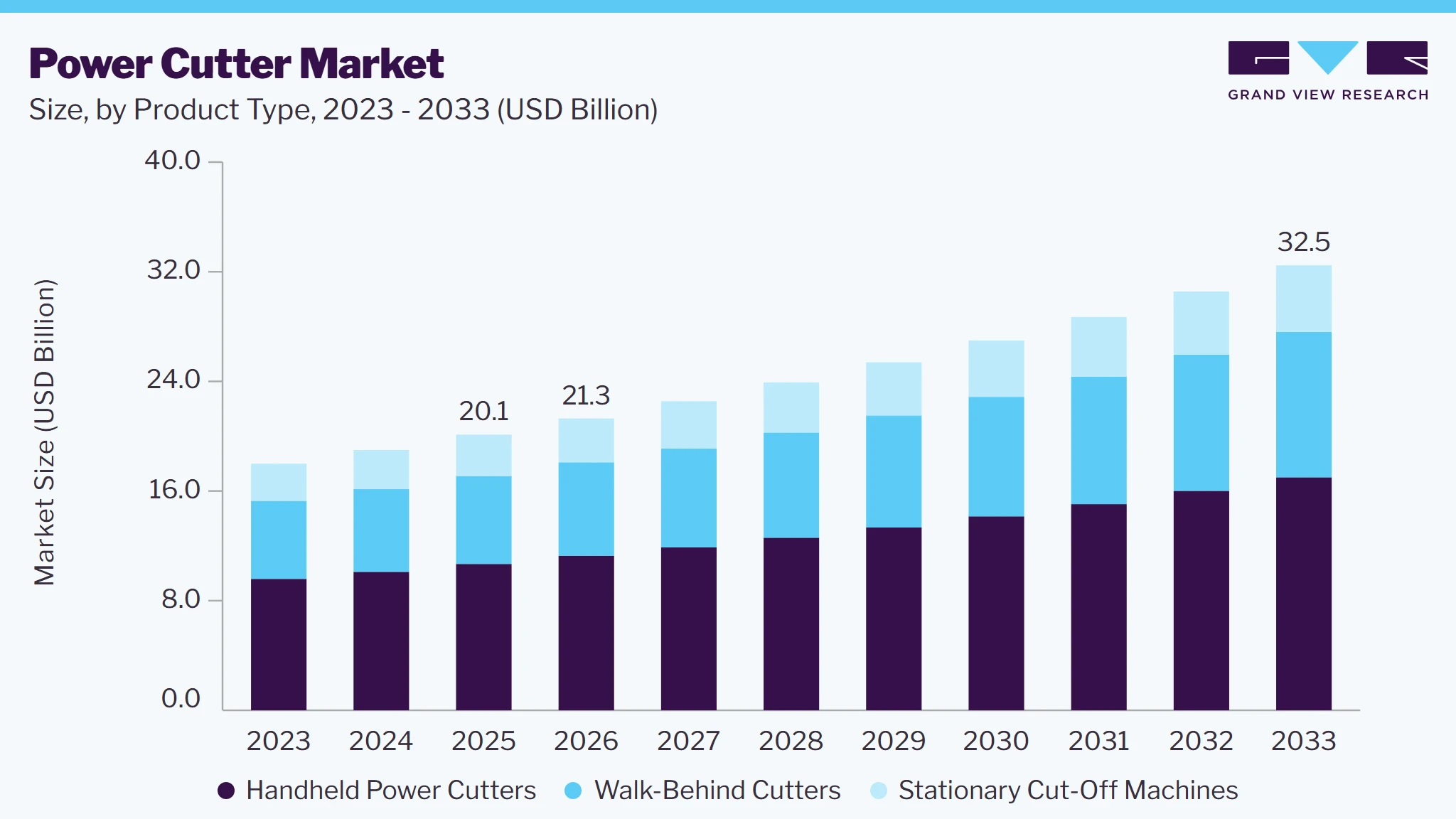 To learn more about this report, Download Free Sample Report
 Equipment replacement cycles and increasing utilization of mechanized cutting tools are contributing to recurring procurement across professional users. The expansion of construction equipment rental services is also widening access to power cutters, particularly among contractors seeking specialized machinery for project-specific requirements. Demand is further supported by maintenance and repair activities across built infrastructure, where compact cutting equipment is used for localized concrete, pavement, and masonry work.
Market Dynamics
The power cutter market is characterized by diverse demand patterns across construction, infrastructure maintenance, renovation, demolition, and industrial applications. Market development is influenced by equipment configuration, cutting capacity, material characteristics, operating conditions, replacement cycles, and equipment utilization intensity. Procurement decisions also vary according to ownership models, rental availability, maintenance requirements, and power-source preferences.
Rising expenditure on road development, building construction, utility networks, renovation, and demolition is increasing demand for equipment capable of cutting concrete, asphalt, masonry, and other dense materials. Power cutters are deployed across pavement work, structural modification, installation activities, and site preparation, supporting demand among contractors and specialized service providers. Ongoing infrastructure maintenance and refurbishment further generate recurring equipment requirements for repair, replacement, and modification activities.
Operation in abrasive and high-load environments accelerates wear of blades and other components, resulting in recurring replacement and servicing requirements. Engine-powered models also involve fuel consumption, lubrication, and periodic engine maintenance, contributing to operating expenditure over the equipment lifecycle. These recurring costs can influence purchasing decisions among smaller contractors and users with lower equipment utilization rates.
Advancements in battery energy density, motor technology, and charging systems are creating opportunities for cordless power cutters across applications requiring flexible equipment deployment. Improvements in runtime and power output are broadening the suitability of battery-powered models for renovation, maintenance, indoor construction, and remote work locations. The shift toward cordless equipment also provides manufacturers with opportunities to differentiate products through battery compatibility, charging performance, operating duration, and system-level integration.
Market Concentration & Characteristics
The power cutter market is fragmented, with competition distributed across established power equipment manufacturers, specialized cutting-equipment suppliers, and regional producers. Market participants serve diverse requirements through portfolios spanning handheld, walk-behind, electric, battery-powered, and engine-driven configurations. Competitive positioning varies by product capability, distribution coverage, brand presence, and application specialization, while dealer networks and equipment rental channels provide important routes to end users.
Product differentiation primarily revolves around cutting depth, power output, blade compatibility, equipment configuration, operating weight, and suitability for specific materials. Manufacturers are expanding product capabilities through brushless motor systems, higher-capacity battery platforms, electronic controls, integrated water-feed mechanisms, and dust-management solutions. Purchasing priorities also differ by user category, with professional contractors emphasizing cutting performance and durability, while rental businesses and smaller operators place greater weight on versatility, maintenance requirements, and overall ownership costs.
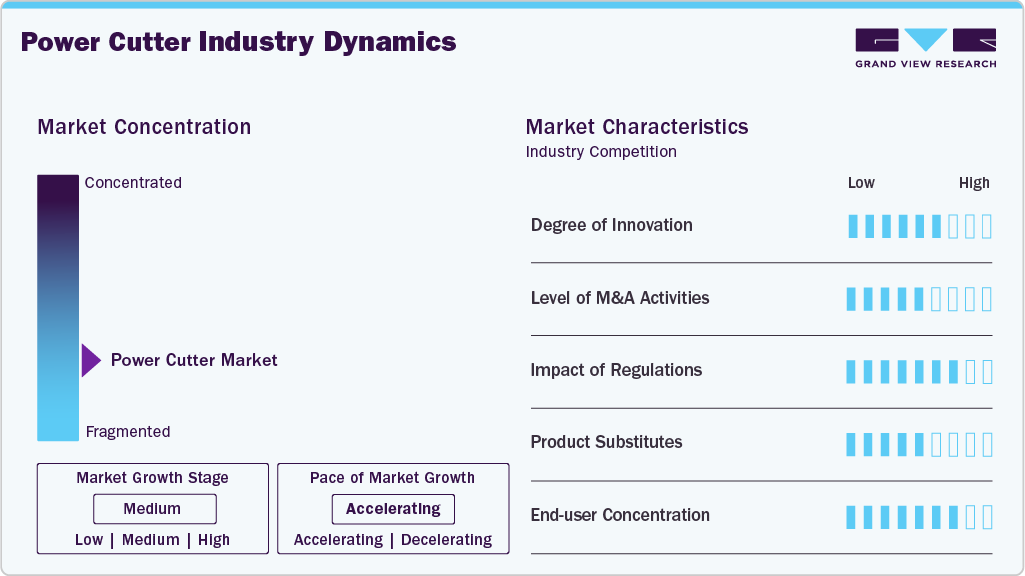 To learn more about this report, Download Free Sample Report
 The market serves a broad range of applications associated with construction, infrastructure maintenance, demolition, roadwork, renovation, and industrial cutting activities. Demand characteristics vary across these applications based on material type, operating conditions, project scale, and equipment utilization frequency. After-sales service, spare-parts availability, technical support, and distribution reach remain important competitive considerations, particularly for users operating equipment under intensive field conditions.
Analyst Perspective
The power cutter market is shaped by continued mechanization of construction and infrastructure work, replacement of aging equipment, and gradual adoption of cordless cutting solutions. Handheld equipment remains central to the market because of its flexibility across varied job-site conditions, while walk-behind and stationary configurations address applications require greater cutting control or repeatability. From a competitive standpoint, manufacturers are differentiating through motor performance, battery technology, operator ergonomics, safety features, and application-specific capabilities rather than equipment configuration alone. Demand conditions also vary considerably by end use and geography, reflecting differences in construction intensity, industrial activity, contractor structures, and equipment ownership models.
Product Type Insights
Handheld power cutters accounted for the largest revenue share of 53.1% in 2025, reflecting their extensive use across construction, renovation, demolition, maintenance, and repair activities. Their compact form factor allows operators to perform cutting tasks across confined and varied work environments, while compatibility with applications involving concrete, masonry, asphalt, and other hard materials broadens their commercial use. Demand is also supported by their suitability for contractors requiring equipment that can be deployed across multiple project types without extensive setup requirements.
Walk-behind cutters are projected to register the fastest CAGR during the forecast period, supported by increasing requirements for controlled and deeper cutting in infrastructure and construction applications. These machines are particularly suited to roadwork, pavement maintenance, concrete slab cutting, and other operations involving extended or linear cutting paths. Their guided operating configuration provides greater cutting stability for demanding applications, supporting adoption where consistent cutting depth and controlled equipment movement are required.
Power Source Insights
Electric-corded power cutters held the largest revenue share of 46.8% in 2025, reflecting their established use in applications requiring stable and uninterrupted power supply. Their ability to deliver consistent cutting performance without dependence on battery runtime supports adoption for extended-duration operations and fixed-site work. Established electrical infrastructure and lower dependence on battery replacement cycles further contribute to their commercial use.
Battery-powered/cordless power cutters are projected to register the fastest CAGR of 6.8% during the forecast period. Adoption is being supported by improvements in battery energy density, motor output, and charging performance, which are enhancing equipment runtime and cutting capability. The cordless configuration is particularly relevant for applications requiring greater operator freedom, rapid equipment repositioning, and access to locations where conventional power connections are unavailable.
End-use Insights
Construction & demolition accounted for the largest revenue share of 50.8% in 2025, reflecting broad deployment of power cutters across building construction, renovation, demolition, and infrastructure-related activities. Equipment is used for concrete and masonry modification, pavement removal, structural alteration, and site preparation, where portability and rapid material processing are important operational considerations. Recurring repair and refurbishment work across the built environment also contributes to sustained equipment demand within this end-use segment.
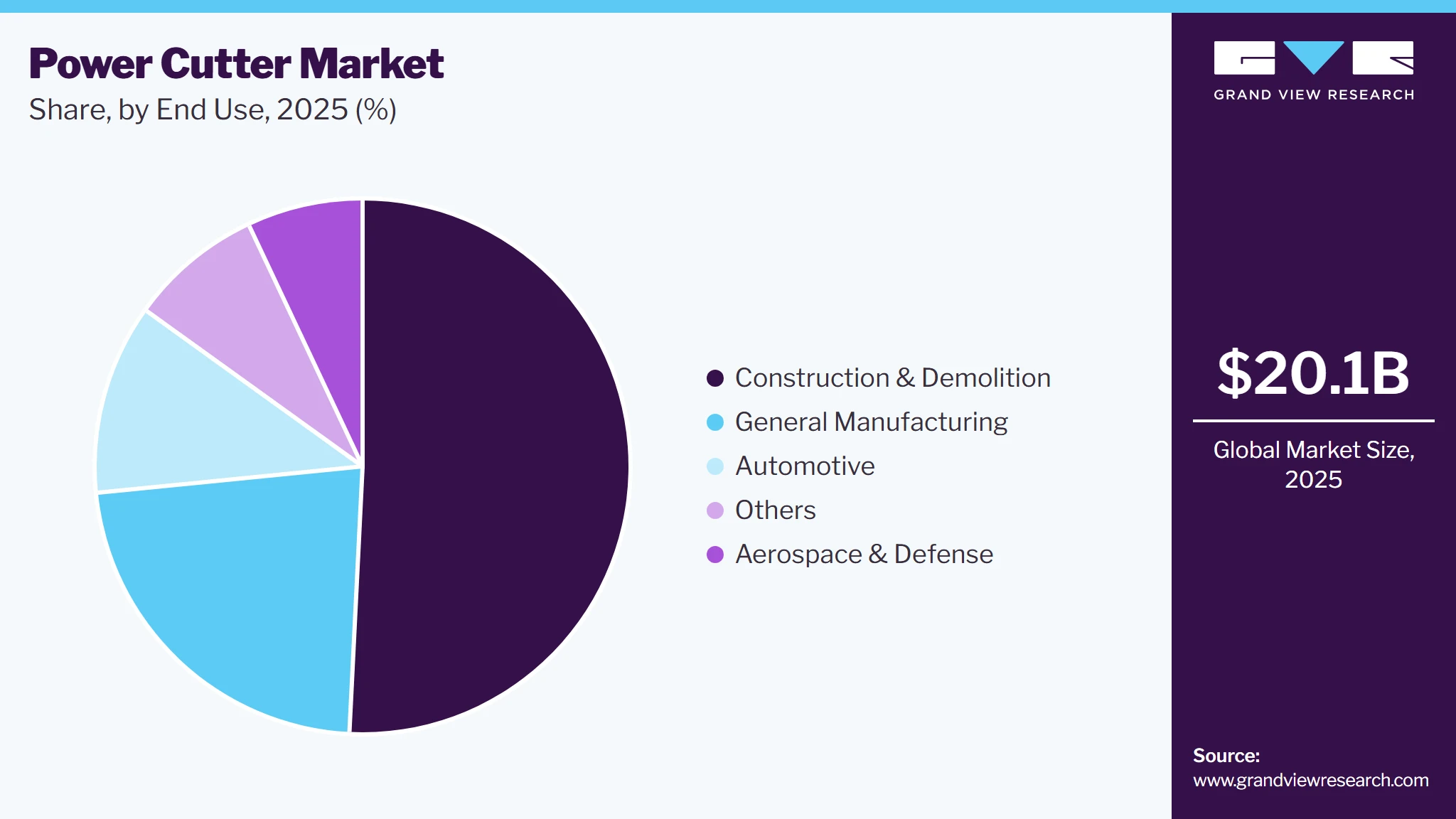 To learn more about this report, Download Free Sample Report
 Aerospace & defense is projected to register the fastest CAGR of 7.7% during the forecast period, supported by rising equipment requirements across aircraft production, component manufacturing, maintenance, and repair operations. Adoption in this segment is associated with applications involving specialized alloys, composite structures, and other engineered materials that require controlled material removal and dimensional accuracy. Increasing aircraft production and maintenance requirements are expected to broaden the use of specialized cutting equipment across aerospace manufacturing and service facilities.
Regional Insights
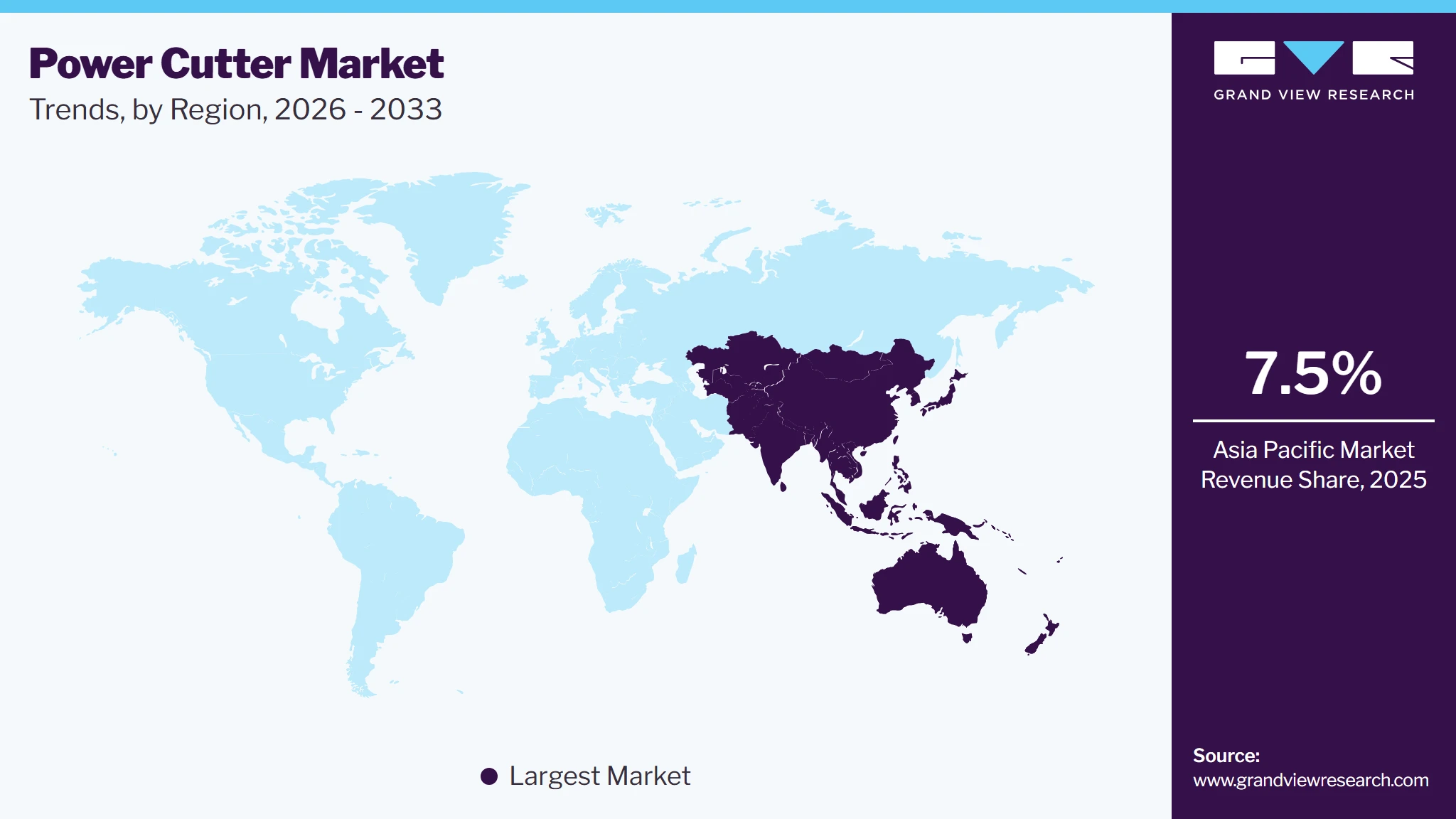
Asia Pacific power cutter market dominated with the largest revenue share of 37.5% in 2025. The region benefits from a large installed base of construction equipment, high-volume building activity, expanding transportation infrastructure, and increasing mechanization of material-processing tasks. Demand spans handheld and walk-behind equipment, with purchasing patterns influenced by project scale, contractor requirements, equipment rental penetration, and the transition toward cordless platforms. Diverse construction practices across developing and mature economies also create a broad product mix ranging from basic professional models to higher-capacity equipment.
 To learn more about this report, Download Free Sample Report
 The power cutter market in China represents a substantial demand center, supported by its extensive building stock, large-scale transportation projects, and sizeable contractor ecosystem. Power cutters are used across concrete slab work, road surfacing, masonry processing, demolition, and building fit-out activities, with demand extending across both large construction enterprises and local contractors. Replacement of older equipment and increasing preference for mechanized site operations provide an additional layer of recurring demand.
India power cutter market is closely linked to rapid urban development, residential and commercial construction, and expansion of transport and utility infrastructure. Small and mid-sized contractors form an important user base, creating demand for versatile equipment that can be moved between project locations and used across multiple material types. Road repair, concrete modification, masonry work, and building renovation represent important application areas, while growing professionalization of construction practices is increasing reliance on powered equipment.
North America Power Cutter Market Trends
North America power cutter market is mature with established dealer, rental, and professional contractor channels. Demand is shaped less by basic equipment penetration and more by replacement cycles, infrastructure upkeep, renovation, and the need for specialized machinery across professional applications. Product selection is influenced by operating durability, cutting performance, ergonomics, emissions, and compatibility with increasingly diversified power-tool platforms.
The power cutter market in the U.S. accounts for a broad range of power cutter applications across commercial construction, concrete contracting, road maintenance, demolition, and utility-related work. The depth of the professional contracting and equipment rental ecosystem facilitates access to specialized cutting equipment without requiring ownership for every project. Demand also benefits from refurbishment of existing commercial and residential structures, where compact cutting tools are required for localized modification and removal work.
Canada power cutter market is characterized by demand from contractors operating across geographically dispersed construction and infrastructure projects. Equipment requirements are influenced by road maintenance, concrete construction, building activity, and resource-sector projects, with portability becoming particularly relevant where machinery must be transported between remote or temporary work locations. Rental utilization and replacement of equipment subjected to demanding operating conditions also contribute to market activity.
Europe Power Cutter Market Trends
Europe power cutter market is mature, in which renovation, building rehabilitation, infrastructure maintenance, and professional construction services form important demand channels. The region's comparatively established building stock creates sustained requirements for controlled material removal and modification rather than equipment demand being tied solely to new construction. Manufacturers are also competing through lower-emission powertrains, battery platforms, vibration reduction, dust-control features, and improved operator ergonomics.
The power cutter market in Germany has a strong professional equipment user base associated with construction trades, infrastructure contractors, industrial maintenance, and building refurbishment. Demand is supported by projects requiring precise modification of concrete and masonry structures, particularly during modernization of existing commercial and residential properties. The country's developed equipment distribution and service infrastructure also favors purchases of higher-specification machinery with reliable after-sales support.
France power cutter market has a diversified application base linked to building rehabilitation, public-works activity, road maintenance, and demolition services. Renovation of aging structures generates demand for compact equipment suited to confined work areas, while public infrastructure projects create applications involving pavement and concrete processing. Equipment rental and professional contracting services further influence purchasing patterns by enabling access to specialized machinery for short-duration projects.
Middle East & Africa Power Cutter Market Trends
Middle East & Africa power cutter market offers a developing market characterized by differences in construction intensity, equipment availability, and project scale across individual countries. Large commercial developments, transport projects, industrial facilities, and urban expansion create demand for high-capacity cutting equipment, while smaller contractors support demand for portable models. Market development is also influenced by the availability of equipment dealers, rental services, replacement parts, and technical support.
The power cutter market in Saudi Arabia represents an important regional demand center as large-scale development programs expand requirements for construction machinery across building, transportation, and urban projects. Power cutters are relevant to concrete preparation, masonry work, pavement modification, and demolition activities associated with major development sites. High project concentration and contractor-led procurement create opportunities for equipment suppliers offering durable machines with strong service and distribution support.
Latin America Power Cutter Market Trends
Latin America power cutter market is diversely shaped by construction activity, urban expansion, road rehabilitation, and the modernization of commercial and residential structures. Market demand varies considerably according to investment conditions and the scale of local contracting industries. Equipment rental, distributor availability, and replacement of aging machinery influence purchasing decisions alongside project-driven demand.
The power cutter market in Brazil has the region's broadest application base, with power cutters used by construction contractors, demolition specialists, road-service providers, and building maintenance operators. Urban construction and rehabilitation generate requirements across concrete, masonry, and pavement work, while the country's extensive geographic coverage creates demand for portable equipment that can be deployed across dispersed projects. Distributor networks and equipment replacement cycles remain important to market development as professional users expand their powered-tool portfolios.
Key Power Cutter Company Insights
Some of the key players operating in the market include Makita, STIHL, among others.
-
Makita Corporation, headquartered in Anjo, Aichi, Japan, is a global power equipment manufacturer with a broad portfolio serving professional construction and material-processing applications. The company offers corded and cordless power cutters designed for cutting concrete, masonry, metal, and other hard materials. Its cordless cutting equipment incorporates technologies such as brushless motors, battery-powered operation, integrated water delivery, electric braking, and vibration-reduction systems, supporting applications that require portable cutting performance and operator control.
-
STIHL, headquartered in Waiblingen, Germany, develops professional outdoor power equipment and cutting machinery for construction, landscaping, renovation, and related applications. Its cut-off machine portfolio includes petrol-powered and battery-powered models designed for processing concrete, masonry, asphalt, and other demanding materials. Product development emphasizes cutting performance, handling, ergonomics, operating control, and reduced emissions, while its established professional distribution and service network supports equipment deployment across demanding job-site environments.
Key Power Cutter Companies:
The following key companies have been profiled for this study on the power cutter market:
-
Makita
-
STIHL
-
Bosch Power Tools
-
Hilti
-
Stanley Black & Decker
-
Husqvarna Construction
-
Wacker Neuson
-
Tyrolit
-
CEDIMA
-
GÖLZ
-
ICS
-
Milwaukee Tool
-
HiKOKI
-
Norton Clipper
-
Dr. Schulze
Competitive Benchmarking
Category
Operating Strategies
Competitive Edge
Weakness
Established Players (e.g., Makita; STIHL; Bosch Power Tools; Hilti; Stanley Black & Decker; Husqvarna Construction; Wacker Neuson; Milwaukee Tool; HiKOKI)
- Broaden power cutter portfolios across corded, cordless, petrol-powered, and specialized configurations, with continued investment in battery systems, motor performance, ergonomics, and safety features.
- Strengthen global distribution, professional dealer networks, rental channels, and aftermarket service capabilities to maintain market coverage.
- Strong brand recognition, extensive professional-user bases, and diversified product portfolios provide broad access to construction and industrial customers.
- Established R&D, manufacturing, and service infrastructure supports product development and reliable supply across major markets.
- Larger operating structures can increase product-development and manufacturing complexity across diverse equipment portfolios.
- Premium positioning and extensive service infrastructure can result in higher product and ownership costs.
Emerging & Regional Players (e.g., Tyrolit; ICS Diamond Tools; Norton Clipper; CEDIMA; GÖLZ, Dr. Schulze)
- Focus on specialized cutting equipment for concrete, masonry, asphalt, and other demanding materials, with emphasis on application-specific configurations and diamond-cutting technologies.
- Expand through specialist distributors, technical sales channels, application support, and regional service networks.
- Specialized engineering expertise and focused product portfolios enable targeted solutions for demanding professional cutting applications.
- Closer alignment with specific material, cutting-depth, and job-site requirements supports differentiation in niche applications.
- Narrower geographic coverage and product portfolios can limit access to broad customer segments served by diversified power-tool manufacturers.
- Smaller scale may constrain investment in global distribution, large-scale product development, and international market expansion.
Recent Developments
-
In May 2025, Hilti’s DSH 600-22 ATC and DSH 700-22 ATC 12-inch battery-powered cut-off saws received recognition in the 2025 Concrete Contractor Top Product Awards. The second-generation models incorporate enhanced cutting performance, extended runtime, faster charging, and safety features such as 3D Active Torque Control and automatic shutdown. The saws are designed for cutting concrete, masonry, asphalt, and metal, supporting their use across construction and related cutting applications.
-
In January 2025, Makita introduced the 40V max XGT GEC03, a 9-inch cordless power cutter, at World of Concrete 2025. The equipment is capable of making cuts up to 3.5 inches deep in materials such as concrete, masonry, and metal. Its brushless motor increases power output by up to 45% over the preceding model and lowers vibration levels by as much as 55%. An integrated water-delivery mechanism helps during cutting operations, while the electric brake and battery-powered design add to its functionality across indoor and outdoor work environments.
Power Cutter Market Report Scope
Report Attribute
Details
Market size in 2025
USD 20.1 billion
Estimated market size in 2026
USD 21.3 billion
Revenue forecast in 2033
USD 32.5 billion
Growth rate
CAGR of 6.2% from 2026 to 2033
Base year for estimation
2025
Historical data
2021 - 2024
Forecast period
2026 - 2033
Quantitative units
Revenue in USD million/billion and CAGR from 2026 to 2033
Report coverage
Revenue forecast, company market position analysis, competitive landscape, growth factors, and trends
Segments covered
Product type, power source, end-use, region
Regional scope
North America; Europe; Asia Pacific; Latin America; Middle East & Africa
Country scope
U.S.; Canada; Mexico; Germany; UK; Italy; Spain; France; China; Japan; India; Australia; South Korea; Brazil; Argentina; Saudi Arabia; UAE; South Africa
Key companies profiled
Makita; STIHL; Bosch Power Tools; Hilti; Stanley Black & Decker; Husqvarna Construction; Wacker Neuson; Tyrolit; CEDIMA; GÖLZ; ICS; Milwaukee Tool; HiKOKI; Norton Clipper; Dr. Schulze
Customization scope
Free report customization (equivalent up to 8 analysts working days) with purchase. Addition or alteration to country, regional & segment scope.
Pricing and purchase options
Avail customized purchase options to meet your exact research needs. Explore purchase options
Global Power Cutter Market Report Segmentation
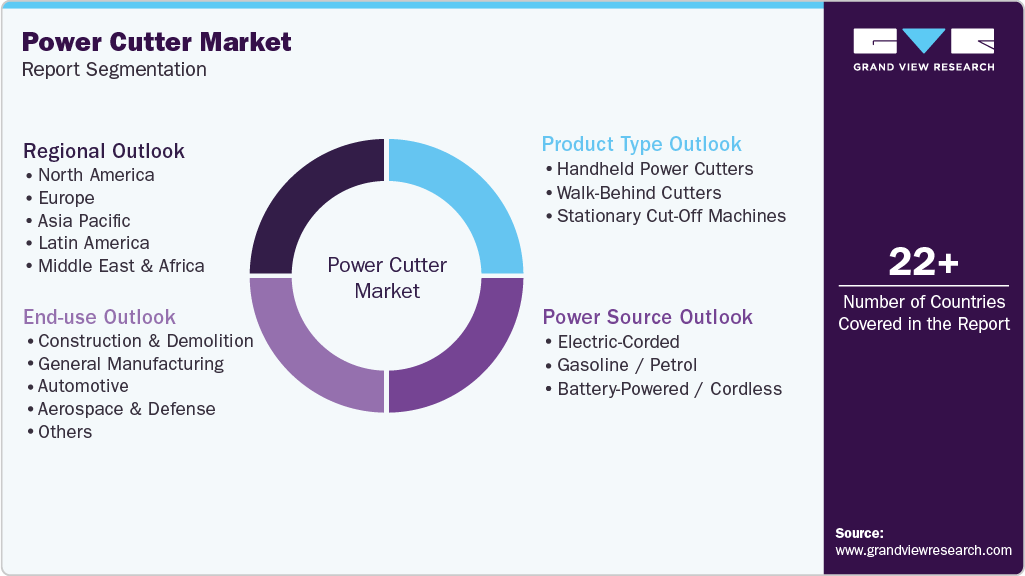
This report forecasts revenue growth at global, regional & country levels and provides an analysis on the industry trends in each of the sub-segments from 2021 to 2033. For this study, Grand View Research has segmented the power cutter market on the basis of product type, power source, end-use, and region:
 To learn more about this report, Download Free Sample Report
 -
Product Type Outlook (Revenue, USD Billion, 2021 - 2033)
-
Handheld Power Cutters
-
Walk-Behind Cutters
-
Stationary Cut-Off Machines
-
-
Power Source Outlook (Revenue, USD Billion, 2021 - 2033)
-
Electric-Corded
-
Gasoline / Petrol
-
Battery-Powered / Cordless
-
-
End-use Outlook (Revenue, USD Billion, 2021 - 2033)
-
Construction & Demolition
-
General Manufacturing
-
Automotive
-
Aerospace & Defense
-
Others
-
-
Regional Outlook (Revenue, USD Billion, 2021 - 2033)
-
North America
-
U.S.
-
Canada
-
Mexico
-
-
Europe
-
Germany
-
France
-
UK
-
Spain
-
Italy
-
-
Asia Pacific
-
China
-
India
-
Japan
-
South Korea
-
Australia
-
-
Latin America
-
Brazil
-
Argentina
-
-
Middle East & Africa
-
Saudi Arabia
-
UAE
-
South Africa
-
-
Research Methodology
The power cutter market figures in this report are based on a proven research process that combines executive interviews with secondary research from proprietary databases, company filings, and recognized regulatory and institutional sources. Market size is built through value-chain sizing-reconciling supply-side and demand-side estimates-and triangulated with bottom-up and top-down approaches. Every estimate passes multiple levels of expert validation before publication, with each power cutter segment quantified using the revenue-capture definitions in the table below.
Segment Definition
Product Type
Revenue Capture Definition
Handheld Power Cutters
Revenue generated from the sale of portable power cutters operated manually for cutting concrete, masonry, asphalt, metal, stone, and other hard materials.
Walk-Behind Cutters
Revenue generated from the sale of guided cutting machines designed for controlled surface and pavement work, including concrete slabs, asphalt, flooring, and similar applications.
Stationary Cut-Off Machines
Revenue generated from the sale of fixed or bench-mounted cutting machines used for precise material separation and sectioning in construction, fabrication, and industrial environments.
Power Source
Revenue Capture Definition
Electric-Corded
Revenue generated from the sale of power cutters equipped with electric motors and designed for operation through a continuous external power connection.
Gasoline / Petrol
Revenue generated from the sale of engine-powered cutters using gasoline or petrol as the primary energy source, generally intended for high-power applications and locations without convenient electrical access.
Battery-Powered / Cordless
Revenue generated from the sale of rechargeable battery-operated power cutters designed to provide cutting capability without a wired power connection during use.
End Use
Revenue Capture Definition
Construction & Demolition
Revenue generated from the sale of power cutters for building construction, demolition, renovation, concrete modification, pavement work, masonry processing, and related site activities.
General Manufacturing
Revenue generated from the sale of power cutters to industrial manufacturers for fabrication, material preparation, equipment maintenance, component alteration, and other production-support activities.
Automotive
Revenue generated from the sale of power cutters to vehicle manufacturers, parts producers, workshops, and repair operations for material preparation, component work, dismantling, and maintenance requirements.
Aerospace & Defense
Revenue generated from the sale of power cutters to aircraft, defense equipment, component, and maintenance organizations for specialized fabrication, material preparation, repair, and modification work.
Others
Revenue generated from the sale of power cutters across mining, utilities, infrastructure services, emergency and rescue operations, and other applications not classified under the specified end-use categories.
Estimation Model
Layer Name
Key Question
Description
Application Demand Layer
Where is cutting equipment required?
Quantify the requirement for power cutters across construction, demolition, infrastructure work, manufacturing, automotive, aerospace & defense, and other operating environments. Assess material-processing needs involving concrete, asphalt, masonry, metals, and other hard materials to define the underlying equipment requirement.
Activity & Replacement Layer
What creates incremental equipment requirements?
Examine construction expenditure, infrastructure projects, industrial output, renovation and demolition activity, contractor utilization, fleet expansion, and replacement cycles. Distinguish first-time purchases from replacement and capacity-addition requirements to determine the underlying volume opportunity.
Segment Adoption Layer
How is the market structured by equipment configuration?
Evaluate purchasing patterns across product type, power source, and end use. Product-type analysis considers handheld, walk-behind, and stationary configurations based on mobility, cutting depth, and operating requirements. Power-source assessment covers electric-corded, gasoline/petrol, and battery-powered/cordless models according to runtime, power delivery, portability, and site conditions.
Revenue Generation Layer
How is market value derived from equipment sales?
Calculate annual revenue from new and replacement power cutter sales across segments and geographic markets. Apply segment-specific pricing based on machine configuration, power output, cutting capacity, blade diameter, drive technology, and equipment specifications. Cross-check market values against manufacturer disclosures, shipment estimates, distributor activity, product portfolios, and underlying project indicators.
Delivered Customizations
This report has been delivered with the following In-depth customizations
Client Request
Customization Delivered
Value Adds
Competitive Benchmarking
A structured benchmarking assessment was conducted for leading power cutter manufacturers based on product portfolio breadth, cutting capacity, power output, motor and engine technology, battery systems, equipment features, application coverage, distribution reach, aftermarket capabilities, product launches, and strategic initiatives.
The analysis provided a comparative view of manufacturer capabilities, technological differentiation, portfolio positioning, and competitive approaches, helping stakeholders assess supplier strengths and identify opportunities for product development and differentiation.
Regional Segmentation
A detailed geographic assessment was developed across Asia Pacific, North America, Europe, Middle East & Africa, and Latin America. The analysis examined construction and infrastructure activity, renovation and demolition, industrial production, equipment replacement, contractor activity, rental penetration, and technology adoption, with country-level variations incorporated where relevant.
The assessment clarified regional demand patterns, market development conditions, and country-specific purchasing factors, supporting geographic expansion decisions, distribution planning, and market-entry strategies.
Opportunity Assessment
A detailed opportunity assessment was conducted across the market's defined product, power-source, and end-use segments. The analysis considered equipment replacement, fleet expansion, construction activity, industrial requirements, cordless adoption, and changing equipment utilization patterns to identify areas of incremental demand.
The assessment helped stakeholders identify emerging demand pockets, evaluate growth opportunities across applications and technologies, prioritize commercial initiatives, and align product development with evolving requirements in the power cutter market.
Frequently Asked Questions About This Report
The global power cutter market size was valued at USD 20.1 billion in 2025 and is projected to reach USD 21.3 billion in 2026.
The global power cutter market is projected to grow at a CAGR of 6.2% from 2026 to 2033, reaching USD 32.5 billion by 2033.
Key companies include Makita, STIHL, Bosch Power Tools, Hilti, Stanley Black & Decker, Husqvarna Construction, Wacker Neuson, Tyrolit, CEDIMA, GÖLZ, ICS, Milwaukee Tool, HiKOKI, Norton Clipper, and Dr. Schulze.
Electric-corded segment dominated the market in 2025, accounting for 46.8% market share.
Aerospace & defense is anticipated to record the fastest growth, with a CAGR of 7.7% during the forecast period.
The market is driven by infrastructure development, building construction, renovation, demolition, road projects, and increasing use of mechanized cutting equipment for concrete, asphalt, masonry, and other hard materials.
Asia Pacific dominated the market, accounting for a revenue share of 37.5% in 2025.
Handheld power cutters accounted for the largest revenue share of 53.1% in 2025.
About the Author(s)
Advanced Interior Materials Research Team
Advanced Materials · Advanced Interior MaterialsThis report was authored by the advanced interior materials research team at Grand View Research - comprising two research analysts, one senior research analyst, and one industry expert - with specialized expertise in the advanced interior materials segment of the advanced materials industry. All findings are based on proprietary advanced materials databases, executive interviews, and regulatory analysis, subject to internal peer review prior to publication.
Last Updated:
Speak to Analyst

Customize this report to your needs - add regions, segments, or data points, with 20% free customization.
Or view our licence options:


ISO 9001:2015 & 27001:2022 Certified
We are GDPR and CCPA compliant! Your transaction & personal information is safe and secure. For more details, please read our privacy policy.


