
- Home
- »
- Renewable Energy
- »
-
Power Tool Batteries Market Size & Share Report 2026-2033GVR Report cover

Power Tool Batteries Market (2026 - 2033)
Size, Share & Trends Analysis Report By Type (Lithium-ion, Nickel-Cadmium, Nickel-Metal Hydride), By Application (Residential, Commercial, Industrial), By Region, And Segment Forecasts
Market Size, 2025
$2.9BMarket Estimate, 2026
$3.1BMarket Forecast, 2033
$5.9BCAGR, 2026–2033
9.4%Power Tool Batteries Market Summary
The global power tool batteries market size was valued at USD 2.9 billion in 2025 and is projected to grow from USD 3.1 billion in 2026 to USD 5.9 billion by 2033, at a CAGR of 9.4% from 2026 to 2033. The market in North America dominated with a revenue share of 38.5% in 2025. The market is witnessing robust growth, fueled by the rising demand for cordless power tools across professional and DIY applications.
 Source: Grand View Research, IR Documents, Primary Interviews, Paid DatabasesTo learn more about this report,
 Download Free Sample Report
 Key Market Trends & Insights
- By type: Lithium-ion segment held the largest market share of 63.6% in 2025.
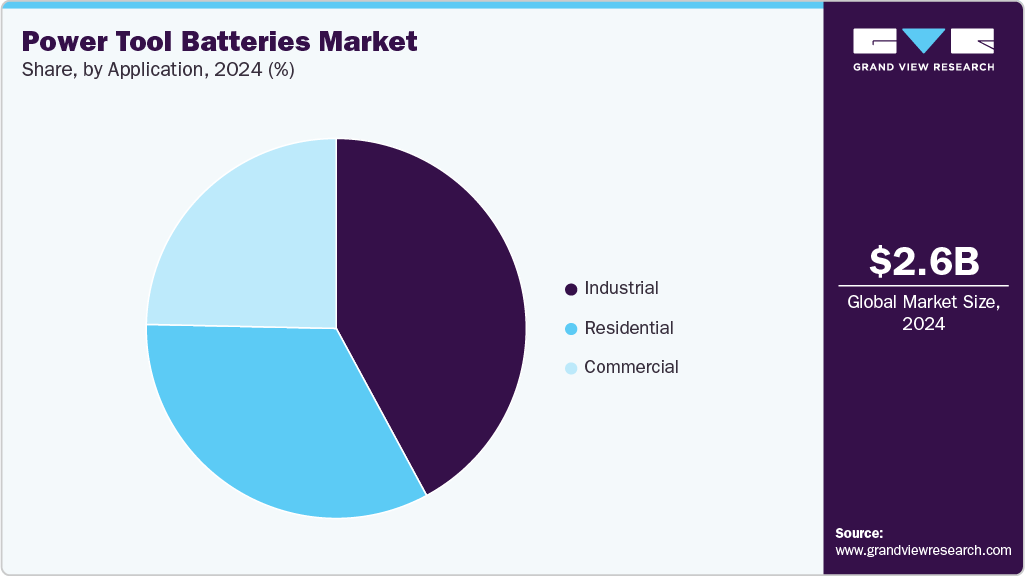
- By application: Industrial segment held the largest market share of 41.4% in 2025.
Regional Highlights
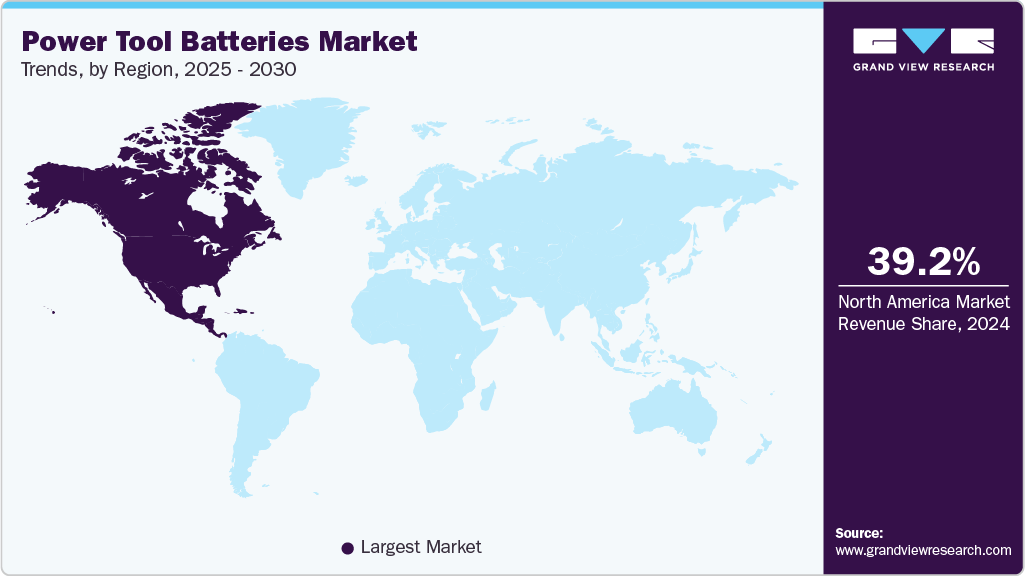
- Largest regional market: North America (38.5% revenue share, 2025)
- Fastest-growing regional market: Asia Pacific (highest CAGR, 2026-2033)
- By country: The U.S. held the largest market share in 2025.
Market Size & Forecast
- Market size in 2025: USD 2.9 Billion
- Estimated market size in 2026: USD 3.1 Billion
- Projected market size by 2033: USD 5.9 Billion
- CAGR (2026-2033): 9.4%
Three ways to get this report
Buy it, customize it, or ask a question.Ask an Analyst
Analyst response in 1 business day
- AccessReport author, directly
- Reply timeWithin 1 working day
- No sales callDirect answer only
- FormatEmail reply
- CostFree, no cost
Get the Full Report
What the study covers
- FormatsPDF · Excel · Dashboard
- Timeline2026–2033 annual, 2025 base
- Coverage20+ countries, 5 regions
- Companies10+ key players profiled
Customize the Report
20% free customization
- IncludeCountries, segments, points
- TailorTo your product definition
- ExtendDeeper competitor detail
- OrA fully bespoke study
- Turnaround5–10 working days
Key factors such as advancements in lithium-ion battery technology, increasing focus on energy efficiency, and the growing popularity of battery-powered equipment over traditional corded tools are driving market expansion. Moreover, favorable regulations promoting sustainable construction practices and the ongoing shift toward electrification in the tools industry support battery adoption globally. Technological innovations, particularly in battery chemistry and thermal management systems, significantly enhance power tool batteries' performance and lifespan. These advancements enable faster charging, higher energy density, and improved safety, making cordless tools more efficient and reliable for industry users.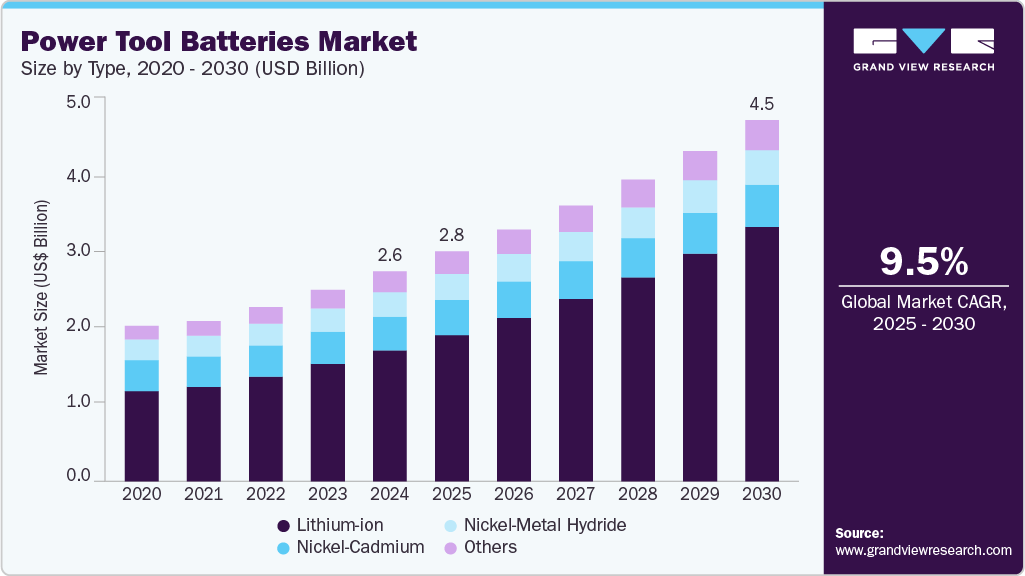 To learn more about this report, Download Free Sample Report
 Additionally, integrating smart battery technologies that allow for real-time monitoring of battery health and usage contributes to operational efficiency and cost savings. As consumers and industries increasingly prioritize portability and sustainability, the demand for advanced battery-powered tools continues to align with global trends toward cleaner, more efficient energy solutions.
The commercial and residential construction sectors are increasingly shifting toward battery-powered tools to enhance job site mobility and reduce emissions. The modular design and compatibility of battery systems across multiple tools within a brand ecosystem offer users greater flexibility and cost-effectiveness. Subscription-based or battery-as-a-service (BaaS) models are also emerging, allowing users to access premium battery technology without substantial upfront investment. This transition is especially pronounced in rapidly developing regions like Asia Pacific, where urban growth and infrastructure expansion boost demand for cordless solutions.
Despite the market's promising outlook, challenges such as the high cost of advanced lithium-ion batteries, recycling complexities, and safety concerns related to overheating or thermal runaway remain. However, continuous R&D and growing regulatory support for battery standardization and recycling infrastructure are expected to address these issues over time. As industries move toward cordless, energy-efficient solutions, power tool batteries are set to play a central role in shaping the future of tool performance, sustainability, and user convenience.
Market Dynamics
The power tool batteries market is primarily driven by the growing adoption of cordless power tools across residential, commercial, and industrial applications, supported by rising construction activity, rapid industrialization, and advancements in rechargeable battery technology. Lithium-ion batteries have become the preferred power source due to their high energy density, lightweight design, fast charging capabilities, and longer operational life compared to conventional nickel-based batteries. In addition, continuous innovations in battery management systems (BMS), fast-charging technologies, and high-capacity battery platforms are improving tool performance, runtime, and user convenience, thereby supporting widespread market adoption.
The increasing preference for cordless power tools is a major driver of the power tool batteries market. Professionals in construction, automotive repair, manufacturing, woodworking, and maintenance industries are increasingly shifting toward cordless equipment owing to its enhanced mobility, improved workplace safety, and operational flexibility. Modern lithium-ion battery platforms provide longer runtime, higher power output, and faster charging, enabling cordless tools to deliver performance comparable to corded alternatives while eliminating the limitations of power cords. These advantages are accelerating battery demand across both professional and do-it-yourself (DIY) applications.
Furthermore, rising investments in residential construction, infrastructure development, and industrial automation, coupled with growing consumer participation in home renovation and DIY projects, continue to strengthen market growth. The expanding product portfolios of leading power tool manufacturers featuring interchangeable battery platforms, intelligent battery management systems, and ultra-fast charging technologies are further supporting battery adoption. Continuous advancements aimed at improving battery lifespan, energy efficiency, and compatibility across multiple tool categories are expected to sustain market growth throughout the forecast period.
Despite their superior performance, lithium-ion power tool batteries involve higher manufacturing and replacement costs than traditional nickel-cadmium and nickel-metal hydride batteries due to the use of advanced materials, sophisticated battery management systems, and stringent safety requirements. These higher upfront costs can limit adoption among price-sensitive consumers and small contractors. In addition, fluctuations in the prices of critical raw materials such as lithium, cobalt, nickel, and graphite may increase battery production costs and impact manufacturer profitability.
Continuous advancements in battery technology and the growing adoption of interchangeable battery ecosystems present significant growth opportunities for the power tool batteries market. Manufacturers are increasingly developing higher-capacity batteries, ultra-fast charging solutions, and intelligent battery management technologies that enhance runtime, productivity, and equipment reliability. At the same time, expanding multi-tool battery platforms that allow a single battery to power a wide range of professional and consumer tools are improving customer convenience and reducing ownership costs. These developments, combined with increasing electrification of construction equipment and rising demand for high-performance cordless solutions, are expected to create substantial growth opportunities throughout the forecast period.
Analyst Perspective
The power tool batteries market is experiencing strong growth, driven by the increasing adoption of cordless power tools across residential, commercial, and industrial applications, supported by rising construction activities, industrial automation, and growing DIY trends. Continuous advancements in lithium-ion battery technology, battery management systems, and fast-charging solutions are improving runtime, energy efficiency, and overall tool performance. While fluctuations in lithium and other critical raw material prices, along with supply chain challenges, remain key constraints, ongoing innovations in high-capacity battery platforms and next-generation rechargeable battery technologies are expanding market opportunities. In the coming years, companies that can strengthen battery technology innovation, improve energy density and charging performance, expand global manufacturing and distribution capabilities, and develop interoperable battery platforms are expected to strengthen their competitive position in the global power tool batteries market.
Type Insights
Based on type, lithium-ion segment led the market with the largest revenue share of 63.6% in 2025 due to its superior energy density, lightweight design, and longer lifespan compared to other chemistries. These batteries support faster charging and deliver consistent power output, making them ideal for DIY enthusiasts for heavy-duty industrial applications and everyday use. Their ability to retain charge over extended periods and low self-discharge rates further enhance their appeal. As the demand for cordless tools continues to rise across various sectors, Lithium-ion batteries remain the preferred choice due to their performance efficiency and decreasing cost trends fueled by mass production and ongoing innovation.
Nickel-cadmium (Ni-Cd), Nickel-Metal Hydride (NiMH), and other battery types continue to serve niche markets, often where cost sensitivity or specific environmental conditions dictate their use. While Ni-Cd batteries offer durability and tolerance to extreme temperatures, their environmental concerns and memory effects have led to declining usage. Though more environmentally friendly, NiMH batteries typically offer lower energy density than lithium-ion options. However, advancements in alternative chemistries and recycling technologies are expected to improve these battery types' competitiveness gradually. Nonetheless, Lithium-ion remains the industry benchmark, supported by continual R&D and widespread manufacturer adoption across power tool platforms.
Application Insights
Based on application, the industrial segment led the market with the largest revenue share of 41.4% in 2025, primarily driven by the increasing reliance on cordless power tools in the manufacturing, automotive, construction, and maintenance sectors. Industries are rapidly adopting battery-powered tools to improve operational flexibility, reduce workplace hazards associated with cords, and meet stricter environmental and safety regulations. High-performance lithium-ion batteries are particularly favoured in this segment for their extended runtime, fast recharging capabilities, and ability to handle heavy-duty workloads. As automation and mechanization continue to rise, the demand for reliable, durable battery systems in industrial settings is expected to maintain strong momentum.
 To learn more about this report, Download Free Sample Report
 The commercial and residential segments also contribute to market growth, propelled by the expanding DIY culture, small business operations, and professional tradespeople seeking efficient and portable solutions. In the commercial sector, contractors and service providers benefit from the mobility and efficiency of battery-operated tools, which help reduce downtime and increase productivity on job sites. Meanwhile, homeowners are increasingly investing in cordless tools for everyday tasks in the residential space, attracted by their ease of use and safety. Across all applications, advancements in battery interoperability-allowing a single battery platform to power multiple tools-enhance user convenience and drive broader adoption.
Regional Insights
North America dominated the power tool batteries market with the largest revenue share of 38.5% in 2025, fueled by high demand across construction, automotive, and home improvement sectors. A strong focus on productivity, worker safety, and energy efficiency supports the widespread adoption of cordless tools in both professional and consumer markets. Lithium-ion battery innovation remains at the forefront, with U.S.-based manufacturers investing heavily in next-gen chemistries, faster-charging solutions, and smart battery systems. Additionally, growing DIY trends and government incentives promoting energy-efficient equipment bolster battery sales across the region. While the U.S. has a dominant market share, Canada also sees growing demand due to increased residential renovation activity and infrastructure development.
 To learn more about this report, Download Free Sample Report
 U.S. Power Tool Batteries Market Trends
The power tool batteries market in the U.S. held the largest share in North America region in 2025. Technological advancements continue to shape the U.S. power tool batteries industry landscape, with a surge in demand for high-capacity, long-life lithium-ion solutions across commercial and industrial applications. Integrating Bluetooth-enabled smart batteries, rapid chargers, and battery platforms compatible across tool lines improves convenience and operational efficiency for contractors and tradespeople. These developments align with sustainability goals and workplace efficiency standards, making the U.S. a hub for innovation and consumption within the global power tool batteries sector.
Asia Pacific Power Tool Batteries Market Trends
The Asia Pacific power tool batteries industry is expected to grow at the highest CAGR of 12.7% over the forecast period, driven by robust urbanization, expanding industrial activity, and increasing adoption of cordless tools. The Asia Pacific power tool batteries industry is witnessing rapid growth, driven by robust urbanization, expanding industrial activity, and increasing adoption of cordless tools. Countries like China and India are experiencing significant demand from their booming construction and manufacturing sectors. Battery technology localization, rising DIY culture, and supportive government programs promoting local tool production are accelerating market penetration. Innovations like cost-effective lithium-ion variants and extended warranty battery packs are gaining traction. At the same time, regional players focus on scalable, budget-friendly options to meet the needs of a diverse consumer base.
Europe Power Tool Batteries Market Trends
A strong focus on sustainability, carbon neutrality, and smart construction practices supports Europe’s market growth. The EU’s Green Deal and circular economy goals are encouraging manufacturers to offer energy-efficient, recyclable, and low-emission power tool battery solutions. Demand is particularly strong in countries like Germany, the UK, and the Nordic region, where the professional trades sector relies heavily on cordless tools for indoor and outdoor applications. Trends such as battery-sharing platforms and modular power packs are emerging as manufacturers respond to cost and sustainability pressures with innovative solutions.
Latin America Power Tool Batteries Market Trends
Latin America is gradually gaining momentum in the power tool batteries industry, driven by increased construction, mining, and agricultural demand. Countries like Brazil, Mexico, and Chile are witnessing growth in both industrial and DIY segments, supported by the affordability and portability of battery-powered tools. While lithium-ion remains the dominant chemistry, market penetration is still challenged by high costs and limited local manufacturing. However, rising investment in infrastructure projects and the growing presence of international tool brands are expected to fuel steady regional expansion.
Middle East & Africa Power Tool Batteries Market Trends
The Middle East & Africa power tool batteries industry is growing steadily, propelled by construction booms in the Gulf region and expanding electrification across Sub-Saharan Africa. The adoption of cordless power tools is accelerating due to the need for mobile, durable, and efficient equipment on remote and large-scale job sites. Countries like Saudi Arabia and the UAE are leading the transition, driven by ambitious infrastructure plans and sustainable building initiatives under programs like Vision 2030 and Energy Strategy 2050. The increasing availability of affordable tools and batteries in Africa unlocks new growth opportunities, particularly in residential and light industrial applications.
Key Power Tool Batteries Company Insights
Some of the key players in the power tool batteries market include Bosch Ltd, Makita Corporation, Stanley Black & Decker Inc., Samsung SDI Co. Ltd, and Panasonic Corporation.
-
In February 2024, Makita Corporation unveiled a new 40V max XGT lithium-ion battery line designed to deliver higher power output and longer runtime for heavy-duty power tools. This launch is part of the company’s strategy to strengthen its position in the professional-grade cordless tool segment.
-
In January 2024, Stanley Black & Decker Inc. announced a partnership with a major battery technology firm to co-develop next-generation solid-state batteries for power tools. The initiative aims to enhance energy density, reduce charging times, and improve battery safety, aligning with the rising demand for high-performance cordless solutions across industrial and commercial sectors.
Key Power Tool Batteries Companies:
The following key companies have been profiled for this study on the power tool batteries market.
-
Bosch Ltd
-
Hilti Corporation
-
Hitachi Ltd
-
Makita Corporation
-
Panasonic Corporation
-
Ryobi Limited
-
Samsung SDI Co. Ltd
-
Sony Group Corporation
-
Stanley Black & Decker Inc.
-
Techtronic Industries Company Limited
Competitive Benchmarking
Category
Operating Strategies
Competitive Edge
Weakness
Established Players (e.g., Robert Bosch GmbH, Makita Corporation, Stanley Black & Decker, Inc., Techtronic Industries Company Limited, Hilti Corporation, Koki Holdings Co., Ltd.)
- Focus on the large-scale development and commercialization of cordless power tool battery platforms supported by extensive manufacturing capabilities, global distribution networks, and strong dealer partnerships.
- Emphasize battery technology innovation, high-capacity lithium-ion platforms, fast-charging solutions, battery management systems (BMS), and compatibility across multiple cordless power tool platforms.
- Benefit from strong global brand recognition, diversified product portfolios, advanced engineering expertise, and well-established distribution and aftersales service networks.
- Continuous investments in research and development, battery platform expansion, smart battery technologies, and manufacturing scale strengthen product differentiation and long-term customer loyalty.
- Face high research and development costs, dependence on critical battery raw materials, and increasing competition from regional manufacturers offering cost-effective alternatives.
- Business performance may be affected by fluctuations in raw material prices, supply chain disruptions, evolving battery regulations, and pricing pressure within the cordless power tool industry.
Emerging & Specialized Players (e.g., Samsung SDI Co., Ltd., Panasonic Energy Co., Ltd., LG Energy Solution, Ltd., Murata Manufacturing Co., Ltd.)
- Focus on the development and supply of high-performance lithium-ion battery cells, advanced battery chemistries, and battery management technologies for power tool manufacturers and OEM partners.
- Emphasize continuous innovation in energy density, charging speed, battery safety, cycle life, and strategic collaborations with global cordless power tool manufacturers.
- Benefit from advanced battery manufacturing capabilities, strong research and development expertise, economies of scale, and long-term supply agreements with leading power tool OEMs.
- Technological leadership in lithium-ion cells and continuous investments in next-generation battery technologies strengthen their competitive position across the global battery value chain.
- Dependence on OEM procurement strategies and long-term supply contracts can limit direct market influence and pricing flexibility.
- Rising raw material costs, supply chain volatility, evolving environmental regulations, and rapid technological advancements require continuous investment to maintain competitiveness.
Power Tool Batteries Market Report Scope
Report Attribute
Details
Market definition
The global power tool batteries market refers to the revenue generated from the sales of rechargeable batteries used to power cordless power tools across residential, commercial, industrial, and professional applications.
Market size in 2025
USD 2.9 billion
Estimated market size in 2026
USD 3.1 billion
Projected market size by 2033
USD 5.9 billion
Growth rate
CAGR of 9.4% from 2026 to 2033
Base year for estimation
2025
Historical data
2021 - 2024
Forecast period
2026 - 2033
Quantitative units
Revenue in USD million and CAGR from 2026 to 2033
Report coverage
Revenue forecast, company ranking, competitive landscape, growth factors, and trends
Segments covered
Type, application, region.
Regional scope
North America; Europe; Asia Pacific; Latin America; Middle East & Africa
Country scope
U.S, Canada, Mexico, Germany, Spain, UK, Russia, France, Italy, India, China, Japan, Australia, Brazil, Argentina, Saudi Arabia, South Africa, UAE
Key companies profiled
Robert Bosch GmbH, Makita Corporation, Stanley Black & Decker, Inc., Techtronic Industries Company Limited, Hilti Corporation, Koki Holdings Co., Ltd., Samsung SDI Co., Ltd., Panasonic Energy Co., Ltd., LG Energy Solution, Ltd., and Murata Manufacturing Co., Ltd.
Customization scope
Free report customization (equivalent up to 8 analysts' working days) with purchase. Addition or alteration to country, regional & segment scope.
Pricing and purchase options
Avail customized purchase options to meet your exact research needs. Explore purchase options
Global Power Tool Batteries Market Report Segmentation
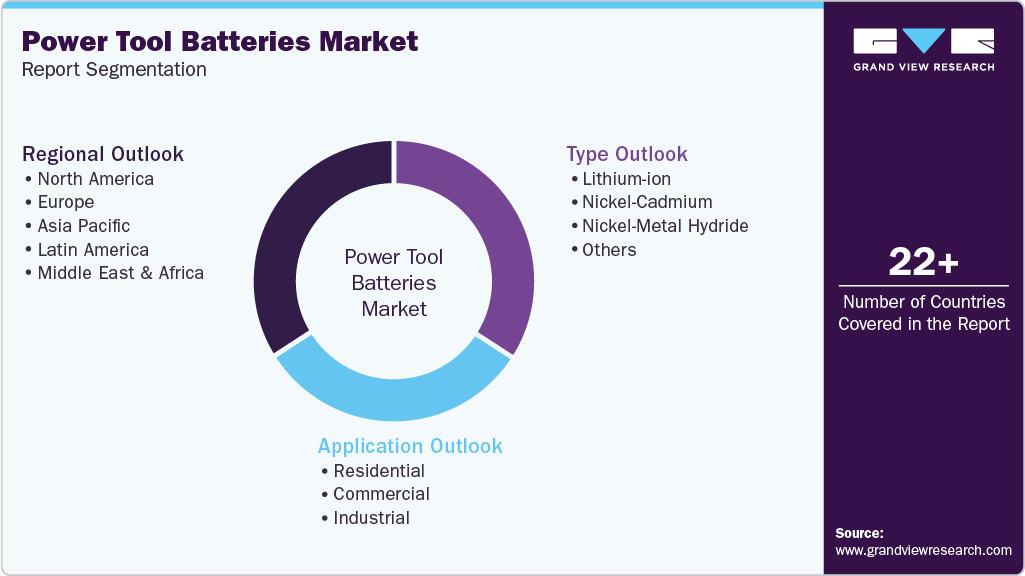
This report forecasts revenue and volume growth at global, regional, and country levels and provides an analysis of the latest industry trends in each of the sub-segments from 2021 to 2033. For the purpose of this study, Grand View Research has segmented the global power tool batteries market report based on type, application, and region:
 To learn more about this report, Download Free Sample Report
 -
Type Outlook (Revenue, USD Million, 2021 - 2033)
-
Lithium-ion
-
Nickel-Cadmium
-
Nickel-Metal Hydride
-
Others
-
-
Application Outlook (Revenue, USD Million, 2021 - 2033)
-
Residential
-
Commercial
-
Industrial
-
-
Regional Outlook (Revenue, USD Million, 2021 - 2033)
-
North America
-
U.S.
-
Canada
-
Mexico
-
-
Europe
-
Germany
-
UK
-
Spain
-
France
-
Italy
-
Russia
-
-
Asia Pacific
-
China
-
India
-
Japan
-
Australia
-
-
Latin America
-
Brazil
-
Argentina
-
-
Middle East
-
Saudi Arabia
-
South Africa
-
UAE
-
-
Research Methodology
The power tool batteries market figures in this report are based on a proven research process that combines executive interviews with secondary research from proprietary databases, company filings, and recognized regulatory and institutional sources. Market size is built through value-chain sizing - reconciling supply-side and demand-side estimates - and triangulated with bottom-up and top-down approaches. Every estimate passes multiple levels of expert validation before publication, with each power tool natteries segment quantified using the revenue-capture definitions in the table below.
Segment Definition
Type
Revenue Capture Definition
Lithium-ion
Revenue is generated from the sale of lithium-ion battery packs, battery cells, battery management systems, chargers, and related accessories used in cordless power tools across residential, commercial, and industrial applications.
Nickel-Cadmium
Revenue is generated from the sale of nickel-cadmium battery packs, compatible chargers, and associated battery products used in legacy and heavy-duty cordless power tools requiring durable and reliable power sources.
Nickel-Metal Hydride
Revenue is generated from the sale of nickel-metal hydride battery packs, charging systems, and related accessories used in selected cordless power tools for professional and consumer applications.
Others
Revenue is generated from the sale of advanced and specialized rechargeable battery technologies, including solid-state, lithium-polymer, and other emerging chemistries, as well as compatible battery management systems and accessories for cordless power tools.
Application
Revenue Capture Definition
Residential
Revenue is generated from the sale of rechargeable power tool batteries, chargers, and battery accessories used for home improvement, DIY projects, maintenance, gardening, and residential repair applications.
Commercial
Revenue is generated from the sale of rechargeable battery systems, fast chargers, and related accessories used in facility management, building maintenance, landscaping, and light commercial construction activities.
Industrial
Revenue is generated from the sale of high-capacity battery packs, battery management systems, rapid charging solutions, and related products used in construction, manufacturing, automotive, aerospace, mining, and other industrial applications.
Estimation Model
Layer Name
Key Question
Description
Cordless Power Tool Demand Base Layer
What forms the demand base?
Identify global demand for power tool batteries across cordless power tools. Assess construction activity, industrial manufacturing, DIY trends, infrastructure investments, and increasing adoption of cordless tools to establish addressable market opportunity.
Battery Manufacturing & Supply Layer
Where are power tool batteries manufactured and supplied?
Estimate the production capacity of power tool batteries across major manufacturing regions. Analyze lithium-ion cell production, battery pack assembly, raw material availability, supply chain networks, distribution channels, and strategic partnerships to evaluate product availability and market accessibility.
Application Adoption Layer
How widely are power-tool batteries deployed?
Analyze the adoption of power tool batteries across residential, commercial, and industrial applications. Evaluate cordless tool penetration, battery platform adoption, charging technologies, runtime requirements, and compatibility across multiple tool categories to assess market penetration.
Revenue Layer
How is market revenue generated?
Expenditures on power tool batteries, battery packs, charging systems, battery management technologies, and related accessories quantify market revenue. Product shipments, average selling prices, and battery sales across residential, commercial, and industrial applications drive overall market value.
Delivered Customizations
This report has been delivered with the following In-depth customizations
Client Request
Customization Delivered
Value Adds
Power Tool Batteries Competitive Landscape Assessment
Detailed competitive landscape analysis covering manufacturers of power tool batteries and battery technologies. The study profiled key market participants based on geographic presence, organizational structure, product portfolio, battery technologies, manufacturing capabilities, distribution networks, customer base, strategic initiatives, and investments in battery innovation, production capacity expansion, and advanced energy storage solutions.
Enabled evaluation of competitive positioning, battery technology capabilities, manufacturing strengths, distribution networks, customer engagement strategies, and market participation across the global power tool batteries value chain.
Application & Technology Assessment
Evaluation of global power tool battery demand across residential, commercial, and industrial applications. Included assessment of battery chemistries, battery management systems (BMS), fast-charging technologies, cordless tool adoption, battery platform compatibility, regulatory standards, and regional demand trends across major markets.
Highlighted application trends, battery technology adoption patterns, and regional growth opportunities. Supported strategic planning, product portfolio optimization, market entry evaluation, and investment prioritization decisions.
Opportunity Assessment
Identification of high-growth opportunities associated with increasing adoption of cordless power tools, advancements in lithium-ion battery technology, expanding interchangeable battery platforms, and growing construction and industrial activities. Assessed emerging opportunities arising from next-generation battery chemistries, rapid charging technologies, battery safety enhancements, and increasing demand for high-performance cordless equipment.
Enabled prioritization of high-value growth opportunities and emerging application segments. Supported long-term business planning, product development strategies, geographic expansion initiatives, and investment decisions aligned with evolving cordless power tool industry requirements.
Frequently Asked Questions About This Report
North America dominated the market with revenue share of 38.5% in 2025.
The U.S. dominated the North American market with a revenue share of 80.8% in 2025.
Asia Pacific is anticipated to register the fastest CAGR of 12.7% over the forecast period.
Based on applications, industrial accounted for largest revenue share of 41.4% in 2025.
The key driver of the global power tool batteries market is the increasing adoption of cordless power tools, supported by rising construction activities, industrial automation, expanding DIY trends, and continuous advancements in lithium-ion battery technology.
The global power tool batteries market is expected to grow at a CAGR of 9.4% from 2026 to 2033, reaching USD 5.9 billion by 2033.
Based on type, lithium-ion accounted for largest revenue share of 63.6% in 2025.
The key players operating in the global power tool batteries market include Robert Bosch GmbH, Makita Corporation, Stanley Black & Decker, Inc., Techtronic Industries Company Limited, Hilti Corporation, Koki Holdings Co., Ltd., Samsung SDI Co., Ltd., Panasonic Energy Co., Ltd., LG Energy Solution, Ltd., and Murata Manufacturing Co., Ltd.
The global power tool batteries market size was valued at USD 2.9 billion in 2025 and is estimated at USD 3.1 billion for 2026.
About the Author(s)
Renewable Energy Research Team
Energy & Power · Renewable EnergyThis report was authored by the renewable energy research team at Grand View Research - comprising two research analysts, one senior research analyst, and one industry expert - with specialized expertise in the renewable energy segment of the energy & power industry. All findings are based on proprietary energy & power databases, executive interviews, and regulatory analysis, subject to internal peer review prior to publication.
Last Updated:
Speak to Analyst

Customize this report to your needs - add regions, segments, or data points, with 20% free customization.
Or view our licence options:


ISO 9001:2015 & 27001:2022 Certified
We are GDPR and CCPA compliant! Your transaction & personal information is safe and secure. For more details, please read our privacy policy.


