
- Home
- »
- Consumer F&B
- »
-
Pre-Workout Supplements Market Size Report, 2026-2033GVR Report cover

Pre-workout Supplements Market (2026 - 2033)
Size, Share & Trends Analysis Report By Form (Powder, Capsule, Ready To Drink), By Distribution Channel (Online, Offline), By Region (North America, Europe, Asia Pacific, Latin America, Middle East and Africa (MEA)), And Segment Forecasts
Market Size, 2025
$21.0BMarket Estimate, 2026
$22.4BMarket Forecast, 2033
$32.2BCAGR, 2026–2033
5.9%Pre-workout Supplements Market Summary
The global pre-workout supplements market size was valued at USD 21.0 billion in 2025 and is projected to grow from USD 22.4 billion in 2026 to USD 32.2 billion by 2033, at a CAGR of 5.9% from 2026 to 2033. North America dominated the pre-workout supplements market with the largest revenue share of 35.2% in 2025. The market growth is attributed to the rising consumer awareness of the health benefits associated with pre-workout supplements, such as improved energy, focus, and endurance during workouts.
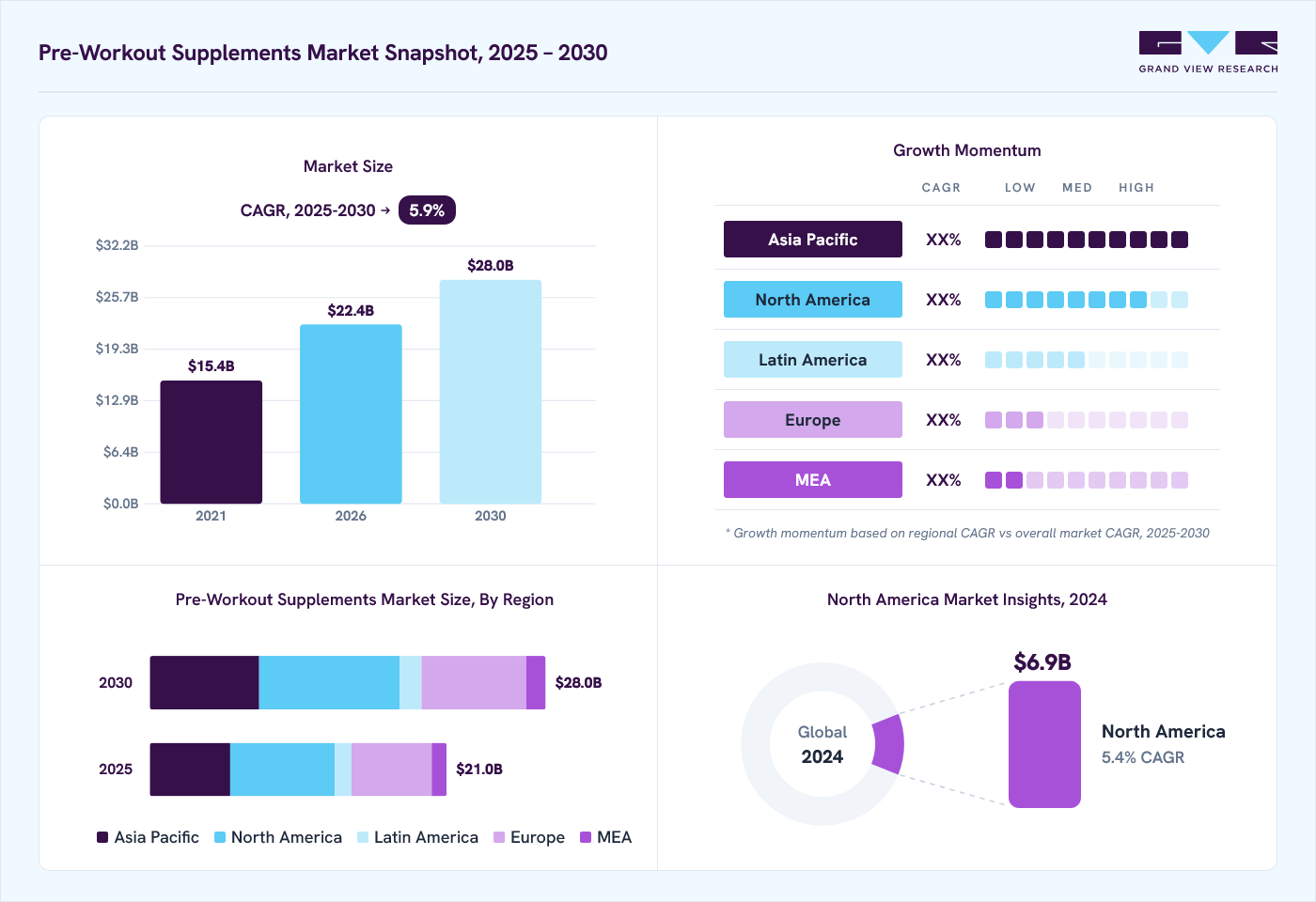 Source: Grand View Research, IR Documents, Primary Interviews, Paid DatabasesTo learn more about this report,
 Download Free Sample Report
 Key Market Trends & Insights
- By form: Powder segment held the largest market share of 88.6% in 2025.
- By distribution channel: Offline channel segment held the largest market share of 78.9% in 2025.
Regional Highlights
- Largest regional market: North America (35.2% revenue share, 2025)
- Fastest-growing regional market: Asia Pacific (highest CAGR, 2026-2033)
- By country: The U.S. held the largest market share in 2025
Market Size & Forecast
- Market size in 2025: USD 21.0 Billion
- Estimated market size in 2026: USD 22.4 Billion
- Projected market size by 2033: USD 32.2 Billion
- CAGR (2026-2033): 5.9%
Three ways to get this report
Buy it, customize it, or ask a question.Ask an Analyst
Analyst response in 1 business day
- AccessReport author, directly
- Reply timeWithin 1 working day
- No sales callDirect answer only
- FormatEmail reply
- CostFree, no cost
Get the Full Report
What the study covers
- FormatsPDF · Excel · Dashboard
- Timeline2026–2033 annual, 2025 base
- Coverage20+ countries, 5 regions
- Companies10+ key players profiled
Customize the Report
20% free customization
- IncludeCountries, segments, points
- TailorTo your product definition
- ExtendDeeper competitor detail
- OrA fully bespoke study
- Turnaround5–10 working days
The increasing number of health and fitness centers and the growing trend of home workouts contribute to market expansion. The rising popularity of functional foods and beverages that provide additional health benefits beyond basic nutrition is propelling demand. Consumers are becoming more proactive about their fitness routines and seeking products to enhance their performance and overall well-being. The availability of pre-workout supplements in various forms, such as powders, capsules, and ready-to-drink beverages, further supports market growth. To learn more about this report, Download Free Sample Report
 Market Dynamics
Pre-workout supplements are widely consumed to support energy, endurance, focus, and workout performance. These products are utilized by athletes, bodybuilders, recreational exercisers, and fitness-conscious consumers across various training programs. Formulations containing caffeine, amino acids, creatine, and performance-support ingredients are available in powders, capsules, ready-to-drink beverages, and gummies. Product innovation, broader retail availability, and consumer preference for performance nutrition continue to shape the competitive landscape of the pre-workout supplements market.
The utilization of sports nutrition products among athletes, fitness enthusiasts, and recreational exercisers remains a key factor supporting the pre-workout supplements market. Consumers increasingly incorporate performance nutrition products into their workout routines to support energy levels, endurance, focus, and exercise efficiency. Greater awareness of ingredient functionality, nutritional supplementation, and workout optimization has contributed to broader acceptance of pre-workout formulations across diverse consumer groups. Recommendations from trainers, nutrition professionals, athletes, and digital fitness platforms further support product adoption and category visibility.
Manufacturers continue to introduce specialized formulations tailored to specific performance objectives, including strength enhancement, endurance support, cognitive focus, and recovery assistance. Product availability across supermarkets, specialty nutrition retailers, e-commerce platforms, and direct-to-consumer channels has improved consumer access to sports nutrition products. In addition, the presence of premium, clean-label, sugar-free, and plant-based formulations has expanded product appeal among health-conscious consumers. These factors support consistent consumption patterns and reinforce the role of pre-workout supplements within the broader sports nutrition industry.
Concerns related to product safety and regulatory compliance remain significant challenges for the pre-workout supplements market. Many products contain stimulants, amino acids, and performance-support ingredients that require careful formulation and labeling. Consumers increasingly evaluate ingredient transparency, dosage accuracy, and scientific evidence supporting product claims before making purchasing decisions. The presence of proprietary blends in some formulations may create uncertainty regarding ingredient composition and concentration levels. Regulatory authorities continue to monitor manufacturing standards, labeling practices, and marketing claims to ensure consumer protection and product quality. Compliance requirements vary across countries, creating operational complexities for manufacturers seeking broader market access. Product recalls, labeling discrepancies, and concerns regarding ingredient authenticity may affect brand credibility and consumer confidence. In addition, evolving regulations related to dietary supplements can increase approval timelines and compliance costs. These factors may create barriers for new product launches and limit market penetration in certain regions.
The development of personalized and clean-label formulations presents substantial opportunities for the pre-workout supplements market. Consumers are placing greater emphasis on transparent ingredient labeling, natural formulations, and products supported by scientific research. This preference has encouraged manufacturers to introduce supplements tailored to specific fitness goals such as endurance, strength, focus, hydration, and recovery. Personalized nutrition platforms and fitness assessment tools enable companies to develop targeted product recommendations based on consumer needs and activity levels. The availability of plant-based, vegan, sugar-free, and allergen-free formulations has expanded product appeal across diverse consumer segments. Innovation in ingredient combinations, functional compounds, and delivery formats continues to support product differentiation. In addition, ready-to-drink beverages, gummies, and single-serve products offer convenience and enhance consumer accessibility. These developments create opportunities for portfolio expansion, stronger brand positioning, and broader adoption of pre-workout supplements across global markets.
Analyst Perspective
The pre-workout supplements market is shaped by formulation innovation, ingredient standardization, regulatory compliance, and portfolio diversification across performance nutrition categories. Competitive positioning increasingly depends on scientifically supported ingredient combinations, transparent labeling practices, and the ability to differentiate products across powders, capsules, tablets, and ready-to-drink formats. Market leadership is likely to remain concentrated among companies with established manufacturing capabilities, broad distribution infrastructure, and strong brand portfolios. Future competitive intensity will be influenced by advancements in clean-label formulations, functional ingredient development, and product format innovation, while regulatory scrutiny and ingredient quality standards continue to play a critical role in shaping industry dynamics.
Form Insights
Based on form, the powder segment led the market with the largest revenue share of 88.6% in 2025. Powdered pre-workout supplements offer a high degree of customization, allowing users to adjust the dosage according to their specific needs and preferences. Also, powders are more cost-effective than other forms like ready-to-drink beverages and capsules. The convenience of mixing powders with water or other beverages makes them a popular choice among fitness enthusiasts. Furthermore, the wide variety of flavors and formulations available in powder form caters to diverse consumer tastes and dietary requirements. The ability to easily integrate powdered supplements into different workout routines and the perception of higher potency also contribute to their popularity.
The ready-to-drink segment is expected to grow at the fastest CAGR of 6.6% over the forecast period. The increasing demand for convenience among fitness enthusiasts is a major driver, as ready-to-drink pre-workout supplements offer a quick and easy way to consume the necessary nutrients without the need for mixing or preparation. The portability of RTD products makes them an attractive option for busy individuals who need a convenient solution to fuel their workouts on the go. Additionally, the growing popularity of functional beverages that provide specific health benefits, such as enhanced energy and endurance, is propelling market demand. The availability of RTD pre-workout supplements in a variety of flavors and formulations caters to diverse consumer preferences, further driving their popularity
Distribution Channel Insights
Based on distribution channel, the offline channel led the market with the largest revenue share of 78.9% in 2025. Traditional retail outlets such as supermarkets, hypermarkets, and specialty nutrition stores remain popular among consumers who prefer to physically inspect and purchase their supplements. The ability to see, touch, and sometimes use sample products before buying builds consumer trust and satisfaction. Additionally, the expert advice from in-store staff can guide consumers in making informed choices tailored to their fitness needs. The wide availability of pre-workout supplements in various forms and flavors in these offline channels caters to diverse consumer preferences. Seasonal promotions, discounts, and loyalty programs offered by brick-and-mortar stores also attract a substantial customer base.
 To learn more about this report, Download Free Sample Report
 The online channel is expected to grow at the fastest CAGR over the forecast period. The increasing popularity of e-commerce platforms and their convenience are making it easier for consumers to purchase pre-workout supplements from the comfort of their homes. Online platforms offer a wide variety of products, detailed descriptions, customer reviews, and ratings, helping consumers make informed decisions. Additionally, the influence of digital marketing and social media advertising is effectively reaching a broader audience and boosting online sales. Exclusive online discounts, promotions, and subscription services further incentivize consumers to shop for pre-workout supplements online. The rise of health-conscious consumers seeking functional foods and supplements is also contributing to the growth of the online channel.
Regional Insights
North America dominated the pre-workout supplements market with the largest revenue share of 35.2% in 2025. The rising awareness of the benefits of pre-workout supplements, such as enhanced energy, focus, and endurance, is boosting consumer demand. The increasing number of fitness centers, gyms, and health clubs across North America, particularly in the U.S. and Canada, is further propelling the market. Additionally, the growing trend of health and wellness, coupled with the rising interest in personal fitness and bodybuilding, is driving the adoption of pre-workout supplements. The region's well-developed retail infrastructure, including both traditional and online channels, ensures wide accessibility to various pre-workout products. The influence of fitness influencers and social media platforms, which promote the effectiveness of these supplements, is also playing a crucial role in market expansion.
 To learn more about this report, Download Free Sample Report
 U.S. Pre-workout Supplements Market Industry
The pre-workout supplements market in the U.S. held the largest share in the North America region in 2025. The increasing consumer focus on health and fitness and the rising trend of personalized workout routines are significantly boosting demand for pre-workout supplements. The proliferation of gyms, fitness centers, and boutique fitness studios across the country is encouraging more individuals to adopt fitness regimes that include pre-workout supplementation. Additionally, the influence of fitness influencers and social media personalities who promote the benefits of pre-workout products is driving consumer interest and adoption. The growing awareness of the importance of nutrition in enhancing workout performance and recovery is further propelling market growth.
Europe Pre-workout Supplements Market Industry
The pre-workout supplements market in the U.K. held the largest share in the Europe region in 2025, owing to the increasing emphasis on healthy lifestyles and fitness activities across European countries, is boosting demand for pre-workout supplements. The region's strong tradition of sports and athletic events, coupled with the growing popularity of gym memberships and fitness classes, is encouraging the adoption of these products. Additionally, the rising awareness of the benefits of pre-workout supplements in enhancing energy, endurance, and overall workout performance is attracting a broad consumer base. The influence of European regulations that ensure high-quality and safe ingredients in supplements further supports market growth. Furthermore, the expansion of online retail channels and the presence of major international and local brands in the European market make pre-workout supplements more accessible to consumers.
Asia Pacific Pre-workout Supplements Market Industry
Asia Pacific pre-workout supplements market is expected to grow at the fastest CAGR of 6.1% over the forecast period. The increasing adoption of Western fitness trends and the rising popularity of gym culture in countries such as China, India, Japan, and Australia are significantly boosting demand for pre-workout supplements. The growing awareness of the health benefits associated with these supplements, including improved energy levels and enhanced workout performance, is attracting health-conscious consumers. The region's expanding middle class, with rising disposable incomes and a greater focus on health and wellness, is also driving market growth. The influence of social media and fitness influencers who promote pre-workout products is also contributing to the market expansion.
Key Pre-workout Supplements Company Insights
Some key companies in the pre-workout supplements market include FINAFLEX, EFX Sports, SynTech Nutrition, BPI Sports, and others.
-
FINAFLEX is a prominent player in the pre-workout supplements industry, offering a variety of pre-workout supplements designed to enhance performance and energy levels. One of their popular products is WRN Pre-Workout, which features a blend of ingredients such as L-Citrulline Malate, Creatine Monohydrate, Beta-Alanine, and Caffeine. This formula is designed to improve blood flow, increase strength, and enhance endurance during workouts.
-
EFX Sports is another leading brand in the pre-workout supplements industry, offering a range of products designed to boost energy, stamina, and performance. Its flagship product, Training Ground PRE, is a fully disclosed, banned-substance-free pre-workout formula that includes ingredients such as Agmatine Sulfate, Beta-Alanine, Caffeine, Citrulline Malate, and Kre-Alkalyn. This product is formulated to enhance muscle power, strength, and growth. EFX Sports also offers other products such as Karbolyn Fuel, a high-performance carbohydrate supplement, and Nytric EFX, a massive pump agent.
Key Pre-workout Supplements Companies
The following key companies have been profiled for this study on the pre-workout supplements market.
-
FINAFLEX
-
EFX Sports
-
SynTech Nutrition
-
BPI Sports
-
eFlow Nutrition LLC
-
Magnum Worldwide
-
Allmax Nutrition
-
MusclePharm
-
MuscleTech
-
MAN Sports Nutrition
Competitive Benchmarking
Operating Strategies
Competitive Edge
Weaknesses
Established Players (e.g., Abbott Laboratories, Glanbia plc, Muscletech, Cellucor)
- Focus on portfolio expansion through new formulations, extensive retail distribution, athlete sponsorships, and investments in research-backed ingredients.
- Strengthen market presence through global brand-building initiatives and strategic partnerships.
- Strong brand recognition, broad distribution networks, and diversified product portfolios across multiple sports nutrition categories.
- Greater access to financial resources and manufacturing capabilities.
- Higher operating costs and complex supply chain management.
- Product innovation may require longer development cycles due to larger organizational structures and regulatory requirements.
Emerging Players (e.g., Transparent Labs, Ryse Supplements, RAW Nutrition, Ekkovision)
- Focus on clean-label formulations, specialty ingredients, direct-to-consumer sales, influencer collaborations, and community-driven marketing strategies.
- Emphasize niche consumer preferences and product differentiation.
- Greater agility in product development, faster response to consumer trends, and strong engagement with fitness-focused communities.
- Ability to target specialized performance and lifestyle segments.
- Limited distribution reach and lower brand awareness compared to established competitors.
- Dependence on digital marketing and customer acquisition efforts may constrain scalability in highly competitive markets.
Recent Developments
-
In August 2024, GAT Sport officially launched Nitraflex ULTRA, a next-generation pre-workout supplement in Strawberry Watermelon, Blue Raspberry, and Peach Pineapple. This product, designed to exceed the performance of its predecessor, Nitraflex Advanced, features cutting-edge ingredients such as the Nitraflex ULTRA Pump & Performance Blend, SuperSodium, DopaPhen, and Dynamine. Nitraflex ULTRA aims to enhance energy, focus, hydration, and muscle performance for athletes.
-
In June 2024, Gold's Gym launched its new Premium Pre-Workout, a sports nutrition product tailored for athletes seeking optimal performance. Inspired by the original Gold's Gym in Venice, California, this supplement is exclusively available on Amazon with Prime shipping options.
Pre-workout Supplements Market Report Scope
Report Attribute
Details
Market size in 2025
USD 21.0 billion
Estimated market size in 2026
USD 22.4 billion
Projected market size by 2033
USD 32.2 billion
Growth rate
CAGR of 5.9% from 2026 to 2033
Base year for estimation
2025
Historical data
2021 - 2024
Forecast period
2026 - 2033
Quantitative units
Revenue in USD million/billion and CAGR from 2026 to 2033
Report coverage
Revenue forecast, company ranking, competitive landscape, growth factors, and trends
Segments covered
Form, distribution channel, region
Regional scope
North America; Europe; Asia Pacific; Latin America; MEA
Country scope
U.S.; Canada; Mexico; Germany; UK; France; Italy; Spain; Norway; Denmark; Sweden; Russia; Iceland; Finland; China; Japan; India; South Korea; Australia; Thailand; Singapore; Brazil; Argentina; Saudi Arabia; South Africa; UAE; Kuwait; Israel
Key companies profiled
Optimum Nutrition; Cellucor; MuscleTech; BSN (Bio-Engineered Supplements & Nutrition); ProSupps; Nutrex Research; MusclePharm; Kaged; Redcon1 and Evlution Nutrition.
Customization scope
Free report customization (equivalent up to 8 analysts' working days) with purchase. Addition or alteration to country, regional & segment scope.
Pricing and purchase options
Avail customized purchase options to meet your exact research needs. Explore purchase options
Global Pre-workout Supplements Market Report Segmentation
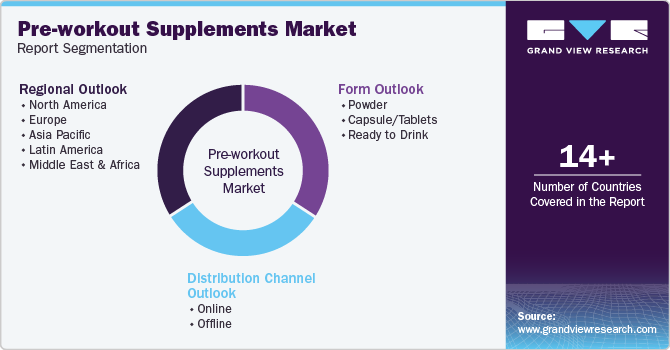
This report forecasts revenue growth at global, regional, and country levels and provides an analysis of the latest industry trends in each of the sub-segments from 2018 to 2030. For this study, Grand View Research has segmented the global pre-workout supplements market report based on form, distribution channel, and region:
 To learn more about this report, Download Free Sample Report
 -
Form Outlook (Revenue, USD Million, 2021 - 2033)
-
Powder
-
Capsule/Tablets
-
Ready to Drink
-
-
Distribution Channel Outlook (Revenue, USD Million, 2021 - 2033)
-
Online
-
Offline
-
-
Regional Outlook (Revenue, USD Million, 2021 - 2033)
-
North America
-
U.S.
-
Canada
-
Mexico
-
-
Europe
-
UK
-
Germany
-
France
-
Italy
-
Spain
-
-
Asia Pacific
-
Japan
-
China
-
India
-
Australia
-
South Korea
-
-
Latin America
-
Brazil
-
-
Middle East and Africa (MEA)
-
Research Methodology
The pre-workout supplements market figures in this report are based on a proven research process that combines executive interviews with secondary research from proprietary databases, company filings, and recognized regulatory and institutional sources. Market size is built through value-chain sizing-reconciling supply-side and demand-side estimates-and triangulated with bottom-up and top-down approaches. Every estimate passes multiple levels of expert validation before publication, with each cryptocurrency payment apps segment quantified using the revenue-capture definitions in the table below.
Segment Definition
Segment - Type
Revenue capture definition
Powder
This segment includes the sales of powdered formulations consumed before exercise to support energy, endurance, focus, and physical performance. Products are available in multiple flavors, serving sizes, and ingredient combinations.
Capsule/Tablets
This segment includes the sales of capsule and tablet formulations preferred for convenience, portability, and precise ingredient dosing. These products are commonly used by consumers seeking an alternative to powdered formats.
Ready To Drink
This segment includes the sales of ready-to-consume beverages formulated for use before physical activity. The category comprises single-serve products distributed through retail, fitness, and convenience channels.
Segment – Distribution Channel
Revenue capture definition
Online
This segment includes the sales of products through e-commerce platforms, brand-owned websites, online marketplaces, and digital nutrition retailers. The channel provides access to a broad product portfolio and subscription-based purchasing options.
Offline
This segment includes the sales of products through supermarkets, hypermarkets, specialty nutrition stores, pharmacies, fitness centers, and other physical retail outlets. Consumers benefit from direct product availability and in-store purchasing experiences.
Estimation Model
Layer Name
Key Question
Description
Consumer Base Layer
Who consumes performance nutrition products?
Identify individuals participating in gym training, sports, and fitness activities to determine the potential consumer base.
Accessibility Layer
Who can access the products?
Assess product availability across online platforms, retail stores, pharmacies, and fitness centers to define the reachable market.
Adoption Layer
Who regularly purchases the products?
Apply supplement usage, consumer awareness, product accessibility, purchasing behavior, and repeat-purchase rates to estimate the active consumer base.
Monetisation Layer
How much revenue is generated?
Estimate revenue using active consumers, purchase frequency, average product prices, and distribution channel sales contributions.
Delivered Customizations
This report has been delivered with the following In-depth customizations
Client Request
Customization Delivered
Value Adds
Performance Nutrition & Ingredient Trend Analysis
Conducted a focused assessment of pre-workout formulations covering caffeine-based products, amino acids, creatine blends, stimulant-free alternatives, clean-label ingredients, and performance-enhancing nutrition trends.
Helps stakeholders identify high-demand ingredient categories, evaluate formulation preferences, and assess product development opportunities across consumer segments.
Fitness Consumer Behavior & Distribution Channel Assessment
Evaluated purchasing behavior across online and offline channels, including specialty nutrition stores, supermarkets, pharmacies, fitness centers, and e-commerce platforms, along with preferences by product format and usage occasion.
Provides insights into channel performance, consumer purchasing patterns, and effective market penetration strategies across key sales channels.
Product Innovation & Competitive Landscape Evaluation
Assessed developments in personalized nutrition, plant-based formulations, ready-to-drink products, functional ingredients, and competitive positioning strategies adopted by key industry participants.
Supports investment and expansion decisions by identifying innovation opportunities, differentiation factors, and commercially attractive product categories.
Frequently Asked Questions About This Report
The global pre-workout supplements market size was valued at USD 21.0 billion in 2025 and is estimated at USD 22.4 billion in 2026.
The global pre-workout supplements market is expected to grow at a CAGR of 5.3% from 2026 to 2033 to reach USD 32.2 billion by 2033.
North America dominated the pre-workout supplements market with a share of 35.2% in 2025.
Some key players operating in pre-workout supplements market include BSN, Finaflex, EFX Sports, Nutrex Research, SynTech Nutrition, BPI Sports LLC, Nutrabolt, JNX Sports, SAN, and eFlow Nutrition LLC.
Key factors include growing fitness participation, rising demand for sports nutrition, increasing gym memberships, product innovation, expanding e-commerce distribution, and greater focus on workout performance.
Powder segment held the largest market share of 88.6% in 2025.
Asia Pacific is the fastest-growing region over the forecast period.
Offline channel segment held the largest market share of 78.9% in 2025.
About the Author(s)
Consumer F&B Research Team
Consumer Goods · Consumer F&BThis report was authored by the consumer f&b research team at Grand View Research - comprising two research analysts, one senior research analyst, and one industry expert - with specialized expertise in the consumer f&b segment of the consumer goods industry. All findings are based on proprietary consumer goods databases, executive interviews, and regulatory analysis, subject to internal peer review prior to publication.
Last Updated:
Speak to Analyst

Customize this report to your needs - add regions, segments, or data points, with 20% free customization.
Or view our licence options:


ISO 9001:2015 & 27001:2022 Certified
We are GDPR and CCPA compliant! Your transaction & personal information is safe and secure. For more details, please read our privacy policy.


