
- Home
- »
- IT Services & Applications
- »
-
Privacy Management Software Market Size Report, 2033GVR Report cover

Privacy Management Software Market (2026 - 2033)
Size, Share & Trends Analysis Report By Deployment Mode (On-premises, Cloud), By Enterprise Size, By Application (Risk Management, Data Governance), By End-use, By Region, And Segment Forecasts
Market Size, 2025
$5.1BMarket Estimate, 2026
$6.6BMarket Forecast, 2033
$68.2BCAGR, 2026–2033
39.5%Privacy Management Software Market Summary
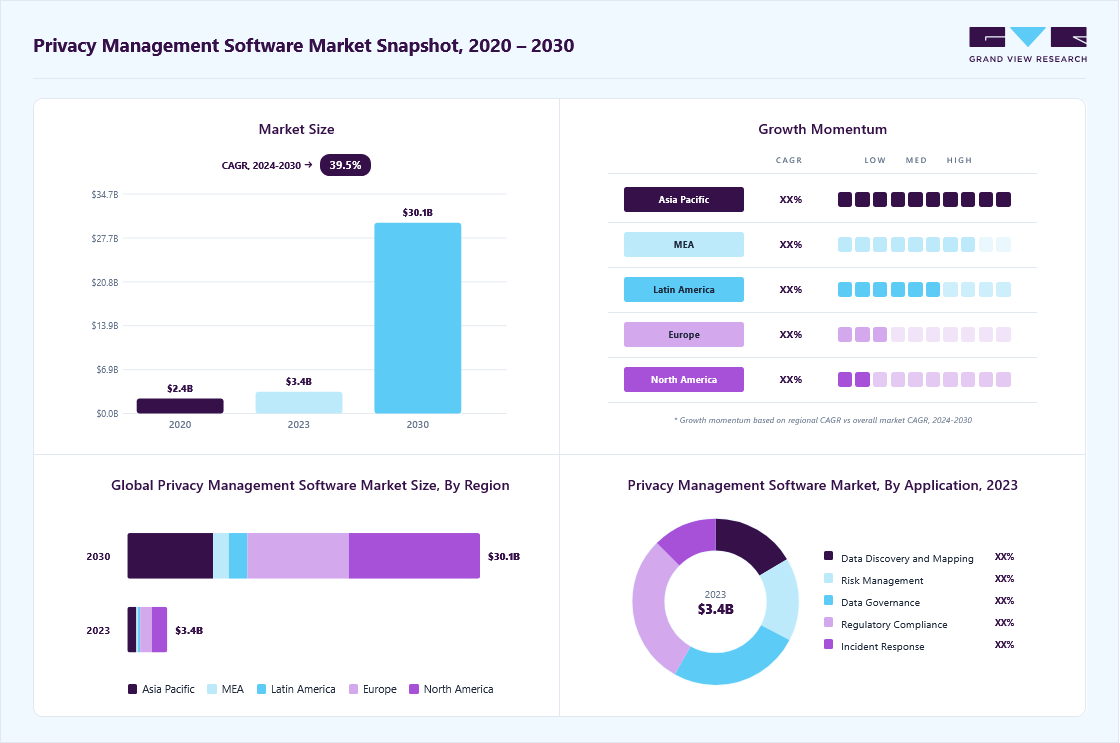
The global privacy management software market size was valued at USD 5.1 billion in 2025 and is projected to grow from USD 6.6 billion in 2026 to USD 68.2 billion by 2033, at a CAGR of 39.5% from 2026 to 2033. The market in North America dominated with a revenue share of 38.3% in 2025. This growth is driven by growing enforcement of comprehensive data privacy regulations across U.S. states and Canada's expanding enterprise adoption of AI governance solutions.
 Source: Grand View Research, IR Documents, Primary Interviews, Paid DatabasesTo learn more about this report,
 Download Free Sample Report
Key Market Trends & Insights
- By deployment mode: On-premises segment led the market and accounted for a share of 61.6% in 2025.
- By enterprise size: Large enterprises segment dominated the market, with a revenue share of 64.4% in 2025.
- By application: Regulatory compliance segment dominated the market, with a revenue share of 28.1% in 2025.
- By end-use: BFSI segment held the largest revenue share in 2025.
Regional Highlights
- Largest regional market: North America (38.3% revenue share, 2025)
- Fastest-growing regional market: Asia Pacific (highest CAGR, 2026-2033)
- By country: The U.S. held the largest market share in 2025.
Market Size & Forecast
- Market size in 2025: USD 5.1 Billion
- Estimated market size in 2026: USD 6.6 Billion
- Projected market size by 2033: USD 68.2 Billion
- CAGR (2026-2033): 39.5%
Prism AI by Grand View Research Free to tryAsk a question about the privacy management software marketTry asking✓Every figure cited from GVR research Prefer the report? Download free sample →
Moreover, growing consumer awareness and concern regarding personal data privacy have pressured companies to implement transparent and comprehensive privacy practices, boosting the demand for privacy management tools. The proliferation of data-driven business models and the expansion of digital services are significant drivers of the privacy management software market. For instance, with over 247.2 million subscribers globally, Netflix's success is attributed to its sophisticated recommendation engine. By incorporating machine learning and data analytics, along with a dedication to streaming optimization, Netflix provides a personalized cinematic experience for each user, thereby cementing its status as a pioneering leader in the entertainment industry. As businesses increasingly rely on data analytics to inform strategic decisions, optimize operations, and enhance customer experiences, the volume and sensitivity of data being collected and processed have surged. This escalation necessitates robust privacy management solutions to ensure data handling practices comply with stringent regulatory standards and mitigate the risks associated with data breaches and unauthorized access. In addition, the widespread adoption of digital services, from e-commerce to cloud computing, has amplified the complexity of managing personal data across diverse platforms and jurisdictions. Consequently, organizations are compelled to implement advanced privacy management software to maintain data integrity, build consumer trust, and sustain competitive advantage in a data-centric landscape.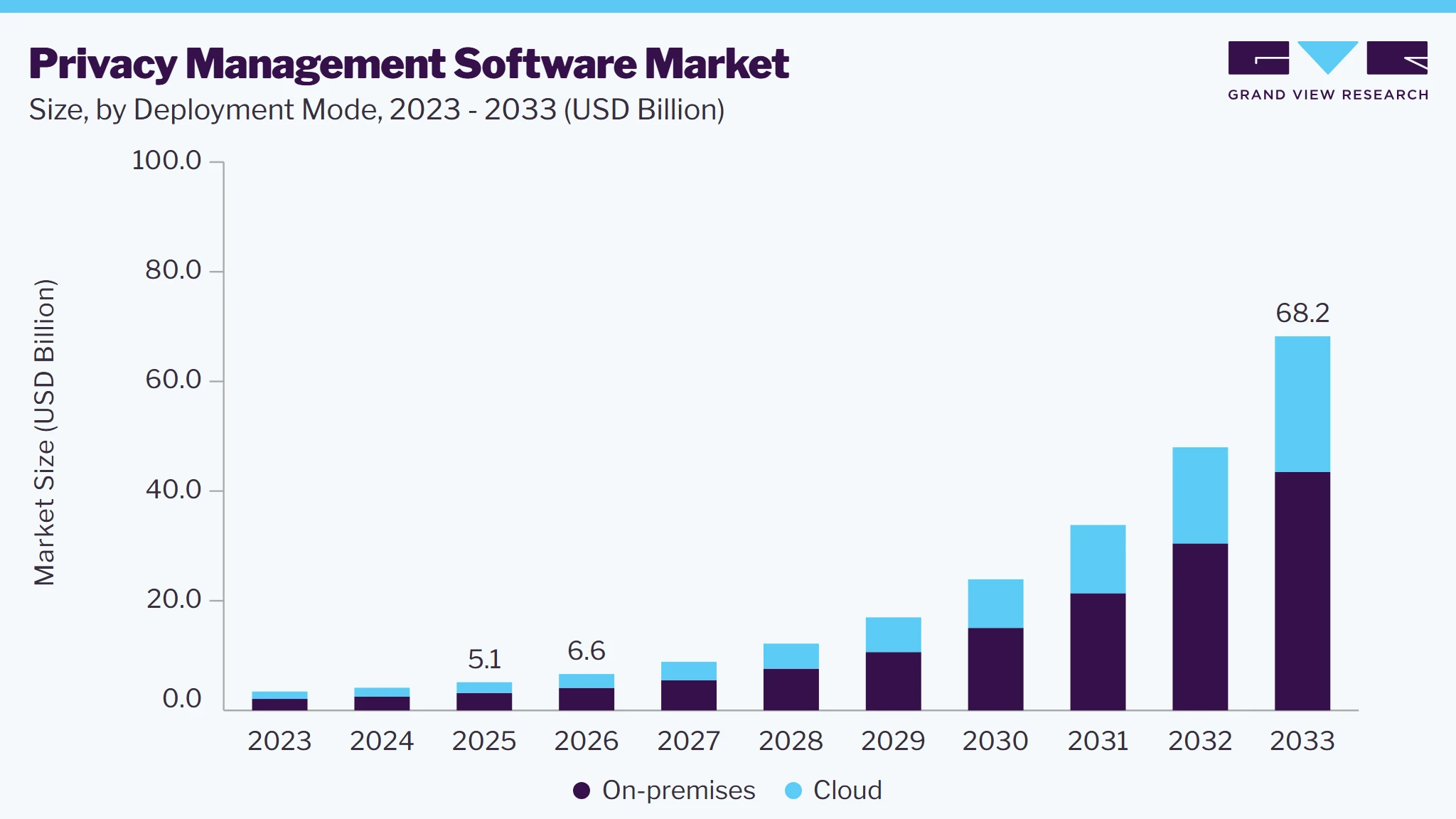 To learn more about this report, Download Free Sample Report
Increasing regulatory requirements significantly drive the privacy management software market. Regulations such as the General Data Protection Regulation (GDPR) in Europe and the California Consumer Privacy Act (CCPA) in the U.S. impose stringent obligations on organizations to manage and protect personal data. Compliance with these regulations necessitates comprehensive privacy management solutions to ensure data handling practices meet legal standards, thereby avoiding substantial fines and reputational damage. Furthermore, as governments worldwide continue to implement and tighten data privacy laws, businesses across various sectors are compelled to adopt advanced privacy management software to navigate the complex regulatory landscape, safeguard consumer trust, and maintain operational integrity.
Market Dynamics
The global privacy management software market is experiencing robust growth as organizations increasingly prioritize data privacy, regulatory compliance, and consumer trust amid the rapid expansion of digital services and cloud-based operations. Enterprises across banking, healthcare, retail, manufacturing, telecommunications, government, and technology sectors are adopting privacy management software to automate compliance with evolving data protection regulations, streamline consent and preference management, manage data subject requests (DSRs), conduct privacy impact assessments (PIAs), and maintain comprehensive data inventories. Modern privacy management platforms integrate artificial intelligence (AI), automation, data discovery, risk assessment, third-party risk management, and continuous compliance monitoring to simplify governance across complex hybrid and multi-cloud environments.
The expanding global regulatory landscape and increasing enterprise focus on protecting personal data are major drivers of the global privacy management software market. Organizations are investing in privacy management platforms to comply with regulations such as GDPR, CCPA/CPRA, LGPD, India's Digital Personal Data Protection Act (DPDP), and numerous emerging national privacy laws. These solutions enable businesses to automate consent management, data mapping, privacy impact assessments, data subject rights fulfillment, breach response, and compliance reporting while reducing manual workloads and regulatory risks. AI-powered privacy management platforms further improve compliance by automating sensitive data discovery, policy enforcement, risk monitoring, and regulatory change management across cloud, SaaS, and on-premises environments. For instance, in March 2026, BigID announced Unified Privacy Management Across People Data and AI, introducing a platform that combines personal data discovery, automated data subject rights (DSR) management, consent enforcement, and AI privacy governance into a single solution. The launch enables organizations to automate privacy compliance across enterprise data environments while addressing increasingly complex global data protection regulations and AI governance requirements. This reflects the growing enterprise demand for automated privacy management solutions driven by evolving regulatory frameworks.
The complexity of global privacy regulations and the costs associated with implementing enterprise-wide privacy governance remain significant restraints for the global privacy management software market. Organizations operating across multiple jurisdictions must continuously adapt to evolving legal requirements, requiring frequent policy updates, system integrations, employee training, and ongoing compliance monitoring. Implementing privacy management platforms often involves integrating with numerous enterprise applications, cloud services, identity management systems, and security tools, increasing deployment complexity and total implementation costs. Smaller organizations, in particular, may face budget constraints, limited privacy expertise, and resource shortages that delay adoption. Additionally, inconsistent regulatory interpretations across countries create further compliance challenges for multinational enterprises managing cross-border data processing activities.
The rapid adoption of artificial intelligence, digital transformation, and privacy-by-design practices presents significant growth opportunities for the global privacy management software market. Organizations are increasingly deploying privacy management platforms that integrate AI governance, automated data classification, continuous risk assessments, consent lifecycle management, and real-time compliance monitoring to support responsible AI adoption and evolving regulatory requirements. Growing investments in multi-cloud environments, digital identity management, third-party risk management, and cross-border data governance are creating demand for scalable privacy management solutions capable of managing complex global compliance frameworks.
Analyst Perspective
The privacy management software market is positioned at the intersection of evolving global data protection regulations, accelerating digital transformation, and the growing adoption of artificial intelligence and cloud computing. Enterprises across BFSI, healthcare, retail, IT and telecommunications, government, and other industries are increasingly deploying privacy management software to automate compliance, strengthen data governance, and build consumer trust in an increasingly data-driven economy. Unlike traditional manual compliance processes, modern privacy management platforms provide centralized governance, automated data discovery and mapping, consent and preference management, data subject rights (DSR) fulfillment, privacy impact assessments (PIAs), and continuous regulatory monitoring. Advanced platforms are increasingly incorporating AI-powered automation, intelligent data classification, third-party risk management, AI governance, and real-time compliance analytics, enabling organizations to efficiently manage complex privacy obligations across hybrid, multi-cloud, and cross-border data environments while reducing compliance risks and improving operational efficiency.
Deployment Mode Insights
Based on deployment mode, the on-premises segment led the market with the largest revenue share of 61.6% in 2025. The need for enhanced control and security primarily drives on-premise deployment. Organizations with stringent data security requirements or those operating in highly regulated industries often prefer on-premise solutions to maintain direct oversight of their data infrastructure. This approach ensures that sensitive information remains within the organization's physical premises, reducing potential exposure to external threats and compliance risks associated with third-party data handling. In addition, on-premise deployment allows for greater customization and integration with existing IT systems, making it an attractive option for businesses with complex or unique data management needs.
The cloud-based segment is anticipated to grow at a significant CAGR over the forecast period. The cloud deployment of privacy management software is propelled by the advantages of scalability, cost-effectiveness, and accessibility. Cloud-based privacy management solutions offer the flexibility to scale resources according to organizational growth and changing regulatory demands without significant capital investment in hardware and maintenance. This model particularly appeals to small and medium-sized enterprises (SMEs) and organizations with distributed workforces, as it provides easy access to privacy management tools from any location with an internet connection. Furthermore, cloud solutions often come with automated updates and advanced features, enabling organizations to stay current with the latest privacy regulations and technological advancements with minimal operational disruption.
Enterprise Size Insights
Based on enterprise size, the large enterprise segment led the market with the largest revenue share of 64.4% in 2025. For large enterprises, the adoption of privacy management software is primarily driven by the complexity and volume of data they handle and the stringent regulatory requirements they must comply with. These organizations often operate across multiple jurisdictions, each with their own data protection laws, necessitating robust privacy management solutions to ensure compliance and mitigate the risk of substantial fines. In addition, large enterprises face heightened scrutiny from regulators and the public, making implementing advanced privacy management tools that provide comprehensive data governance, risk assessment, and incident response capabilities imperative. The ability to integrate these tools with existing IT infrastructure and scale them to accommodate vast amounts of data further reinforces the appeal of privacy management software for large enterprises.
The small & medium enterprise (SME) segment is anticipated to expand at a compound annual growth rate of over 40% during the forecast period. SMEs are driven to adopt privacy management software primarily for cost-efficiency and competitive advantage. Privacy management software offers SMEs an affordable solution to achieve compliance without requiring extensive in-house resources or expertise. Furthermore, leveraging such software can differentiate SMEs in the marketplace by demonstrating a commitment to data privacy and security, attracting privacy-conscious customers and business partners. The ease of implementation and user-friendly interfaces of many privacy management solutions also cater to SMEs' limited IT capacities, making these tools an essential component of their operational strategy.
Application Insights
Based on application, the regulatory compliance segment led the market with the largest revenue share of 28.1% in 2025 in the privacy management software market. The primary driver for applying privacy management software for regulatory compliance is the increasing complexity and stringency of data protection laws worldwide. Privacy management software provides the tools to automate and streamline compliance processes, reducing the risk of non-compliance and associated penalties. These solutions enable organizations to implement standardized data protection practices, conduct regular audits, and maintain comprehensive records of data handling activities, thus ensuring continuous compliance with evolving regulatory requirements. In addition, privacy management software often includes features for monitoring regulatory updates and integrating compliance controls into daily operations, making it an essential tool for organizations aiming to stay ahead of legal obligations.
The data discovery and mapping segment is anticipated to grow at the highest CAGR during the forecast period. The application of privacy management software for data discovery and mapping is driven by the need for comprehensive visibility and control over organizational data. As businesses generate and accumulate vast amounts of data across various systems and locations, understanding where sensitive information resides and how it flows becomes increasingly challenging. Privacy management software facilitates the discovery and mapping of data by using advanced scanning and classification techniques to accurately identify and categorize data assets. This capability is crucial for creating a detailed inventory of personal data, assessing data processing activities, and identifying potential privacy risks. Effective data discovery and mapping enable organizations to implement targeted data protection measures, enhance data governance, and respond promptly to data subject access requests and breach incidents.
End-use Insights
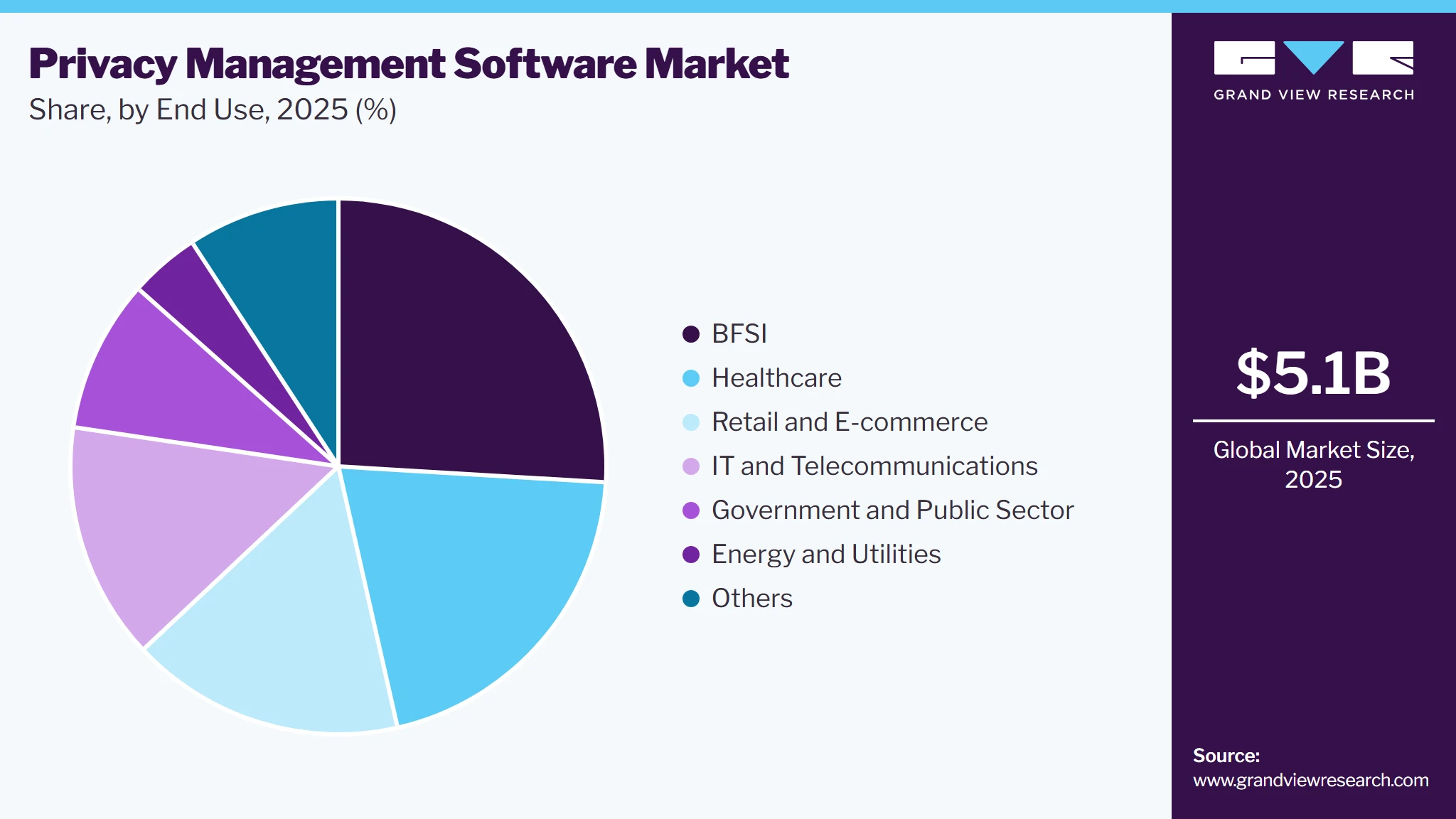
Based on end-use, BFSI segment led the market with the largest revenue share of 25.9% in 2025. The application of privacy management software in the BFSI sector is driven by the critical need to protect susceptible financial data and comply with stringent regulatory requirements. The BFSI sector handles vast amounts of personal and financial information, making it a prime target for cyber-attacks and data breaches. Privacy management software provides robust security measures to safeguard this data, ensuring organizations can protect their customers' information and maintain trust. In addition, the BFSI sector is subject to rigorous regulatory standards, such as the Payment Card Industry Data Security Standard (PCI DSS) and anti-money laundering (AML) laws. Privacy management software helps BFSI organizations navigate these complex regulatory landscapes by automating compliance processes, facilitating audits, and providing comprehensive reporting capabilities.
 To learn more about this report, Download Free Sample Report
The healthcare segment is anticipated to grow at a CAGR of over 41.7% during the forecast period. In the healthcare sector, the application of privacy management software is primarily driven by the imperative to protect patient data and adhere to stringent healthcare regulations. Healthcare organizations manage an extensive range of sensitive personal health information (PHI), which is governed by regulations such as the Health Insurance Portability and Accountability Act (HIPAA) in the U.S. and the General Data Protection Regulation (GDPR) in Europe. Privacy management software enables healthcare providers to implement robust data protection measures, ensuring PHI's confidentiality, integrity, and availability.
Regional Insights
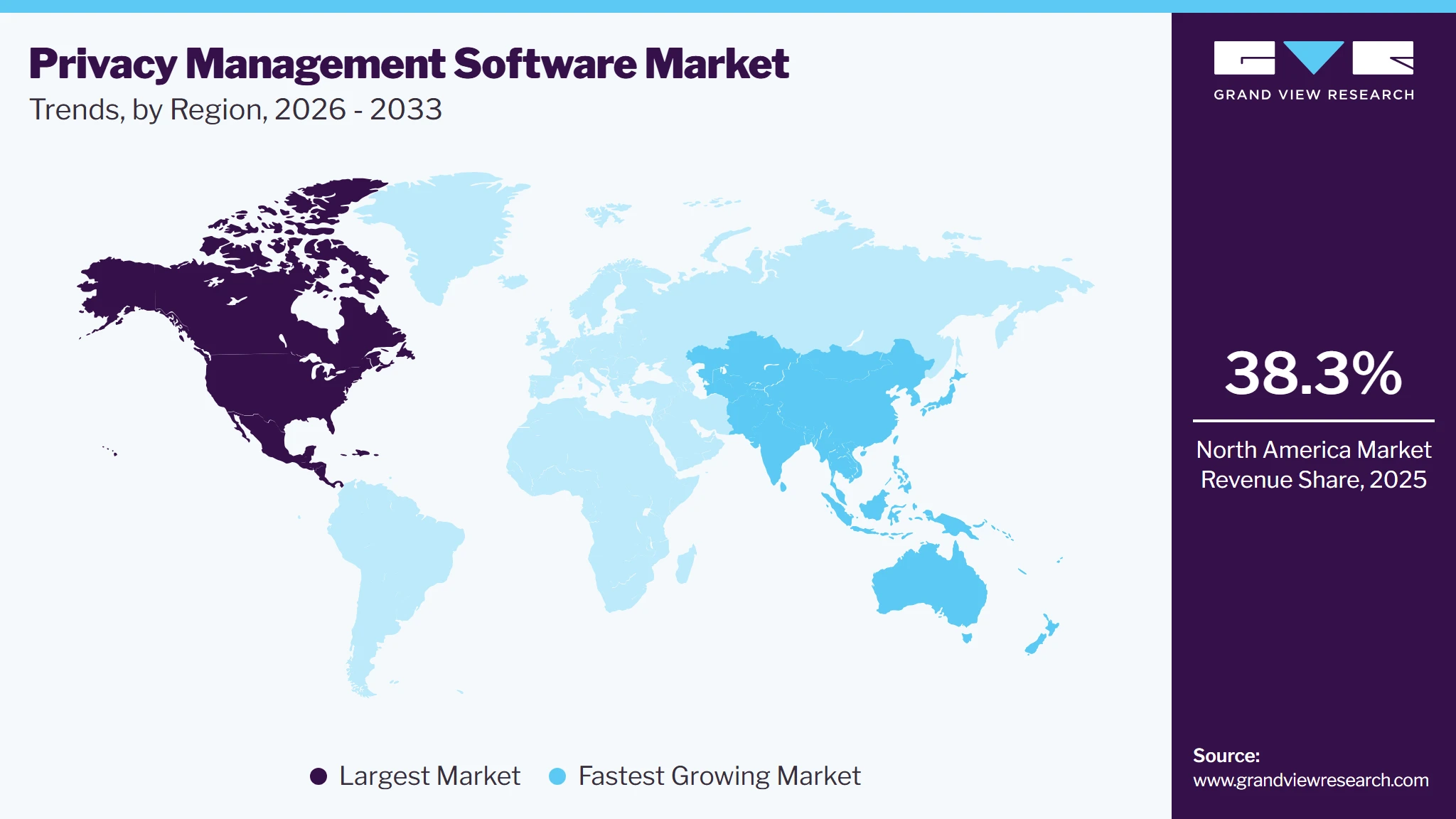
North America dominated the global privacy management software market with the largest revenue share of 38.3% in 2025. In North America, the privacy management software market is experiencing growth driven by stringent data protection regulations such as the California Consumer Privacy Act (CCPA) and increasing consumer awareness of data privacy. Organizations are adopting advanced privacy management solutions to ensure compliance and protect against data breaches, focusing on integrating artificial intelligence and machine learning for enhanced data governance.
 To learn more about this report, Download Free Sample Report
U.S. Privacy Management Software Market Trends
The privacy management software market in the U.S. held the largest share in the North America region in 2025. In the U.S., the market is characterized by a strong emphasis on regulatory compliance due to a patchwork of state-level privacy laws and federal initiatives. Companies increasingly invest in privacy management software to navigate this complex regulatory environment, leveraging features such as automated compliance monitoring, risk assessments, and incident response management to maintain robust data protection practices.
Europe Privacy Management Software Market Trends
The privacy management software market in Europe is growing significantly at a CAGR of over 39.1% from 2026 to 2033. In Europe, the General Data Protection Regulation (GDPR) remains the primary catalyst for the privacy management software market. Organizations across the continent are focused on maintaining GDPR compliance, which requires robust data protection measures and transparent data handling practices. The market is seeing increased adoption of privacy management software with advanced features such as data mapping, impact assessments, and consent management to ensure ongoing regulatory adherence and protect consumer rights.
Asia Pacific Privacy Management Software Market Trends
The privacy management software market in the Asia Pacific is growing at a fastest CAGR of 41.0% from 2026 to 2033. In the Asia Pacific region, rapid digitalization and the expansion of e-commerce are critical drivers of the privacy management software market. Countries such as India, Japan, and Australia are implementing stricter data privacy laws, prompting businesses to adopt comprehensive privacy management solutions. The market is also influenced by growing consumer demand for data privacy and security, pushing organizations to prioritize privacy management in their operations.
Key Privacy Management Software Company Insights
Key players operating in the network emulator market include OneTrust, LLC., TrustArc Inc., Securiti, BigID Inc., Spirion, LLC, One Identity LLC, DataGrail, Inc., Collibra, International Business Machines Corporation, and DataGuard. The companies are focusing on various strategic initiatives, including new product development, partnerships & collaborations, and agreements to gain a competitive advantage over their rivals. The following are some instances of such initiatives.
-
In March 2024, TrustArc Inc., a provider of data privacy management and governance solutions, announced two product innovations to revolutionize the privacy landscape: NymityAI and Responsible AI Certification. These products will be available starting March 27, 2024. Launching these innovations underscores TrustArc's dedication to aiding businesses in adopting responsible artificial intelligence (AI) practices through a verified and credible methodology while enhancing their privacy program management with the most comprehensive legal research application available via NymityAI.
-
In February 2024, BigID Inc., a data protection firm, announced new access governance capabilities designed to enhance security posture, achieve zero-trust security, mitigate insider risk, and accelerate compliance with artificial intelligence regulations. These new access governance controls focus on remediating overexposed sensitive data and over-privileged users, enabling customers to manage, monitor, and revoke access to sensitive data across both cloud and on-premise environments. The solution supports platforms including on-premise SMB file shares, Microsoft 365, and Amazon Web Services Inc. S3, among others. By leveraging this new solution, organizations can automatically investigate, identify, and remediate access rights violations involving sensitive structured and unstructured data. The service proactively reduces the risk of data overexposure and overprivileged users, monitors potential insider threats, and manages external user and group access to sensitive data.
Key Privacy Management Software Companies
The following key companies have been profiled for this study on the privacy management software market.
-
BigID Inc.
-
Collibra
-
DataGrail, Inc.
-
DataGuard
-
International Business Machines Corporation
-
One Identity LLC
-
OneTrust, LLC.
-
Securiti
-
Spirion, LLC
-
TrustArc Inc.
Competitive Benchmarking
Category
Operating Strategies
Competitive Edge
Weakness
Established Players (OneTrust, LLC.; TrustArc Inc.; Securiti; BigID Inc.; Collibra; IBM Corporation)
- Established players focus on delivering comprehensive privacy management platforms that integrate data discovery and classification, consent and preference management, data subject rights (DSR) automation, privacy impact assessments (PIAs), regulatory compliance, AI governance, third-party risk management, and enterprise data governance.
- Their strategies emphasize continuous platform innovation, AI-powered compliance automation, expansion of cloud-native capabilities, strategic partnerships with cloud, cybersecurity, and GRC providers, and support for evolving global privacy regulations across hybrid and multi-cloud environments.
- Established players benefit from extensive global customer bases, mature enterprise platforms, significant R&D investments, strong partner ecosystems, and broad regulatory expertise.
- Their integrated privacy, security, governance, and compliance capabilities, combined with scalable SaaS offerings, advanced AI-driven automation, and global professional services, enable large-scale deployments for multinational organizations managing complex privacy and compliance requirements.
- These companies face challenges associated with complex product portfolios, higher implementation and subscription costs, lengthy enterprise procurement cycles, and increasing competition from specialized privacy technology vendors.
- Maintaining support for rapidly evolving global regulations, expanding AI governance capabilities, and integrating with diverse enterprise IT environments can increase development complexity and operational costs.
Emerging Players (DataGrail, Inc.; DataGuard; One Identity LLC)
- Emerging players focus on delivering cloud-native, easy-to-deploy privacy management solutions emphasizing automated compliance, consent management, DSR fulfillment, privacy assessments, identity-centric governance, and streamlined regulatory reporting.
- Their strategies prioritize rapid product innovation, AI-enabled workflow automation, flexible SaaS delivery, competitive pricing, technology partnerships, and expansion into mid-market and enterprise organizations undergoing digital transformation.
- Emerging players offer agile product development, intuitive user experiences, rapid implementation, flexible deployment models, and competitive subscription pricing.
- Their ability to quickly incorporate new regulatory requirements, automate privacy workflows, integrate with SaaS ecosystems, and provide scalable compliance capabilities enables organizations to accelerate privacy program maturity with lower operational complexity.
- Limited global brand recognition, comparatively smaller enterprise customer bases, narrower partner ecosystems, and fewer international implementation resources may restrict broader market expansion.
- These companies also face challenges in scaling global operations, expanding channel partnerships, continuously investing in AI and regulatory capabilities, and competing against established vendors offering broader governance, security, and compliance platforms.
Privacy Management Software Report Scope
Report Attribute
Details
Market size value in 2025
USD 5.1 billion
Market size value in 2026
USD 6.6 billion
Revenue forecast in 2033
USD 68.2 billion
Growth rate
CAGR of 39.5% from 2026 to 2033
Base year for estimation
2025
Historical data
2021 - 2024
Forecast period
2026 - 2033
Quantitative units
Revenue in USD million/billion, and CAGR from 2026 to 2033
Report coverage
Revenue forecast, company market share analysis, competitive landscape, growth factors, and trends
Segments covered
Deployment mode, enterprise size, application,, end-use, region
Regional scope
North America; Europe; Asia Pacific; Latin America; MEA
Country scope
U.S.; Canada; Mexico; Germany; UK; France; China; Japan; India; South Korea; Australia; Brazil; Saudi Arabia; South Africa; UAE
Key companies profiled
OneTrust, LLC.; TrustArc Inc.; Securiti; BigID Inc.; Spirion, LLC; One Identity LLC; DataGrail, Inc.; Collibra; IBM Corporation; DataGuard
Customization scope
Free report customization (equivalent up to 8 analysts' working days) with purchase. Addition or alteration to country, regional & segment scope.
Pricing and purchase options
Avail customized purchase options to meet your exact research needs. Explore purchase options
Global Privacy Management Software Market Segmentation
This report forecasts revenue growth at global, regional, and country levels and provides an analysis of the latest industry trends in each of the sub-segments from 2021 to 2033. For this study, Grand View Research has segmented the privacy management software market report based on deployment mode, enterprise size, application, end-use, and region:
-
Deployment Mode Outlook (Revenue, USD Billion, 2021 - 2033)
-
On-premises
-
Cloud
-
-
Enterprise Size Outlook (Revenue, USD Billion, 2021 - 2033)
-
Large Enterprises
-
Small and Medium Enterprises (SMEs)
-
-
Application Outlook (Revenue, USD Billion, 2021 - 2033)
-
Data Discovery and Mapping
-
Risk Management
-
Data Governance
-
Regulatory Compliance
-
Incident Response
-
-
End-use Outlook (Revenue, USD Billion, 2021 - 2033)
-
BFSI
-
Government and Public Sector
-
Healthcare
-
Retail and E-commerce
-
IT and Telecommunications
-
Energy and Utilities
-
Others
-
-
Regional Outlook (Revenue, USD Billion, 2021 - 2033)
-
North America
-
U.S.
-
Canada
-
Mexico
-
-
Europe
-
Germany
-
UK
-
France
-
-
Asia Pacific
-
China
-
India
-
Japan
-
South Korea
-
Australia
-
-
Latin America
-
Brazil
-
-
Middle East & Africa
-
UAE
-
Saudi Arabia
-
South Africa
-
-
Research Methodology
The privacy management software market figures in this report are based on a proven research process that combines executive interviews with secondary research from proprietary databases, company filings, and recognized regulatory and institutional sources. Market size is built through value-chain sizing - reconciling supply-side and demand-side estimates - and triangulated with bottom-up and top-down approaches. Every estimate passes multiple levels of expert validation before publication, with each privacy management software segment quantified using the revenue-capture definitions in the table below.
Segment Definition
Segment - Deployment Mode
Revenue capture definition
On-premises
Revenue is generated from perpetual software licenses, subscriptions, maintenance, implementation, and support services for privacy management software deployed within an organization's own IT infrastructure. Revenue includes modules for consent management, data discovery and mapping, data subject rights (DSR) management, privacy impact assessments (PIAs), regulatory compliance, reporting, and privacy governance.
Cloud
Revenue is generated from subscription-based (SaaS) privacy management software delivered through public, private, or hybrid cloud environments. Revenue includes recurring subscription fees, platform licensing, cloud hosting, AI-powered privacy automation, compliance monitoring, consent management, data discovery, DSR automation, analytics, and managed services.
Segment - Enterprise Size
Revenue capture definition
Large Enterprises
Revenue is generated from privacy management software deployed by large organizations with complex multi-region operations requiring enterprise-scale data governance, regulatory compliance, automated privacy workflows, AI governance, third-party risk management, and integration with enterprise security and GRC platforms.
Small and Medium Enterprises (SMEs)
Revenue is generated from privacy management software adopted by SMEs to manage privacy compliance, consent management, customer data governance, regulatory reporting, and data subject requests through cost-effective, scalable, and cloud-based platforms with simplified deployment and administration.
Segment - Application
Revenue capture definition
Data Discovery and Mapping
Revenue is generated from software that automatically discovers, classifies, inventories, and maps personal and sensitive data across enterprise systems, cloud environments, databases, and applications to support privacy compliance.
Risk Management
Revenue is generated from solutions that identify, assess, monitor, and mitigate privacy risks through privacy impact assessments (PIAs), vendor risk assessments, AI risk management, and continuous compliance monitoring.
Data Governance
Revenue is generated from software that enables organizations to establish privacy policies, data retention schedules, consent governance, data lifecycle management, and enterprise-wide privacy controls.
Regulatory Compliance
Revenue is generated from software that automates compliance with global privacy regulations through consent management, data subject rights (DSR) fulfillment, audit trails, regulatory reporting, policy management, and continuous compliance monitoring.
Incident Response
Revenue is generated from solutions supporting privacy incident management, breach notification workflows, case management, investigation, remediation, and regulatory reporting following data privacy incidents.
Segment - End Use
Revenue capture definition
BFSI
Revenue is generated from privacy management software deployed by banks, financial institutions, insurers, and fintech companies to manage customer data protection, regulatory compliance, consent management, and privacy governance.
Healthcare
Revenue is generated from privacy management software used by hospitals, healthcare providers, pharmaceutical companies, and life sciences organizations to safeguard patient information, manage consent, and comply with healthcare privacy regulations.
Retail and E-commerce
Revenue is generated from solutions enabling retailers and online commerce platforms to manage customer consent, preference management, marketing compliance, consumer privacy rights, and personal data governance.
IT and Telecommunications
Revenue is generated from privacy management software adopted by IT service providers, cloud providers, software vendors, and telecommunications companies to govern large-scale customer and enterprise data while ensuring regulatory compliance.
Government and Public Sector
Revenue is generated from privacy management software used by government agencies and public institutions to protect citizen data, automate regulatory compliance, manage data access requests, and strengthen public sector privacy governance.
Energy and Utilities
Revenue is generated from privacy management software deployed by electricity, oil & gas, water, and utility companies to protect customer and operational data, manage regulatory obligations, and strengthen enterprise data governance.
Others
Revenue is generated from privacy management software adopted across manufacturing, education, transportation, media, hospitality, legal services, and other industries to automate privacy compliance, data governance, and risk management processes.
Estimation Model
Layer
Question
Analysis
Privacy & Regulatory Demand Layer
Who can benefit from privacy management software?
Identify organizations that collect, process, store, or transfer personal and sensitive data and must comply with evolving data protection regulations. These include enterprises across BFSI, healthcare, retail and e-commerce, IT and telecommunications, government, manufacturing, education, and other industries. Organizations seeking to automate privacy compliance, strengthen data governance, manage consent, fulfill data subject rights (DSRs), reduce regulatory risks, and enhance customer trust represent the core demand base for privacy management software.
Digital Transformation & Compliance Readiness Layer
Who can deploy privacy management software?
Evaluate organizations based on their digital transformation maturity, cloud adoption, enterprise application landscape, cybersecurity investments, governance and compliance programs, AI adoption, and availability of structured data management processes. Organizations operating hybrid or multi-cloud environments with centralized IT governance, identity management, data governance, and security frameworks possess the operational readiness to successfully deploy privacy management software.
Adoption & Utilization Layer
Who actively uses privacy management software?
Analyze software adoption across multinational enterprises, financial institutions, healthcare providers, retailers, cloud service providers, telecommunications operators, government agencies, manufacturers, and other organizations managing large volumes of personal data. Active users leverage privacy management software for data discovery and mapping, consent and preference management, privacy impact assessments (PIAs), data subject request (DSR) automation, regulatory compliance monitoring, third-party risk management, AI governance, incident response, and enterprise-wide privacy governance.
Monetization Layer
How much revenue is generated?
Assess revenue generated through subscription-based (SaaS) and perpetual licensing of privacy management software, including modules for consent management, data discovery and classification, data mapping, regulatory compliance, privacy assessments, DSR automation, risk management, incident response, AI governance, analytics, and reporting. Additional revenue streams include implementation, customization, system integration, consulting, managed services, employee training, technical support, software maintenance, upgrades, and long-term enterprise subscription and service agreements associated with privacy management deployments.
Delivered Customizations
This report has been delivered with the following In-depth customizations
Client Request
Customization Delivered
Value Adds
AI Governance & Privacy Automation Trends
Conducted a structured analysis of blade server technologies focused on AI-ready architectures, GPU-accelerated computing, high-performance processors, memory optimization, HPC deployments, and infrastructure supporting AI training and inference workloads.
Helps stakeholders understand emerging AI-powered privacy technologies, identify high-growth innovation areas, and evaluate investment opportunities in intelligent privacy governance and regulatory automation.
Cloud Privacy, Data Governance & Multi-Cloud Compliance Trends
Conducted a comprehensive analysis of privacy management software adoption across public cloud, private cloud, hybrid and multi-cloud environments, including cloud data governance, cross-border data transfers, SaaS privacy management, and enterprise compliance initiatives.
Helps stakeholders identify opportunities in cloud privacy management, assess enterprise data governance strategies, and evaluate solutions that enhance regulatory compliance, operational efficiency, and secure data management across distributed IT environments.
Global Regulatory Compliance & Data Protection Trends
Conducted a comprehensive analysis of privacy management solutions supporting GDPR, CCPA/CPRA, LGPD, India's DPDP Act, and other global privacy regulations, with emphasis on automated compliance workflows, consent lifecycle management, third-party risk management, and continuous regulatory monitoring.
Helps stakeholders understand evolving global privacy requirements, evaluate compliance investment strategies, mitigate regulatory risks, and identify growth opportunities driven by expanding data protection legislation and enterprise privacy governance initiatives.
Frequently Asked Questions About This Report
The global privacy management software market size was estimated at USD 5.1 billion in 2025 and is expected to reach USD 6.6 billion in 2026.
The global privacy management software market is expected to grow at a compound annual growth rate of 39.5% from 2026 to 2033 to reach USD 68.2 billion by 2033.
Key factors include as organizations increasingly prioritize data privacy, regulatory compliance, and consumer trust amid the rapid expansion of digital services and cloud-based operations.
North America dominated with 38.3% revenue share in 2025.
Asia Pacific is the fastest-growing region over the forecast period.
The on-premises segment led with a 61.6% revenue share in 2025 and is the fastest-growing segment.
The large enterprises segment led with a 64.4% revenue share in 2025, while the SMEs segment is the fastest-growing segment.
The regulatory compliance segment held the largest share (over 28.0%) in 2025, while the data discovery and mapping segment is the fastest-growing segment.
Key players operating in the privacy management software market include OneTrust, LLC.; TrustArc Inc.; Securiti; BigID Inc.; Spirion, LLC; One Identity LLC; DataGrail, Inc.; Collibra; IBM Corporation; DataGuard
About the Author(s)
IT Services & Applications Research Team
Technology · IT Services & ApplicationsThis report was authored by the it services & applications research team at Grand View Research - comprising two research analysts, one senior research analyst, and one industry expert - with specialized expertise in the it services & applications segment of the technology industry. All findings are based on proprietary technology databases, executive interviews, and regulatory analysis, subject to internal peer review prior to publication.
Last Updated:
Speak to Analyst

Customize this report to your needs - add regions, segments, or data points, with 20% free customization.
Or view our licence options:


ISO 9001:2015 & 27001:2022 Certified
We are GDPR and CCPA compliant! Your transaction & personal information is safe and secure. For more details, please read our privacy policy.


