
- Home
- »
- Advanced Interior Materials
- »
-
Professional Footwear Market Size, Share Report, 2026-2033GVR Report cover

Professional Footwear Market (2026 - 2033)
Size, Share & Trends Analysis Report By End Use (Construction, Oil & Gas, Chemicals, Food Processing, Pharmaceuticals, Healthcare, Transportation & Logistics, Mining, HORECA, Aviation, Military, DIY), By Region, And Segment Forecasts
Market Size, 2025
$19.3BMarket Estimate, 2026
$20.6BMarket Forecast, 2033
$32.6BCAGR, 2026–2033
6.8%Professional Footwear Market Summary
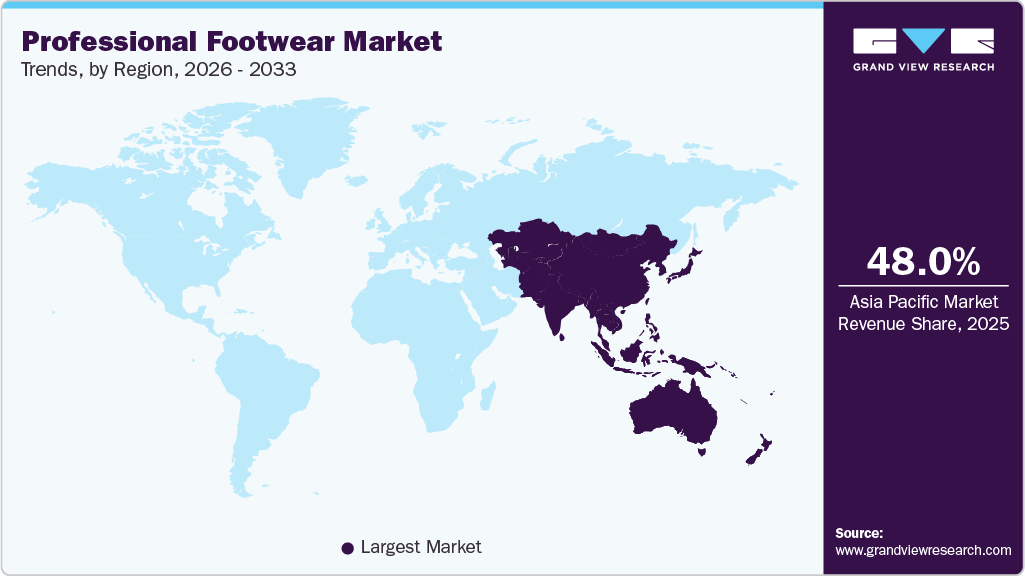
The global professional footwear market size was valued at USD 19.3 billion in 2025 and is projected to grow from USD 20.6 billion in 2026 to USD 32.6 billion by 2033, at a CAGR of 6.8% from 2026 to 2033. The Asia Pacific held the largest share of 46.1% of the global market in 2025. The market is primarily driven by increasing awareness of workplace safety and the implementation of strict regulatory standards across industries such as construction, manufacturing, oil & gas, and mining.
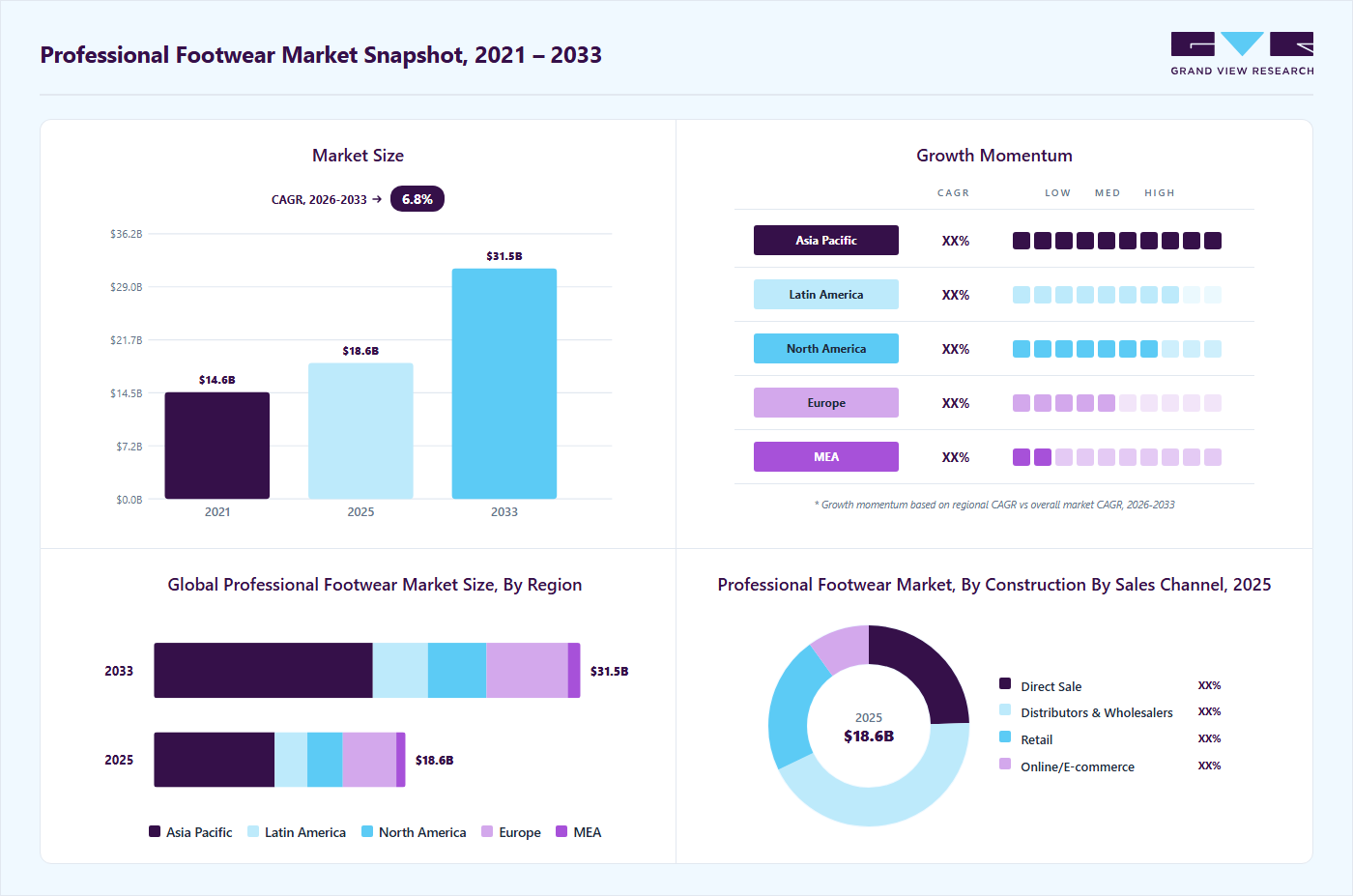 Source: Grand View Research, IR Documents, Primary Interviews, Paid DatabasesTo learn more about this report,
 Download Free Sample Report
 Key Market Trends & Insights
- By end-use: Manufacturing sector dominated the market and accounted for 29.5% share in 2025.
- By end-use: The transportation & logistics segment is growing at a fastest CAGR over the forecast period.
Regional Highlights
- Largest regional market: Asia Pacific (46.1% revenue share, 2025)
- By country: The China led the Asia Pacific market in 2025.
Market Size & Forecast
- Market size in 2025: USD 19.3 Billion
- Estimated market size in 2026: USD 20.6 Billion
- Projected market size by 2033: USD 32.6 Billion
- CAGR (2026-2033): 6.8%
Three ways to get this report
Buy it, customize it, or ask a question.Ask an Analyst
Analyst response in 1 business day
- AccessReport author, directly
- Reply timeWithin 1 working day
- No sales callDirect answer only
- FormatEmail reply
- CostFree, no cost
Get the Full Report
What the study covers
- FormatsPDF · Excel · Dashboard
- Timeline2026–2033 annual, 2025 base
- Coverage20+ countries, 5 regions
- Companies10+ key players profiled
Customize the Report
20% free customization
- IncludeCountries, segments, points
- TailorTo your product definition
- ExtendDeeper competitor detail
- OrA fully bespoke study
- Turnaround5–10 working days
Governments and regulatory bodies are enforcing the use of certified personal protective equipment (PPE), including safety footwear, to reduce workplace injuries. The growth of industrial activities, infrastructure development, and the expansion of sectors such as logistics, healthcare, and services are fueling market growth. Moreover, as the global workforce continues to expand, there is a rising demand for durable, comfortable, and performance-oriented footwear suitable for long working hours. Technological advancements in materials and design, along with increasing focus on ergonomic and lightweight footwear, are also contributing to the adoption of professional footwear, while the rising emphasis on eco-friendly materials is gradually aligning with trends in the sustainable footwear market.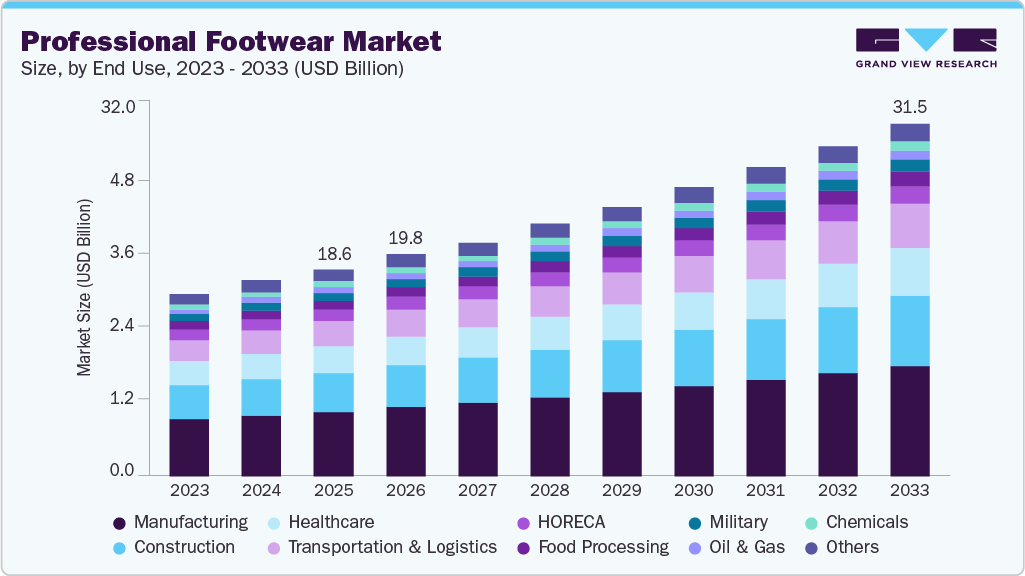 To learn more about this report, Download Free Sample Report
 Market Dynamics
Growing awareness around worker safety and accident prevention is a major factor driving the demand for professional footwear across industries. Employers are increasingly prioritizing employee well-being, recognizing that workplace injuries not only impact productivity but also lead to higher compensation costs and operational disruptions.
As a result, organizations are actively investing in high-quality personal protective equipment (PPE), including safety footwear, to minimize risks and ensure safer working environments. This rising awareness is strongly supported by stringent regulatory standards and compliance requirements across regions.
Regulations such as OSHA 29 CFR 1910.136 and 1926.96 in the U.S., ISO 20345 globally, EU Regulation (EU) 2016/425, and IS 15298 in India mandate the use of protective footwear in hazardous workplaces. These standards require footwear to meet specific criteria such as impact resistance, slip resistance, and protection against electrical hazards, pushing employers to adopt certified safety footwear solutions.
The widespread presence of low-cost counterfeit and substandard footwear continues to pose a major challenge for the professional footwear market. These products are typically priced significantly lower than certified safety footwear, making them highly appealing to cost-sensitive buyers, particularly in developing and price-driven markets.
Many small businesses and contractors prioritize short-term cost savings over long-term safety benefits, leading to increased adoption of such products. However, these low-quality alternatives often fail to meet basic safety requirements, which can result in higher risks of workplace injuries and accidents.
A major concern with counterfeit footwear is that it often closely resembles branded and certified products in appearance, making it difficult for buyers to distinguish between genuine and fake items. Despite their similar look, these products are manufactured using inferior raw materials and lack proper testing and quality assurance processes. As a result, they do not provide adequate protection against hazards such as impact, compression, punctures, or slips. This not only endangers workers but also undermines trust in established brands, as customers may unknowingly associate poor performance with recognized manufacturers.
Industry Concentration & Characteristics
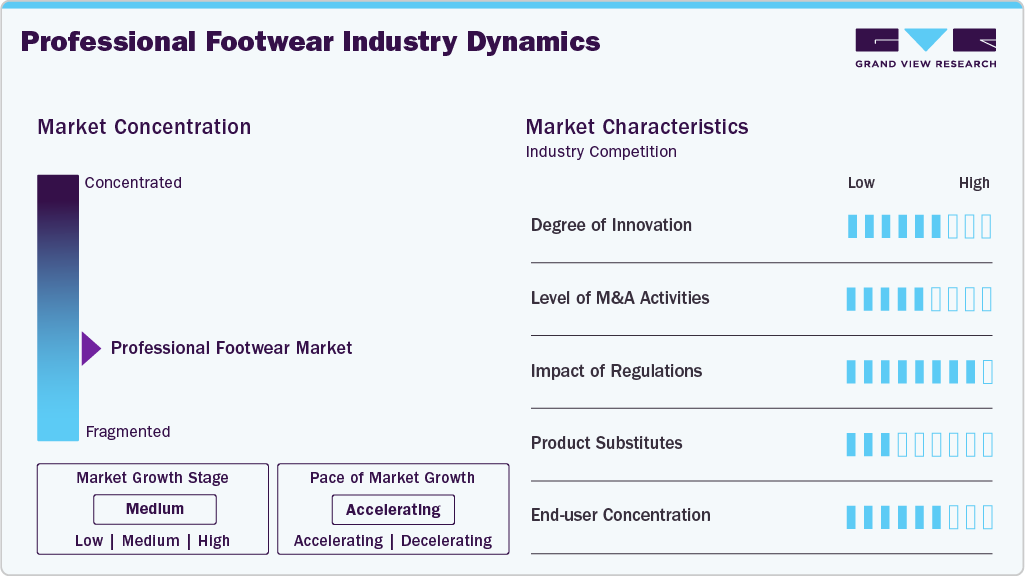
The professional footwear industry is fragmented, with the presence of several global players alongside numerous regional and local manufacturers. While established companies hold a significant share due to strong brand recognition, product innovation, and compliance with international safety standards, a large portion of the market is occupied by smaller players catering to price-sensitive and local demand. The availability of low-cost alternatives and contract manufacturing further increases competition, resulting in a fragmented market structure with no single player dominating globally.
The professional footwear industry demonstrates a moderate to high degree of innovation, driven by the need to enhance safety, comfort, and durability. Manufacturers are continuously developing advanced materials such as lightweight composites, TPU (Thermoplastic Polyurethane), and EVA (Ethylene-Vinyl Acetate) to improve product performance. In addition, innovations in ergonomic design, anti-fatigue technology, and breathable materials are gaining importance, especially for workers engaged in long-duration tasks. Emerging trends such as smart footwear and sensor-based safety features are also beginning to shape the future of the market.
 To learn more about this report, Download Free Sample Report
 Regulations play a critical role in shaping the market, as safety footwear is governed by stringent standards such as ISO 20345, ASTM, OSHA, and regional certifications like BIS and EU PPE regulations. These regulations mandate specific safety features, including impact resistance, slip resistance, and protection against electrical hazards. Compliance with these standards is essential for market participation, influencing product design, testing processes, and manufacturing practices. Increasing enforcement of safety regulations, particularly in developing regions, is further driving the adoption of certified footwear.
The market is characterized by a diverse end-user base, with demand spread across industries such as construction, manufacturing, oil & gas, healthcare, logistics, and mining. However, certain sectors like construction and manufacturing dominate due to higher exposure to workplace hazards. While large industrial clients contribute significantly through bulk purchases, smaller enterprises and informal sectors also represent a substantial share, especially in emerging markets. This varied end-user concentration creates opportunities for both premium and cost-effective product offerings across different segments.
Drivers, Opportunities & Restraints
The market is primarily driven by increasing awareness of workplace safety and the enforcement of stringent regulatory standards across industries such as construction, manufacturing, and oil & gas. Employers are increasingly investing in certified safety footwear to reduce workplace injuries and comply with regulations. In addition, rapid industrialization, infrastructure development, and expansion of logistics and service sectors are further supporting steady demand for protective footwear.
The market also presents strong opportunities driven by technological advancements and evolving customer preferences. The growing demand for lightweight, ergonomic, and comfortable footwear is encouraging manufacturers to innovate with advanced materials and designs. Furthermore, the rising adoption of sustainable materials and expansion of e-commerce channels are opening new growth avenues, with increasing alignment toward the sustainable footwear market creating additional opportunities for product innovation and differentiation. Increasing demand from emerging sectors such as healthcare, aviation, and services is also broadening the market scope.
High costs of certified safety footwear can restrict adoption in price-sensitive markets, particularly among small and medium enterprises. In addition, fluctuations in raw material prices and the availability of low-cost counterfeit products create pricing pressure and impact profitability. Supply chain disruptions and limited awareness in unorganized sectors also continue to pose challenges for market expansion.
End Use Insights
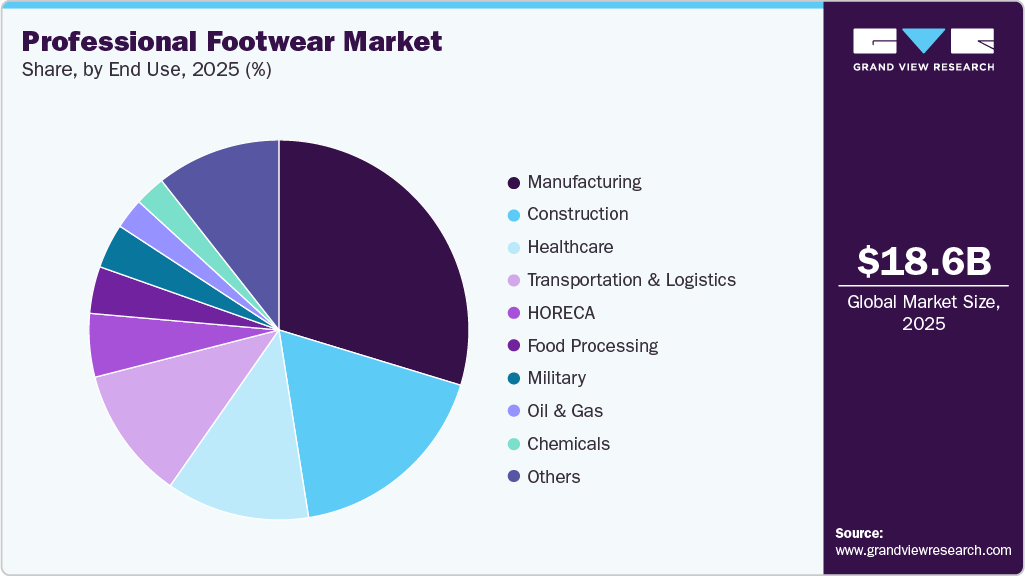
The manufacturing sector dominated the market in 2025 and accounted for 29.5% share, due to its large workforce and continuous exposure to workplace hazards such as heavy machinery, sharp materials, and slippery surfaces. Manufacturing environments require consistent use of safety footwear with features like impact resistance, anti-slip soles, and durability, making it a major demand contributor. In addition, strict safety regulations and compliance requirements in industrial facilities further support the widespread adoption of certified footwear in this segment.
 To learn more about this report, Download Free Sample Report
 The transportation & logistics segment is the fastest growing, driven by the rapid expansion of e-commerce, warehousing, and supply chain networks globally. Workers in this sector are exposed to risks such as heavy lifting, material handling, and long working hours, increasing the need for comfortable and durable footwear. The growing focus on worker productivity, safety compliance, and ergonomic design is further accelerating demand for professional footwear in this segment.
Regional Insights
The North America professional footwear market is supported by a well-established regulatory framework and strong industrial base across the U.S., Canada, and Mexico. Workplace safety regulations enforced by agencies such as OSHA (Occupational Safety and Health Administration) and CCOHS (Canadian Center for Occupational Health and Safety) require the use of certified safety footwear in hazardous industries. This consistent regulatory enforcement ensures steady demand across sectors such as construction, manufacturing, and energy.
U.S. Professional Footwear Market Trends
The U.S. footwear market, particularly within the professional footwear segment, led North America, driven by a strong industrial base and strict workplace safety regulations. High workforce participation across sectors such as manufacturing, oil & gas, and logistics continues to support consistent demand for protective footwear. In addition, rising defense expenditure is contributing to demand for specialized and tactical footwear, with the World Bank reporting U.S. military spending of USD 916.01 billion in 2023 and USD 997.31 billion in 2024.
Canada professional footwear market is gradually expanding within the regional market, supported by growing investments in industrial and infrastructure development. Data from Statistics Canada shows that investment in industrial building construction rose from approximately USD 1.65 billion in 2021 to over USD 2.19 billion in 2024, indicating sustained project activity and workforce deployment. This trend is increasing the need for safety equipment, including professional footwear, while a stronger focus on occupational safety standards is further supporting market growth.
Europe Professional Footwear Market Trends
The professional footwear market in Europe is shaped by strict safety regulations and a strong culture of workplace protection. Compliance with standards such as EN ISO 20345 and the EU PPE Regulation (2016/425) is mandatory across high-risk industries, including manufacturing, construction, and logistics. Strong enforcement and high employer responsibility contribute to stable and continuous demand across the region.
Germany professional footwear market is supported by its strong industrial base and advanced manufacturing sector. The country’s well-established industries, including automotive, machinery, and chemicals, drive consistent demand for safety footwear. According to the International Trade Administration, Germany’s global exports increased from USD 955 billion in 2022 to over USD 1 trillion in 2023, reflecting steady growth in advanced manufacturing activities. This expansion indicates higher industrial output and workforce engagement, thereby supporting demand for certified professional footwear.
The professional footwear market in France is emerging as a growing market within the region, driven by increasing industrial activities and infrastructure development. The country is witnessing rising investments in sectors such as manufacturing, transportation, and energy, which require strong safety compliance. In addition, growing emphasis on workplace safety standards and the adoption of protective equipment are contributing to the steady demand for professional footwear in France.
Asia Pacific Professional Footwear Market Trends
The professional footwear market in the Asia Pacific is driven by rapid industrial growth, large-scale infrastructure development, and a vast workforce operating in hazardous conditions. Expanding industries such as manufacturing, construction, mining, and logistics are increasing the need for safety footwear. Although regulatory enforcement varies by country, rising awareness and industrial expansion are supporting consistent demand.
 To learn more about this report, Download Free Sample Report
 China professional footwear market dominates the Asia Pacific, supported by its large-scale manufacturing base and strong presence across industries such as construction, mining, and heavy engineering. The country’s extensive industrial output and export-oriented economy result in a vast workforce operating in high-risk environments, driving continuous demand for safety footwear. In addition, increasing focus on workplace safety regulations and modernization of industrial facilities is further strengthening the adoption of certified professional footwear across sectors.
The professional footwear market in India is the fastest-growing market in the region, driven by rapid infrastructure development, expanding industrial activities, and a growing workforce base. According to the India Brand Equity Foundation, the country’s logistics market was valued at around USD 228.4 billion in 2024 and is projected to reach approximately USD 428.7 billion by 2033, supporting a workforce of over 22 million people. These developments are significantly increasing workforce exposure to construction, material handling, and transportation risks, thereby driving consistent demand for professional footwear across these sectors.
Latin America Professional Footwear Market Trends
The professional footwear market in Latin America is largely influenced by resource-based industries, particularly mining, along with growing industrial and infrastructure activities. Countries like Chile, Peru, and Argentina have strong mining sectors that require a large workforce exposed to challenging environments. This drives the need for durable and protective footwear suited for harsh working conditions.
Brazil professional footwear market is supported by its strong industrial base and presence in sectors such as mining, construction, agriculture, and manufacturing. The country’s extensive workforce operating in hazardous environments drives consistent demand for protective footwear. In addition, ongoing investments in infrastructure and industrial development are increasing the need for safety-compliant footwear across various industries.
Middle East & Africa Professional Footwear Market Trends
The professional footwear market in the Middle East & Africa is driven by a mix of resource industries and ongoing infrastructure development. In the Middle East, countries such as Saudi Arabia and the UAE are investing heavily in construction projects, leading to increased workforce deployment in high-risk environments. These conditions require protective footwear with features such as impact resistance, slip protection, and durability, supporting market growth across the region.
Saudi Arabia professional footwear market led the Middle East & Africa, driven by large-scale infrastructure development and strong activity in the oil & gas sector. Ongoing projects under national development initiatives are increasing workforce deployment across construction, energy, and industrial sites, where exposure to hazardous conditions necessitates the use of protective footwear. This creates consistent demand for safety-compliant and durable footwear across key industries.
Key Professional Footwear Company Insights
Some of the key players operating in the market include Wolverine World Wide Inc, VF Corporation, and Bata Corporation.
-
Wolverine World Wide Inc. is a global brand of footwear, apparel, and accessories with a 142-year history and presence in approximately 200 countries. The company focuses on creating high-quality products and building strong brands. Its portfolio includes owned brands such as Bates, Chaco, Hush Puppies, Merrell, Saucony, Soft Style, Stride Rite, Sweaty Betty, and Wolverine, as well as licensed brands like Cat Footwear and Harley-Davidson Footwear.
-
VF Corporation is a global company that designs, manufactures, and distributes footwear and apparel through multiple brands, including The North Face, Vans, Timberland, and JanSport. It operates across outdoor, workwear, and casual segments, serving consumers in many countries. The company focuses on product durability, operational efficiency, and wide market reach, while integrating sustainability, safety, and quality considerations throughout its manufacturing processes and supply chains.
Key Professional Footwear Companies:
The following key companies have been profiled for this study on the professional footwear market.
- Wolverine World Wide Inc.
- VF Corporation
- Bata Corporation
- ASICS
- PIP
- Dunlop Protective Footwear
- Rock Fall (UK) LTD.
- Hilson Footwear Pvt. Ltd.
- U-Power Group Spa
- Cofra SRL
- Uvex Group
- Elten GmbH
- Carhartt
- Rahman Group
- Ariat International, Inc.
Recent Developments
-
In May 2025, Protective Industrial Products, Inc. completed the acquisition of Honeywell’s Personal Protective Equipment business, expanding its portfolio with established brands such as Fendall, Fiber-Metal, Howard Leight, Miller, North, and Salisbury. This acquisition strengthens PIP’s global presence and enhances its capabilities in providing a broad range of safety and protective equipment solutions.
-
In October 2025, Adidas announced plans to enter the safety footwear market in 2026 with the launch of its ‘Pro Work’ line. The new range is expected to target industrial and professional users, marking the company’s expansion into occupational footwear. This move reflects diversification beyond sportswear into workwear-related product segments.
Professional Footwear Market Report Scope
Report Attribute
Details
Market size in 2025
USD 19.3 billion
Estimated market size in 2026
USD 20.6 billion
Projected market size by 2033
USD 32.6 billion
Growth rate
CAGR of 6.8% from 2026 to 2033
Historical data
2021 - 2025
Forecast period
2026 - 2033
Quantitative units
Volume in thousand pairs, revenue in USD million/billion, and CAGR from 2026 to 2033
Report coverage
Volume & revenue forecast, company market position analysis, competitive landscape, growth factors, and trends
Segments covered
End use, region
Regional scope
North America, Europe, Asia Pacific, Latin America, MEA
Country Scope
U.S.; Canada; Mexico; Spain; France; Germany; Italy; UK; Scandinavia; Netherlands; China; India; Japan; Thailand; Malaysia, New Zealand; Australia; South Korea; Indonesia; Brazil; Argentina; Chile; Peru; Colombia; Saudi Arabia; UAE; South Africa
Key companies profiled
Wolverine World Wide Inc; VF Corporation; Bata Corporation; ASICS; PIP; Dunlop Protective Footwear; Rock Fall (UK) Ltd.; Hilson Footwear Pvt. Ltd.; U-Power Group S.p.A.; Cofra S.r.l.; Uvex Group; Elten GmbH; Carhartt; Rahman Group; Ariat International, Inc.
Customization scope
Free report customization (equivalent up to 8 analysts working days) with purchase. Addition or alteration to country, regional & segment scope.
Pricing and purchase options
Avail customized purchase options to meet your exact research needs. Explore purchase options
Global Professional Footwear Market Report Segmentation
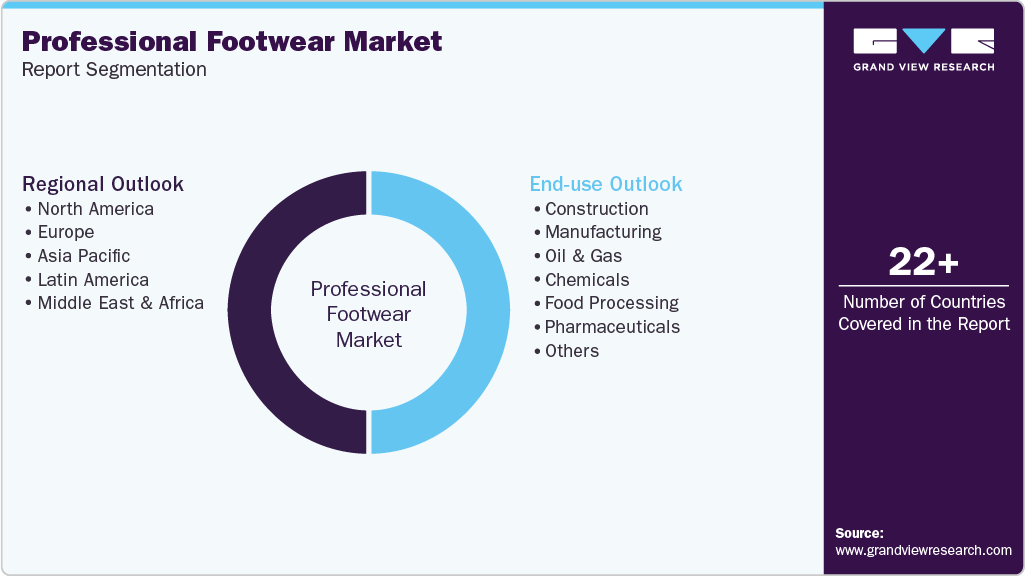
This report forecasts volume & revenue growth at global, regional & country levels, and provides an analysis on the latest trends and opportunities in each of the sub-segments from 2021 to 2033. For this study, Grand View Research has segmented the global professional footwear market based on end use and region:
 To learn more about this report, Download Free Sample Report
 -
End Use Outlook (Revenue, USD Billion, Volume, Thousand Pairs, 2021 - 2033)
-
Construction
-
By Sales Channel
-
Direct Sale
-
Distributors & Wholesalers
-
Retail
-
Online/E-commerce
-
-
-
Manufacturing
-
By Sales Channel
-
Direct Sale
-
Distributors & Wholesalers
-
Retail
-
Online/E-commerce
-
-
-
Oil & Gas
-
By Sales Channel
-
Direct Sale
-
Distributors & Wholesalers
-
Retail
-
Online/E-commerce
-
-
-
Chemicals
-
By Sales Channel
-
Direct Sale
-
Distributors & Wholesalers
-
Retail
-
Online/E-commerce
-
-
-
Food Processing
-
By Sales Channel
-
Direct Sale
-
Distributors & Wholesalers
-
Retail
-
Online/E-commerce
-
-
-
Pharmaceuticals
-
By Sales Channel
-
Direct Sale
-
Distributors & Wholesalers
-
Retail
-
Online/E-commerce
-
-
-
Healthcare
-
By Sales Channel
-
Direct Sale
-
Distributors & Wholesalers
-
Retail
-
Online/E-commerce
-
-
-
Transportation & Logistics
-
By Sales Channel
-
Direct Sale
-
Distributors & Wholesalers
-
Retail
-
Online/E-commerce
-
-
-
Mining
-
By Sales Channel
-
Direct Sale
-
Distributors & Wholesalers
-
Retail
-
Online/E-commerce
-
-
-
HORECA
-
By Sales Channel
-
Direct Sale
-
Distributors & Wholesalers
-
Retail
-
Online/E-commerce
-
-
-
Aviation
-
By Sales Channel
-
Direct Sale
-
Distributors & Wholesalers
-
Retail
-
Online/E-commerce
-
-
-
Military
-
By Sales Channel
-
Government & Defense Tenders
-
Direct Institutional Procurement
-
Authorized Distributors
-
Defense Contractors
-
-
-
DIY
-
By Sales Channel
-
Direct Sale
-
Distributors & Wholesalers
-
Retail
-
Online/E-commerce
-
-
-
Others
-
By Sales Channel
-
Direct Sale
-
Distributors & Wholesalers
-
Retail
-
Online/E-commerce
-
-
-
-
Regional Outlook (Revenue, USD Billion, Volume, Thousand Pairs, 2021 - 2033)
-
North America
-
U.S.
-
Canada
-
Mexico
-
-
Europe
-
Spain
-
Germany
-
Italy
-
France
-
UK
-
Scandinavia
-
Netherlands
-
-
Asia Pacific
-
China
-
India
-
Japan
-
Australia
-
South Korea
-
Indonesia
-
Thailand
-
Malaysia
-
New Zealand
-
-
Latin America
-
Brazil
-
Argentina
-
Peru
-
Chile
-
Colombia
-
-
Middle East & Africa
-
Saudi Arabia
-
UAE
-
South Africa
-
-
Frequently Asked Questions About This Report
The Asia Pacific market held the largest share of the global revenue in 2025 accounting for 46.1% driven by rapid industrial growth, large-scale infrastructure development, and a vast workforce operating in hazardous conditions. Expanding industries such as manufacturing, construction, mining, and logistics are increasing the need for safety footwear.
Key players include Wolverine World Wide Inc; VF Corporation; Bata Corporation; ASICS; PIP; Dunlop Protective Footwear; Rock Fall (UK) Ltd.; Hilson Footwear Pvt. Ltd.; U-Power Group S.p.A.; Cofra S.r.l.; Uvex Group; Elten GmbH; Carhartt; Rahman Group; Ariat International, Inc.
The professional footwear market is driven by strict workplace safety regulations and increasing awareness of worker protection across industries. Additionally, growth in construction, manufacturing, and infrastructure activities is fueling demand for durable and safety-compliant footwear.
The global professional footwear market size was valued at USD 19.3 billion in 2025 and is estimated at USD 20.6 billion for 2026.
The global professional footwear market is expected to grow at a CAGR of 6.8% from 2026 to 2033, reaching USD 32.6 billion by 2033.
The manufacturing segment led with a 29.5% revenue share in 2025, while the transportation & logistics is the fastest-growing segment.
About the Author(s)
Advanced Interior Materials Research Team
Advanced Materials · Advanced Interior MaterialsThis report was authored by the advanced interior materials research team at Grand View Research - comprising two research analysts, one senior research analyst, and one industry expert - with specialized expertise in the advanced interior materials segment of the advanced materials industry. All findings are based on proprietary advanced materials databases, executive interviews, and regulatory analysis, subject to internal peer review prior to publication.
Last Updated:
Speak to Analyst

Customize this report to your needs - add regions, segments, or data points, with 20% free customization.
Or view our licence options:


ISO 9001:2015 & 27001:2022 Certified
We are GDPR and CCPA compliant! Your transaction & personal information is safe and secure. For more details, please read our privacy policy.


