
- Home
- »
- Advanced Interior Materials
- »
-
Protective Relay Market Size And Share Report, 2026-2033GVR Report cover
![Protective Relay Market (2026 - 2033)Report]()
Protective Relay Market (2026 - 2033)
Size, Share & Trends Analysis Report By Voltage (Low Voltage, Medium Voltage, High Voltage), By Application (Feeder Protection, Generator Protection, Bus-Bar Protection), By End Use (Infrastructure, Industrial), By Region, And Segment Forecasts
Market Size, 2025
$3.8BMarket Estimate, 2026
$4.0BMarket Forecast, 2033
$5.7BCAGR, 2026–2033
5.2%Protective Relay Market Summary
The global protective relay market size was valued at USD 3.8 billion in 2025 and is projected to grow from USD 4.0 billion in 2026 to USD 5.7 billion in 2033, at a CAGR of 5.2% from 2026 to 2033. Asia Pacific dominated the market, accounting for a revenue share of 32.0% in 2025. As significant investments are directed to infrastructure projects across regions, there is a concurrent surge in energy consumption, driving the popularity of smart grid technologies for effective energy management.
Key Market Trends & Insights
- By voltage: The medium-voltage segment held the largest market share, approximately 46.0%, in 2025.
- By application: The feeder protection segment accounted for the highest revenue share of around 29.2% in 2025.
- By end use: The power segment accounted for the highest revenue share of around 34.0% in 2025.
Regional Highlights
- Largest regional market: Asia Pacific (32.0% revenue share, 2025)
- Fastest-growing regional market: North America (highest CAGR, 2026 - 2033)
Market Size & Forecast
- Market size in 2025: USD 3.8 Billion
- Estimated market size in 2026: USD 4.0 Billion
- Projected market size by 2033: USD 5.7 Billion
- CAGR (2026-2033): 5.2%
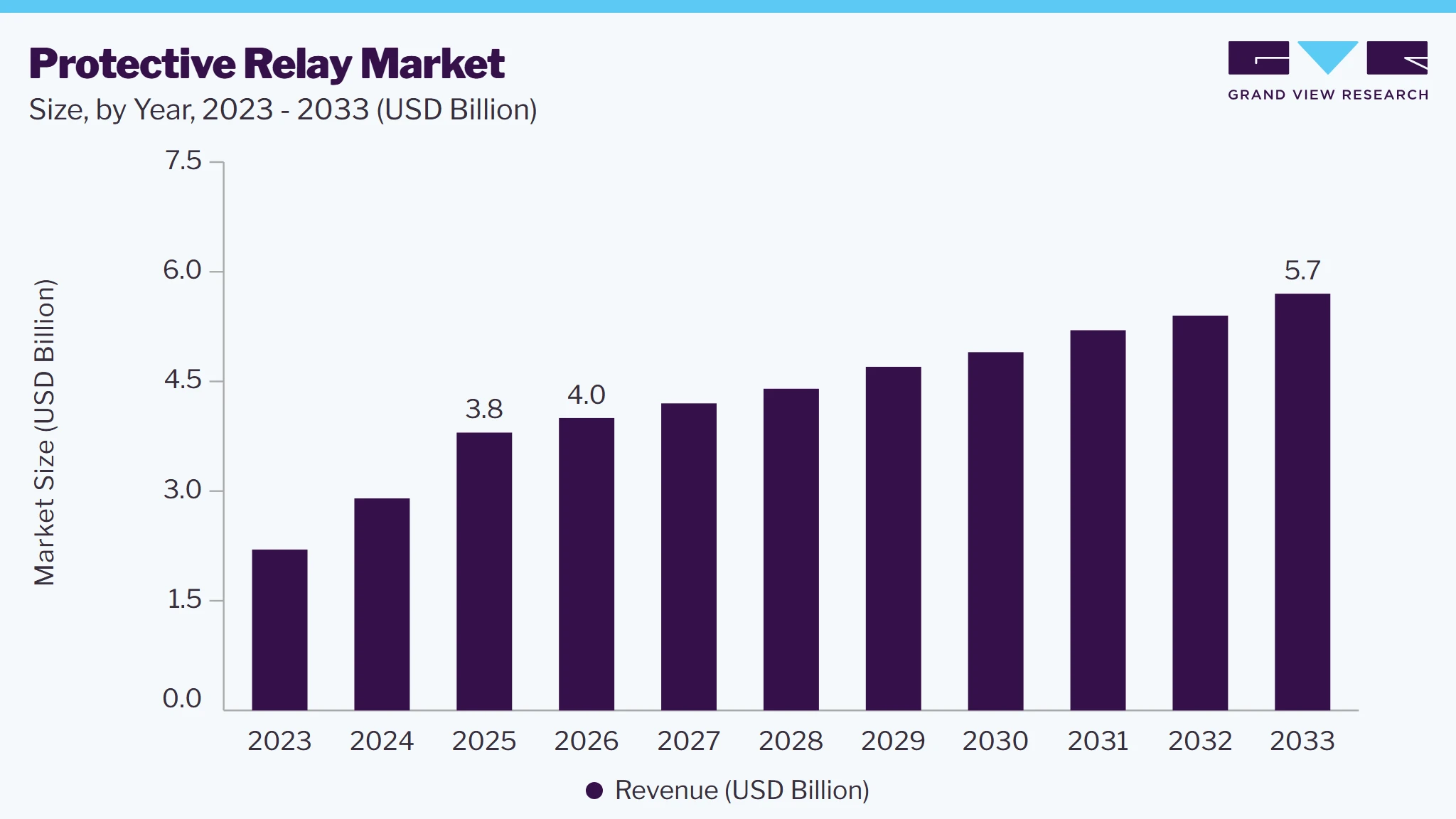
The growing emphasis on power quality and reliability recognizes the potential consequences of voltage fluctuations and frequency variations, including equipment damage and power disruptions. These factors collectively underscore the increasing significance of protective relays in safeguarding and ensuring the stable operation of power systems.
Market Dynamics
The rapid growth of smart grid infrastructure and the adoption of renewable energy sources are driving demand for protective relays. The utilities are increasingly supplementing traditional centralized power generation with distributed energy resources, including wind, solar, and battery energy storage systems, thereby transforming power distribution from a static, unidirectional flow to a multifaceted, dynamic, and multidirectional network.
This transition demands sophisticated, microprocessor-enabled digital and numerical protective relays capable of real-time analysis, automatic fault location, and adaptive protection schemes. In addition, large amounts of public funding, such as grid resilience programs in North America and the rollout of smart distribution systems throughout the Asia-Pacific, are pushing utility operators to replace obsolete hardware with IEDs in quick succession.
The high up-front cost of sophisticated digital relay systems, along with the complexities of retrofitting a legacy network, are crucial limiting factors for market growth. Modernizing a substation not only involves the acquisition of expensive numerical relays but also the upgrade of communication architectures, workforce training, and the implementation of robust cybersecurity architecture to meet demanding regulatory requirements, such as NERC CIP and NIS-2.
Higher capital expenditures and operational costs for utilities/industrial owners in developing economies might lengthen deployment timelines for such systems. It is also challenging to effectively address interoperability issues, communication disruptions, and system downtime arising from integrating the latest digital relays based on modern communication protocols (such as IEC 61850) into decade-old analog/electromechanical legacy infrastructure.
The ongoing global shift to software-defined digital substations, together with the widespread adoption of the IEC 61850 communication standard, represents the largest market opportunity in the protective relay space today. Analog, legacy substations require extensive, unwieldy point-to-point copper wiring to connect the switchgear and relays. This is replaced by a high-speed fiber-optic process bus that converts electrical measurement data into secure, instantaneous digital packets within a digital substation.
This communication standard allows for a multi-vendor, highly interconnected architecture of sophisticated IEDs that seamlessly communicate via high-speed GOOSE messages. By eliminating the hardware silo, manufacturers are free to build next-generation intelligent protective relays featuring remote cloud connectivity, digital twin simulation, and predictive fault algorithms, which will drastically reduce utility O&M spending, making this a profitable venture toward a future filled with smart cities and highly profitable, software-enhanced protection systems.
Analysts’ Perspective
The global market is expected to grow steadily in the coming years. Factors such as grid modernization, integration of renewable energy, substation automation, and increasing investments in power system reliability across various countries will favor the market expansion. Significant upgrades to aging transmission and distribution infrastructure worldwide will create sustained demand for intelligent digital relays with advanced monitoring and communication capabilities. Competitive advantage will increasingly depend on manufacturers' ability to offer IEC 61850-compliant, cybersecurity-enabled, and IoT-connected relay solutions that support smart grid applications. Companies with strong digital protection portfolios, software analytics capabilities, and integrated automation platforms will be better positioned to capture market share as utilities prioritize grid resilience, operational efficiency, and renewable energy connectivity.
Voltage Insights
The medium-voltage segment held the largest market share, approximately 46.0%, in 2025. The high share is attributed to increased use of medium-voltage protective relays in power systems and substations. The growing populations in China, India, Japan, Saudi Arabia, and the UAE have driven a notable population relocation rate, surging demand for residential infrastructure, and electricity consumption. Thus, the escalating demand for electricity in these nations is projected to fuel market growth over the coming years.
The low-voltage segment is expected to exhibit a significant CAGR over the forecast period. The proliferation of smart grids, especially in urban areas, has significantly driven the growth of low-voltage protective relays. Smart grids require advanced protection and control systems to efficiently manage and monitor electricity distribution. Low-voltage protective relays safeguard smart grid components, such as distribution lines, transformers, and distribution automation devices.
Application Insights
The feeder protection segment dominated the market, accounting for the highest revenue share of around 29.2% in 2025. The excessive need for protective relays to protect power transmission lines is expected to fuel market growth over the forecast period. The likelihood of fault incidence in transmission lines is greater than in other counterparts, as these lines are long enough and operate in open environments. Thus, the cables & lines that make up the feeder system need concentrated protection, or they can cause damage to the atmosphere.
The breaker protection segment is expected to grow at a significant CAGR over the forecast period. With the growing importance of maintaining a resilient and reliable power supply, utilities and industries have been investing in upgrading their protective relay systems. Breaker protection relays are designed to respond quickly and accurately to fault conditions, reducing downtime and minimizing equipment damage. They help improve the overall resilience and reliability of power systems, which is paramount for critical infrastructure and industrial processes.
End Use Insights
The power segment dominated the market, accounting for the highest revenue share of around 34.0% in 2025. Industrial development and the global surge in power generation capacity are projected to increase demand for protective relays. The growing population and rising per capita electricity consumption in Asia are key drivers of demand over the coming years.
The infrastructure segment is expected to grow significantly over the forecast period. Urbanization and population growth in many areas have increased electricity demand. It has prompted the expansion of power generation, transmission, and distribution networks to meet rising energy needs. With the development of new infrastructure or the expansion of existing infrastructure, the demand for protective relays to safeguard these assets and ensure an uninterrupted power supply is expected to grow.
Regional Insights
The Asia Pacific protective relay market accounted for the largest revenue share, over 32.0%, in 2025. Increasing funding for the renewable energy sector, paired with modernizing grid infrastructure, is a key driver of demand for protective relays in the region. Mounting infrastructure development in China and India, driven by rising economic growth in these countries, is projected to favor market growth over the forecast period.

North America Protective Relay Market Trends
The protective relay market in North America is expected to grow rapidly over the forecast period. North America, particularly the U.S., has actively promoted grid modernization initiatives to enhance the reliability, efficiency, and security of its power infrastructure. These initiatives often involve deploying advanced protective relay technologies to monitor and control power flow, detect faults, and improve grid resilience. Government incentives and funding to upgrade aging grid infrastructure have further boosted the demand for protective relays in the region.
Key Protective Relay Company Insights
Key players in the market are undertaking numerous strategic initiatives, including acquisitions and mergers, collaborations, new product development, and partnerships with other prominent players. Continuous R&D to offer product differentiation is expected to be the major success factor for industry participants.
Key Protective Relay Companies:
The following key companies have been profiled for this study on the protective relay market.
-
ABB
-
Doble Engineering Company
-
Eaton
-
Fanox
-
Mitsubishi Electric Corporation
-
General Electric
-
NR Electric Co., Ltd.
-
Siemens
-
Schneider Electric
-
Schweitzer Engineering Laboratories, Inc.
-
TIEPCO
-
ZIV
-
TOSHIBA CORPORATION
Recent Developments
-
In May 2026, Siemens AG released the SIPROTEC 5 version 11.00 firmware suite, integrating enhanced Phasor Measurement Unit (PMU) and Power Quality functions directly into its modular relays. The release expands IoT cloud connectivity and multi-vendor interoperability under IEC 61850 Edition 2, allowing utility operators to build low-cost optical Ethernet rings with maximum fault tolerance.
-
In May 2025, ABB launched REC615, a new addition to its Relion product family, specifically engineered for grid automation in medium-voltage secondary power distribution systems. This advanced offering combines protection, control, monitoring, and power-quality analysis into a single, unified platform. The primary focus of the REC615 is to streamline grid automation, enhance fault indication, and maximize power network efficiency across ring main units and load break switches.
-
In February 2026, Siemens AG launched Siprotec V, a virtualized substation protection solution that replaces up to 60 hardware-based intelligent electronic devices (IEDs) with a single server-based software architecture. This software-defined development accelerates grid expansion, significantly reduces physical footprint requirements in substation buildings, and enables utilities to run comprehensive digital twins for protection testing prior to hardware commissioning.
Protective Relay Market Report Scope
Report Attribute
Details
Market size in 2025
USD 3.8 billion
Estimated market size in 2026
USD 4.0 billion
Projected market size by 2033
USD 5.7 billion
Growth rate
CAGR of 5.2% from 2026 to 2033
Historical data
2021 - 2025
Forecast period
2026 - 2033
Quantitative units
Revenue in USD billion, and CAGR from 2026 to 2033
Report coverage
Revenue forecast, company ranking, competitive landscape, growth factors, and trends
Segments covered
Voltage, application, end use, region
Regional scope
North America; Europe; Asia Pacific; Latin America; MEA
Country scope
U.S.; Canada; Germany; France; UK; China; India; Japan; South Korea; Australia; Brazil; Mexico; South Africa; Saudi Arabia; UAE
Key companies profiled
ABB; Doble Engineering Company; Eaton; Fanox; Mitsubishi Electric Corporation; General Electric; NR Electric Co., Ltd.; Siemens; Schneider Electric; Schweitzer Engineering Laboratories, Inc.; TIEPCO; ZIV; TOSHIBA CORPORATION
Customization scope
Free report customization (equivalent up to 8 analysts working days) with purchase. Addition or alteration to country, regional & segment scope.
Pricing and purchase options
Avail of customized purchase options to meet your exact research needs. Explore purchase options
Global Protective Relay Market Report Segmentation
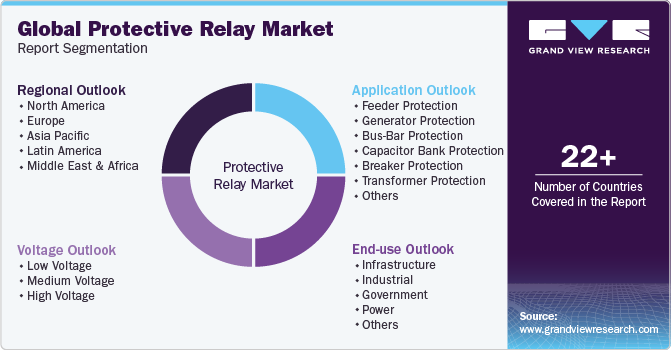
This report forecasts revenue growth at the global, regional, and country levels and provides an analysis of the latest industry trends and opportunities in each of the sub-segments from 2021 to 2033. For this study, Grand View Research has segmented the global protective relay market report based on voltage, application, end use, and region:
-
Voltage Outlook (Revenue, USD Billion, 2021 - 2033)
-
Low Voltage
-
Medium Voltage
-
High Voltage
-
-
Application Outlook (Revenue, USD Billion, 2021 - 2033)
-
Feeder Protection
-
Generator Protection
-
Bus-Bar Protection
-
Capacitor Bank Protection
-
Breaker Protection
-
Transformer Protection
-
Others
-
-
End-use Outlook (Revenue, USD Billion, 2021 - 2033)
-
Infrastructure
-
Industrial
-
Government
-
Power
-
Others
-
-
Regional Outlook (Revenue, USD Billion, 2021 - 2033)
-
North America
-
U.S.
-
Canada
-
-
Europe
-
Germany
-
France
-
UK
-
-
Asia Pacific
-
China
-
India
-
Japan
-
South Korea
-
Australia
-
-
Latin America
-
Brazil
-
Mexico
-
-
Middle East & Africa
-
South Africa
-
Saudi Arabia
-
UAE
-
-
Frequently Asked Questions About This Report
Some key players operating in the protective relay market include ABB Ltd., Doble Engineering Company, Eaton Corporation Plc, Schweitzer Engineering Laboratories, Inc., General Electric, Mitsubishi Electric Corp., and Schneider Electric among others.
Key factors that are driving the market growth include the upsurge in power & infrastructure projects in Asia Pacific coupled with rising investments in the transmission & distribution networks across the globe.
The protective relay market size was estimated at USD 3,222.9 million in 2022 and is expected to reach USD 3.41 billion in 2023.
The protective relay market is expected to grow at a compound annual growth rate of 5.2% from 2023 to 2030 to reach USD 5.09 billion by 2030.
Asia Pacific dominated the protective relay market with a share of 30.9% in 2022. This is attributable to increasing funding in renewable sector coupled with the modernization of grid infrastructure.
About the Author(s)
Advanced Interior Materials Research Team
Advanced Materials · Advanced Interior MaterialsThis report was authored by the advanced interior materials research team at Grand View Research - comprising two research analysts, one senior research analyst, and one industry expert - with specialized expertise in the advanced interior materials segment of the advanced materials industry. All findings are based on proprietary advanced materials databases, executive interviews, and regulatory analysis, subject to internal peer review prior to publication.
Last Updated:
Speak to Analyst

Need a Tailored Report?
Customize this report to your needs — add regions, segments, or data points, with 20% free customization.
Or view our licence options:


ISO 9001:2015 & 27001:2022 Certified
We are GDPR and CCPA compliant! Your transaction & personal information is safe and secure. For more details, please read our privacy policy.












