
- Home
- »
- Advanced Interior Materials
- »
-
Protective Textile Fibers Market Size And Share Report, 2033GVR Report cover

Protective Textile Fibers Market (2026 - 2033)
Size, Share & Trends Analysis Report By Fiber Type (Aramid, Polyolefin, Polyamide, Polyester), By Product (Staple Fibers, Filament Fibers), By End Use (Industrial, Oil & Gas), By Region, And Segment Forecasts
Market Size, 2025
$4.1BMarket Estimate, 2026
$4.4BMarket Forecast, 2033
$6.7BCAGR, 2026–2033
6.3%Protective Textile Fibers Market Summary
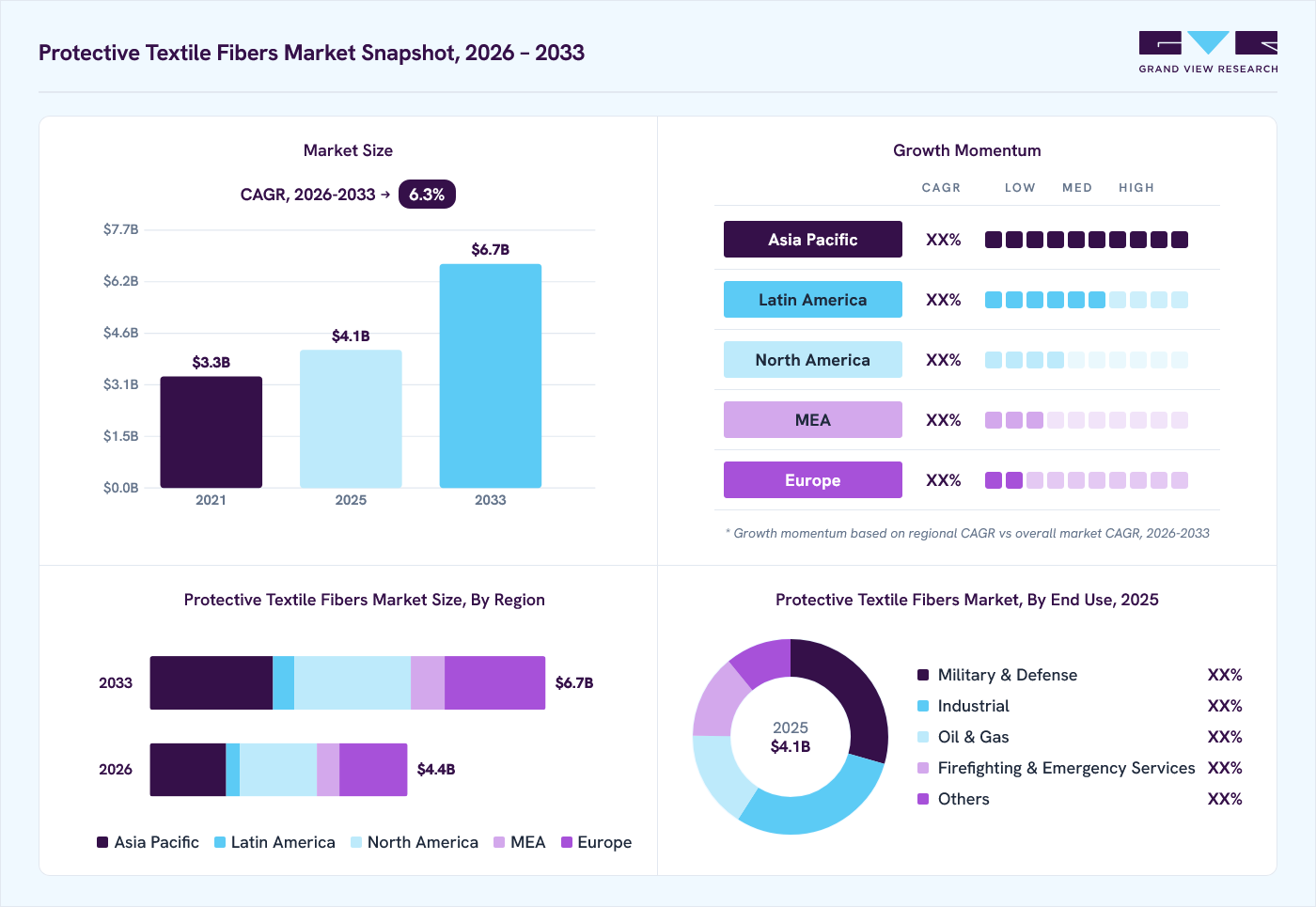
The global protective textile fibers market size was valued at USD 4.1 billion in 2025 and is projected to grow from USD 4.4 billion in 2026 to USD 6.7 billion by 2033, at a CAGR of 6.3% from 2026 to 2033. North America dominated the market, accounting for the largest revenue share of 29.9% in 2025. The market is expanding as industries increasingly require high-performance fibers that provide protection against heat, flames, cuts, abrasion, chemicals, and other workplace hazards.
 Source: Grand View Research, IR Documents, Primary Interviews, Paid DatabasesTo learn more about this report,
 Download Free Sample Report
 Key Market Trends & Insights
- By product: Filament fibers segment is expected to grow at a CAGR of 6.7% over the forecast period.
- By end use: Industrial segment dominated the market with a revenue share of 29.5% in 2025.
- By fiber type: Polyolefin segment is projected to register a CAGR of 7.1% during the forecast period from 2026 to 2033.
Regional Highlights
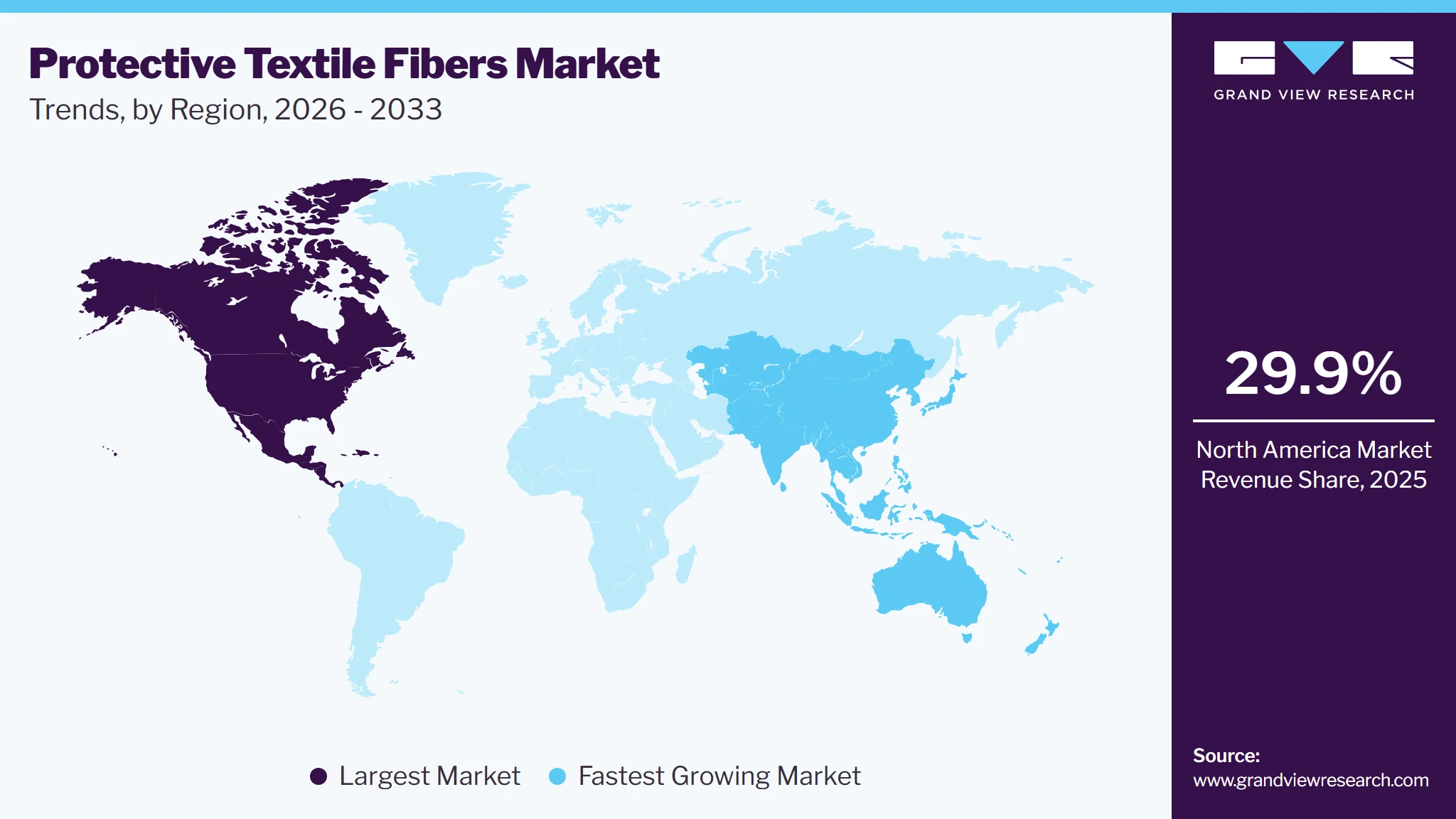
- Largest regional market: North America (29.9% revenue share, 2025)
- Fastest-growing regional market: Asia Pacific (highest CAGR, 2026-2033)
- By country: The U.S. held the largest market share in 2025
Market Size & Forecast
- Market size in 2025: USD 4.1 Billion
- Estimated market size in 2026: USD 4.4 Billion
- Projected market size by 2033: USD 6.7 Billion
- CAGR (2026-2033): 6.3%
Three ways to get this report
Buy it, customize it, or ask a question.Ask an Analyst
A direct answer, usually in 1 working day
- AccessReport author, directly
- Reply timeWithin 1 working day
- No sales callDirect answer only
- FormatEmail reply
- CostFree, no cost
Get the Full Report
What the study covers
- FormatsPDF · Excel · Dashboard
- Timeline2026–2033 annual, 2025 base
- Coverage20+ countries, 5 regions
- Companies10+ key players profiled
Customize the Report
20% free customization
- IncludeCountries, segments, points
- TailorTo your product definition
- ExtendDeeper competitor detail
- OrA fully bespoke study
- Turnaround5–10 working days
The market demand is supported by the growing use of protective clothing and technical textiles across military and defense, industrial, oil and gas, firefighting, construction, healthcare, and transportation applications. The increasing emphasis on worker safety and the need for lightweight and durable protective solutions are further supporting market growth.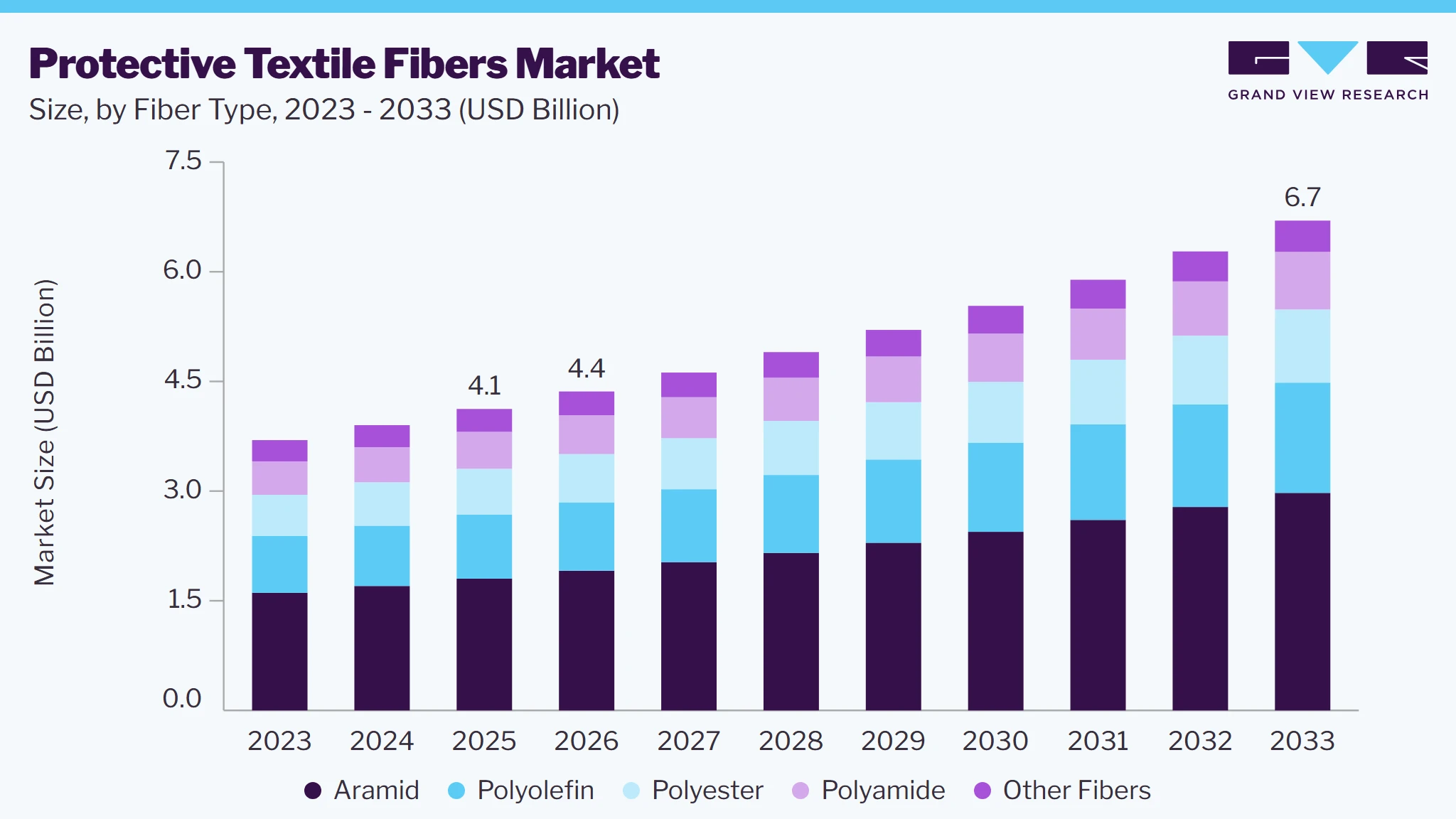 To learn more about this report, Download Free Sample Report
 Stringent occupational safety requirements and increasing awareness of workplace protection are driving the adoption of specialized protective fibers. Industries operating in high-risk environments are increasingly shifting toward advanced fiber materials that provide enhanced protection while maintaining flexibility, comfort, and durability. The growing deployment of protective workwear in industrial and emergency-response applications is also contributing to demand for high-performance fibers.
Technological advancements are resulting in the development of high-strength, heat-resistant, lightweight, and multifunctional fibers. Manufacturers are increasingly focusing on advanced fiber blends, nanotechnology-enabled materials, bio-based fibers, and recycling technologies to improve protective performance and reduce environmental impact. The development of fibers offering multiple protection properties within a single material is also emerging as an important trend in the market.
Market Dynamics
The market is influenced by increasing workplace safety requirements, growing demand for high-performance protective clothing, advancements in fiber technology, sustainability initiatives, and the expansion of high-risk industrial applications. At the same time, high production costs, complex manufacturing processes, and the availability of alternative protective materials can affect market growth.
The increasing need for protection against multiple workplace hazards is driving demand for high-performance textile fibers. Industries such as oil and gas, construction, metal processing, firefighting, and defense require materials capable of providing protection against heat, flames, cuts, abrasion, chemicals, and other hazards. This is increasing the adoption of specialized fibers such as aramid, polyolefin, modacrylic, and other high-performance materials.
The growing focus on worker safety is also encouraging industries to replace conventional textile materials with advanced fibers that offer improved protection without significantly increasing garment weight. Demand for lightweight, durable, and multifunctional protective materials is supporting the development of advanced fiber technologies and expanding their use across multiple end-use industries.
High-performance protective fibers generally require specialized raw materials, manufacturing processes, and technical expertise, resulting in higher production costs compared with conventional textile fibers. The high cost of advanced fibers can increase the overall price of protective garments and textiles, particularly in price-sensitive markets and applications.
Complex processing requirements and the need to meet stringent performance and certification standards can further increase manufacturing costs. These factors may limit adoption among smaller industrial users and manufacturers that have limited budgets for advanced protective textile solutions.
The increasing focus on sustainability is creating opportunities for manufacturers to develop bio-based, recyclable, and lower-impact protective fibers. Growing efforts to reduce textile waste and improve material circularity are encouraging investment in fiber recycling technologies and sustainable raw materials while maintaining the required protective performance.
The development of multifunctional fibers also provides significant opportunities for market participants. Fibers that combine properties such as flame resistance, cut resistance, chemical resistance, and thermal protection can reduce material requirements and improve the performance of protective textiles. Increasing demand for lightweight and multifunctional protective workwear is expected to support innovation in this area.
Market Concentration & Characteristics
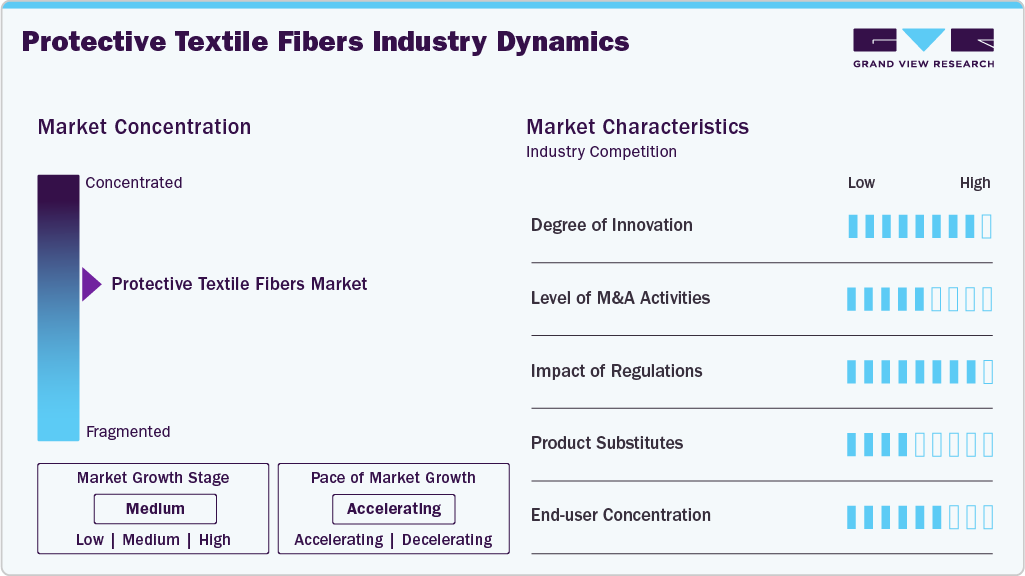
The protective textile fibers industry is characterized by the presence of established manufacturers with specialized fiber technologies, extensive product portfolios, and strong relationships with protective textile manufacturers and industrial customers. Leading companies compete through product innovation, performance enhancement, application-specific fiber development, and expansion of production capabilities.
Market concentration varies across fiber categories, with certain high-performance fiber segments dominated by specialized manufacturers with proprietary technologies and established certifications. Companies are increasingly investing in new fiber grades, sustainable materials, strategic partnerships, and geographic expansion to strengthen their market position.
 To learn more about this report, Download Free Sample Report
 Protective textile fibers face substitution from alternative materials and technologies that provide similar protective functions. These include protective coatings, films, laminates, nonwoven materials, and composite structures used in applications requiring thermal, chemical, mechanical, or flame protection.
However, the degree of substitution varies by application because fiber-based solutions can provide a combination of protection, flexibility, breathability, durability, and comfort. The availability of application-specific alternatives may nevertheless influence material selection, particularly where cost, weight, or specific performance requirements are more important than fiber-based construction.
Analyst Perspective
The market is expected to remain driven by the need for reliable protection in hazardous working environments, with occupational safety requirements providing a fundamental source of demand. Market development is increasingly moving beyond basic protection toward lightweight, multifunctional, durable, and comfortable fiber solutions that can address several hazards simultaneously. Innovation in high-performance fibers, fiber blends, sustainable materials, and recycling technologies will shape product development, while material costs and stringent performance requirements will continue to influence adoption. Demand is expected to remain particularly relevant across industrial manufacturing, energy, construction, defense, firefighting, chemicals, and other applications where protective performance is critical.
Fiber Type Insights
The aramid segment held the highest revenue share of 43.7% in 2025, supported by its high strength-to-weight ratio, excellent heat and flame resistance, and strong mechanical performance. These properties make aramid fibers widely used in protective clothing, firefighting apparel, military and defense equipment, industrial workwear, and other applications requiring reliable protection under demanding conditions.
The polyolefin segment is expected to grow at a CAGR of 7.1% over the forecast period, as demand increases for lightweight, high-strength protective fibers offering chemical resistance, impact protection, and a favorable strength-to-weight ratio. Growing use of ultra-high-molecular-weight polyethylene (UHMWPE) fibers in ballistic protection, cut-resistant products, industrial safety equipment, and advanced protective textiles is expected to support segment expansion.
Product Insights
The staple fibers segment held the highest revenue share of 65.1% in 2025, driven by its broad use in spun yarns, blended fabrics, nonwoven structures, and protective garments. Staple fibers can be blended with other high-performance materials to achieve targeted combinations of strength, thermal protection, abrasion resistance, comfort, and durability, supporting their adoption across industrial and protective textile applications.
The filament fibers segment is expected to grow at a CAGR of 6.7% over the forecast period, due to increasing demand for continuous, high-strength fibers in advanced protective textile structures. Their use in woven, knitted, braided, and composite textile constructions enables manufacturers to develop lightweight and durable products with enhanced mechanical, thermal, and abrasion resistance for applications requiring high-performance protection.
End Use Insights
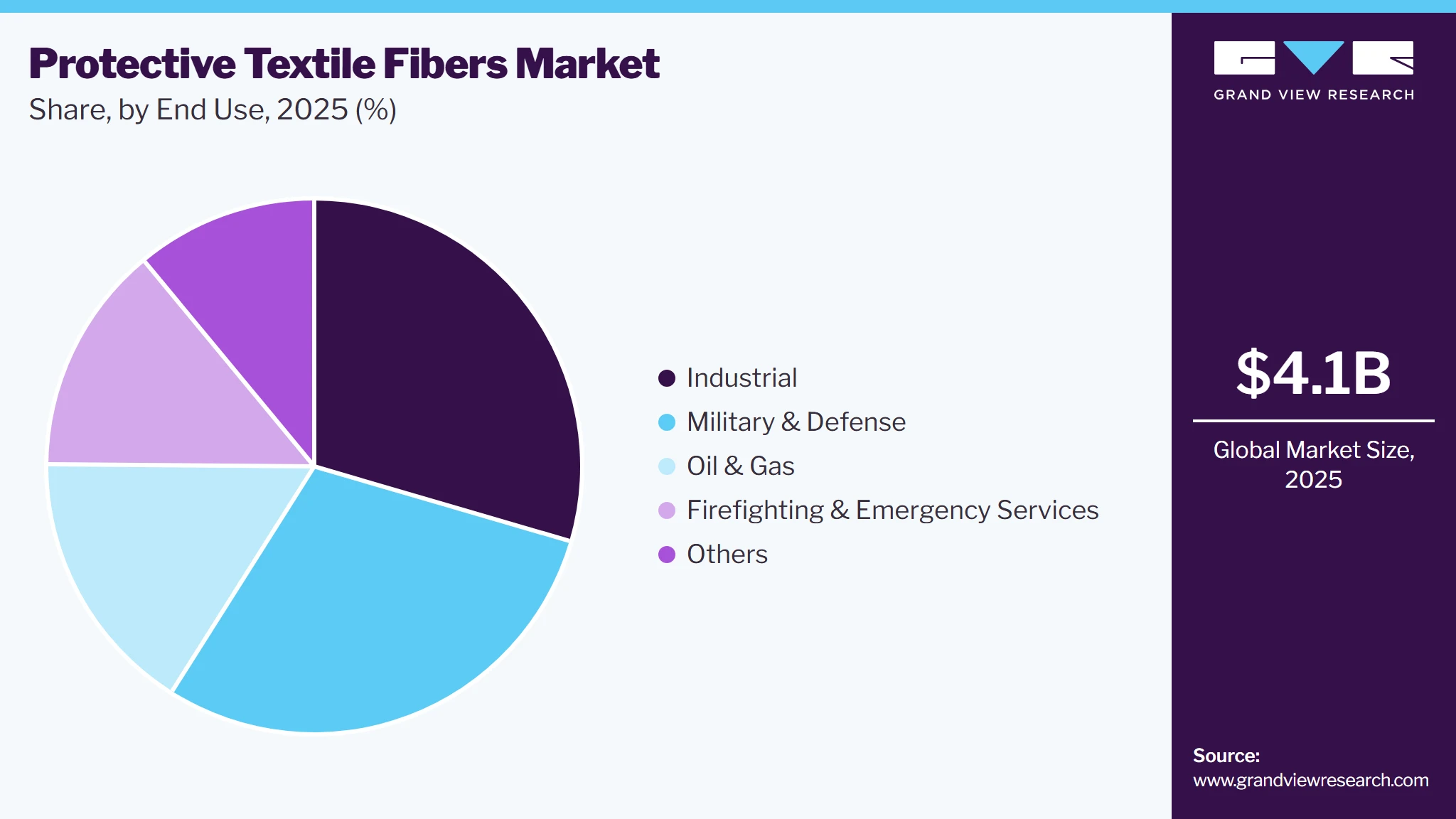
The industrial segment held the highest revenue market share of 29.5% in 2025, supported by extensive demand for protective fibers in manufacturing, construction, chemicals, utilities, mining, and other hazardous working environments. Increasing workplace safety requirements and the need for protection against heat, flame, cuts, abrasion, chemicals, and mechanical hazards continue to drive the use of high-performance protective fibers in industrial workwear and technical textiles.
 To learn more about this report, Download Free Sample Report
 The military & defense segment is expected to grow at a CAGR of 7.4% over the forecast period, as defense organizations increase demand for lightweight and high-performance protective materials for uniforms, ballistic protection, combat equipment, and specialized protective gear. The development of advanced aramid, UHMWPE, and multifunctional fibers with improved strength, ballistic resistance, flame resistance, and weight reduction is supporting their adoption in modern defense applications.
Regional Insights
North America dominated the global protective textile fibers market and accounted for the largest revenue share of 29.9% in 2025, due to established occupational safety practices and extensive applications across oil and gas, chemicals, manufacturing, utilities, construction, firefighting, defense, and law enforcement. The region has a significant demand for advanced aramid and other high-performance fibers used where thermal, flame, cut, ballistic, and mechanical protection is required. Continued emphasis on worker safety, performance standards, and high-value industrial applications supports demand for specialized protective fiber solutions.
 To learn more about this report, Download Free Sample Report
 U.S. Protective Textile Fibers Market Trends
The protective textile fibers market in the U.S. represents a major market within North America, supported by its large industrial, energy, construction, defense, and emergency-response sectors. Demand for protective textile fibers is closely associated with workplace safety requirements and the need for specialized protective apparel in hazardous environments. The market also benefits from demand for high-performance materials that provide multiple protection properties while maintaining lower weight and improved mobility.
Asia Pacific Protective Textile Fibers Market Trends
The protective textile fibers market in the Asia Pacific has a strong demand for protective textile fibers due to its large manufacturing base, expanding construction activity, growing energy infrastructure, and increasing emphasis on industrial worker safety. China, Japan, South Korea, India, and Southeast Asian economies support demand through manufacturing, automotive, chemicals, electronics, construction, and energy-related applications. Growing industrialization and improving workplace safety practices are expected to support the adoption of higher-performance protective fibers, particularly in applications requiring enhanced thermal, mechanical, and chemical protection.
China protective textile fibers market is significant for protective textile fibers due to its extensive manufacturing, construction, chemical, energy, and industrial sectors. Demand is supported by the country's large industrial workforce and the increasing adoption of occupational safety equipment. Domestic production capabilities across synthetic and high-performance fibers also support the development of protective textile supply chains. Demand is increasingly influenced by requirements for higher-performance materials, industrial safety compliance, durability, and improved worker comfort.
Europe Protective Textile Fibers Market Trends
The protective textile fibers market in Europe is well-developed, supported by stringent occupational safety requirements, established industrial manufacturing, and demand for high-performance workwear. Germany, France, Italy, the UK, and other European economies have applications across chemicals, automotive, manufacturing, construction, energy, firefighting, and defense. Sustainability is becoming increasingly important, encouraging manufacturers and users to consider fiber durability, material efficiency, recycling, and lower-impact production alongside conventional performance requirements.
The protective textile fibers market in Germany is an important European market due to its strong manufacturing, automotive, chemicals, engineering, construction, and industrial equipment sectors. The country's industrial structure generates demand for protective workwear capable of addressing thermal, mechanical, chemical, and other occupational hazards. Demand is also supported by the adoption of advanced technical textiles and increasing interest in lightweight, durable, and sustainable protective textile solutions.
Central and South America Protective Textile Fibers Market Trends
The protective textile fibers market in CSA represents an emerging market, supported by mining, oil and gas, construction, agriculture, manufacturing, and energy activities. Brazil is a key demand center because of its large industrial and resource-based economy. Market development is influenced by industrial safety requirements, economic conditions, availability of specialized protective products, and the gradual adoption of higher-performance workwear across hazardous occupations.
Middle East & Africa Protective Textile Fibers Market Trends
The protective textile fibers market in MEA is supported by oil and gas, petrochemicals, construction, mining, utilities, and infrastructure development. The hazardous operating conditions associated with several of these industries create demand for protective textiles with high thermal, flame, chemical, and mechanical resistance. Infrastructure investments and industrial diversification across Gulf economies are also expanding the application base for advanced protective textile fibers.
Key Protective Textile Fibers Company Insights
Some of the key players operating in the market include Teijin Aramid and DuPont.
-
Teijin Aramid is a high-performance fiber manufacturer specializing in aramid fibers, including Twaron, Technora, and Teijinconex. Its fibers are used across protective textiles, firefighting, industrial safety, automotive, and defense applications.
-
DuPont is a diversified specialty materials company and a major manufacturer of Kevlar and Nomex fibers. Its high-performance fibers are widely used for thermal, flame, cut, abrasion, and ballistic protection across industrial, defense, firefighting, and other demanding applications.
PBI Performance Products and Toyobo are some of the emerging market participants.
-
PBI Performance Products specializes in PBI high-performance fibers designed for extreme-temperature and flame-resistant applications. Its fibers are primarily used in firefighting, industrial protective clothing, military, and other applications requiring high thermal and flame protection.
-
Toyobo is a Japanese specialty materials manufacturer with expertise in high-performance fibers, including Zylon PBO fiber. Its advanced fibers are used in protective, ballistic, industrial, and other applications requiring high strength, heat resistance, and lightweight performance.
Key Protective Textile Fibers Companies
The following key companies have been profiled for this study on the protective textile fibers market:
-
Teijin Aramid
-
DuPont
-
Avient
-
Honeywell
-
Kolon Industries
-
Hyosung Advanced Materials
-
Toyobo
-
PBI Performance Products
-
Huvis
-
Sinochem International
Competitive Benchmarking
Category
Operating Strategies
Competitive Edge
Weakness
Established Players: Teijin Aramid, DuPont, Avient, Honeywell, Kolon Industries, Hyosung Advanced Materials
- Invest in advanced aramid, UHMWPE, and high-performance fiber technologies to enhance strength, thermal resistance, flame resistance, cut resistance, and ballistic protection.
- Expand production capacity, geographic presence, and fiber portfolios to serve military & defense, industrial, oil & gas, firefighting, and other protective applications.
- Develop application-specific fiber grades and strengthen partnerships with protective textile manufacturers, defense contractors, and industrial garment producers.
- Established manufacturing infrastructure and extensive technical expertise support consistent production of high-performance protective fibers.
- Broad portfolios across aramid, UHMWPE, and specialty fibers enable participation across multiple protective textile applications.
- Strong R&D capabilities, customer relationships, quality systems, and global distribution networks support adoption in demanding protective applications.
- High capital requirements for specialized fiber manufacturing, R&D, quality systems, and capacity expansion.
- Stringent performance requirements and customer qualification processes can lengthen product development and commercialization cycles.
- Higher costs of advanced protective fibers can limit adoption in price-sensitive applications compared with conventional textile fibers.
Emerging & Specialized Players: Toyobo, PBI Performance Products, Huvis, Sinochem International
- Focus on specialized high-performance fibers for firefighting, defense, industrial workwear, ballistic protection, and other demanding applications.
- Expand market presence through partnerships with protective textile manufacturers, defense suppliers, industrial garment producers, and distributors.
- Prioritize fiber innovation, lightweight construction, material optimization, and customized solutions for specialized protective requirements.
- Specialized product portfolios enable focus on targeted high-performance protective textile applications.
- Technical capabilities support differentiation through thermal resistance, flame resistance, strength, lightweight construction, and ballistic performance.
- A greater focus on selected fiber technologies provides flexibility to develop customized solutions for specialized customer requirements.
- Relatively smaller scale and narrower product portfolios compared with leading global high-performance fiber manufacturers.
- Greater dependence on selected protective textile applications can limit diversification across end-use industries.
- Limited scale in certain markets can result in higher production costs and constrain price competitiveness.
Recent Developments
-
In June 2026, Teijin Aramid formally launched Twaron Next, a more sustainable para-aramid fiber incorporating circular and/or bio-based feedstocks while maintaining the performance of standard Twaron. The circular-content variant can reduce CO₂ emissions by up to 7% versus virgin Twaron, according to the company.
-
In August 2025, DuPont announced an agreement to sell its Aramids business, including Kevlar and Nomex, to Arclin for approximately $1.8 billion.
Protective Textile Fibers Market Report Scope
Report Attribute
Details
Market size in 2025
USD 4.1 billion
Estimated market size in 2026
USD 4.4 billion
Projected market size in 2033
USD 6.7 billion
Growth Rate
CAGR of 6.3% from 2026 to 2033
Actual data
2021 - 2025
Forecast period
2026 - 2033
Quantitative units
Revenue in USD billion and CAGR from 2026 to 2033
Report coverage
Revenue forecast, company ranking, competitive landscape, growth factors, and trends
Segments covered
Fiber type, product, end use, region
Regional scope
North America; Asia Pacific; Europe; CSA; MEA
Country scope
U.S.; Canada; Mexico; Germany; UK; France; Italy; Spain; China; Japan; India; South Korea; Brazil; Saudi Arabia
Key companies profiled
Teijin Aramid; DuPont; Avient; Honeywell; Kolon Industries; Hyosung Advanced Materials; Toyobo; PBI Performance Products; Huvis; Sinochem International
Customization scope
Free report customization (equivalent up to 8 analysts working days) with purchase. Addition or alteration to country, regional & segment scope.
Pricing and purchase options
Avail customized purchase options to meet your exact research needs. Explore purchase options
Global Protective Textile Fibers Market Report Segmentation
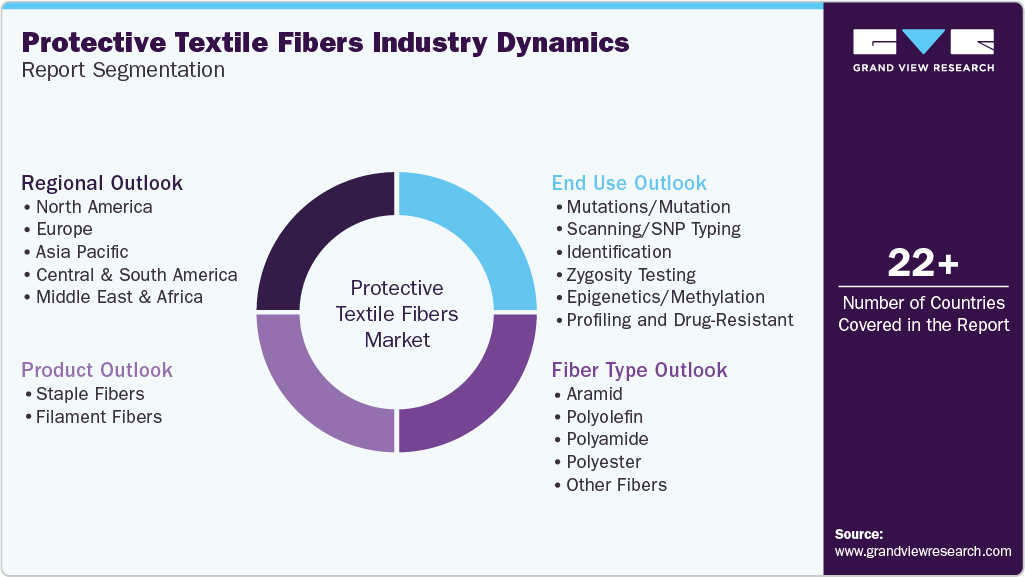
This report forecasts revenue growth at the regional & country levels and provides an analysis of the industry trends in each of the sub-segments from 2021 to 2033. For this study, Grand View Research has segmented the global protective textile fibers market report based on fiber type, product, end use, and region:
 To learn more about this report, Download Free Sample Report
 -
Fiber Type Outlook (Revenue, USD Billion; 2021 - 2033)
-
Aramid
-
Polyolefin
-
Polyamide
-
Polyester
-
Other Fibers
-
-
Product Outlook (Revenue, USD Billion; 2021 - 2033)
-
Staple Fibers
-
Filament Fibers
-
-
End Use Outlook (Revenue, USD Billion; 2021 - 2033)
-
Military & Defense
-
Industrial
-
Oil & Gas
-
Firefighting & Emergency Services
-
Other Industries
-
-
Regional Outlook (Revenue, USD Billion; 2021 - 2033)
-
North America
-
U.S.
-
Canada
-
Mexico
-
-
Europe
-
UK
-
Germany
-
France
-
Italy
-
Spain
-
-
Asia Pacific
-
China
-
Japan
-
India
-
South Korea
-
-
Central and South America
-
Brazil
-
-
Middle East and Africa
-
Saudi Arabia
-
-
Research Methodology
The protective textile fibers market figures in this report are based on a proven research process that combines executive interviews with secondary research from proprietary databases, company filings, and recognized regulatory and institutional sources. Market size is built through value-chain sizing-reconciling supply-side and demand-side estimates-and triangulated with bottom-up and top-down approaches. Every estimate passes multiple levels of expert validation before publication, with each protective textile fibers segment quantified using the revenue-capture definitions in the table below.
Segment Definition
Segment - Fiber Type
Revenue Capture Definition
Aramid
Revenue generated from the sale of aramid protective textile fibers used in protective clothing, firefighting apparel, military and defense equipment, industrial workwear, and other applications requiring high strength, heat resistance, flame resistance, and mechanical protection.
Polyolefin
Revenue generated from the sale of polyolefin protective textile fibers used in protective clothing, industrial textiles, ballistic protection, and other applications requiring lightweight construction, high strength-to-weight ratios, chemical resistance, and impact protection.
Polyamide
Revenue generated from the sale of polyamide protective textile fibers used in industrial workwear, protective clothing, cut-resistant textiles, abrasion-resistant products, and other applications requiring strength, flexibility, durability, and mechanical protection.
Polyester
Revenue generated from the sale of polyester protective textile fibers used in industrial workwear, protective apparel, high-visibility textiles, and other applications requiring durability, abrasion resistance, dimensional stability, moisture management, and cost-effective protection.
Other Fibers
Revenue generated from the sale of other protective textile fibers, including specialty, natural, regenerated, and high-performance fibers, used in protective clothing and technical textile applications requiring specialized thermal, chemical, mechanical, or environmental protection properties.
Segment - Product
Revenue Capture Definition
Staple Fibers
Revenue generated from the sale of protective textile staple fibers used in spun yarns, blended fabrics, nonwoven materials, and other textile structures for protective clothing and technical applications requiring strength, durability, thermal protection, abrasion resistance, or other protective properties.
Filament Fibers
Revenue generated from the sale of protective textile filament fibers used in woven, knitted, braided, and other continuous-filament textile structures for applications requiring high strength, durability, flexibility, thermal resistance, and specialized protective performance.
Segment - End Use
Revenue Capture Definition
Military & Defense
Revenue generated from the sale of protective textile fibers used in military uniforms, ballistic protection, combat equipment, protective gear, and other defense applications requiring high strength, flame resistance, cut resistance, abrasion resistance, and ballistic or mechanical protection.
Industrial
Revenue generated from the sale of protective textile fibers used in industrial workwear, protective garments, gloves, technical textiles, and other industrial applications requiring resistance to heat, flames, cuts, abrasion, chemicals, and mechanical hazards.
Oil & Gas
Revenue generated from the sale of protective textile fibers used in flame-resistant workwear, protective garments, gloves, and other safety equipment for oil and gas operations requiring protection against heat, flames, chemicals, sparks, and other hazardous working conditions.
Firefighting & Emergency Services
Revenue generated from the sale of protective textile fibers used in firefighter clothing, emergency-response apparel, rescue equipment, and other protective applications requiring high thermal resistance, flame resistance, heat protection, durability, and mechanical protection.
Other Industries
Revenue generated from the sale of protective textile fibers used across other industries, including construction, automotive, utilities, mining, chemicals, transportation, and other applications requiring specialized protection against thermal, mechanical, chemical, electrical, or environmental hazards.
Estimation Model
Layer Name
Key Question
Description
Parent Market Analysis
What is the overall size and growth outlook of the global protective textiles, technical textiles, high-performance fibers, and specialty fiber markets?
The estimation begins with the broader protective textiles, technical textiles, high-performance fibers, and specialty materials markets. Production, consumption, industrial activity, workplace safety requirements, and application development are assessed to establish the addressable market for protective textile fibers.
Protective Fiber Penetration Analysis
What proportion of the broader high-performance fiber and technical textile market is represented by protective textile fibers across different fiber types and protection requirements?
This layer estimates the penetration of protective textile fibers across aramid, polyolefin, polyamide, polyester, natural, regenerated, and other fiber types, considering their material properties, production, protection performance, and adoption. Penetration is further assessed across thermal & flame protection, cut & abrasion protection, chemical protection, electrical protection, ballistic protection, and mechanical protection.
Regional & End-use Demand Assessment
Which regions, fiber types, protection requirements, and end-use industries contribute the highest demand for protective textile fibers?
Demand is assessed across major regions based on industrial activity, workplace safety requirements, manufacturing output, construction activity, energy production, hazardous-environment employment, and regulatory standards. End use-level demand is evaluated across industrial manufacturing, construction, oil & gas, chemicals, firefighting, defense & military, automotive, utilities, mining, and other applications.
Company Revenue Validation & Market Forecasting
How is the final market size validated and forecast across fiber types, protection requirements, regions, and end-use industries?
Final estimates are validated using company revenues, production capacities, product portfolios, manufacturing facilities, investments, capacity expansions, technological developments, and application-specific developments. Bottom-up and top-down approaches are triangulated across company, fiber type, protection requirement, regional, and end use data to generate market estimates and forecasts.
Delivered Customizations
This report has been delivered with the following In-depth customizations
Client Request
Customization Delivered
Value Adds
Technology & Product Innovation Assessment
Evaluate key technologies and product developments across high-performance fiber engineering, fiber blending, multifunctional fibers, lightweight protective fibers, advanced coatings and finishes, and smart protective textiles based on protection performance, durability, weight reduction, comfort, manufacturing complexity, and commercial adoption.
Helps identify emerging technologies, innovation trends, technology gaps, and product-development opportunities while highlighting areas with potential for higher-performance, multifunctional, lightweight, and next-generation protective fiber solutions.
Protection Performance & Application Assessment
Assess protective textile fiber requirements across thermal & flame protection, cut & abrasion protection, chemical protection, electrical protection, ballistic protection, and mechanical protection based on hazard exposure, performance requirements, applicable standards, product adoption, and end-use suitability.
Provides visibility into major protection requirements and application areas while identifying opportunities for specialized fiber development, performance enhancement, product differentiation, and expansion into high-value protective applications.
Competitive Landscape & Capacity Benchmarking
Benchmark key protective textile fiber manufacturers based on production capacity, fiber portfolio, manufacturing footprint, technology capabilities, protective application coverage, geographic presence, partnerships, investments, and capacity expansion plans.
Provides a clear view of competitive positioning, market concentration, production capabilities, leading players, strategic strengths, and potential gaps for new investments, partnerships, product development, or market entry.
About the Author(s)
Advanced Interior Materials Research Team
Advanced Materials · Advanced Interior MaterialsThis report was authored by the advanced interior materials research team at Grand View Research - comprising two research analysts, one senior research analyst, and one industry expert - with specialized expertise in the advanced interior materials segment of the advanced materials industry. All findings are based on proprietary advanced materials databases, executive interviews, and regulatory analysis, subject to internal peer review prior to publication.
Last Updated:
Speak to Analyst

Customize this report to your needs - add regions, segments, or data points, with 20% free customization.
Or view our licence options:


ISO 9001:2015 & 27001:2022 Certified
We are GDPR and CCPA compliant! Your transaction & personal information is safe and secure. For more details, please read our privacy policy.


