Psoriatic Arthritis Treatment Market Summary
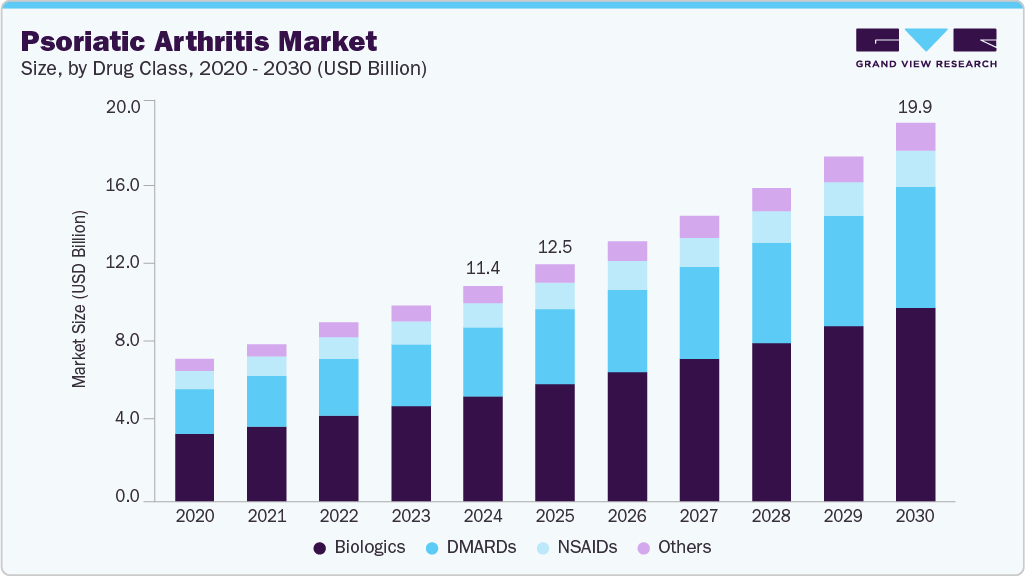
The global psoriatic arthritis market size was estimated at USD 11.35 billion in 2024 and is projected to reach USD 19.91 billion by 2030, growing at a CAGR of 9.8% from 2025 to 2030. The new product launches, promising pipeline, a significant rise in consumer awareness, and increasing disease burden are some factors expected to fuel market growth.
Key Market Trends & Insights
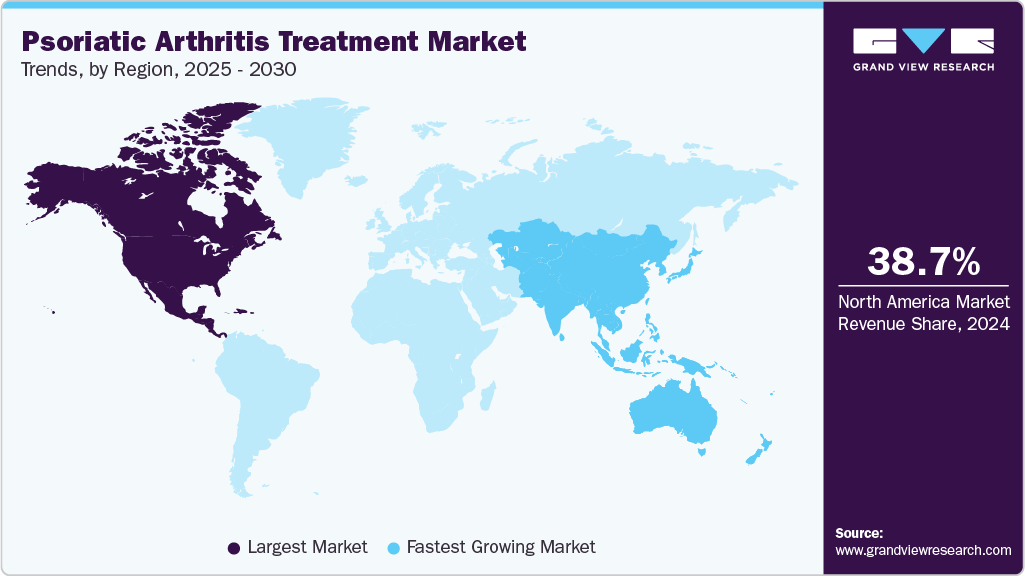
- North America psoriatic arthritis treatment dominated the global market and accounted for a revenue share of 38.7% in 2024.
- The U.S. psoriatic arthritis treatment industry is expected to grow significantly over the forecast period.
- By drug class, biologics segment dominated the psoriatic arthritis industry and accounted for a revenue share of 49.1% in 2024.
- By type, prescriptions segment dominated the market, accounting for a revenue share of 81.1% in 2024.
- By route of administration, injectables segment dominated the market and accounted for a revenue share of 51.1% in 2024.
Market Size & Forecast
- 2024 Market Size: USD 11.35 billion
- 2030 Projected Market Size: USD 19.91 billion
- CAGR (2025-2030): 9.8%
- North America: Largest market in 2024
- Asia Pacific: Fastest growing market
Psoriatic arthritis is a chronic degenerative condition associated with psoriasis. In the absence of proper and timely treatment, the disease may lead to irreversible joint damage. Although the exact causative factors remain unknown, research suggests that nearly 40% of cases are attributable to genetic factors.
Psoriatic arthritis may be misdiagnosed as rheumatoid arthritis or gout. However, heightened consumer awareness, aided by multiple campaigns organized by private and public organizations, is likely to reduce the rates of misdiagnosis or incorrect treatment. In addition, the high cost of treatment and the adverse effects of some drugs are expected to restrain market growth.
There is a significant paradigm shift in the treatment of psoriatic arthritis, driven by the targeted action of biologics and the emergence of biosimilars. However, the consumer demand for cost-effective medicines with improved safety and efficacy profiles is likely to have a positive impact on market dynamics.
Healthcare infrastructure improvements and increased insurance coverage in emerging markets are also pivotal. Countries in Asia-Pacific and Latin America are witnessing rapid health system upgrades, enabling wider access to high-cost biologic therapies. As these markets mature, they present new opportunities for both multinational and domestic drug makers to tap into previously underserved populations.
Drug Class Insights
Biologics dominated the psoriatic arthritis industry and accounted for a revenue share of 49.1% in 2024 and is expected to grow at the fastest CAGR over the forecast period. Biologics have reshaped the treatment landscape by offering targeted approaches that significantly improve joint symptoms, skin lesions, and overall quality of life. Their ability to modulate specific immune pathways-like IL-17, IL-23, and TNF-makes them especially effective for patients who do not respond well to traditional DMARDs (Disease-Modifying Anti-Rheumatic Drugs). Their dominance also reflects the continued rollout of novel biologics with better safety profiles and longer dosing intervals, which enhance patient compliance.
The DMARDs segment is expected to grow significantly over the forecast period. The increasing global prevalence of psoriatic arthritis is prompting greater utilization of both conventional and targeted synthetic DMARDs. As diagnostic capabilities improve and awareness rises among healthcare professionals and patients alike, early-stage interventions with DMARDs are becoming more frequent and effective. The rising prominence of targeted synthetic DMARDs-such as Janus kinase (JAK) inhibitors and phosphodiesterase 4 (PDE4) inhibitors-further underscores this momentum. These agents offer significant therapeutic value with oral administration, rendering them more accessible and convenient compared to injectable biologics.
Type Insights
Prescriptions dominated the market, accounting for a revenue share of 81.1% in 2024, and are expected to grow at the fastest CAGR over the forecast period. This dominance reflects the chronic and complex nature of psoriatic arthritis, which often necessitates long-term, specialist-guided pharmacological interventions. The widespread use of biologics and targeted synthetic DMARDs-both requiring professional prescription and monitoring-further contributes to the elevated market share. These therapies are typically initiated and adjusted by rheumatologists, reinforcing the importance of prescription-based treatment pathways.
The OTC segment is expected to grow significantly over the forecast period, driven by an increasing emphasis on self-care and symptom management among patients with mild to moderate manifestations of psoriatic arthritis. As public awareness surrounding the disease and its treatment options improves, many individuals are turning to non-prescription alternatives-such as topical analgesics, anti-inflammatory creams, and supplements-for initial or adjunctive relief.
Route Of Administration Insights
Injectables dominated the market and accounted for a revenue share of 51.1% in 2024. Injectables are favored for their targeted mechanism of action and proven efficacy in controlling both joint and skin symptoms associated with psoriatic arthritis. Agents such as TNF inhibitors (e.g., adalimumab, etanercept) and IL-17/IL-23 inhibitors have become mainstays of treatment, especially in moderate-to-severe cases. Their long dosing intervals and robust clinical profiles contribute to high patient adherence and widespread physician confidence.
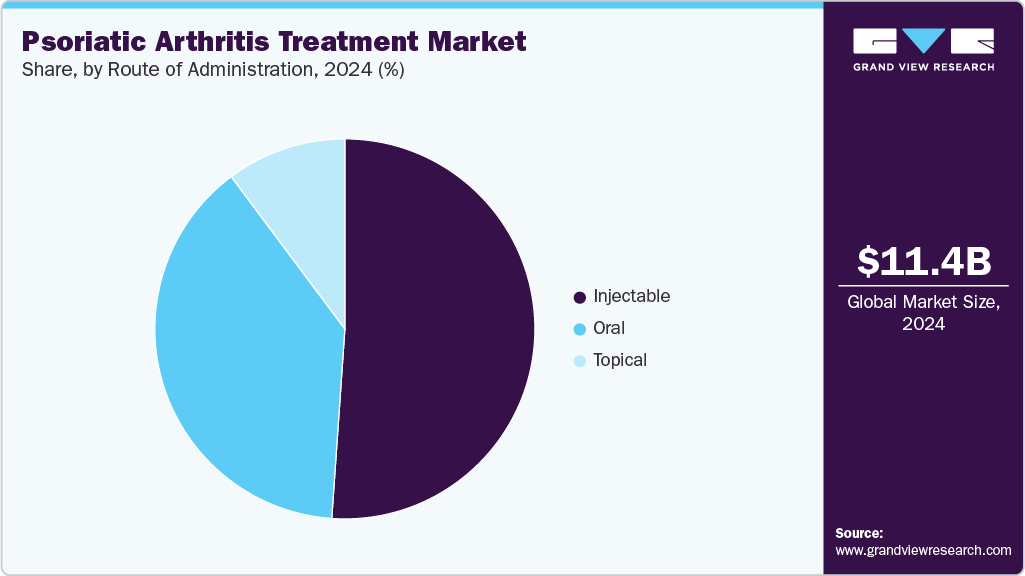
The oral segment is expected to grow significantly over the forecast period. The oral segment is gaining momentum due to their ease of administration, cost-efficiency, and strong efficacy profiles. Unlike biologics, which require injection or infusion, oral medications offer a high degree of patient convenience and adherence, especially for individuals seeking less invasive long-term treatment regimens. The growing availability of these agents-coupled with favorable safety data from recent clinical trials-is further enhancing their appeal among clinicians and patients alike.
Regional Insights
North America psoriatic arthritis treatment dominated the global market and accounted for a revenue share of 38.7% in 2024. The region's growth is attributed to its advanced healthcare infrastructure, high per capita healthcare expenditure, and strong presence of leading pharmaceutical manufacturers. The U.S., in particular, accounts for most regional market share due to widespread access to specialty care, comprehensive insurance coverage, and early adoption of biologics and novel targeted therapies. Furthermore, the region's robust regulatory and reimbursement framework propels this growth, facilitating the timely approval and commercialization of innovative treatment modalities.
U.S. Psoriatic Arthritis Treatment Market Trends
The U.S. psoriatic arthritis treatment industry is expected to grow significantly over the forecast period. This upward trajectory is driven by a combination of factors, including the high and rising prevalence of psoriatic arthritis, widespread accessibility to advanced biologic and targeted therapies, and a well-established healthcare infrastructure that supports early diagnosis and specialist-led care.
Europe Psoriatic Arthritis Treatment Market Trends
The European psoriatic arthritis treatment industry was identified as a lucrative region in 2024. The region's growth is driven by its robust healthcare infrastructure, widespread access to specialist care, and a high disease awareness level among patients and providers. Countries such as Germany, the U.K., and France have demonstrated particularly strong uptake of advanced therapies, including biologics and targeted synthetic DMARDs, supported by favorable reimbursement policies and national treatment guidelines.
Asia Pacific Psoriatic Arthritis Treatment Market Trends
Asia Pacific is expected to grow at the fastest CAGR of 10.9% over the forecast period.The region’s rapidly expanding population, coupled with increasing awareness and diagnosis of psoriatic arthritis, is driving demand for both advanced and accessible treatment options. Countries such as China, India, and Japan are witnessing rising healthcare investments, improved diagnostic infrastructure, and broader insurance coverage, all of which are enabling earlier intervention and sustained disease management.
Key Psoriatic Arthritis Treatment Company Insights
Some of the key companies in the psoriatic arthritis market include AbbVie Inc., Johnson & Johnson Services, Inc., Bristol-Myers Squibb Company, and others.
-
AbbVie is a leading biopharmaceutical company with a strong presence in the immunology space, particularly in the treatment of autoimmune diseases such as psoriatic arthritis. The company’s portfolio includes blockbuster therapies like Humira (adalimumab) and Skyrizi (risankizumab), both of which have demonstrated significant efficacy in managing joint and skin symptoms associated with psoriatic arthritis.
-
Johnson & Johnson, through its Janssen Pharmaceuticals division, is a key player in the psoriatic arthritis market with a diversified immunology portfolio. Its notable products include Stelara (ustekinumab) and Tremfya (guselkumab).
Key Psoriatic Arthritis Treatment Companies:
The following are the leading companies in the psoriatic arthritis treatment market. These companies collectively hold the largest market share and dictate industry trends.
- AbbVie Inc.
- Amgen Inc.
- Johnson & Johnson Services, Inc.
- Bristol-Myers Squibb Company
- Novartis AG
- Eli Lilly and Company
- Pfizer, Inc.
Recent Developments
-
In June 2025, FDA approved Celltrion’s Steqeyma biosimilar (ustekinumab-stba) in a new 45mg/0.5mL single-dose vial for pediatric patients (ages 6-17, <60kg) with plaque psoriasis or psoriatic arthritis. Approval followed strong phase 3 data confirming comparable safety and efficacy.
-
In May 2025, Biocon Biologics' partner Yoshindo launched Ustekinumab BS subcutaneous injection in Japan for psoriatic arthritis and psoriasis vulgaris after Japan’s Pharmaceuticals and PMDA approval of subcutaneous ustekinumab (Bmab 1200) in January 2025.
Psoriatic Arthritis Market Report Scope
|
Report Attribute
|
Details
|
|
Market size value in 2025
|
USD 12.46 billion
|
|
Revenue forecast in 2030
|
USD 19.91 billion
|
|
Growth Rate
|
CAGR of 9.8% from 2025 to 2030
|
|
Base year for estimation
|
2024
|
|
Historical data
|
2017 - 2023
|
|
Forecast period
|
2025 - 2030
|
|
Quantitative units
|
Revenue in USD million and CAGR from 2025 to 2030
|
|
Report coverage
|
Revenue forecast, company ranking, competitive landscape, growth factors, and trends
|
|
Segments covered
|
Drug class, type, route of administration, region
|
|
Key companies profiled
|
AbbVie Inc.; Amgen Inc.; Johnson & Johnson Services, Inc.; Bristol-Myers Squibb Company; Novartis AG; Eli Lilly and Company; Pfizer, Inc.
|
|
Customization scope
|
Free report customization (equivalent up to 8 analysts working days) with purchase. Addition or alteration to country, regional & segment scope.
|
|
Pricing and purchase options
|
Avail customized purchase options to meet your exact research needs. Explore purchase options
|
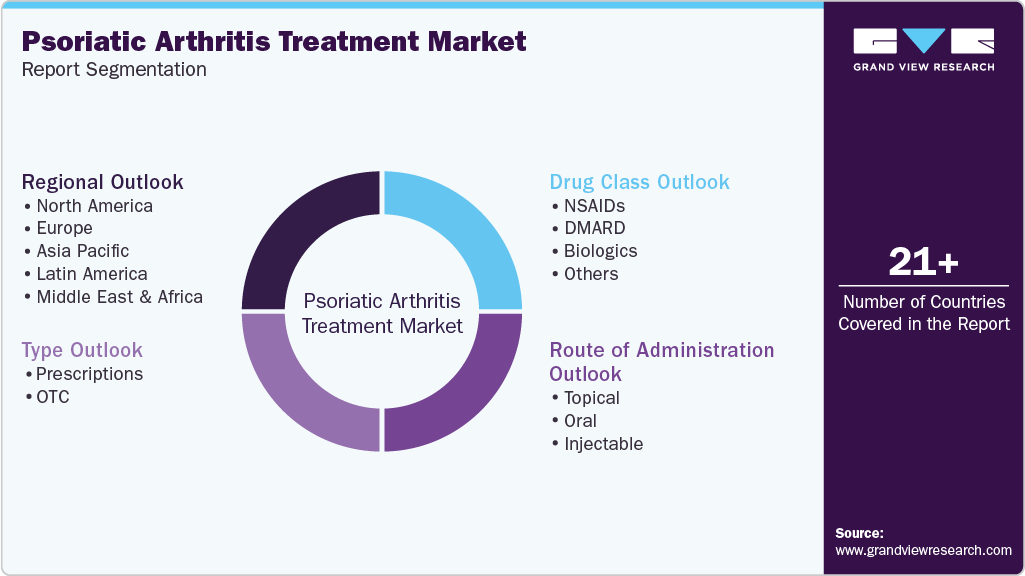
Global Psoriatic Arthritis Market Report Segmentation
This report forecasts revenue growth at global, regional, and country levels and provides an analysis of the latest industry trends in each of the sub-segments from 2018 to 2030. For this study, Grand View Research has segmented the global psoriatic arthritis market report based on drug class, type, route of administration, and region:
-
Drug Class Outlook (Revenue, USD Million, 2018 - 2030)
-
NSAIDs
-
DMARD
-
Biologics
-
Others
-
Type Outlook (Revenue, USD Million, 2018 - 2030)
-
Route of Administration Outlook (Revenue, USD Million, 2018 - 2030)
-
Regional Outlook (Revenue, USD Million, 2018 - 2026)
-
North America
-
Europe
-
U.K.
-
Germany
-
Spain
-
France
-
Italy
-
Asia Pacific
-
Japan
-
China
-
India
-
South Korea
-
Australia
-
Latin America
-
Middle East & Africa
-
South Africa
-
Saudi Arabia
-
UAE

 Download Sample Report