
- Home
- »
- Next Generation Technologies
- »
-
Quantum Photonics Market Size & Share Report, 2026-2033GVR Report cover
![Quantum Photonics Market (2026 - 2033)Report]()
Quantum Photonics Market (2026 - 2033)
Size, Share & Trends Analysis Report By Offering (Systems, Services), By Application (Quantum Computing, Quantum Communication, Quantum Sensing & Metrology), By End Use (Government & Defense, BFSI), By Region, And Segment Forecasts
Market Size, 2025
$2.1BMarket Estimate, 2026
$2.6BMarket Forecast, 2033
$12.9BCAGR, 2026–2033
25.5%Quantum Photonics Market Summary
The global quantum photonics market size was valued at USD 2.1 billion in 2025 and is projected to grow from USD 2.6 billion in 2026 to USD 12.9 billion by 2033, at a CAGR of 25.5% from 2026 to 2033. The North America held the largest share of 33.1% of the global market in 2025. The market growth is primarily driven by the accelerating demand for ultra-secure communication systems, particularly in response to rising cybersecurity threats and the anticipated risks presented by quantum computing to classical encryption.
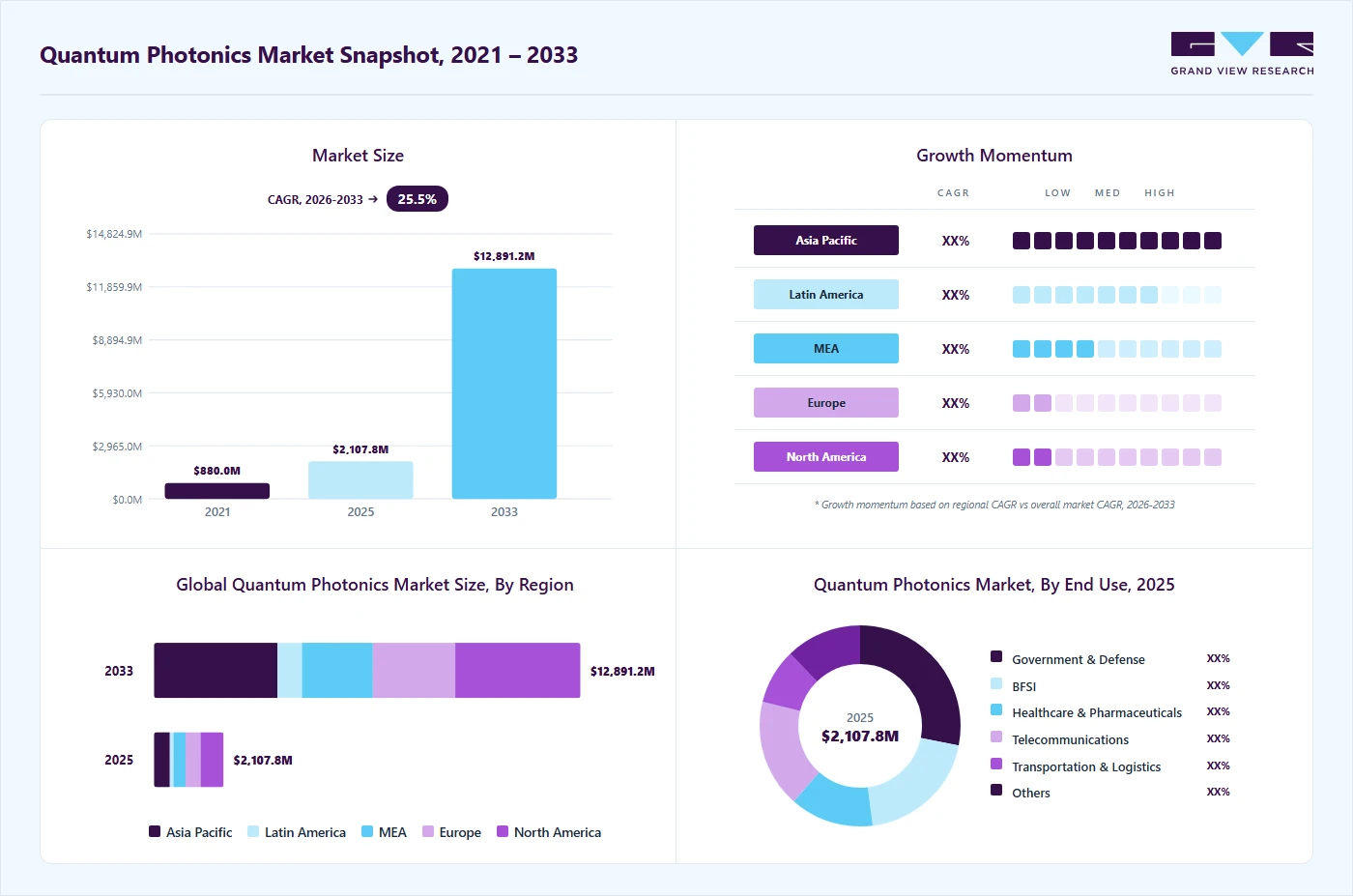
Key Market Trends & Insights
- By offering: Systems segment led the market with the share of 61.3% in 2025.
- By application: Quantum computing segment held a dominant share of 45.3% in 2025.
- By end-use: Telecommunications segment is expected to grow at the fastest CAGR of 28.9% from 2026 to 2033.
Regional Highlights
- Largest regional market: North America (33.1% revenue share, 2025)
- Fastest-growing regional market: Asia Pacific (highest CAGR, 2026-2033).
- By country: The U.S. led the North America market in 2025.
Market Size & Forecast
- Market size in 2025: USD 2.1 Billion
- Estimated market size in 2026: USD 2.6 Billion
- Projected market size by 2033: USD 12.9 Billion
- CAGR (2026-2033): 25.5%
Governments across major economies are investing heavily in quantum-safe communication infrastructure, including quantum key distribution (QKD) networks that rely on photonic technologies. The expansion of national quantum programs and cross-border collaborations is further supporting the deployment of fiber-based and satellite-based quantum communication systems. In parallel, the growing need for high-speed data transmission with minimal signal loss is increasing the adoption of photonic components in next-generation communication networks. Telecommunications providers are actively exploring the integration of quantum photonics into 5G and future 6G architectures to enhance network security and performance.Another key trend gaining traction in the quantum photonics industry is its ability to operate at room temperature and use existing semiconductor fabrication techniques, making it more practical for commercialization. Advances in silicon photonics, integrated photonic circuits, and optical interconnects are enabling more compact and scalable quantum systems. In addition, hybrid quantum systems that combine photonics with other qubit technologies are expanding the role of photonics in control, readout, and data transfer functions. The rising involvement of technology companies, startups, and research institutions is accelerating innovation and reducing technical barriers.
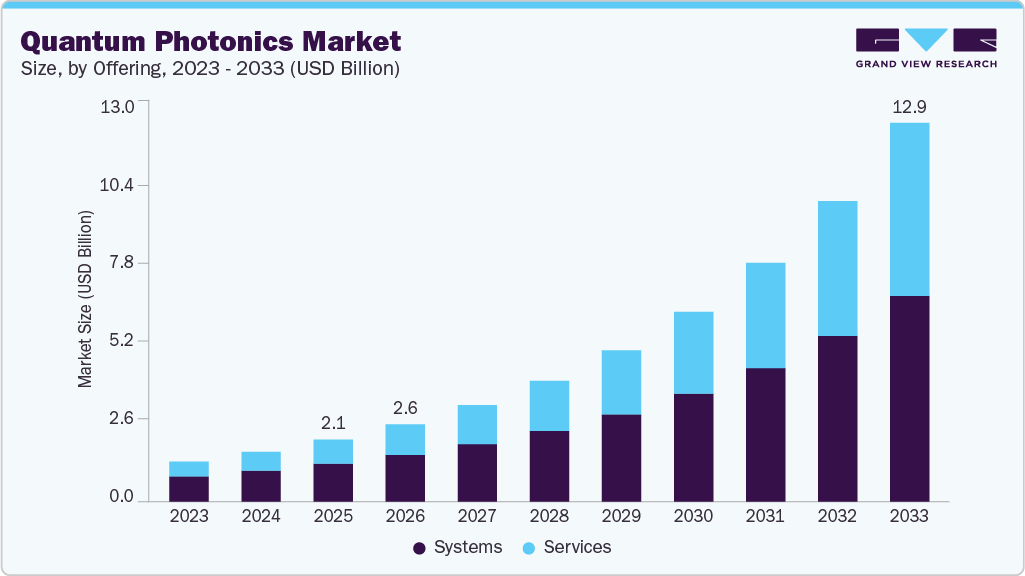
Furthermore, the market is also witnessing a strong push from the growing adoption of quantum sensing and metrology applications, particularly in high-precision industries such as healthcare, defense, and energy. The increasing demand for precision diagnostics, imaging technologies, and environmental monitoring further supports the adoption of photonic-based quantum sensors. Additionally, the commercialization of quantum technologies is driving the emergence of service-based models, including quantum-as-a-service and managed quantum networks, expanding market accessibility. The ecosystem is evolving rapidly with increased collaboration between academia, industry, and government bodies to accelerate deployment and standardization.
Offering Insights
The systems segment led the quantum photonics market, accounting for 61.3% of the global revenue in 2025. The QKD systems segment is driven by increasing demand for secure communication frameworks that protect sensitive data against quantum-enabled cyber threats. Governments and defense organizations are investing in dedicated quantum communication networks to ensure long-term data security and sovereignty. For instance, in March 2026, KEEQuant launched chip-scale Quantum Key Distribution (QKD) technology based on photonic integration of transmitter and receiver lasers, modulators, receiver optics, and detectors onto Photonic Integrated Circuits (PICs), replacing conventional discrete optical assemblies.
The services segment is expected to grow significantly during the forecast period, driven by the growing need for remote access to advanced photonic quantum systems without requiring significant capital investment in hardware infrastructure. Enterprises and research institutions increasingly rely on cloud-based platforms to experiment with, test, and validate algorithms and use cases in a scalable, cost-efficient environment. For instance, in March 2026, Qoro launched Solo, a self‑serve cloud platform for parallelized simulation of hybrid quantum‑classical computing workloads, providing users with scalable access to high‑performance classical compute resources focused on quantum‑aware algorithms.
Application Insights
The quantum computing segment accounted for the largest revenue share in 2025. The quantum computing application segment in the quantum photonics market is driven by the increasing need to solve computational problems that remain intractable for classical systems, particularly in areas such as optimization, simulation, and complex data analysis. For instance, in May 2025, Quandela launched Belenos, a 12-qubit photonic quantum computer that delivers 4,000 times the computational power of its predecessor through advanced squeezed-light sources and optimized quantum-state generation.
The quantum communication segment is expected to grow significantly over the forecast period, driven by the integration of quantum communication into next-generation telecom frameworks such as 5G and 6G, which is increasing demand for photonic technologies capable of delivering ultra-secure and reliable data transmission. For instance, in July 2025, Space TS collaborated with Synergy Quantum to develop India's first homegrown quantum-secure satellite. This project will use post-quantum cryptography (PQC) to protect satellite payloads and ensure secure communication between the satellite and ground stations.
End Use Insights
The government & defense segment led the quantum photonics industry in 2025, driven by the increasing need for advanced secure communication systems to protect sensitive national data from evolving cyber threats and future quantum-enabled decryption risks. Governments are prioritizing quantum technologies to maintain technological superiority and strengthen cybersecurity frameworks. For instance, in February 2026, Xanadu and Lockheed Martin announced a joint research initiative to advance the foundations of quantum machine learning using photonic quantum computing hardware for government and defense use cases.
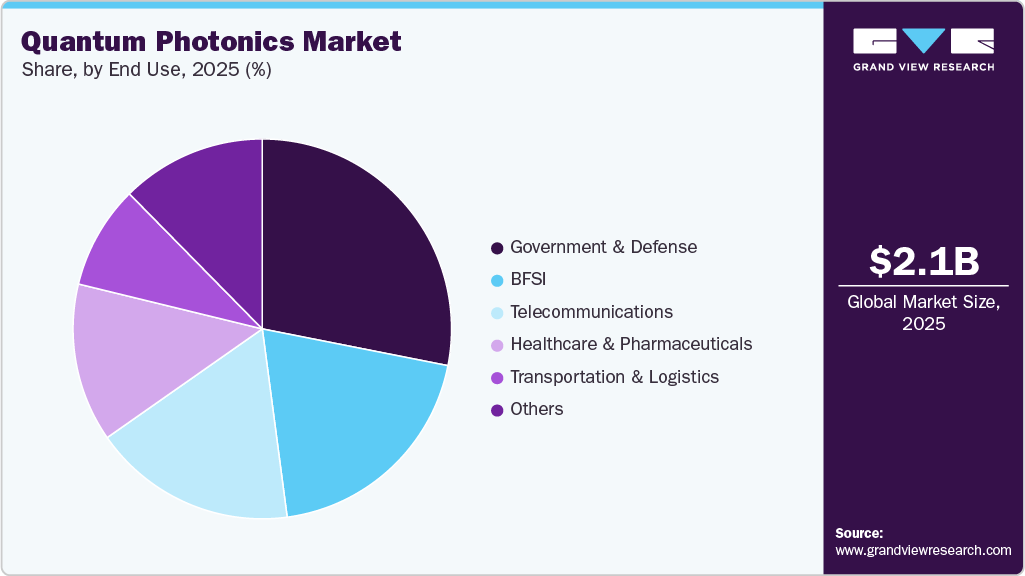
The telecommunications segment is expected to grow significantly over the forecast period. This segment is driven by the growing need to secure communication infrastructure against emerging threats posed by quantum computing, which can compromise existing cryptographic systems. Telecom stakeholders are actively focusing on the development of quantum-enabled network architectures and testbeds to enable seamless integration with existing infrastructure. For instance, in February 2026, Photonic Inc. partnered with TELUS to demonstrate the world's first quantum teleportation over 30 km of TELUS's existing PureFibre commercial network infrastructure, enabling quantum communications on deployed telecom systems.
Regional Insights
North America dominated the quantum photonics market, accounting for a 33.1% revenue share in 2025. The market growth is driven by the strong presence of advanced research institutions and established technology companies engaged in quantum innovation. High levels of venture capital activity and private sector funding are supporting the development of photonic quantum startups and commercialization initiatives. The region benefits from early adoption across industries such as aerospace, defense, and high-performance computing, enabling practical deployment of quantum technologies. In addition, a well-developed semiconductor and photonics manufacturing ecosystem supports rapid prototyping and scaling of photonic components.
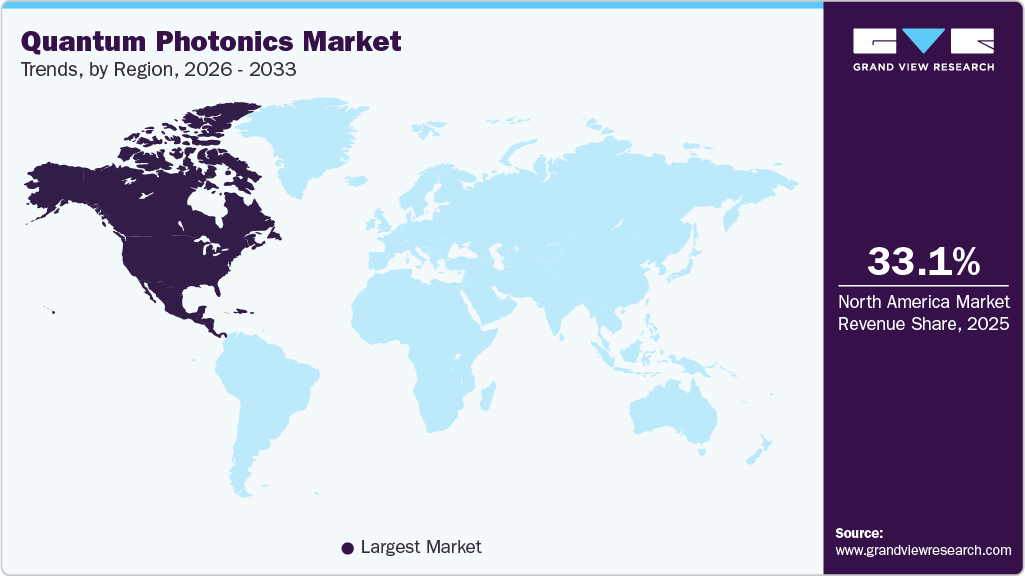
U.S. Quantum Photonics Market Trends
Extensive federal research programs and strategic investments in quantum information science across multiple agencies drive the U.S. quantum photonics industry’s growth. A strong startup ecosystem and active participation from leading technology firms are accelerating advancements in photonic quantum computing and communication systems. The presence of specialized quantum testbeds and national laboratories is enabling rapid experimentation, validation, and deployment of new technologies. In addition, access to advanced fabrication facilities and skilled talent is supporting continuous innovation and commercialization.
Europe Quantum Photonics Market Trends
In Europe, the market growth is driven by coordinated regional initiatives that promote cross-border collaboration and standardized development of quantum technologies. Strong focus on superior technological capabilities is encouraging investment in domestic photonics manufacturing and secure communication infrastructure. The region’s industrial base, particularly in automotive, chemicals, and advanced engineering, is integrating quantum photonics for optimization and simulation applications. Public-private partnerships and structured funding programs enabling long-term research continuity and technology validation.
Asia Pacific Quantum Photonics Market Trends
The Asia Pacific quantum photonics industry’s growth is driven by large-scale infrastructure development and the rapid expansion of quantum communication networks across major economies. Increasing focus on domestic production of photonic components is reducing reliance on external supply chains and strengthening regional capabilities. Government-led initiatives are accelerating the establishment of innovation hubs, research centers, and pilot projects across multiple industries. The region is also witnessing strong integration of quantum technologies into telecommunications and digital infrastructure.
Key Quantum Photonics Company Insights
Some key companies in the quantum photonics industry are Xanadu AI, Nu Quantum, Pixel Photonics, and ID Quantique.
-
Xanadu AI develops photonic quantum computing technologies that focus on using light-based systems for information processing and simulation tasks. The company designs both hardware and software platforms, including cloud-accessible quantum computing solutions and open-source tools for quantum machine learning and photonic circuit design. Its approach emphasizes scalability through photonic architectures, enabling efficient transmission and manipulation of quantum information using photons. The organization is engaged in advancing algorithms and computational methods that address complex problems across chemistry, materials science, and optimization.
-
Nu Quantum focuses on the development of quantum networking technologies designed to enable scalable and distributed quantum computing systems. The company builds photonic hardware solutions that interconnect quantum processors, supporting the creation of larger computational architectures through entanglement-based networking. Its technology portfolio includes single-photon sources, detectors, and networking units that facilitate secure communication and efficient quantum data transfer. The organization operates with a multidisciplinary approach, combining expertise across physics, engineering, and system design to address scalability challenges in quantum computing.
Key Quantum Photonics Companies:
The following key companies have been profiled for this study on the quantum photonics market.
- ID Quantique
- Lightmatter
- Nu Quantum
- ORCA Computing
- Pixel Photonics
- PsiQuantum
- Quandela
- Qubitekk
- QuiX Quantum
- Xanadu AI
Recent Developments
-
In March 2026, ORCA Computing introduced a GPU-accelerated photonic quantum simulator built with NVIDIA’s cuTensorNet and cuQuantum library. This simulator helps scale up photonic quantum circuit simulations for the PT-2 processor. Unlike earlier tools that focused on qubit-based models, it simplifies modeling larger photonic systems in hybrid quantum-classical workflows.
-
In December 2025, Singapore's Agency for Science, Technology and Research (ASTAR) collaborated with Xanadu Quantum Technologies Inc. to strengthen their work together on photonic quantum computing. It draws on ASTAR's strengths in photonics integration, quantum sensing, materials, semiconductors, and advanced packaging.
-
In June 2025, Nu Quantum introduced the world’s first 19-inch rack-mounted Quantum Networking Unit (QNU). This device is built to support dynamic entanglement distribution across quantum data centers, making it a practical solution for distributed quantum computing. The QNU combines a dynamic entangler system with a real-time quantum network orchestrator, providing sub-microsecond control latency and synchronization over data center distances to connect multiple quantum processors.
Quantum Photonics Market Report Scope
Report Attribute
Details
Market size in 2025
USD 2.1 billion
Estimated market size in 2026
USD 2.6 billion
Projected market size by 2033
USD 12.9 billion
Growth rate
CAGR of 25.5% from 2026 to 2033
Base year for estimation
2025
Actual data
2021 - 2024
Forecast period
2026 - 2033
Quantitative units
Revenue in USD million and CAGR from 2026 to 2033
Report coverage
Revenue forecast, company ranking, competitive landscape, growth factors, and trends
Segments covered
Offering, application, end use, regional
Regional scope
North America; Europe; Asia Pacific; Latin America; MEA
Country scope
U.S., Canada, Mexico, UK; Germany; France; China; Japan; India; South Korea; Australia; Brazil; KSA; UAE; South Africa
Key companies profiled
ID Quantique; Lightmatter; Nu Quantum; ORCA Computing; Pixel Photonics; PsiQuantum; Quandela; Qubitekk; QuiX Quantum; Xanadu AI
Customization scope
Free report customization (equivalent up to 8 analysts working days) with purchase. Addition or alteration to country, regional & segment scope.
Pricing and purchase options
Avail customized purchase options to meet your exact research needs. Explore purchase options
Global Quantum Photonics Market Report Segmentation
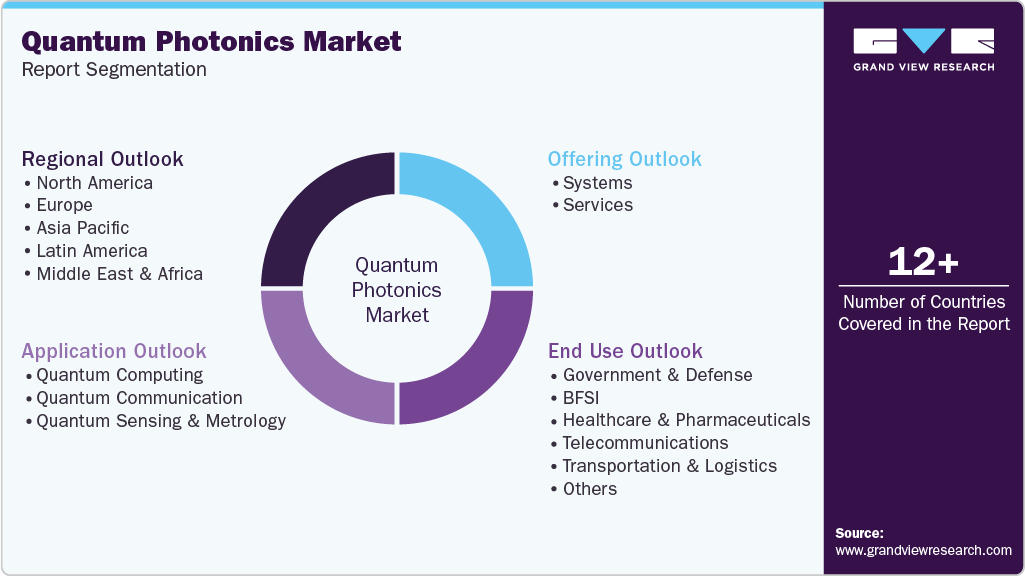
This report forecasts revenue growth at the global, regional, and country levels and provides an analysis of the latest industry trends in each of the sub-segments from 2021 to 2033. For this study, Grand View Research has segmented the global quantum photonics market report based on offering, application, end use, and region.
-
Offering Outlook (Revenue, USD Million, 2021 - 2033)
-
Systems
-
Services
-
-
Application Outlook (Revenue, USD Million, 2021 - 2033)
-
Quantum Computing
-
Quantum Communication
-
Quantum Sensing & Metrology
-
-
End Use Outlook (Revenue, USD Million, 2021 - 2033)
-
Government & Defense
-
BFSI
-
Healthcare & Pharmaceuticals
-
Telecommunications
-
Transportation & Logistics
-
Others
-
-
Regional Outlook (Revenue, USD Million, 2021 - 2033)
-
North America
-
U.S.
-
Canada
-
Mexico
-
-
Europe
-
UK
-
Germany
-
France
-
-
Asia Pacific
-
China
-
Japan
-
India
-
South Korea
-
Australia
-
-
Latin America
-
Brazil
-
-
Middle East and Africa (MEA)
-
KSA
-
UAE
-
South Africa
-
-
Frequently Asked Questions About This Report
The systems segment dominated the market, with a revenue share of 61.3% in 2025.
The quantum computing segment accounted for the largest revenue share of 45.3% in 2025.
The government & defense segment dominated the market and accounted for the largest share in 2025.
The global quantum photonics market size was valued at USD 2.1 billion in 2025 and is estimated at USD 2.6 billion for 2026.
The global quantum photonics market is expected to grow at a CAGR of 25.5% from 2026 to 2033, reaching USD 12.9 billion by 2033.
North America dominated the quantum photonics market with a share of 33.1% in 2025. This is attributable by the strong presence of advanced research institutions and established technology companies engaged in quantum innovation.
Key players include ID Quantique; Lightmatter; Nu Quantum; ORCA Computing; Pixel Photonics; PsiQuantum; Quandela; Qubitekk; QuiX Quantum; Xanadu AI.
Key factors that are driving the market growth include the accelerating demand for ultra-secure communication systems, particularly in response to rising cybersecurity threats and the anticipated risks presented by quantum computing to classical encryption.
About the Author(s)
Next Generation Technologies Research Team
Technology · Next Generation TechnologiesThis report was authored by the next generation technologies research team at Grand View Research - comprising two research analysts, one senior research analyst, and one industry expert - with specialized expertise in the next generation technologies segment of the technology industry. All findings are based on proprietary technology databases, executive interviews, and regulatory analysis, subject to internal peer review prior to publication.
Last Updated:
Speak to Analyst


Customize this report to your needs — add regions, segments, or data points, with 20% free customization.
Or view our licence options:


ISO 9001:2015 & 27001:2022 Certified
We are GDPR and CCPA compliant! Your transaction & personal information is safe and secure. For more details, please read our privacy policy.


