
- Home
- »
- Automotive & Transportation
- »
-
Railway Traction Battery Market Size Report, 2026-2033GVR Report cover

Railway Traction Battery Market (2026 - 2033)
Size, Share & Trends Analysis Report By Train Type (Suburban, Tramways), By Capacity (Below 300 kWh, 800-1,500 kWh), By Region (North America, Europe, Asia Pacific, Latin America, MEA), And Segment Forecasts
Market Size, 2025
$280.3MMarket Estimate, 2026
$296.6MMarket Forecast, 2033
$444.5MCAGR, 2026–2033
6.0%Railway Traction Battery Market Summary
The global railway traction battery market size was valued at USD 280.3 million in 2025 and is projected to grow from USD 296.6 million in 2026 to USD 444.5 million by 2033, at a CAGR of 6.0% from 2026 to 2033. The Asia Pacific railway traction battery market held the largest share of 44.3% of the global market in 2025. Rapid electrification of rail networks and advancements in lithium-ion battery technology are driving market growth.
 Source: Grand View Research, IR Documents, Primary Interviews, Paid DatabasesTo learn more about this report,
 Download Free Sample Report
Key Market Trends & Insights
- By train type: The locomotives segment accounted for the largest revenue share of 29.1% in 2025.
- By capacity: The 300-800 kWh segment dominated the market in 2025.
Regional Highlights
- Largest regional market: Asia Pacific (44.3% revenue share, 2025)
- By country: The India is expected to grow at the fastest rate during the forecast period.
Market Size & Forecast
- Market size in 2025: USD 280.3 Million
- Estimated market size in 2026: USD 296.6 Million
- Projected market size by 2033: USD 444.5 Million
- CAGR (2026-2033): 6.0%
Prism AI by Grand View Research Free to tryAsk a question about the railway traction battery marketTry asking✓Every figure cited from GVR research Prefer the report? Download free sample →
The market study specifically focuses on lithium-ion battery technology. Rapid electrification of rail networks is emerging as a major market driver. Governments worldwide are increasingly investing in railway electrification projects to reduce reliance on diesel locomotives and support sustainable transportation systems. In addition, the rising adoption of battery-electric and hybrid trains, along with the expansion of metro, light rail, and high-speed rail infrastructure across emerging economies, is accelerating demand for advanced railway traction batteries. Furthermore, the growing focus on reducing greenhouse gas emissions from the transportation sector is encouraging railway operators to adopt cleaner, energy-efficient rail technologies.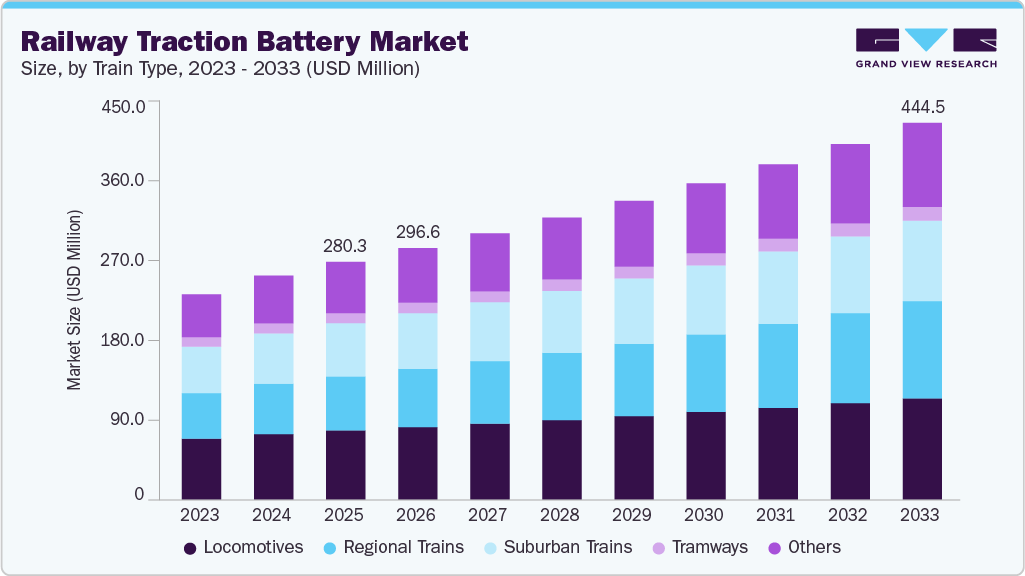 To learn more about this report, Download Free Sample Report
Railway operators are increasingly shifting away from conventional diesel locomotives to reduce greenhouse gas emissions and improve energy efficiency. Battery-electric trains are gaining popularity for operation on partially electrified and non-electrified routes, where full catenary electrification is economically challenging. Hybrid train systems integrating lithium-ion traction batteries and regenerative braking technologies are also improving operational flexibility and lowering fuel consumption. Several countries across Europe and the Asia Pacific are investing heavily in battery-powered rolling stock to support sustainable transportation goals. This trend is expected to accelerate further as governments strengthen decarbonization initiatives in the transportation sector, thereby driving market growth.
Regulatory requirements are playing a crucial role in shaping the railway traction battery industry, as governments and transportation authorities worldwide implement stricter emission standards and sustainability policies for the rail sector. Regulations supporting net-zero emissions and sustainable mobility are accelerating the adoption of battery-electric and hybrid trains. In addition, railway traction batteries must comply with strict international safety and operational standards related to vibration resistance, thermal stability, and fire safety. For instance, IEC 62928 is an international standard that defines the design, operational, and safety requirements for lithium-ion batteries used in railway vehicles. The standard specifically applies to battery energy storage systems (ESS) utilized for traction power in rail applications, including hybrid and battery-electric trains.
The market is increasingly witnessing strategic collaborations between railway operators, rolling stock manufacturers, and battery suppliers to strengthen technological capabilities and secure long-term supply chains. Companies are entering partnerships to develop advanced traction battery systems, battery-electric locomotives, and integrated rail energy storage solutions. Major suppliers such as Hitachi Rail, ABB, Toshiba, and HOPPECKE are expanding their railway battery portfolios and investing in smart battery management technologies. For example, in May 2025, HOPPECKE partnered with TKIL Industries to jointly develop and manufacture advanced railway battery systems for metros, locomotives, and regional trains in India, highlighting the growing trend toward regional manufacturing and long-term rail electrification partnerships.
Urbanization and the expansion of metro and high-speed rail infrastructure across emerging economies are further contributing to market growth. Countries in the Asia Pacific, particularly India and China, are rapidly expanding urban transit systems to address increasing passenger traffic and urban congestion. Electrified metro rail projects require efficient traction battery systems for backup power, energy recovery, and operational stability. The integration of renewable energy into railway systems, including solar-powered stations and energy-efficient rail operations, is also increasing the importance of advanced battery storage technologies.
Market Dynamics
Rapid technological advancements in lithium-ion battery technology are transforming the market. Continuous improvements in battery energy density, charging speed, thermal stability, and lifecycle performance are enhancing the operational capabilities of battery-electric trains. Manufacturers are increasingly developing lightweight and compact railway traction battery systems that improve train efficiency and reduce overall energy consumption. The growing adoption of Lithium Iron Phosphate (LFP) battery chemistry is further improving battery safety and durability for railway applications.
In addition, advanced Battery Management Systems (BMS) and predictive monitoring technologies are enabling better battery performance optimization and preventive maintenance. These technological developments are improving the commercial feasibility of railway traction batteries globally.
One of the major restraints on market growth is the high initial cost of battery-powered rail systems and supporting infrastructure. Railway operators transitioning from conventional diesel locomotives to battery-electric or hybrid trains often face high upfront costs for train procurement, retrofitting existing rolling stock, and upgrading rail infrastructure. These costs can be particularly challenging for developing economies and regional railway operators with limited transportation budgets. In addition, installing charging infrastructure and grid connectivity systems further increases project costs.
Emerging rail infrastructure projects across developing economies are creating strong growth opportunities for the market. Rapid urbanization and rising public transportation demand are encouraging governments to invest heavily in metro rail systems, regional rail corridors, and sustainable rail infrastructure. Many developing countries are increasingly adopting battery-electric and hybrid rail technologies to reduce diesel dependency and lower transportation emissions. Since complete railway electrification requires significant investment, battery-powered trains are emerging as cost-effective solutions for partially electrified routes. Increasing government funding and international investments in sustainable transportation are further supporting market expansion. As rail modernization projects continue to grow across Asia Pacific, the Middle East, Latin America, and Africa, demand for railway traction batteries is expected to increase substantially.
Market Concentration & Characteristics
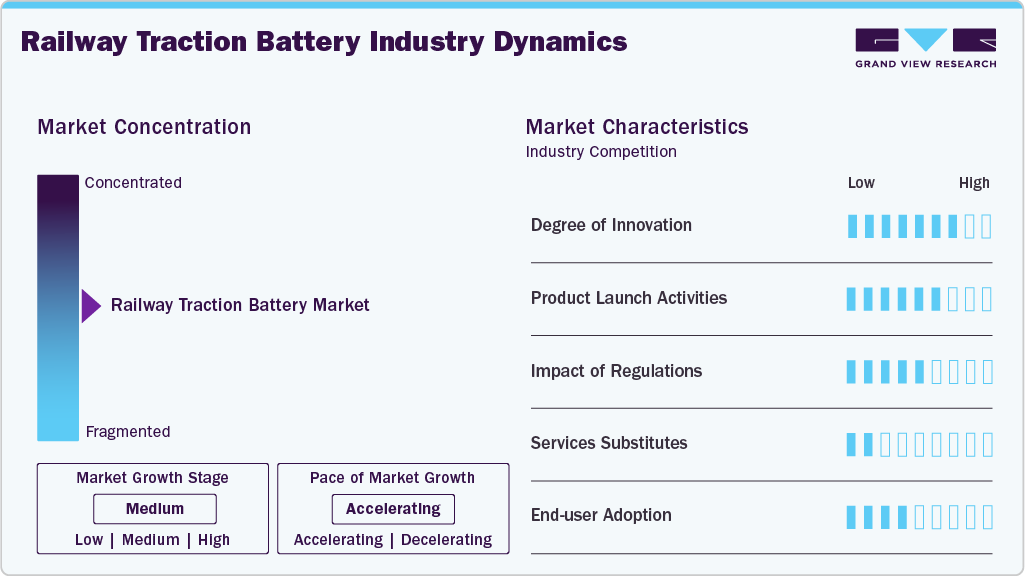
The railway traction battery industry is moderately concentrated, with a limited number of established global players accounting for a significant share of the overall market revenue. Major companies such as Toshiba Corporation, ALSTOM SA, Saft Groupe S.A., Hitachi, Ltd., and ABB Ltd. dominate the competitive landscape through strong technological capabilities, established railway partnerships, and long-term supply agreements with rolling stock manufacturers and railway operators. High entry barriers, including railway safety certifications, advanced battery technology requirements, and substantial research and development investments, limit the participation of smaller players. However, increasing global investments in sustainable rail transportation and battery-electric train technologies are gradually encouraging new entrants and strategic collaborations within the market.
 To learn more about this report, Download Free Sample Report
The market is currently witnessing accelerating growth driven by rising railway electrification projects, increasing adoption of battery-electric and hybrid trains, and stringent emission reduction regulations across the transportation sector. The degree of innovation in the market remains high as manufacturers continue to invest in advanced lithium-ion battery technologies, lightweight battery architectures, fast-charging systems, and smart Battery Management Systems (BMS). Product launch activities are also increasing as companies focus on developing high-capacity and energy-efficient traction battery solutions for regional rail, metro, and freight applications. In addition, regulatory impact on the market is high due to strict railway safety standards and global decarbonization initiatives, while the threat of substitutes remains relatively low as railway traction batteries continue to emerge as a practical and cost-effective solution for sustainable rail mobility.
Train Type Insights
The locomotives segment dominated the market in 2025, accounting for the largest share of 29.1%. Advancements in high-capacity battery technologies are driving the growth of railway traction batteries for locomotives. Continuous improvements in lithium-ion and emerging battery chemistries have significantly enhanced energy density, power output, and thermal stability, enabling batteries to support the high energy demands of heavy-duty locomotive operations. These advancements allow locomotives to operate over longer distances with improved reliability, making battery-electric and hybrid configurations increasingly viable for freight and mainline applications.
The regional trains segment is expected to grow at the fastest CAGR over the forecast period. A practical solution to reducing carbon emissions in regional rail transport is accelerating the adoption of railway traction batteries. Battery-electric traction systems are emerging as a scalable, cost-effective approach to decarbonizing regional rail networks that are often only partially electrified. Unlike high-speed or long-haul corridors that can justify extensive electrification, regional routes typically operate under lower traffic density and tighter budget constraints, making large-scale overhead line infrastructure investments economically challenging. Traction batteries enable seamless operation across both electrified and non-electrified sections without reliance on diesel engines, while reducing carbon emissions.
Capacity Insights
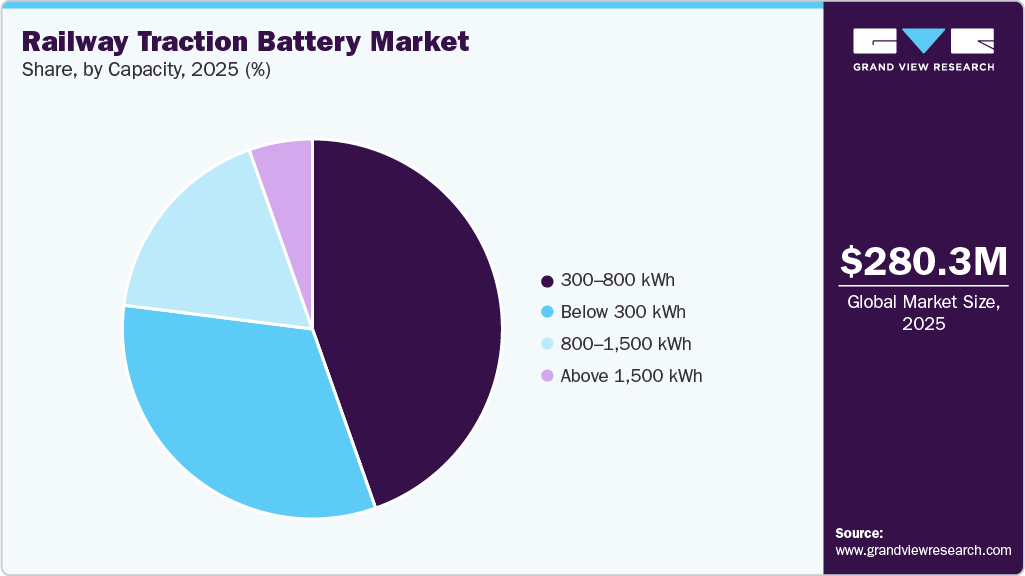
The 300-800 kWh segment dominated the market in 2025. Batteries with 300-800 kWh capacity are widely used in battery-electric multiple units (BEMUs), hybrid locomotives, and regional rail systems. These systems generally include advanced thermal management technologies, regenerative braking integration, and fast charging, which increase overall system pricing. The expansion of partially electrified rail networks is driving the market for batteries with 300-800 kWh capacity.
 To learn more about this report, Download Free Sample Report
The 800-1,500 kWh segment is expected to witness the fastest CAGR over the forecast period. The 800-1,500 kWh batteries represent high-capacity traction battery systems primarily deployed in long-distance regional trains, freight locomotives, and heavy-duty railway applications. These battery systems support regenerative braking, allowing recovered energy to be stored and reused, thereby improving overall energy efficiency and lowering operating costs. The rising deployment of battery-electric and hybrid locomotives for long-distance and heavy-duty rail operations is driving the market for batteries with 800-1,500 kWh capacity.
Regional Insights
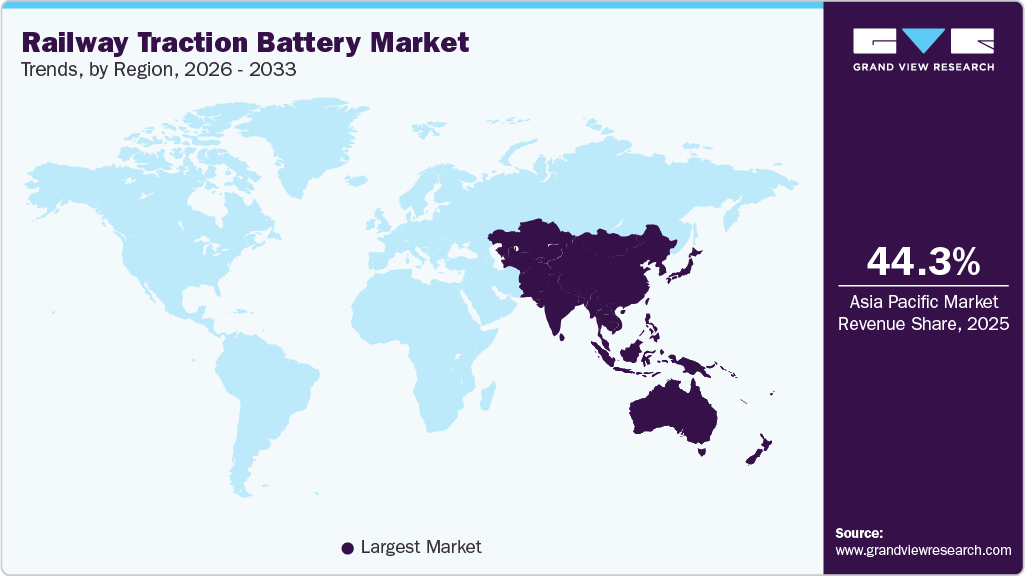
Asia Pacific dominated the railway traction battery industry, accounting for 44.3% in 2025, driven by rapid railway electrification, expanding metro rail infrastructure, and increasing investments in sustainable transportation systems. Countries across the region are heavily investing in high-speed rail, urban transit systems, and battery-electric trains to reduce dependence on diesel-powered locomotives and lower transportation emissions. The region also benefits from the presence of major lithium-ion battery manufacturers and strong battery supply chain ecosystems, particularly in China, Japan, and South Korea.
 To learn more about this report, Download Free Sample Report
India Railway Traction Battery Market Trends
The railway traction battery market in India is expected to grow at the fastest rate during the forecast period, driven by the large-scale railway electrification projects, metro rail expansion, and increasing focus on sustainable transportation infrastructure. Indian Railways has nearly completed electrification of its broad-gauge rail network and is increasingly exploring battery-electric and hybrid train technologies for regional and non-electrified routes, which in turn creates demand for the traction batteries.
China railway traction battery market held a significant market share in 2025, driven by its extensive high-speed rail network, strong battery manufacturing capabilities, and aggressive investments in railway modernization. The country has established itself as a global leader in lithium-ion battery production and battery-electric transportation technologies, supporting cost-efficient supply chains for railway battery systems.
Europe Railway Traction Battery Market Trends
The railway traction battery market in Europe is expected to grow at a moderate rate over the forecast period, driven by strong environmental regulations, advanced railway infrastructure, and aggressive decarbonization targets in the transportation sector. Several European countries are actively replacing diesel-powered trains with battery-electric and hybrid rolling stock to support net-zero emission goals and sustainable mobility initiatives. The region is witnessing substantial investments in battery-powered regional trains, railway electrification projects, and hydrogen-battery hybrid rail systems.
Germany railway traction battery market held a substantial market share in 2025, driven by its strong focus on sustainable rail transportation, advanced railway engineering capabilities, and growing adoption of battery-electric trains. The country is actively investing in regional battery-powered train projects to replace diesel locomotives operating on non-electrified routes. German railway operators and technology companies are also focusing on advanced lithium-ion battery systems, fast-charging technologies, and hydrogen-battery hybrid train solutions.
The railway traction battery market in the UK is expected to grow at the fastest rate during the forecast period, due to increasing investments in rail decarbonization and sustainable transportation infrastructure. The UK government and railway operators are increasingly promoting battery-electric and hybrid train technologies to reduce reliance on diesel-powered rolling stock and support net-zero carbon objectives. Several battery train pilot projects and regional rail electrification initiatives are currently underway across the country, which, in turn, are expected to drive demand for traction batteries.
North America Railway Traction Battery Market Trends
The railway traction battery market in North America is expected to grow at a moderate CAGR over the forecast period, driven by increased focus on freight rail decarbonization, railway modernization, and sustainable transportation initiatives. Railway operators across the region are increasingly exploring battery-electric and hybrid locomotive technologies to reduce diesel consumption and comply with emission-reduction targets, thereby driving market growth.
The U.S. railway traction battery market held a dominant position in the region in 2025, driven by growing efforts to decarbonize the freight rail sector and improve operational efficiency across railway networks. Major freight rail operators and technology companies are increasingly investing in battery-electric locomotives, hybrid rail systems, and sustainable rail technologies to reduce emissions and fuel costs.
Key Railway Traction Battery Company Insights
Some of the key companies in the railway traction battery industry include Toshiba Corporation, ALSTOM SA, Saft Groupe S.A., Hitachi, Ltd., among others.
-
Toshiba Corporation is a diversified technology and infrastructure company with operations in energy systems, industrial solutions, electronic devices, and transportation infrastructure. Toshiba develops and supplies advanced lithium-ion battery technologies and energy storage systems. Its railway battery solutions use proprietary SCiB lithium-ion technology, designed for long operational life, enhanced safety, rapid charging, and high power output.
-
Alstom SA is a global provider of rail transportation and mobility solutions, specializing in rolling stock, signaling systems, rail infrastructure, and sustainable mobility technologies. The company serves high-speed rail, metro, tram, regional, and freight segments to support modernization and electrification projects worldwide. Alstom develops battery-powered and hybrid train technologies to reduce emissions, improve energy efficiency, and enable catenary-free operations on non-electrified routes.
Key Railway Traction Battery Companies:
The following key companies have been profiled for this study on the railway traction battery market.
- Saft Groupe S.A.
- Exide Industries Limited
- Hitachi Ltd.
- Toshiba Corporation
- Medha Servo Drives Pvt Ltd (MSDPL)
- Ritar International Group
- HOPPECKE Batterien GmbH & Co. KG
- ALSTOM SA
- ABB Ltd.
- Leclanché SA
Competitive Benchmarking
Operating Strategies
Competitive Edge
Weaknesses
Mature Players: Toshiba Corporation, ALSTOM SA, Saft Groupe S.A., Hitachi, Ltd., and ABB Ltd.
- Mature players are strengthening strategic partnerships with rolling stock OEMs and railway operators while expanding retrofit solutions that replace diesel propulsion systems with lithium-ion traction battery technologies.
- Expanding modular and scalable traction battery platforms with advanced battery and thermal management systems to improve railway safety, efficiency, and operational reliability
- Established brands gain their competitive edge from partnerships with rolling stock OEMs and railway operators, proven traction battery deployment history, and strong compliance capabilities, enabling them to deliver high-reliability, safety-certified, and large-scale traction battery systems with integrated lifecycle support, including maintenance and retrofit solutions for existing fleets.
- Mature players face challenges such as slower innovation cycles and higher cost structures, as legacy engineering processes and long certification timelines can delay the adoption of next-generation lithium-ion traction technologies, thus making it difficult to respond quickly to rapidly evolving battery chemistries and cost pressures.
Emerging Players: Exide Industries Limited, Medha Servo Drives Pvt Ltd (MSDPL), Ritar International Group
- Emerging players are entering the market through pilot deployments and retrofit projects to validate lithium-ion traction performance and secure approvals, such as RDSO certification, before scaling.
- They are adopting a fast-iteration, cost-driven approach with modular battery designs and strong OEM partnerships to address gaps in traction-grade engineering, safety validation, and manufacturing capability.
- Their advantage comes from technology agility and innovation speed, offering cost-competitive, modular lithium-ion traction battery solutions with advanced digital features (BMS, predictive analytics), while leveraging partnerships to quickly adapt to traction requirements and gain market entry through certification.
Emerging players' primary weaknesses are limited traction-grade experience and constrained manufacturing scale, which result in a reliance on OEM partnerships and prolonged certification cycles, as well as challenges in proving long-term reliability, safety, and lifecycle performance in large-scale railway operations. Recent Developments
-
In April 2025, Toshiba launched a new SCiB battery module with significantly improved heat dissipation, nearly doubling its thermal management capability. The upgraded module had enhanced safety, reliability, and efficiency for high-power applications. These SCiB batteries have been widely used in hybrid vehicles and industrial applications, including trains.
-
In January 2025, ABB and Škoda Group partnered to support the modernization of Czech railways by deploying new battery-electric trains. ABB agreed to provide traction battery systems for Škoda Group’s newly developed battery-electric multiple units (BEMUs). The initial order included 195 Pro Series battery packs for 15 BEMUs ordered by České dráhy (Czech Railways). The partnership also included a 15-year service agreement to support long-term operational efficiency and maintenance.
Railway Traction Battery Market Report Scope
Report Attribute
Details
Market size in 2025
USD 280.3 million
Estimated Market size in 2026
USD 296.6 million
Projected Market size by 2033
USD 444.5 million
Growth rate
CAGR of 6.0% from 2026 to 2033
Historical data
2021 - 2025
Forecast period
2026 - 2033
Quantitative units
Revenue in USD million/billion, volume in units, and CAGR from 2026 to 2033
Report coverage
Revenue forecast, volume forecast, company ranking, competitive landscape, growth factors, and trends
Segments covered
Train type, capacity, region
Regional scope
North America; Europe; Asia Pacific; Latin America; MEA
Country scope
U.S.; Canada; Mexico; Germany; UK; France; China; Japan; India; South Korea; Australia; Brazil; KSA; UAE; South Africa
Key companies profiled
Saft Groupe S.A.; Exide Industries Limited; Hitachi Ltd.; Toshiba Corporation; Medha Servo Drives Pvt Ltd (MSDPL); Ritar International Group; HOPPECKE Batterien GmbH & Co. KG; ALSTOM SA; ABB Ltd.; Leclanché SA
Customization scope
Free report customization (equivalent up to 8 analysts working days) with purchase. Addition or alteration to country, regional & segment scope.
Pricing and purchase options
Avail customized purchase options to meet your exact research needs. Explore purchase options
Global Railway Traction Battery Market Report Segmentation
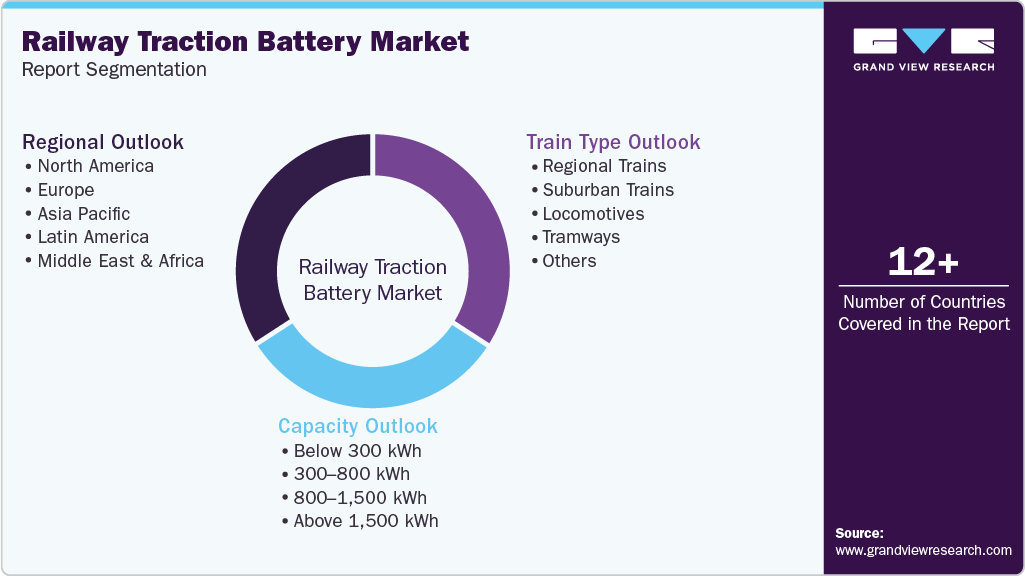
This report forecasts revenue growth at global, regional, and country levels and provides an analysis of the latest industry trends in each of the sub-segments from 2021 to 2033. For this study, Grand View Research has segmented the global railway traction battery market report based on train type, capacity, and region:
 To learn more about this report, Download Free Sample Report
-
Train Type Outlook (Revenue, USD Million, Volume Units 2021 - 2033)
-
Regional Trains
-
Suburban Trains
-
Locomotives
-
Tramways
-
Others
-
-
Capacity Outlook (Revenue, USD Million, 2021 - 2033)
-
Below 300 kWh
-
300-800 kWh
-
800-1,500 kWh
-
Above 1,500 kWh
-
-
Regional Outlook (Revenue, USD Million, Volume Units, 2021 - 2033)
-
North America
-
U.S.
-
Canada
-
Mexico
-
-
Europe
-
Germany
-
UK
-
France
-
-
Asia Pacific
-
China
-
Japan
-
India
-
South Korea
-
Australia
-
-
Latin America
-
Brazil
-
-
Middle East and Africa (MEA)
-
KSA
-
UAE
-
South Africa
-
-
Delivered Customizations
This report has been delivered with the following In-depth customizations
Client Request
Customization Delivered
Value Adds
Volume Analysis of the Railway Traction Battery Market by Train Type
Volume demand analysis for regional trains, locomotives, suburban trains, trams, and others
Assessment of battery deployment trends across these train types
Forecasting of traction battery demand based on train production volumes
Supported production planning and supply chain optimization
Enabled train-type-specific market opportunity analysis
Assisted in long-term demand and procurement forecasting
Railway Traction Battery Market Analysis by Capacity
Detailed analysis of battery capacity segments, including Below 300 kWh, 300-800 kWh, 800-1,500 kWh, and Above 1,500 kWh
Assessment of pricing trends, energy demand, and adoption patterns across each capacity segment
Evaluation of train-type suitability and operational applications based on battery capacity requirements
Enabled identification of high-growth battery capacity segments
Supported product portfolio optimization and strategic capacity planning
Assisted in demand forecasting and investment decision-making based on railway application requirements
Competitive Benchmarking & Strategic Positioning in the Railway Traction Battery Market
Benchmarking of key competitors across battery technologies, partnerships, and innovation
Comparative assessment of market share, production capabilities, and technology strategies
Analysis of competitive strengths, gaps, and differentiation areas
Identified competitive white spaces and growth gaps
Supported strategic positioning and differentiation
Enabled data-driven competitive strategy development
Railway Traction Battery Market Size Analysis in Terms of kWh
Delivered market sizing and forecasts in terms of battery energy capacity (kWh)
Analysis of energy storage demand by train type
Evaluation of regional demand trends and installed battery capacity across passenger and freight rail networks
Enabled accurate assessment of energy storage demand within the railway sector
Supported strategic production planning and battery capacity optimization
Assisted in identifying high-growth application areas and long-term investment opportunities
Frequently Asked Questions About This Report
The global railway traction battery market size was valued at USD 280.3 million in 2025 and is expected to reach USD 296.6 million in 2026.
Asia Pacific dominated with a 44.3% revenue share in 2025.
The locomotives segment led with a 29.1% revenue share in 2025, while regional trains is the fastest-growing segment over the forecast period.
Some of the key participants in the global railway traction battery market include Saft Groupe S.A.; Exide Industries Limited; Hitachi Ltd.; Toshiba Corporation; Medha Servo Drives Pvt Ltd (MSDPL); Ritar International Group; HOPPECKE Batterien GmbH & Co. KG; ALSTOM SA; ABB Ltd.; Leclanché SA.
Rapid electrification of rail networks and advancements in lithium-ion battery technology are driving growth of the railway traction battery market.
About the Author(s)
Automotive & Transportation Research Team
Technology · Automotive & TransportationThis report was authored by the automotive & transportation research team at Grand View Research - comprising two research analysts, one senior research analyst, and one industry expert - with specialized expertise in the automotive & transportation segment of the technology industry. All findings are based on proprietary technology databases, executive interviews, and regulatory analysis, subject to internal peer review prior to publication.
Last Updated:
Speak to Analyst

Customize this report to your needs - add regions, segments, or data points, with 20% free customization.
Or view our licence options:


ISO 9001:2015 & 27001:2022 Certified
We are GDPR and CCPA compliant! Your transaction & personal information is safe and secure. For more details, please read our privacy policy.


