
- Home
- »
- Advanced Interior Materials
- »
-
Rammed Earth Construction Materials Market Report, 2025-2033GVR Report cover

Rammed Earth Construction Materials Market (2025 - 2033)
Size, Share & Trends Analysis Report By Product (Stabilized Rammed Earth (SRE), Unstabilized Rammed Earth (URE)), By End-use, By Region, And Segment Forecasts
Market Size, 2024
$1.5BMarket Estimate, 2026
$1.7BMarket Forecast, 2033
$2.9BCAGR, 2025–2033
7.5%Rammed Earth Construction Market Summary
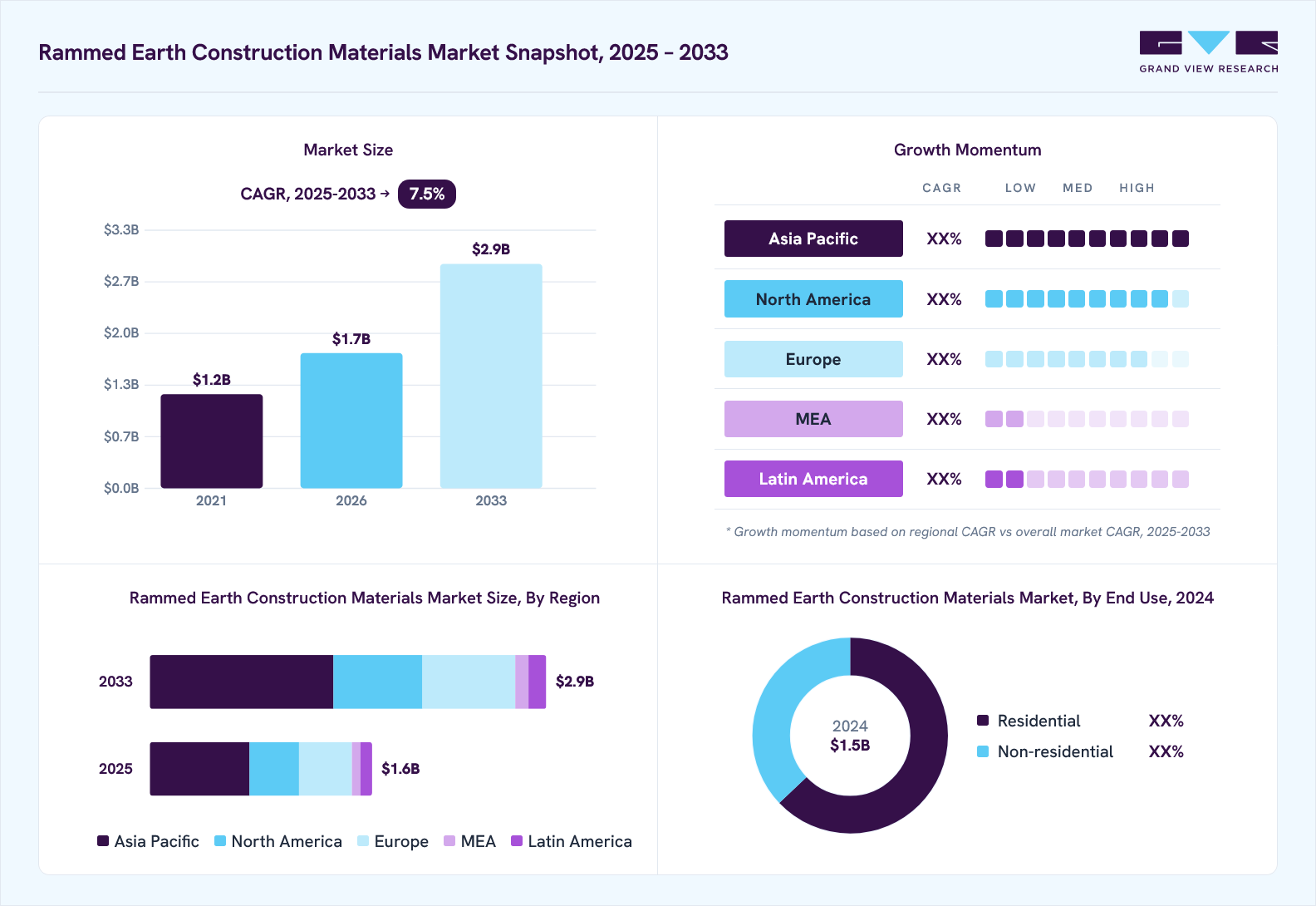
The global rammed earth construction materials market size was valued at USD 1.5 billion in 2024 and is projected to grow from USD 1.7 billion in 2026 to USD 2.9 billion by 2033, at a CAGR of 7.5% from 2025 to 2033. Asia Pacific dominated the market, accounting for a revenue share of 44.6% in 2024. The increasing global focus on sustainable and low-carbon construction practices is a key market driver.
 Source: Grand View Research, IR Documents, Primary Interviews, Paid DatabasesTo learn more about this report,
 Download Free Sample Report
 Key Market Trends & Insights
- By product, prefabricated rammed earth blocks/panels is expected to grow at the fastest CAGR of 8.1% over the forecast period.
- By end use, residential is expected to grow at the fastest CAGR of 7.6% over the forecast period.
Market Size & Forecast
- Market size in 2024: USD 1.5 Billion
- Projected market size by 2033: USD 2.9 Billion
- CAGR (2025-2033): 7.5%
- Asia Pacific: Largest market in 2024
Three ways to get this report
Buy it, customize it, or ask a question.Ask an Analyst
Analyst response in 1 business day
- AccessReport author, directly
- Reply timeWithin 1 working day
- No sales callDirect answer only
- FormatEmail reply
- CostFree, no cost
Get the Full Report
What the study covers
- FormatsPDF · Excel · Dashboard
- Timeline2025–2033 annual, 2024 base
- Coverage20+ countries, 5 regions
- Companies10+ key players profiled
Customize the Report
20% free customization
- IncludeCountries, segments, points
- TailorTo your product definition
- ExtendDeeper competitor detail
- OrA fully bespoke study
- Turnaround5–10 working days
As the construction industry seeks alternatives to energy-intensive materials like concrete and steel, rammed earth has emerged as an eco-friendly solution due to its minimal embodied energy and use of locally sourced soil. The method’s ability to regulate temperature naturally through high thermal mass reduces dependence on artificial heating and cooling systems, aligning well with the global transition toward energy-efficient buildings. Furthermore, growing awareness of traditional and natural building techniques among architects and developers is fostering renewed interest in rammed earth as a viable modern construction material.Technological advancements in construction techniques and soil stabilization are further propelling market growth. The incorporation of stabilizing agents, such as lime, cement, or natural polymers, has enhanced the structural integrity and weather resistance of rammed earth walls, making them suitable for both residential and commercial projects in diverse climates. Modern equipment, digital modeling, and 3D visualization tools have also enabled greater precision and efficiency in rammed earth construction. These developments enable architects to create complex designs while maintaining sustainability, thereby helping to bridge the gap between traditional craftsmanship and contemporary construction requirements.
 To learn more about this report, Download Free Sample Report
 Rising urbanization and the increasing demand for sustainable housing in developing economies are significantly contributing to market expansion. Governments and NGOs in regions such as the Asia Pacific, Africa, and Latin America are encouraging the use of locally available, cost-effective materials for affordable and resilient housing solutions. Rammed earth’s thermal performance, durability, and resistance to fire and pests make it particularly attractive in regions with extreme climatic conditions. In addition, its ability to reduce transportation costs and reliance on industrial materials supports rural and community-driven construction initiatives.
Market Concentration & Characteristics
The global rammed earth construction materials industry is characterized by a moderate degree of innovation, primarily focused on material stabilization techniques and sustainable building practices. Innovations are being driven by the integration of stabilizers such as lime, cement, and natural polymers to enhance the durability, weather resistance, and load-bearing capacity of rammed earth structures. Furthermore, advancements in formwork systems and mechanized compaction technologies are improving construction efficiency and structural consistency. The level of mergers and collaborations within the market remains relatively low but is gradually increasing as eco-friendly construction gains global attention, encouraging partnerships between sustainable material suppliers, green architecture firms, and academic research institutions.
 To learn more about this report, Download Free Sample Report
 Regulations have a notable impact on market dynamics, with building codes and environmental standards influencing adoption rates, particularly in developed regions that emphasize carbon reduction and green certifications. Substitutes for rammed earth, such as compressed stabilized earth blocks and sustainable concrete alternatives, exist but are often more energy-intensive to produce, making rammed earth appealing for low-carbon construction. End-user concentration is moderate, with demand primarily driven by residential and eco-tourism developers, as well as institutional projects seeking sustainability credentials. This structure supports steady market growth, as awareness of environmental conservation and long-term cost efficiency continues to drive interest in rammed earth construction solutions.
Product Insights
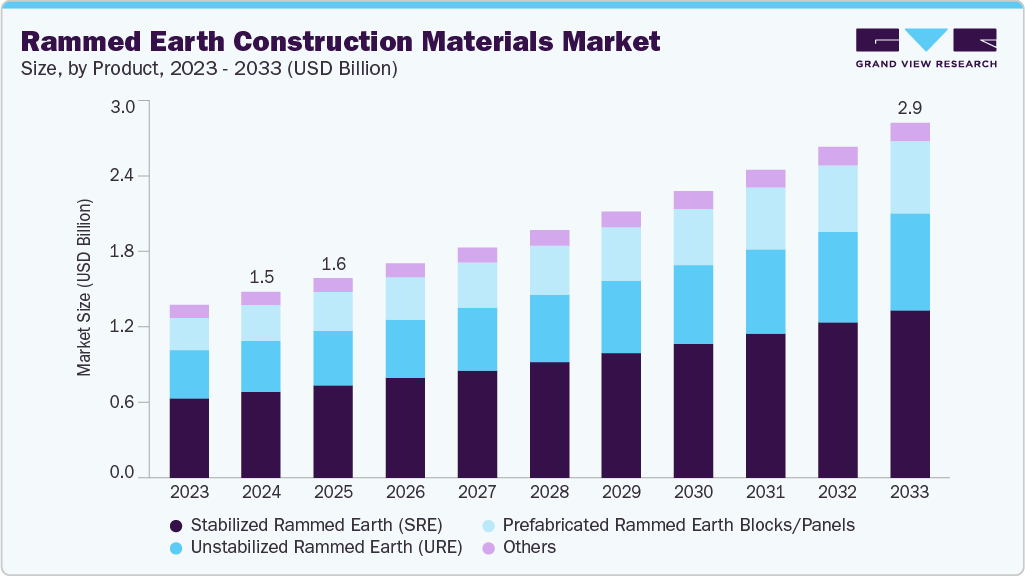
The stabilized rammed earth (SRE) segment led the market, accounting for the largest revenue share of 46.2% in 2024, driven by increasing demand for structurally robust and weather-resistant building materials suitable for modern architectural applications. The addition of stabilizing agents, such as cement or lime, enhances the compressive strength, water resistance, and longevity of SRE, making it an ideal choice for both residential and commercial buildings. The growing adoption of urban construction is attributed to its low embodied energy and superior thermal performance. The segment benefits from rising investments in green building technologies and sustainable construction certifications.
The prefabricated rammed earth blocks/panels segment is expected to grow at the fastest CAGR of 8.1% over the forecast period, driven by advancements in modular construction and the increasing need for time-efficient building solutions. Prefabrication techniques enable controlled production, consistent quality, and reduced on-site labor requirements, appealing to large-scale developers and public infrastructure projects. The rising popularity of modular and prefabricated eco-homes is also fueling demand for these ready-to-install elements. The segment benefits from technological advancements in formwork systems and compaction machinery, which ensure uniform density and structural integrity.
End-use Insights
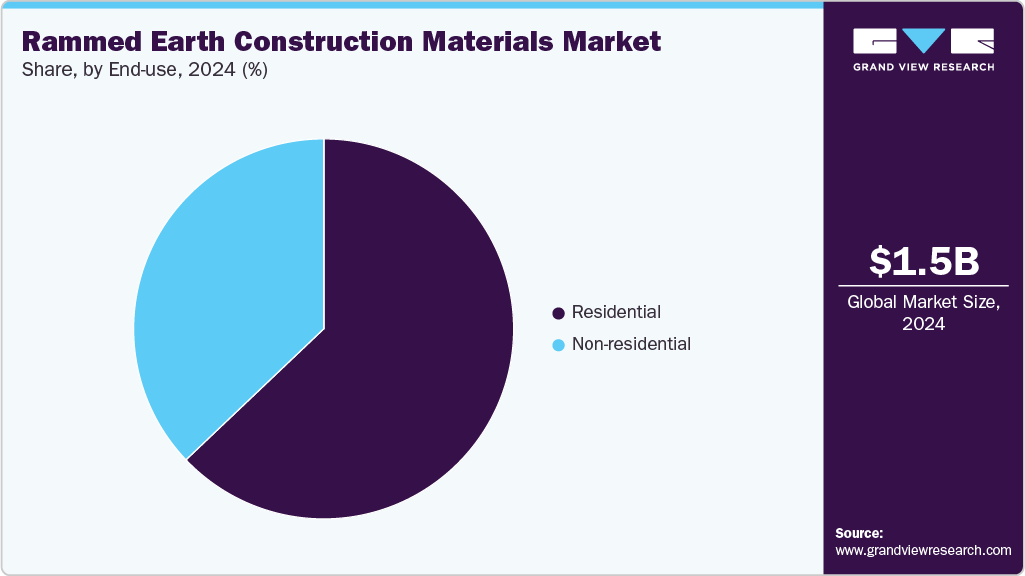
Residential dominated the market, accounting for the largest revenue share of 62.9% in 2024, driven by a growing consumer preference for sustainable, energy-efficient, and aesthetically distinctive housing. Homeowners are increasingly opting for rammed earth due to its natural thermal insulation, durability, and low maintenance requirements. The rising awareness of eco-friendly construction methods and carbon-neutral living further supports the adoption of these practices. Moreover, government incentives for green home development and sustainable design certifications such as LEED and BREEAM are boosting demand.
 To learn more about this report, Download Free Sample Report
 Non-residential is expected to grow significantly at a CAGR of 7.3% over the forecast period, driven by expanding applications of rammed earth materials in commercial, institutional, and public infrastructure projects. Architects and developers are incorporating rammed earth for its acoustic performance, fire resistance, and unique visual texture in educational facilities, offices, and cultural centers. Growing emphasis on corporate sustainability and eco-conscious branding among enterprises is encouraging the use of low-carbon materials in construction. Moreover, the long lifespan and minimal environmental impact of rammed earth structures appeal to public sector initiatives promoting green building practices.
Regional Insights
The North America rammed earth construction materials market is primarily driven by the region’s growing focus on sustainable architecture and eco-friendly building materials. The increasing adoption of green construction certifications, such as LEED and WELL standards, has encouraged the use of natural materials with low embodied energy. Rising consumer awareness regarding energy-efficient homes and carbon footprint reduction further supports market expansion. Furthermore, government initiatives promoting sustainable infrastructure and resilient building techniques are fueling adoption. Technological advancements in soil stabilization and modern formwork are enhancing material performance and construction efficiency. Overall, demand is gaining momentum in both residential and commercial sectors, emphasizing sustainable design aesthetics.
U.S. Rammed Earth Construction Materials Market Trends
The U.S. rammed earth construction materials marketis driven by a growing preference for natural, low-carbon materials in response to tightening environmental regulations and energy efficiency standards. Federal and state-level incentives for sustainable housing, combined with innovations in green building technologies, have accelerated the adoption of sustainable housing. Prominent architectural firms are experimenting with rammed earth designs for their thermal performance and aesthetic appeal. The trend of off-grid and net-zero homes is also fostering the use of locally sourced earth materials. Moreover, the presence of eco-conscious consumers and sustainable real estate developers is contributing to market growth. The material’s fire resistance and long lifespan add to its appeal in diverse climatic regions across the U.S.
Asia Pacific Rammed Earth Construction Materials Market Trends
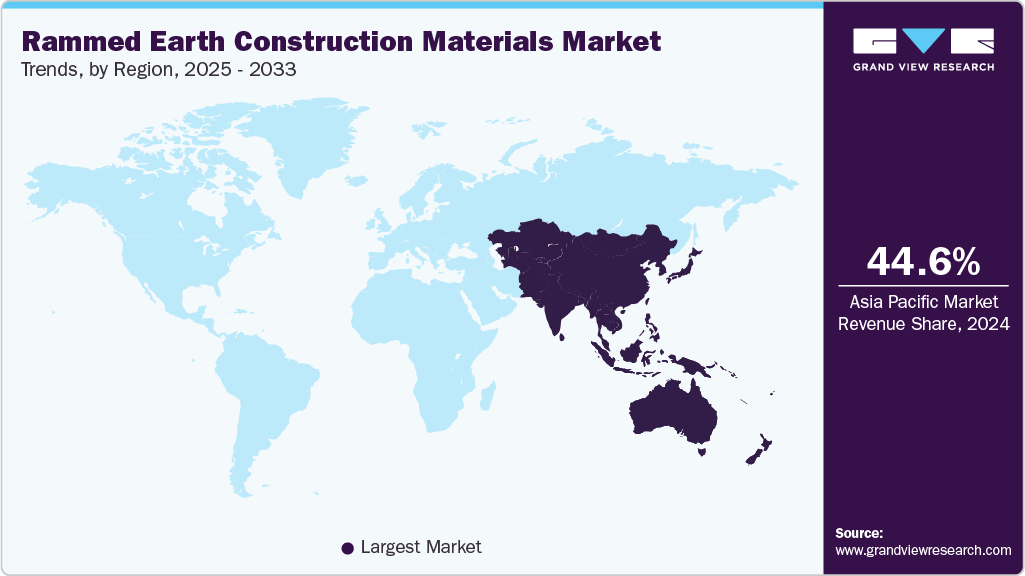
The Asia Pacific held the largest revenue market share of 44.6% in 2024, driven by rising sustainable urban development projects and growing interest in vernacular architecture practices. Countries across the region are adopting eco-friendly materials to balance rapid urbanization with environmental preservation goals. Supportive government policies for sustainable construction in countries like India, Australia, and Japan have strengthened market prospects. Moreover, the growing tourism industry is fueling the use of rammed earth in eco-resorts and cultural infrastructure. Advances in modern compaction technology are making rammed earth more structurally reliable and scalable. The material’s affordability and availability also make it an attractive solution for both rural and urban applications.
 To learn more about this report, Download Free Sample Report
 The rammed earth construction materials market in China growth is driven by a resurgence in traditional building methods aligned with modern sustainability goals. The increasing emphasis on green construction and carbon neutrality targets under national policies is promoting the use of natural materials, such as rammed earth. The government’s push for low-energy buildings and rural revitalization programs has created new opportunities for rammed earth applications. Local developers are adopting innovative stabilization methods to enhance the strength and longevity of rammed earth structures. In addition, cultural heritage preservation projects are reviving ancient construction techniques with modern engineering support. The growing green tourism sector is also boosting demand in eco-friendly architectural developments.
Europe Rammed Earth Construction Materials Market Trends
The rammed earth construction materials market in Europe is driven by stringent environmental regulations and widespread adoption of sustainable construction practices. The European Green Deal and regional policies promoting circular economy principles are encouraging the use of low-carbon materials, such as rammed earth. The region’s architectural sector is increasingly favoring bio-based and locally sourced materials to reduce lifecycle emissions. The growing demand for passive housing and energy-efficient structures further supports its adoption. Educational institutions and research centers are actively developing advanced stabilization techniques to enhance the structural integrity of buildings. Moreover, awareness about the aesthetic and acoustic benefits of rammed earth is increasing its usage in public and residential projects.
Germany rammed earth construction materials marketis fueled by its strong commitment to sustainability, innovation, and eco-conscious construction standards. The country’s focus on energy-efficient building under the Energy Performance of Buildings Directive (EPBD) has encouraged the use of natural materials. German architects and engineers are incorporating rammed earth for its thermal regulation, fire resistance, and recyclability. Research initiatives by universities and green construction firms are optimizing local soil compositions for modern applications. In addition, government incentives for sustainable housing projects are promoting wider market adoption. The cultural appreciation for minimalist and natural aesthetics also aligns well with the design characteristics of rammed earth.
Latin America Rammed Earth Construction Materials Market Trends
The rammed earth construction materials market in Latin America is driven by the growing demand for cost-effective, sustainable housing solutions that cater to the region’s diverse climates. Increasing awareness of traditional building methods combined with eco-friendly innovations supports the use of rammed earth. Governments and NGOs promoting affordable green housing projects are playing a vital role in adoption. The region’s abundant availability of raw materials and low energy requirements for production enhance its economic feasibility. Furthermore, the growing eco-tourism industry is encouraging the use of natural materials in lodges and resorts. These factors collectively strengthen the demand for rammed earth in residential and community-based developments.
Middle East & Africa Rammed Earth Construction Materials Market Trends
The rammed earth construction materials market in the Middle East & Africa is driven by rising interest in sustainable and climate-responsive architecture. Rammed earth’s natural insulation and temperature regulation properties make it ideal for the region’s hot and arid climates. Governments are increasingly investing in green building standards to reduce energy consumption and environmental impact. In Africa, sustainable housing programs and NGO-led projects are promoting affordable earthen construction. The material’s adaptability to local soil and minimal carbon footprint further enhance its relevance. Growing architectural appreciation for blending modern design with indigenous materials is also fueling regional adoption.
Key Rammed Earth Construction Materials Company Insights
Some key players operating in the market include Rammed Earth Enterprises and Martin Rauch ZT GmbH.
-
Rammed Earth Enterprises specializes in residential and commercial projects that utilize natural materials to achieve superior thermal efficiency and aesthetic value. Its product offerings include stabilized rammed earth walls, structural panels, and custom earth mixtures optimized for local soil conditions.
-
Rauch ZT GmbH combines traditional craftsmanship with advanced engineering to produce prefabricated rammed earth panels for residential, cultural, and institutional buildings. Its portfolio includes modular wall systems and prefabricated façade elements designed for sustainability and high thermal mass performance.
The Earth Structures Group and Rammed Earth Works are among the emerging market participants.
-
Earth Structures Group provides comprehensive services, including design consulting, on-site construction, and soil composition testing. Its product offerings encompass commercial, public, and residential rammed earth walls known for durability, aesthetic appeal, and energy efficiency.
-
Rammed Earth Works focuses on structural integrity and environmental sustainability, offering a wide range of products, including stabilized rammed earth walls, pigments, and sealants. It serves clients in both residential and institutional sectors seeking durable and eco-conscious architecture.
Key Rammed Earth Construction Companies:
The following are the leading companies in the rammed earth construction materials market. These companies collectively hold the largest Market share and dictate industry trends.
- Rammed Earth Enterprises
- Martin Rauch ZT GmbH
- Earth Structures Group
- Rammed Earth Works
- David Easton Rammed Earth Builders
- Terra Firma Builders Guild
- Clayworks Limited
- SIREWALL Inc.
- Rammed Earth Consulting
Rammed Earth Construction Materials Market Report Scope
Report Attribute
Details
Market size in 2024
USD 1.5 billion
Estimated market size in 2026
USD 1.7 billion
Projected market size by 2033
USD 2.9 billion
Growth rate
CAGR of 7.5% from 2025 to 2033
Actual data
2021 - 2024
Forecast period
2025 - 2033
Quantitative units
Revenue in USD million/billion, and CAGR from 2025 to 2033
Report coverage
Revenue forecast, company ranking, competitive landscape, growth factors, and trends
Segments covered
End-use, product, region
Regional scope
North America; Europe; Asia Pacific; CSA; MEA
Country scope
U.S.; Canada; Mexico; UK; Germany; France; Italy; Spain; China; India; Japan
Key companies profiled
Rammed Earth Enterprises; Martin Rauch ZT GmbH; Earth Structures Group; Rammed Earth Works; David Easton Rammed Earth Builders; Terra Firma Builders Guild; Clayworks Limited; SIREWALL Inc.; Rammed Earth Consulting
Customization scope
Free report customization (equivalent up to 8 analysts’ working days) with purchase. Addition or alteration to country, regional & segment scope.
Pricing and purchase options
Avail customized purchase options to meet your exact research needs. Explore purchase options
Global Rammed Earth Construction Materials Market Report Segmentation
This report forecasts revenue growth at global, regional, and country levels and provides an analysis of the latest industry trends in each of the sub-segments from 2021 to 2033. For this study, Grand View Research has segmented the global rammed earth construction materials market report based on product, end-use, and region:
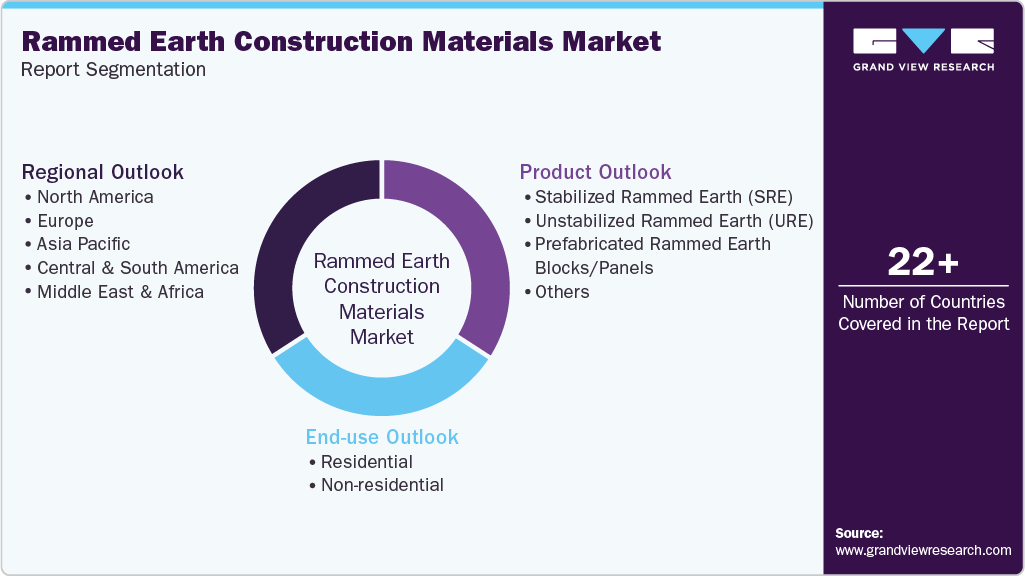 To learn more about this report, Download Free Sample Report
 -
Product Outlook (Revenue, USD Million, 2021 - 2033)
-
Stabilized Rammed Earth (SRE)
-
Unstabilized Rammed Earth (URE)
-
Prefabricated Rammed Earth Blocks/Panels
- Others
-
-
End-use Outlook (Revenue, USD Million, 2021 - 2033)
-
Residential
-
Non-residential
-
-
Regional Outlook (Revenue, USD Million, 2021 - 2033)
-
North America
-
U.S.
-
Canada
-
Mexico
-
-
Europe
-
Germany
-
UK
-
France
-
Italy
-
Spain
-
-
Asia Pacific
-
China
-
Japan
-
India
-
-
Central & South America
-
Middle East & Africa
-
Frequently Asked Questions About This Report
The global rammed earth construction materials market size was valued at USD 1.5 billion in 2024 and is estimated at USD 1.7 billion for 2026.
The global rammed earth construction materials market is expected to grow at a CAGR of 7.5% from 2025 to 2033, reaching USD 2.9 billion by 2033.
Stabilized rammed earth (SRE) segment led the market and accounted for the largest revenue share of 46.2% in 2024, driven by increasing demand for structurally robust and weather-resistant building materials suitable for modern architectural applications.
Some of key players in the rammed earth construction materials market are Rammed Earth Enterprises, Martin Rauch ZT GmbH, Earth Structures Group, Rammed Earth Works, David Easton Rammed Earth Builders, Terra Firma Builders Guild, Clayworks Limited, SIREWALL Inc., and Rammed Earth Consulting.
The key factors driving the rammed earth construction materials market include growing emphasis on sustainable and low-carbon construction practices, increasing adoption of energy-efficient building materials, advancements in stabilization and prefabrication technologies, supportive government regulations promoting green architecture, and rising consumer awareness toward environmentally friendly and durable construction alternatives.
About the Author(s)
Advanced Interior Materials Research Team
Advanced Materials · Advanced Interior MaterialsThis report was authored by the advanced interior materials research team at Grand View Research - comprising two research analysts, one senior research analyst, and one industry expert - with specialized expertise in the advanced interior materials segment of the advanced materials industry. All findings are based on proprietary advanced materials databases, executive interviews, and regulatory analysis, subject to internal peer review prior to publication.
Last Updated:
Speak to Analyst

Customize this report to your needs - add regions, segments, or data points, with 20% free customization.
Or view our licence options:


ISO 9001:2015 & 27001:2022 Certified
We are GDPR and CCPA compliant! Your transaction & personal information is safe and secure. For more details, please read our privacy policy.


