
- Home
- »
- Advanced Interior Materials
- »
-
Recycled Fibers Market Size & Share, Industry Report, 2030GVR Report cover

Recycled Fibers Market (2025 - 2030) Size, Share & Trends Analysis Report By Material (Synthetic Recycled Fibers, Natural Recycled Fibers), By End-use (Textile & Apparel, Automotive, Construction), By Region, And Segment Forecasts
Market Size, 2024
$26.3BMarket Estimate, 2026
$28.3BMarket Forecast, 2030
$40.8BCAGR, 2025–2030
7.6%Recycled Fibers Market Summary
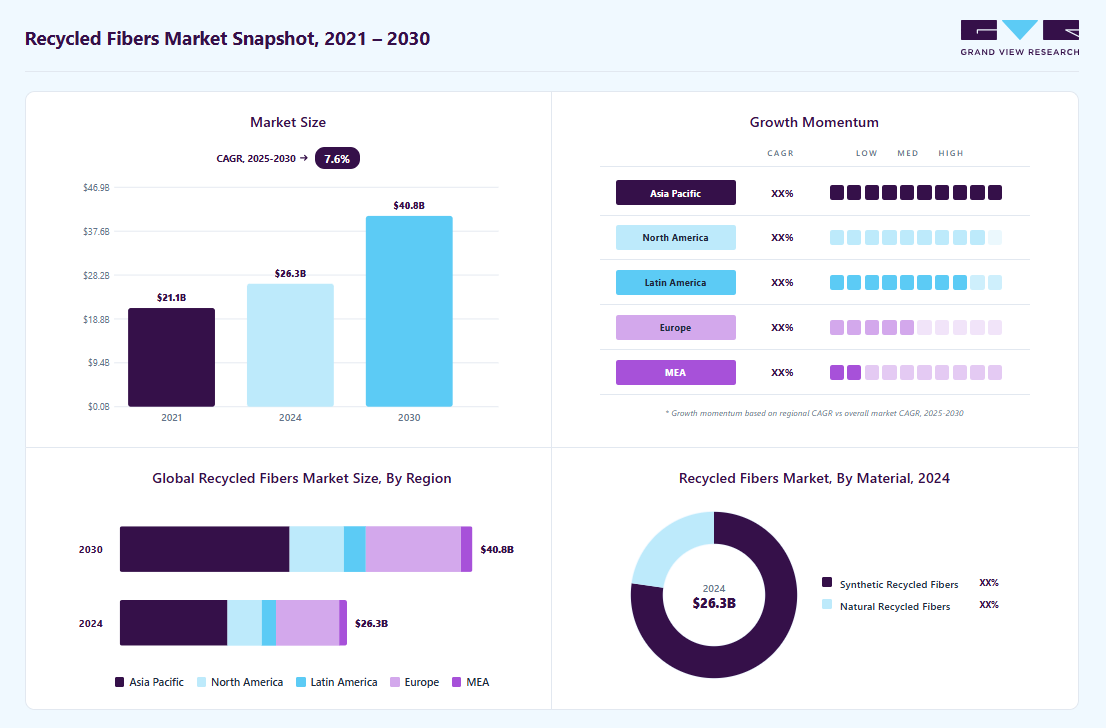
The global recycled fibers market size was estimated at USD 26.31 billion in 2024 and is projected to reach USD 40.82 billion by 2030, growing at a CAGR of 7.6% from 2025 to 2030, driven by increasing environmental awareness, regulatory pressures, and technological advancements. Consumers, particularly younger demographics like millennials and Gen Z, are prioritizing sustainability in their purchasing decisions, leading to a heightened demand for eco-friendly textiles.
 Source: Grand View Research, IR Documents, Primary Interviews, Paid DatabasesTo learn more about this report,
 Download Free Sample Report
Key Market Trends & Insights
- Asia Pacific recycled fibers market dominated globally with the revenue share of about 47.3% in 2024.
- The U.S. recycled fibers market is anticipated to register significant CAGR over the forecast period.
- By material, the synthetic recycled fibers segment led the market with a revenue share of 77.3% in 2024.
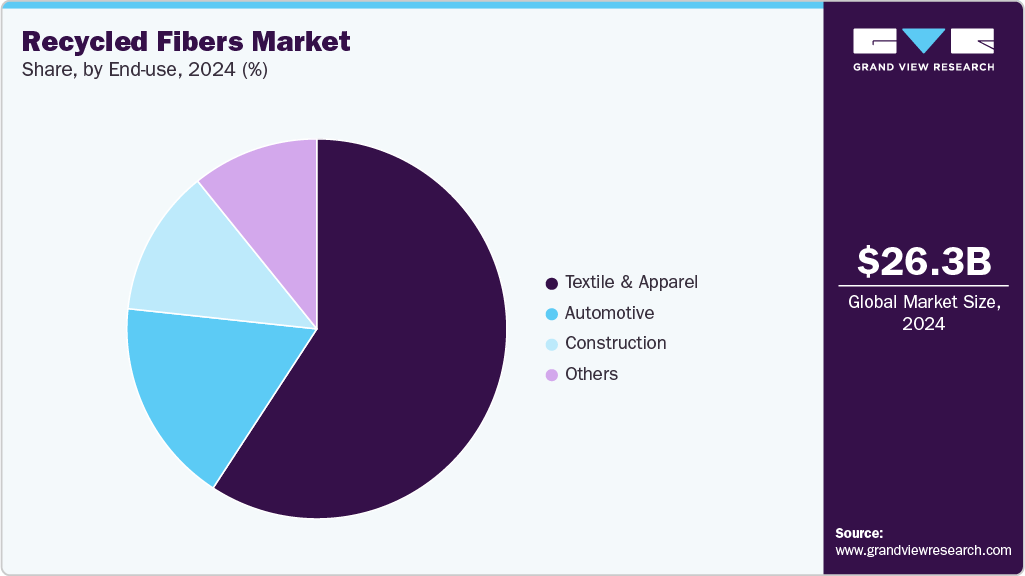
- By end-use, the textile & apparel segment dominated the market with a revenue share of 59.2% in 2024.
Market Size & Forecast
- 2024 Market Size: USD 26.31 Billion
- 2030 Projected Market Size: USD 40.82 Billion
- CAGR (2025-2030): 7.6%
- Asia Pacific: Largest market in 2024
Three ways to get this report
Buy it, customize it, or ask a question.Ask an Analyst
Analyst response in 1 business day
- AccessReport author, directly
- Reply timeWithin 1 working day
- No sales callDirect answer only
- FormatEmail reply
- CostFree, no cost
Get the Full Report
What the study covers
- FormatsPDF · Excel · Dashboard
- Timeline2025–2030 annual, 2024 base
- Coverage20+ countries, 5 regions
- Companies10+ key players profiled
Customize the Report
20% free customization
- IncludeCountries, segments, points
- TailorTo your product definition
- ExtendDeeper competitor detail
- OrA fully bespoke study
- Turnaround5–10 working days
Consumers, particularly younger demographics like millennials and Gen Z, are prioritizing sustainability in their purchasing decisions, leading to a heightened demand for eco-friendly textiles. Governments worldwide are implementing stricter regulations to reduce textile waste and promote circular economies, compelling manufacturers to adopt sustainable practices. Technological innovations in recycling processes have improved the quality and efficiency of recycled fibers, making them more competitive with virgin materials.Several factors are propelling the demand for recycled fibers. Environmental concerns, such as the negative impacts of the textile industry on the planet, are motivating both consumers and businesses to seek sustainable alternatives. The concept of a circular economy, focusing on reducing waste and reusing materials, is gaining traction, encouraging the adoption of recycled fibers. In addition, using recycled fibers can result in cost savings for manufacturers by reducing the need for virgin raw materials and lowering waste disposal costs.
 To learn more about this report, Download Free Sample Report
Innovations in the recycled fibers industry are enhancing the quality and applicability of recycled materials. Advancements in recycling technologies, including mechanical and chemical recycling methods, have improved the efficiency of converting waste materials into high-quality fibers. For example, companies like Aquafil S.p.A. have developed technologies to produce textile fibers from wood pulp without harmful chemicals, and initiatives like Project Re:claim are recycling polyester textiles into new yarns. These innovations are expanding the potential applications of recycled fibers across various industries, including fashion, automotive, and construction.
Market Concentration & Characteristics
The recycled fibers industry is moderately concentrated, with a mix of established global players and emerging regional manufacturers competing in the space. Major companies such as Unifi Inc., Martex Fiber, and Sateri hold significant market shares due to their advanced recycling technologies, large-scale operations, and strategic partnerships with fashion and textile brands. However, the market also sees growing participation from smaller, innovative firms that focus on niche applications or local supply chains. This competition is fostering a dynamic environment where companies are investing in research and development to improve fiber quality, enhance process efficiency, and strengthen sustainability credentials to differentiate themselves.
 To learn more about this report, Download Free Sample Report
Despite the market growth, recycled fibers face competition from various product substitutes. Virgin fibers such as cotton, polyester, and wool continue to dominate many segments due to their consistency, quality, and established supply chains. In addition, alternatives like lyocell and bamboo-based fibers, which are considered sustainable but are not necessarily recycled, also pose a threat. These substitutes often offer better performance characteristics, such as softness or durability, which can challenge the broader adoption of recycled fibers. However, as environmental regulations tighten and consumer demand for sustainable products increases, recycled fibers are expected to gain a stronger competitive edge over traditional and semi-sustainable alternatives.
Material Insights
The synthetic recycled fibers segment led the market with the largest revenue share of 77.3% in 2024, mainly due to the widespread use and recycling of polyester (rPET). These fibers are primarily sourced from post-consumer PET bottles and textile waste, making them abundant and cost-effective. Synthetic recycled fibers offer strong durability, resilience, and versatility, making them ideal for use in various applications, including sportswear, automotive interiors, home furnishings, and industrial textiles. Leading brands in fashion and apparel have adopted rPET in their sustainability strategies, further accelerating demand and establishing this segment’s leadership in the market.
Natural recycled fibers, such as recycled cotton, wool, and hemp, are anticipated to represent the fastest-growing segment due to rising consumer demand for biodegradable and less chemically processed alternatives. Although currently smaller in market share, natural recycled fibers are gaining popularity for their lower environmental footprint and compatibility with circular fashion trends. Advances in textile sorting and fiber recovery technologies are making recycling post-consumer cotton garments at scale more feasible. As eco-conscious consumers and sustainable fashion brands prioritize biodegradability and carbon reduction, this segment will witness robust growth in the coming years.
End-use Insights
The textile & apparel segment dominated the market with the largest revenue share of 59.2% in 2024, driven by increasing consumer awareness around sustainability and the push for circular fashion. Major global brands such as Adidas, H&M, and Patagonia are incorporating recycled fibers, particularly recycled polyester and cotton, into their product lines to reduce environmental impact and meet sustainability targets. The vast volume of textile production and consumption globally, especially in fast fashion, creates both a significant demand for recycled materials and a steady supply of textile waste, reinforcing this sector's leading position.
 To learn more about this report, Download Free Sample Report
The automotive industry is anticipated to emerge as the fastest-growing segment in the market. Automakers increasingly incorporate recycled materials into vehicle interiors, insulation, and soundproofing components to align with stringent environmental regulations and sustainability goals. Recycled fibers help reduce vehicle weight, improve fuel efficiency, and support circular material use, especially in electric vehicle (EV) production. As the automotive sector shifts toward greener manufacturing, the demand for high-performance, sustainable materials like recycled PET and natural fiber blends is expected to grow rapidly.
Regional Insights
North America recycled fibers market holds a significant position globally, driven by a combination of consumer demand, regulatory support, and corporate sustainability initiatives. The region has seen increasing interest in eco-conscious products, particularly in sectors such as fashion, automotive, and furniture. Leading apparel companies, including Nike and Levi’s, are incorporating recycled fibers into their product lines, while automakers like Ford and General Motors are using them in vehicle interiors. In addition, growing investment in R&D, the development of advanced recycling technologies, and partnerships between municipalities and private enterprises are helping strengthen North America's recycling infrastructure, enabling the region to process and utilize more textile waste efficiently.
U.S. Recycled Fibers Market Trends
The U.S. recycled fibers industry is at the forefront in the North American region. With a strong emphasis on sustainable product development and circular business models, the U.S. market is seeing robust adoption of recycled fibers across various industries. Government and state-level initiatives promote waste diversion and resource recovery, while innovative startups and established manufacturers are advancing chemical recycling techniques to improve fiber quality and usability. Furthermore, rising consumer preference for ethically produced clothing and increased collaboration between fashion brands and recycling companies create a fertile market expansion environment. Educational campaigns and NGO-led programs are also helping to raise public awareness about textile recycling.
Asia Pacific Recycled Fibers Market Trends
Asia Pacific recycled fibers industry dominated globally with the largest revenue share of about 47.3% in 2024, driven by its massive textile production base and well-established recycling infrastructure. Countries like China, India, and Bangladesh serve as key hubs for both the generation of textile waste and the consumption of recycled fibers, thanks to their roles in the global apparel supply chain. The presence of low-cost labor, abundant raw materials, and large-scale textile manufacturers gives the region a competitive edge. Furthermore, growing awareness of environmental issues, government initiatives supporting sustainability, and increasing demand from domestic and international brands for recycled content further boost the market. The rising adoption of circular economy practices and increased investment in innovative recycling technologies are expected to sustain Asia Pacific's lead in the years ahead.
 To learn more about this report, Download Free Sample Report
China recycled fibers industry is the largest contributor to the Asia Pacific market, with a highly developed textile industry and an increasing focus on sustainable production. As one of the top recyclers of PET bottles and post-consumer textiles, China has built an extensive ecosystem for both mechanical and chemical recycling. The government’s aggressive push toward a greener economy through initiatives like the “Made in China 2025” and the Green Supply Chain program is encouraging companies to adopt recycled fibers in large volumes. Moreover, China's role as a manufacturing giant for international brands drives strong export demand for garments and textiles made with recycled content. Continued innovation and expansion of recycling facilities position China to remain a global leader in the sector.
Europe Recycled Fibers Market Trends
The recycled fibers industry in Europe remains a global sustainability leader and is a mature market for recycled fibers, supported by stringent environmental regulations and progressive waste management systems. The European Union’s Circular Economy Action Plan, Extended Producer Responsibility (EPR) schemes, and other green policies are driving manufacturers to integrate recycled content in textiles and other products. Major fashion houses, automakers, and furniture companies in the region have set ambitious sustainability goals, resulting in a growing reliance on recycled inputs. Europe’s highly developed sorting and collection infrastructure, particularly in countries like Germany, the Netherlands, and France, allows for better recovery of post-consumer textile waste, facilitating higher-quality recycled fiber production and broader usage across industries.
Germany recycled fibers industry stands out as a key innovator in the European market, known for its strict environmental laws, advanced technology, and strong emphasis on sustainable industrial practices. German companies are actively investing in closed-loop production systems, and the country has become a center for pilot projects and technological advancement in fiber recycling. High environmental consciousness among consumers and manufacturers alike has spurred demand for recycled textiles in the fashion, automotive, and construction sectors. Furthermore, public-private partnerships and government subsidies support continued research and infrastructure development, reinforcing Germany’s leadership role in the region's circular economy transition.
Central & South America Recycled Fibers Market Trends
The Central & South America recycled fibers industry is an emerging market, gradually catching up with global sustainability trends. The region is witnessing increased awareness about the environmental impact of textile waste, particularly in larger economies like Brazil, Chile, and Argentina. Brazil, in particular, has a growing number of textile manufacturers that are incorporating recycled fibers into home furnishings, workwear, and fashion products. However, the region still faces significant challenges, including underdeveloped waste collection systems, limited technological infrastructure, and a lack of policy enforcement. Despite these barriers, government and NGO-led initiatives, combined with rising consumer interest in sustainable products, are beginning to drive progress.
Middle East & Africa Recycled Fibers Market Trends
The Middle East & Africa recycled fibers industry represents the smallest but steadily growing region globally. While the region faces infrastructural and regulatory limitations, there is growing momentum, particularly in countries like the UAE, Saudi Arabia, and South Africa. Governments are increasingly incorporating sustainability into national development plans, such as Saudi Vision 2030 and the UAE’s Green Agenda. These initiatives are creating opportunities for investment in textile recycling and circular manufacturing. In addition, international collaborations and funding from global environmental organizations are helping to launch pilot projects aimed at improving waste management and fiber recovery. As industrialization and urbanization accelerate, the demand for eco-friendly materials, including recycled fibers, will also increase.
Key Recycled Fibers Company Insights
Some of the key players operating in the market include Indorama Ventures Public Company Limited and Reliance Industries Limited
-
Indorama Ventures is the world's largest producer of polyethylene terephthalate (PET), operating recycling facilities across Asia, Europe, and the U.S. Since entering the recycling business in 2011, the company has transformed post-consumer PET bottles into recycled polyester yarns, supporting sustainability goals globally. In 2023, Indorama generated approximately 1.4% of its total revenues from recycled products, with an estimated total avoided emissions of 324,256 tCO₂e.
-
Reliance Industries is a major player in India’s recycled fibers industry, operating advanced PET recycling plants that convert vast amounts of plastic waste into high-quality fibers. The company is focused on expanding its recycling capacity and developing sustainable, circular materials to support environmental goals.
Recover Textile Systems and UNIFI, Inc., are some of the emerging market participants in the recycled fibers industry.
-
Recover Textile Systems specializes in mechanically recycling cotton textile waste into new recycled cotton fibers. Focused on textile-to-textile recycling, the company aims to promote sustainability by turning pre-consumer and post-consumer textile waste into yarns for fresh fabric production.
-
Unifi, Inc. is a leading innovator in recycled synthetic yarns, producing REPREVE fibers made from recycled plastic bottles and textile waste. Through its programs, Unifi supports circular supply chains by collecting and converting polyester fabric waste into performance fibers used in various industries.
Key Recycled Fibers Companies:
The following are the leading companies in the recycled fibers market. These companies collectively hold the largest market share and dictate industry trends.
- Indorama Ventures Public Company Limited
- Reliance Industries Limited
- Recover Textile Systems
- UNIFI, Inc.
- Lenzing AG
- Patagonia.
- Infinited Fiber Company.
- Recover Textile Systems
- Aquafil S.p.A.
- Hyosung TNC
Recent Developments
-
In August 2024, Unifi launched ThermaLoop, a down-like insulation material made from 100% recycled polyester that is machine-washable, lightweight, and highly thermally efficient.
Recycled Fibers Market Report Scope
Report Attribute
Details
Market size value in 2025
USD 28.30 billion
Revenue forecast in 2030
USD 40.82 billion
Growth rate
CAGR of 7.6% from 2025 to 2030
Base year for estimation
2024
Historical data
2018 - 2023
Forecast period
2025 - 2030
Quantitative units
Revenue in USD million/billion, and CAGR from 2025 to 2030
Report coverage
Revenue forecast, company ranking, competitive landscape, growth factors, and trends
Segments covered
Material, end-use, region
Regional scope
North America; Europe; Asia Pacific; Central & South America; Middle East & Africa
Country scope
U.S.; Canada; Mexico; U.K.; Germany; France; Italy; Spain; China; India; Japan; South Korea
Key companies profiled
Indorama Ventures Public Company Limited; Reliance Industries Limited; Mycoworks; UNIFI, Inc.; Lenzing AG; Patagonia; Infinited Fiber Company; Recover Textile Systems; Hyosung TNC; Aquafil S.p.A.
Customization scope
Free report customization (equivalent to 8 analysts’ working days) with purchase. Addition or alteration to country, regional & segment scope.
Pricing and purchase options
Avail customized purchase options to meet your exact research needs. Explore purchase options
Global Recycled Fibers Market Report Segmentation
This report forecasts revenue growth at the global, regional, and country levels and provides an analysis of the latest industry trends in each of the sub-segments from 2018 to 2030. For this study, Grand View Research has segmented the global recycled fibers market report based on material, end-use, and region.
 To learn more about this report, Download Free Sample Report
-
Material Outlook (Revenue, USD Million, 2018 - 2030)
-
Synthetic Recycled Fibers
-
Natural Recycled Fibers
-
-
End-use Outlook (Revenue, USD Million, 2018 - 2030)
-
Textile & Apparel
-
Automotive
-
Construction
-
Others
-
-
Regional Outlook (Revenue, USD Million, 2018 - 2030)
-
North America
-
U.S.
-
Canada
-
Mexico
-
-
Europe
-
Germany
-
UK
-
France
-
Italy
-
Spain
-
-
Asia Pacific
-
China
-
Japan
-
India
-
South Korea
-
-
Central & South America
-
Middle East & Africa
-
Frequently Asked Questions About This Report
The global recycled fibers market size was estimated at USD 26.31 billion in 2024 and is expected to reach USD 28.30 billion in 2025.
The global recycled fibers market is expected to grow at a compound annual growth rate of 7.6% from 2025 to 2030 to reach USD 40.82 billion by 2030.
The synthetic recycled fibers segment led the market and accounted for the largest revenue share, 77.3%, in 2024, due to their wide availability, durability, and cost-effectiveness across diverse applications like apparel and automotive.
Indorama Ventures Public Company Limited, Reliance Industries Limited, Recover Textile Systems, UNIFI, Inc., Lenzing AG, Patagonia, Infinited Fiber Company, Recover Textile Systems, Hyosung TNC, and Aquafil S.p.A. are prominent companies in the recycled fibers market.
Rising environmental awareness, government regulations, circular economy initiatives, and growing consumer demand for sustainable products are key factors driving the recycled fibers market.
About the Author(s)
Advanced Interior Materials Research Team
Advanced Materials · Advanced Interior MaterialsThis report was authored by the advanced interior materials research team at Grand View Research - comprising two research analysts, one senior research analyst, and one industry expert - with specialized expertise in the advanced interior materials segment of the advanced materials industry. All findings are based on proprietary advanced materials databases, executive interviews, and regulatory analysis, subject to internal peer review prior to publication.
Last Updated:
Speak to Analyst

Customize this report to your needs - add regions, segments, or data points, with 20% free customization.
Or view our licence options:


ISO 9001:2015 & 27001:2022 Certified
We are GDPR and CCPA compliant! Your transaction & personal information is safe and secure. For more details, please read our privacy policy.


