
- Home
- »
- Advanced Interior Materials
- »
-
Recycled Refractories Market Size Report, 2026-2033GVR Report cover

Recycled Refractories Market (2026 - 2033)
Size, Share & Trends Analysis Report By Product (Silica, Alumina, Magnesia), By End-use (Iron & Steel, Cement & Lime, Glass & Ceramics, Non-Ferrous Metals), By Region, And Segment Forecasts
Market Size, 2025
$14.4BMarket Estimate, 2026
$15.4BMarket Forecast, 2033
$28.5BCAGR, 2026–2033
9.2%Recycled Refractories Market Summary
The recycled refractories market size was valued at USD 14.4 billion in 2025 and is projected to grow from USD 15.4 billion in 2026 to USD 28.5 billion by 2033, at a CAGR of 9.2% from 2026 to 2033. Asia Pacific dominated the recycled refractories market with the largest revenue share of 75.2% in 2025. As the world becomes more conscious of the environmental impact of industrial activities, recycling has gained significant attention.
 Source: Grand View Research, IR Documents, Primary Interviews, Paid DatabasesTo learn more about this report,
 Download Free Sample Report
 Key Market Trends & Insights
- By end use: Iron and steel segment held the largest market share of 66.7% in 2025.
- By product: Alumina segment held the largest market share of 47.1% in 2025.
Regional Highlights
- Largest regional market: Asia Pacific (75.2% revenue share, 2025)
- By country: China held the largest market share in 2025
Market Size & Forecast
- Market size in 2025: USD 14.4 Billion
- Estimated market size in 2026: USD 15.4 Billion
- Projected market size by 2033: USD 28.5 Billion
- CAGR (2026-2033): 9.2%
Three ways to get this report
Buy it, customize it, or ask a question.Ask an Analyst
Analyst response in 1 business day
- AccessReport author, directly
- Reply timeWithin 1 working day
- No sales callDirect answer only
- FormatEmail reply
- CostFree, no cost
Get the Full Report
What the study covers
- FormatsPDF · Excel · Dashboard
- Timeline2026–2033 annual, 2025 base
- Coverage20+ countries, 5 regions
- Companies10+ key players profiled
Customize the Report
20% free customization
- IncludeCountries, segments, points
- TailorTo your product definition
- ExtendDeeper competitor detail
- OrA fully bespoke study
- Turnaround5–10 working days
Refractory materials, heat-resistant and crucial in high-temperature processes such as steel, cement, and glass production, are often subjected to extreme conditions that lead to wear and degradation. Instead of discarding these materials, industries find value in recycling and reusing them, thus reducing waste and conserving resources. This trend aligns with global goals of reducing carbon footprints and mitigating the environmental effects of manufacturing processes. To learn more about this report, Download Free Sample Report
 Traditional refractory materials, such as alumina, magnesia, and silica, are often expensive to mine and process. As the prices of these raw materials fluctuate, industries seek alternative sources to ensure cost-effectiveness and resource availability. Recycled refractories, derived from the leftover materials of industrial processes, offer a more affordable and sustainable option. As a result, companies are increasingly turning to recycling solutions to minimize costs while maintaining the performance of their refractories.
Modern recycling techniques have made it possible to efficiently clean, process, and reuse refractory materials that were once discarded as waste. Innovations such as advanced separation technologies, chemical treatments, and mechanical processes have improved the quality of recycled refractories, making them more viable for reuse in industrial applications. These advancements have expanded the potential for recycling and ensured that recycled materials maintain the high performance required in demanding industries.
Regulatory pressures and sustainability goals imposed by governments and environmental organizations further propel the demand for recycled refractories. Policies to reduce industrial waste, lower emissions, and promote circular economies are becoming more stringent. In response, many companies in sectors such as steel, cement, and foundries are adopting recycling programs to comply with regulations. Recycled refractories offer a solution that helps businesses meet their environmental targets while reducing their dependency on non-renewable resources. This regulatory environment has incentivized businesses to invest in recycling technologies and adopt sustainable practices.
The global movement towards a circular economy is another vital driver behind the growth of recycled refractories. This approach emphasizes resource efficiency by maximizing material use throughout its lifecycle while minimizing waste generation. As industries increasingly recognize the importance of sustainability, there is a collective push towards adopting practices that support material reuse and recycling initiatives within manufacturing processes. In June 2024, MIRECO, a joint venture between RHI Magnesita and Horn & Co. Group, expanded its production footprint in Italy by acquiring Refrattari Trezzi, a specialist in refractory recycling. This strategic acquisition enhances MIRECO's ability to supply high-value secondary raw materials and customized services to the steel and industrial sectors, reinforcing its commitment to sustainability and the circular economy.
Market Dynamics
The recycled refractories market is experiencing steady growth driven by increasing sustainability initiatives, rising raw material costs, and growing adoption of circular economy practices across high-temperature industries. End-use sectors such as iron & steel, cement, glass, non-ferrous metals, and ceramics are increasingly incorporating recycled refractory materials to reduce landfill waste, lower production costs, and decrease dependence on virgin refractory minerals. Stringent environmental regulations regarding industrial waste disposal and carbon emissions are further encouraging the use of recycled refractories. In addition, advancements in refractory processing technologies and improved quality control measures are enhancing the performance and acceptance of recycled refractory products, supporting market expansion globally.
The increasing emphasis on sustainability and waste reduction across industrial sectors is a key factor driving the recycled refractories market. Industries such as iron & steel, cement, glass, and non-ferrous metals generate substantial volumes of spent refractory materials during furnace maintenance and relining operations. Traditionally, much of this material was disposed of in landfills; however, growing environmental regulations and corporate sustainability commitments are encouraging manufacturers to recover, process, and reuse these materials. Recycling refractories helps reduce industrial waste, conserve natural resources, and lower the environmental footprint associated with extracting and processing virgin refractory minerals.
In addition, rising raw material costs and supply chain uncertainties are accelerating the adoption of recycled refractory products. Critical refractory minerals such as magnesia, bauxite, and alumina are becoming increasingly expensive due to mining restrictions, energy costs, and geopolitical factors affecting supply. Recycled refractories provide a cost-effective alternative while maintaining acceptable performance in many industrial applications. Major steel producers and refractory manufacturers are investing in closed-loop recycling programs and advanced processing technologies to improve material recovery rates and support circular economy objectives. As industries continue to prioritize resource efficiency and carbon reduction, demand for recycled refractories is expected to grow steadily over the forecast period.
Variability in the chemical composition and physical properties of spent refractory materials remains a major challenge for the recycled refractories market. Refractory products are exposed to different operating conditions, resulting in contamination, wear, and structural degradation that can affect recyclability. Maintaining consistent quality and performance standards for recycled refractories often requires extensive sorting, processing, and testing procedures, increasing operational complexity and costs. Furthermore, some critical applications in steelmaking and other high-temperature processes continue to prefer virgin refractory materials due to concerns regarding durability, reliability, and process safety.
The growing emphasis on resource efficiency and conservation of critical refractory minerals presents significant opportunities for the recycled refractories market. Key raw materials such as magnesia, bauxite, and alumina are subject to supply constraints, price volatility, and environmental regulations governing mining activities. As a result, manufacturers are increasingly investing in refractory recycling technologies to recover valuable materials from spent refractories and reduce dependence on virgin resources. Furthermore, governments and industrial organizations are promoting waste valorization and circular manufacturing practices, creating favorable conditions for recycled refractory adoption. Continued advancements in processing technologies and increasing acceptance of recycled materials across end-use industries are expected to generate substantial growth opportunities throughout the forecast period.
Analyst Perspective
The recycled refractories market is gaining momentum as industries increasingly prioritize waste reduction, resource efficiency, and sustainable manufacturing practices. Growing adoption of circular economy initiatives in iron & steel, cement, glass, and non-ferrous metals industries is driving demand for recycled refractory materials as a cost-effective alternative to virgin raw materials. Rising environmental regulations, increasing disposal costs, and supply constraints for key refractory minerals further support market growth. While challenges related to material quality and recovery infrastructure persist, ongoing advancements in recycling technologies and stronger industry commitment to sustainability are expected to drive steady market expansion over the coming years.
End Use Insights
Based on end use, the iron and steel segment led the market with the largest revenue share of 66.7% in 2025. Recycled refractories, crucial in steel production, offer a sustainable alternative to traditional materials, aligning with the growing focus on reducing industrial waste and carbon emissions. As steelmakers strive to improve operational efficiency and reduce their environmental footprint, the demand for recycled refractories continues to rise. These materials are highly valued for maintaining high performance while offering significant savings compared to fresh refractory products, driving their increasing adoption in the steel sector.
Cement & lime is anticipated to grow significantly over the forecast period. The ongoing urbanization and infrastructure development across emerging markets contribute to the rising demand for cement. As cities expand, the need for residential, commercial, and industrial buildings grows, increasing cement consumption. Consequently, this surge in demand for cement results in higher requirements for refractory materials, which are vital for maintaining the high-temperature environments inside kilns and furnaces. The adoption of recycled refractories in cement helps meet this demand more sustainably by reducing costs and improving resource efficiency.
Product Insights
Based on product, the alumina segment led the market with the largest revenue share of 47.1% in 2025. Alumina is crucial in high-temperature industrial processes, including steel, cement, glass, and non-ferrous metal production. As industries seek to lower their environmental impact, recycling Alumina not only contributes to reducing waste but also significantly cuts down on the need for virgin materials. This aligns with the growing trend of circular economy practices, where manufacturers strive to reintroduce materials back into the production cycle, fostering sustainability in high-energy-consuming industries.
 To learn more about this report, Download Free Sample Report
 Magnesia is anticipated to register the fastest CAGR over the forecast period. As magnesia-based refractories are widely used in high-temperature applications such as furnaces, kilns, and converters, the increasing demand for these industries is a key driver for the growth of recycled magnesia refractories. Manufacturers focus on recycling these refractories to reduce costs while maintaining performance, appealing to industries looking for eco-friendly and cost-efficient solutions. Additionally, the push for sustainability and resource conservation encourages using recycled magnesia, which helps reduce the environmental impact of mining new magnesia.
Regional Insights
North America’s recycled refractories market is anticipated to grow significantly over the forecast period. The region has a well-established industrial base, and with an increasing focus on sustainability and resource efficiency, the demand for recycled refractories has increased. The region’s strong industrial sector continues to drive the need for refractories, while recycling offers a cost-effective and eco-friendly solution.
U.S. Recycled Refractories Market Trends
The U.S. recycled refractories market is anticipated to grow steadily, driven by increasing demand from steel and cement industries. Sustainability regulations are likely to boost adoption as manufacturers seek cost-effective and eco-friendly solutions. The availability of high-quality recycled materials is projected to enhance their competitiveness against virgin refractories. Advancements in processing technologies are likely to improve efficiency and expand application areas.
Asia Pacific Recycled Refractories Market Trends
Asia Pacific dominated the recycled refractories market with the largest revenue share of 75.2% in 2025 and is growing due to the increased industrialization and urbanization in the region, especially in emerging economies like China and India, are key drivers. These countries are undergoing rapid industrial growth, leading to higher refractory demand. As production processes evolve, the need for sustainable solutions has emerged, with recycled refractories gaining traction due to their cost-effectiveness and environmental benefits.
 To learn more about this report, Download Free Sample Report
 China Recycled Refractories Market Trends
The recycled refractories market in China held the largest share in the Asia Pacific region in 2025.
Europe Recycled Refractories Market Trends
The European Union has long promoted environmental responsibility with comprehensive policies to reduce carbon emissions, enhance energy efficiency, and minimize waste. These policies have created a conducive environment for recycling across industries, including the refractory sector. Recycling refractories reduces the need for virgin raw materials, which not only helps conserve natural resources but also lowers the environmental impact of manufacturing. As European industries face growing pressure to meet sustainability targets, the demand for recycled refractories has risen as they help reduce energy consumption, carbon emissions, and waste generation, aligning with regulatory requirements and corporate sustainability goals.
Central & South America Recycled Refractories Market Trends
Central & South America have diverse and growing industrial sectors, with key industries such as steel, cement, and non-ferrous metals playing a prominent role in the region's economy. As these industries expand and modernize, a demand for refractories is rising, essential for high-temperature industrial applications. With the ongoing push for more sustainable practices and economic efficiency, recycled refractories are becoming an increasingly important solution, contributing to the market's growth in the region.
Middle East & Africa Recycled Refractories Market Trends
The MEA region has a robust industrial base which requires high-performance refractories for high-temperature applications. As these industries grow and modernize, the demand for refractories rises. However, the region’s increasing focus on sustainability, cost efficiency, and resource conservation makes recycled refractories more attractive, driving market growth.
Key Recycled Refractories Company Insights
Some of the key players operating in the market include Global Recycling, Deref S.p.A, Harsco Corporation, and others
-
Global Recycling is a leading company specializing in the recycling of refractory materials, and it has over 25 years of experience in the industry. Based in India, the company focuses on repurposing discarded refractories from various sectors, such as steel, cement, glass, aluminum, copper, fertilizer, petrochemicals, and ceramics, into high-quality raw materials for refractory manufacturers.
-
Deref S.p.A. is a prominent player in the European refractory recycling and Iron & Steel. Deref’s innovative ReStoRe technology (REfractory and STeel REcovery) transforms low-value spent refractory waste into high-value products for steelmaking. This process involves upgrading spent refractories sourced from periodic demolitions of refractory units, allowing them to be reused in Electric Arc Furnace and Blast Furnace cycles instead of relying on primary raw materials like lime, dolo-lime, bauxite, and metallic scrap.
Key Recycled Refractories Companies:
The following key companies have been profiled for this study on the recycled refractories market.
-
Global Recycling
-
Krosaki Harima Corporation
-
Deref S.p.A.
-
Harsco Corporation
-
HORN & CO. GROUP
-
LKAB Minerals
-
Mineralen Kollée
-
REF Minerals
-
RHI Magnesita
-
Jai Balajee Trading Co.
-
Refratechnik
-
Valoref (Saint-Gobain)
Competitive Benchmarking
Category
Operating Strategies
Competitive Edge
Weakness
Established Players (e.g., RHI Magnesita, Valoref (Saint-Gobain), Harsco Corporation, Refratechnik, Krosaki Harima Corporation, LKAB Minerals)
- Focus on large-scale refractory recycling, raw material recovery, and circular economy initiatives integrated with refractory manufacturing.
- Invest in advanced sorting, crushing, beneficiation, and material recovery technologies to improve recycled material quality.
- Develop closed-loop recycling programs with steel, cement, glass, and non-ferrous metal producers to secure long-term feedstock supply.
- Expand global processing networks and sustainability-driven product portfolios.
- Strong global presence, established customer relationships, and extensive refractory expertise.
- Access to large volumes of spent refractories through integrated collection and recycling networks.
- Advanced processing capabilities enable production of high-quality recycled refractory materials suitable for demanding applications.
- Significant financial resources support capacity expansion, technology development, and regulatory compliance.
- High capital investment requirements for collection, sorting, processing, and quality-control infrastructure.
- Exposure to fluctuations in industrial production and refractory consumption cycles.
- Complex logistics are associated with collection and transportation of spent refractory materials.
- Regulatory and quality requirements can increase operating costs.
Emerging & Regional Players (e.g., Deref S.p.A., Global Recycling, REF Minerals, HORN & CO. GROUP)
- Focus on specialized refractory recycling services, regional collection networks, and niche material recovery opportunities.
- Emphasize efficient processing, customized recycling solutions, and partnerships with local steel and industrial facilities.
- Expand through strategic collaborations with refractory manufacturers and industrial end users.
- Target high-recovery-value refractory streams and regional circular economy initiatives.
- Greater operational flexibility and responsiveness to customer-specific requirements.
- Strong regional expertise and proximity to key refractory-consuming industries.
- Ability to develop specialized recycling solutions for specific refractory types and applications.
- Lower organizational complexity enables faster implementation of new recycling technologies and processes.
- Limited geographic reach, processing capacity, and financial resources compared to global leaders.
- Greater dependence on regional industrial activity and local refractory waste availability.
- Challenges in competing with vertically integrated refractory manufacturers that operate their own recycling facilities.
- Limited ability to secure large multinational recycling contracts and long-term supply agreements.
Recycled Refractory Market Report Scope
Report Attribute
Details
Market definition
Market size is defined as the annual consumption value of recovered and reprocessed refractory materials used in high-temperature industrial processes across end-use industries, including iron and steel, cement, glass, non-ferrous metals, and other industrial sectors.
Market size in 2025
USD 14.4 billion
Estimated market size in 2026
USD 15.4 billion
Projected market size by 2033
USD 28.5 billion
Growth rate
CAGR of 9.2% from 2026 to 2033
Base year for estimation
2025
Historical data
2021 - 2024
Forecast period
2026 - 2033
Quantitative units
Revenue in USD million, volume in kilotons, and CAGR from 2026 to 2033
Report coverage
Revenue forecast, volume forecast, company ranking, competitive landscape, growth factors, and trends
Segments covered
End use, product, and region
Regional scope
North America; Europe; Asia Pacific; Latin America; Middle East & Africa
Country scope
U.S.; Canada; Mexico; Germany; France; Russia; China; India; Japan; South Korea; Brazil; Saudi Arabia
Key companies profiled
Deref S.p.A.; Global Recycling; Harsco Corporation; HORN & CO. GROUP; Krosaki Harima Corporation; LKAB Minerals; REF Minerals; Refratechnik; RHI Magnesita; Valoref (Saint-Gobain)
Customization scope
Free report customization (equivalent up to 8 analysts' working days) with purchase-addition or alteration to country, regional & segment scope.
Pricing and purchase options
Avail customized purchase options to meet your exact research needs. Explore purchase options
Global Recycled Refractories Market Report Segmentation
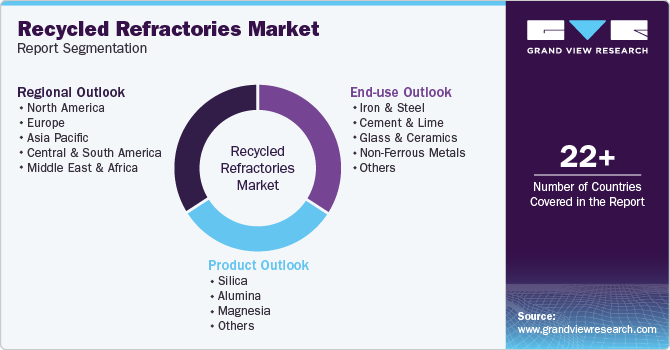
This report forecasts revenue and volume growth at global, regional, and country levels and provides an analysis of the latest industry trends in each of the sub-segments from 2021 to 2033. For this study, Grand View Research has segmented the global recycled refractories market report based on product, end use, and region:
 To learn more about this report, Download Free Sample Report
 -
Product Outlook (Volume, Kilotons; Revenue, USD Million, 2021 - 2033)
-
Silica
-
Alumina
-
Magnesia
-
Others
-
-
End Use Outlook (Volume, Kilotons; Revenue, USD Million, 2021 - 2033)
-
Iron & Steel
-
Cement & Lime
-
Glass & Ceramics
-
Non-Ferrous Metals
-
Others
-
-
Regional Outlook (Volume, Kilotons; Revenue, USD Million, 2021 - 2033)
-
North America
-
U.S.
-
Canada
-
Mexico
-
-
Europe
-
Germany
-
France
-
Russia
-
UK
-
-
Asia Pacific
-
China
-
India
-
Japan
-
South Korea
-
-
Central & South America
-
Brazil
-
-
Middle East
-
Saudi Arabia
-
-
Research Methodology
The recycled refractories market figures in this report are based on a proven research process that combines executive interviews with secondary research from proprietary databases, company filings, and recognized regulatory and institutional sources. Market size is built through value-chain sizing - reconciling supply-side and demand-side estimates - and triangulated with bottom-up and top-down approaches. Every estimate passes multiple levels of expert validation before publication, with each recycled refractories segment quantified using the revenue-capture definitions in the table below.
Segment Definition
End Use
Revenue Capture Definition
Iron & Steel
This segment includes recycled refractories consumed in blast furnaces, basic oxygen furnaces (BOF), electric arc furnaces (EAF), ladles, tundishes, and secondary steelmaking operations. Revenue is generated from the sale of recycled refractory materials used to manufacture refractory products and monolithics that withstand high temperatures, mechanical wear, and chemical attack during iron and steel production.
Cement & Lime
This segment comprises recycled refractories utilized in rotary kilns, preheaters, coolers, and lime kilns. Revenue is generated from supplying recycled refractory raw materials and products that enhance lining life, reduce operating costs, and maintain thermal efficiency in cement and lime manufacturing processes.
Glass & Ceramics
This segment includes recycled refractories used in glass melting furnaces, regenerators, forehearths, ceramic kilns, and associated high-temperature processing equipment. Revenue is generated from the sale of recycled refractory materials incorporated into furnace linings and insulation systems to improve operational efficiency and reduce raw material consumption.
Non-Ferrous Metals
This segment covers recycled refractories consumed in the production and processing of aluminum, copper, nickel, zinc, lead, and other non-ferrous metals. Revenue is generated from supplying recycled refractory products used in furnaces, converters, ladles, and holding vessels that require resistance to thermal shock, corrosion, and molten metal attack.
Others
This segment includes recycled refractories utilized in petrochemical, power generation, waste incineration, foundry, and other industrial high-temperature applications. Revenue is generated from the supply of recycled refractory materials and products used to protect processing equipment and improve operational sustainability.
Product
Revenue Capture Definition
Alumina
Revenue is generated from the sale of recycled alumina-based refractory materials recovered from spent refractory linings and reused in the production of bricks, castables, and monolithic refractories for high-temperature industrial applications.
Magnesia
This segment includes recycled magnesia-based refractory materials reclaimed from steelmaking and other high-temperature processes. Revenue is generated from supplying recycled magnesia aggregates and raw materials for the manufacture of refractory products requiring excellent slag resistance and thermal stability.
Silica
Revenue is generated from the sale of recycled silica-based refractory materials recovered and reprocessed for use in furnace linings, glass manufacturing, and other applications requiring high-temperature resistance and dimensional stability.
Others
This segment includes recycled chromite, dolomite, zirconia, carbon-containing, and other specialty refractory materials. Revenue is generated from the supply of recovered refractory raw materials used in specialized industrial applications where specific thermal, chemical, and mechanical performance characteristics are required.
Estimation Model
Layer Name
Key Question
Description
Refractory Waste Generation Base Layer
What forms the demand base?
Identify the volume of spent refractories generated from iron & steel, cement & lime, glass & ceramics, non-ferrous metals, and other high-temperature industries. Assess refractory replacement cycles, maintenance shutdown frequencies, refractory consumption rates, and waste generation across key end-use sectors. This layer establishes the total recyclable refractory material available for recovery and reuse.
Recycled Refractory Raw Material Recovery & Processing Layer
Where are recycled refractories sourced and processed?
Estimate the availability of recyclable refractory materials recovered from spent furnace linings, ladles, kilns, converters, and other high-temperature equipment. Analyze collection networks, sorting technologies, processing facilities, recycling rates, regional recovery infrastructure, and the role of refractory recyclers and manufacturers in the value chain.
Application Consumption Intensity Layer
How much recycled refractory material is consumed?
Analyze the utilization of recycled refractory materials across refractory bricks, monolithics, castables, gunning mixes, ramming masses, and specialty refractory products. Evaluate recycled content ratios, technical suitability, quality requirements, end-use acceptance levels, and consumption intensity across iron & steel, cement, glass, and non-ferrous metal industries.
Revenue Layer
How is market revenue generated?
Market revenue is quantified through the processing, recovery, and sale of recycled refractory raw materials and products supplied to high-temperature industries. Revenue generation is influenced by spent refractory availability, recycling efficiency, processing costs, virgin raw material prices, environmental regulations, circular economy initiatives, and demand from refractory manufacturers and industrial end users. Investments in sustainable manufacturing and waste reduction programs further support market growth.
Delivered Customizations
This report has been delivered with the following In-depth customizations
CLIENT REQUEST
CUSTOMIZATION DELIVERED
VALUE ADDS
Demand Analysis
Detailed analysis of recycled refractory demand across key end-use industries, including iron & steel, cement & lime, glass & ceramics, non-ferrous metals, and other industrial applications. Assessed industry-wise consumption patterns, refractory replacement cycles, recycled material adoption rates, and regional demand trends.
Enabled identification of high-demand end-use sectors and regional consumption hotspots, supporting market entry strategies, capacity planning, and investment prioritization.
Refractory Recycling Rate Assessment
Detailed analysis of spent refractory generation, recovery rates, recycling rates, and landfill diversion across iron & steel, cement, glass, and non-ferrous metal industries by region.
Enabled identification of regions and industries with the highest recycling potential, supporting capacity expansion and investment decisions.
Opportunity Assessment
Identification of high-growth opportunities driven by increasing circular economy adoption, stringent environmental regulations, rising raw material costs, and growing demand for sustainable refractory solutions. Assessed opportunities across steelmaking, cement production, glass manufacturing, and advanced refractory recycling technologies.
Enabled prioritization of attractive growth segments, supported long-term investment planning, and identified strategic opportunities in refractory recycling, resource recovery, and sustainable manufacturing initiatives.
Frequently Asked Questions About This Report
Asia Pacific dominated the recycled refractories market with the largest revenue share of 75.2% in 2025.
The recycled refractories market in China held the largest share in the Asia Pacific region in 2025.
Asia Pacific is expected to register the fastest CAGR of 9.6% over the forecast period.
Based on product, the alumina segment led the market with the largest revenue share of 47.1% in 2025.
The recycled refractories market is expected to grow at a compound annual growth rate of 9.2% from 2026 to 2033 to reach USD 28.5 billion by 2033.
Based on end use, the iron and steel segment led the market with the largest revenue share of 66.7% in 2025.
The key players operating in the recycled refractories market are Deref S.p.A., Global Recycling, Harsco Corporation, HORN & CO. GROUP, Krosaki Harima Corporation, LKAB Minerals, REF Minerals, Refratechnik, RHI Magnesita, and Valoref (Saint-Gobain), among others.
The key factor driving the growth of the global recycled refractories market is the increasing adoption of circular economy practices and sustainability initiatives aimed at reducing industrial waste, lowering raw material consumption, and minimizing carbon emissions across high-temperature industries.
The recycled refractories market size was estimated at USD 14.4 billion in 2025 and is expected to reach USD 15.4 billion in 2026.
About the Author(s)
Advanced Interior Materials Research Team
Advanced Materials · Advanced Interior MaterialsThis report was authored by the advanced interior materials research team at Grand View Research - comprising two research analysts, one senior research analyst, and one industry expert - with specialized expertise in the advanced interior materials segment of the advanced materials industry. All findings are based on proprietary advanced materials databases, executive interviews, and regulatory analysis, subject to internal peer review prior to publication.
Last Updated:
Speak to Analyst

Customize this report to your needs - add regions, segments, or data points, with 20% free customization.
Or view our licence options:


ISO 9001:2015 & 27001:2022 Certified
We are GDPR and CCPA compliant! Your transaction & personal information is safe and secure. For more details, please read our privacy policy.


