
- Home
- »
- Plastics Polymers & Resins
- »
-
Recycled Rubber Construction Materials Market Report 2033GVR Report cover
![Recycled Rubber Construction Materials Market (2026 - 2033)Report]()
Recycled Rubber Construction Materials Market (2026 - 2033)
Size, Share & Trends Analysis Report By Form (Granules/Crumb Rubber, Powder, Chips/Shreds, Bound Rubber Products), By Application, By Region, And Segment Forecasts
Market Size, 2025
$1.7BMarket Estimate, 2026
$1.8BMarket Forecast, 2033
$3.2BCAGR, 2026–2033
8.2%Recycled Rubber Construction Materials Market Summary
The global recycled rubber construction materials market size was valued at USD 1.7 billion in 2025 and is projected to grow from USD 1.8 billionin 2026 to USD 3.2 billion by 2033, at a CAGR of 8.2% from 2026 to 2033. Asia Pacific dominated the market, accounting for the largest revenue share of 56.1% in 2025. Growing demand for recycled rubber construction materials across residential, commercial, infrastructure, roofing, flooring, and industrial applications is supporting market growth.

Key Market Trends & Insights
- By form: Granules/crumb segment dominated the market accounting for 38.6% market share in 2025
- By application: Road construction segment led the market by application, accounting for 39.9% of revenue in 2025.
Regional Highlights
- Largest regional market: Asia Pacific (56.1% revenue share, 2025)
- By country: India dominated the Asia Pacific with the largest revenue share in 2025
Market Size & Forecast
- Market size in 2025: USD 1.7 Billion
- Estimated market size in 2026: USD 1.8 Billion
- Projected market size by 2033: USD 3.2 Billion
- CAGR (2026-2033): 8.2%
Rapid adoption of circular material technologies is emerging as a key trend in the recycled rubber construction materials market. Manufacturers are increasingly developing rubber-based paving, flooring, roofing, insulation, and protective products that incorporate post-consumer and post-industrial rubber while maintaining durability and functional performance. Demand is rising across green buildings, infrastructure, transportation, and industrial applications, where resource efficiency, waste reduction, and lower environmental impacts are becoming important material requirements.
The growing demand for sustainable construction and infrastructure materials is a major driver of the recycled rubber construction materials market. These materials provide durability, impact resistance, flexibility, vibration absorption, and resource efficiency, making them suitable for flooring, roofing, playgrounds, roads, foundations, and protective applications. Increasing environmental awareness, landfill reduction initiatives, and sustainability regulations are further accelerating the adoption of recycled rubber solutions across construction and infrastructure projects.
Expansion of green construction and circular infrastructure presents a significant opportunity for the recycled rubber construction materials market. Increasing investments in sustainable buildings, resilient transportation systems, and environmentally responsible infrastructure are creating new demand for recycled rubber products with high functional performance. In addition, advancements in rubber processing, composite technologies, and product formulation are enabling manufacturers to improve durability, versatility of applications, and material efficiency while supporting the transition toward circular construction solutions.
Market Dynamics
Road and highway infrastructure is emerging as a key application for recycled rubber construction materials, driven by the need for durable and high-performance asphalt solutions. Rubber-modified asphalt incorporates recycled tire rubber to improve flexibility, crack resistance, rutting resistance, and pavement durability. These materials help contractors extend roadway service life while reducing tire waste, supporting broader adoption across highways, roads, bridges, and other transportation infrastructure projects.
Growing emphasis on resilient and sustainable infrastructure is further accelerating the adoption of recycled rubber construction materials in road development. Manufacturers are advancing rubber-modified asphalt technologies that combine improved pavement performance with noise reduction and resource efficiency. Increasing investments in road modernization, infrastructure resilience, and circular construction practices are therefore creating favorable conditions for the broader use of recycled rubber asphalt modifiers across transportation projects.
Microplastics and environmental concerns are emerging as a key restraint for the recycled rubber construction materials market, driven by growing scrutiny over potential rubber particle runoff from crumb rubber used in artificial turf, playground surfaces, and other applications. Concerns regarding particle migration, environmental persistence, and potential ecosystem impacts can increase regulatory requirements and compliance costs. These factors may limit adoption among environmentally sensitive end users, particularly where stricter material safety and sustainability standards influence purchasing decisions.
Advanced devulcanization presents a significant opportunity for the recycled rubber construction materials market, driven by demand for higher-performance and value-added recycled materials. Manufacturers are developing advanced technologies to selectively break down vulcanized rubber bonds while preserving material properties and improving mechanical strength. These innovations can enable recycled rubber to approach the tensile performance of virgin rubber, expanding its use in structural components, flooring, roofing, infrastructure, and other demanding construction applications while supporting circularity objectives.
Market Concentration & Characteristics
The market growth stage is medium, and growth is accelerating. The market exhibits slight fragmentation, with key players dominating the industry landscape. Major companies such as Ultimate RB/RB Rubber Products, Inc., KN Rubber, Tuflex/Rubber Products, Inc., QRRI (Quality Rubber Recycling Inc.), Heffco Elastomers Inc., RG2S Solutions, Plasticade Canada, Euroshield, Hatko Kauçuk/Hatko Sound Barriers, Terrain Floorings, Sun-Flex/Sunflex Recycling Pvt. Ltd., Fab Rubbers, Greenvitect Revolution Pvt. Ltd., Trirubber India Inc., Rubber Worx Flooring Solutions, Swarna Rubber Industries LLP, Renew Tire Recycling Center, Green Polymeric Materials (GPM)and others play a significant role in shaping the market dynamics. These leading players often drive innovation in the market by introducing new products, technologies, and materials to meet the industry's evolving demands.
Innovation in the recycled rubber construction materials market is driven by advances in devulcanization, rubber processing, composite formulation, and surface modification technologies. Improved material consistency, mechanical strength, adhesion, and durability are expanding applications across roofing, flooring, asphalt, insulation, and structural products. These developments enhance performance, processing efficiency, and application versatility while supporting higher-value utilization of recycled rubber and reducing dependence on virgin construction materials.
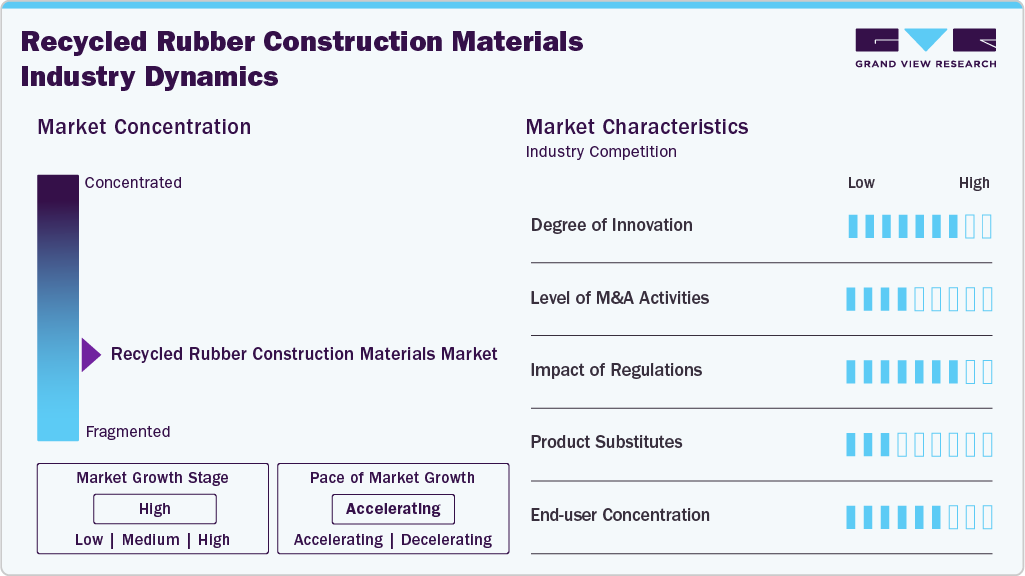
Regulatory requirements and environmental standards also shape market development. Manufacturers must address concerns related to microplastic release, chemical composition, emissions, material safety, and product durability before commercialization, which can increase testing and compliance costs. However, companies with strong R&D capabilities, advanced processing technologies, and validated recycled-rubber formulations can strengthen regulatory acceptance, build customer confidence, and support wider adoption in sustainable construction and infrastructure applications.
Analyst Perspective
The recycled rubber construction materials market is transitioning from low-cost recycling to high-value, specialized applications over the next 5-10 years. Growth is driven by infrastructure renewal, circular economy policies, and demand in road construction, sports surfaces, and green building. Technological advances in devulcanization and particle engineering are improving product strength, acoustic performance, and durability. Buyers now prioritize certified sustainability and performance over price, favoring suppliers with integrated supply chains and technical expertise. However, profitability faces constraints from feedstock variability, processing costs, logistics, and strict regulatory oversight on emissions.
Form Insights
The granules/crumb segmentdominated the market across form segmentation in terms of revenue, accounting for 38.6% market share in 2025, and is forecast to grow at an 8.7% CAGR from 2026 to 2033. The segment is being driven by continuous advances in rubber granulation, crumb processing, devulcanization, and particle-size control technologies, which enable precise control over consistency, elasticity, strength, and surface characteristics. This allows manufacturers to develop recycled rubber granules and crumb rubber with different performance characteristics for specific end-use requirements. Customized processing improves material quality, application efficiency, and product compatibility, supporting product differentiation and strengthening the role of granules and crumb rubber across sustainable construction and infrastructure applications.
The powder segment is expected to expand at a 9.5% CAGR in the recycled rubber construction materials market over the forecast period. Powder represents a significant product segment within the recycled rubber construction materials market, driven by its versatility, durability, elasticity, and ease of incorporation into construction formulations. Demand is increasing as manufacturers seek sustainable material solutions for asphalt modification, flooring, roofing, coatings, and sealants. Recycled rubber powder enables manufacturers to improve impact resistance, flexibility, and wear performance while utilizing recovered rubber waste, supporting resource efficiency, product durability, and lower environmental impact across diverse construction applications.
Application Insights
The road construction segment led the market by application, accounting for 39.9% of revenue in 2025, and is projected to grow at an 8.7% CAGR from 2026 to 2033. The road construction segment is gaining traction in the recycled rubber construction materials market due to increasing demand for durable, sustainable, and cost-effective pavement solutions. Recycled rubber materials enable manufacturers to develop rubber-modified asphalt, paving products, and road surfaces that provide improved crack resistance, flexibility, noise reduction, and weathering performance. Their ability to enhance pavement durability, extend service life, and divert waste tires from landfills is accelerating adoption across roads, highways, and transportation infrastructure applications.

The flooring & sports surfaces segment is expected to grow at the fastest CAGR of 9.2% over the forecast period. The flooring and sports surfaces segment represents a high-value application area for recycled rubber construction materials, supported by increasing demand for durable, resilient, and environmentally responsible surface solutions. Recycled rubber granules, tiles, and mats provide excellent impact absorption, elasticity, slip resistance, and wear performance, helping improve safety and reduce maintenance requirements. Growing adoption of sustainable construction practices, green infrastructure, and recycled-content standards is further accelerating demand for recycled rubber solutions across gyms, playgrounds, athletic tracks, and sports facilities.
Regional Insights
The Asia Pacific recycled rubber construction materials industry held the largest revenue share of 56.1% in 2025. The region is expected to grow at a CAGR of 8.7% over the forecast period. Rapid industrialization and expanding construction activities are supporting strong growth of the recycled rubber construction materials market across the Asia Pacific. Increasing investments in residential, commercial, industrial, and infrastructure projects are driving demand for sustainable rubber-based solutions across roofing, flooring, roads, and protective applications. Rising adoption of green building practices, growing environmental awareness, and government initiatives promoting circular materials are further accelerating regional market development, while expanding construction output continues to strengthen adoption.

India Recycled Rubber Construction Materials Market Trends
India’s market for recycled rubber construction materials is expanding steadily, supported by rising construction activity and growing adoption of sustainable building solutions. Increasing investments in residential, commercial, industrial, and infrastructure development are strengthening demand for recycled rubber products across roofing, flooring, roads, and protective applications. Government initiatives promoting circular construction, rising environmental awareness, and growing preference for durable, low-impact materials are further encouraging the adoption of recycled rubber solutions across the country.
North America Recycled Rubber Construction Materials Market Trends
North America is a key growth region for the recycled rubber construction materials market, supported by strong demand from construction, infrastructure, transportation, and industrial applications. The region’s emphasis on sustainable building practices and circular material technologies is driving adoption of recycled rubber products for roofing, flooring, asphalt modification, and protective applications. Growing investments in resilient infrastructure, waste tire recycling, and environmentally responsible construction materials are further strengthening regional market development.
The U.S. recycled rubber construction materials market represents a major contributor to regional growth, supported by established construction infrastructure, advanced recycling capabilities, and increasing adoption of sustainable materials. Rising utilization of recycled rubber solutions across commercial buildings, residential construction, roadways, and sports facilities is accelerating demand. Strong emphasis on resource efficiency, environmental compliance, and durable building systems is further encouraging manufacturers to develop high-performance recycled rubber materials for diverse construction applications.
Europe Recycled Rubber Construction Materials Market Trends
Europe’s recycled rubber construction materials market is expanding due to increasing adoption of sustainable and circular construction materials across residential, commercial, infrastructure, and industrial applications. Demand is rising for recycled rubber products used in roofing, flooring, road construction, and protective applications that provide durability while supporting lower environmental impact and resource efficiency. Additionally, stringent sustainability regulations, circular economy initiatives, and growing preference for recycled-content materials are encouraging broader adoption of recycled rubber solutions across the region.
Central & South America Recycled Rubber Construction Materials Market Trends
Growing construction activities, expanding infrastructure development, and rising adoption of sustainable building technologies are driving demand for recycled rubber construction materials across Central & South America. These materials are increasingly utilized in residential, commercial, industrial, and infrastructure applications due to their durability, flexibility, impact resistance, and environmental benefits. Increasing investments in green construction, resilient infrastructure, and waste reduction initiatives are further supporting market growth, while growing environmental awareness continues to encourage regional adoption of recycled rubber solutions.
Middle East and Africa Recycled Rubber Construction Materials Market Trends
Increasing construction activity, expanding infrastructure development, and rising adoption of sustainable building technologies are driving demand in the Middle East & Africa recycled rubber construction materials market. Growing utilization of recycled rubber solutions across residential, commercial, industrial, and infrastructure applications is supporting demand for durable, flexible, and environmentally responsible materials. Additionally, investments in green buildings, sustainable infrastructure, and waste reduction initiatives are encouraging the transition toward circular construction materials, while economic diversification programs are strengthening regional adoption.
Key Recycled Rubber Construction Materials Company Insights
Some of the key players operating in the market include Heffco Elastomers and Green Polymeric Materials (GPM).
-
Heffco Elastomers participates in the recycled rubber construction materials market through recycled rubber processing and rubber-based products designed for construction, flooring, industrial, and infrastructure applications. Supported by rubber compounding expertise and material processing capabilities, the company provides durable and performance-oriented solutions offering flexibility, impact resistance, and wear resistance, supporting growing demand for sustainable construction materials and value-added applications that utilize recycled rubber across diverse end-use sectors.
-
Green Polymeric Materials (GPM) participates in the recycled rubber construction materials market through recycled rubber processing and sustainable material solutions designed for construction, flooring, landscaping, and infrastructure applications. Supported by material processing capabilities and recycled rubber technologies, the company provides products offering durability, flexibility, impact resistance, and resource efficiency, supporting growing demand for sustainable construction materials and higher-value applications that utilize recovered rubber from end-of-life tires.
Worx Flooring Solutions; Swarna Rubber Industries LLP are some of the emerging participants in the recycled rubber construction materials market.
-
Worx Flooring Solutions is a flooring solutions company focused on recycled rubber flooring products for applications across gyms, sports facilities, playgrounds, commercial spaces, and recreational environments. Leveraging recycled rubber processing and flooring technologies, the company develops durable surface solutions that provide impact absorption, flexibility, wear resistance, and safety. Its focus on sustainable flooring development supports growing adoption of recycled rubber materials across environmentally responsible construction and recreational applications.
-
Swarna Rubber Industries LLP is a rubber products manufacturer focused on recycled and rubber-based solutions for applications across construction, flooring, infrastructure, and industrial sectors. Leveraging rubber processing expertise and product manufacturing capabilities, the company develops performance-oriented materials that provide durability, flexibility, impact resistance, and wear performance. Its focus on rubber product development supports growing adoption of recycled rubber construction materials across sustainable building, infrastructure, and industrial applications.
Key Recycled Rubber Construction Materials Companies
The following key companies have been profiled for this study on the recycled rubber construction materials market.
-
Ultimate RB/RB Rubber Products, Inc.
-
KN Rubber Tuflex/Rubber Products, Inc.
-
QRRI (Quality Rubber Recycling Inc.)
-
Heffco Elastomers Inc.
-
RG2S Solutions
-
Plasticade Canada
-
Euroshield
-
Hatko Kauçuk/Hatko Sound Barriers
-
Terrain Floorings
-
Sun-Flex/Sunflex Recycling Pvt. Ltd.
-
Fab Rubbers
-
Greenvitect Revolution Pvt. Ltd.
-
Trirubber India Inc.
-
Rubber Worx Flooring Solutions
-
Swarna Rubber Industries LLP
-
Renew Tire Recycling Center
-
Green Polymeric Materials (GPM)
Competitive Benchmarking
Operating Strategies
Competitive Edge
Weakness
Mature Players: Ultimate RB/RB Rubber Products, Inc.; KN Rubber; Tuflex/Rubber Products, Inc.; QRRI; Heffco Elastomers; RG2S Solutions; Euroshield; Hatko Kauçuk/Hatko Sound Barriers; Terrain Floorings; Renew Tire Recycling Center; Green Polymeric Materials (GPM).
- Extensive focus on recycled rubber flooring, roofing products, rubber mats, sound barriers, playground surfaces, asphalt modifiers, and other construction-oriented solutions.
- Continuous investment in tire recycling, rubber processing, granulation, devulcanization, product formulation, and application-specific material development.
- Expansion through construction-sector relationships, customized product development, recycling capabilities, regional distribution networks, and partnerships across infrastructure and building applications.
- Strong expertise in recycled rubber processing, rubber-based construction products, flooring, roofing, acoustic solutions, and infrastructure applications.
- Established manufacturing and recycling capabilities, product portfolios, customer relationships, and application knowledge provide strong market access.
- Diverse product offerings enable customized solutions combining durability, impact resistance, flexibility, acoustic performance, and waste reduction benefits across construction and infrastructure applications.
- Recycled rubber products can involve higher processing, transportation, and installation costs compared with conventional materials in certain applications.
- Dependence on construction, infrastructure, automotive, and tire recycling markets exposes companies to cyclical demand and fluctuations in recycled rubber feedstock availability.
- Increasing environmental scrutiny, product qualification requirements, and technological investments in advanced recycling and devulcanization can raise R&D, testing, and compliance costs.
Emerging Players: Plasticade Canada; Sun-Flex/Sunflex Recycling Pvt. Ltd.; Fab Rubbers; Greenvitect Revolution Pvt. Ltd.; Trirubber India Inc.; Rubber Worx Flooring Solutions; Swarna Rubber Industries LLP
- Focus on recycled rubber flooring, mats, playground surfaces, construction products, rubber granules, and other sustainable material solutions for residential, commercial, recreational, and industrial applications.
- Continuous investment in recycled rubber processing, product development, material quality, and application-specific formulations to improve durability, safety, flexibility, and performance.
- Expansion across regional construction and infrastructure markets through sustainable product development, customized solutions, recycling capabilities, and industry relationships.
- Strong specialization in recycled rubber products, sustainable construction materials, flooring systems, and application-specific solutions.
- Differentiated products combining durability, impact absorption, flexibility, acoustic performance, and recycled-content benefits provide access to sustainability-focused applications.
- Focused regional operations and specialized product portfolios enable faster customization and access to niche construction, flooring, landscaping, and infrastructure applications.
- Specialized product portfolios and regional market concentration may limit exposure to broader construction material applications.
- Limited production scale, recycling infrastructure, and brand recognition compared with established players can constrain market penetration and customer reach.
- Advanced processing technologies, product certification, quality control, and compliance requirements can increase development and production costs, particularly when entering large-scale infrastructure projects.
Recent Developments
-
In July 2026, Pirelli, Pyrum Innovations, Synthos, and BASF launched a European tire-to-tire circularity initiative to process end-of-life and scrap tires into secondary raw materials, including synthetic rubber, for use in new tire production. The project uses ISCC PLUS-certified recycled materials and supports closed-loop rubber recovery, reducing reliance on virgin feedstocks while strengthening circular material supply chains and advancing sustainable rubber utilization across the tire and construction materials value chain.
-
In July 2025, the Tire Industry Association (TIA), Asphalt Plus, and Maryland authorities collaborated on an infrastructure initiative involving the installation of Maryland’s first rubber-modified asphalt using recycled tire rubber. The project aims to demonstrate improved pavement durability and longer service life while supporting tire recycling and more sustainable road construction practices, highlighting the growing adoption of recycled rubber materials in infrastructure applications.
Recycled Rubber Construction Materials Market Report Scope
Report Attribute
Details
Market size in 2025
USD 1.7 billion
Estimated market size in 2026
USD 1.8 billion
Projected market size by 2033
USD 3.2 billion
Growth rate
CAGR of 8.2% from 2026 to 2033
Historical data
2021 - 2025
Forecast period
2026 - 2033
Quantitative units
Revenue in USD million/billion, volume in tons, and CAGR from 2026 to 2033
Report coverage
Revenue & volume forecast, competitive landscape, growth factors, and trends
Segments covered
Form, application, region
Regional scope
North America; Europe; Asia Pacific; Central & South America; Middle East & Africa
Country Scope
U.S.; Canada; Mexico; Europe; Germany; UK; France; Italy; Spain; China; India; Japan; South Korea; Australia; Brazil; Argentina; Saudi Arabia; UAE; South Africa
Key companies profiled
Ultimate RB/RB Rubber Products, Inc.; KN Rubber; Tuflex/Rubber Products, Inc.; QRRI (Quality Rubber Recycling Inc.); Heffco Elastomers Inc.; RG2S Solutions; Plasticade Canada; Euroshield; Hatko Kauçuk/Hatko Sound Barriers; Terrain Floorings; Sun-Flex/Sunflex Recycling Pvt. Ltd.; Fab Rubbers; Greenvitect Revolution Pvt. Ltd.; Trirubber India Inc.; Rubber Worx Flooring Solutions; Swarna Rubber Industries LLP; Renew Tire Recycling Center; Green Polymeric Materials (GPM)
Customization scope
Free report customization (equivalent to up to 8 analyst working days) with purchase. Addition or alteration to country, regional & segment scope
Pricing and purchase options
Avail customized purchase options to meet your exact research needs. Explore purchase options
Global Recycled Rubber Construction Materials Market Report Segmentation
This report forecasts revenue growth at the global, regional, and country levels and provides an analysis of the latest industry trends across sub-segments from 2021 to 2033. For this study, Grand View Research has segmented the global recycled rubber construction materials market report based on form, application, and region:

-
Form Outlook (Volume, Kilotons; Revenue, USD Million; 2021 - 2033)
-
Granules/Crumb Rubber
-
Powder
-
Chips/Shreds
-
Bound Rubber Products
-
-
Application Outlook (Volume, Kilotons; Revenue, USD Million; 2021 - 2033)
-
Road Construction
-
Flooring & Sports Surfaces
-
Landscaping
-
Roofing
-
Concrete & Cement Modification
-
Others
-
-
Regional Outlook (Volume, Kilotons; Revenue, USD Million; 2021 - 2033)
-
North America
-
U.S.
-
Canada
-
Mexico
-
-
Europe
-
Germany
-
UK
-
France
-
Italy
-
Spain
-
-
Asia Pacific
-
China
-
India
-
Japan
-
South Korea
-
Australia
-
-
Central & South America
-
Brazil
-
Argentina
-
-
Middle East & Africa
-
Saudi Arabia
-
UAE
-
South Africa
-
-
Research Methodology
The recycled rubber construction materials market figures in this report are based on a proven research process that combines executive interviews with secondary research from proprietary databases, company filings, and recognized regulatory and institutional sources. Market size is built through value-chain sizing—reconciling supply-side and demand-side estimates—and triangulated with bottom-up and top-down approaches. Every estimate passes multiple levels of expert validation before publication, with each recycled rubber construction materials segment quantified using the revenue-capture definitions in the table below.
Segment Definition
Segment - Form
Revenue capture definition
Granules/Crumb Rubber
Revenue is captured through recycled rubber granules and crumb rubber used in road construction, sports surfaces, flooring, landscaping, and construction products. Value is driven by particle-size consistency, elasticity, impact resistance, durability, and compatibility with asphalt and binding systems. Demand is supported by increasing tire recycling, sustainable construction practices, infrastructure development, and applications requiring performance enhancement, waste reduction, and cost-effective material solutions.
Powder
Revenue is generated through recycled rubber powder used in asphalt modification, concrete and cement modification, coatings, flooring, roofing, and other construction applications. Value is influenced by particle fineness, dispersion, compatibility, durability, and reinforcement performance. Growth is supported by increasing demand for recycled-content materials, improved pavement performance, sustainable construction practices, and applications requiring enhanced flexibility, crack resistance, impact resistance, and resource efficiency.
Chips/Shreds
Revenue is captured through recycled rubber chips and shreds used in landscaping, playgrounds, drainage systems, road construction, and lightweight construction applications. Value is driven by particle size, cushioning, drainage performance, durability, and ease of installation. Demand is supported by increasing adoption of sustainable landscaping materials, recreational infrastructure, tire waste utilization, and applications requiring impact absorption, moisture management, ground stabilization, and long-term outdoor performance.
Bound Rubber Products
Revenue comes from bound recycled rubber products, including tiles, mats, pavers, flooring systems, molded components, and rubberized construction products used across buildings, infrastructure, sports, and landscaping applications. Value is supported by durability, impact resistance, flexibility, dimensional stability, and installation efficiency. Growth is driven by demand for finished recycled rubber solutions, sustainable construction materials, resilient surfaces, and application-specific products offering higher performance and value addition.
Segment - Application
Revenue capture definition
Road Construction
Revenue is captured through recycled rubber materials used in rubber-modified asphalt, road surfaces, paving systems, and transportation infrastructure. Value is driven by improved crack resistance, flexibility, rutting resistance, noise reduction, durability, and pavement service life. Demand is supported by increasing road development and rehabilitation, infrastructure investments, tire waste recycling initiatives, and growing adoption of sustainable pavement technologies that reduce material consumption and improve roadway performance.
Flooring & Sports Surfaces
Revenue is generated through recycled rubber flooring, tiles, mats, playground surfaces, athletic tracks, gym flooring, and sports infrastructure. Value is driven by impact absorption, elasticity, slip resistance, durability, noise reduction, and user safety. Growth is supported by increasing construction of recreational facilities, gyms, schools, and sports infrastructure, along with growing preference for sustainable materials that provide resilient surface performance, lower maintenance requirements, and effective utilization of recycled tire rubber.
Landscaping
Revenue is captured through recycled rubber mulch, chips, mats, edging products, and landscaping surfaces used in gardens, playgrounds, parks, pathways, and outdoor recreational areas. Value is driven by durability, cushioning, moisture management, weather resistance, and reduced maintenance requirements. Demand is supported by increasing adoption of sustainable landscaping practices, urban development, recreational infrastructure, and growing utilization of recycled rubber as an alternative to conventional landscaping materials.
Roofing
Revenue is generated through recycled rubber roofing tiles, shingles, underlayments, membranes, and other rubber-based roofing products used in residential, commercial, and industrial structures. Value is driven by weather resistance, flexibility, impact resistance, durability, and resistance to temperature variations. Demand is supported by increasing construction and renovation activities, sustainable building initiatives, and growing preference for durable roofing systems that utilize recycled materials and provide long-term protection against environmental exposure.
Concrete & Cement Modification
Revenue comes from recycled rubber materials incorporated into concrete, cementitious products, mortars, and other construction mixtures to modify flexibility, impact resistance, weight, and durability characteristics. Value is supported by improved crack resistance, energy absorption, lightweight properties, and waste rubber utilization. Growth is driven by increasing research and adoption of rubberized concrete, sustainable construction practices, infrastructure development, and demand for lower-impact materials that incorporate recycled content into building and civil engineering applications.
Others
Revenue is captured through specialized applications including vibration isolation, acoustic barriers, drainage systems, playground infrastructure, industrial flooring, railway applications, and specialty construction products. Value is supported by impact absorption, sound reduction, flexibility, durability, moisture resistance, and application versatility. Emerging uses create opportunities for higher-value recycled rubber products, customized formulations, engineered composites, and diversified revenue streams across sustainable construction, infrastructure, industrial, recreational, and environmental applications.
Estimation Model
Layer Name
Key Question
Description
Top-Down Recycled Rubber Construction Materials Demand Assessment Layer
What defines market boundaries?
This layer establishes global demand for recycled rubber construction materials across road construction, flooring & sports surfaces, landscaping, roofing, concrete & cement modification, and other construction and infrastructure applications. Demand is filtered through macro drivers such as tire recycling, circular economy adoption, sustainable construction, infrastructure development, waste reduction initiatives, environmental regulations, and increasing preference for recycled-content materials. This defines the total addressable market based on consumption and revenue generated from recycled rubber construction materials.
End-Use Demand Validation Layer
Where is demand generated?
This layer maps demand across residential, commercial, industrial, recreational, transportation, and infrastructure applications, including roads, highways, sports facilities, playgrounds, roofing systems, landscaping projects, and concrete construction. Market sizing is aligned with performance requirements such as durability, elasticity, impact resistance, crack resistance, noise reduction, weather resistance, cushioning, flexibility, abrasion resistance, and compatibility with asphalt, concrete, and binding systems across different applications.
Consumption-to-Revenue Conversion Layer
Who captures market revenue?
This layer translates recycled rubber consumption and application volumes into revenue potential using product utilization rates, particle-size requirements, processing intensity, formulation requirements, application methods, product specifications, and project-specific material requirements. Pricing differentials across granules/crumb rubber, powder, chips/shreds, and bound rubber products are incorporated to estimate value realization across rubber recyclers, material processors, construction product manufacturers, distributors, contractors, flooring suppliers, and downstream users.
Regional Demand Verification Layer
How are assumptions validated?
This layer validates demand distribution across North America, Europe, Asia Pacific, Central & South America, and the Middle East & Africa by assessing construction activity, road infrastructure investments, tire recycling capacity, sustainable building adoption, landscaping and sports infrastructure development, and environmental regulations. Regional construction trends, recycling infrastructure, technology maturity, feedstock availability, supply chain dynamics, government initiatives, and circular economy policies are used to verify market penetration assumptions and strengthen forecast reliability.
Delivered Customizations
This report has been delivered with the following In-depth customizations
Client Request
Customization Delivered
Value Adds
Regional segmentation
Market assessment across North America, Europe, Asia Pacific, Central & South America, and Middle East & Africa, with country-level analysis for key markets such as the U.S., Canada, India, and other major construction markets.
Identifies regional growth pockets, construction activity, sustainability adoption, recycling infrastructure, and market-entry opportunities.
Cross-segmentation
Cross-analysis across product types, including granules/crumb rubber and powder, and applications such as road construction, roofing, flooring & sports surfaces, foundations, and other construction applications.
Highlights high-growth product-application combinations and identifies areas with stronger demand potential and commercial attractiveness.
Competitive benchmarking
Benchmarking of established and emerging manufacturers based on product portfolio, recycled-rubber capabilities, application coverage, geographic presence, manufacturing capabilities, and strategic positioning.
Provides a clear view of competitive intensity, differentiation factors, market positioning, and potential partnership or investment targets.
Frequently Asked Questions About This Report
The Asia Pacific recycled rubber construction materials market accounted for the largest share of 56.1% market size in 2025.
India was the leading player in the recycled rubber construction materials market and is expected to grow at a compound annual growth rate of 11.0%.
The recycled rubber construction materials market was estimated at around USD 1.7 billion in the year 2025 and is expected to reach around USD 1.8 billion in 2026.
The recycled rubber construction materials market is expected to grow at a compound annual growth rate of 8.2% from 2026 to 2033 to reach around USD 3.2 billion by 2033.
The granules/crumb rubber in the recycled rubber construction materials industry led the plastics in recycled rubber construction materials form market in 2025 with a 38.6% share. Growing demand for sustainable construction materials, coupled with advances in rubber recycling and processing technologies, is accelerating granules/crumb rubber adoption for flooring, road construction, roofing, playgrounds, and impact-absorbing applications.
The key players in the recycled rubber construction materials market are Ultimate RB / RB Rubber Products, Inc., KN Rubber, Tuflex / Rubber Products, Inc., QRRI (Quality Rubber Recycling Inc.), Heffco Elastomers Inc., RG2S Solutions, Plasticade Canada, Euroshield, Hatko Kauçuk / Hatko Sound Barriers, Terrain Floorings, Sun-Flex / Sunflex Recycling Pvt. Ltd., Fab Rubbers, Greenvitect Revolution Pvt. Ltd., Trirubber India Inc., Rubber Worx Flooring Solutions, Swarna Rubber Industries LLP, Renew Tire Recycling Center, Green Polymeric Materials (GPM)
Rising demand for recycled rubber construction materials across residential, commercial, infrastructure, roofing, flooring, and industrial applications is driving market growth. Their durability, flexibility, vibration resistance, and sustainability support roofing membranes, flooring, insulation, paving products, and protective coatings, encouraging adoption as green construction practices expand.
Based on application, the road construction segment accounted for the largest share of 39.9% market size in 2025. Growing infrastructure investment, increasing road development, and advances in recycled rubber processing technologies are accelerating the adoption of recycled rubber construction materials for asphalt modification, road surfaces, paving products, drainage systems, and traffic-calming applications.
The powder segment, based on application, is expected to grow at a CAGR of 9.5% for the forecast period.
About the Author(s)
Plastics Polymers & Resins Research Team
Industry · Plastics Polymers & ResinsThis report was authored by the plastics polymers & resins research team at Grand View Research - comprising two research analysts, one senior research analyst, and one industry expert - with specialized expertise in the plastics polymers & resins segment of the industry industry. All findings are based on proprietary industry databases, executive interviews, and regulatory analysis, subject to internal peer review prior to publication.
Last Updated:
Speak to Analyst

Customize this report to your needs — add regions, segments, or data points, with 20% free customization.
Or view our licence options:


ISO 9001:2015 & 27001:2022 Certified
We are GDPR and CCPA compliant! Your transaction & personal information is safe and secure. For more details, please read our privacy policy.












