
- Home
- »
- Medical Devices
- »
-
Respiratory Durable Medical Equipment Market Report, 2033GVR Report cover

Respiratory Durable Medical Equipment Market (2026 - 2033)
Size, Share & Trends Analysis Report By Product (Sleep Apnea Devices, Oxygen Therapy, Nebulizer Equipment, Home & Transport Ventilators), By Region, And Segment Forecasts
Market Size, 2025
$48.0BMarket Estimate, 2026
$50.4BMarket Forecast, 2033
$70.6BCAGR, 2026–2033
4.9%Respiratory Durable Medical Equipment Market Summary
The global respiratory durable medical equipment market size was valued at USD 48.0 billion in 2025 and is projected to grow from USD 50.4 billion in 2026 to USD 70.6 billion by 2033, at a CAGR of 4.9% from 2026 to 2033. North America dominated the market, accounting for a revenue share of 41.0% in 2025. The significant factors contributing to market growth include the rising prevalence of chronic respiratory diseases, growing adoption of home mechanical ventilation, rising demand for portable respiratory equipment, and expansion of remote respiratory therapy monitoring.
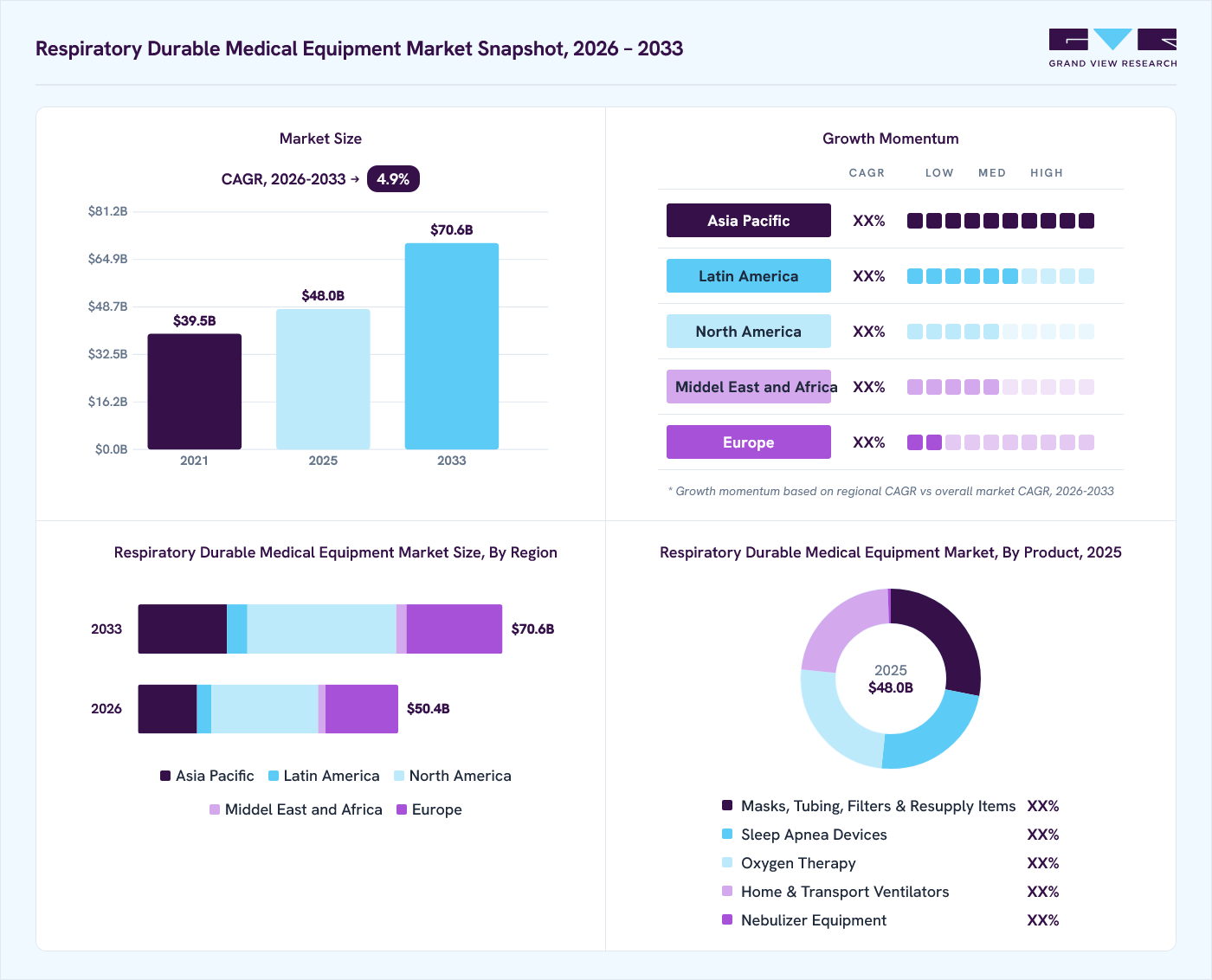 Source: Grand View Research, IR Documents, Primary Interviews, Paid DatabasesTo learn more about this report,
 Download Free Sample Report
Key Market Trends & Insights
- By product: Oxygen therapy devices segment accounted for the largest revenue share of 25.0% in 2025.
Regional Highlights
- Largest regional market: North America (41.0% revenue share, 2025)
- Fastest-growing regional market: Asia Pacific (highest CAGR, 2026-2033)
- By country: The U.S. held the largest market share in 2025
Market Size & Forecast
- Market size in 2025: USD 48.0 Billion
- Estimated market size in 2026: USD 50.4 Billion
- Projected market size by 2033: USD 70.6 Billion
- CAGR (2026-2033): 4.9%
Prism AI by Grand View Research Free to tryAsk a question about the respiratory durable medical equipment marketTry asking✓Every figure cited from GVR research Prefer the report? Download free sample →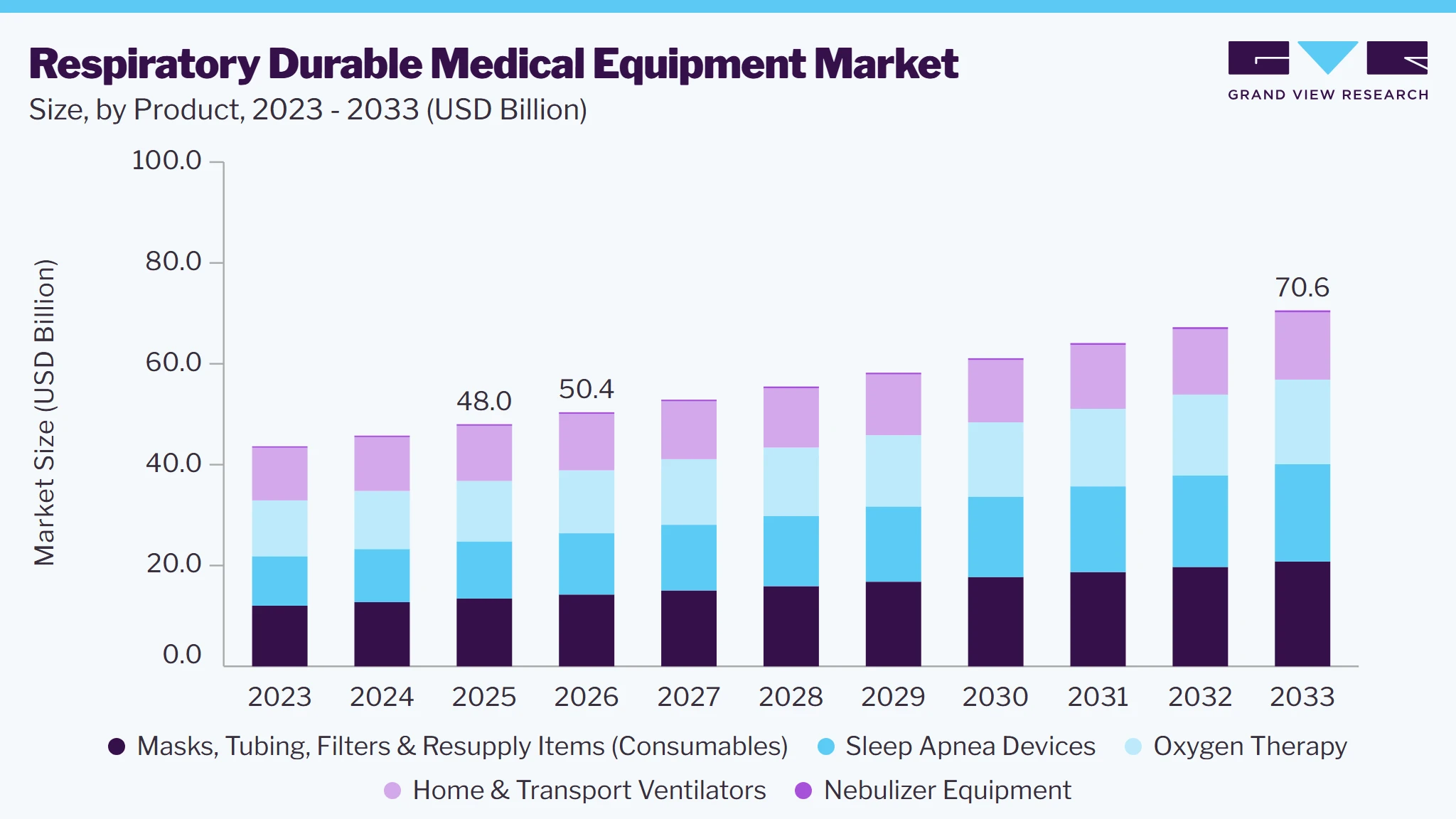 To learn more about this report, Download Free Sample Report
Market Dynamics
The respiratory durable medical equipment market is driven by the growing adoption of home-based respiratory care and increasing demand for long-term respiratory support. Advancements in portable and connected respiratory equipment are improving therapy monitoring and patient management, while AI and data-driven technologies are enabling personalized therapy and automated monitoring. However, high equipment costs and reimbursement and coverage limitations may restrict adoption, particularly among patients with limited insurance coverage and in cost-sensitive markets.
Chronic respiratory diseases, particularly COPD and asthma, affect a large and growing patient population, increasing the need for long-term respiratory support and driving demand for respiratory durable medical equipment. According to the World Health Organization (WHO), published in November 2024, COPD affects more than 380 million people globally and causes over 3 million deaths each year, this substantial disease burden is expected to support sustained demand for long-term respiratory equipment, including oxygen concentrators, nebulizers, and home ventilators.
Moreover, in 2025, WHO reported that COPD cases are projected to increase by 23% globally between 2020 and 2050, with greater increases expected among women and people living in low- and middle-income countries. The increasing prevalence of chronic respiratory conditions is expected to support demand for oxygen concentrators, home ventilators, nebulizers, and other long-term respiratory DME used for disease management.
The high cost of advanced respiratory DME can limit adoption among patients, homecare providers, and healthcare facilities. Products such as home ventilators, portable oxygen concentrators, connected PAP devices, and AI-enabled respiratory equipment require higher investment due to integrated sensors, connectivity, monitoring capabilities, and advanced algorithms.
In addition, maintenance, replacement of accessories, software updates, and other recurring expenses increase the total cost of ownership. High out-of-pocket costs can further restrict access for patients with limited insurance coverage or reimbursement support. Thus, the higher acquisition and ownership costs of advanced respiratory DME can constrain adoption, particularly in cost-sensitive markets.
Integration of AI in respiratory durable medical equipment is creating opportunities for manufacturers to develop personalized, adaptive, and data-driven respiratory DME, supporting therapy optimization, patient adherence, and remote monitoring. Companies such are incorporating AI and machine-learning technologies into respiratory therapy devices to personalize treatment settings and improve patient experience. For instance, in December 2025, ResMed received FDA clearance for Smart Comfort, an AI-enabled digital medical device that uses machine-learning algorithms and real-world sleep data to recommend personalized CPAP comfort settings. The technology is designed to support CPAP initiation and long-term adherence, demonstrating the potential for AI to enhance conventional respiratory DME with personalized therapy capabilities.
“For people new to CPAP therapy, personalized comfort settings can help them adjust faster and more comfortably, improving confidence and overall health, Smart Comfort’s FDA clearance marks an important milestone for the future of personalized, data-driven care. It’s another example of how we’re using technology and real-world evidence to make sleep health more personal, accessible and effective.”
- Justin Leong, Chief Product Officer at Resmed
Market Concentration & Characteristics
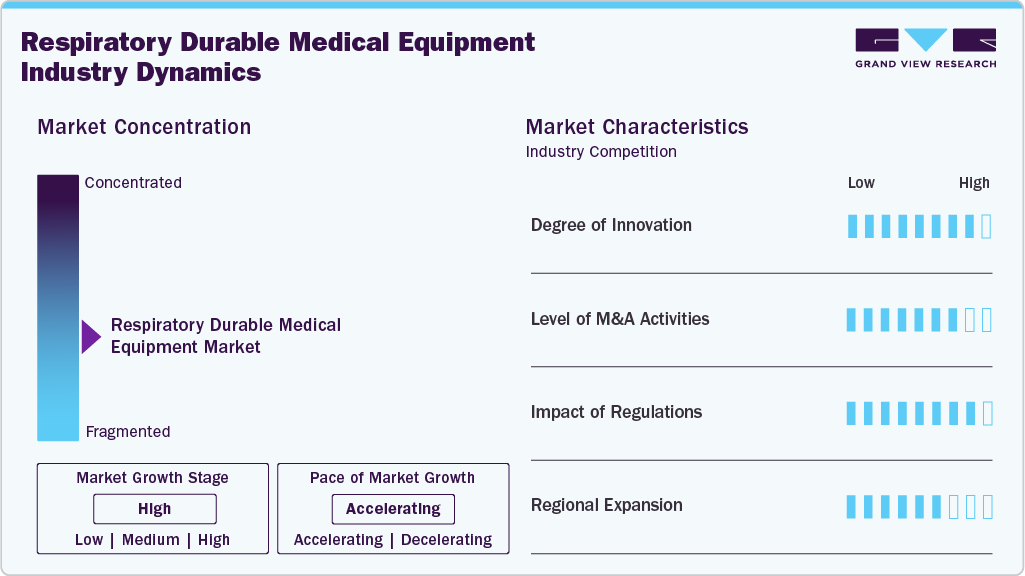
The chart below illustrates the relationship between market concentration, industry characteristics, and industry participants. The x-axis represents the level of industry concentration, ranging from low to high. The y-axis represents various industry characteristics, including industry competition, regulatory impact, level of partnership and collaboration activities, degree of innovation, and regional expansion. For instance, the respiratory durable medical equipment market is slightly fragmented, with many product providers entering the market. The degree of innovation, the level of partnerships & collaboration activities, and the impact of regulations on the industry are high. However, the regional expansion observes moderate growth.
The degree of innovation in the respiratory durable medical equipment market is high, with manufacturers adopting advanced materials, connectivity, automated technologies, and personalized designs to improve therapy comfort, usability, and adherence. For instance, in February 2026, ResMed launched the AirTouch F30i Comfort full-face CPAP mask, featuring a breathable fabric cushion, fabric-wrapped frame, and AdaptiSeal technology for a personalized fit. This highlights the innovation in CPAP equipment focused on improving patient comfort and therapy adherence.
 To learn more about this report, Download Free Sample Report
“At Resmed, we’re focused on designing health technologies that people want to use night after night. That means designing masks that help make it easier for people to start and stay on CPAP therapy. With the AirTouch F30i Comfort, we’re extending our fabric-mask innovation to more patients, combining softness, breathability and performance to help people sleep better, breathe better and live healthier lives.”
- Justin Leong, chief product officer at Resmed
The level of merger and acquisition activity in the market is high, as companies pursue acquisitions to expand home-based respiratory care capabilities, strengthen product portfolios, and broaden access to patients. For instance, in July 2025, ResMed acquired VirtuOx, integrating its home diagnostic capabilities into ResMed’s ecosystem to streamline sleep-apnea diagnosis and treatment and strengthen collaboration with healthcare providers and HME suppliers. The development demonstrates increasing integration across the home respiratory care pathway and supports broader adoption of connected respiratory DME.
“VirtuOx and Resmed are aligned in our focus to simplify healthcare and expand access. Joining Resmed gives us the opportunity to scale our impact, reach and help more patients, and keep innovating on behalf of the providers and health systems we serve.”
- Steve Lica, CEO of VirtuOx
Regulations have a significant impact on the respiratory durable medical equipment market, particularly through requirements for device safety, quality, reimbursement, and patient protection. Manufacturers must comply with regulatory standards for product approval, clinical performance, manufacturing quality, and post-market surveillance. These requirements increase compliance costs and can lengthen product development and approval timelines, while also encouraging manufacturers to improve device safety, reliability, and quality.
Leading vendors in the respiratory durable medical equipment market are expanding regionally through strategic partnerships, product launches, acquisitions, and expanded distribution networks. These initiatives help companies strengthen their presence across key markets, improve access to respiratory equipment, and address growing demand for home-based respiratory care and localized patient support.
Analyst Perspective
The market is driven by the increasing prevalence of chronic respiratory diseases, increasing adoption of home-based respiratory care, and growing demand for long-term respiratory support. The continuous advancements in portable, connected, and personalized respiratory devices are improving therapy monitoring, patient mobility, and treatment adherence across homecare settings. Companies are investing in AI-enabled devices, remote monitoring, product innovation, strategic partnerships, and regional expansion to strengthen their market presence. Growing healthcare expenditure, expansion of homecare services, favorable reimbursement for eligible respiratory equipment, and the increasing need for long-term management of respiratory conditions are further supporting market growth.
Product Insights
The oxygen therapy devices segment accounted for the largest revenue share of 25.0% in 2025. The segment includes stationary oxygen concentrators, portable oxygen concentrators (POCs), cylinders and regulators, and conservers. The increasing adoption of home-based oxygen therapy and demand for portable equipment that enables greater patient mobility drive the market growth. Manufacturers are expanding their portable oxygen portfolios to improve flexibility and usability. For instance, in May 2026, Inogen launched the Rove 6 portable oxygen concentrator in Brazil, expanding its international presence and access to portable oxygen therapy.
The sleep apnea devices segment is expected to grow at fastest CAGR of 6.84% over the forecast period from 2026 to 2033. The segment includes APAP, fixed CPAP, BiPAP/VPAP, and integrated humidifiers. Growth is driven by increasing diagnosis of obstructive sleep apnea and rising adoption of home-based PAP therapy. Companies are focusing on improved comfort, fit, compatibility, and patient adherence to expand PAP adoption. For instance, in January 2026, Inogen officially announced the U.S. launch of its Aurora CPAP masks for patients with obstructive sleep apnea. The FDA 510(k)-cleared masks are designed for comfort, reliability, and compatibility with most CPAP devices, expanding Inogen's presence in the sleep-apnea market.
“The launch of Aurora CPAP masks represents a pivotal step in Inogen’s evolution towards expanding into a broad home care respiratory solutions company and our entry into the sleep apnea market, With Aurora Masks, we are bringing the same patient-centric innovation that defines our respiratory solutions to a new category, delivering comfort, performance, and reliability. We see Aurora Masks as a growth catalyst that reinforces our commitment to leading in patient outcomes in home respiratory care.”
- Kevin Smith, President and Chief Executive Officer.
Regional Insights
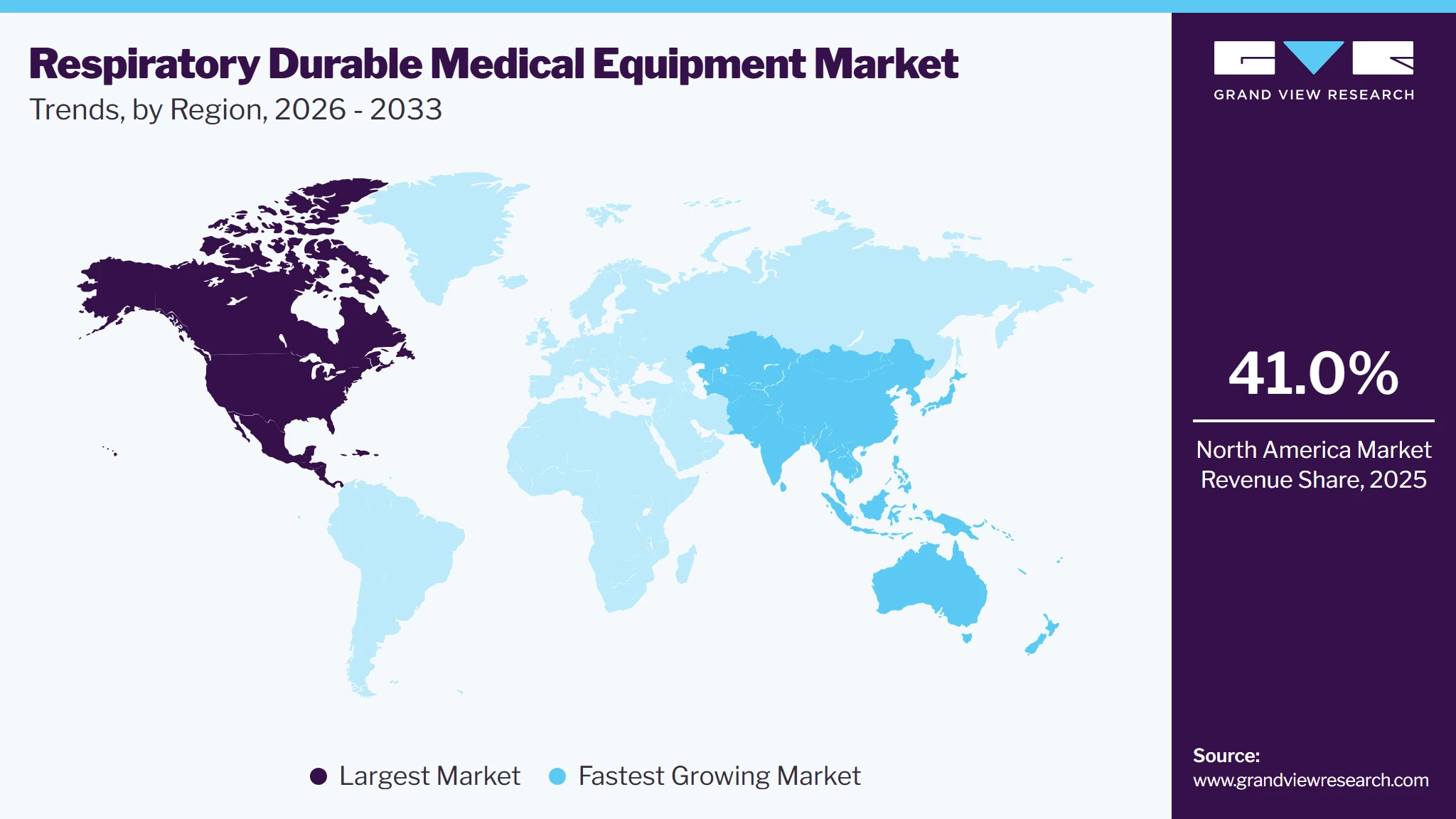
North America dominated the global respiratory durable medical equipment market with a revenue share of 41.0% in 2025. This dominance is supported by the high prevalence of chronic respiratory diseases, established home healthcare infrastructure, and broad availability of oxygen therapy, PAP devices, nebulizers, and home ventilators. The region also benefits from established reimbursement systems and a strong presence of respiratory DME manufacturers and home medical equipment providers. In the U.S., Medicare coverage for home respiratory equipment further supports market adoption.
 To learn more about this report, Download Free Sample Report
U.S. Respiratory Durable Medical Equipment Market Trends
The U.S. DME market held the largest revenue share in the North American market, driven by high demand for CPAP devices, oxygen concentrators, respiratory assist devices, and home mechanical ventilators. For instance, in June 2025, CMS established national Medicare coverage for noninvasive positive-pressure ventilation in the home for eligible patients with chronic respiratory failure resulting from COPD, covering qualifying respiratory assist devices and home mechanical ventilators. This policy strengthens access to home-based respiratory DME and supports demand for long-term ventilation equipment.
Europe Respiratory Durable Medical Equipment Market Trends
DME market in Europe is supported by an established healthcare infrastructure, increasing demand for home respiratory care, and growing adoption of PAP therapy, oxygen therapy, and home ventilation. Aging populations and the increasing burden of COPD and sleep apnea are supporting long-term demand for respiratory DME. In addition, manufacturers are expanding technology-enabled respiratory care across European markets, supporting greater use of connected and home-based respiratory equipment.
In UK, the respiratory durable medical equipment market is driven by the NHS's increasing demand for sleep-apnea diagnosis and home-based treatment, alongside established respiratory and homecare services. For instance, in May 2026, ResMed launched AirConnect Dx in the UK, a digital pathway integrating referral, screening, home sleep testing, reporting, logistics, and patient support. NHS evaluations reported up to a 97% reduction in referral-to-diagnosis time, supporting faster access to sleep-apnea treatment and strengthening the ecosystem for PAP-based respiratory care.
The respiratory durable medical equipment market in Germany is driven by its developed healthcare system, established homecare networks, and demand for oxygen therapy, PAP devices, and home ventilation. The country's aging population and high prevalence of chronic respiratory and sleep-related breathing disorders support long-term respiratory equipment demand. Increasing use of connected respiratory devices and remote therapy management is further supporting the shift toward home-based respiratory care.
Asia Pacific Respiratory Durable Medical Equipment Market Trends
Asia Pacific is expected to register the fastest CAGR of 6.0% during the forecast period from 2026 to 2033. The regional market growth due to rising respiratory disease prevalence, expanding healthcare infrastructure, increasing healthcare expenditure, and growing adoption of home-based respiratory treatment. Demand is increasing for oxygen concentrators, PAP devices, nebulizers, and portable respiratory equipment as healthcare systems expand access to chronic disease management outside hospitals. The presence of regional manufacturers and increasing availability of lower-cost respiratory devices is also supporting market penetration.
The Japan respiratory durable medical equipment market is supported by an aging population and an established healthcare reimbursement system. According to the article published in July 2025 based on Japanese administrative claims data found that CPAP persistence remained high, with 90.1% of patients continuing therapy at 90 days and 77.1% at one year, demonstrating the established use of CPAP therapy in the country.
China is a significant growth market in Asia Pacific, supported by its large patient population, expanding healthcare infrastructure, and increasing demand for home oxygen therapy, CPAP devices, and nebulizers. Domestic manufacturers are expanding access to respiratory equipment, while international manufacturers are developing local distribution and product strategies. For instance, in January 2025, Inogen entered a strategic collaboration with Yuwell to expand its respiratory product portfolio, distribute respiratory products across the global accelerate its entry into China. The collaboration demonstrates increasing regional expansion and portfolio diversification among respiratory DME manufacturers.
Latin America Respiratory Durable Medical Equipment Market Trends
Latin America is a significant region in the global market, experiencing increasing demand for respiratory DME as healthcare systems expand homecare services and chronic respiratory disease management. Growing COPD prevalence, demand for oxygen therapy, and increasing availability of portable respiratory equipment are supporting market growth. However, differences in healthcare infrastructure, reimbursement coverage, and access to specialized respiratory services continue to influence adoption across individual countries.
Middle East & Africa Respiratory Durable Medical Equipment Market Trends
The Middle East & Africa respiratory durable medical equipment market is experiencing steady growth, driven by increasing healthcare investment, growing demand for chronic disease management, and expansion of home-based care services. Demand for oxygen concentrators, PAP devices, nebulizers, and ventilators is increasing as healthcare systems improve access to respiratory treatment. In the Middle East, established healthcare systems and investment in specialized respiratory services support adoption of advanced DME, while African markets present longer-term opportunities as access to home oxygen and respiratory equipment expands.
Key Respiratory Durable Medical Equipment Company Insights
Key players in the global respiratory durable medical equipment market are adopting innovative strategies, including product launches, strategic partnerships, acquisitions, and connected respiratory technologies to strengthen their market presence. Companies are expanding portfolios across oxygen therapy, PAP devices, nebulizers, and home ventilation, while integrating remote monitoring and personalized therapy capabilities to improve patient outcomes and support the growing shift toward home-based respiratory care.
Key Respiratory Durable Medical Equipment Companies
The following key companies have been profiled for this study on the respiratory durable medical equipment market.
-
ResMed Inc.
-
Koninklijke Philips N.V.
-
Fisher & Paykel Healthcare Limited
-
Drive DeVilbiss International
-
Invacare Corporation
-
Inogen
-
React Health, Inc.
-
Breas Medical AB
-
Medtronic
-
Drägerwerk AG & Co. KGaA
-
Hamilton Medical AG
-
Getinge AB
-
GE HealthCare
-
Chart Industries, Inc.
-
CAIRE Inc. (Niterra Co., Ltd.)
-
OMRON Healthcare, Inc.
-
Yuwell (Jiangsu Yuyue Medical Equipment & Supply Co., Ltd.)
-
BMC Medical Co., Ltd.
-
Apex Medical Corp.
-
PARI GmbH
-
GCE Group
Recent Developments
-
In May 2026, Hamilton Medical officially launched the HAMILTON-EM7 emergency ventilation system at RETTmobil 2026, specifically designed for prehospital emergency and transport ventilation. The system demonstrates innovation in portable respiratory equipment by providing dedicated mechanical ventilation capabilities for time-critical emergency settings, supporting the expansion of advanced ventilation technology beyond traditional hospital environments.
-
In February 2026, Oxymed launched the Inteli 5 LPM home oxygen concentrator, which automatically adjusts oxygen flow based on real-time SpO₂ levels through a Bluetooth-connected pulse oximeter. These developments demonstrate an opportunity to shift respiratory DME from fixed-function equipment toward adaptive systems that respond to individual patient needs, supporting higher-value products and differentiated offerings.
-
In June 2025, Inogen has launched the Voxi 5 stationary oxygen concentrator, delivering 1-5 L/min of continuous-flow oxygen in a compact, quiet, and durable design aimed at making long-term home oxygen therapy more affordable and accessible.
“With Voxi 5, we are fulfilling our mission to make respiratory care more accessible and empowering for patients, This launch exemplifies our commitment to innovation, affordability, and enhancing the quality of life for those dependent on oxygen therapy.”
- Kevin Smith, President and Chief Executive Officer.
-
In June 2025, Owens & Minor, Inc. and Rotech Healthcare Holdings Inc. mutually agreed to terminate their planned acquisition, with Owens & Minor paying an USD 80 million termination fee after regulatory clearance concerns made the deal unviable.
“For many months, our teammates, along with the Rotech team, have worked tirelessly in cooperation with the Federal Trade Commission to close this transaction, and while we believe there would have been ample benefits to patients, payors, and providers by adding Rotech to our Patient Direct business, the path to obtain regulatory clearance for this merger proved unviable in terms of time, expense, and opportunity.”
- Edward A. Pesicka, President & Chief Executive Officer of Owens & Minor.
Respiratory Durable Medical Equipment Market Report Scope
Report Attribute
Details
Market size in 2025
USD 48.0 billion
Estimated market size in 2026
USD 50.4 billion
Projected market size by 2033
USD 70.6 billion
Growth rate
CAGR of 4.9% from 2026 to 2033
Actual data
2021 - 2025
Forecast period
2026 - 2033
Quantitative units
Market value in USD million/billion, and CAGR from 2025 to 2033
Report coverage
Revenue forecast, company ranking, competitive landscape, growth factors, and trends
Segments covered
Product, region
Regional scope
North America; Europe; Asia Pacific; Latin America; MEA
Country scope
U.S.; Canada; Mexico; Germany; UK; France; Italy; Spain; Norway; Denmark; Sweden; China; Japan; India; South Korea; Australia; Thailand; Brazil; Argentina; Saudi Arabia; South Africa; UAE; Kuwait
Key companies profiled
ResMed Inc.; Koninklijke Philips N.V.; Fisher & Paykel Healthcare Limited; Drive DeVilbiss International; Invacare Corporation; Inogen; React Health, Inc.; Breas Medical AB; Medtronic; Drägerwerk AG & Co. KGaA; Hamilton Medical AG; Getinge AB; GE HealthCare; Chart Industries, Inc.; CAIRE Inc. (Niterra Co., Ltd.); OMRON Healthcare, Inc.; Yuwell (Jiangsu Yuyue Medical Equipment & Supply Co., Ltd.); BMC Medical Co., Ltd.; Apex Medical Corp.; PARI GmbH; GCE Group
Customization scope
Free report customization (equivalent up to 8 analysts working days) with purchase. Addition or alteration to country, regional & segment scope.
Pricing and purchase options
Avail customized purchase options to meet your exact research needs. Explore purchase options
Global Respiratory Durable Medical Equipment Market Segmentation
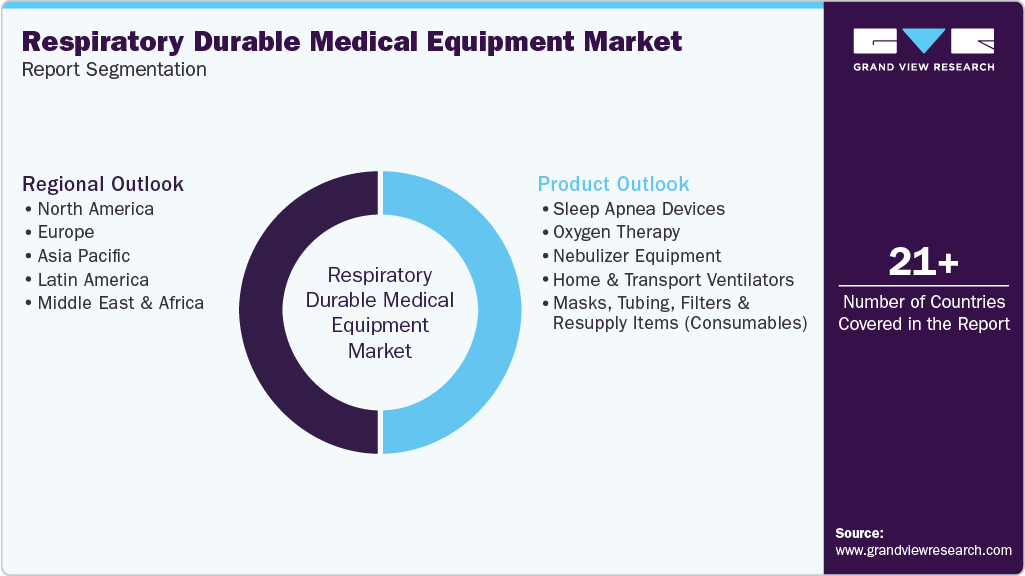
This report forecasts revenue growth at global, regional, and country levels and provides an analysis of the latest industry trends in each of the sub-segments from 2021 to 2033. For this study, Grand View Research has segmented the global respiratory durable medical equipment market report based on product and region:
 To learn more about this report, Download Free Sample Report
-
Product Outlook (Revenue, USD Million, 2021 - 2033)
-
Sleep Apnea Devices
-
Auto-titrating CPAP (APAP)
-
Fixed CPAP
-
BiPAP / VPAP
-
Integrated Humidifiers
-
-
Oxygen Therapy
-
Stationary Oxygen Concentrators
-
Portable Oxygen Concentrators (POCs)
-
Cylinders & Regulators
-
Conservers
-
-
Nebulizer Equipment
-
Compressor Nebulizers
-
Mesh Nebulizers
-
Drug-specific nebulizers
-
-
Home & Transport Ventilators
-
Adult/pediatric long-term home ventilators
-
Portable Transport Ventilators
-
-
Masks, Tubing, Filters & Resupply Items (Consumables)
-
CPAP masks
-
CPAP cushions
-
Oxygen tubing & filters
-
Humidifier chambers
-
Bacterial/viral filters
-
Aerosol delivery accessories
-
-
-
Regional Outlook (Revenue, USD Million, 2021 - 2033)
-
North America
-
U.S.
-
Canada
-
Mexico
-
-
Europe
-
UK
-
Germany
-
France
-
Italy
-
Spain
-
Denmark
-
Sweden
-
Norway
-
-
Asia Pacific
-
China
-
Japan
-
India
-
South Korea
-
Australia
-
Thailand
-
-
Latin America
-
Brazil
-
Argentina
-
-
Middle East and Africa (MEA)
-
South Africa
-
Saudi Arabia
-
UAE
-
Kuwait
-
-
Research Methodology
The respiratory durable medical equipment market figures in this report are based on a proven research process that combines executive interviews with secondary research from proprietary databases, company filings, and recognized regulatory and institutional sources. Market size is built through value-chain sizing-reconciling supply-side and demand-side estimates-and triangulated with bottom-up and top-down approaches. Every estimate passes multiple levels of expert validation before publication, with each respiratory durable medical equipment segment quantified using the revenue-capture definitions in the table below.
Segment Definition
Segment- Product
Revenue Capture Definition
Sleep Apnea Devices
Revenue generated from respiratory durable medical equipment used to diagnose, manage, and treat sleep-disordered breathing, including APAP, fixed CPAP, BiPAP/VPAP devices, and integrated humidifiers.
This segment also includes:
- Auto-titrating CPAP (APAP)
- Fixed CPAP
- BiPAP / VPAP
- Integrated Humidifiers
Oxygen Therapy
Revenue generated from respiratory durable medical equipment used to deliver supplemental oxygen for patients requiring long-term or portable oxygen therapy, including stationary and portable oxygen concentrators, oxygen cylinders and regulators, and oxygen conservers.
This segment also includes:
- Stationary Oxygen Concentrators
- Portable Oxygen Concentrators (POCs)
- Cylinders & Regulators
- Conservers
Nebulizer Equipment
Revenue generated from respiratory durable medical equipment used to convert liquid medications into an inhalable aerosol for respiratory disease management, including compressor, mesh, and drug-specific nebulizers.
This segment also includes:
- Compressor Nebulizers
- Mesh Nebulizers
- Drug-specific nebulizers
Home & Transport Ventilators
Revenue generated from respiratory durable medical equipment used to provide mechanical ventilatory support for patients requiring long-term or emergency respiratory assistance, including adult/pediatric home ventilators and portable transport ventilators.
This segment also includes:
- Adult/pediatric long-term home ventilators
- Portable Transport Ventilators
Masks, Tubing, Filters & Resupply Items (Consumables)
Revenue generated from respiratory DME accessories and recurring resupply products used with respiratory therapy equipment, including CPAP masks and cushions, oxygen tubing and filters, humidifier chambers, and bacterial/viral filters.
This segment also includes:
- CPAP masks
- CPAP cushions
- Oxygen tubing & filters
- Humidifier chambers
- Bacterial/viral filters
- Aerosol delivery accessories
Estimation Model
Category
Method
Description
Top-Down
Commodity Flow Analysis
Market size was estimated by analyzing revenues generated by key respiratory DME manufacturers and suppliers, supported by company annual reports, investor presentations, distributor data, industry databases, and primary research. Revenue contributions from private companies were assessed and validated to derive the overall market value.
Segmentation
Country-Level Segment Share Modeling
Market shares for sleep apnea devices, oxygen therapy, nebulizer equipment, home & transport ventilators, and consumables were derived using country-specific disease burden, equipment adoption, healthcare infrastructure, reimbursement policies, and product penetration. Weighted averages were applied to determine regional and global segment distributions.
Validation
Data Triangulation & Validation Model
Market estimates were validated through triangulation of secondary research, primary interviews, company-level revenue assessments, shipment and installed-base data, reimbursement information, and demand-side adoption analysis to ensure consistency across products, regions, and end users.
Forecasting
Forecasting & CAGR Modeling
Market forecasts were developed using historical market trends, chronic respiratory disease prevalence, sleep apnea diagnosis and treatment rates, homecare adoption, technology advancements, healthcare expenditure, reimbursement changes, and regulatory developments. Trend and growth modeling were applied to project future market size and CAGR.
Delivered Customizations
This report has been delivered with the following In-depth customizations
Client Request
Customization Delivered
Value Adds
Pricing Analysis
Analyzed respiratory durable medical equipment pricing by product, device capabilities, reimbursement coverage, accessories, and recurring resupply costs across key vendors and markets.
Supports vendor comparison, cost benchmarking, procurement planning, and evaluation of total ownership costs.
Competitive Positioning Analysis & Market Share Analysis
Company market share analysis, respiratory DME product portfolios, technological capabilities, distribution networks, strategic initiatives, partnerships, and regional presence of key vendors.
Enables competitor benchmarking, identifies market opportunities, and supports strategic decision-making.
Regional Opportunity Analysis
Evaluated regional opportunities based on respiratory disease burden, healthcare expenditure, homecare infrastructure, reimbursement policies, respiratory DME adoption, and demand for long-term respiratory support.
Helps identify high-growth regions, prioritize market expansion strategies, and support investment planning.
Frequently Asked Questions About This Report
The global respiratory durable medical equipment market size was valued at USD 48.0 billion in 2025 and is projected to reach USD 50.4 billion in 2026.
The global respiratory durable medical equipment market is expected to grow at a CAGR of 4.9% from 2026 to 2033 to reach USD 70.6 billion by 2033.
The oxygen therapy segment dominated the market in terms of revenue share of 25.0% in 2025, while the sleep apnea devices segment is the fastest growing product .
North America dominated the global respiratory durable medical equipment market with a revenue share of 41.0% in 2025.
Key factors that are driving the market growth include the rising prevalence of chronic respiratory diseases, growing adoption of home mechanical ventilation, rising demand for portable respiratory equipment, and expansion of remote respiratory therapy monitoring.
Some key players operating in the respiratory durable medical equipment market include ResMed Inc., Koninklijke Philips N.V., Fisher & Paykel Healthcare Limited, Drive DeVilbiss International, Invacare Corporation, Inogen, React Health, Inc., Breas Medical AB, Medtronic, Drägerwerk AG & Co. KGaA, Hamilton Medical AG, Getinge AB, GE HealthCare, Chart Industries, Inc., CAIRE Inc. (Niterra Co., Ltd.), OMRON Healthcare, Inc., Yuwell (Jiangsu Yuyue Medical Equipment & Supply Co., Ltd.), BMC Medical Co., Ltd., Apex Medical Corp., PARI GmbH, GCE Group
Asia Pacific is the fastest-growing region over the forecast period.
About the Author(s)
Medical Devices Research Team
Healthcare · Medical DevicesThis report was authored by the medical devices research team at Grand View Research - comprising two research analysts, one senior research analyst, and one industry expert - with specialized expertise in the medical devices segment of the healthcare industry. All findings are based on proprietary healthcare databases, executive interviews, and regulatory analysis, subject to internal peer review prior to publication.
Last Updated:
Speak to Analyst

Customize this report to your needs - add regions, segments, or data points, with 20% free customization.
Or view our licence options:


ISO 9001:2015 & 27001:2022 Certified
We are GDPR and CCPA compliant! Your transaction & personal information is safe and secure. For more details, please read our privacy policy.


