
- Home
- »
- Distribution & Utilities
- »
-
RF Power Meter Market Size, Share & Trends Report, 2033GVR Report cover
![RF Power Meter Market (2026 - 2033)Report]()
RF Power Meter Market (2026 - 2033)
Size, Share & Trends Analysis Report By Type (Handheld, Benchtop, Portable), By Application (Telecommunications, Automotive, Aerospace & Defense, Electronics), By Region (North America, Europe, APAC, CSA, MEA), And Segment Forecasts
Market Size, 2025
$3.4BMarket Estimate, 2026
$3.7BMarket Forecast, 2033
$6.3BCAGR, 2026–2033
8.0%RF Power Meter Market Summary
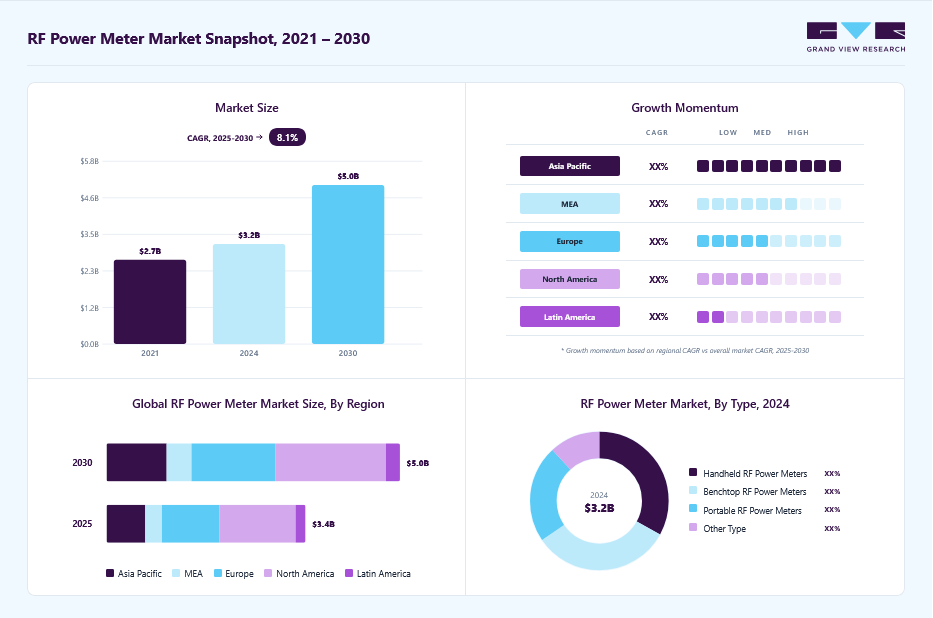
The global radio frequency (RF) power meter market size was valued at USD 3.4 billion in 2025 and is projected to grow from USD 3.7 billion in 2026 to USD 6.3 billion by 2033, growing at a CAGR of 8.0% from 2026 to 2033. North America dominated the market, accounting for the largest global share of 38.3% in 2025. Demand for RF power meters in telecommunications and aerospace is likely to emerge as a key factor for industry growth over the forecast period.
Key Market Trends & Insights
- By type: Handheld RF power meters segment held the largest revenue share of 33.1% in 2025.
- By application: Telecommunications segment held the largest revenue share of 33.9% in 2025.
Regional Highlights
- Largest regional market: North America (38.3% revenue share, 2025)
- Fastest-growing regional market: Asia pacific (fastest CAGR, 2026-2033)
- By country: The U.S. held the largest share of North America in 2025.
Market Size & Forecast
- Market size in 2025: USD 3.4 Billion
- Estimated market size in 2026: USD 3.7 Billion
- Projected market size by 2033: USD 6.3 Billion
- CAGR (2026-2033): 8.0%
Three ways to get this report
Buy it, customize it, or ask a question.Ask an Analyst
A direct answer, usually in 1 working day
- AccessReport author, directly
- Reply timeWithin 1 working day
- No sales callDirect answer only
- FormatEmail reply
- CostFree, no cost
Get the Full Report
What the study covers
- FormatsPDF · Excel · Dashboard
- Timeline2026–2033 annual, 2025 base
- Coverage20+ countries, 5 regions
- Companies10+ key players profiled
Customize the Report
20% free customization
- IncludeCountries, segments, points
- TailorTo your product definition
- ExtendDeeper competitor detail
- OrA fully bespoke study
- Turnaround5–10 working days
The increased adoption of 5G networks and wireless communication technologies is projected to drive the demand for accurate power measurement tools in the coming years. The growing demand for reliable power measurement equipment in military and defense applications is expected to provide significant growth opportunities for the RF power meter sector. According to the U.S. Department of Defense, military expenditure in 2023 reached approximately USD 877 billion, contributing to the increased demand for precision testing equipment such as RF power meters. Additionally, the expansion of IoT and smart city initiatives is anticipated to boost market growth by driving demand for wireless infrastructure testing and monitoring solutions.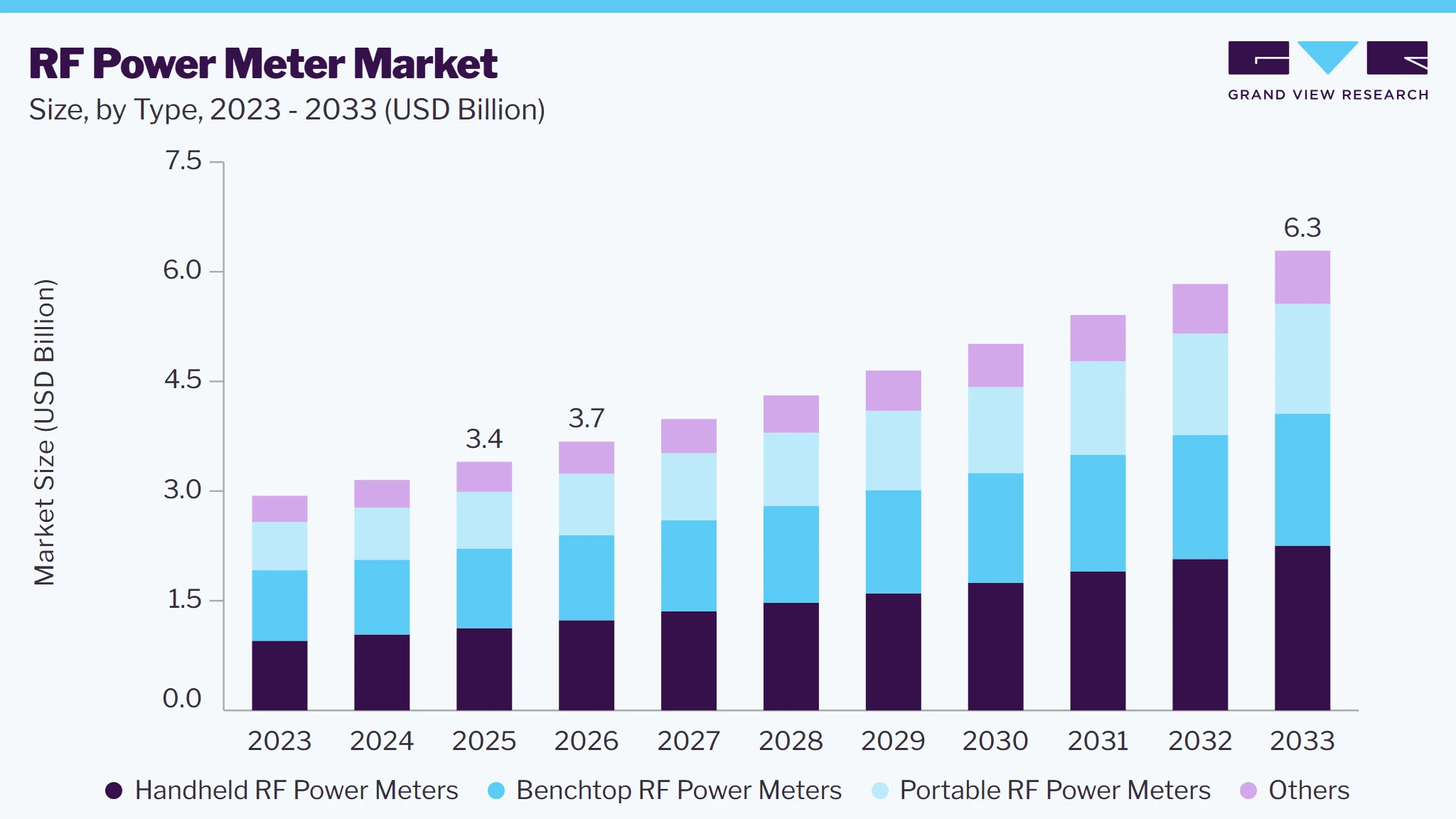
Market Dynamics
The RF power meter market is primarily driven by the increasing demand for accurate radio frequency (RF) and microwave signal measurement across telecommunications, aerospace & defense, semiconductor manufacturing, satellite communications, and research applications. RF power meters are essential for testing, calibration, and performance verification of wireless communication systems, RF components, electronic devices, and network infrastructure. The rapid expansion of 5G networks, increasing adoption of connected devices, and growing complexity of RF systems are driving demand for advanced RF power measurement solutions worldwide.
The increasing deployment of 5G networks and next-generation wireless communication technologies remains a key growth driver for the RF power meter market. RF power meters are extensively used during the design, testing, installation, and maintenance of base stations, antennas, wireless modules, and communication equipment to ensure signal accuracy, network reliability, and regulatory compliance. The ongoing expansion of mobile broadband networks, private wireless networks, and Internet of Things (IoT) ecosystems is significantly increasing demand for RF testing and measurement equipment across the telecommunications sector.
In addition, the growing production of smartphones, wireless devices, connected sensors, and RF-enabled electronic components is driving the need for precise power measurement solutions throughout product development and manufacturing processes. As communication technologies continue to advance toward higher frequencies, wider bandwidths, and more complex network architectures, manufacturers and network operators are increasingly investing in high-performance RF power meters to support quality assurance, performance optimization, and next-generation wireless innovation.
Despite favorable growth prospects, the high cost of advanced RF power meters, precision sensors, and associated calibration services can limit adoption among small and medium-sized enterprises, research institutions, and budget-constrained end users. In addition, maintaining measurement accuracy requires periodic calibration, specialized technical expertise, and ongoing equipment upgrades to accommodate evolving wireless standards and higher-frequency applications. These factors can increase total ownership costs and create purchasing challenges for certain end-user segments, thereby restraining market growth.
The growing deployment of satellite communication systems, low Earth orbit (LEO) satellite constellations, and advanced aerospace communication networks presents significant growth opportunities for the RF power meter market. Additionally, the increasing adoption of automated test and measurement environments across semiconductor manufacturing, telecommunications equipment production, and electronics testing facilities is driving demand for highly accurate and software-integrated RF power measurement solutions. The integration of RF power meters with automated testing platforms and Industry 4.0-enabled manufacturing processes is expected to create new avenues for market expansion over the forecast period.
Analyst Perspective
The radio frequency (RF) power meter market is growing steadily due to the expansion of wireless networks, 5G infrastructure, and demand for accurate RF and microwave signal measurement. Increasing investments in telecommunications, semiconductors, satellite communications, connected devices, and advanced wireless technologies are driving adoption. Despite high equipment costs and frequent technology upgrades, advancements in measurement accuracy, sensor technologies, and automated testing are improving efficiency. Growing demand for high-frequency testing and automated test environments is creating new opportunities. Companies focusing on precision, high-frequency capabilities, and key sectors such as telecommunications, semiconductors, and aerospace are expected to gain a competitive edge.
Type Insights
Based on type, the handheld RF power meters segment led the market with the largest revenue share of 33.1% in 2025. The handheld RF power meter segment dominated the market due to its versatility, portability, and cost-effectiveness across various industries, particularly in telecommunications, aerospace & defense, and electronics sectors. These devices are highly preferred for field testing and on-site measurements, offering ease of use and accuracy in real-time applications. Their growing adoption in 5G infrastructure deployment, along with increasing use in maintenance and testing activities in the broadcasting sector, is expected to drive segment growth.
The benchtop RF power meters segment is anticipated to grow steadily, driven by their high accuracy and broader functionality in research labs and industrial environments. These meters are widely used in R&D activities and production testing in sectors like aerospace & defense, and telecommunications. The increasing focus on developing next-generation communication systems and advanced military communication equipment is likely to bolster the demand for benchtop RF power meters in the coming years.
Application Insights
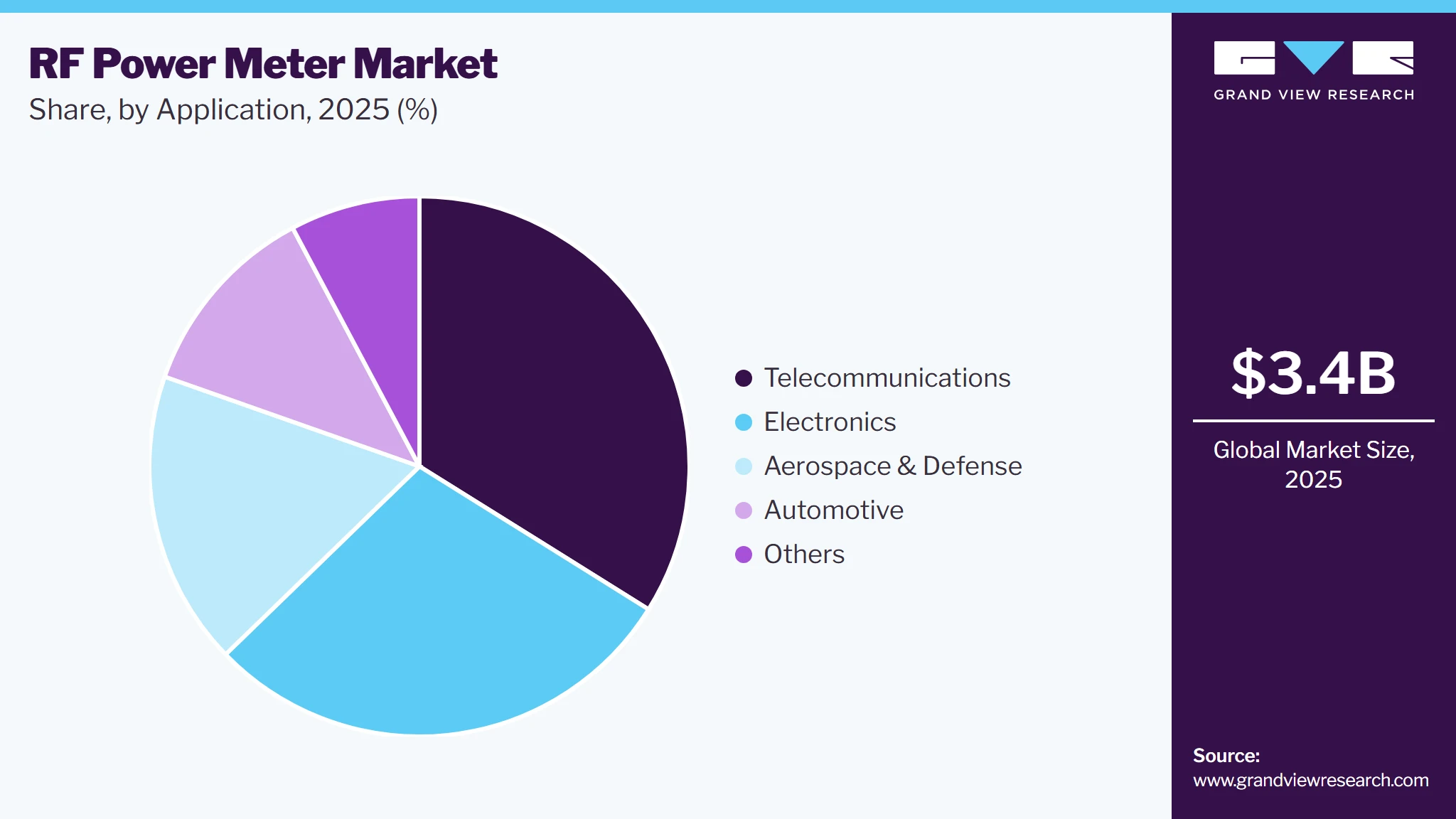
Based on applications, the telecommunications segment led the market with the largest revenue share of 33.9% in 2025. The telecommunications segment accounted for the largest share of the RF power meter industry due to the ongoing expansion of 5G networks and the increasing number of connected devices worldwide. The International Data Corporation reported that global spending on 5G infrastructure reached USD 13 billion in 2023, further driving the demand for RF testing solutions.
The aerospace & defense segment is expected to grow steadily, driven by the increased deployment of advanced radar systems and satellite communication networks. Military organizations in regions such as North America and Europe are heavily investing in upgrading communication infrastructure, further boosting market demand.
The automotive segment is witnessing growing interest due to the integration of wireless communication technologies in connected and electric vehicles. The development of vehicle-to-everything (V2X) communication systems is anticipated to offer significant growth opportunities for RF power meter manufacturers.
Regional Insights
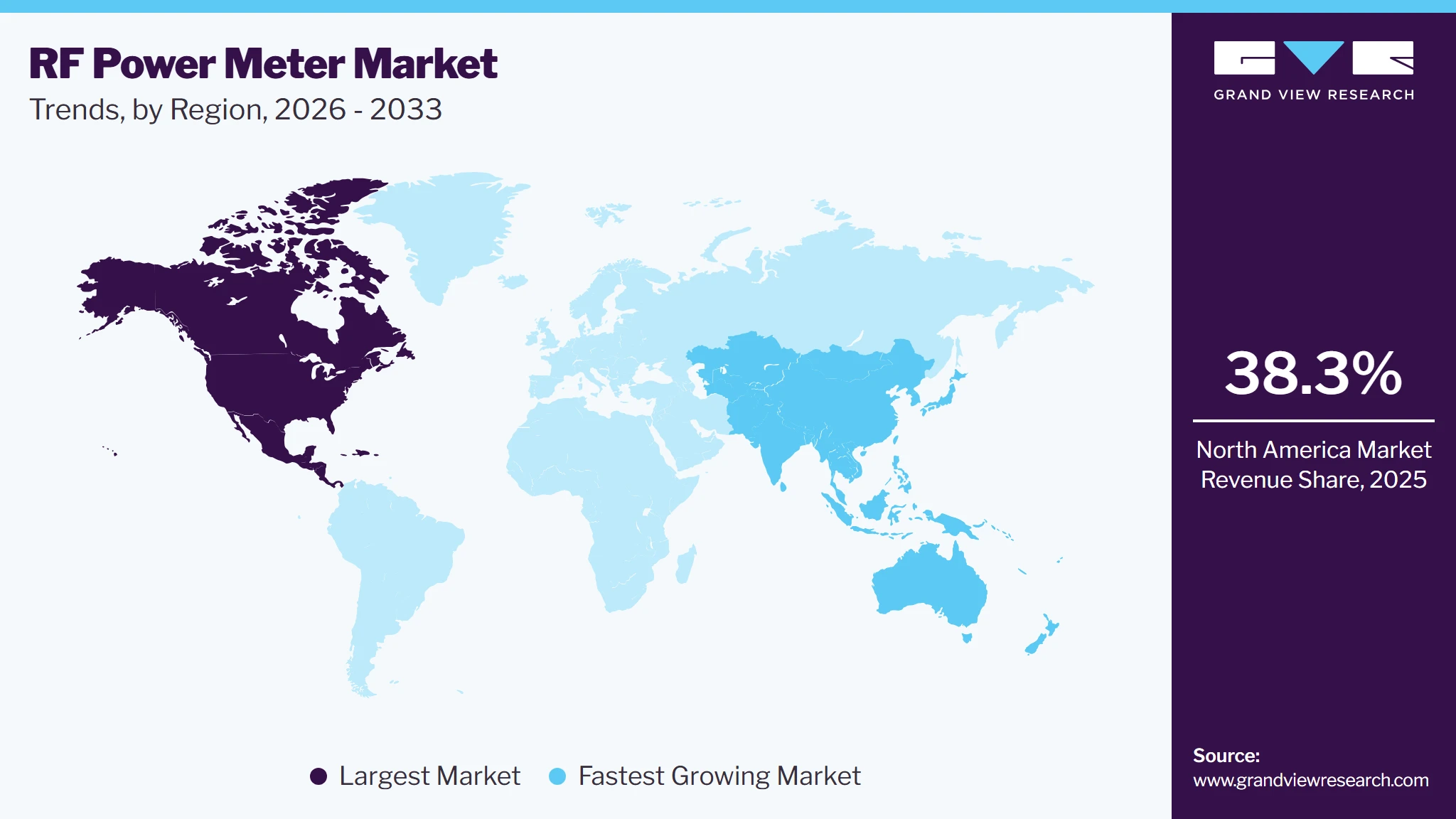
North America dominated the RF power meter market with the largest revenue share of 38.3% in 2025, driven by the presence of key manufacturers and extensive investment in 5G infrastructure. The U.S. government’s emphasis on strengthening communication networks and the defense sector has been a key factor in driving market growth. For example, the Federal Communications Commission (FCC) allocated an additional USD 9 billion for 5G Fund initiatives in rural areas, creating a robust demand for RF power meters.
U.S. RF Power Meter Market Trends
The RF power meter market in the U.S. held the largest share in the North America region in 2025. The U.S. RF power meter market is driven by the growing demand for high-precision measurements in telecommunications, aerospace, and electronics industries. Increasing advancements in 5G technology and the rise of IoT applications present significant opportunities for market growth, fueling the need for accurate RF power measurement solutions.
Asia Pacific RF Power Meter Market Trends
The Asia Pacific region is expected to witness the fastest growth over the forecast period due to rapid industrialization and the expanding telecommunications sector in countries such as China, Japan, and South Korea. China, in particular, leads the region in 5G infrastructure development. According to the China Academy of Information and Communications Technology, the country added over 800,000 5G base stations in 2023, creating significant opportunities for RF power meter manufacturers.
Europe RF Power Meter Market Trends
Europe’s RF power meter market is anticipated to grow at a steady pace, driven by advancements in the automotive and aerospace sectors. The European Union's investments in smart transportation and communication technologies are likely to support market growth. Germany, known for its robust automotive industry, is increasingly adopting RF testing solutions in electric vehicle manufacturing and autonomous driving systems.
Central & South America RF Power Meter Market Trends
In Central and South America, the growing adoption of wireless communication technologies and government initiatives to enhance connectivity are expected to drive market growth. Brazil and Mexico are key markets in the region, with increased spending on telecommunications and defense sectors supporting the demand for RF power meters.
Middle East & Africa RF Power Meter Market Trends
The Middle East & Africa region is experiencing growing demand for RF power meters due to expanding telecommunications infrastructure and military modernization programs. Countries such as the UAE and Saudi Arabia are investing heavily in 5G technology and advanced radar systems for defense, creating significant market opportunities.
Key RF Power Meter Company Insights
Some of the key players operating in the market include Rohde & Schwarz, and Keysight Technologies, and Anritsu.
-
Keysight Technologies is a global leader in electronic measurement solutions, offering a wide range of RF power meters for telecommunications, aerospace & defense applications. The company is known for its cutting-edge technology and reliable testing solutions.
-
Rohde & Schwarz specializes in test and measurement equipment for wireless communication, broadcasting, and aerospace sectors. The company’s RF power meters are widely used for accurate power measurements in 5G networks and radar systems.
-
Anritsu is a leading provider of RF testing solutions, focusing on innovation in mobile communications, automotive radar, and IoT testing technologies.
Key RF Power Meter Companies
The following key companies have been profiled for this study on the radio frequency power meter market.
-
Keysight Technologies, Inc.
-
Rohde & Schwarz GmbH & Co. KG
-
Anritsu Corporation
-
Bird Technologies
-
Tektronix, Inc.
-
Wireless Telecom Group, Inc.
-
Boonton Electronics Corporation
-
Narda Safety Test Solutions GmbH
-
VIAVI Solutions Inc.
Competitive Benchmarking
Category
Operating Strategies
Competitive Edge
Weakness
Established Players (e.g., Keysight Technologies, Inc., Rohde & Schwarz GmbH & Co. KG, Anritsu Corporation, Tektronix, Inc., VIAVI Solutions Inc.)
- Focus on the development and commercialization of high-performance RF power meters, power sensors, and integrated test and measurement solutions across telecommunications, aerospace & defense, semiconductor, and electronics industries.
- Emphasize technological innovation, product portfolio expansion, calibration services, software integration, and long-term partnerships with communication equipment manufacturers, research institutions, and defense organizations.
- Benefit from strong brand recognition, extensive intellectual property portfolios, advanced R&D capabilities, and well-established global distribution networks.
- Broad product portfolios, high measurement accuracy, and comprehensive service offerings support customer retention and enable participation in large-scale testing, manufacturing, and infrastructure projects.
- Face high research and development costs associated with evolving wireless communication standards, higher-frequency technologies, and advanced measurement requirements.
- Revenue growth may be affected by fluctuations in capital spending across telecommunications, semiconductors, and industrial electronics sectors, as well as extended product development cycles.
Emerging & Specialized Players (e.g., Bird Technologies, Wireless Telecom Group, Inc., Boonton Electronics Corporation, Narda Safety Test Solutions GmbH, Gigatronics Incorporated)
- Focus on specialized RF power measurement solutions, niche testing applications, portable instruments, and industry-specific measurement technologies for aerospace, defense, industrial, and wireless communication markets.
- Emphasize technical expertise, customized solutions, application-focused product development, and targeted expansion within specialized RF and microwave testing segments.
- Benefit from specialized product offerings, strong application knowledge, and the ability to address highly specific customer requirements across targeted end-use industries.
- Agile organizational structures support faster product development, quicker response to emerging technology trends, and greater flexibility in serving niche markets.
- Limited financial resources, narrower product portfolios, and smaller geographic footprints compared to large multinational competitors.
- Expansion often requires significant investments in research and development, certification capabilities, distribution networks, and customer acquisition, which may constrain long-term market penetration.
Recent Developments
-
In October 2024, Keysight Technologies and the UK’s National Physical Laboratory announced a breakthrough in cryogenic RF power measurement technology. This collaboration has developed the industry’s first traceable cryogenic RF power measurement system, enabling accurate measurements at extremely low temperatures, essential for quantum computing and advanced communication systems.
-
In April 2024, Anritsu introduced a new IQ capture and IQ streaming option for its Field Master MS2080A RF spectrum analyzer, enhancing real-time data analysis capabilities for 5G, IoT, and aerospace applications. This new feature allows users to capture and stream IQ data for comprehensive post-processing and signal analysis, improving troubleshooting and performance evaluation.
RF Power Meter Report Scope
Report Attribute
Details
Market definition
The global RF Power Meter Market refers to the revenue generated from the sales of RF power measurement instruments, including benchtop RF power meters, handheld RF power meters, and associated measurement solutions, used for testing, calibration, monitoring, and performance verification of radio frequency and microwave signals across telecommunications, aerospace & defense, semiconductor, satellite communication, and research applications.
Market size value in 2025
USD 3.4 billion
Market size value in 2026
USD 3.7 billion
Revenue forecast in 2033
USD 6.3 billion
Growth rate
CAGR of 8.0% from 2026 to 2033
Base year for estimation
2025
Historical data
2021 - 2024
Forecast period
2026 - 2033
Quantitative units
Revenue in USD million/billion, and CAGR from 2026 to 2033
Report coverage
Revenue forecast, company ranking, competitive landscape, growth factors, and trends
Segments covered
Type, application, region
Regional scope
North America; Europe; Asia Pacific; Central & South America; Middle East & Africa
Country scope
U.S, Canada, Mexico, Germany, UK, France, India, China, Japan, South Korea, Brazil, Saudi Arabia, UAE
Key companies profiled
Keysight Technologies, Inc., Rohde & Schwarz GmbH & Co. KG, Anritsu Corporation, Bird Technologies, Tektronix, Inc., Wireless Telecom Group, Inc., Boonton Electronics Corporation, Narda Safety Test Solutions GmbH, VIAVI Solutions Inc., Gigatronics Incorporated.
Customization scope
Free report customization (equivalent up to 8 analysts' working days) with purchase. Addition or alteration to country, regional & segment scope.
Pricing and purchase options
Avail customized purchase options to meet your exact research needs. Explore purchase options
Global RF Power Meter Market Report Segmentation
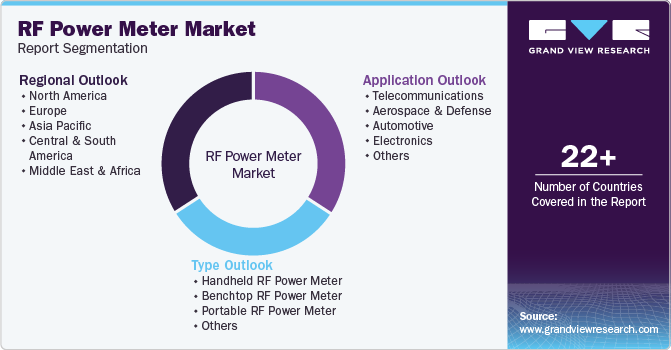
This report forecasts revenue and volume growth at global, regional, and country levels and provides an analysis of the latest industry trends in each of the sub-segments from 2021 to 2033. For the purpose of this study, Grand View Research has segmented the global RF power meter market report on the basis of type, application, and region.
-
Type Outlook (Volume, Kilotons; Revenue, USD Million; 2021 - 2033)
-
Handheld RF Power Meter
-
Benchtop RF Power Meter
-
Portable RF Power Meter
-
Others
-
-
Application Outlook (Volume, Kilotons; Revenue, USD Million; 2021 - 2033)
-
Telecommunications
-
Aerospace & Defense
-
Automotive
-
Electronics
-
Others
-
-
Regional Outlook (Volume, Kilotons; Revenue, USD Million; 2021 - 2033)
-
North America
-
U.S.
-
Canada
-
Mexico
-
-
Europe
-
Germany
-
UK
-
France
-
-
Asia Pacific
-
China
-
India
-
Japan
-
South Korea
-
-
Central & South America
-
Brazil
-
-
Middle East & Africa
-
Saudi Arabia
-
UAE
-
-
Research Methodology
The RF power meter market figures in this report are based on a proven research process that combines executive interviews with secondary research from proprietary databases, company filings, and recognized regulatory and institutional sources. Market size is built through value-chain sizing - reconciling supply-side and demand-side estimates - and triangulated with bottom-up and top-down approaches. Every estimate passes multiple levels of expert validation before publication, with each RF power meter segment quantified using the revenue-capture definitions in the table below.
Segment Definition
Type
Revenue Capture Definition
Handheld RF Power Meters
Handheld RF power meters are battery-operated, fully self-contained devices with integrated displays used for field testing, installation, maintenance, and troubleshooting of RF systems. Revenue includes device sales, integrated sensors, calibration, software, and support services.
Benchtop RF Power Meters
Benchtop RF power meters are high-precision laboratory and production-grade instruments used for RF measurement, calibration, product development, and quality assurance. Revenue includes instrument sales, external sensors, software, and calibration services.
Portable RF Power Meters
Portable RF power meters are compact, transportable systems using external sensors or modular interfaces for mobile testing environments. They offer higher flexibility and accuracy than handheld devices for field and industrial applications. Revenue includes instrument sales, sensor modules, software, and maintenance services.
Others
This segment includes USB-based, modular, rack-mounted, and specialized RF power measurement systems used for niche applications. Revenue is derived from equipment sales, custom solutions, software integration, and calibration services.
Application
Revenue Capture Definition
Telecommunications
RF power meters are extensively used in telecommunications for testing, calibration, installation, and maintenance of wireless communication infrastructure, including base stations, antennas, mobile devices, and network equipment. Revenue capture includes instrument sales, sensor deployment, calibration services, network testing operations, and integration with telecom infrastructure deployment and maintenance activities.
Aerospace & Defense
The aerospace and defense sector uses RF power meters to test radar systems, satellite communication equipment, military communication networks, electronic warfare systems, and avionics. Revenue is generated through equipment procurement, calibration services, defense testing programs, aerospace research activities, and integration into mission-critical communication and surveillance systems.
Automotive
RF power meters are used in automotive applications to test wireless communication modules, connected vehicle systems, telematics devices, vehicle-to-everything (V2X) technologies, radar sensors, and advanced driver-assistance systems (ADAS). Market revenue includes equipment sales, validation testing activities, automotive electronics development, and quality assurance processes across vehicle manufacturing operations.
Electronics
The electronics segment employs RF power meters for semiconductor testing, RF component validation, consumer electronics manufacturing, wireless device development, and production line quality control. Revenue is attributed to instrument sales, sensor solutions, automated test equipment integration, calibration activities, and measurement services supporting electronics design and manufacturing operations.
Others
This category includes applications across research institutions, universities, healthcare electronics, industrial automation, broadcasting, satellite ground stations, and energy communication networks. Associated revenues are linked to RF power meter sales, calibration and maintenance services, testing operations, research activities, and specialized RF measurement requirements across diverse end-use sectors.
Estimation Model
Layer Name
Key Question
Description
RF Testing Demand Base Layer
What forms the demand base?
Identify global demand for RF power measurement solutions across industries requiring accurate testing, calibration, validation, and monitoring of radio frequency and microwave signals. Assess activity levels in telecommunications infrastructure deployment, semiconductor manufacturing, aerospace & defense electronics, automotive connectivity systems, and wireless device development to establish the addressable market opportunity.
RF Equipment Manufacturing & Supply Layer
Where are RF power meters manufactured and supplied?
Estimate the manufacturing and supply capabilities of RF power meters, power sensors, and related measurement solutions across key regions. Analyze manufacturing facilities, technology development capabilities, component supply chains, distribution networks, calibration infrastructure, and channel partnerships to assess market accessibility and competitive supply dynamics.
Application Adoption Layer
How extensively are RF power meters utilized?
Analyze the adoption of RF power meters across telecommunications, aerospace & defense, automotive, electronics, and other end-use applications. Evaluate testing requirements, quality assurance standards, wireless communication deployments, semiconductor validation activities, and RF system development programs influencing instrument demand and utilization rates.
Revenue Layer
How is market revenue generated?
Expenditures on RF power meters, power sensors, calibration services, software platforms, maintenance contracts, and automated test system integration quantify market revenue. Equipment sales volumes, average selling prices, technology complexity, testing intensity, and capital investments across end-use industries drive the overall market value.
Delivered Customizations
This report has been delivered with the following In-depth customizations
Client Request
Customization Delivered
Value Adds
RF Power Meter Competitive Landscape Assessment
Detailed competitive landscape analysis covering manufacturers and suppliers of RF power meters, power sensors, calibration solutions, and RF measurement systems. The study profiled key market participants based on geographic presence, organizational structure, product portfolio, technology capabilities, distribution networks, customer base, strategic initiatives, and investments in product development, software integration, and measurement accuracy enhancements.
Enabled evaluation of competitive positioning, technology leadership, distribution strengths, customer engagement strategies, and market participation across the RF test and measurement value chain.
Application & Technology Assessment
Evaluation of global RF power meter demand across telecommunications, aerospace & defense, automotive, electronics, and other end-use applications. Included assessment of RF measurement technologies, power sensing solutions, testing methodologies, wireless communication trends, semiconductor validation requirements, regulatory considerations, and adoption patterns across major regional markets.
Highlighted application trends, technology adoption patterns, and regional demand opportunities. Supported strategic planning, product portfolio optimization, market entry evaluation, and investment prioritization decisions.
Opportunity Assessment
Identification of high-growth opportunities associated with 5G network deployment, satellite communications, semiconductor manufacturing expansion, advanced wireless technologies, and automated test environments. Assessed emerging opportunities arising from increasing RF complexity, higher-frequency communication systems, Industry 4.0 adoption, and growing investments in aerospace, defense, and next-generation connectivity infrastructure.
Enabled prioritization of high-value growth opportunities and emerging application segments. Supported long-term business planning, product development strategies, technology investments, and expansion decisions aligned with evolving RF testing and measurement requirements.
Frequently Asked Questions About This Report
Based on type, handheld RF power meters accounted for largest revenue share of 33.1% in 2025, while portable RF power meters are anticipated to register the second fastest CAGR over the forecast period.
North America dominated the market with revenue share of 38.3% in 2025.
U.S. dominated the North America market with a revenue share of 78.3% in 2025.
Asia Pacific is anticipated to register the fastest CAGR of 9.0% over the forecast period.
The RF power meter market size was valued at USD 3.4 billion in 2025 and is estimated at USD 3.7 billion in 2026.
The RF power meter market is expected to grow at a compound annual growth rate of 8.0% from 2026 to 2033 to reach USD 6.3 billion by 2033.
Based on applications, telecommunications accounted for largest revenue share of 33.9% in 2025.
The key players operating in the RF power meter market include Keysight Technologies, Inc., Rohde & Schwarz GmbH & Co. KG, Anritsu Corporation, Bird Technologies, Tektronix, Inc., Wireless Telecom Group, Inc., Boonton Electronics Corporation, Narda Safety Test Solutions GmbH, VIAVI Solutions Inc., and Gigatronics Incorporated.
The key drivers of the global RF power meter market are the increasing deployment of 5G networks, the expansion of wireless communication infrastructure, and the growing demand for accurate RF and microwave signal measurement across the telecommunications, aerospace & defense, electronics, and automotive industries.
About the Author(s)
Distribution & Utilities Research Team
Energy & Power · Distribution & UtilitiesThis report was authored by the distribution & utilities research team at Grand View Research - comprising two research analysts, one senior research analyst, and one industry expert - with specialized expertise in the distribution & utilities segment of the energy & power industry. All findings are based on proprietary energy & power databases, executive interviews, and regulatory analysis, subject to internal peer review prior to publication.
Last Updated:
Speak to Analyst


Customize this report to your needs - add regions, segments, or data points, with 20% free customization.
Or view our licence options:


ISO 9001:2015 & 27001:2022 Certified
We are GDPR and CCPA compliant! Your transaction & personal information is safe and secure. For more details, please read our privacy policy.


