
- Home
- »
- Medical Devices
- »
-
Robot-assisted Endoscope Market Size Report, 2026-2033GVR Report cover
![Robot-assisted Endoscope Market (2026 - 2033)Report]()
Robot-assisted Endoscope Market (2026 - 2033)
Size, Share & Trends Analysis Report By End-use (Hospitals, Outpatient Facilities), By Region (North America, Asia Pacific, Europe, Latin America, MEA), And Segment Forecasts
Market Size, 2025
$1.6BMarket Estimate, 2026
$1.7BMarket Forecast, 2033
$3.0BCAGR, 2026–2033
8.2%Robot-assisted Endoscope Market Summary
The global robot-assisted endoscope market was valued at USD 1.6 billion in 2025 and is projected to grow from USD 1.7 billion in 2026 to USD 3.0 billion in 2033, at a CAGR of 8.2% from 2026 to 2033.North America dominated the market, accounting for a revenue share of 41.0% in 2025. The factors, such as greater diagnostic capabilities, and quicker recovery periods, have led to consistent growth in the market. The development of more advanced and functional robot-assisted endoscope systems can be attributed to substantial technological developments in the fields of robotics and endoscopy. The demand for sophisticated endoscopic technology, particularly robot-assisted endoscopes, has increased with the rising prevalence of chronic diseases like cancer and gastrointestinal disorders.
Key Market Trends & Insights
- By end-use: The outpatient facilities segment held the largest market share of around 53.0% in 2025.
Regional Highlights
- Largest regional market: North America (41.0% revenue share, 2025)
- Fastest-growing regional market: Asia Pacific (highest CAGR, 2026-2033)
Market Size & Forecast
- Market size in 2025: USD 1.6 Billion
- Estimated market size in 2026: USD 1.7 Billion
- Projected market size by 2033: USD 3.0 Billion
- CAGR (2026-2033): 8.2%
The increased prevalence of chronic diseases, including pancreatic cancer, inflammatory bowel disease, and gastroesophageal reflux disease (GERD), among individuals of all ages as a result of unhealthy lifestyles, is one of the key reasons driving the market's expansion. According to the American College of Gastroenterology, in the US, an estimated 10 to 15 % of adults experience symptoms of IBS, an inflammatory bowel disease that’s considered one of the most commonly diagnosed gastrointestinal issues. Robotic endoscopy is viable & safe, and it enhances clinical & surgical outcomes for patients with IBS.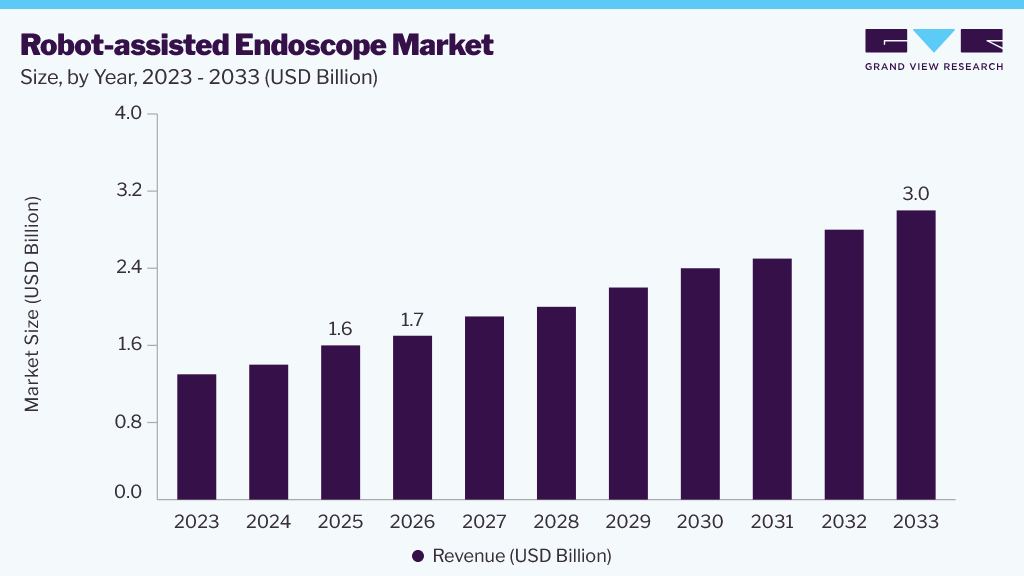
Advantages enabled by robotic endoscopy in identifying irritable bowel syndrome and inflammatory bowel syndrome are anticipated to fuel demand and accelerate market expansion. Moreover, the increasing expenditures on technological advancements in endoscopic visualization systems by a variety of market participants are anticipated to fuel the market's expansion over the projected period. New investments in this sector also contribute to the growth potential. For instance, in April 2025, CMR Surgical Ltd., a manufacturer of robotically assisted devices designed to improve control of endoscopic instruments, announced it had secured a financing round of over USD 200 million, backed by existing investors and Trinity Capital. Such developments are likely to facilitate the growth of this market during the forecast period.
Among the surgeries performed are endoscopic neurosurgery, uterine fibroids, bulging prostate, bladder cancer, and central airway blockage removal. Moreover, the regulatory approvals for various robotic endoscopic platforms drive the market growth. In March 2025, Johnson & Johnson MedTech announced it had received the U.S. FDA clearance for its MONARCH QUEST robotic-assisted bronchoscopy platform. With this approval, MONARCH became the multispecialty, adaptable robotic device for bronchoscopy and urology procedures. These developments are key in shaping the further course of this industry.
Analyst Perspective
The global robot-assisted endoscope market is expected to experience significant growth. The growth of this market is primarily driven by factors such as increasing inclination toward minimally invasive surgical procedures, inclusion of artificial intelligence (AI) and robotics in healthcare applications, and the rising number of Ambulatory Surgical Centers (ASCs). An increasing number of gastrointestinal procedures and growing prevalence of lifestyle-related GI conditions are likely to develop strong demand for technology-assisted surgical equipment in multiple regions. Traditional open surgeries are increasingly replaced by laparoscopy and therapeutic endoscopy. Key companies in this market have been relying on strategies such as partnerships, acquisitions, portfolio expansions, and others to improve market share.
End-use Insights
The outpatient facilities segment dominated the market with a revenue share of 53.0% in 2025. This includes day surgery clinics or ambulatory surgery centers (ASCs), which have been using robot-assisted endoscopes more frequently in their procedures. Outpatient facilities strive to offer patients convenient and effective medical care. Minimally invasive procedures are prioritized wherever possible in outpatient settings. This target is in accordance with the goal that robot-assisted endoscopes, which provide less invasive alternatives for numerous diagnostic and treatment procedures, aim to achieve.
Robot-assisted endoscopes are appealing in outpatient settings because they often lead to shorter recovery times and shorter operative times. The segment is also expected to grow at the fastest CAGR from 2026 to 2033. Robot-assisted endoscopes can help eliminate the need for more involved surgical procedures and shorten hospital stays, making them cost-effective for outpatient facilities. Outpatient facilities may see increased demand for such treatments due to the rising prevalence of gastrointestinal illnesses and other conditions requiring endoscopic procedures. Robotic endoscopes can help to effectively address this demand.
Regional Insights
North America dominated the global market with a revenue share of 41.0% in 2025. The existence of a well-established healthcare industry, hospitals' financial capacity to invest in robotic endoscopy equipment, public awareness of robot-assisted medical procedures, and the presence of a sizable market participant base in the area are the key drivers of market growth. The increasing number of clinical trial studies for robot-assisted endoscopes boosts market growth. For instance, in April 2025, Medtronic plc announced that its Expand URO U.S. clinical trial evaluating the Hugo robotic-assisted surgery system successfully met its primary safety and effectiveness endpoints in urologic procedures.

During the projected period, the market’s expansion is anticipated to be aided by the accessibility of sophisticated robotic endoscopies and their widespread use in surgical procedures. With the use of this minimally invasive technology, surgeons can reach parts of the mouth and throat that are difficult to reach. The otolaryngologists at Cancer Treatment Centers of America (CTCA) had received extensive training in using the Flex robotic system to treat patients with head and neck cancer.
Asia Pacific Robot-assisted Endoscope Market Trends
The availability of such cutting-edge robotic endoscopic tools in North America demonstrates the uptake of cutting-edge technologies. During the anticipated period, this circumstance is anticipated to accelerate the market's growth. Asia Pacific is expected to register the fastest CAGR of xx% during the forecast period. The regional demand is anticipated to be driven by factors, such as increased disposable income, healthcare costs, and the prevalence of chronic disorders. In addition, the need is anticipated to be fueled by the increasing use of robotic systems in healthcare facilities. Moreover, the increasing investment in cutting-edge medical technologies and procedures, such as robotic-assisted endoscopies, has resulted from rising healthcare spending countries such as China and India.
Key Robot-assisted Endoscope Company Insights
To sustain a high level of competitive rivalry, market participants are investing an extensive amount of funds in the development and launch of new products. For instance, in May 2025, EndoQuest Robotics reported completion of the first clinical procedures in its PARADIGM trial using the Endoluminal Surgical (ELS) System. The endoluminal robotic surgery instrument known as the ELS system enables therapeutic endoscopy specialists and doctors to execute both upper and lower gastrointestinal procedures without leaving scars by using a trans-anal or trans-oral method. These initiatives support the market's continuing competitiveness.
Key Robot-assisted Endoscope Companies
The following key companies have been profiled for this study on the robot-assisted endoscope market:
-
Asensus Surgical US, Inc.
-
Intuitive Surgical Operations, Inc.
-
Ethicon Inc. (Johnson & Johnson)
-
Johnson & Johnson Services, Inc.
-
Brainlab SE
-
Medtronic plc.
-
Boston Scientific Corporation
-
Stryker
-
Karl Storz SE & Co. KG
-
CMR Surgical Ltd.
Recent Developments
- In July 2025, Olympus Corporation entered into a strategic partnership with Revival Healthcare Capital to co-found Swan EndoSurgical, a new company focused on developing next-generation endoluminal robotic systems for gastrointestinal applications. The collaboration aims to advance minimally invasive robotic endoscopy technologies to improve precision, expand therapeutic capabilities, and enhance patient outcomes in gastrointestinal procedures.
- In August 2024, KARL STORZ completed the acquisition of Asensus Surgical Inc., a global leader in digital and robotic surgery solutions. The transaction strengthens KARL STORZ’s position in robotic assisted and endoscopic surgery by integrating Asensus’ technologies, including its Senhance platform, into its broader surgical visualization and minimally invasive surgery ecosystem.
Robot-assisted Endoscope Market Report Scope
Report Attribute
Details
Market size in 2025
USD 1.6 billion
Estimated market size in 2026
USD 1.7 billion
Projected market size by 2033
USD 3.0 billion
Growth rate
CAGR of 8.2% from 2026 to 2033
Base year for estimation
2025
Historical data
2021 - 2024
Forecast period
2026 - 2033
Quantitative units
Revenue in USD billion, and CAGR from 2026 to 2033
Report coverage
Revenue forecast, company ranking, competitive landscape, growth factors, and trends
Segments covered
End-use, region
Regional Scope
North America; Europe; Asia Pacific; Latin America; MEA
Country Scope
U.S.; Canada; UK; Germany; France; Italy; Spain; Denmark; Sweden; Norway; Japan; China; India; Australia; South Korea; Thailand; Brazil; Mexico; Argentina; South Africa; Saudi Arabia; UAE; Kuwait
Key companies profiled
Asensus Surgical US, Inc.; Intuitive Surgical Operations, Inc.; Ethicon Inc. (Johnson & Johnson); Johnson & Johnson Services, Inc.; Brainlab SE; Medtronic plc.; Boston Scientific Corporation; Stryker; Karl Storz SE & Co. KG; CMR Surgical Ltd.
Customization scope
Free report customization (equivalent up to 8 analysts working days) with purchase. Addition or alteration to country, regional & segment scope.
Pricing and purchase options
Avail of customized purchase options to meet your exact research needs. Explore purchase options
Global Robot-assisted Endoscope Market Report Segmentation
This report forecasts revenue growth at global, regional, and country levels and provides an analysis of the latest industry trends and opportunities in each of the sub-segments from 2021 to 2033. For this study, Grand View Research has segmented the robot-assisted endoscope market report on the basis of end-use, and region:
- End-use Outlook (Revenue, USD Million, 2021 - 2033)
- Hospitals
- Outpatient Facilities
- Regional Outlook (Revenue, USD Million, 2021 - 2033)
- North America
- U.S.
- Canada
- Europe
- UK
- Germany
- France
- Italy
- Spain
- Denmark
- Sweden
- Norway
- Asia Pacific
- Japan
- China
- India
- Australia
- South Korea
- Thailand
- Latin America
- Brazil
- Mexico
- Argentina
- Middle East & Africa (MEA)
- South Africa
- Saudi Arabia
- UAE
- Kuwait
- North America
Frequently Asked Questions About This Report
The global robot-assisted endoscope market is expected to grow at a CAGR of 8.2% from 2026 to 2033, reaching USD 3.0 billion.
Key players include Asensus Surgical US, Inc.; Intuitive Surgical Operations, Inc.; Ethicon Inc. (Johnson & Johnson); Johnson & Johnson Services, Inc.; Brainlab SE; Medtronic plc.; Boston Scientific Corporation; Stryker; Karl Storz SE & Co. KG; CMR Surgical Ltd.
The global robot-assisted endoscope market size was valued at USD 1.6 billion in 2025 and is estimated at USD 1.7 billion for 2026..
North America dominated with a 41.0% revenue share in 2025.
Outpatient facilities dominated the robot-assisted endoscope market with a share of 53.0% in 2025.
About the Author(s)
Medical Devices Research Team
Healthcare · Medical DevicesThis report was authored by the medical devices research team at Grand View Research - comprising two research analysts, one senior research analyst, and one industry expert - with specialized expertise in the medical devices segment of the healthcare industry. All findings are based on proprietary healthcare databases, executive interviews, and regulatory analysis, subject to internal peer review prior to publication.
Last Updated:
Speak to Analyst


Customize this report to your needs — add regions, segments, or data points, with 20% free customization.
Or view our licence options:


ISO 9001:2015 & 27001:2022 Certified
We are GDPR and CCPA compliant! Your transaction & personal information is safe and secure. For more details, please read our privacy policy.


