
- Home
- »
- Alcohol & Tobacco
- »
-
Rum Market Size, Share And Growth Report, 2026-2033GVR Report cover

Rum Market (2026 - 2033)
Size, Share & Trends Analysis Report By Product (Dark & Golden Rum, White Rum, Flavored and Spiced Rum), By Distribution Channel (Off-Trade, On-Trade), By Region (North America, Europe, Asia Pacific,Central & South America,MEA), And Segment Forecasts
Market Size, 2025
$18.2BMarket Estimate, 2026
$19.2BMarket Forecast, 2033
$29.6BCAGR, 2026–2033
6.4%Rum Market Summary
The global rum market size was valued at USD 18.2 billion in 2025 and is projected to grow from USD 19.2 billion in 2026 to USD 29.6 billion by 2033, growing at a CAGR of 6.4% from 2026 to 2033. Asia Pacific dominated the rum market with the largest revenue share of 39.5% in 2025. The global market is experiencing robust growth fueled by rising demand for distilled liquor among millennials, who are increasingly drawn to spirits with distinctive character and cultural heritage.
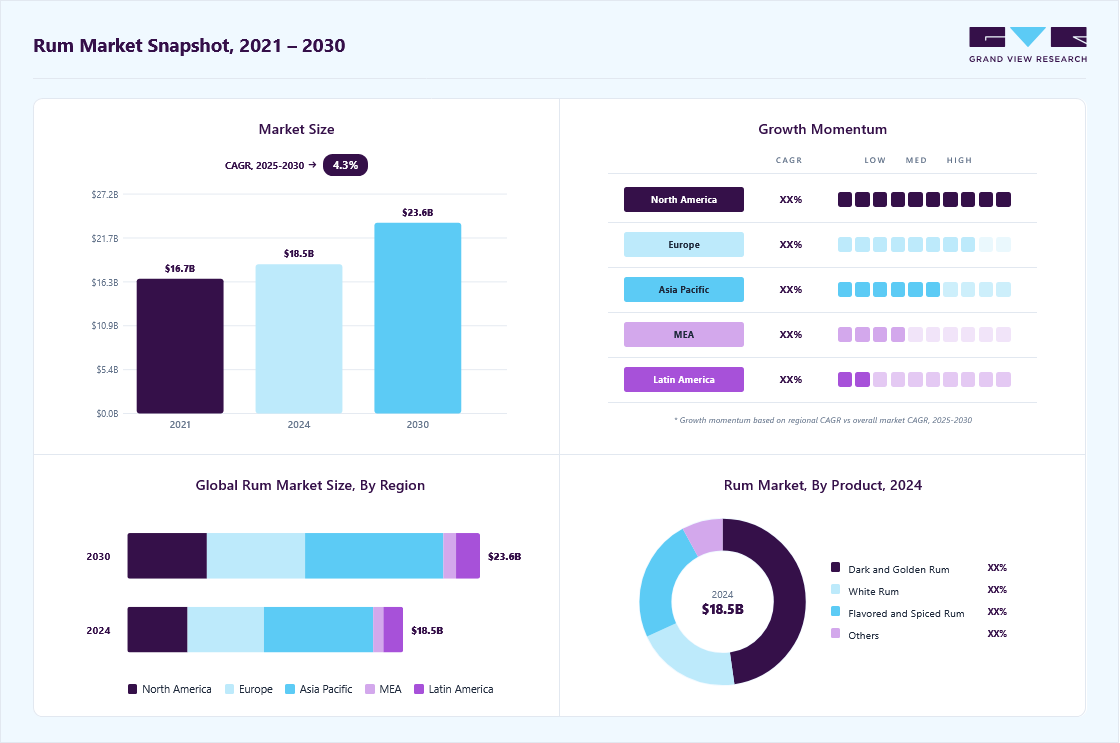 Source: Grand View Research, IR Documents, Primary Interviews, Paid DatabasesTo learn more about this report,
 Download Free Sample Report
 Key Market Trends & Insights
- By product: Dark and golden rum led the market with the largest revenue share of 47.6% in 2025.
- By distribution channel: Off-trade channel led the market with the largest revenue share of 79.4% in 2025.
Regional Highlights
- Largest regional market: Asia Pacific (39.5% revenue share, 2025)
- Fastest-growing regional market: North America (highest CAGR, 2026-2033)
- By country: India held the largest market share in 2025
Market Size & Forecast
- Market size in 2025: USD 18.2 Billion
- Estimated market size in 2026: USD 19.2 Billion
- Projected market size by 2033: USD 29.6 Billion
- CAGR (2026-2033): 6.4%
Three ways to get this report
Buy it, customize it, or ask a question.Ask an Analyst
Analyst response in 1 business day
- AccessReport author, directly
- Reply timeWithin 1 working day
- No sales callDirect answer only
- FormatEmail reply
- CostFree, no cost
Get the Full Report
What the study covers
- FormatsPDF · Excel · Dashboard
- Timeline2026–2033 annual, 2025 base
- Coverage20+ countries, 5 regions
- Companies10+ key players profiled
Customize the Report
20% free customization
- IncludeCountries, segments, points
- TailorTo your product definition
- ExtendDeeper competitor detail
- OrA fully bespoke study
- Turnaround5–10 working days
The premiumization of alcoholic beverages has further accelerated this trend, as consumers seek higher-quality, craft, and small-batch rums with refined taste profiles. Additionally, the introduction of new and exotic flavors, such as tropical fruits, spices, and dessert-inspired variants, has broadened rum’s appeal, especially among younger and experimental drinkers, driving both on-trade and off-trade sales worldwide.The alcohol industry is witnessing some major shifts in consumer behavior and drinking patterns, especially among Gen Z and millennials. Nowadays, consumers have become more experimental and are ready to spend more on premium products. They express a keen interest in substituting their regular beverages for extravagant premium alcohol drinks.
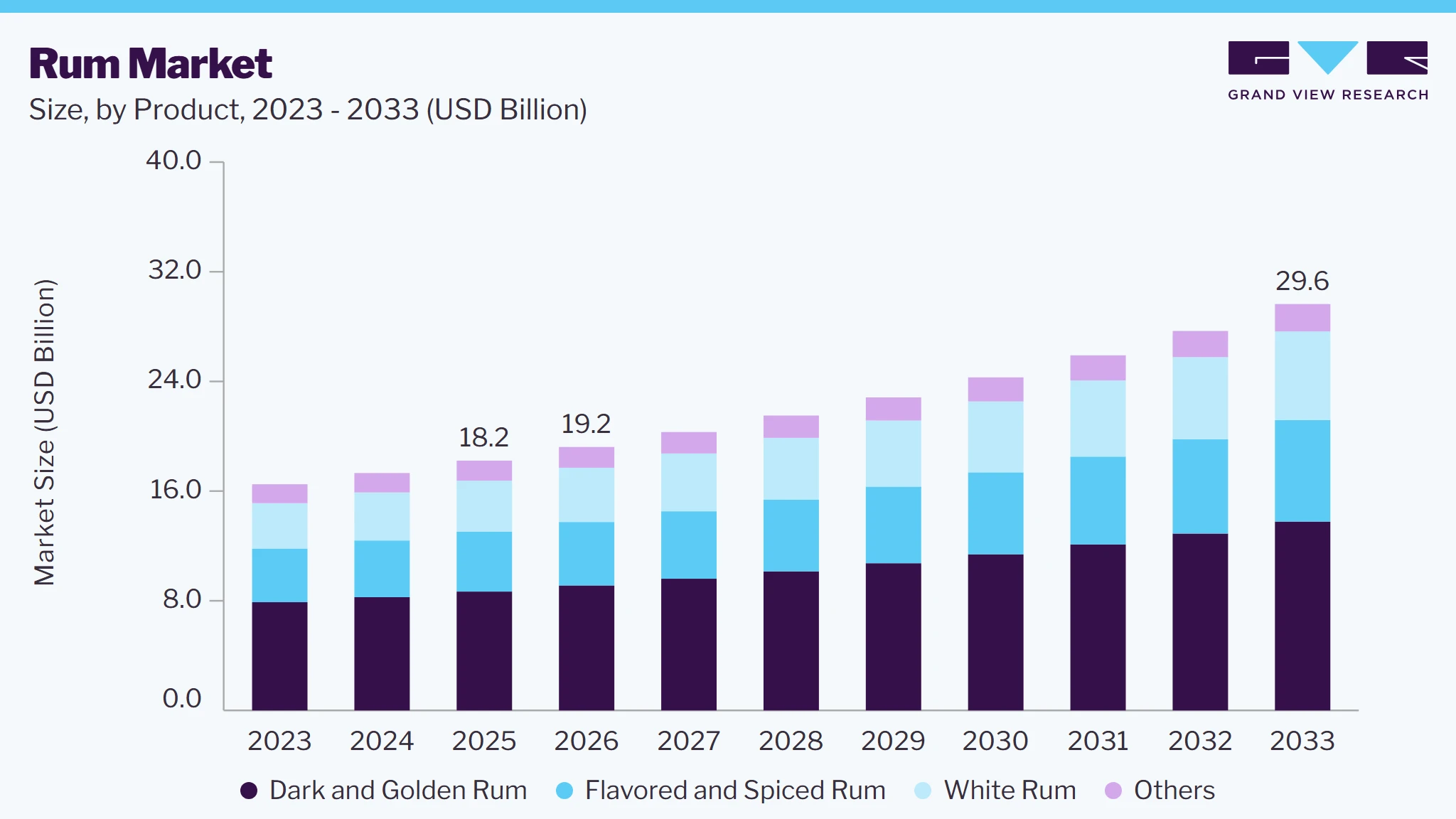 To learn more about this report, Download Free Sample Report
 The shift in consumption habits, coupled with a notable surge in the beverage premiumization trend, has significantly contributed to this transformation. According to an article published by Park Street Imports, LLC. in October 2024, rum’s perception has shifted as producers move away from the nautical branding once popular with brands like Sailor Jerry, Captain Morgan, and Kraken. New premium brands such as Ten to One Rum, Foursquare, and Diplomático now emphasize production techniques and the rich history of the spirit. This shift has attracted younger drinkers, with those aged 25-34 accounting for the largest share (20.7%) of rum consumers. Brands are focusing on educating consumers and using quality cues to position rum as a premium spirit.
According to an article published by Ground Signal, a company specializing in AI-powered solutions for the beverage alcohol industry, in March 2024, premium rum sales were 42% higher than average in accounts within Ground Signal’s proprietary Multicultural High Energy Dining segment.
Moreover, due to consumers' changing consumption patterns, manufacturers of premium alcoholic drinks are focusing on strategies like mergers and acquisitions to gain traction and expand their market shares. For instance, in January 2023, Brown‑Forman Corporation acquired the Diplomático Rum brand and related assets from Destillers United Group S.L. (Russia). This acquisition marked Brown‑Forman’s entry into the growing super-premium rum category.
A key factor driving the rum industry is the expansion of product portfolios by manufacturers worldwide, particularly with new flavored dark rum offerings and premium-designed rum to attract a broader consumer base. For instance, in March 2025, Brugal Rum launched the Andrés Brugal Edition 02, the second limited edition in its ultra-premium range, with only 416 bottles available globally. Retailing at USD 3,000 per bottle, it features a blend of four single casks aged in American oak, showcasing flavors of coconut, vanilla, and gentle spice.
According to the Distilled Spirits Council of the United States, in 2024, nearly 21 million 9-liter cases of rum were sold in the U.S., further highlighting the growing demand and the industry's response to evolving consumer preferences.
Furthermore, Rum's popularity in cocktails is a key factor driving its market growth. Its versatility in drinks like the Mojito, Daiquiri, and Piña Colada has made it particularly appealing to younger consumers. As cocktail culture continues to expand globally, rum’s ability to blend with a variety of flavors-from tropical fruits to spices-has made it a preferred choice for both bartenders and home mixologists. This trend, coupled with the rise of craft cocktails and innovative flavored rums, has strengthened rum’s presence in bars and restaurants, driving both casual and premium sales. According to the 2024 Cocktail Trends Report published by Bacardi, rum is considered an essential spirit for on-premise programs, as four of the ten best-selling cocktails identified in the report are rum-based drinks.
Consumer Insights
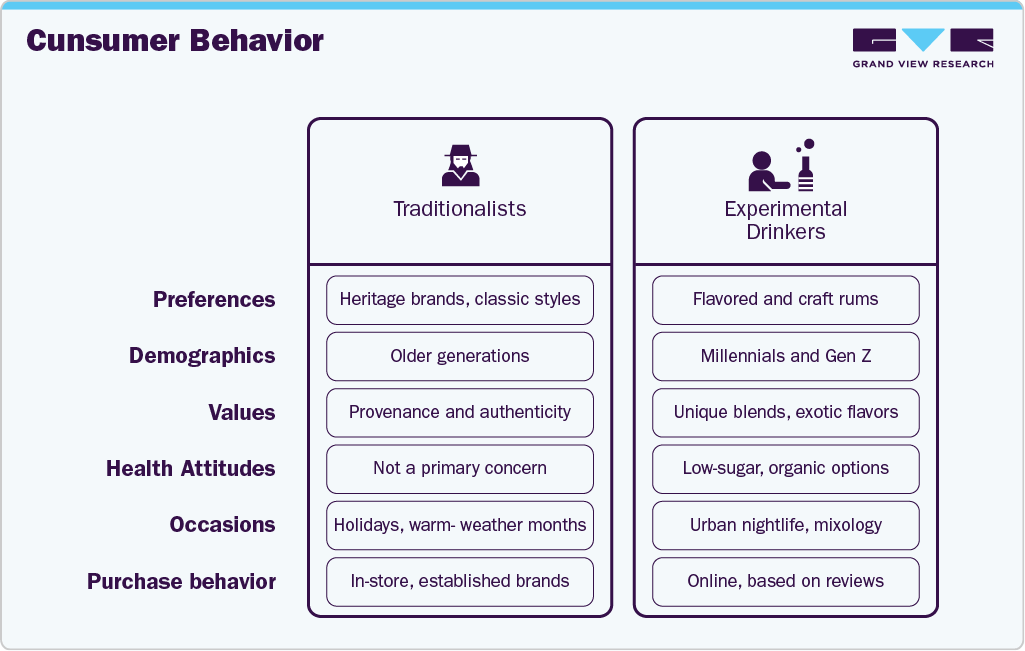 To learn more about this report, Download Free Sample Report
 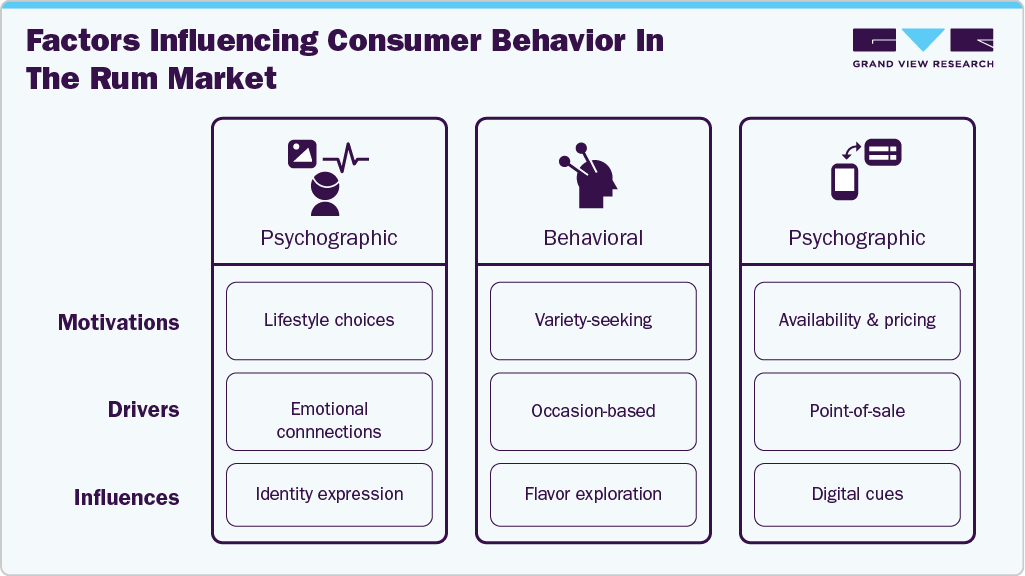 To learn more about this report, Download Free Sample Report
 Market Dynamics
The rum market continues to evolve as consumers increasingly seek premium, flavored, aged, and craft spirit offerings that deliver distinctive taste profiles and authentic consumption experiences. Rum is consumed across a wide range of occasions, including cocktails, social gatherings, hospitality venues, and premium sipping experiences, supporting its appeal among both traditional and emerging consumer segments.
The global rum market is experiencing a structural shift toward premiumization, driven by changing consumer preferences, increased willingness to trade up, and strategic repositioning by major spirits companies. Rum, traditionally perceived as a value-driven spirit consumed primarily in mixed drinks, is increasingly being repositioned as a premium and ultra-premium category comparable to whisky and cognac. This transformation is being reinforced by growing demand for aged expressions, craft production methods, and limited-edition releases that emphasize heritage, authenticity, and craftsmanship. For instance, In December 2025, Radico Khaitan launched Kohinoor Reserve Dark Rum, a triple-aged premium expression matured in bourbon, cognac, and vermouth casks. The company explicitly stated that consumers are increasingly shifting toward richer, more complex rum profiles, supporting premiumization in the Indian market.
Regulatory fragmentation and high taxation remain significant restraints for the global rum market, particularly in major consumption and production regions such as India and the Caribbean. Alcohol is one of the most heavily regulated consumer categories worldwide, and rum is especially impacted due to its dependence on state-controlled distribution systems, excise duties, and licensing restrictions. These regulatory complexities increase landed costs, reduce pricing transparency, and constrain the scalability of both domestic and international rum brands. According to the U.S. Alcohol and Tobacco Tax and Trade Bureau (TTB), alcohol imports into India are subject to multiple layers of taxation and regulatory approvals, with each state maintaining distinct rules for distribution and retail operations. This fragmented structure increases compliance burden for global spirits companies and leads to substantial price variation across regions, limiting the ability of rum brands to implement consistent national pricing or marketing strategies. As a result, premium rum products often face elevated final retail prices, which restricts affordability and slows premium category penetration in price-sensitive markets.
The growing adoption of digital commerce and on-demand alcohol delivery platforms is creating a significant growth opportunity for the global rum market. Consumers are increasingly purchasing alcoholic beverages through e-commerce platforms, quick-commerce services, and direct-to-consumer (DTC) channels due to the convenience of home delivery, broader product selection, and easier access to premium and imported brands. This trend is particularly beneficial for rum producers, as online channels enable brands to reach consumers beyond traditional retail networks while enhancing visibility for premium, craft, and limited-edition offerings.
The continued digitalization of alcohol retail is transforming purchasing behavior across major markets. Consumers are increasingly using online platforms to explore product reviews, compare brands, discover new expressions, and purchase premium spirits that may not be available in local stores. Digital channels also allow rum companies to leverage targeted marketing, personalized recommendations, and subscription-based offerings to strengthen customer engagement and brand loyalty. For example, DoorDash reported continued growth in alcohol delivery offerings through its marketplace and retail partnerships, reflecting increasing consumer adoption of online alcohol purchasing. The company has continued investing in age-verification technologies and regulatory compliance tools to support the expansion of alcohol e-commerce.
Analyst Perspective
The rum market is entering a phase where value creation is increasingly decoupled from volume growth. While the category benefits from premiumization trends, the more important shift is the repositioning of rum from a cocktail-led spirit to a premium sipping and collectible category capable of competing with whisky, tequila, and cognac. The key competitive advantage will not belong to the producer with the broadest portfolio, but to the brand that can successfully combine provenance, aging expertise, and premium storytelling into a globally recognizable value proposition. As consumer preferences increasingly favor authenticity and experience over consumption volume, rum producers that establish strong origin credentials, transparent production narratives, and differentiated maturation techniques will be best positioned to capture premium margins and expand beyond the category's traditional consumption occasions.
Product Insights
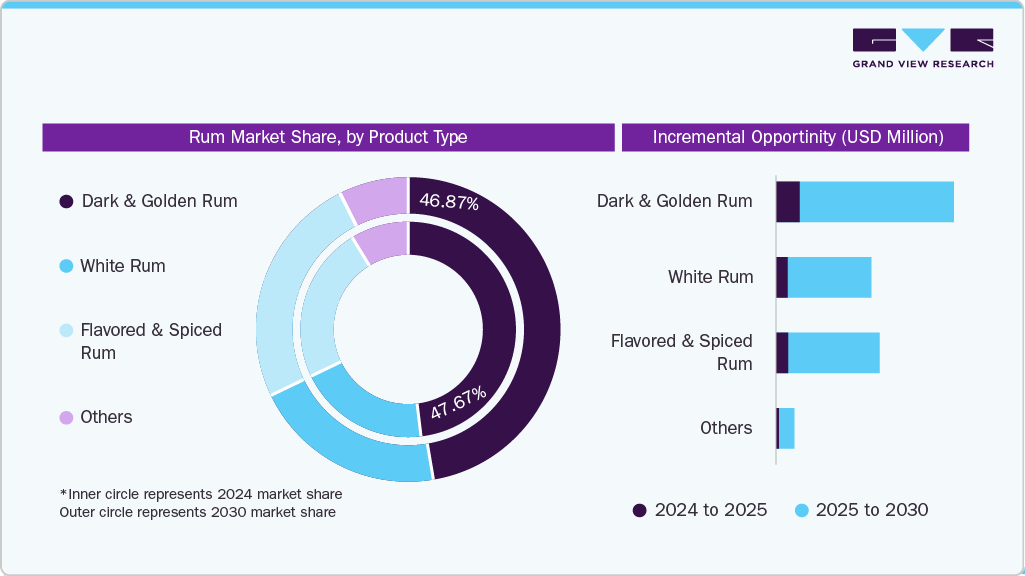
Based on product, dark and golden rum led the market with the largest revenue share of 47.6% in 2025 and is expected to grow with a CAGR of 6.1% for the forecast period, owing to their rich, aged profiles that align with the premiumization trend, growing cocktail culture, and consumer preference for authenticity and heritage. Their versatility in both sipping and mixology, combined with strong appeal among connoisseurs and casual drinkers alike, made them the dominant choice across markets.
Rum makers are increasingly producing new and improved formulations for dark and golden rum. For instance, in March 2023, Goslings Rum of Bermuda introduced Spirited Seas, marking its venture into ocean-aged rum. This unique offering, with an alcohol by volume (ABV) of 44%, is valued at USD 60 for 750 ml. Goslings Rum Spirited Seas has been introduced in various markets across the U.S.
Flavored and spiced rum is expected to grow at a CAGR of 4.7% from 2025 to 2030, due to its strong appeal among younger consumers seeking sweeter, more approachable profiles and novelty-driven experiences. The rise of ready-to-drink (RTD) cocktails, experimentation in mixology, and demand for seasonal or exotic flavor infusions have made this category highly versatile and trend-responsive. Its lower entry barrier compared to traditional aged rums also supports broader consumption in casual settings, social occasions, and festivals, especially in North America and parts of Europe.
In April 2025, The Kraken Gold Spiced Rum launched a new 50-milliliter travel-friendly bottle format, priced at USD 1.49, which maintains the same 35% ABV and flavor profile that includes caramel, oak, and banana bread notes. This smaller size caters to consumer demand for portable and lower-alcohol options without compromising on quality or taste. The introduction aligns with trends showing that gold and spiced rums account for 41% of total rum consumption in the U.S.
 To learn more about this report, Download Free Sample Report
 Distribution Channel Insights
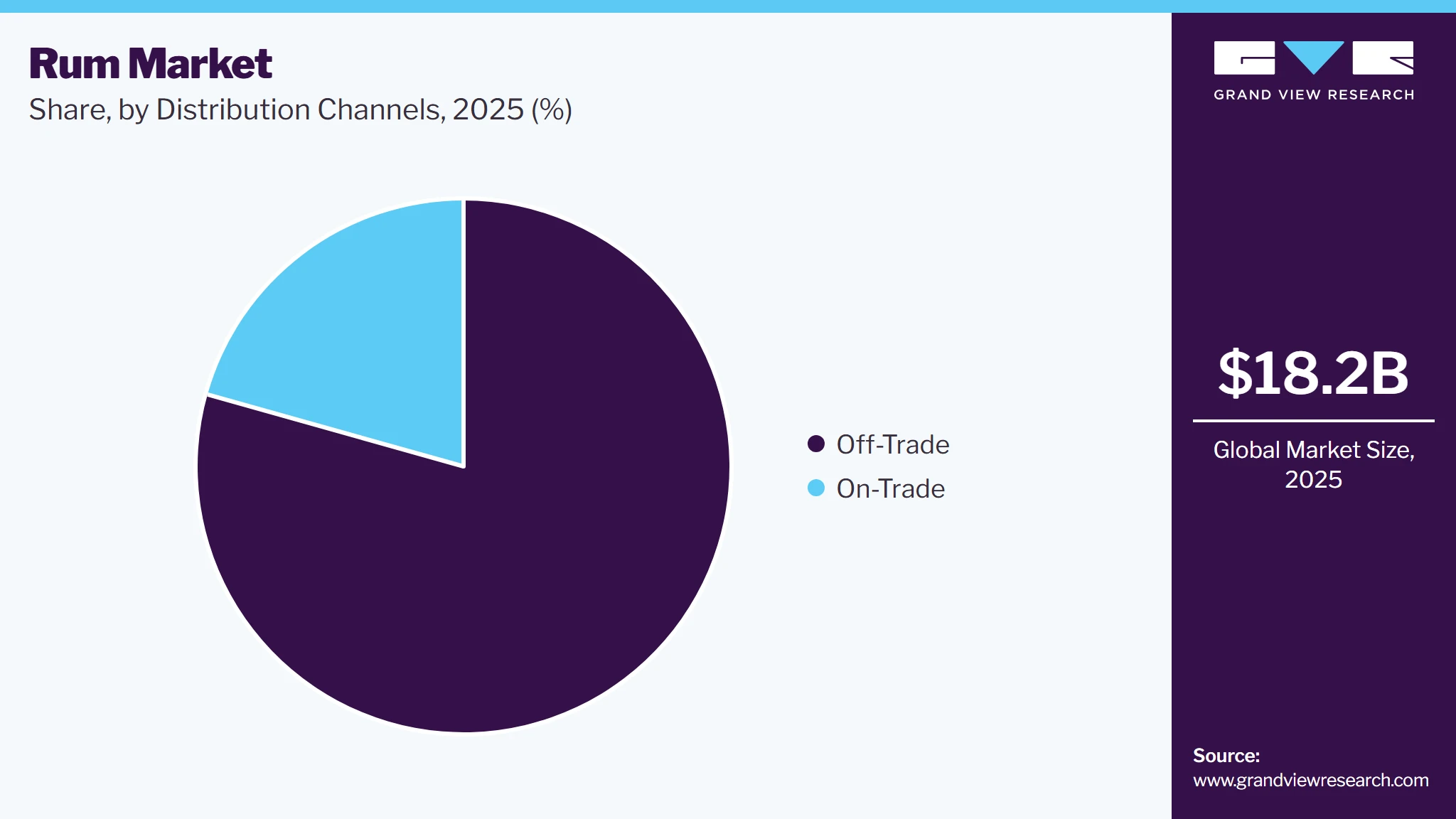
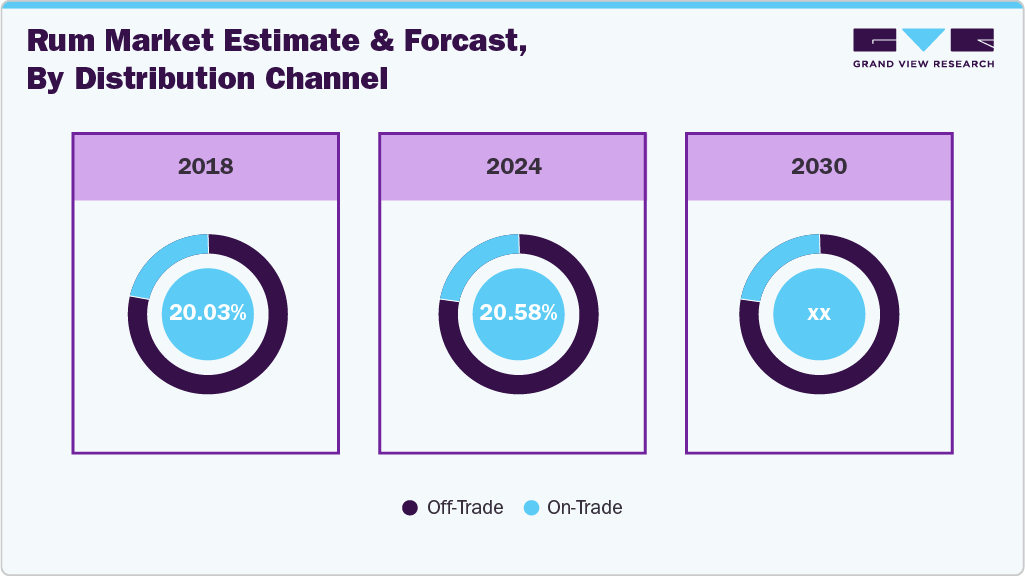
Based on distribution channel, the off-trade channel led the market with the largest revenue share of 79.4% in 2025, due to shifting consumer habits favoring convenience, affordability, and at-home consumption. Post-pandemic lifestyles, including remote work and increased socializing at home, led consumers to purchase rum more frequently from supermarkets, liquor stores, and online platforms rather than bars or restaurants. Off-trade channels also offer a wider range of price points and promotional deals, making them more attractive for routine or bulk purchases. Additionally, the rise of e-commerce and organized retail in both mature and emerging markets has further boosted accessibility, making off-trade the preferred choice for a broader base of casual and cost-conscious consumers.
 To learn more about this report, Download Free Sample Report
 According to an article published in Food Dive in May 2023, it was found that 23% of consumers consumed more alcohol at home over the past 12 months compared to 16% who consumed more alcohol on the premises. It has been observed that since the COVID-19 pandemic, consumers prefer staying home and drinking rather than going out. This has significantly boosted the off-trade consumption of rum.
 To learn more about this report, Download Free Sample Report
 The sales of rum through the on-trade distribution channel are projected to grow at a CAGR of 4.8% from 2025 to 2030, due to the resurgence of social and experiential drinking in bars, restaurants, clubs, and resorts as global hospitality sectors continue to recover and expand post-pandemic. Rising consumer demand for premium and craft cocktails, increasing tourism, and a growing interest in curated drinking experiences are encouraging on-premise establishments to diversify and elevate their rum offerings. Furthermore, the popularity of rum-based signature drinks and mixology trends is enhancing its appeal in upscale and themed venues, driving higher per-serving margins and boosting volume growth in on-trade environments worldwide.
According to a survey administered by the U.S. Substance Abuse and Mental Health Services Administration (SAMHSA), there are approximately 69,485 registered bars in the U.S. as of 2023 and this number has grown by 1.3% from 2022. Milwaukee, Wisconsin is the “drunkest city,” with the maximum number of bars, breweries, and wine bars in 2023.
Regional Insights
Asia Pacific dominated the rum market with the largest revenue share of 39.5% in 2025, The rum market in India held the largest share in the Asia Pacific region in 2025. majorly driven by its large and youthful population, rising disposable incomes, and evolving drinking culture across key markets such as India, the Philippines, Thailand, and Australia. In particular, India, one of the world’s largest rum-consuming countries, continues to drive volume through both mass-market and premium segments, fueled by domestic production, growing urbanization, and increasing social acceptance of alcohol. For instance, in March 2025, Khukri Rum, produced by Nepal's first distillery, MCKT Beverages Pvt. Ltd., entered the Indian market with its three premium expressions: Khukri XXX Rum, Khukri Spiced Rum, and Khukri White Rum.
 To learn more about this report, Download Free Sample Report
 North America Rum Market Trends
The North America rum market is projected to grow at a CAGR of 7.0% from 2026 to 2033. The rum industry is experiencing rapid growth due to rising consumer interest in premiumization, craft spirits, and diverse flavor profiles, particularly among millennials and Gen Z consumers. The growing popularity of rum-based cocktails, such as mojitos and dark 'n' stormies, in bars and at-home settings is fueling demand, while innovation in flavored and aged rum varieties is attracting new consumers seeking unique experiences. Additionally, the expanding presence of craft distilleries, increased marketing around Caribbean heritage and authenticity, and the broader shift toward spirits over beer are contributing to sustained growth. In April 2025, The North Saanich distiller, a 99-year-old farm in British Columbia, launched Canada’s first limited edition agricole rum, marking a significant milestone in the country's distilling history. This unique rum is crafted from freshly pressed sugarcane juice, distinguishing it from traditional rums made from molasses. The distillation process emphasizes the natural flavors of the sugarcane, resulting in a product that reflects the terroir of the region.
The U.S. rum market is experiencing robust growth, driven by factors such as the increasing popularity of rum-based cocktails, such as mojitos and piña coladas, among consumers. The growing trend toward premiumization is fueling demand for high-quality aged and craft rums, particularly in the cocktail and spirits connoisseur segments. The continued expansion of e-commerce and online alcohol sales is also making rum more accessible to a broader audience. In November 2024, Oxbow Rum Distillery broadened its reach by launching an e-commerce platform, enabling customers in more than 30 states to purchase its premium, additive-free Oxbow Estate Rum and False River Rums directly from the brand's website, hosted by Flaviar.com.
Europe Rum Market Trends
The Europe rum market is projected to grow at a CAGR of 4.4% from 2025 to 2030. This can be attributed to the rising demand for premium and craft rum in key markets like the UK, France, and Germany. In the UK, rum is gaining popularity as a cocktail base, while France is seeing growth in aged and spiced rum due to its ties with Caribbean territories. Germany’s strong retail network and interest in exotic flavors are also fueling off-trade sales, supported by e-commerce and evolving drinking habits. In April 2025, BACARDÍ launched passionfruit-flavored rum across European markets. This new product, BACARDÍ Passionfruit, combines the brand's signature white rum with bold passionfruit flavor, offering a sweet, tangy, and vibrant taste experience.
Key Rum Company Insights
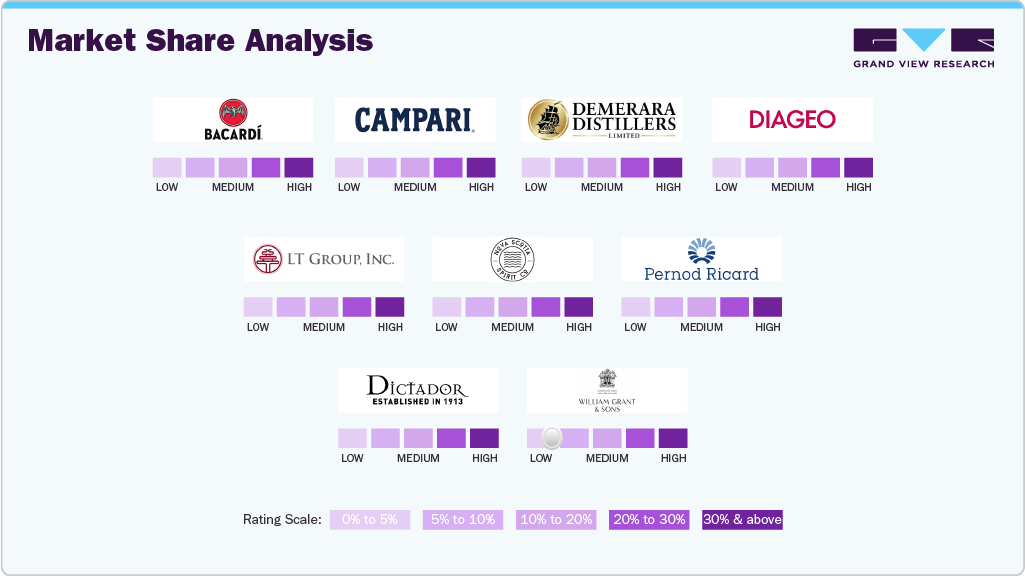
The rum market is highly competitive, with both local and international players vying for market share. Major international brands like Bacardi, Havana Club, and Captain Morgan dominate the global landscape, while regional distilleries such as Mount Gay in the Caribbean and Oxbow Rum Distillery in the U.S. continue to carve out their niches. Local players benefit from a strong connection to the heritage of their regions, offering authentic products that resonate with consumers.
The market is relatively fragmented, with a wide range of brands, from large-scale producers to small craft distilleries. This fragmentation is driven by consumer demand for variety, with a growing preference for premium, artisanal, and flavored rums. While international brands maintain a significant share, smaller producers are gaining traction by offering unique products and tapping into niche segments.
Analyzing market competition is crucial for understanding the competitive dynamics and identifying growth opportunities. It helps companies assess their position relative to key competitors, enabling them to develop targeted strategies, such as expanding distribution, enhancing product offerings, or pursuing mergers and acquisitions.
 To learn more about this report, Download Free Sample Report
 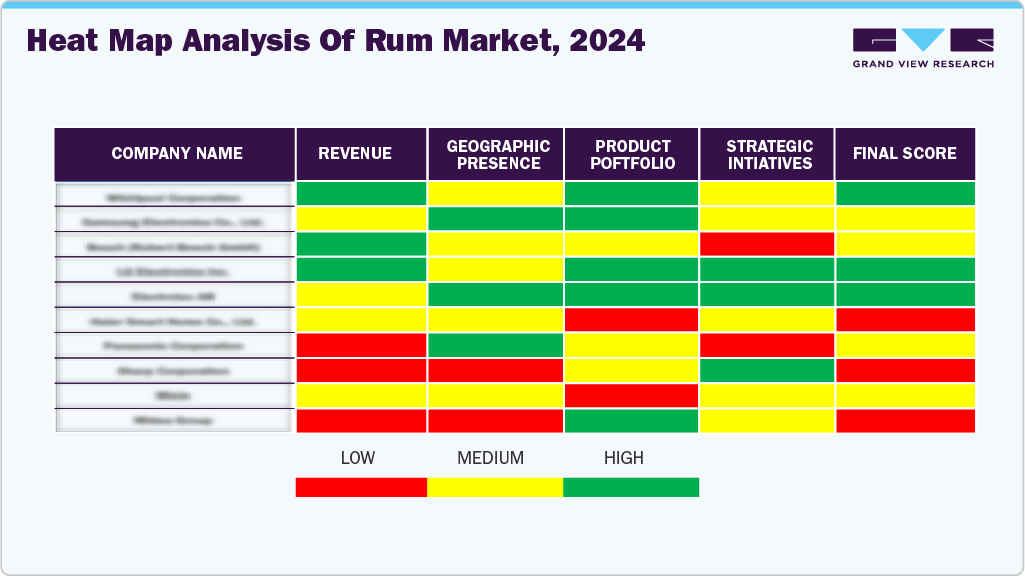 To learn more about this report, Download Free Sample Report
 Key Rum Companies:
The following are the leading companies in the rum market. These companies collectively hold the largest market share and dictate industry trends.
- Bacardi Limited
- Davide Campari-Milano N.V.
- Demerara Distillers Ltd. (DDL)
- Diageo Plc
- LT Group Inc.
- Nova Scotia Spirit Co.
- Pernod Ricard SA
- Dictador Europe Sp. z o.o.
- William Grant & Sons Ltd.
- Mohan Meakin Limited
Competitive Benchmarking
Category
Operating Strategies
Competitive Edge
Weakness
Established Players (Bacardi Limited, Diageo Plc, LT Group Inc.)
- Mature rum producers focus on portfolio premiumization through aged, super-premium, flavored, and limited-edition offerings to enhance value realization and brand equity.
- Established players benefit from strong global distribution networks, extensive brand recognition, diversified product portfolios, and long-standing relationships with retailers and on-trade operators.
- Dependence on mature markets and complex global supply chains can expose operations to regulatory changes, taxation pressures, and fluctuations in raw material availability.
Emerging Players (Mohan Meakin Limited, Nova Scotia Spirit Co., Dictador Europe Sp. z o.o.)
- Emerging rum producers focus on craft production, small-batch releases, origin-specific offerings, and innovative cask-finishing techniques to differentiate their products.
- Players focus on artisanal production, local sourcing, and experimentation enables stronger differentiation in competitive premium segments.
- Limited financial resources and distribution capabilities can restrict market reach and brand visibility relative to established competitors.
Recent Developments
-
In March 2025, Brugal Rum launched the Andrés Brugal Edition 02, the second limited edition in its ultra-premium range, with only 416 bottles available globally. Retailing at USD 3,000 per bottle, it features a blend of four single casks aged in American oak, showcasing flavors of coconut, vanilla, and gentle spice.
-
In March 2025, Wray & Nephew launched Wray’s 43, a new UK-exclusive white Jamaican rum with an ABV of 43%, designed to cater to the growing demand for flavorful, easy-to-mix spirits. This limited edition rum is a blend of unaged Jamaican white rums, featuring notes of rich fruits, charred pineapple, and molasses.
Rum Market Report Scope
Report Attribute
Details
Market size in 2025
USD 18.2 billion
Estimated market size in 2026
USD 19.2 billion
Projected market size by 2033
USD 29.6 billion
Growth rate
CAGR of 6.4% from 2026 to 2033
Base year for estimation
2025
Historical data
2021 - 2024
Forecast period
2026 - 2033
Quantitative units
Revenue in USD billion and CAGR from 2026 to 2033
Report coverage
Revenue forecast, company ranking, competitive landscape, growth factors, and trends
Segments covered
Product, distribution channel, region
Regional scope
North America; Europe; Asia Pacific; Central & South America; MEA
Country scope
U.S.; Canada; Mexico; Germany; UK; France; Italy; Spain; Russia; China; Japan; India; South Korea; Australia & New Zealand; Philippines; Brazil; Argentina; South Africa
Key companies profiled
Bacardi Limited; Davide Campari-Milano N.V.; Demerara Distillers Ltd. (DDL); Diageo Plc; LT Group Inc.; Nova Scotia Spirit Co.; Pernod Ricard SA; Dictador Europe Sp. z o.o.; William Grant & Sons Ltd.; and Mohan Meakin Limited
Customization scope
Free report customization (equivalent up to 8 analysts' working days) with purchase. Addition or alteration to country, regional & segment scope.
Pricing and purchase options
Avail customized purchase options to meet your exact research needs.Explore purchase options
Global Rum Market Report Segmentation
This report forecasts revenue growth at the global, regional, and country levels and provides an analysis of the latest industry trends and opportunities in each of the sub-segments from 2021 to 2033. For the purpose of this study, Grand View Research has segmented the global rum market report on the basis of product, distribution channel and region.
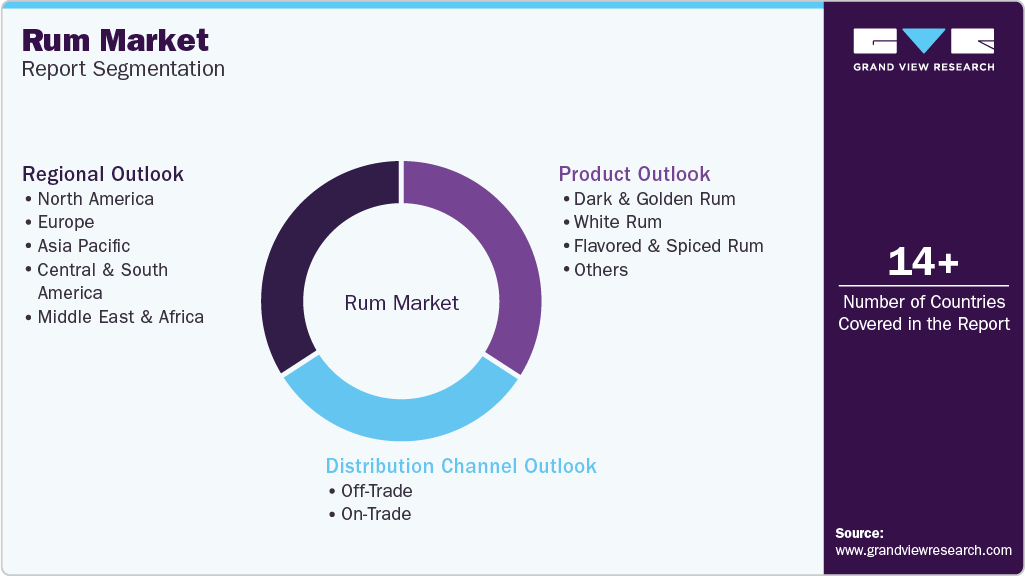 To learn more about this report, Download Free Sample Report
 -
Product Outlook (Revenue, USD Million, 2021 - 2033)
-
Dark and Golden Rum
-
White Rum
-
Flavored and Spiced Rum
-
Others
-
-
Distribution Channel Outlook (Revenue, USD Million, 2021 - 2033)
-
Off-Trade
-
On-Trade
-
-
Regional Outlook (Revenue, USD Million, 2021 - 2033)
-
North America
-
U.S.
-
Canada
-
Mexico
-
-
Europe
-
UK
-
Germany
-
France
-
Italy
-
Russia
-
-
Asia Pacific
-
China
-
Japan
-
India
-
Australia
-
Philippines
-
-
Central & South America
-
Brazil
-
Argentina
-
-
Middle East & Africa
-
South Africa
-
-
Research Methodology
Segment Definition
Segment - Product
Revenue capture definition
Dark and Golden Rum
This segment includes revenue generated from the sale of dark rum and golden rum products, which are typically aged in oak barrels for varying durations to develop richer color, flavor, and aroma profiles. Dark and golden rums are commonly consumed neat, on the rocks, or used in premium cocktails and culinary applications. Revenue is driven through retail sales, on-trade consumption in bars and restaurants, travel retail channels.
White Rum
This segment includes revenue generated from the sale of white rum products, which are generally filtered after aging or produced with minimal aging to achieve a clear appearance and lighter flavor profile. Revenue is generated through off-trade retail sales, hospitality and foodservice channels, and large-scale consumption in cocktail-focused establishments and home-mixing occasions.
Flavored and Spiced Rum
This segment includes revenue generated from the sale of flavored and spiced rum products infused with natural or artificial flavors, spices, fruits, herbs, or botanical ingredients to enhance taste and broaden consumer appeal. Revenue is driven through retail sales, ready-to-drink (RTD) cocktail applications, seasonal product launches, and premium flavored rum innovations designed to support consumer recruitment and category expansion.
Others
This segment includes revenue generated from the sale of specialty rum products that do not fall under conventional white, dark, golden, flavored, or spiced rum categories. It includes premium aged rum, overproof rum, agricole rum, craft and artisanal rum, organic rum, limited-edition releases, and region-specific rum variants. Revenue is generated through specialty retail stores, premium spirits distributors, duty-free channels, collector-focused offerings, and niche consumer segments seeking unique production methods, origins, and flavor experiences.
Segment - Distribution Channel
Revenue capture definition
Off-Trade
This segment includes revenue generated through the sale of rum products via retail channels intended for off-premise consumption. These channels include supermarkets, hypermarkets, liquor stores, convenience stores, specialty beverage retailers, and e-commerce platforms. Growth in this segment is supported by increasing at-home consumption, premium spirit purchases, and expanding online alcohol retail.
On-Trade
This segment includes revenue generated through the sale of rum products for on-premise consumption at bars, pubs, restaurants, hotels, resorts, nightclubs, and other hospitality venues. Revenue is driven by cocktail consumption, premium spirit offerings, tourism activity, and experiential drinking occasions within the foodservice and hospitality sectors.
Estimation Model
Layer
Key Question
Description
Legal Drinking Population Layer
Who can legally consume alcohol?
Identify the legal drinking-age population across key countries and regions. Apply country-specific alcohol consumption participation rates to derive the total addressable consumer base for alcoholic beverages.
Spirits Consumption Layer
Who consumes distilled spirits?
Filter the alcohol-consuming population by spirits consumption rates using national alcohol consumption statistics and beverage preference data. This establishes the potential consumer base participating in the spirits category.
Rum Consumption Layer
Who actively consumes rum?
Apply rum category penetration rates within the spirits market, incorporating regional consumption patterns, on-trade and off-trade sales trends, and consumer preference data to estimate the active rum consumer population.
Revenue Monetization Layer
How is rum revenue generated?
Multiply active rum consumers by average annual rum expenditure, incorporating product mix across white, dark, gold, flavored, premium, and super-premium rum segments.
Delivered Customizations
This report has been delivered with the following In-depth customizations
CLIENT REQUEST
CUSTOMIZATION DELIVERED
VALUE ADDS
Growth Potential of E-commerce, Direct-to-Consumer, and Alcohol Delivery Channels
Assessed the adoption of online alcohol retail, direct-to-consumer sales models, quick-commerce platforms, and alcohol delivery services, including their impact on rum accessibility, premium product discovery, and consumer purchasing behavior.
Enables stakeholders to identify high-growth distribution channels, optimize route-to-market strategies, and evaluate opportunities for expanding premium rum sales through digital commerce ecosystems.
Market Share Assessment of Established and Emerging Industry Participants
Evaluated the competitive positioning, brand portfolios, geographic presence, distribution capabilities, and market influence of leading multinational producers and emerging craft rum companies.
Provides strategic insights into competitive intensity, market concentration, partnership opportunities, and areas for differentiation to support investment and expansion decisions.
Product Innovation Trends Across Aged, Craft, Flavored, and Limited-Edition Rum Categories
Analyzed innovation activity across premium aged rum, craft offerings, flavored variants, cask-finished expressions, and limited-edition launches, including evolving consumer preferences and premiumization strategies.
Provides insights into emerging product development trends, consumer demand shifts, and premiumization opportunities, enabling stakeholders to strengthen innovation pipelines, refine product positioning, and capitalize on high-growth rum segments.
Frequently Asked Questions About This Report
The global rum market size was estimated at USD 18.2 billion in 2025 and is expected to reach USD 19.2 billion in 2026.
The global rum market is expected to grow at a compound annual growth rate of 6.4% from 2026 to 2033 to reach USD 29.6 billion by 2033
Some of the key market players in the rum market are Bacardi Limited; Davide Campari-Milano N.V.; Demerara Distillers Ltd. (DDL); Diageo Plc; LT Group Inc.; Nova Scotia Spirit Co.; Pernod Ricard SA; Dictador Europe Sp. z o.o.; William Grant & Sons Ltd.; and Mohan Meakin Limited
Factors such as increasing consumer interest and expanding cocktail culture are expected to drive the industry growth globally. Product innovation and diversification have attracted new consumers and provided existing consumers with a wider range of options to choose from. Furthermore, there has been a shift in consumer preferences toward spirits with natural and authentic qualities. Rum, as a product with a rich history and often produced from natural ingredients like sugarcane, appeals to consumers seeking authentic and artisanal products.
Dark and golden rum held the largest revenue share of 47.6% in 2025 and is the fastest-growing product.
North America region is the fastest growing region market for the forecast period.
Asia Pacific dominated the rum market with the largest revenue share of 39.5% in 2025.
Off-Trade distributions held the largest market share of 79.4% for the year 2025.
About the Author(s)
Alcohol & Tobacco Research Team
Consumer Goods · Alcohol & TobaccoThis report was authored by the alcohol & tobacco research team at Grand View Research - comprising two research analysts, one senior research analyst, and one industry expert - with specialized expertise in the alcohol & tobacco segment of the consumer goods industry. All findings are based on proprietary consumer goods databases, executive interviews, and regulatory analysis, subject to internal peer review prior to publication.
Last Updated:
Speak to Analyst

Customize this report to your needs - add regions, segments, or data points, with 20% free customization.
Or view our licence options:


ISO 9001:2015 & 27001:2022 Certified
We are GDPR and CCPA compliant! Your transaction & personal information is safe and secure. For more details, please read our privacy policy.


