
- Home
- »
- Next Generation Technologies
- »
-
SaaS Financing Market Size & Share Report, 2026-2033GVR Report cover
![SaaS Financing Market (2026 - 2033)Report]()
SaaS Financing Market (2026 - 2033)
Size, Share & Trends Analysis Report By Financing Type (Debt, Equity), By Enterprise Size (Small Enterprises, Large Enterprise), By End-user Industry (BFSI, Healthcare & Life Sciences, Retail & E-commerce), By Region, And Segment Forecasts
Market Size, 2025
$64.9BMarket Estimate, 2026
$70.9BMarket Forecast, 2033
$140.2BCAGR, 2026–2033
10.2%SaaS Financing Market Summary
The global SaaS financing market size was valued at USD 64.9 billion in 2025 and is projected to grow from USD 70.9 billion in 2026 to USD 140.2 billion by 2033, at a CAGR of 10.2% from 2026 to 2033. The market in North America dominated with a revenue share of 41.2% in 2025. The rapid expansion of subscription-based software companies, increasing adoption of recurring-revenue financing models, and the rising demand for non-dilutive funding solutions are key factors driving market growth.
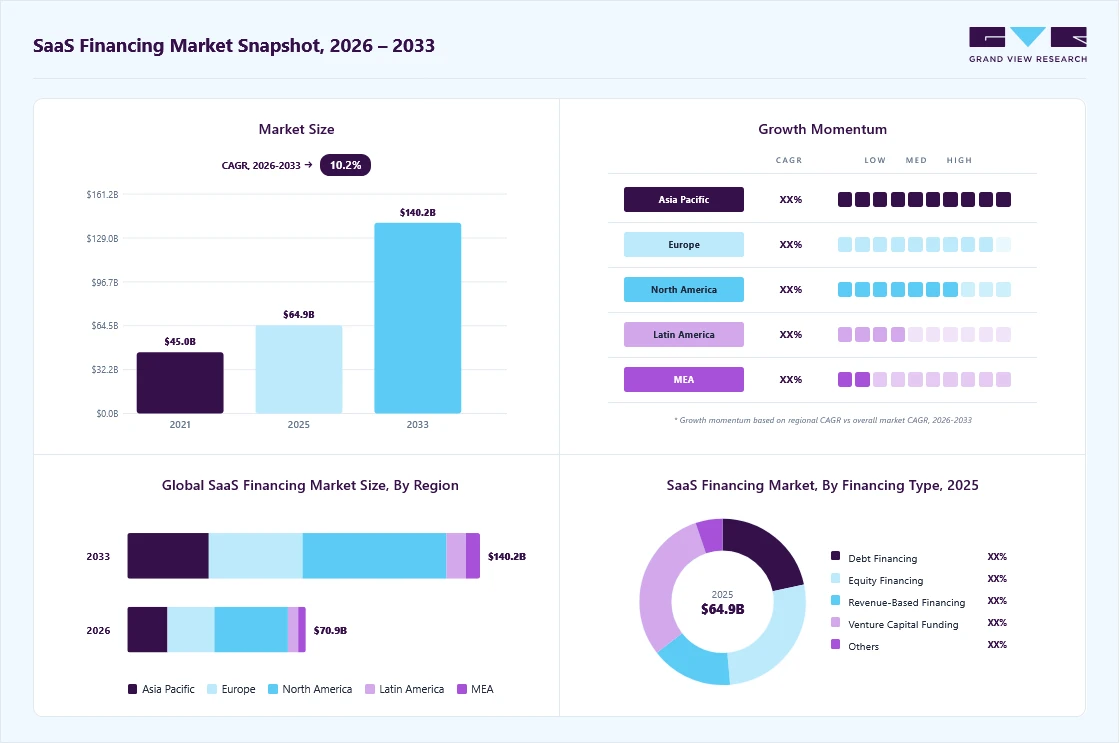
Key Market Trends & Insights
- By financing type: The venture capital funding segment accounted for the largest share of 30.2% in 2025.
- By enterprise size: The small enterprises segment accounted for the largest market share of 45.7% in 2025.
- By end-user industry: The IT & telecommunications segment held the largest market share of 35.8% in 2025.
Regional Highlights
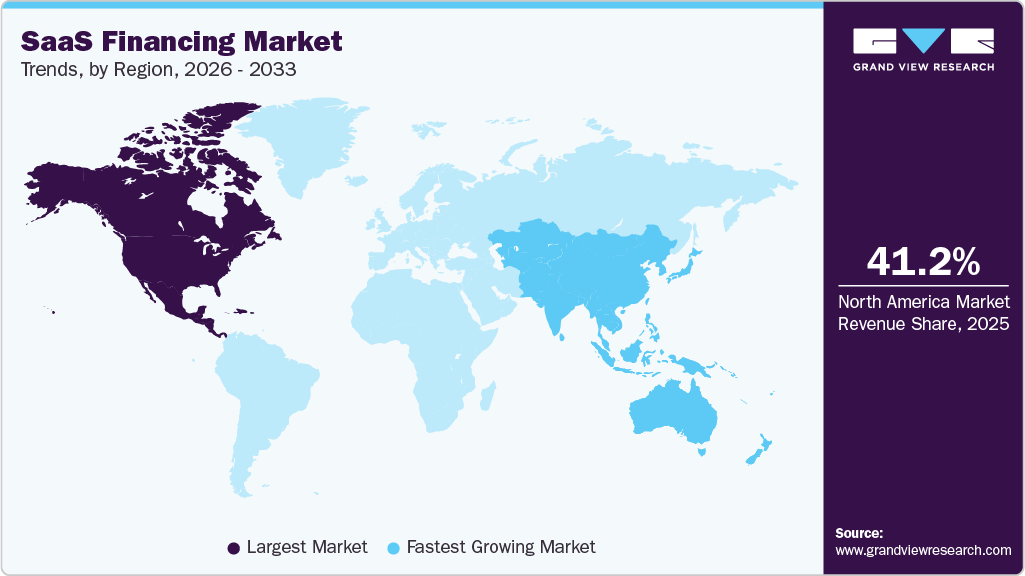
- Largest regional market: North America (41.2% revenue share, 2025)
- Fastest-growing regional market: Asia Pacific (highest CAGR, 2026-2033)
- The saas financing industry in the U.S. held the largest revenue share in 2025.
Market Size & Forecast
- Market size in 2025: USD 64.9 Billion
- Estimated market size in 2026: USD 70.9 Billion
- Projected market size by 2033: USD 140.2 Billion
- CAGR (2026-2033): 10.2%
As SaaS companies prioritize scalability and predictable revenue streams, financing solutions such as venture capital funding, revenue-based financing, and venture debt are gaining traction across startup ecosystems globally.The rapid growth of the global SaaS industry is a major factor accelerating the market. SaaS companies require continuous capital to support software development, cloud infrastructure expansion, customer acquisition, and global scaling strategies. According to the U.S. Small Business Administration (SBA), access to flexible financing remains one of the most critical challenges for technology startups, encouraging the development of specialized funding models tailored to subscription-based businesses.
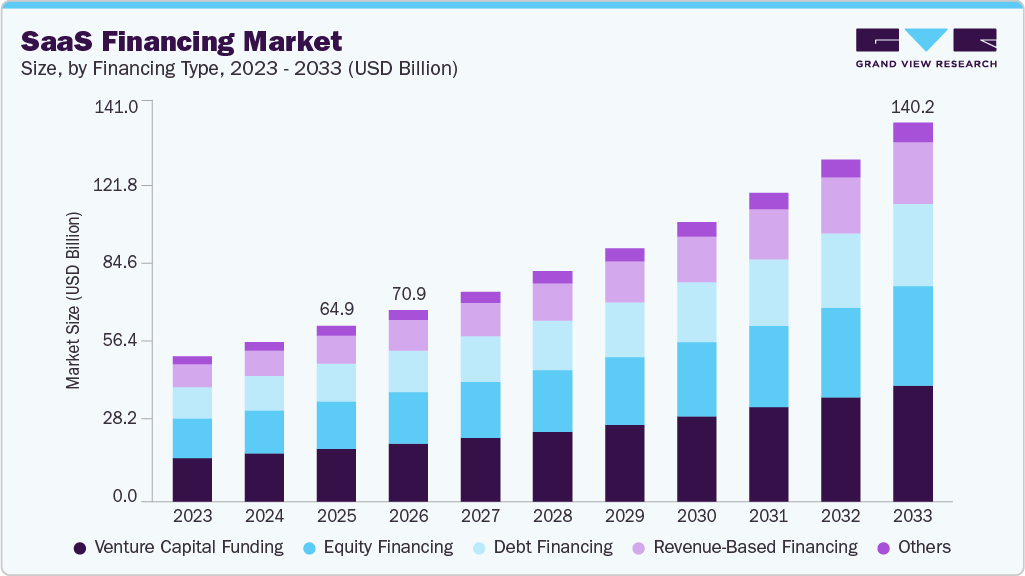
The rise of revenue-based financing (RBF) has significantly transformed startup funding strategies. Unlike traditional venture capital, RBF enables SaaS companies to secure capital based on recurring revenue performance, allowing founders to avoid substantial equity dilution. Organizations such as the OECD have noted the increasing adoption of alternative financing models, including venture debt, crowdfunding, and revenue-sharing agreements, across the global startup ecosystem as companies seek more flexible capital structures.
Digital transformation across industries is also boosting demand for SaaS solutions and, in turn, SaaS financing. The U.S. National Institute of Standards and Technology (NIST) highlights that cloud computing and SaaS platforms are now core components of enterprise IT modernization strategies. Businesses across sectors increasingly rely on subscription-based software for data analytics, cybersecurity, and operational management, creating a growing ecosystem of SaaS providers requiring external financing.
The global expansion of startup ecosystems is another major driver. According to OECD entrepreneurship indicators, venture capital investment in technology startups has grown steadily over the past decade, with SaaS startups representing a significant portion of funding rounds. This growth has encouraged financial institutions, venture funds, and fintech lenders to develop specialized financing products designed specifically for SaaS businesses.
SaaS financing providers are also leveraging data-driven underwriting models. Advanced analytics platforms evaluate SaaS company performance using metrics such as customer lifetime value (CLV), churn rates, and ARR growth. These models improve risk assessment accuracy and enable lenders to provide faster funding approvals. As a result, SaaS financing is becoming an increasingly critical component of the global digital innovation ecosystem.
Financing Type Insights
The venture capital funding segment accounted for the largest share of 30.2% in 2025. Venture capital remains the most prominent funding source for SaaS startups and scale-ups. Venture investors typically provide growth capital to companies demonstrating strong ARR growth and high customer retention metrics. The availability of global venture capital funds and technology-focused investment firms has significantly contributed to the expansion of SaaS ecosystems in North America and Europe.
The revenue-based financing segment is projected to grow at the fastest CAGR during the forecast period. This financing structure enables SaaS companies to repay capital as a percentage of monthly revenue, aligning financing costs with business performance. As SaaS companies increasingly prefer non-dilutive capital solutions, revenue-based financing platforms are rapidly gaining adoption across startup ecosystems.
Enterprise Size Insights
The small enterprises segment accounted for the largest market share of 45.7% in 2025. Early-stage SaaS startups rely heavily on external financing to support product development, infrastructure scaling, and customer acquisition. Many of these companies leverage venture capital funding, revenue-based financing, or seed investments to accelerate growth during the early stages of business expansion.
The medium-sized enterprises segment is expected to grow at a significant CAGR over the forecast period. Growth-stage SaaS companies require larger financing rounds to expand globally, develop new product offerings, and invest in advanced technologies such as artificial intelligence and data analytics. Venture debt and structured growth financing solutions are becoming increasingly popular among mid-stage SaaS companies seeking to scale operations efficiently.
End-user Industry Insights
The IT & telecommunications segment dominated the market in 2025, accounting for 35.8% of the total share. The rapid proliferation of cloud computing platforms, cybersecurity software, and enterprise collaboration tools has fueled demand for SaaS solutions within the technology sector. As SaaS companies expand their digital product portfolios, they increasingly require financing to scale infrastructure and enhance software innovation.
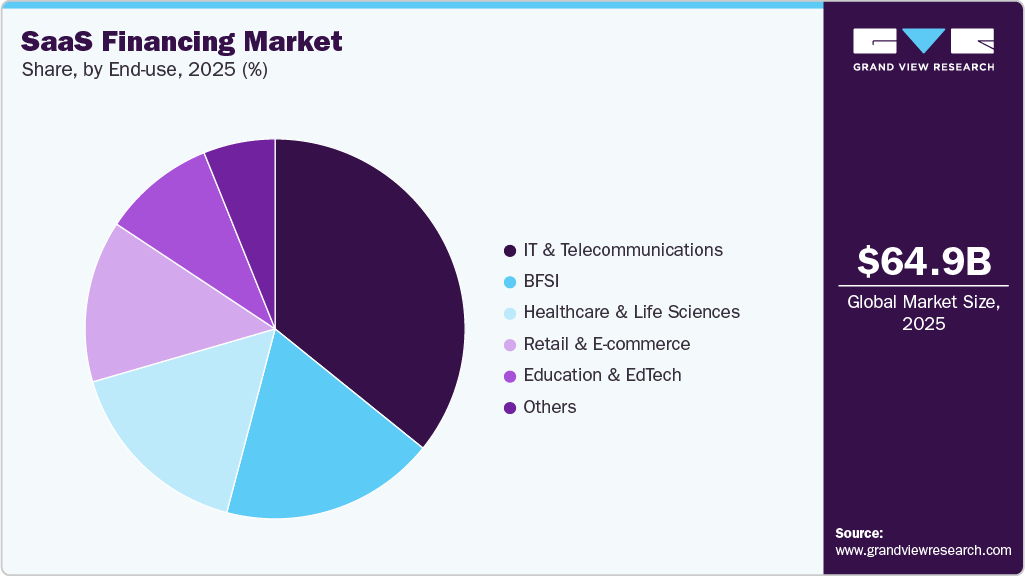
The healthcare & life sciences segment is projected to grow at the fastest CAGR over the forecast period. The adoption of healthcare SaaS platforms, including electronic health records (EHR), telemedicine solutions, and health data analytics platforms, is accelerating globally. As healthcare organizations increasingly digitize operations, SaaS providers serving this sector require capital to support regulatory compliance, data security, and platform scalability.
Regional Insights
The North America SaaS financing market accounted for the largest share of 41.2% in 2025. The region hosts one of the world’s most advanced startup ecosystems, supported by venture capital networks, fintech lenders, and technology accelerators. Major technology hubs such as Silicon Valley, New York, and Toronto have become global centers for SaaS startup formation and funding activity.
U.S. SaaS Financing Market Trends
The SaaS financing market in the U.S. remains the largest contributor in North America. According to the U.S. Small Business Administration, access to venture capital and private equity remains a key driver supporting the growth of technology startups. The presence of numerous venture capital firms and startup accelerators has enabled SaaS companies to secure early-stage and growth funding more efficiently than in most other regions.
Europe SaaS Financing Market Trends
The SaaS financing market in Europe has emerged as a rapidly expanding SaaS ecosystem, supported by strong fintech innovation and venture capital growth. Government initiatives promoting digital transformation and technology entrepreneurship are encouraging SaaS startup formation across countries such as the UK, Germany, and France. These developments have strengthened the region’s position in the global market.
Germany SaaS financing market is experiencing increased SaaS financing activity as enterprises invest heavily in industrial digitalization, Industry 4.0 technologies, and enterprise automation platforms. Venture capital firms and growth equity investors are focusing on SaaS companies delivering solutions for manufacturing, supply chain management, and enterprise resource planning. In addition, the presence of strong startup hubs such as Berlin and Munich is fostering greater access to venture funding and SaaS-focused investment programs.
The SaaS financing market in the UK has emerged as one of the leading SaaS financing hubs in Europe due to its mature venture capital ecosystem and strong fintech sector. Investors are increasingly supporting high-growth SaaS startups specializing in financial technology, cybersecurity, and business productivity software. The rise of revenue-based financing platforms and venture debt providers is also enabling SaaS companies to secure non-dilutive capital to scale globally while maintaining equity ownership.
Asia Pacific SaaS Financing Market Trends
The SaaS financing market in the Asia Pacific is expected to grow at the fastest CAGR during the forecast period. Rapid digital transformation, expanding startup ecosystems, and increasing venture capital activity are fueling SaaS innovation in countries such as India, China, Singapore, and Australia. The growing adoption of cloud computing and enterprise software solutions across industries is driving strong demand for SaaS financing in the region.
China SaaS financing market is expanding due to rapid digitalization across industries such as manufacturing, retail, and logistics. Domestic venture capital funds and technology investors are actively financing SaaS startups that offer AI-enabled business software, cloud platforms, and enterprise productivity tools. The growing adoption of cloud computing among small and medium enterprises and strong support for digital economy initiatives are also accelerating funding activities in the SaaS ecosystem.
The SaaS financing market in Japan is evolving steadily as traditional enterprises accelerate digital transformation. Japanese financial institutions and venture capital firms are increasingly investing in SaaS companies focusing on enterprise software, cloud collaboration tools, and automation solutions. In addition, the strong presence of large corporations and technology conglomerates is encouraging corporate venture capital investments and strategic funding partnerships with emerging SaaS providers.
India SaaS financing market is witnessing strong growth driven by the rapid expansion of the domestic SaaS startup ecosystem and increasing global adoption of Indian SaaS platforms. Investors and fintech lenders are increasingly offering revenue-based financing and venture debt to SaaS startups with recurring revenue models. Government initiatives supporting digital innovation and the rising presence of SaaS unicorns are also encouraging venture capital firms and alternative lenders to provide flexible financing structures tailored to subscription-based businesses.
Key SaaS Financing Company Insights
Some of the major players in the global market include Lighter Capital, Capchase, Pipe, Founderpath, Clearco, SaaS Capital, ARC Startup Loans, Trinity Capital, and Silicon Valley Bank, among others. These companies specialize in providing venture debt, revenue-based financing, and growth capital tailored to SaaS business models.
-
Capchase provides non-dilutive financing solutions for SaaS companies, enabling startups to access capital based on recurring revenue performance. Its funding model allows businesses to scale customer acquisition and operational activities without giving up equity.
-
Pipe operates a financial platform that allows SaaS companies to convert recurring revenue streams into upfront capital. By enabling companies to trade future subscription revenue for immediate funding, Pipe has helped accelerate the adoption of alternative SaaS financing models globally.
Key SaaS Financing Companies:
The following key companies have been profiled for this study on the SaaS financing market.
- Lighter Capital
- Capchase
- Pipe
- Founderpath
- Clearco
- SaaS Capital
- Trinity Capital
- Silicon Valley Bank
- Arc
- Wayflyer
Recent Developments
-
In January 2025, Lighter Capital secured a USD 30 million funding facility supported by the Victorian Government and iPartners to expand non-dilutive financing for technology startups in Australia. The capital will be used to fund early-stage SaaS and subscription-based companies seeking growth capital without giving up equity.
SaaS Financing Market Report Scope
Report Attribute
Details
Market size in 2025
USD 64.9 billion
Estimated market size in 2026
USD 70.9 billion
Projected market size by 2033
USD 140.2 billion
Growth rate
CAGR of 10.2% from 2026 to 2033
Historical data
2021 - 2025
Forecast period
2026 - 2033
Quantitative units
Revenue in USD million/billion and CAGR from 2026 to 2033
Report coverage
Revenue forecast, company ranking, competitive landscape, growth factors, and trends
Segments covered
Financing type, enterprise size, end-user industry, region
Regional scope
North America; Europe; Asia Pacific; Latin America; MEA
Country scope
U.S.; Canada; Mexico; Germany; UK; France; China; Japan; India; South Korea; Australia; Brazil; KSA; UAE; South Africa
Key companies profiled
Lighter Capital; Capchase; Pipe; Founderpath; Clearco; SaaS Capital; Trinity Capital; Silicon Valley Bank; ARC; Wayflyer
Customization scope
Free report customization (equivalent up to 8 analysts working days) with purchase. Addition or alteration to country, regional & segment scope.
Pricing and purchase options
Avail customized purchase options to meet your exact research needs. Explore purchase options
Global SaaS Financing Market Report Segmentation
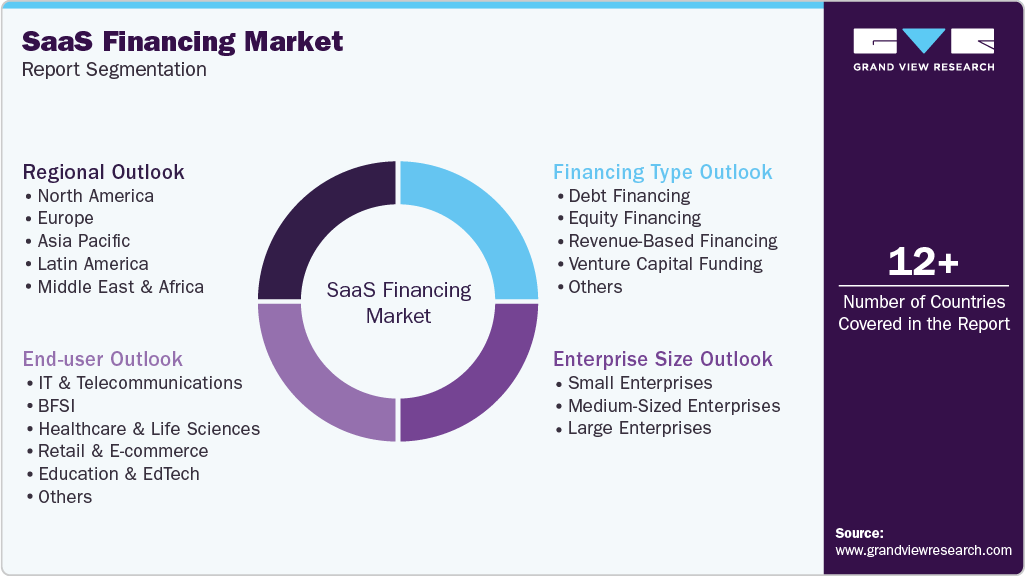
This report forecasts revenue growth at the global, regional, and country levels and provides an analysis of the latest industry trends in each of the sub-segments from 2021 to 2033. For this study, Grand View Research has segmented the global SaaS Financing market report based on financing type, enterprise size, end-user industry, and region:
-
Financing Type Outlook (Revenue, USD Million, 2021 - 2033)
-
Debt Financing
-
Equity Financing
-
Revenue-Based Financing
-
Venture Capital Funding
-
Others
-
-
Enterprise Size Outlook (Revenue, USD Million, 2021 - 2033)
-
Small Enterprises
-
Medium-Sized Enterprises
-
Large Enterprises
-
-
End-user Industry Outlook (Revenue, USD Million, 2021 - 2033)
-
IT & Telecommunications
-
BFSI
-
Healthcare & Life Sciences
-
Retail & E-commerce
-
Education & EdTech
-
Others
-
-
Regional Outlook (Revenue, USD Million, 2021 - 2033)
-
North America
-
U.S.
-
Canada
-
Mexico
-
-
Europe
-
Germany
-
UK
-
France
-
-
Asia Pacific
-
China
-
Japan
-
India
-
South Korea
-
Australia
-
-
Latin America
-
Brazil
-
-
Middle East and Africa (MEA)
-
KSA
-
UAE
-
South Africa
-
-
Frequently Asked Questions About This Report
The venture capital funding segment led with a 30.2% revenue share in 2025, while revenue-based financing is the fastest-growing segment.
Small enterprises segment held the largest revenue share 45.7% in 2025.
IT & telecommunications held the largest share (over 35.8%) in 2025 and healthcare & life sciences is the fastest-growing market.
The global SaaS financing market size was estimated at USD 64.9 billion in 2025 and is expected to reach USD 70.9 billion in 2026.
North America held the largest market share of 41.2% in 2025.
Some of the players in the market are Lighter Capital, Capchase, Pipe, Founderpath, Clearco, SaaS Capital, Trinity Capital, Silicon Valley Bank, ARC, and Wayflyer.
The key driving trend in the SaaS financing market is the rising adoption of revenue-based and non-dilutive financing models. As SaaS companies generate predictable recurring revenue (MRR/ARR), financing providers increasingly offer funding tied to these revenue streams. This enables startups and growth-stage SaaS firms to access capital for expansion without giving up equity, while data-driven fintech platforms make funding faster and more accessible.
The global SaaS financing market size is expected to grow at a significant CAGR of 10.2% to reach USD 140.2 billion in 2033.
About the Author(s)
Next Generation Technologies Research Team
Technology · Next Generation TechnologiesThis report was authored by the next generation technologies research team at Grand View Research - comprising two research analysts, one senior research analyst, and one industry expert - with specialized expertise in the next generation technologies segment of the technology industry. All findings are based on proprietary technology databases, executive interviews, and regulatory analysis, subject to internal peer review prior to publication.
Last Updated:
Speak to Analyst


Customize this report to your needs — add regions, segments, or data points, with 20% free customization.
Or view our licence options:


ISO 9001:2015 & 27001:2022 Certified
We are GDPR and CCPA compliant! Your transaction & personal information is safe and secure. For more details, please read our privacy policy.


