
- Home
- »
- Beauty & Personal Care
- »
-
Salon Beauty & Personal Care Products Market Report, 2033GVR Report cover
![Salon Beauty & Personal Care Products Market Size, Share & Trend Report]()
Salon Beauty & Personal Care Products Market (2026 - 2033) Size, Share & Trend Analysis Report By Product (Hair Care Products, Skin Care Products, Color Cosmetics Products), By Ingredient Type, By Salon Type, By Distribution Channel, By Region, And Segment Forecasts
- Report ID: GVR-4-68040-901-5
- Number of Report Pages: 80
- Format: PDF
- Historical Range: 2021 - 2025
- Forecast Period: 2026 - 2026
- Industry: Consumer Goods
- Report Summary
- Table of Contents
- Segmentation
- Methodology
- Download FREE Sample
-
 Download Sample Report
Salon Beauty & Personal Care Products Market Summary
The global salon beauty & personal care products market size was estimated at USD 128.64 billion in 2025 and is projected to reach USD 222.33 billion by 2033, growing at a CAGR of 7.1% from 2026 to 2033. Premiumization and the shift toward experiential beauty are significantly shaping the global market, as consumers increasingly expect salon visits to deliver both high-quality results and an elevated service experience.
Key Market Trends & Insights
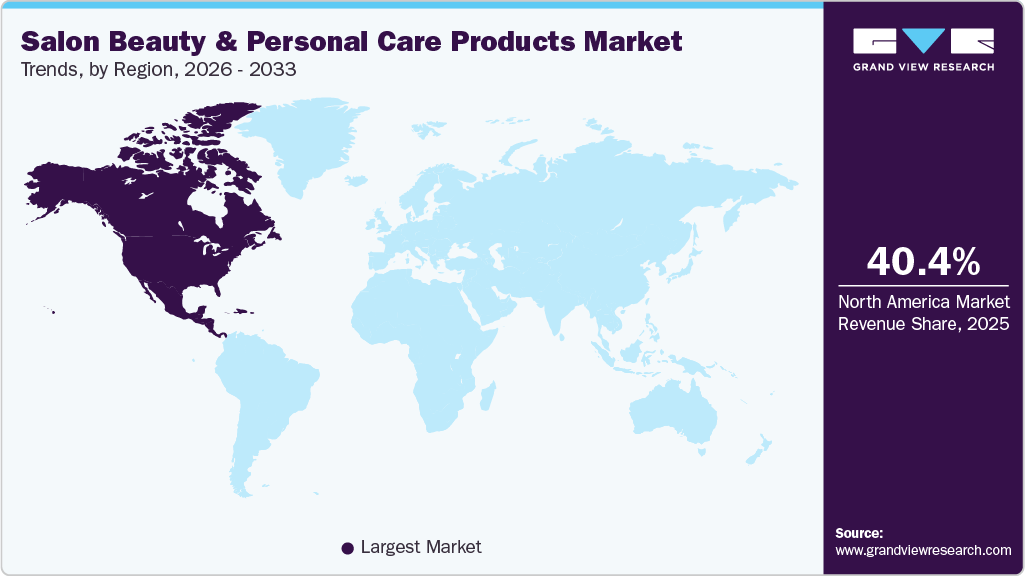
- North America dominated the global salon beauty & personal care products market with the largest revenue share of 40.4% in 2025.
- By ingredient type, the conventional / chemical-based segment led the market with the largest revenue share of 66.1% in 2025.
- By product, the hair care products segment led the market with the largest revenue share of 42.1% in 2025.
- By salon type, the independent salon segment led the market with the largest revenue share of 41.8% in 2025.
- By distribution channel, the professional distributors/wholesalers segment led the market with the largest revenue share of 37.0% in 2025.
Market Size & Forecast
- 2025 Market Size: USD 128.64 Billion
- 2033 Projected Market Size: USD 222.33 Billion
- CAGR (2026-2033): 7.1%
- North America: Largest market in 2025
This transition is encouraging salons to adopt premium product portfolios that enhance treatment outcomes while also improving the overall sensory experience through texture, fragrance, and application rituals.As services become more personalized and multi-step, reliance on professional-grade formulations is increasing, allowing salons to justify higher pricing and build stronger customer retention through differentiated service delivery.
Alongside this, rising preference for salon-grade performance and visible, treatment-oriented results is reinforcing demand across the market, as consumers prioritize efficacy over basic cosmetic use. Products designed for specific concerns such as hair damage repair, scalp health, hydration, and anti-aging are gaining traction, reflecting a broader shift toward performance-driven beauty routines. Consumers are also becoming more ingredient-aware and inclined toward formulations backed by professional validation, encouraging consistent product use in salon treatments and driving repeat service adoption.
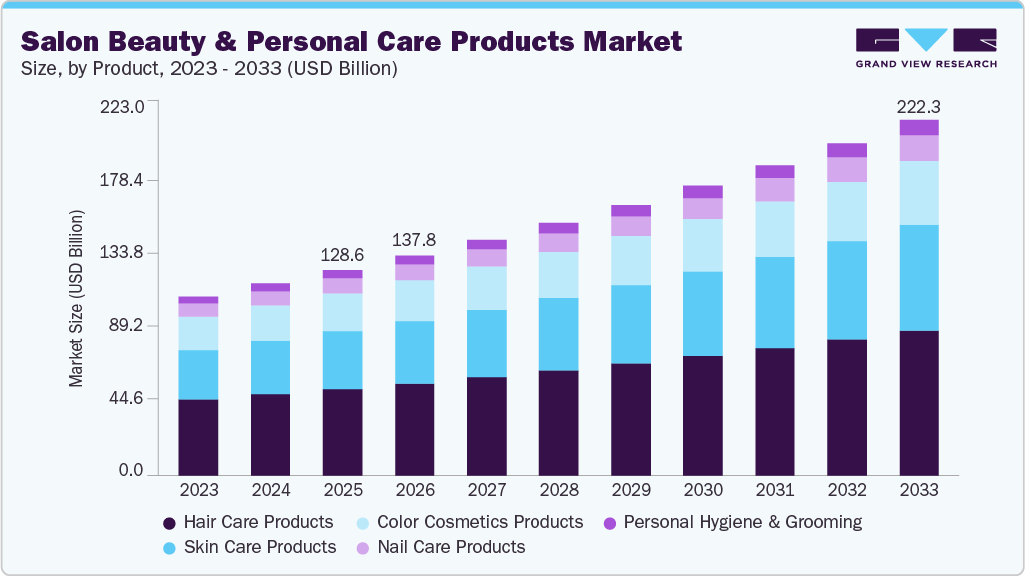
The ongoing expansion of professional salon networks is further strengthening product demand, as organized chains, independent studios, and specialized service formats continue to scale across urban and emerging markets. The increasing penetration of formats such as hair color bars, skin clinics, and express grooming outlets is creating a more structured service ecosystem that relies on continuous product supply. Standardization of services across organized players is also leading to predictable procurement patterns, supporting bulk purchasing and long-term supplier relationships within the B2B landscape.
At the same time, rising disposable incomes and higher spending on personal grooming are enabling consumers to access more frequent and premium salon services, particularly in emerging economies. This shift is supporting higher adoption of advanced treatments such as smoothing, strengthening, and targeted skin therapies, all of which require consistent use of high-value professional products. As consumers trade up from basic services to specialized treatments, overall product consumption within salons continues to rise, strengthening demand across mid-range and premium categories.
Continuous innovation in professional formulations and technology is also playing a critical role in market expansion, as brands focus on developing high-efficacy, targeted solutions aligned with evolving consumer expectations. Advancements in areas such as bond-repair technologies, microbiome-focused skincare, and AI-driven diagnostic tools are enhancing treatment precision and personalization within salon environments. Faster product development cycles and agile manufacturing capabilities are further enabling brands to respond quickly to emerging trends and consumer feedback, ensuring a steady pipeline of new and improved offerings.
In addition, strong direct-to-salon (B2B) distribution models are reinforcing market growth by enabling brands to establish closer relationships with professional service providers. Direct engagement through training programs, in-salon education, and exclusive partnerships is improving product adoption and ensuring correct usage within treatments. This approach also supports consistent replenishment cycles and strengthens brand loyalty within the professional ecosystem, making direct B2B distribution a key channel for sustained market growth.
Brand Market Share Insights
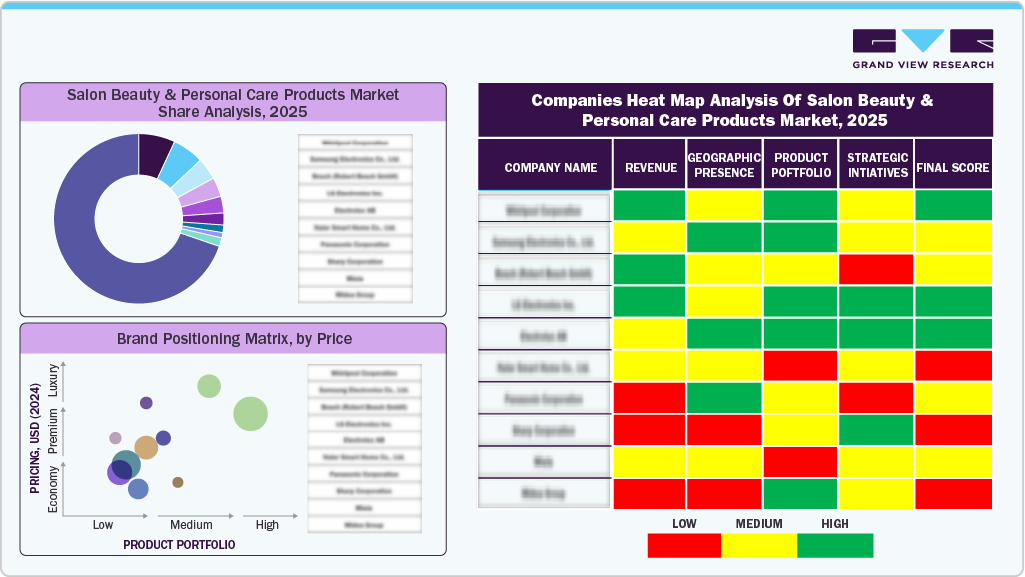
The global salon beauty & personal care products industry is highly competitive, driven by multinational leaders such as L'Oréal Groupe, Estée Lauder Companies, Shiseido Company, Procter & Gamble, and Unilever, as well as emerging professional-first brands. Companies are focusing on salon-exclusive, high-performance formulations and strengthening direct-to-salon distribution through training and stylist engagement. At the same time, digital platforms are accelerating product visibility and innovation cycles, while cross-border expansion and partnerships with organized salon chains are supporting global reach and consistent demand, making the salon beauty & personal care products industry increasingly dynamic and innovation-driven.
Product Insights
The hair care segment led the market with the largest revenue share of 42.1% in 2025, supported by high service frequency and consistent product usage across professional salon environments. Demand is largely concentrated in treatment-oriented categories such as shampoos, conditioners, masks, serums, and bond-repair systems, which are integrated into routine salon services, including hair repair, smoothing, coloring, and scalp treatments. These products are widely adopted for their ability to deliver visible, immediate results while supporting long-term hair health, making them essential across both basic and advanced service offerings. Professional brands are increasingly focusing on formulations that address specific concerns such as damage repair, hydration, frizz control, and scalp care, reinforcing repeat usage and higher consumption volumes.
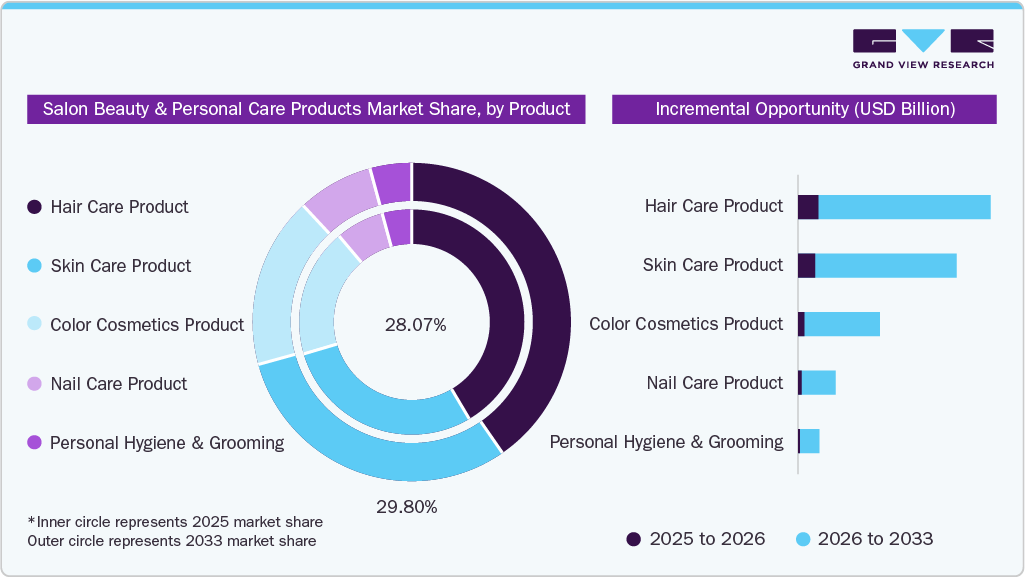
The skin care products segment is anticipated to grow at the fastest CAGR of 7.9% from 2026 to 2033, driven by rising demand for treatment-oriented and results-driven formulations within professional salon services. Products such as serums, masks, peels, and advanced facial treatments are increasingly being adopted as consumers prioritize targeted solutions for concerns including hydration, anti-aging, pigmentation, and skin barrier repair. These formulations are designed to deliver visible improvements while integrating seamlessly into multi-step salon protocols, supporting repeat treatments and long-term usage. Growing consumer awareness around ingredient efficacy, dermatological benefits, and preventive skincare is encouraging salons to expand their service portfolios with specialized skin treatments.
Ingredient Type Insights
The conventional/chemical-based segment led the market with the largest revenue share of 66.1% in 2025, supported by strong reliance on clinically proven, high-performance formulations widely used across professional salon services. These products are widely adopted for treatments such as hair repair, coloring, smoothing, and advanced skincare procedures, where consistent, immediate results are critical. Professionals prefer formulations based on established actives, conditioning agents, and functional ingredients due to their predictable performance, ease of application, and compatibility across a wide range of hair and skin types. In addition, their cost efficiency and broad availability across product formats, including shampoos, conditioners, creams, and treatment solutions, enable seamless integration into routine salon operations.
The organic/natural segment is expected to grow at the fastest CAGR of 9.2% from 2026 to 2033, driven by rising consumer preference for natural, plant-based formulations aligned with clean beauty and skin wellness trends. These products typically incorporate traditional Chinese botanical ingredients such as ginseng, green tea, and lotus extracts, which are perceived as gentle and suitable for sensitive skin, strengthening consumer trust and adoption. Organic formulations are commonly positioned as safer alternatives to synthetic products, offering skin-nourishing and long-term care benefits without harsh chemicals. In addition, expanding availability through e-commerce platforms, specialty beauty retailers, and brand-owned digital channels is improving accessibility to organic skincare solutions.
Salon Type Insights
The independent salons segment led the market with the largest revenue share of 41.8% in 2025, supported by their strong presence in local markets and their ability to operate with lower overhead costs than organized chains. These salons are widely accessible across urban and semi-urban areas, making them a primary touchpoint for routine grooming and beauty services. Their flexible pricing structures and service customization enable them to cater to a broad consumer base, driving consistent foot traffic and repeat visits. In addition, independent operators often have greater freedom in product selection, enabling them to adopt a diverse mix of professional brands based on performance and cost efficiency. This operational flexibility, combined with high service frequency and localized demand, continues to support steady product consumption.

The dermatology clinics & med-spas segment is expected to grow at the fastest CAGR of 11.6% from 2026 to 2033, supported by rising consumer preference for clinically backed, results-driven treatments that go beyond basic grooming. Demand is increasing for advanced procedures such as chemical peels, laser therapies, anti-aging treatments, and medical-grade facials, which require the use of high-efficacy professional products. These settings emphasize targeted solutions for concerns such as pigmentation, acne, aging, and skin sensitivity, encouraging the adoption of specialized formulations with active ingredients and proven outcomes. In addition, growing awareness around preventive skincare and long-term skin health is driving repeat visits and structured treatment plans, leading to higher product consumption.
Distribution Channel Insights
The professional distributors/wholesalers segment led the market with the largest revenue share of 37.0% in 2025. Distributors enable salons to access a wide portfolio of professional-grade products, including haircare, skincare, and treatment solutions, through streamlined bulk procurement models. Their strong relationships with manufacturers and salons allow efficient inventory management, timely replenishment, and access to newly launched formulations. In addition, distributors often provide technical support, training sessions, and product education, helping salon professionals adopt products effectively within service protocols.
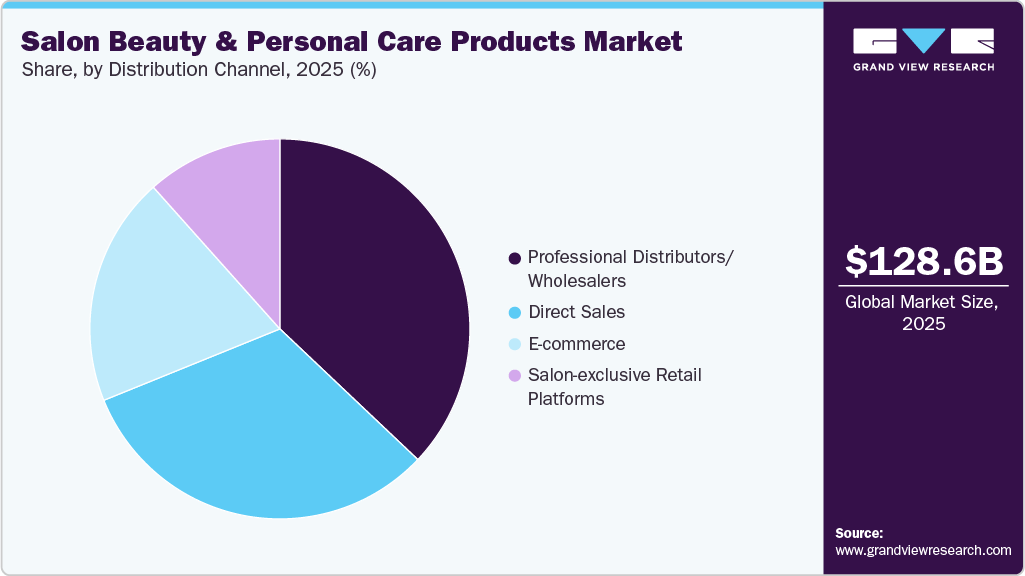
The e-commerce segment is expected to grow at the fastest CAGR of 8.8% from 2026 to 2033, driven by increasing digital adoption and the shift toward convenient, direct purchasing of professional-grade products. Consumers are increasingly turning to online platforms to access a wider assortment of salon-exclusive brands, compare product performance, and purchase based on reviews, expert recommendations, and ingredient transparency. E-commerce platforms enable easy access to premium and niche products that may not be readily available in physical salons or stores, supporting broader market reach. In addition, features such as subscription-based replenishment, personalized recommendations, and seamless delivery are improving purchase frequency and customer retention.
Regional Insights
North America dominated the global salon beauty & personal care products market with the largest revenue share of 40.4% in 2025. The North American industry is supported by high consumer spending on premium salon services and strong penetration of organized salon chains across the region. Demand is driven by widespread adoption of professional treatments such as hair coloring, repair therapies, anti-aging facials, and scalp care services, which require consistent use of high-performance products. Consumers in the region show a strong preference for clinically backed, results-oriented formulations, encouraging salons to adopt advanced and treatment-focused product portfolios. In addition, the presence of well-established salon networks, professional stylists, and strong brand-salon partnerships is ensuring steady product consumption.
U.S. Salon Beauty & Personal Care Products Market Trends
The salon beauty & personal care products market in the U.S. accounted for the largest market revenue share in North America in 2025, supported by a highly developed salon industry and strong consumer spending on professional beauty services. Demand is driven by widespread adoption of advanced treatments such as hair coloring, repair systems, anti-aging facials, and scalp therapies, which require consistent use of high-performance, salon-grade products. Consumers in the U.S. show a strong preference for clinically backed, results-oriented formulations, encouraging salons to integrate premium and treatment-focused product portfolios into their services. In addition, the presence of large organized salon chains, independent professionals, and well-established brand partnerships ensures steady product consumption across the market.
The Canada salon beauty & personal care products market is expected to grow at a significant CAGR of 8.4% from 2026 to 2033, supported by increasing demand for professional, treatment-oriented skincare and haircare services. Consumers are increasingly preferring solutions focused on hydration, skin barrier repair, anti-aging, and scalp health, encouraging salons to expand advanced service offerings that rely on high-efficacy products. Demand is also shifting toward clean, dermatologically tested formulations suitable for sensitive skin and aligned with ingredient transparency expectations. In addition, the steady expansion of organized salon chains and premium service formats is improving accessibility to professional treatments across urban areas.
Europe Salon Beauty & Personal Care Products Market Trends
The salon beauty & personal care products market in Europe is driven by strong demand for premium, professional salon services and high adoption of advanced haircare and skincare treatments across the region. Consumers are increasingly opting for specialized services such as hair coloring, repair therapies, anti-aging facials, and scalp treatments, driving consistent use of high-performance salon-grade products. The market is also benefiting from a well-established network of organized salon chains and independent professionals, ensuring steady product consumption across key countries. In addition, rising preference for clean-label, sustainable, and dermatologically tested formulations is encouraging salons to adopt more refined product portfolios aligned with evolving consumer expectations.
The UK salon beauty & personal care products market held a significant share in Europe in 2025, supported by strong demand for premium salon services and advanced, treatment-oriented beauty solutions. Consumers are increasingly opting for professional services such as hair coloring, repair treatments, anti-aging facials, and scalp care, driving consistent use of high-performance salon-grade products. The market is also influenced by rising preference for clinically backed formulations and visible, results-driven outcomes, encouraging salons to adopt more specialized product portfolios. In addition, strong engagement with digital beauty platforms and evolving grooming routines is supporting higher service frequency and product usage.
The salon beauty & personal care products market in Germany is expected to grow at the fastest CAGR of 9.2% from 2026 to 2033, supported by strong demand for high-efficacy, professional-grade treatments and increasing preference for clean, dermatologically tested formulations. Consumers are actively seeking solutions focused on skin barrier repair, hydration, anti-aging, and scalp health, encouraging salons to expand advanced service offerings that rely on performance-driven products. The market is also benefiting from rising awareness around ingredient transparency and sustainability, with salons prioritizing formulations that are gentle, effective, and suitable for sensitive skin.
Asia Pacific Salon Beauty & Personal Care Products Market Trends
The salon beauty & personal care products market in the Asia Pacific is anticipated to grow at the fastest CAGR during the forecast period, driven by the rapid expansion of organized salon chains and the increasing penetration of professional grooming services across urban and semi-urban areas. Growing working populations and changing lifestyle patterns are driving more frequent salon visits, particularly for haircare, skincare, and grooming treatments that require consistent use of professional products. The region is also witnessing strong demand for affordable yet performance-driven services, encouraging salons to adopt a wide mix of mid-range and premium product offerings. In addition, the rising influence of younger consumers and evolving beauty standards are supporting experimentation with new treatments and service formats, leading to higher product consumption. Continuous expansion of training institutes and professional education programs is further strengthening service quality and product adoption.
The China salon beauty & personal care products market is driven by fast-paced urban lifestyles and rising grooming awareness among younger consumers. High demand for services such as hair styling, coloring, and skin treatments is driving consistent use of professional products across salon networks. The market is also benefiting from the rapid growth of independent salons and small-format studios, which are expanding access to professional services across tier-2 and tier-3 cities. In addition, strong price segmentation, from affordable services to premium treatments, is enabling broader consumer participation, driving volume as well as value growth. Continuous upgrades in salon service quality and growing emphasis on customer experience are further supporting higher product consumption.
The salon beauty & personal care products market in India is expected to grow at a significant CAGR of 10.3% from 2026 to 2033, supported by the rapid expansion of organized salon chains and increasing penetration of professional grooming services across urban and semi-urban markets. Rising participation of working professionals and changing lifestyle patterns are driving a higher frequency of salon visits for haircare, skincare, and grooming treatments, leading to consistent demand for professional products. The market is also benefiting from strong price segmentation, with consumers actively opting for both affordable services and premium treatments, enabling broader market reach. In addition, the growth of franchise-led salon formats and localized service providers is improving accessibility, while increasing emphasis on service standardization and customer experience is driving repeat visits and higher product consumption.
Central & South America Salon Beauty & Personal Care Products Market Trends
The salon beauty & personal care products market in Central & South America is driven by increasing demand for professional grooming services and rising salon penetration across key markets. Growing urban populations and evolving beauty standards are encouraging more frequent salon visits for haircare, skincare, and styling treatments, driving consistent use of professional products. The market is also benefiting from a strong preference for cost-effective yet performance-driven services, leading salons to adopt a balanced mix of mid-range and premium product offerings. In addition, the expansion of independent salons and localized service providers is improving accessibility, particularly in developing urban clusters.
Middle East & Africa Salon Beauty & Personal Care Products Market Trends
The salon beauty & personal care products market is expected to grow at a substantial CAGR of 6.2% from 2026 to 2033, supported by the steady expansion of salon infrastructure and increasing adoption of professional grooming services across key urban markets. Rising demand for haircare, skincare, and grooming treatments is driving consistent use of salon-grade products, particularly for services such as hair styling, repair treatments, and advanced facials. The market is also benefiting from the growing presence of premium salons and international beauty service providers, which are elevating service standards and encouraging the use of high-performance formulations. In addition, improving access to professional training and skill development is enhancing service quality and product application across salons. Increasing focus on appearance, social grooming, and lifestyle-driven beauty routines is further supporting repeat visits and sustained product consumption.
Key Salon Beauty & Personal Care Products Companies:
The following key companies have been profiled for this study on the salon beauty & personal care products market.
- L'Oréal Group
- Estée Lauder Companies
- Procter & Gamble
- Unilever
- Shiseido Company
- Coty Inc.
- Beiersdorf
- Natura &Co
- Kao Corporation
- Wella Professionals
- Winona
- Chando
- Pechoin
- Inoherb
- Dr. Yu (Dr. Yu Skincare)
Recent Developments
-
In March 2026,Schwarzkopf, a brand of Henkel, launched its new KERATÎME Care & Styling range in the U.S., marking its expansion beyond hair color into the growing hair bonding and treatment category. The collection, powered by proprietary Multiplex Bonding Technology, is designed to strengthen hair, protect against damage, and deliver styling benefits in a single routine. Introduced exclusively through Walmart, the launch reflects the brand’s strategy to make professional-quality, science-driven hair care more accessible while strengthening its presence in mass retail.
-
In January 2026,The Estée Lauder Companies Inc. announced that its professional haircare brand Bumble and bumble will expand distribution through a strategic partnership with SalonCentric, a leading U.S. salon product distributor. Beginning February 2026, the brand’s products and education programs will be available across SalonCentric’s nationwide store network and digital platforms, significantly increasing access for licensed beauty professionals. This move is aimed at strengthening the brand’s presence in the professional channel, driving in-salon adoption, and expanding long-term engagement with hairstylists.
Salon Beauty & Personal Care Products Market Report Scope
Report Attribute
Details
Market size value in 2026
USD 137.78 billion
Revenue forecast in 2033
USD 222.33 billion
Growth rate
CAGR of 7.1% from 2026 to 2033
Base year for estimation
2026
Historical data
2021 - 2025
Forecast period
2026 - 2033
Quantitative units
Revenue in USD million/billion, and CAGR from 2026 to 2033
Report coverage
Revenue forecast, company ranking, competitive landscape, growth factors, and trends
Segments covered
Product, ingredient type, salon type, distribution channel, region
Regional scope
North America; Europe; Asia Pacific; Central & South America; Middle East & Africa
Country scope
U.S.; Canada; Mexico; Germany; UK; France; Italy; Spain; China; India; Japan; Australia & New Zealand; South Korea; Brazil; South Africa
Key companies profiled
L'Oréal Group; Estée Lauder Companies; Procter & Gamble; Unilever; Shiseido Company; Coty Inc.; Beiersdorf; Natura &Co; Kao Corporation; Wella Professionals; Winona; Chando; Pechoin; Inoherb; Dr. Yu (Dr. Yu Skincare)
Customization scope
Free report customization (equivalent up to 8 analysts working days) with purchase. Addition or alteration to country, regional & segment scope.
Pricing and purchase options
Avail customized purchase options to meet your exact research needs. Explore purchase options
Global Salon Beauty & Personal Care Products Market Report Segmentation
This report forecasts revenue growth at global, regional & country levels and provides an analysis of the latest trends and opportunities in each of the sub-segments from 2021 to 2033. For this study, Grand View Research has segmented the global salon beauty & personal care products market report based on the product, ingredient type, salon type, distribution channel, and region.
-
Product Outlook (Revenue, USD Million, 2021 - 2033)
-
Hair Care Products
-
Skin Care Products
-
Color Cosmetics Products
-
Nail Care Products
-
Personal Hygiene & Grooming
-
-
Ingredient Type Outlook (Revenue, USD Million, 2021 - 2033)
-
Conventional / Chemical-based
-
Organic / Natural
-
Vegan / Cruelty-free
-
Dermatologically Tested / Clinical-grade
-
-
Salon Type Outlook (Revenue, USD Million, 2021 - 2033)
-
Independent Salons
-
Salon Chains / Franchises
-
Luxury / Premium Salons
-
Dermatology Clinics & Med-Spas
-
Barbershops / Men's Grooming Studios
-
-
Distribution Channel Outlook (Revenue, USD Million, 2021 - 2033)
-
Direct Sales
-
Professional Distributors / Wholesalers
-
Salon-exclusive Retail Platforms
-
E-commerce
-
-
Regional Outlook (Revenue, USD Million, 2021 - 2033)
-
North America
-
U.S.
-
Canada
-
Mexico
-
-
Europe
-
Germany
-
UK
-
France
-
Italy
-
Spain
-
-
Asia Pacific
-
China
-
India
-
Japan
-
Australia & New Zealand
-
South Korea
-
-
Central & South America
-
Brazil
-
-
Middle East & Africa
-
South Africa
-
-
Frequently Asked Questions About This Report
b. The global salon beauty & personal care products market size was estimated at USD 128.64 billion in 2025 and is expected to reach USD 137.78 billion in 2026.
b. The global salon beauty & personal care products market is expected to grow at a compound annual growth rate of 7.1% from 2026 to 2033 to reach USD 222.33 billion by 2033.
b. Hair care products accounted for the largest market share of 42.1% in 2025, due to their high frequency of use across washing, conditioning, styling, and treatment routines in salon settings. Strong demand for professional-grade shampoos, conditioners, hair color, and repair treatments, along with repeat service cycles, continues to drive segment dominance
b. Some key players operating in the global salon beauty & personal care products market L'Oréal Group; Estée Lauder Companies; Procter & Gamble; Unilever; Shiseido Company; Coty Inc.; Beiersdorf; Natura &Co; Kao Corporation; Wella Professionals
b. The salon beauty & personal care products market is driven by rising consumer spending on professional grooming and appearance, along with increasing preference for salon-grade products offering higher efficacy than at-home alternatives


Share this report with your colleague or friend.
Need a Tailored Report?
Customize this report to your needs — add regions, segments, or data points, with 20% free customization.


ISO 9001:2015 & 27001:2022 Certified
We are GDPR and CCPA compliant! Your transaction & personal information is safe and secure. For more details, please read our privacy policy.
Trusted market insights - try a free sample
See how our reports are structured and why industry leaders rely on Grand View Research. Get a free sample or ask us to tailor this report to your needs.













