
- Home
- »
- Communication Services
- »
-
Satellite Ocean Surveillance Market Size, Share Report, 2033GVR Report cover
![Satellite Ocean Surveillance Market Size, Share & Trends Report]()
Satellite Ocean Surveillance Market (2026 - 2033) Size, Share & Trends Analysis Report By Orbit Type (LEO, MEO, GEO), By Satellite Class (Nano Satellite (<10 kg), Micro Satellite (10-100 kg)), By Satellite Payload (Synthetic Aperture Radar (SAR), Electro-Optical (EO)), By Application, By End Use, By Region, And Segment Forecasts
- Report ID: GVR-4-68040-907-1
- Number of Report Pages: 150
- Format: PDF
- Historical Range: 2021 - 2024
- Forecast Period: 2026 - 2033
- Industry: Technology
- Report Summary
- Table of Contents
- Segmentation
- Methodology
- Download FREE Sample
-
 Download Sample Report
Satellite Ocean Surveillance Market Summary
The global satellite ocean surveillance market size was valued at USD 505.7 million in 2025 and is projected to reach USD 1,870.4 million by 2033, growing at a CAGR of 18.3% from 2026 to 2033. The market growth is fueled by the rising need for maritime domain awareness and border security across coastal nations, the increasing adoption of satellite-based vessel tracking and automatic identification systems for detecting illegal fishing and smuggling activities, and the expanding investments in maritime surveillance infrastructure to strengthen national defense capabilities.
Key Market Trends & Insights
- North America dominated the global satellite ocean surveillance market with the largest revenue share of over 35% in 2025.
- The satellite ocean surveillance market in the U.S. led the North America market and held the largest revenue share of over 77% in 2025.
- By orbit type, the Low Earth Orbit (LEO) segment held the dominant position and accounted for the highest revenue share of over 65% in 2025.
- By satellite class, the nano satellite (less than 10 kg) segment is expected to grow at the highest CAGR of over 22% from 2026 to 2033.
- By application, the maritime security & surveillance segment accounted for the largest revenue share of over 33% in 2025.
Market Size & Forecast
- 2025 Market Size: USD 505.7 Million
- 2033 Projected Market Size: USD 1,870.4 Million
- CAGR (2026-2033): 18.3%
- North America: Largest market in 2025
The growth of the satellite ocean surveillance market is driven by the increasing demand for maritime security and domain awareness across coastal regions, the expansion of global shipping routes and offshore energy infrastructure, and the rising investments in advanced satellite-based surveillance systems to detect illegal fishing, piracy, and environmental hazards. The adoption of satellite ocean surveillance solutions is accelerating as governments, naval forces, and commercial maritime operators seek reliable large-area monitoring capabilities to improve operational safety and emergency response coordination. The growing integration of artificial intelligence and real-time data analytics platforms enhances threat detection accuracy, situational awareness, and predictive maritime intelligence, supporting more efficient ocean management and security operations.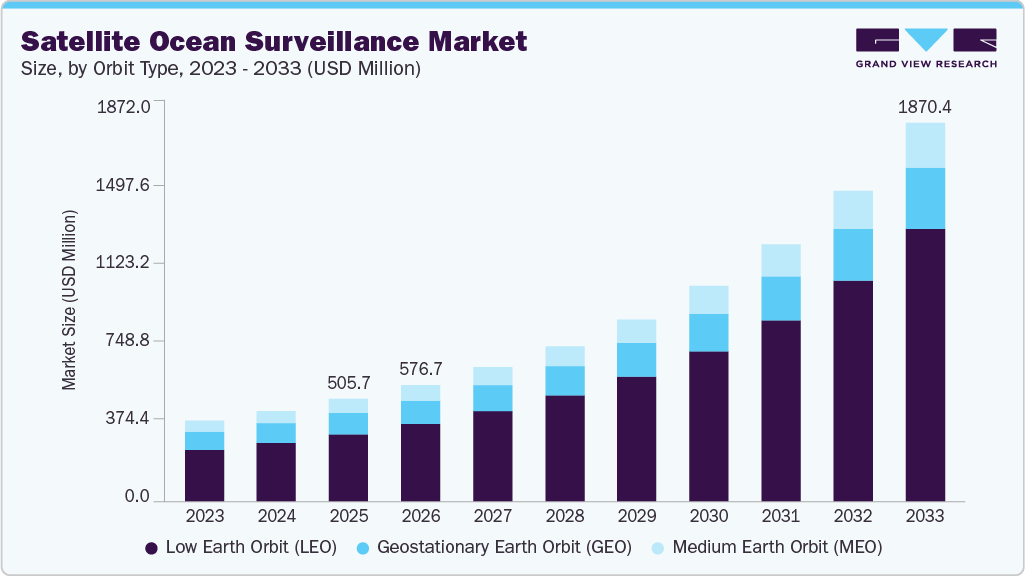
The rapid expansion of offshore energy exploration, subsea infrastructure development, and maritime transportation networks is accelerating the need for persistent ocean monitoring and risk management solutions. Oil and gas operators, offshore wind developers, and shipping companies are increasingly deploying satellite ocean surveillance systems to monitor offshore platforms and underwater pipelines. The integration of satellite-based remote sensing technologies enables early detection of oil spills, equipment failures, and hazardous weather conditions, reducing operational disruptions and financial losses. This growing reliance on satellite-enabled monitoring for asset protection, safety assurance, and regulatory compliance is strengthening demand for the satellite ocean surveillance industry.
Additionally, the increasing frequency of climate-related disasters, marine pollution incidents, and extreme weather events is driving the adoption of the satellite ocean surveillance industry. Government agencies and environmental organizations are leveraging satellite-based ocean observation systems to track storm patterns, monitor coastal flooding, and assess ocean pollution levels in real time. The availability of continuous geospatial data supports predictive modeling, early warning systems, and coordinated emergency response planning to minimize environmental and economic impacts. This rising focus on climate resilience, disaster preparedness, and sustainable ocean resource management is expanding the role of satellite surveillance technologies.
Moreover, maritime domain awareness and coastal border protection is significantly driving the adoption of satellite ocean surveillance technologies across defense and security agencies worldwide. Governments are investing in satellite-enabled monitoring systems to detect unauthorized vessel movements, illegal fishing activities, and maritime smuggling operations across expansive ocean territories. The deployment of advanced automatic identification systems (AIS), radio frequency detection payloads, and high-resolution satellite imagery platforms enables continuous vessel tracking in remote maritime regions. This growing emphasis on strengthening maritime sovereignty, safeguarding economic zones, and enhancing naval operational readiness is reinforcing the importance of satellite-based surveillance infrastructure.
Furthermore, the growing commercialization of space technologies and the deployment of low-cost small satellite constellations are enabling scalable and cost-efficient ocean surveillance capabilities. These advancements improve revisit times, reduce latency in data transmission, and enhance accessibility to real-time maritime intelligence for logistics operators, fisheries management agencies, and coastal authorities. This shift toward cost-effective satellite deployment models and high-availability monitoring services is accelerating market growth and expanding adoption across transportation, fisheries, and global trade ecosystems.
Orbit Type Insights
The Low Earth Orbit (LEO) segment accounted for the largest market share of over 65% in 2025, driven by its ability to provide high-frequency revisit rates, low-latency data transmission, and high-resolution imaging capabilities. Governments and commercial operators are prioritizing investments in LEO satellite constellations that enable near-real-time vessel tracking, illegal fishing detection, and offshore infrastructure monitoring. The continued expansion of multi-satellite constellation deployments and increasing demand for persistent maritime domain awareness across critical sea routes reinforce the segment’s leading position in the market.
The Medium Earth Orbit (MEO) segment is expected to witness a significant CAGR of over 16% from 2026 to 2033. The segment growth is driven by the increasing demand for wide-area coverage and reliable navigation and communication support for long-duration maritime surveillance missions. The rising adoption of MEO satellites for integrated maritime positioning, secure communication relay, and coordinated fleet management is accelerating deployment in this orbit category. The growing focus on enhancing global maritime connectivity, improving surveillance coverage, and supporting resilient navigation infrastructure is expected to support the expansion of the segment in the satellite ocean surveillance industry.
Satellite Class Insights
The small satellite (100-500 kg) segment accounted for the largest market share in 2025, driven by its optimal balance between payload capacity, operational flexibility, and cost efficiency for large-scale ocean monitoring missions. The continued expansion of low Earth orbit (LEO) satellite constellations, maritime surveillance programs, and offshore infrastructure monitoring initiatives further reinforces the segment’s position. The growing focus on scalable surveillance infrastructure, persistent vessel tracking, and real-time maritime intelligence is sustaining the dominance of the small satellite (100-500 kg) segment in the satellite ocean surveillance market.
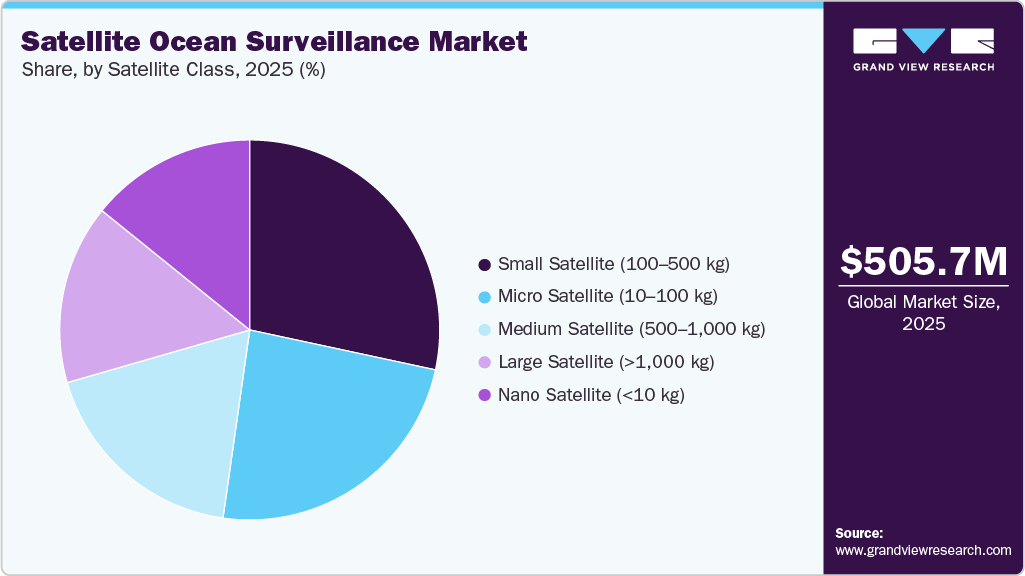
The nano satellite (<10 kg) segment is expected to witness the highest CAGR from 2026 to 2033, owing to its low manufacturing and launch costs, rapid deployment capabilities, and suitability for distributed satellite network architectures. The rising demand for cost-effective ocean monitoring solutions among emerging economies, research institutions, and commercial maritime operators is encouraging the adoption of nano satellites. The growing emphasis on agile space missions, responsive satellite deployment, and continuous data collection is expected to support expansion in the segment of the satellite ocean surveillance industry.
Satellite Payload Insights
The synthetic aperture radar (SAR) segment accounted for the largest market share in 2025, driven by its ability to provide all-weather, day-and-night imaging capabilities for continuous ocean monitoring. The continued expansion of defense surveillance programs, coastal monitoring initiatives, and offshore infrastructure protection projects further reinforces the segment’s position, as SAR technology enables precise detection of vessels, oil spills, and unauthorized maritime activities. The growing focus on enhancing maritime domain awareness, strengthening border security, and ensuring reliable monitoring of critical sea routes is sustaining the dominance of the SAR segment.
The radio frequency (RF) detection segment is expected to witness a significant CAGR from 2026 to 2033, owing to the rising demand for advanced signal intelligence capabilities and real-time monitoring of maritime communications, which is encouraging government agencies and commercial operators to deploy RF detection payloads capable of geolocating radio transmissions from ships and offshore assets. The growing emphasis on countering illegal fishing, maritime smuggling, and unauthorized naval activities through enhanced electronic intelligence and anomaly detection is expected to support expansion in the satellite ocean surveillance market.
Application Insights
The maritime security & surveillance segment accounted for the largest market share in 2025, owing to the increasing demand for continuous monitoring of territorial waters, strategic shipping lanes, and exclusive economic zones (EEZs). The continued expansion of naval modernization programs, coast guard surveillance initiatives, and integrated maritime domain awareness (MDA) frameworks further reinforces the segment’s leading position. The growing focus on safeguarding national borders, preventing smuggling and piracy activities, and ensuring secure maritime transportation infrastructure is sustaining the dominance of the segment in the satellite ocean surveillance market.
The illegal fishing monitoring segment is expected to witness the highest CAGR from 2026 to 2033. This growth is driven by the increasing enforcement of international fisheries regulations and rising concerns over illegal and unregulated (IUU) fishing activities. The rising need for real-time vessel identification and marine biodiversity protection is encouraging authorities to deploy advanced satellite technologies such as synthetic aperture radar (SAR) and automatic identification system (AIS) data integration. The growing emphasis on sustainable fisheries management, ocean resource conservation, and maritime law enforcement is expected to support expansion in the market.
End Use Insights
The defense & intelligence agencies segment accounted for the largest market share in 2025, owing to the increasing demand for persistent maritime domain awareness, national border security monitoring, and strategic naval surveillance. The continued expansion of space-based intelligence, surveillance, and reconnaissance (ISR) programs, coupled with rising government investments in next-generation satellite constellations and secure communication networks, further reinforces the segment’s leading position. The growing focus on strengthening homeland security, countering maritime threats, and ensuring continuous situational awareness is sustaining the dominance of the defense & intelligence agencies segment in the satellite ocean surveillance market.
The commercial EO operators segment is expected to witness the highest CAGR from 2026 to 2033. This growth is owing to the rapid commercialization of satellite data services, expanding demand for high-frequency maritime intelligence, and increasing adoption of subscription-based geospatial analytics platforms. The rising need for real-time vessel tracking, offshore asset monitoring, and environmental compliance reporting is encouraging private satellite operators to deploy scalable low-Earth-orbit constellations. The growing emphasis on data-driven maritime operations and cost-efficient monitoring solutions is expected to support expansion in the satellite ocean surveillance industry.
Regional Insights
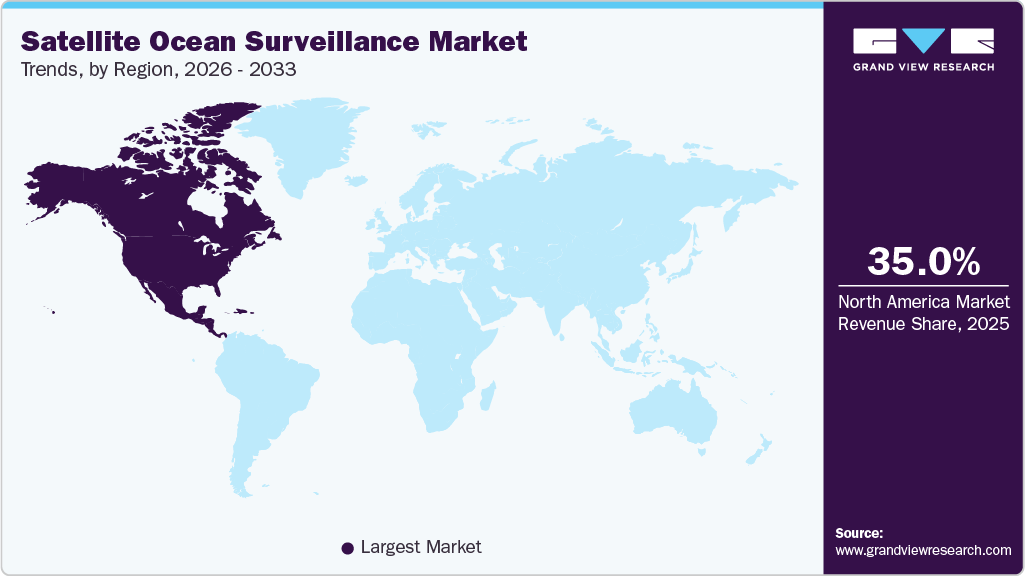
North America dominated the satellite ocean surveillance market with a share of over 35% in 2025, driven by the strong presence of advanced satellite manufacturing capabilities, extensive coastal surveillance infrastructure, and sustained defense spending on maritime intelligence. The region is witnessing increasing demand for persistent ocean monitoring systems to support illegal fishing detection, Arctic navigation safety, and offshore energy asset protection. The growing integration of satellite-based surveillance with naval command systems and homeland security networks is accelerating the deployment of high-performance satellite ocean surveillance solutions across the region.
U.S. Satellite Ocean Surveillance Market Trends
The U.S. satellite ocean surveillance dominated the market with a share of over 77% in 2025, fueled by large-scale investments in next-generation Earth observation satellites, increasing deployment of space-based maritime domain awareness platforms, and the strong presence of commercial satellite operators. The rising demand for monitoring illegal maritime activities and safeguarding offshore oil and gas infrastructure. Continuous technological advancements in synthetic aperture radar imaging, secure satellite communications, and autonomous maritime monitoring systems are contributing to sustained market growth in the country.
Europe Satellite Ocean Surveillance Market Trends
Europe satellite ocean surveillance market is expected to grow at a CAGR of over 17% from 2026 to 2033. The market growth is driven by increasing regional collaboration on maritime security, strong environmental sustainability regulations, and expanding investments in coastal monitoring and marine ecosystem protection initiatives. The region is experiencing rising demand for satellite-based ocean surveillance solutions to support fisheries management and maritime safety compliance. The integration of satellite data with digital maritime platforms and the implementation of unified maritime surveillance frameworks are improving operational coordination and accelerating technology adoption across the satellite ocean surveillance industry.
The UK satellite ocean surveillance market is expected to grow significantly in the coming years, driven by the expanding deployment of satellite-enabled maritime surveillance systems for naval operations, coastal border monitoring, and offshore wind farm protection. Increasing investments in space-based situational awareness programs and advanced geospatial intelligence platforms are supporting the modernization of national maritime security. The growing focus on protecting strategic sea routes, ensuring compliance with maritime safety regulations, and strengthening emergency response readiness is boosting demand for high-precision satellite ocean surveillance technologies in the country.
The German satellite ocean surveillance market is fueled by the increasing emphasis on industrial logistics monitoring, environmental risk management, and transportation network security across major economic corridors. The country is witnessing rising adoption of satellite-based ocean surveillance technologies for monitoring maritime cargo flows, port operations, and offshore energy installations to enhance supply chain visibility. Strong government support for digital transformation initiatives and advanced engineering capabilities is encouraging the development of highly efficient satellite monitoring solutions for maritime infrastructure and environmental protection applications.
Asia Pacific Satellite Ocean Surveillance Market Trends
The Asia Pacific satellite ocean surveillance market is expected to grow at the highest CAGR of over 20% from 2026 to 2033, driven by the rapid expansion of national maritime security programs, increasing investments in coastal disaster early warning systems, and rising demand for surveillance technologies to monitor territorial waters. The region is experiencing strong adoption of satellite ocean surveillance platforms to support typhoon tracking, fisheries regulation enforcement, and maritime trade route management. The growing deployment of regional satellite constellations and expanding government initiatives focused on maritime safety are significantly enhancing demand for advanced satellite ocean surveillance technologies across the market.
The Japan satellite ocean surveillance market is gaining traction owing to the increasing adoption of satellite-based ocean observation systems for tsunami detection, coastal erosion monitoring, and maritime navigation safety. The country is focusing on integrating satellite surveillance technologies into disaster resilience planning and marine environmental protection programs to strengthen national preparedness against natural hazards. The growing emphasis on high-accuracy remote sensing technologies and infrastructure resilience planning is encouraging investments in the reliable and high-performance satellite ocean surveillance industry in Japan.
The China satellite ocean surveillance market is rapidly expanding, driven by strong government support for domestic satellite constellation deployment and increasing investments in maritime security modernization programs. The country is witnessing growing adoption of satellite ocean surveillance technologies for monitoring shipping traffic, enforcing maritime regulations, and supporting large-scale coastal infrastructure development. The expansion of satellite data analytics platforms, demand for high-frequency maritime intelligence, and continuous advancements in indigenous satellite manufacturing are accelerating the adoption of surveillance technologies.
Key Satellite Ocean Surveillance Company Insights
Some of the key players operating in the market are Northrop Grumman and L3Harris Technologies, Inc., among others.
-
Northrop Grumman is a provider of advanced space-based surveillance, reconnaissance, and maritime monitoring solutions, delivering high-performance satellite systems and integrated intelligence platforms. The company’s strong capabilities in satellite payload development, persistent surveillance technologies, and defense modernization programs enable continuous monitoring of ocean territories and critical maritime infrastructure. Its long-standing partnerships with defense agencies and leadership in secure satellite communication networks have reinforced its strategic role in the satellite ocean surveillance industry.
-
L3Harris Technologies, Inc. is a provider of space-based sensing, satellite communication, and geospatial intelligence systems that support maritime surveillance and naval situational awareness missions. The company delivers advanced payloads, remote sensing instruments, and mission-critical communication technologies designed to enhance real-time ocean monitoring. Its continuous investment in space-based ISR (intelligence, surveillance, and reconnaissance) infrastructure and integration of secure data transmission technologies have strengthened its position as a key technology provider in the satellite ocean surveillance market.
ICEYE and Spire Global, Inc. are some of the emerging market participants in the satellite ocean surveillance market.
-
ICEYE is an emerging provider of satellite ocean surveillance solutions specializing in synthetic aperture radar (SAR) imaging technologies that enable all-weather, day-and-night monitoring of maritime environments, oil spills, sea ice movement, and vessel activity. The company operates one of the world’s largest SAR satellite constellations and focuses on delivering high-frequency, near-time geospatial intelligence for border monitoring and port surveillance. Its innovation in miniaturized radar satellites and rapid constellation deployment capabilities has positioned the company as an innovator in the satellite ocean surveillance industry.
-
Spire Global, Inc. is an emerging provider of satellite-enabled maritime intelligence and vessel tracking services, leveraging a large constellation of nanosatellites equipped with Automatic Identification System (AIS) sensors to monitor ship movements, detect illegal fishing activities, and support maritime domain awareness operations. The company delivers space-to-cloud data analytics platforms that provide real-time ocean intelligence for government agencies, shipping companies, and fisheries management authorities. Its scalable satellite network and focus on maritime data services are driving increasing adoption of its solutions across commercial and defense ocean surveillance applications.
Key Satellite Ocean Surveillance Companies:
The following key companies have been profiled for this study on the satellite ocean surveillance market.
- AIRBUS
- Thales
- Northrop Grumman
- L3Harris Technologies, Inc.
- Lockheed Martin Corporation
- Planet Labs PBC
- Capella Space
- Spire Global, Inc.
- ICEYE
- BlackSky
Recent Developments
-
In February 2026, Airbus collaborated with ST Engineering to jointly develop next-generation synthetic aperture radar (SAR) capabilities and AI-enabled geospatial analytics solutions. The collaboration focuses on advancing high-resolution maritime monitoring and real-time ocean intelligence systems to support vessel tracking, coastal surveillance, and maritime security operations. This initiative demonstrates the growing demand for integrated satellite sensing and analytics platforms in the satellite ocean surveillance market, particularly for large-scale maritime monitoring and defense applications.
-
In January 2025, ICEYE launched four new synthetic aperture radar (SAR) satellites to expand its global monitoring constellation and enhance persistent ocean observation capabilities. The additional satellites improve revisit frequency and enable continuous monitoring of maritime activities, oil spills, and sea ice movement across remote ocean regions. This expansion demonstrates the accelerating deployment of high-frequency radar satellite constellations to support real-time maritime surveillance and environmental monitoring in the satellite ocean surveillance industry.
-
In October 2025, Planet Labs PBC secured a contract from the U.S. Navy to provide satellite-based vessel detection and maritime monitoring services across strategic areas in the Pacific Ocean. The agreement includes the delivery of high-frequency satellite imagery and geospatial analytics to support naval operations and maritime security decision-making. This development demonstrates the expanding role of commercial Earth observation constellations in enhancing ocean surveillance, fleet tracking, and regional maritime intelligence capabilities.
Satellite Ocean Surveillance Market Report Scope
Report Attribute
Details
Market size value in 2026
USD 576.7 million
Revenue forecast in 2033
USD 1,870.4 million
Growth rate
CAGR of 18.3% from 2026 to 2033
Base year for estimation
2025
Historical data
2021 - 2024
Forecast period
2026 - 2033
Quantitative units
Revenue in USD million/billion and CAGR from 2026 to 2033
Report Product
Revenue forecast, company ranking, competitive landscape, growth factors, and trends
Segments covered
Orbit type, satellite class, satellite payload, application, end use, region
Region scope
North America; Europe; Asia Pacific; Latin America; Middle East & Africa
Country scope
U.S.; Canada; Mexico; UK; Germany; France; China; Japan; India; South Korea; Australia; Brazil; Saudi Arabia; UAE; South Africa
Key companies profiled
AIRBUS; Thales; Northrop Grumman; L3Harris Technologies, Inc.; Lockheed Martin Corporation; Planet Labs PBC; Capella Space; Spire Global, Inc.; ICEYE; BlackSky
Customization scope
Free report customization (equivalent to up to 8 analyst’s working days) with purchase. Addition or alteration to country, regional & segment scope.
Pricing and purchase options
Avail customized purchase options to meet you exact research needs. Explore purchase options
Global Satellite Ocean Surveillance Market Report Segmentation
This report forecasts revenue growth at global, regional, and country levels and provides an analysis of the latest technological trends in each of the sub-segments from 2021 to 2033. For this study, Grand View Research has segmented the satellite ocean surveillance market report based on orbit type, satellite class, satellite payload, application, end use, and region:
-
Orbit Type Outlook (Revenue, USD Million, 2021 - 2033)
-
Low Earth Orbit (LEO)
-
Medium Earth Orbit (MEO)
-
Geostationary Earth Orbit (GEO)
-
-
Satellite Class Outlook (Revenue, USD Million, 2021 - 2033)
-
Nano Satellite (<10 kg)
-
Micro Satellite (10-100 kg)
-
Small Satellite (100-500 kg)
-
Medium Satellite (500-1,000 kg)
-
Large Satellite (>1,000 kg)
-
-
Satellite Payload Outlook (Revenue, USD Million, 2021 - 2033)
-
Synthetic Aperture Radar (SAR)
-
Electro-Optical (EO)
-
Thermal Infrared (IR)
-
Radio Frequency (RF) Detection
-
Others
-
-
Application Outlook (Revenue, USD Million, 2021 - 2033)
-
Maritime Security & Surveillance
-
Illegal Fishing Monitoring
-
Environmental Monitoring
-
Search & Rescue Operations
-
Offshore Infrastructure Monitoring
-
Vessel Tracking & Navigation
-
Others
-
-
End Use Outlook (Revenue, USD Million, 2021 - 2033)
-
Defense & Intelligence Agencies
-
Coast Guard & Maritime Authorities
-
Commercial EO Operators
-
Civil Space Agencies
-
Fisheries Authorities
-
Others
-
-
Regional Outlook (Revenue, USD Million, 2021 - 2033)
-
North America
-
U.S.
-
Canada
-
Mexico
-
-
Europe
-
UK
-
Germany
-
France
-
-
Asia Pacific
-
China
-
Japan
-
India
-
South Korea
-
Australia
-
-
Latin America
-
Brazil
-
-
Middle East and Africa (MEA)
-
Saudi Arabia
-
UAE
-
South Africa
-
-
Frequently Asked Questions About This Report
b. The global satellite ocean surveillance market size was valued at USD 505.7 million in 2025 and is expected to reach USD 576.7 million in 2026.
b. The global satellite ocean surveillance market is expected to grow at a compound annual growth rate of 18.3% from 2026 to 2033 to reach USD 1,870.4 million by 2033.
b. The Low Earth Orbit (LEO) segment accounted for the largest market share of over 65% in 2025, driven by its ability to provide high-frequency revisit rates, low-latency data transmission, and high-resolution imaging capabilities. Governments and commercial operators are prioritizing investments in LEO satellite constellations that enable near-real-time vessel tracking, illegal fishing detection, and offshore infrastructure monitoring. The continued expansion of multi-satellite constellation deployments and increasing demand for persistent maritime domain awareness across critical sea routes reinforce the segment’s leading position in the market.
b. Some key players operating in the satellite ocean surveillance market include AIRBUS, Thales, Northrop Grumman, L3Harris Technologies, Inc., Lockheed Martin Corporation, Planet Labs PBC, Capella Space, Spire Global, Inc., ICEYE, BlackSky
b. The market growth is fueled by the rising need for maritime domain awareness and border security across coastal nations, the increasing adoption of satellite-based vessel tracking and automatic identification systems for detecting illegal fishing and smuggling activities, and the expanding investments in maritime surveillance infrastructure to strengthen national defense capabilities.


Share this report with your colleague or friend.
Need a Tailored Report?
Customize this report to your needs — add regions, segments, or data points, with 20% free customization.


ISO 9001:2015 & 27001:2022 Certified
We are GDPR and CCPA compliant! Your transaction & personal information is safe and secure. For more details, please read our privacy policy.
Trusted market insights - try a free sample
See how our reports are structured and why industry leaders rely on Grand View Research. Get a free sample or ask us to tailor this report to your needs.













